
Market Overview
| Study Period | 2021 - 2032 |
|---|---|
| Forecast Data Period | 2027 - 2032 |
| Base Year Market Size (2026) | USD 2.81 Billion |
| Market Size (2027) | USD 2.95 Billion |
| Market Size (2032) | USD 3.77 Billion |
| Growth Rate (2027 - 2032) | 5.08 % |
| Market Concentration | Medium |
Major Players *Disclaimer: Major Players sorted in no particular order Image © Mordor Intelligence. Reuse requires attribution under CC BY 4.0. | |
Asia-Pacific Self Blood Glucose Monitoring Market Analysis by Mordor Intelligence
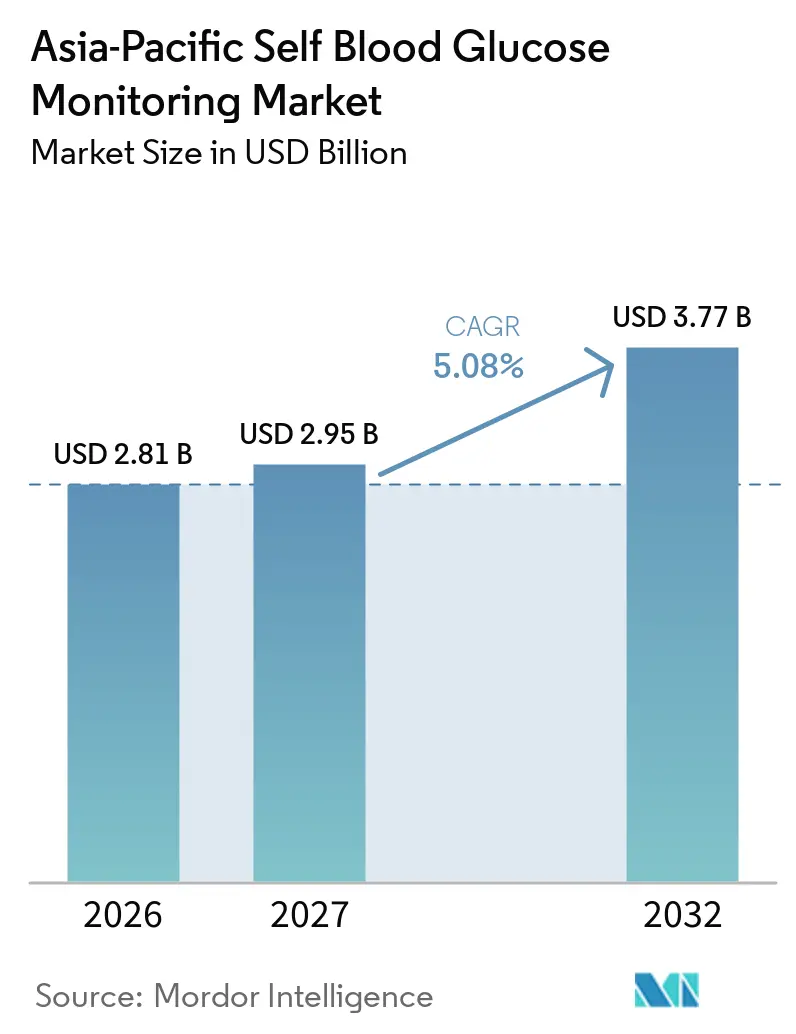
The Asia-Pacific Self Blood Glucose Monitoring Market size is expected to increase from USD 2.81 billion in 2026 to USD 2.95 billion in 2027 and reach USD 3.77 billion by 2032, growing at a CAGR of 5.08% over 2027-2032.
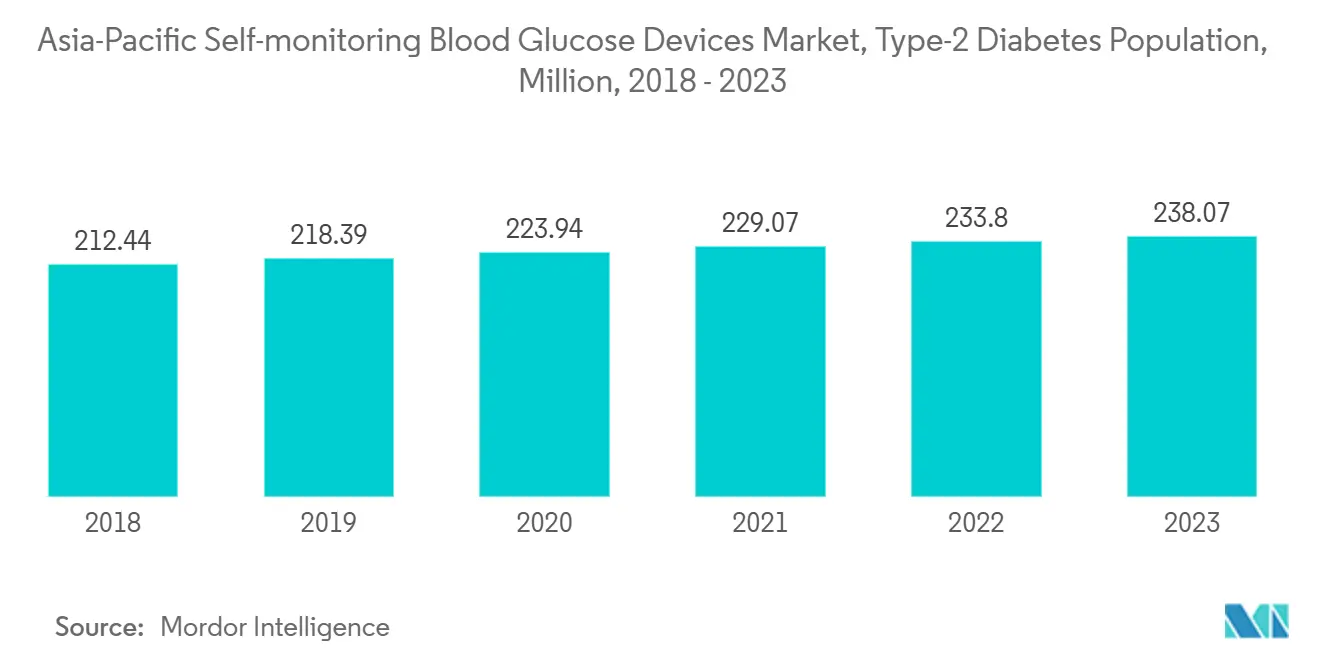
According to International Diabetes Federation (IDF), 90 million adults (20-79) are living with diabetes in the IDF South-East Asia (SEA) Region. This figure is estimated to increase to 113 million by 2030 and 152 million by 2045 and 206 million adults (20-79) are living with diabetes in the IDF Western Pacific Region which is estimated to increase to 238 million by 2030 and 260 million by 2045.
The main diagnosis for diabetes patients is imbalances in blood glucose levels, which are not in compliance with the standard blood glucose levels. The general lab diagnostic tests can only help to diagnose the disease by physicians. Patients with more fluctuations in glucose levels need to get it checked every day. Patients administering insulin need to check their blood glucose levels frequently, adjust the doses of insulin, or change the medication, if necessary, which is only possible with the use of self-monitoring blood glucose devices.
Diabetes mellitus has been of wide concern with its high prevalence, resulting in increased financial burdens for clinical systems, individuals, and governments. The market players are adopting various strategies such as collaborations, partnerships, mergers, acquisitions, and expansions to increase market share. For instance, in August 2021, FIND announced that agreements were signed with i-SENS, Inc. (Seoul, South Korea) and SD BIOSENSOR, Inc. (Suwon-si, South Korea) to increase low- and middle-income countries' access to blood glucose test strips by improving affordability.
Therefore, owing to the aforementioned factors the studied market is anticipated to witness growth over the analysis period.
Note: Market numbers in this report are based on Mordor Intelligence's proprietary estimation framework, which combines nine months of actuals with Q4 projections for base year 2026.
Asia-Pacific Self Blood Glucose Monitoring Market Trends and Insights
Test strips segment holds the highest market share in the current year
The test strips segment holds the highest market share of about 73% in the Asia-Pacific self-monitoring blood glucose market in the current year.
Test strips remain a core revenue-generating component of self-monitoring systems because patients require repeated testing throughout the life of the monitoring device. Consequently, increasing testing frequency and the growing installed base of glucose meters can support sustained demand for consumable strips across Asia-Pacific.
The recurring nature of strip consumption provides manufacturers with an ongoing revenue stream beyond the initial sale of glucose meters. Market growth is therefore increasingly linked to the number of active users, testing frequency, disease-management practices, and availability of compatible consumables.
Thus, owing to the increased prevalence of diabetes and the above-mentioned factors, the market is expected to grow over the forecast period.
China holds the highest market share in the Asia-Pacific Self Blood Glucose Monitoring Market in the current year
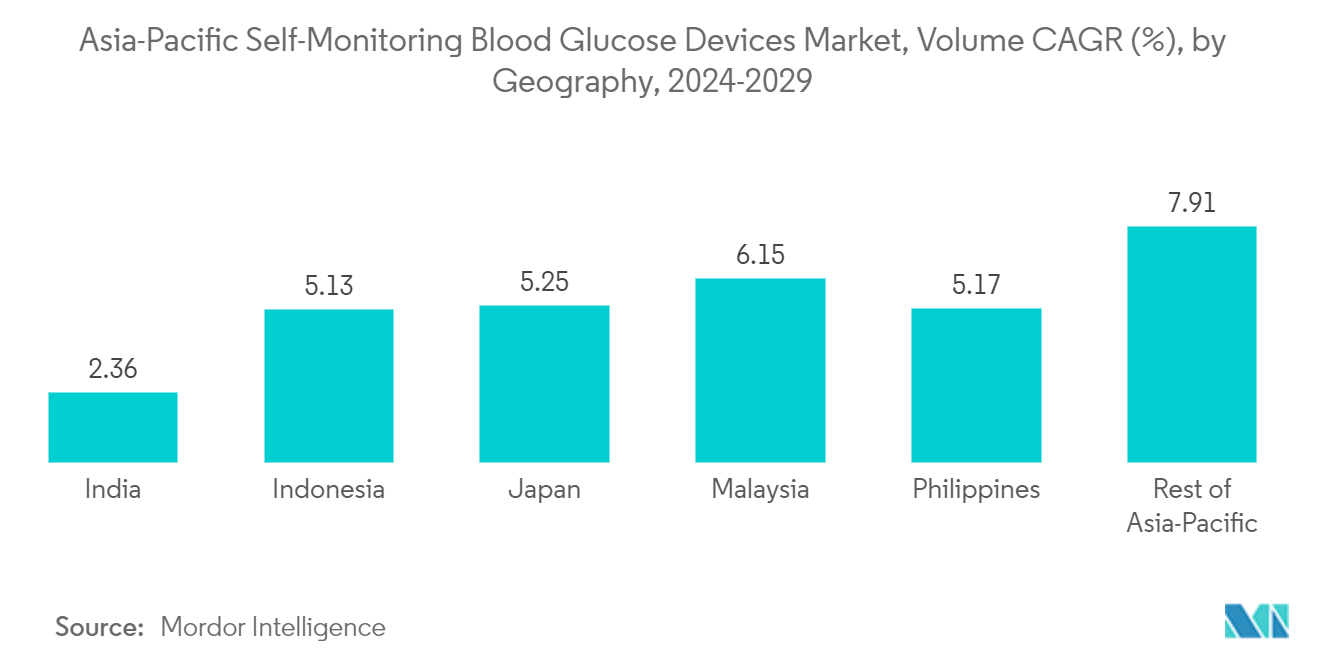
China holds the highest market share in the Asia-Pacific self-monitoring blood glucose market in the current year and is expected to register a CAGR of about 5.7% over the forecast period.
As per the IDF 2021 report, an estimated 141 million adults were living with diabetes in China. The country had the highest number of deaths from diabetes in the Western Pacific region, at approximately 1.4 million, and the second-highest diabetes-related health expenditure in the world, at 165.3 billion USD. More than half of adults currently living with diabetes in China are undiagnosed. About 90% of people with diabetes have type-2 diabetes. The rise in the number of people with type-2 diabetes is driven by a complex interplay of socio-economic, demographic, environmental, and genetic factors. Key contributors include urbanization, an aging population, decreasing levels of physical activity, and increased levels of overweight and obesity.
Evidence suggests that type-2 diabetes can often be prevented, while early diagnosis and access to appropriate care for all types of diabetes can avoid or delay complications for people living with the condition. When diabetes is undetected or inadequately treated, people with diabetes are at risk of serious and life-threatening complications, such as heart attack, stroke, kidney failure, blindness, and lower-limb amputation. These result in reduced quality of life and higher healthcare costs. China has significantly improved the detection and management of diabetes with its pilot projects in national demonstration areas and its attempts to improve health system integration. These initiatives demonstrate a willingness to confront the rise of diabetes with strategies based on health promotion, disease detection, and management of the multiple conditions and complications associated with the disease.
Therefore, owing to the aforesaid factors, the growth of the studied market is anticipated in the Asia-Pacific region.
Competitive Landscape
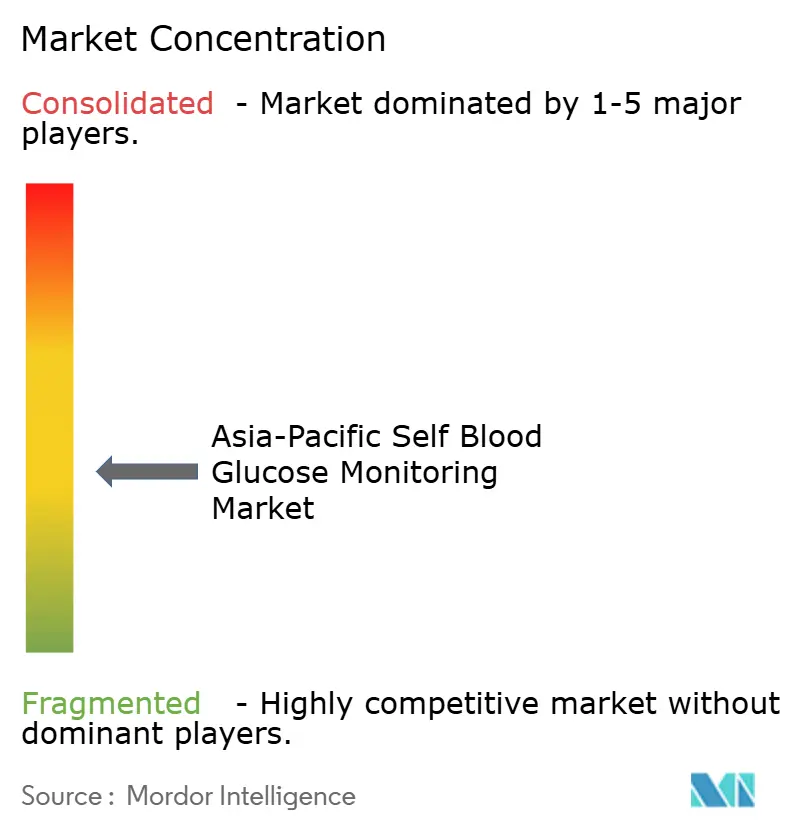
The Asia-Pacific Self Blood Glucose Monitoring Market is fragmented with a few major manufacturers like Abbott, LifeScan, Roche, and Ascensia etc. gaining presence in major countries of the Asia-Pacific market, while the remaining market comprises other local or region-specific manufacturers.
Asia-Pacific Self Blood Glucose Monitoring Industry Leaders
-
I-Sens
-
Abbott Diabetes Care
-
Ascensia Diabetes Care
-
LifeScan Inc.
-
Roche Diabetes Care
- *Disclaimer: Major Players sorted in no particular order
Market Opportunities and Future Outlook
A clear whitespace is opening for next-generation self-monitoring workflows that reduce fingerstick burden and connect patients to mobile apps, as regional regulators and health systems validate newer sensing formats alongside conventional SMBG. Abbott expanded FreeStyle Libre 2 Plus availability in Vietnam in June 2026, and South Korea clearance events for newer glucose-monitoring systems are reinforcing regulatory momentum and elevating competition against legacy meter-plus-strip portfolios, while increasing demand for companion apps, data sharing, and patient-support services.
Commercial opportunity also sits in the consumables and access layer, since test strips account for a dominant share of component spend (about 73% in the current year) and affordability remains central to adoption. Programs and collaborations that target strip pricing and supply continuity, such as the FIND agreements with i-SENS and SD BIOSENSOR to improve access to blood glucose test strips, highlight room for value-based tenders, local manufacturing and distribution partnerships, and product designs optimized for frequent testing in home/personal settings across high-burden markets such as China and India.
Recent Industry Developments
- June 2026: Abbott launched the FreeStyle Libre 2 Plus flash glucose monitoring system in Vietnam, adding minute-by-minute glucose readings and smartphone connectivity with real-time alerts. The rollout strengthens competition in connected glucose monitoring across Southeast Asia and elevates consumer expectations for app-integrated, lower-burden self-management versus traditional SMBG routines.
- April 2026: South Korea clearance events for newer glucose-monitoring systems continue to expand access in a key APAC market, signaling regulatory momentum that sharpens competitive dynamics for CGM providers beyond legacy meter-based offerings.
- February 2026: LifeScan and i-SENS announced a partnership to launch a CGM system under the OneTouch Vita brand, with initial rollouts planned for Europe. The collaboration pairs LifeScan's global brand and channel reach with i-SENS biosensor capabilities, sharpening competitive dynamics for incumbents that sell SMBG systems alongside emerging CGM ecosystems.
Research Methodology Framework and Report Scope
Market Definition and Coverage
This market covers self blood glucose monitoring (SMBG) devices used by people with diabetes to check capillary blood glucose outside of lab settings across Asia Pacific. It includes meters, test strips, and lancets, and it is sized in revenue terms.
Scope exclusions: Continuous glucose monitoring (CGM) systems, insulin delivery devices, and laboratory glucose testing equipment are not counted in this SMBG market size.
Segmentation Overview
- Components
- Glucometer Devices
- Test Strips
- Lancets
- End User
- Hospital/Clinics
- Home/Personal
- Geography
- Japan
- South Korea
- China
- India
- Australia
- Vietnam
- Malaysia
- Indonesia
- Philippines
- Thailand
- Rest of Asia-Pacific
Data Sources, Market Sizing, and Validation
Desk Research
Desk work started with building the country coverage and diabetes monitoring context using public health and trade references across Asia Pacific. We relied on the World Health Organization, International Diabetes Federation, World Bank, OECD health statistics, and national health ministries to anchor diabetes prevalence, diagnosis, and care access signals that tend to influence SMBG demand.
To translate that demand context into a market model, we also checked public customs and trade statistics where available, along with regulatory and reimbursement cues from national agencies, plus company annual reports, earnings decks, and reputable press coverage for product and pricing direction. A paid subscription for company financials and news intelligence was used to cross-check revenue exposure and recent product moves, and a patent database was reviewed to understand innovation pace around strips, meters, and sampling. These sources are illustrative, and other public and paid references were also reviewed for data collection, validation, and clarification.
Primary Interviews and Surveys
Fieldwork focused on validating what drives SMBG purchasing and use across large and mid-sized Asia Pacific markets, and on closing gaps desk sources do not answer well, such as channel mix, price bands, and replacement cycles. We spoke with device and consumables stakeholders, distributors, pharmacy and hospital procurement contacts, and clinicians who influence monitoring frequency, then used those inputs to tighten assumptions across the region.
Distribution of primary research fieldwork respondents
| Company type | Respondent position |
|---|---|
| Top tier: 33% | CXOs: 14% |
| Mid tier: 53% | Functional/Unit leaders: 27% |
| Smaller Players: 14% | Managers: 59% |
Market-Sizing & Forecasting
The sizing model is built using a top-down demand pool reconstructed from diabetes prevalence, diagnosis and treated rates, and an estimated share of patients using fingerstick testing. That demand is converted into annual strip consumption, then paired with meter and lancet attachment rates.
Because country reporting quality varies, we normalize key inputs using a small set of repeatable indicators before rolling results up to the Asia Pacific total.
To keep totals realistic, we corroborate the top-down output with selective bottom-up approximations, such as sampled average selling price by channel, distributor feedback on strip volumes, and supplier revenue splits across meters and consumables. Key inputs include monitoring frequency per patient, strip pack sizes and wastage, retail versus institutional pricing spread, replacement cycle for meters, and reimbursement or subsidy signals that can shift adherence. Forecasts are developed using scenario analysis, with expert feedback used to stress-test how these variables may move, and for smaller countries we apply proxies to similar markets and re-check them during interviews.
Data Validation & Update Cycle
Validation is performed through checks for logical consistency before final numbers are signed off. We compare modeled strip volumes and implied spend per diagnosed patient with independent signals such as diabetes population trends, public health spending direction, and observed pricing bands from channel checks, then review and correct outliers with documented reasons.
A second analyst reviews assumptions, calculations, and country roll-ups. Re-contact is triggered when responses conflict or when a key variable shifts materially. The report is refreshed on an annual cycle, and interim updates are made when major events occur, including reimbursement changes or sharp pricing moves in strips. Before delivery, a final pass is completed to ensure recent developments are reflected in the narrative and forecast inputs.
Mordor Intelligence's Asia Pacific Self Blood Glucose Monitoring Market Size Compared Against Other Published Estimates
Published numbers for this market can look different even when they sound similar, because the product scope and the demand signals used to convert patients into device and strip spend are not consistent. Differences also come from how each study treats country coverage, currency conversion timing, and how often assumptions like monitoring frequency and average selling prices are refreshed.
Strip consumption checks, implied spend per diagnosed patient, and channel pricing validation are the evidence points that keep Mordor Intelligence focused on SMBG-only revenue across meters, test strips, and lancets, without including CGM systems in the counted totals.
Benchmark comparison
| Source | Market Size | Gaps in Research Methodology |
|---|---|---|
| Mordor Intelligence | USD 2.67 B (2025) | |
| Industry Research Publisher A | USD 2.33 B (2024) | Uses a different base year and can apply different pack size and usage assumptions for strips, which shifts implied volumes and the blended price outcome. |
| Consulting Publisher B | USD 3.76 B (2024) | Covers the broader blood glucose monitoring space, which typically includes CGM, so the counted product set and adoption curve are not aligned to SMBG-only devices and consumables. |
The comparison indicates that much of the spread is driven by product inclusion and by how patient counts are translated into yearly strip usage and pricing. When these inputs are kept explicit and checked against observable signals, the resulting value can be replicated and updated as conditions change.
Key Questions Answered in the Report
How big is the Asia-Pacific Self Blood Glucose Monitoring Market?
The Asia-Pacific Self Blood Glucose Monitoring Market size is expected to reach USD 2.95 billion in 2027 and grow at a CAGR of 5.08% to reach USD 3.77 billion by 2032.
What is the current Asia-Pacific Self Blood Glucose Monitoring Market size?
In 2026, the Asia-Pacific Self Blood Glucose Monitoring Market size is expected to reach USD 2.81 billion.
Who are the key players in Asia-Pacific Self Blood Glucose Monitoring Market?
I-Sens, Abbott Diabetes Care, Ascensia Diabetes Care, LifeScan Inc. and Roche Diabetes Care are the major companies operating in the Asia-Pacific Self Blood Glucose Monitoring Market.
What years does this Asia-Pacific Self Blood Glucose Monitoring Market cover, and what was the market size in 2026?
In 2026, the Asia-Pacific Self Blood Glucose Monitoring Market size was estimated at USD 2.81 billion. The report covers the Asia-Pacific Self Blood Glucose Monitoring Market historical market size for years: 2019, 2020, 2021, 2022, 2023 and 2024. The report also forecasts the Asia-Pacific Self Blood Glucose Monitoring Market size for years: 2027, 2028, 2029, 2030, 2031, and 2032.