
Market Overview
| Study Period | 2021 - 2031 |
|---|---|
| Forecast Data Period | 2026 - 2031 |
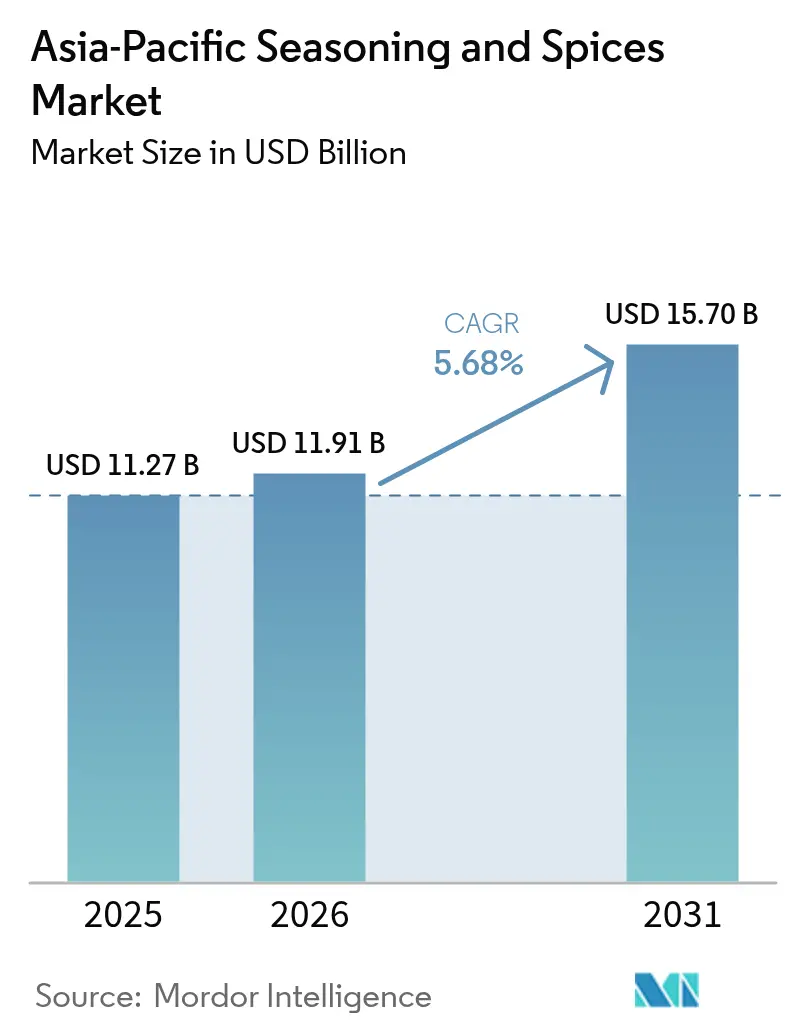
| Base Year Market Size (2025) | USD 11.27 Billion |
| Market Size (2026) | USD 11.91 Billion |
| Market Size (2031) | USD 15.7 Billion |
| Growth Rate (2026 - 2031) | 5.68 % |
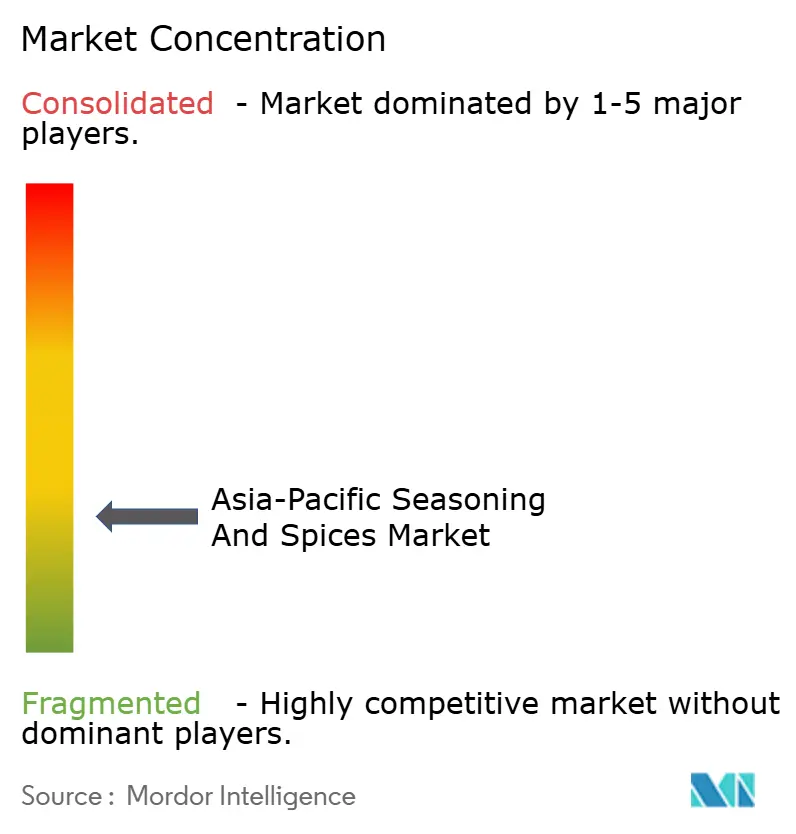
| Market Concentration | Low |
Major Players *Disclaimer: Major Players sorted in no particular order Image © Mordor Intelligence. Reuse requires attribution under CC BY 4.0. | |
Asia-Pacific Seasoning And Spices Market Analysis by Mordor Intelligence
The Asia Pacific seasoning and spices market size was valued at USD 11.27 billion in 2025 and estimated to grow from USD 11.91 billion in 2026 to reach USD 15.70 billion by 2031, at a CAGR of 5.68% during the forecast period (2026-2031). Urban households actively drive demand as they seek convenient options that do not compromise on authentic taste. Processed-food manufacturers increasingly rely on standardized blends to meet consistent quality requirements, while the market witnesses a growing preference for premium formats. Rising disposable incomes in tier-2 and tier-3 cities significantly expand the consumer base. Modern grocery stores and e-commerce platforms play a crucial role in enhancing product accessibility and reach. Culinary tourism and the popularity of fusion cuisine trends encourage processors to accelerate the launch of innovative products. Furthermore, regional price fluctuations in key spices like pepper and turmeric prompt companies to diversify their supply chains to ensure stability.
Key Report Takeaways
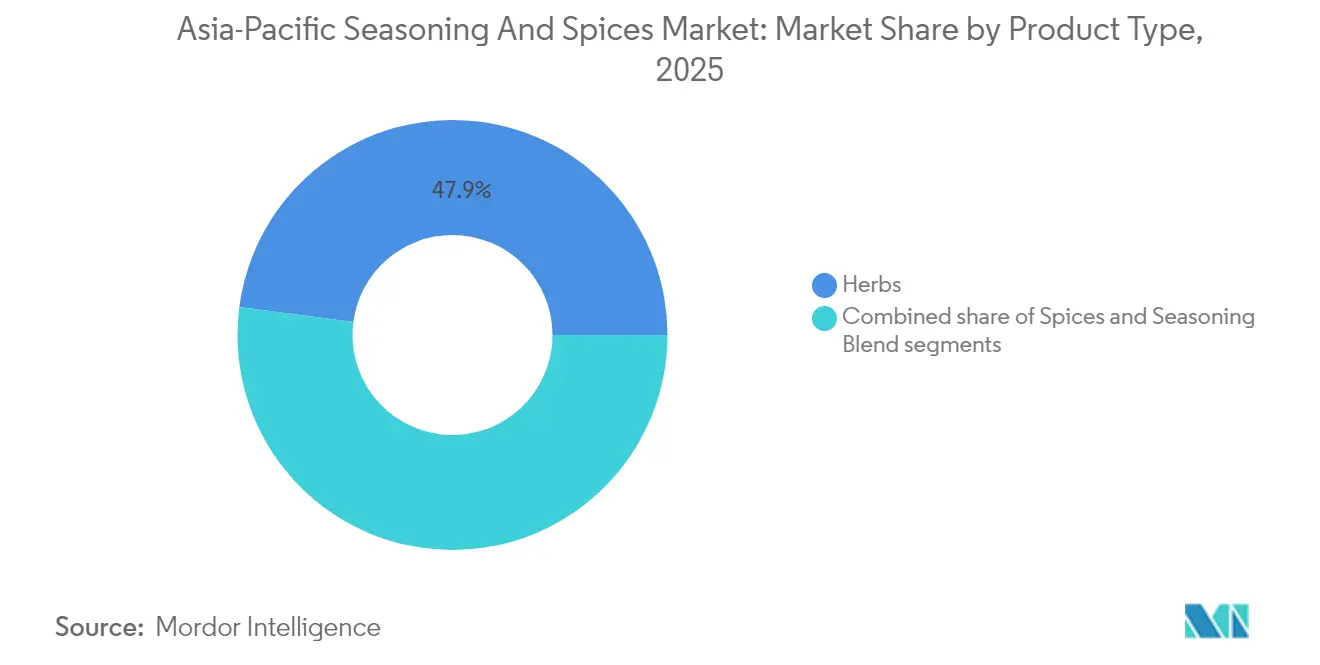
- By product type, herbs led with 47.92% revenue share in 2025. Seasoning blends are projected to expand at a 6.04% CAGR to 2031.
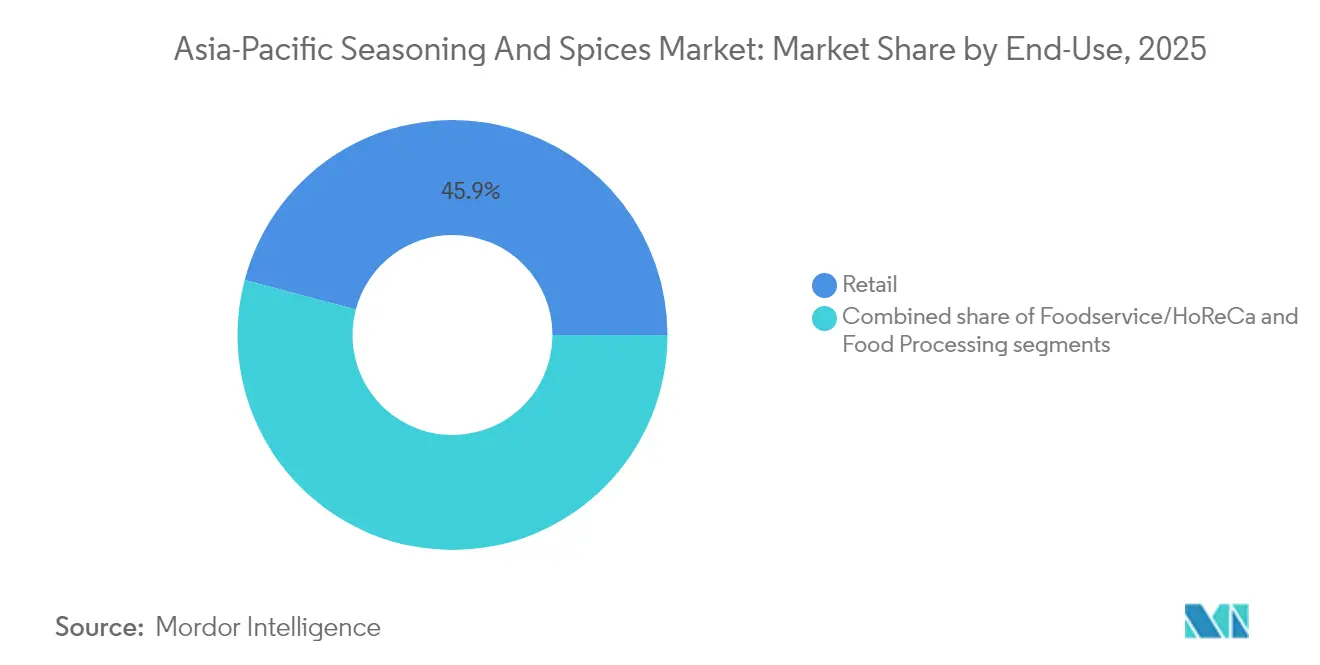
- By end-use, retail held 45.88% of the Asia Pacific seasoning and spices market share in 2025, while foodservice/HoReCa records the highest projected CAGR at 5.93% through 2031.
- By geography, China commanded 36.32% share of the Asia Pacific seasoning and spices market in 2025 and Australia is advancing at a 6.22% CAGR through 2031.
Note: Market size and forecast figures in this report are generated using Mordor Intelligence’s proprietary estimation framework, updated with the latest available data and insights as of 2026.
Market Trends and Insights
Drivers Impact Analysis of Asia-Pacific Seasoning And Spices Market*
| Driver | (~) % Impact on CAGR Forecast | Geographic Relevance | Impact Timeline |
|---|---|---|---|
| Rising demand for convenience foods with ethnic flavours | +1.2% | Asia-Pacific core, spill-over to urban centers | Medium term (2-4 years) |
| Growing consumer shift toward natural/organic seasonings | +0.9% | Regional with early gains in Japan, Australia, South Korea | Long term (≥ 4 years) |
| Increasing product offerings and retail penetration | +1.1% | China, India, Indonesia, Thailand | Short term (≤ 2 years) |
| Expansion of processed and ready-to-eat food industry | +1.4% | Asia-Pacific core, particularly China and India | Medium term (2-4 years) |
| Innovation in spice blends and seasonings | +0.8% | Global, with concentration in developed Asia-Pacificmarkets | Long term (≥ 4 years) |
| Increasing use of spices as natural preservatives and functional ingredients | +0.7% | Regional, more pronounced in urban areas | Long term (≥ 4 years) |
| Source: Mordor Intelligence | |||
Rising demand for convenience foods with ethnic flavours
The market is experiencing significant growth, driven by the rising demand for convenience foods infused with ethnic flavors. Consumers in the region are increasingly seeking ready-to-eat or easy-to-prepare meals that offer authentic taste experiences reflective of diverse cultural cuisines. This trend is fueled by changing lifestyles, urbanization, and the growing influence of global food culture. As per a UN-Habitat report, Asia is home to 54% of the world's urban population, translating to over 2.2 billion individuals. Projections indicate that by 2050, Asia's urban populace will swell by another 1.2 billion, marking a 50% increase [1]. This rapid urbanization is contributing to the growing demand for convenient food options, including those with ethnic flavors, as urban consumers often have busier lifestyles and limited time for meal preparation. Additionally, the preference for ethnic flavors is supported by the expanding middle-class population, which has greater disposable income to spend on premium and diverse food products. Manufacturers are capitalizing on this demand by introducing innovative seasoning and spice blends tailored to regional and international tastes, further propelling the market's growth. Moreover, the increasing penetration of international cuisines in the Asia-Pacific region has amplified the demand for ethnic seasonings and spices.
Growing consumer shift toward natural/organic seasonings
The clean label trend has transformed the spice industry, now including not just basic ingredients but also flavorings and extracts, with natural herbs and spices gaining prominence. Heightened consumer awareness and a growing demand for transparency in food products have driven changes in spice procurement and certification processes. The FAO's World of Organic Agriculture 2024 report reveals that organic agriculture spans 188 countries, with at least 4.5 million farmers managing over 96 million hectares of land organically [2]. This trend has replaced synthetic flavor enhancers with natural spice extracts, creating opportunities for suppliers of standardized natural alternatives. Consumers willingly pay a premium for certified organic and clean-label spices, prompting manufacturers to expand their organic portfolios, enforce stricter quality control, and improve sourcing practices. Companies now provide detailed information about product origins, processing methods, and sustainability efforts to align with consumer preferences for minimally processed products without artificial additives.
Increasing product offerings and retail penetration
Retailers in the Asia-Pacific seasoning and spices market are actively expanding their product lines to cater to diverse consumer preferences. This expansion includes introducing innovative seasoning blends, organic and natural spice options, and region-specific flavors to meet the growing demand for variety and authenticity. Additionally, companies are increasing their retail penetration by leveraging both traditional and modern distribution channels. They are focusing on enhancing their presence in supermarkets, hypermarkets, convenience stores, and e-commerce platforms to ensure wider accessibility. Furthermore, the growing urbanization and rising disposable incomes in the region are driving consumers to explore premium and exotic spice options, further encouraging retailers to diversify their offerings. Companies are also investing in marketing campaigns and promotional activities to create awareness about their products and attract a larger customer base. The increasing adoption of digital platforms and the rise of online grocery shopping have further enabled retailers to reach remote areas, ensuring that their products are available to a broader audience. These strategies collectively aim to capture a larger consumer base, strengthen brand loyalty, and drive sustained growth in the Asia-Pacific seasoning and spices market.
Expansion of processed and ready-to-eat food industry
The expansion of the processed and ready-to-eat food industry is a significant driver of the Asia-Pacific seasoning and spices market. The growing demand for convenience foods, driven by busy lifestyles and increasing urbanization, has led to a surge in the consumption of processed and ready-to-eat meals. These meals often require the use of a variety of seasonings and spices to enhance flavor, preserve freshness, and meet diverse consumer preferences. Categories such as snack foods, ready-to-eat meals, and other convenience-driven foods are increasingly incorporating a wide range of seasonings, from dry spice blends to liquid marinades, to elevate their taste profiles and cater to evolving consumer demands. This growing reliance on seasonings is propelling the food processing sector's expansion, presenting manufacturers with opportunities to offer functional and clean-label formulations for large-scale food production. Additionally, the rising influence of Western food culture and the increasing availability of international cuisines in the region have further fueled the demand for spices and seasonings. Data from Japan's Ministry of Internal Affairs and Communications reveals that in 2024, Japanese households spent an average of 6,854 yen on snack foods, the highest level in a decade[3]. This trend underscores the growing consumption of processed and packaged foods, which is expected to continue during the forecast period, contributing to the growth of the Asia-Pacific seasoning and spices market.
Restraints Impact Analysis of Asia-Pacific Seasoning And Spices Market*
| Restraint | (~) % Impact on CAGR Forecast | Geographic Relevance | Impact Timeline |
|---|---|---|---|
| Concerns regarding food safety and quality | -0.8% | Regional, particularly in urban areas | Short term (≤ 2 years) |
| Presence of additives affecting sensory experience | -0.5% | Asia-Pacific core, consumer-driven markets | Medium term (2-4 years) |
| Higher cost of organic and chemical-free ingredients | -0.7% | Regional, more acute in secondary cities | Long term (≥ 4 years) |
| Geopolitical trade-route disruptions | -1.1% | Regional, with spillover to emerging markets | Short term (≤ 2 years) |
| Source: Mordor Intelligence | |||
Concerns regarding food safety and quality
Food safety incidents and contamination concerns pose significant challenges to the growth of the spice market. Regulatory authorities are tightening testing requirements, and consumers are becoming more discerning about product quality. In 2023, the European Union documented 248 safety issues related to spices and herbs. Common issues included violations of pesticide residue limits and salmonella contamination. These concerns prompted the EU to increase inspection frequencies for certain products and their origins. Meanwhile, China's GACC registration requirements for overseas exporters add another layer of compliance challenges. In the U.S., the FDA's heightened scrutiny on spice safety, spurred by notable contamination incidents, has escalated testing and certification costs throughout the supply chain. Smaller producers, often lacking the resources for thorough testing protocols, feel the brunt of these safety concerns. This has led to market consolidation, benefiting larger players with established quality management systems. Additionally, new traceability requirements complicate operations and inflate costs. Companies are now mandated to keep meticulous records across the supply chain, ensuring swift action during recall scenarios.
Presence of additives affecting sensory experience
The presence of additives significantly impacts the sensory experience, acting as a restraint in the Asia-Pacific seasoning and spices market. Additives, often used to enhance shelf life, texture, or flavor, can alter the natural taste and aroma of seasonings and spices, which are key factors influencing consumer preferences. This alteration may lead to a diminished perception of authenticity and quality, particularly in a market where traditional and natural flavors are highly valued. Consumers in the Asia-Pacific region, known for their strong inclination toward authentic and culturally significant flavors, are increasingly scrutinizing the use of additives in food products. Additionally, growing consumer awareness regarding the potential health risks associated with certain additives, such as artificial flavor enhancers, preservatives, and synthetic colorants, has further contributed to this restraint. The rising trend of clean-label products, where consumers demand transparency in ingredient lists, has placed additional pressure on manufacturers to reduce or eliminate additives. Regulatory bodies in the region are also imposing stricter guidelines on the use of additives, which could limit their application and affect product formulations. For instance, countries like India and China have introduced stringent food safety standards, requiring manufacturers to comply with permissible limits for additives. These regulations, while ensuring consumer safety, often increase production costs and complicate the product development process.
*Our forecasts treat driver/restraint impacts as directional, not additive. The impact forecasts reflect baseline growth, mix effects, and variable interactions.
Asia-Pacific Seasoning And Spices Market Segment Analysis
By Product Type:
Herbs Hold Sway While Blends OutpaceHerbs hold the largest market share in the Asia Pacific seasoning and spices market, accounting for a substantial 47.92% of the market in 2025. This dominance is deeply rooted in the region’s rich culinary heritage, where fresh and dried herbs are integral to the preparation of traditional dishes. The widespread use of herbs across diverse regional cuisines highlights their importance as essential flavoring agents that enhance taste and aroma. Consumers in the Asia Pacific continue to favor herbs for their natural qualities and health benefits, further cementing their market leadership. Culinary practices in countries like India, China, and Southeast Asia emphasize herb-based seasoning, which boosts consistent demand. This strong preference for herbs reflects the cultural significance and versatility they bring to cooking across the region.
Seasoning blends represent the fastest-growing segment in the Asia Pacific seasoning and spices market, exhibiting a robust CAGR of 6.04% through 2031. This rapid growth is primarily driven by the food processing industry's increasing need for standardized and consistent flavor profiles in their products. Seasoning blends offer a convenient solution for both manufacturers and consumers, simplifying the cooking process while ensuring reliable taste outcomes. The expanding urban population and hectic lifestyles further fuel consumers’ demand for ready-to-use blends that save time without compromising flavor. Additionally, foodservice sectors such as restaurants and quick-service outlets are adopting seasoning blends extensively to maintain product quality across multiple outlets. As consumers seek convenience combined with authentic taste experiences, seasoning blends continue to gain traction, positioning themselves as a key growth driver in the market.

By End-Use:
Retail Dominance Challenged by Foodservice AccelerationThe retail segment continues to dominate the Asia-Pacific seasoning and spices market, holding a commanding 45.88% market share in 2025. This leadership is largely attributed to the rapid expansion of modern trade channels, including supermarkets, hypermarkets, and convenience stores, which enhance consumer access to a wide variety of spice products. Furthermore, the growing penetration of e-commerce platforms has significantly boosted the availability and convenience of purchasing spices, especially in urban and semi-urban areas. As more consumers embrace online shopping, they benefit from a broader selection and competitive pricing. The retail channel also benefits from rising disposable incomes and changing consumer lifestyles that favor home cooking and experimentation with diverse flavors. Overall, these factors solidify the retail segment’s leading position in the market by catering to a broad demographic of spice consumers.
In contrast, the foodservice and HoReCa segment is positioned as the fastest-growing segment in the Asia-Pacific seasoning and spices market, with a robust CAGR of 5.93% projected through 2031. This notable growth is fueled by the expansion of the restaurant industry, which continues to flourish as urbanization and disposable incomes rise. Additionally, the recovery of tourism across the region is igniting demand for unique dining experiences that celebrate authentic ethnic flavors and traditional spice blends. Consumers increasingly seek off-premise dining options and gourmet food experiences that are rich in regional taste profiles, driving the adoption of specialized seasoning products in this segment. The HoReCa sector also benefits from innovations in menu offerings and an increased focus on food quality and authenticity.
Geography Analysis
China Seasoning and Spices Market
In 2025, China secures a dominant 36.32% market share, capitalizing on its vast domestic consumption and a well-established condiment manufacturing base catering to both local and export demands. Spices and seasonings are deeply woven into the fabric of regional cuisines in China, underscoring the market's cultural significance. The country's strong export capabilities further enhance its position, with Chinese condiments and spices being widely distributed across global markets. Additionally, the integration of traditional flavors with modern culinary trends has bolstered domestic demand, ensuring sustained growth in the market.
Australia Seasoning and Spices Market
Australia stands out as the fastest-growing market, boasting a 6.22% CAGR projected through 2031. This growth is fueled by its multicultural populace, a penchant for premium products, and a robust demand for specialty spices that resonate with its diverse ethnic communities. The increasing preference for organic and sustainably sourced spices among Australian consumers has also contributed to the market's expansion. Furthermore, the rising popularity of international cuisines has driven the import of unique and exotic spices, catering to the evolving tastes of the population and supporting the market's upward trajectory.
APAC Seasoning and Spices Market
Growth trajectories across the Asia-Pacific region reveal a tapestry of economic maturity and consumer sophistication. Japan, with its focus on premium offerings and health-centric ingredients, showcases a mature market. India, on the other hand, plays a pivotal role in the regional market, driven by its position as one of the largest producers and consumers of spices globally. The Indian market benefits from a rich culinary heritage, a growing middle-class population, and increasing exports of spices to international markets. Meanwhile, Southeast Asian nations like Indonesia, Thailand, and Vietnam are witnessing vigorous growth, propelled by a burgeoning middle class and swift urbanization. These countries are experiencing a surge in demand for packaged and ready-to-use seasonings, reflecting changing lifestyles and consumer preferences.
Regulatory Landscape
Across Asia-Pacific, seasoning and spice suppliers face tightening food-safety controls that increasingly emphasize standardized specifications, traceability, and additive governance for both domestic sales and export eligibility. In China, the Standardization Administration of China issued GB/T 15691-2026 (General Technical Conditions for Spices and Seasonings) on March 31, 2026, with implementation from October 1, 2026. This replaced the 2008 version and raises the need for aligned testing and quality documentation for processors and blenders. In India, spices, condiments, and related products are regulated through FSSAI standards, and compliance expectations can increase verification costs for smaller players as testing and record-keeping become more stringent.
Regional work to reduce technical barriers to trade is also progressing alongside national rulemaking. ASEAN published Annex I on Maximum Use Levels of Food Additives in April 2026, which provides a common reference for functional classes used in seasoning formulations (including preservatives and acidity regulators). Thailand FDA is also working on modernizing flavoring classifications via a proposed Ministry of Public Health notification (as of July 2026) that adopts a more structured, positive-list approach. Vietnam updated implementation guidance for the Law on Food Safety through Decree No. 46/2026/ND-CP (January 26, 2026), including packaging and labeling-related provisions relevant to small-format seasoning and herb packs, adding another compliance consideration for brands serving modern retail and e-commerce channels.
Competitive Landscape
The Asia Pacific seasoning and spices market demonstrates a moderately concentrated structure, indicating a fragmented competitive environment. This market is characterized by the presence of global leaders, strong regional players, and specialized local processors, all competing to capture market share. The competitive dynamics are shaped by varying consumer preferences, regional culinary traditions, and the ability of companies to adapt to these factors. The fragmented nature of the market allows smaller players to thrive by catering to niche demands, while global companies leverage their scale and resources to maintain a competitive edge.
Global players such as McCormick dominate the market by utilizing their extensive global scale, advanced technical capabilities, and strong distribution networks. These companies invest heavily in research and development to innovate and introduce new products that align with evolving consumer tastes. Their ability to cater to a wide range of preferences across multiple geographies gives them a significant advantage. Additionally, global players often focus on strategic partnerships and acquisitions to expand their presence in the Asia Pacific region, further solidifying their market position.
On the other hand, regional players like Ajinomoto, Lee Kum Kee, and MDH Spices maintain a strong foothold by leveraging their deep understanding of local markets and cultural authenticity. These companies excel in offering products that resonate with regional culinary traditions and consumer preferences. Their ability to adapt quickly to local trends and maintain close relationships with distributors and retailers enhances their competitiveness. Furthermore, the emphasis on quality, authenticity, and heritage allows these regional players to build strong brand loyalty among consumers, ensuring sustained growth in the market.
Asia-Pacific Seasoning And Spices Industry Leaders
-
Olam International
-
Kerry Group PLC
-
Ajinomoto Co., Inc.
-
Kikkoman Corporation
-
McCormick & Company, Inc.
- *Disclaimer: Major Players sorted in no particular order
Asia-Pacific Seasoning And Spices Market Companies Covered in this Report
- McCormick & Company, Inc.
- Olam International
- Ajinomoto Co., Inc.
- Kerry Group plc
- Kikkoman Corporation
- Sensient Technologies Corp.
- House Foods Group Inc.
- Everest Food Products Pvt Ltd
- MDH Spices
- Lee Kum Kee Co. Ltd
- Vietnam Pepper Association (VPA)
- Wingreens Farms
- Thai President Foods PLC
- Sichuan Baijia Food Co.
- Shinho Food
- Unilever PLC
- Frontier Co-op
- Döhler GmbH
- Cargill, Incorporated
- Schulze & Co. KG
Read Analysis of Asia-Pacific Seasoning And Spices Companies
Market Opportunities and Future Outlook
Manufacturing localization and applications-led innovation are creating openings for standardized seasoning blends used by food processing and foodservice firms, especially where consistent flavor performance is needed across multiple outlets and packaged-food SKUs. In Southeast Asia, capacity build-outs point to continued demand for regional production of savory solutions, including ofi (olam food ingredients) and WNC Capital Holdings announcing a joint venture to build a seasoning and flavor solutions facility in Bulacan, Philippines (commissioning targeted by Q4 2026), and Ajinomoto Philippines beginning construction activities for a new Tarlac factory focused on seasonings and food mixes. These actions support faster product iteration and customer co-creation for dry mixes, marinades, and breading systems aligned with convenience-food growth and local taste profiles.
Regulatory frameworks are also shifting the basis of competition toward clean-label, additive-governed, and compliance-ready portfolios, including salt and additive management, transparent labeling, and digitized food-safety systems. The APFRAS Seoul 2026 Declaration highlights an industry and regulator focus on integrating digital technologies into food-safety management and advancing regional harmonization, which favors suppliers able to provide auditable specifications and traceability across multi-origin spice supply chains. Ingredient and flavor majors are reinforcing regional supply networks as well, including Givaudan inaugurating a production facility in Cikarang, Indonesia for savory, sweet, and snack flavor powders for regional distribution, while condiment players expand closer to demand centers, including Kikkoman announcing plans for its first manufacturing plant in India to support local production.
Recent Industry Developments in Asia-Pacific Seasoning And Spices Market
- July 2026: Givaudan inaugurated a new production facility in Cikarang, Indonesia, to manufacture savoury, sweet, and snack flavour powders for regional distribution. The added local capacity supports shorter lead times and formulation adaptation for Asia-Pacific customers that use seasonings and flavour systems in processed foods and snacks.
- June 2026: Kikkoman Corporation announced plans for its first manufacturing plant in India to support local production of its condiments. Establishing in-country manufacturing strengthens responsiveness to India-specific taste profiles and reduces reliance on imports for a high-volume condiment and seasoning market.
- May 2026: Ajinomoto Philippines Corporation held a groundbreaking for a new factory in the TARI Estate, Tarlac City, with an investment of around PHP 9.1 billion to produce seasonings and breading mixes such as AJI-GINISA and Crispy Fry. The project expands domestic manufacturing depth for packaged seasonings used in retail and foodservice channels, reinforcing scale and supply continuity in the Philippines.
Asia-Pacific Seasoning And Spices Market Report Scope and Research Methodology
Market Definition and Coverage
For this methodology, the market covers seasonings and spices sold for cooking and food preparation across Asia-Pacific, captured in value terms in USD. It includes single spices, herbs, and salt and salt substitutes used by retail buyers, food processors, and foodservice users.
Scope exclusions: We exclude fresh whole herbs sold as produce and any non-food uses (such as cosmetics or home fragrance) where the purchase is not meant for eating.
Segments Covered in This Report
- By Product Type
- Herbs
- Thyme
- Basil
- Oregano
- Parsley
- Other Herbs and Seasoning
- Spices
- Pepper
- Cardamom
- Cinnamon
- Clove
- Nutmeg
- Turmeric
- Other Spices
- Seasoning Blends
- Herbs
- By End-Use
- Retail
- Food Processing
- Bakery and Confectionery
- Soup, Noodles and Pasta
- Meat and Seafood
- Sauces, Salads and Dressings
- Savoury Snacks
- Other Applications
- Foodservice/HoReCa
- By Geography
- China
- India
- Japan
- Australia
- South Korea
- Indonesia
- Thailand
- Rest of Asia-Pacific
Data Sources, Market Sizing, and Validation
Desk Research
Desk research started with building a clean fact base on spice and herb production, trade movement, and food consumption signals across key Asia-Pacific countries. Public sources such as FAOSTAT, UN Comtrade, national agriculture and food statistics portals, and central bank or statistics office inflation series helped us sanity check volumes, import dependency, and price direction by country.
To connect the supply signals with demand, we also reviewed sources such as Codex Alimentarius standards (to align product boundaries), customs tariff notes, and peer-reviewed food science journals that discuss usage intensity and processing trends. Company annual reports, investor presentations, and reputable press were used to understand channel mix shifts and portfolio focus, and then a paid subscription database for company financials and another for shipment-level import and export checks were used selectively where public reporting was thin. These examples are not exhaustive, and many other sources were also referenced for data collection, validation, and clarification during the research process.
Primary Interviews and Surveys
Primary work focused on interviews and surveys with manufacturers, distributors, food processors, and foodservice procurement roles who observe real price moves and volume changes. We used these discussions to pressure-test assumptions on blend penetration, premiumization, and the split between retail packs versus bulk formats, while also checking differences in demand drivers across major Asia-Pacific sub-regions.
Distribution of primary research fieldwork respondents
| Company type | Respondent position |
|---|---|
| Top tier: 39% | CXOs: 12% |
| Mid tier: 46% | Functional/Unit leaders: 29% |
| Smaller Players: 15% | Managers: 59% |
Market-Sizing & Forecasting
Sizing was built using a top-down approach where food consumption and processing activity indicators are translated into seasoning and spice demand pools, and then converted into value using observed price ranges and mix weights. The results were corroborated with selective bottom-up approximations, such as supplier and distributor roll-ups in a few countries, plus sampled average selling price (ASP) times estimated volumes for key categories. These category estimates were then used to adjust totals when gaps were clear.
Key inputs used in the model included import and export flows for spices and herb products, domestic production trends for major growing countries, retail price inflation for packaged foods, foodservice recovery signals, and the pace of processed food output expansion. Since mixes and pricing can move fast, we treated blend penetration and premium product share as explicit variables, and they were updated using interview feedback before finalizing each country view. For forecasting, scenario analysis was used to reflect different paths for input cost pressure, packaged food growth, and foodservice demand, and the final trajectory was selected based on where most primary respondents converged.
Where bottom-up detail was incomplete, gaps were handled by using proxy intensity rates from similar countries and then scaling them with trade exposure and packaged food penetration, so the assumptions stayed explainable and repeatable.
Data Validation & Update Cycle
Outputs were checked against independent signals such as trade balance movements, food inflation patterns, and noticeable step changes in processing demand, and then outliers were investigated before sign-off. If a large variance appeared for a country, the underlying drivers were rechecked, and follow-up calls were triggered to confirm whether the issue was scope, pricing, or timing.
Each report is refreshed annually, and interim updates are made when material events change pricing, trade availability, or demand conditions in a visible way. Before delivery, a fresh analyst pass is completed so clients receive the most up-to-date view that still aligns with the same market definition and model logic.
Mordor Intelligence's Asia Pacific Seasoning and Spices Market Size Compared With Other Published Estimates
Published market sizes for Asia-Pacific seasonings and spices can look far apart because the market boundary is not always set the same way, and the price and mix assumptions can be handled very differently. Differences also show up when one publisher uses a newer base year, uses a narrower set of countries, or applies a faster shift to value-added blends without cross-checking trade and inflation signals.
The table points to a wide spread that is mainly explained by what gets counted inside the category and the year used for currency and pricing. This is why comparability needs extra care. Some estimates fold in broader flavoring ingredients or extracts and then apply a single blended growth rate, while under Mordor Intelligence's scope the value is built around defined seasoning and spice products in Asia-Pacific, with separate checks on trade flows and country level price progression before totals are finalized.
Benchmark comparison
| Source | Market Size | Gaps in Research Methodology |
|---|---|---|
| Mordor Intelligence | USD 11.27 B (2025) | |
| Trade Publisher A | USD 5.28 B (2024) | Uses an earlier base year and appears to apply a tighter product boundary that can undercount retail seasoning mixes and salt substitutes, and this tends to pull down the value when prices rise quickly. |
| Industry Portal B | USD 6.95 B (2029) | Shows a later-year value that is not directly comparable to a base-year figure, and the summary definition suggests adjacent flavoring items may be included, which can shift totals depending on what is treated as a seasoning versus a broader ingredient. |
Overall, the difference across publishers is less about math and more about scope, timing, and how pricing is moved forward by country and product mix. By keeping the steps tied to clear demand signals like trade flows and food activity indicators, the estimate stays traceable and can be reworked when assumptions change.
Key Questions Answered in the Report
What is the 2026 value of the Asia Pacific seasoning and spices market?
The market is valued at USD 11.91 billion in 2026.
Which segment holds the highest share by type?
Herbs lead with 47.92% revenue share in 2025.
Which country contributes the largest revenue?
China accounts for 36.32% of regional revenue in 2025.
What is the expected CAGR for seasoning blends?
Seasoning blends are forecast to grow at a 6.04% CAGR through 2031.
Why are natural / organic seasonings gaining traction?
Consumers seek clean-label products and are willing to pay premiums for certified ingredients.