
Market Overview
| Study Period | 2021 - 2031 |
|---|---|
| Forecast Data Period | 2026 - 2031 |
| Base Year Market Size (2025) | USD 30.97 Billion |
| Market Size (2026) | USD 32.49 Billion |
| Market Size (2031) | USD 41.34 Billion |
| Growth Rate (2026 - 2031) | 4.93 % |
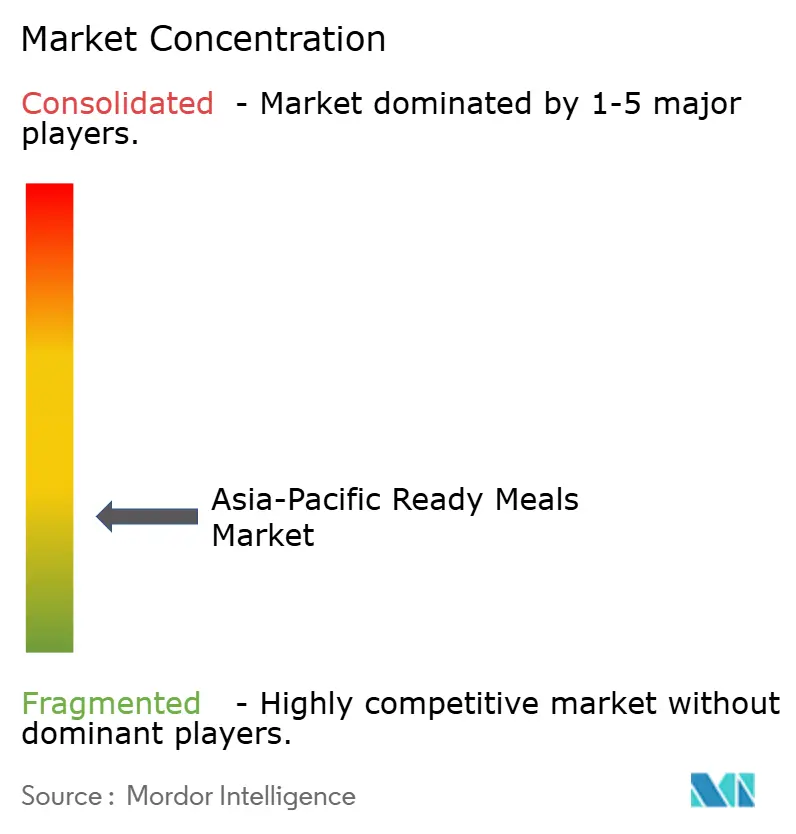
| Market Concentration | Low |
Major Players *Disclaimer: Major Players sorted in no particular order Image © Mordor Intelligence. Reuse requires attribution under CC BY 4.0. | |
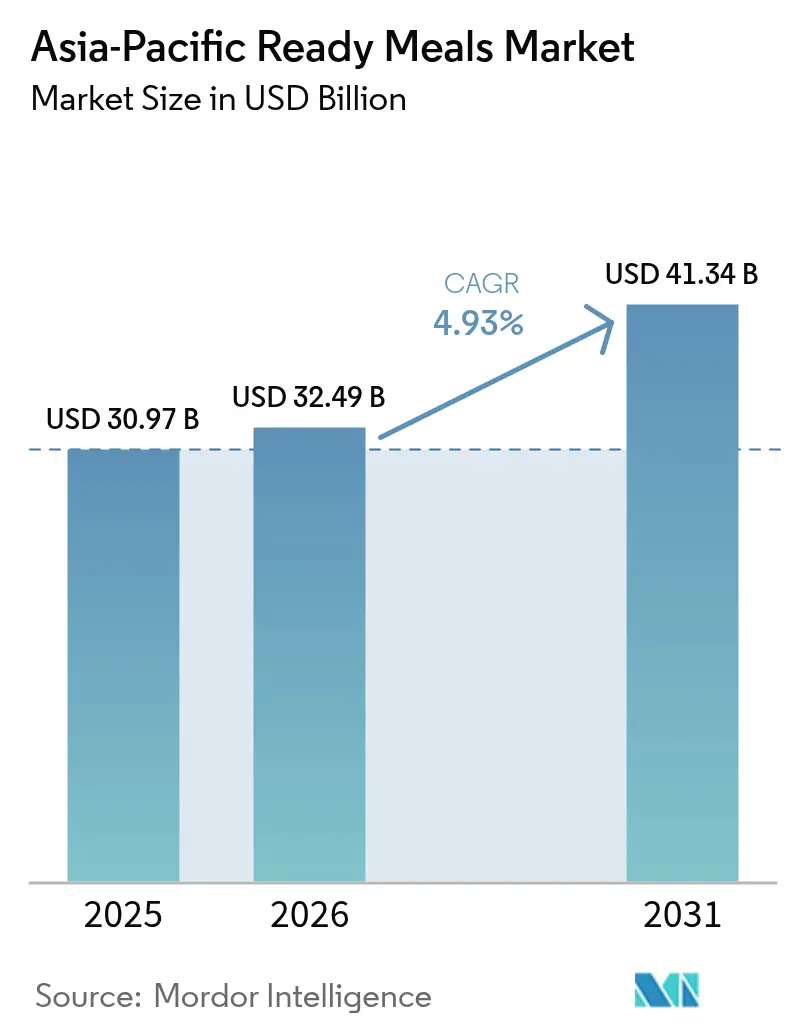
Asia-Pacific Ready Meals Market Analysis by Mordor Intelligence
The Asia-Pacific ready meals market size is expected to grow from USD 30.97 billion in 2025 to USD 32.49 billion in 2026 and is forecast to reach USD 41.34 billion by 2031 at 4.93% CAGR over 2026-2031. This growth is fueled by rapid urbanization, increasing disposable incomes, and smaller household sizes, all leaning towards the allure of convenient, time-saving food options. In nations like China, Japan, and South Korea, tech-driven cold chains not only bolster product safety but also broaden market reach by ensuring efficient storage and transportation of ready meals. Innovations like 'free-from' ingredients, plant-based proteins, and sustainable packaging are attracting a wider audience by catering to health-conscious and environmentally aware consumers. Concurrently, the surge in digital adoption and advancements in last-mile logistics are steering sales towards e-commerce platforms, enabling consumers to access a variety of ready meal options with greater convenience across the Asia-Pacific ready meals landscape.
Key Report Takeaways
- By product type, chilled products led with 44.02% of Asia-Pacific ready meals market share in 2025, while frozen products are forecast to expand at a 5.16% CAGR through 2031.
- By ingredient, conventional formulations held 81.02% share of the Asia-Pacific ready meals market size in 2025; free-from options record the fastest growth at 5.42% CAGR, through 2031.
- By category, non-vegetarian meals captured 63.02% share of the Asia-Pacific ready meals market size in 2025; vegetarian meals are advancing at a 5.73% CAGR to 2031.
- By distribution channel, supermarkets and hypermarkets accounted for 36.86% of the Asia-Pacific ready meals market share in 2025, while online retail is growing at 6.02% CAGR.
- By geography, China dominated with 30.93% of Asia-Pacific ready meals market share in 2025; the Rest of Asia-Pacific is set to log a 6.21% CAGR through 2031.
Note: Market size and forecast figures in this report are generated using Mordor Intelligence’s proprietary estimation framework, updated with the latest available data and insights as of 2026.
Asia-Pacific Ready Meals Market Trends and Insights
Drivers Impact Analysis*
| Driver | (~) % Impact on CAGR Forecast | Geographic Relevance | Impact Timeline |
|---|---|---|---|
| Technological advancements in food preservation | +1.2% | Global, with early adoption in Japan and South Korea | Medium term (2-4 years) |
| Sustainability and eco-friendly packaging | +0.8% | Asia-Pacific core, strongest in Australia and Singapore | Long term (≥ 4 years) |
| Innovation in plant-based and alternative proteins | +0.9% | China, India, and Australia leading adoption | Medium term (2-4 years) |
| Cultural and ethnic diversity | +0.7% | Global, with fusion trends in urban centers | Long term (≥ 4 years) |
| Flavor and culinary trends | +0.6% | Regional variations across all Asia-Pacific markets | Short term (≤ 2 years) |
| Surge in demand for clean-label ready meals | +0.5% | Developed Asia-Pacific markets, expanding to emerging economies | Medium term (2-4 years) |
| Source: Mordor Intelligence | |||
Technological advancements in food preservation
In the Asia-Pacific ready meals market, advanced preservation technologies are not only extending shelf life but also ensuring nutritional integrity and sensory appeal. Governments across the region are actively promoting the adoption of innovative food preservation methods to reduce food waste and enhance food security. For example, the Indian Ministry of Food Processing Industries (MoFPI) has introduced initiatives to modernize food processing infrastructure, including the adoption of advanced preservation methods [1]. Similarly, China's National Development and Reform Commission (NDRC) has emphasized the importance of reducing food waste through technological advancements in food processing and preservation. Moreover, industry associations are playing a crucial role in driving innovation. The Japan Food Industry Association (JFIA) has been actively collaborating with stakeholders to promote research and development in food preservation technologies. These efforts are aimed at addressing the increasing consumer demand for ready meals that offer convenience without compromising on quality or safety.
Sustainability and eco-friendly packaging
The shift towards sustainable packaging is gaining significant momentum across the region, driven by regulatory mandates and the increasing environmental awareness of consumers. Governments in the region are enforcing stricter regulations to reduce plastic waste, while consumers are actively seeking eco-friendly alternatives to align with their values. These efforts have led to the production of carboxymethyl cellulose films, which utilize these agricultural by-products effectively. Additionally, researchers and companies are advancing the development of polylactic acid (PLA) and biogenic vaterite CaCO3-Ag hybrid films. These materials not only exhibit superior antimicrobial properties but also maintain biodegradability, addressing critical concerns related to food safety and environmental sustainability. In markets where sustainability credentials heavily influence purchasing decisions, businesses are capitalizing on this trend. Younger consumers, in particular, are prioritizing eco-friendly options and are willing to pay premium prices for products that align with their environmental values. As a result, the adoption of sustainable packaging solutions is becoming a strategic imperative for companies aiming to thrive in this evolving market landscape.
Innovation in plant-based and alternative proteins
Across the Asia-Pacific, plant-based ready meals are undergoing a wave of innovation. Taiwan's Industrial Technology Research Institute is at the forefront, crafting sophisticated alternatives like plant-based eggs, lobster, and even foie gras, all derived from macroalgae and patented fungal strains. As per the 2023 report by the Good Food Institute, nearly 80% of consumers in Southeast Asia expressed a preference for plant-based meat products, provided these alternatives can be priced 20% lower than their conventional counterparts [2]. Government initiatives are further driving this growth. Australia's government introduced grants and subsidies to promote plant-based food production, aligning with its sustainability goals. These measures aim to reduce the environmental impact of traditional meat production while fostering innovation in the food sector. This wave of innovation isn't just about substituting proteins. It's about refining texture, flavor, and nutritional profiles. Companies like Lypid are pioneering plant-based fats that mimic the mouthfeel and cooking properties of their animal-derived counterparts.
Cultural and ethnic diversity
The Asia-Pacific ready meals market is actively leveraging the region's rich culinary heritage by creating fusion cuisines that combine traditional flavors with modern convenience. Korean companies, such as BokManSa, are driving this trend by internationalizing traditional dishes like frozen Gimbap. This approach highlights significant demographic shifts, as the expansion of Asian diaspora communities and the increasing global appreciation for Asian cuisines open up new market opportunities beyond traditional geographic boundaries. Businesses are also extending this cultural fusion into the development of premium products. They are transforming traditional instant noodles into premium offerings by incorporating high-quality ingredients and sophisticated flavor profiles. Indonesians, as reported by the Australian Export Grains Innovation Center in 2024, consume between 12 and 13 billion individual servings of instant noodles annually. This staggering figure represents nearly 15% of the global consumption, translating to roughly 48 packets per person each year. In contrast, Australians average about 16 packets annually, which breaks down to one packet every 3.5 weeks. South Korea stands out as the world's top per capita consumer, with an impressive 73 packets consumed each year, equating to about 1.5 packets weekly [3]
Restraints Impact Analysis*
| Restraint | (~) % Impact on CAGR Forecast | Geographic Relevance | Impact Timeline |
|---|---|---|---|
| Short shelf life for premium products | -0.4% | Japan, South Korea, and premium segments across Asia-Pacific | Short term (≤ 2 years) |
| Strong competition from fresh and home-cooked alternatives | -0.6% | Rural areas across Asia-Pacific, strongest in India and Indonesia | Medium term (2-4 years) |
| Taste and quality perception | -0.3% | Global, with cultural variations in acceptance | Long term (≥ 4 years) |
| Limited appeal in rural areas | -0.5% | Rural regions across emerging Asia-Pacific economies | Long term (≥ 4 years) |
| Source: Mordor Intelligence | |||
Strong competition from fresh and home-cooked alternatives
Traditional cooking practices and a strong preference for fresh food continue to hinder the adoption of ready meals across the Asia-Pacific region. This challenge is particularly pronounced in rural areas, where residents actively engage in cooking due to their well-developed skills and ample time availability. Urban food consumption studies highlight a growing trend of dining out; however, home cooking still holds significant cultural value. For example, rural households in Indonesia consistently choose traditional markets and rice mills over modern retail options. Consumer perception research shows that the packaging of ready-to-eat meals often diminishes their appeal and perceived healthiness. However, when consumers evaluate these products without the influence of packaging, their sensory quality can mitigate these negative perceptions. In markets where food preparation is deeply rooted in cultural identity and family traditions, competition remains intense. As a result, ready meal manufacturers are positioning their products as supplements to traditional meals rather than as complete replacements, aiming to align with these cultural practices.
Short shelf life for premium products
Premium ready meals, particularly those that prioritize fresh ingredients and minimal processing, face significant challenges due to their short shelf life. These constraints actively restrict their distribution reach, as maintaining product freshness becomes increasingly difficult over extended supply chains. The short shelf life not only limits the geographical areas where these products can be sold but also forces manufacturers and retailers to adopt faster turnover strategies to avoid spoilage. Additionally, the limited shelf life elevates inventory risks for manufacturers and retailers, as unsold products are more likely to result in wastage. This issue underscores the importance of efficient logistics, streamlined supply chains, and robust inventory management strategies to mitigate losses and ensure product quality. Companies must also invest in innovative packaging solutions and preservation techniques to extend shelf life without compromising the premium quality that consumers expect. Addressing these challenges is critical for businesses aiming to expand their market presence while maintaining profitability and customer satisfaction.
*Our forecasts treat driver/restraint impacts as directional, not additive. The impact forecasts reflect baseline growth, mix effects, and variable interactions.
Segment Analysis
By Product Type: Frozen Segment Accelerates Despite Chilled Dominance
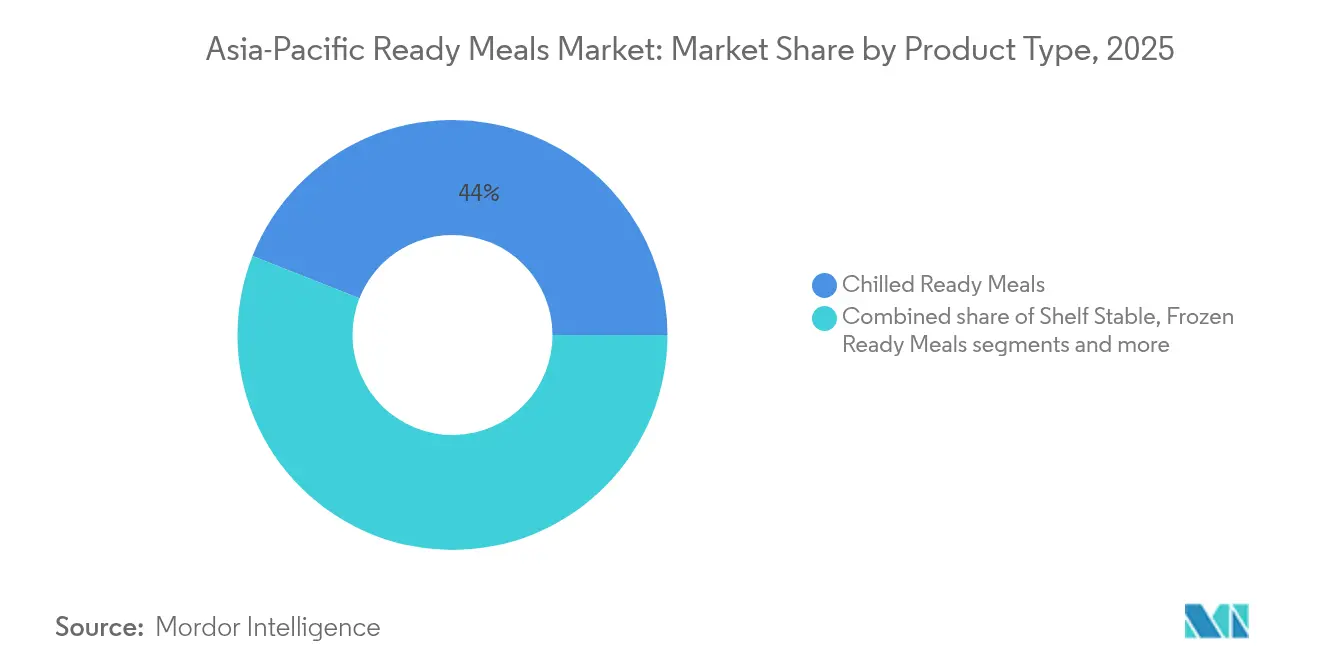
Chilled ready meals maintain market leadership with 44.02% share in 2025, benefiting from consumer perception of freshness and superior taste profiles compared to frozen alternatives. However, frozen ready meals are experiencing robust growth at 5.16% CAGR through 2031, driven by technological innovations in preservation and expanding cold chain infrastructure across emerging markets. Shelf stable products serve niche applications in rural areas and emergency preparedness, while freeze-dried ready meals target premium outdoor and military segments with extended shelf life capabilities.
Advanced freezing technologies are transforming frozen product quality, with Japanese companies implementing 3D freezing systems that preserve texture and flavor integrity previously achievable only in fresh products. The convergence of preservation technology and consumer convenience preferences suggests frozen segments will continue gaining market share, particularly as distribution networks expand into underserved geographic regions where fresh product delivery remains challenging.

By Ingredient: Free-From Acceleration Challenges Conventional Dominance
In 2025, conventional ingredients dominated the market, holding an 81.02% share. This dominance is attributed to well-established supply chains and the cost advantages associated with traditional formulations, which continue to appeal to manufacturers and consumers alike. Meanwhile, "free-from" products are experiencing significant growth, with a robust 5.42% CAGR projected through 2031. This growth is driven by increasing consumer awareness of health and dietary restrictions, as well as a rising preference for products catering to specific needs, such as gluten-free or allergen-free options. The trend is particularly evident in developed markets, where consumers are more inclined to pay a premium for specialized and health-focused ingredients.
Clean-label trends are exerting a transformative influence on both segments. Conversely, synthetic additives are facing growing resistance due to concerns over their potential health impacts. The ingredient landscape is further evolving due to regulatory developments, including China's proposed labeling standards. These standards aim to enforce clearer ingredient disclosures, which could accelerate the industry's shift toward more recognizable and natural components. Such regulatory changes are expected to impact all product categories, pushing manufacturers to reformulate their offerings to align with consumer demand for transparency and natural ingredients.
By Distribution Channel: Supermarkets/Hypermarkets Dominate, While Online Retail Stoes Surge
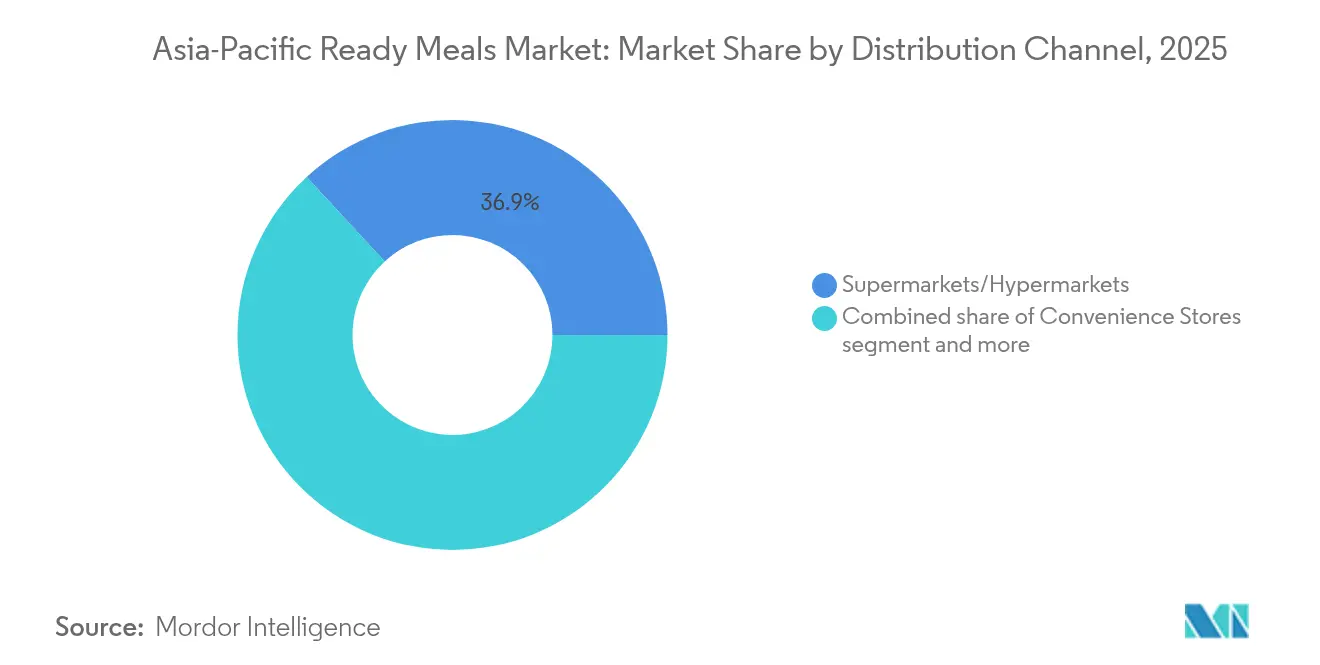
In 2025, supermarkets and hypermarkets accounted for 36.86% of the market. This significant contribution was driven by strategic eye-level merchandising, which enhances product visibility and attracts consumer attention. These retail formats also capitalize on impulse purchases, as customers are more likely to add ready meals to their carts when they are prominently displayed. Additionally, supermarkets and hypermarkets offer a wide variety of ready meal options, catering to diverse consumer preferences and dietary needs. Their ability to provide fresh, frozen, and shelf-stable ready meals under one roof makes them a preferred choice for many consumers.
Online retail stores are emerging as a rapidly growing distribution channel in the market. These platforms are projected to experience a 6.02% CAGR through 2031, driven by the increasing penetration of e-commerce and the rising preference for online shopping. Consumers are drawn to the convenience of browsing and purchasing ready meals from the comfort of their homes, with the added benefit of doorstep delivery. Online platforms also offer a broader range of products compared to physical stores, including niche and specialty ready meals that may not be readily available elsewhere. The integration of advanced technologies, such as AI-driven recommendations and personalized shopping experiences, further enhances customer satisfaction.
By Category: Vegetarian Surge Reflects Dietary Evolution
In 2025, non-vegetarian ready meals command a dominant 63.02% market share in the Asia-Pacific ready meals market, buoyed by longstanding preferences for traditional proteins and well-established supply chains for both meat and seafood. The region's cultural inclination toward meat and seafood consumption, coupled with the availability of diverse non-vegetarian ready meal options, has solidified this segment's leadership. Countries like China, Japan, and South Korea are key contributors to this dominance, driven by their rich culinary traditions and high demand for convenience foods. Meanwhile, vegetarian options are on a rapid ascent, boasting a 5.73% CAGR projected through 2031. This surge underscores a shift in dietary choices and a growing environmental awareness, especially among the younger demographic. Urban centers across the region, such as Tokyo, Shanghai, and Taipei, are at the forefront of this movement, witnessing a pronounced acceptance of plant-based alternatives. The increasing influence of Western dietary trends and the rising popularity of flexitarian diets are further fueling the growth of vegetarian ready meals in the Asia-Pacific market.
Driving the expansion of this category is a wave of innovation in plant-based proteins. Notably, research institutes in Taiwan are pioneering advanced alternatives, crafting plant-based seafood and meat analogs from macroalgae and fungal strains. These innovations are not only catering to the growing vegetarian and vegan population but are also appealing to health-conscious consumers seeking sustainable and nutritious meal options. The Asia-Pacific region's robust R&D capabilities, combined with government support for sustainable food production, are expected to accelerate the development and adoption of plant-based ready meals. Additionally, collaborations between food manufacturers and research institutions are playing a pivotal role in enhancing the taste, texture, and nutritional profile of plant-based products, further driving their acceptance among consumers.
Geography Analysis
In 2025, China commands a 30.93% share of the Asia-Pacific ready meals market, capitalizing on its vast urban populace, a well-established cold chain infrastructure, and advanced food processing capabilities. This market thrives on robust domestic demand, fueled by the fast-paced lifestyles of urban dwellers and a rise in disposable income among the middle class. Additionally, China's strong distribution networks and government support for the food processing industry further bolster its dominance in the region. The presence of leading domestic and international players in the country also contributes to the market's growth, as they continue to innovate and expand their product portfolios to cater to evolving consumer preferences.
Meanwhile, the broader Asia-Pacific region showcases the most significant growth potential, projected at a 6.21% CAGR through 2031. This surge is largely attributed to emerging markets such as India, Indonesia, and Vietnam, where ready meal penetration remains low but adoption rates are witnessing a swift uptick. These countries are experiencing rapid urbanization, rising disposable incomes, and a growing preference for convenient food options, which are driving the demand for ready meals. Furthermore, improvements in cold chain logistics and increasing investments by key players in these markets are expected to accelerate growth during the forecast period.
For instance, India is witnessing a surge in demand for frozen and shelf-stable ready meals due to the expanding working population and the influence of Western food habits. Similarly, Indonesia and Vietnam are benefiting from the rising number of supermarkets and hypermarkets, which are improving the accessibility of ready meals to a broader consumer base. The region's growth is also supported by the increasing penetration of e-commerce platforms, enabling consumers to purchase ready meals conveniently. These factors collectively position the Asia-Pacific region as a lucrative market for ready meal manufacturers and suppliers.
Regulatory Landscape
Regulation across Asia-Pacific is tightening around ready-to-eat and prepared foods, with a shift from broad hygiene rules to product-specific standards and auditable assurance systems. In February 2026, China notified a draft National Food Safety Standard for Prepared Dishes through SAMR and the NHC. The draft defines the category and sets technical requirements, including a maximum shelf life of 12 months, and a prohibition on food preservatives for prepared dishes, which raises the bar for formulation, labeling, and cold-chain discipline for compliant ready-meal portfolios.
In Southeast Asia, compliance obligations are becoming more prescriptive at the operator level. Singapore introduced the Singapore Food Agency (SFA) SAFE framework on January 19, 2026, replacing the prior A-D hygiene grading approach and strengthening inspection and hygiene assurance expectations across food establishments handling ready meals. Vietnam issued Decree No. 46/2026/ND-CP in January 2026 to implement measures under the Law on Food Safety, reinforcing declarations of conformity requirements for pre-packaged processed foods and additives. This increases the documentation and technical file demands for cross-border and domestic ready-meal launches.
Competitive Landscape
In the Asia-Pacific ready meals market, a concentration score of 3 out of 10 highlights a fragmented competitive landscape. This fragmentation, driven by diverse cultural preferences and regulatory nuances, leans towards regional specialization rather than a one-size-fits-all global approach. The market's diversity creates significant opportunities for both established multinational corporations and emerging local players to differentiate themselves. By focusing on tailored product development and region-specific distribution strategies, companies can effectively address the unique demands of various consumer segments across the region. Additionally, the fragmented nature of the market allows smaller players to thrive by catering to niche markets, while larger corporations can leverage their resources to scale operations and expand their footprint in high-growth areas.
Strategic partnerships and joint ventures are playing a pivotal role in reshaping the competitive dynamics of the market. Notable examples include CP Foods collaborating with Maejo University to conduct hemp research aimed at developing healthier ready meals, catering to the growing consumer demand for nutritious and innovative food options. This partnership underscores the increasing importance of research and development in creating differentiated products that align with evolving consumer preferences. Additionally, the CP Foods-Uoriki joint venture is targeting Thailand's premium seafood market, leveraging their combined expertise to meet the rising demand for high-quality seafood products. Such collaborations not only enhance product offerings but also enable companies to strengthen their market position by tapping into specialized segments.
Furthermore, the competitive landscape is becoming increasingly complex due to the growing influence of e-commerce platforms and direct-to-consumer brands. These channels often bypass traditional retail networks, enabling brands to directly engage with consumers and build stronger relationships. This shift is intensifying competitive pressures on established distribution networks, compelling incumbent players to invest in and develop robust omnichannel strategies to maintain their market relevance and effectively compete in this evolving environment. Companies are increasingly focusing on integrating online and offline channels to provide a seamless shopping experience, ensuring they remain competitive in a market that is rapidly adapting to digital transformation.
Asia-Pacific Ready Meals Industry Leaders
-
McCain Foods Ltd
-
Nestlé SA
-
The Campbell's Company
-
Ajinomoto Co., Inc.
-
Conagra Brands Inc.
- *Disclaimer: Major Players sorted in no particular order
Market Opportunities and Future Outlook
Capacity build-outs and vertical integration are creating room for scaled, locally produced ready meals that can better meet shelf-life, temperature control, and cost targets across urban Asia-Pacific. In April 2026, Acecook Vietnam completed a USD 200 million factory in Vinh Long with 17 production lines and initial capacity of 1.2 billion product packets annually, showing how major manufacturers are adding regional throughput and modern lines that can support a wider portfolio of convenient prepared foods, with improved supply availability for modern retail and e-commerce.
Convenience-led manufacturing expansion and protein-centric processing hubs are also broadening the assortment for chilled and frozen meal components for both domestic consumption and export within the region. In South Korea, GS Retail (Fresh Serve) expanded ready-meal output at its Osan plant in May 2026, including doubling triangle kimbap production to 37 million units. BGF Foods (BGF Retail) also invested KRW 16.2 billion to expand its Jincheon facility, lifting total capacity by 60%. In June 2026, Dongwon F&B opened the Jincheon Second Plant with 40 tons per day capacity focused on fish cakes, imitation crab meat, and ready meals, supporting manufacturers and private labels that need consistent supply of processed proteins and ready-meal inputs aligned with cold-chain retail formats.
Recent Industry Developments
- July 2026: Nestle (Thai) Co., Ltd. received Thailand Board of Investment (BOI) approval for a major investment to build a new smart coffee factory and logistics center in Samut Prakan. The project strengthens local manufacturing and distribution infrastructure that supports broader packaged food and beverage availability across Southeast Asia through a more integrated regional supply footprint.
- September 2025: ITOCHU Corporation commenced import and domestic marketing of Campbell Japan Inc. soup products in Japan after securing the relevant rights. The move broadened branded soup availability through established Japanese retail channels, supporting ready-to-heat meal occasions and adding competitive pressure in packaged meal solutions.
- November 2024: Nissin Foods, together with Nissin Asia, established Australia Nissin Foods Pty., Ltd. to import and sell products across Australia and New Zealand. Creating a local joint-venture platform improved route-to-market control for packaged convenience foods, reinforcing competitive intensity for ready-to-prepare and ready-to-eat categories in Oceania.
Research Methodology Framework and Report Scope
Market Definition and Coverage
For this study, the Asia-Pacific ready meals market means packaged meals that are already cooked or fully assembled, and are meant to be eaten after simple heating, with chilled, frozen, and shelf-stable formats included across Asia-Pacific.
Scope exclusions: We exclude meal kits that require cooking steps and meals prepared and consumed within food-service settings such as cafeterias and restaurants.
Segmentation Overview
- By Product Type
- Frozen Ready Meals
- Chilled Ready Meals
- Shelf Stable
- Freeze-Dried Ready Meals
- By Ingredient
- Conventional
- Free-From
- By Category
- Vegetarian
- Non-vegetarian
- By Distribution Channel
- Supermarkets/Hypermarkets
- Convenience Stores
- Online Retail Stores
- Other Distribution Channels
- By Geography
- China
- India
- Japan
- Australia
- Indonesia
- South Korea
- Thailand
- Singapore
- Rest of Asia-Pacific
Data Sources, Market Sizing, and Validation
Desk Research
Desk research was used to set the demand context and to keep assumptions realistic across countries that have very different eating habits and cold chain penetration. We referred to public sources such as national statistics offices and food expenditure series, customs and tariff databases for processed food trade, and agriculture or food safety agencies that publish packaged food guidance.
We also used sources such as FAO food balance sheets, UN Comtrade, WTO tariff and trade notes, and relevant industry associations that track packaged food and retail developments in the region. Alongside this, company annual reports, investor presentations, and reputable press helped validate channel mix changes (especially e-commerce and convenience retail). A paid subscription for company financials and a shipment-level trade database were selectively used to cross-check revenue scale and import dependency in specific markets. These sources are not exhaustive, and many other references were used to collect, validate, and clarify data points during the study.
Primary Interviews and Surveys
Primary work focused on converting the desk findings into usable sizing inputs, then pressure-testing them with people who see pricing and volumes in real time. We spoke with packaged food manufacturers, distributors, retail channel managers, and category specialists across key Asia-Pacific markets so assumptions on format mix, average selling prices, and route-to-market shares could be confirmed and adjusted.
Distribution of primary research fieldwork respondents
| Company type | Respondent position |
|---|---|
| Top tier: 39% | CXOs: 14% |
| Mid tier: 40% | Functional/Unit leaders: 34% |
| Smaller Players: 21% | Managers: 52% |
Market-Sizing & Forecasting
The market was built using a top-down approach where packaged food spending and ready meal penetration were reconstructed by country and then aggregated to the region, and then checked with bottom-up approximations to keep totals reasonable. Those checks relied on sampled price points by format and channel, visible product mix shifts in chilled versus frozen versus shelf-stable, and supplier and retailer sense-checks on unit velocities.
Inputs that were used (illustrative) include urbanization and working-population share, household size trends, cold chain and freezer availability signals, retail channel expansion (modern trade, convenience stores, and online), and average selling price movement by pack size and format. When a country had limited public detail, we filled gaps using proxy indicators from similar markets and then corrected the output based on interview feedback. Forecasting leaned on scenario analysis tied to macro conditions and channel expansion, and assumptions were aligned to what primary respondents viewed as realistic for price inflation, format adoption, and distribution reach.
Data Validation & Update Cycle
Model outputs were cross-checked against independent signals, such as packaged food category growth, import and export direction for prepared foods, and observable shelf pricing movements in key markets. Outliers were reviewed at country level, then the drivers were re-tested, and we re-contacted sources when variances could not be explained through clear market events.
Before sign-off, the work goes through more than one analyst review so calculations, currency handling, and assumptions are consistent across countries. Reports are refreshed annually, and interim updates are made when material events occur, such as sharp input cost moves or meaningful regulatory changes. Before delivery, a fresh pass is completed so clients receive the latest updated view.
Mordor Intelligence's Asia Pacific Ready Meals Market Sizing Compared With Other Published Estimates
Published market sizes for ready meals in Asia-Pacific can differ because the category is easy to stretch, and because pricing and channel assumptions vary by country and by refresh timing. Differences also show up when studies mix retail-only sales with food-service spending, or when they roll ready meals into wider convenience foods.
Some published figures appear to include adjacent convenience categories and longer forecast horizons, which can lift the starting value through broader counting and faster assumed adoption. In Mordor Intelligence, the value is limited to packaged ready meals that are pre-cooked and consumed after simple heating, and meal kits that require cooking steps are kept out, which tightens the demand pool and aligns it to retail and direct-to-consumer sales signals.
Benchmark comparison
| Source | Market Size | Gaps in Research Methodology |
|---|---|---|
| Mordor Intelligence | USD 30.97 B (2025) | |
| Regional Consultancy A | USD 40.95 B (2025) | Uses a wider convenience food style scope for ready meals and applies a longer-horizon growth curve that can pull more adjacent meal formats into the counted revenue base. |
| Trade Journal B | USD 32.49 B (2026) | Reports the next-year value without clearly separating chilled, frozen, and shelf-stable pricing changes by country, which can shift totals depending on currency timing and inflation handling. |
The spread in published values is mainly explained by what gets counted as a ready meal, and how prices and timing are treated across very different Asia-Pacific markets. By keeping inclusions tied to heat-and-eat packaged meals and then validating the totals with channel and pricing checks, the estimate stays traceable to clear drivers and repeatable steps.
Key Questions Answered in the Report
How large is the Asia-Pacific ready meals market in 2026?
It is valued at USD 32.49 billion, with a forecast to reach USD 41.34 billion by 2031.
Which product type is growing fastest?
Frozen ready meals register the highest growth at a 5.16% CAGR thanks to 3D-freezing and wider cold-chain reach.
Why is online retail important for ready meals?
E-commerce offers same-day delivery and broad assortment, driving a 6.02% CAGR for online sales channels through 2031.
Which country leads the regional market?
China holds the top position with 30.93% market share, supported by large urban populations and robust cold-chain logistics.
How fragmented is the competitive landscape?
The market is highly fragmented with a concentration score of 3, meaning significant room exists for both multinationals and agile local entrants.