
Market Overview
| Study Period | 2020 - 2031 |
|---|---|
| Forecast Data Period | 2026 - 2031 |
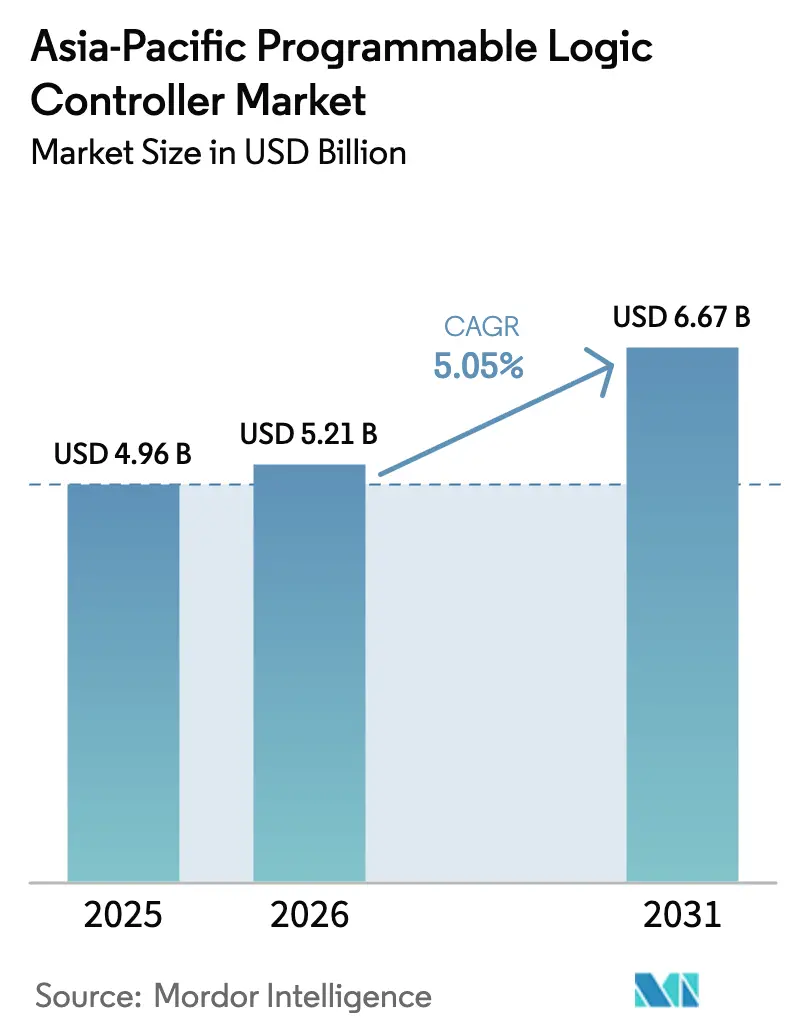
| Base Year Market Size (2025) | USD 4.96 Billion |
| Market Size (2026) | USD 5.21 Billion |
| Market Size (2031) | USD 6.67 Billion |
| Growth Rate (2026 - 2031) | 5.05 % |
| Market Concentration | Medium |
Major Players *Disclaimer: Major Players sorted in no particular order Image © Mordor Intelligence. Reuse requires attribution under CC BY 4.0. | |
Asia-Pacific Programmable Logic Controller Market Analysis by Mordor Intelligence
The Asia-Pacific programmable logic controller market size is expected to grow from USD 4.96 billion in 2025 to USD 5.21 billion in 2026 and is forecast to reach USD 6.67 billion by 2031 at 5.05% CAGR over 2026-2031. Industrial digitalization programs, sovereign manufacturing policies, and the shift to cyber-physical production lines fuel this momentum. China’s 43.31% share anchors regional demand, while India’s 7.5% CAGR underscores an emerging diversification of production capacity. Hardware and software components account for 75.7% of the revenue in 2024, while the services segment’s 6.2% CAGR signals a transition toward value-added integration and lifecycle support. Modular controllers remain the preferred form factor, but soft PLC platforms are gaining ground as virtualization and edge computing mature. The automotive sector leads with 28.6% share, whereas water and wastewater treatment registers the fastest adoption, supported by smart-city infrastructure outlays. Semiconductor supply constraints, 5G-enabled time-sensitive networking, and escalating cybersecurity requirements continue to reshape price structures, performance benchmarks, and total cost of ownership calculations.[1]
Key Report Takeaways
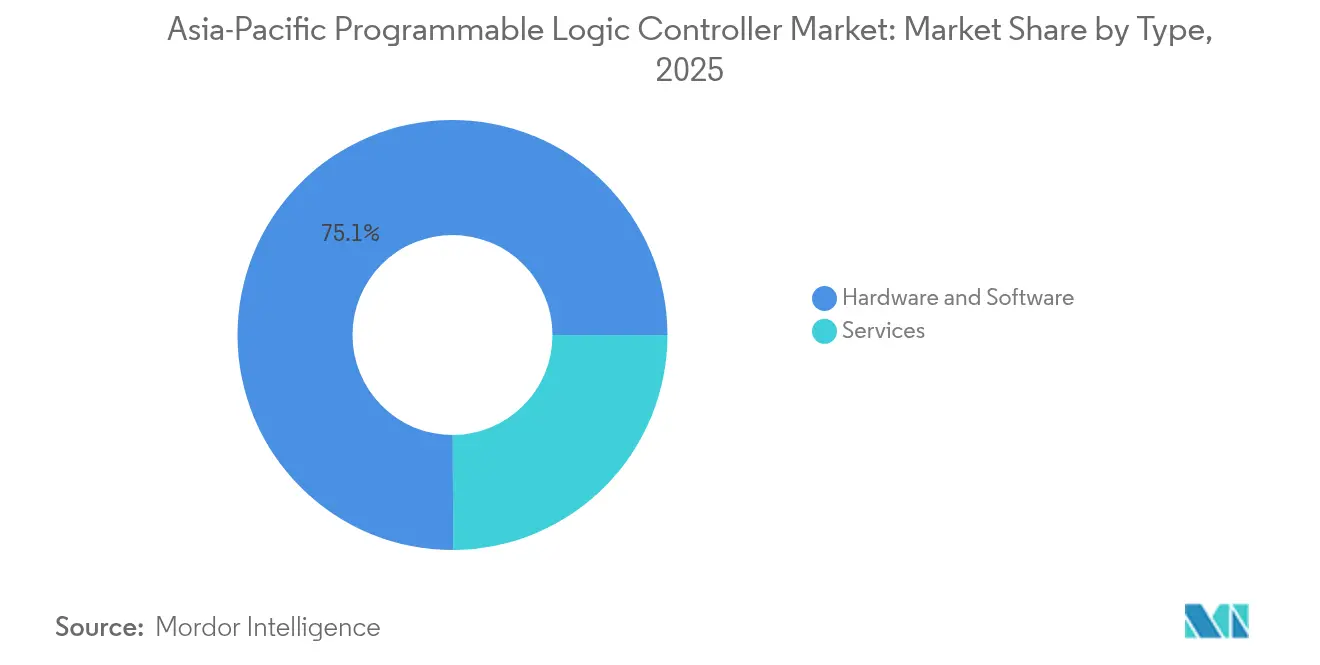
- By type, hardware and software accounted for 75.05% of the Asia-Pacific programmable logic controller market share in 2025, while services are projected to expand at a 6.05% CAGR through 2031.
- By architecture, modular PLCs led the Asia-Pacific programmable logic controller market with a 55.10% revenue share in 2025; soft PLC platforms are projected to post a 6.68% CAGR through 2031.
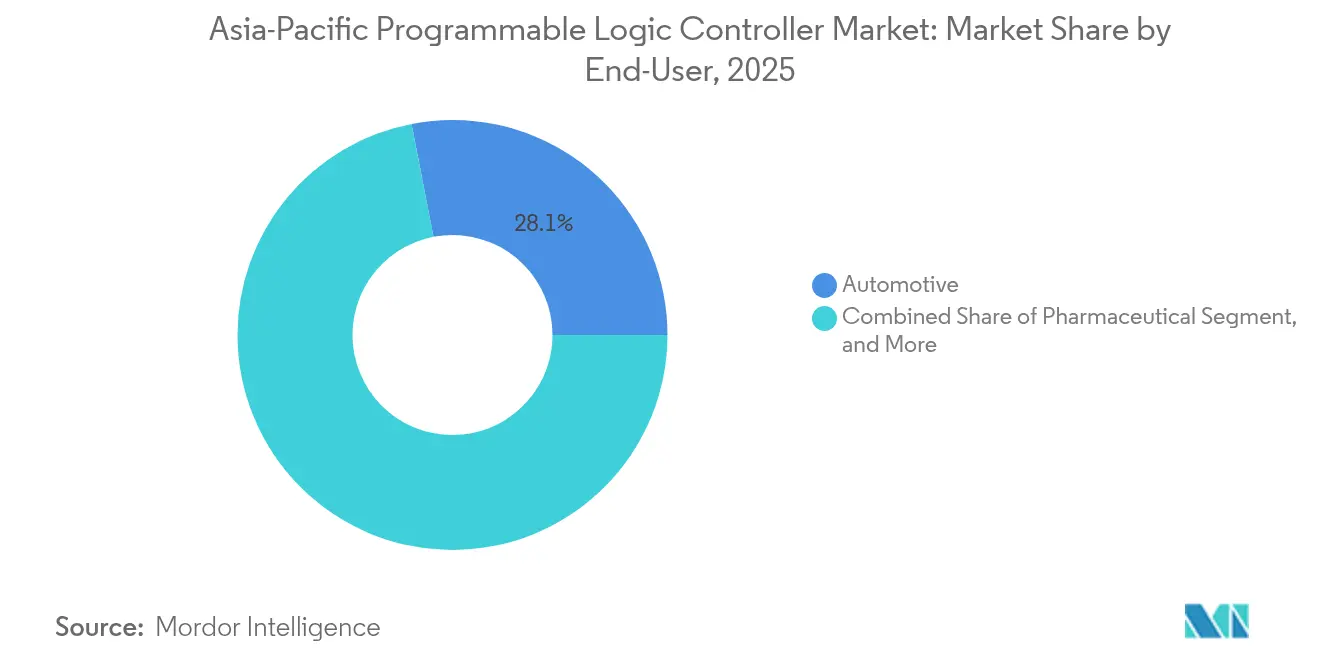
- By end-user, the automotive sector held 28.05% of the Asia-Pacific programmable logic controller market size in 2025, whereas the water and wastewater treatment sector is projected to track an 7.75% CAGR to 2031.
- By input/output type, digital I/O commanded 65.12% share of the Asia-Pacific programmable logic controller market in 2025, while mixed I/O configurations are advancing at a 6.63% CAGR through 2031.
- By geography, China dominated the Asia-Pacific programmable logic controller market with a 42.95% share in 2025, and India is forecast to deliver the fastest growth of 7.18% CAGR between 2026 and 2031.
Note: Market size and forecast figures in this report are generated using Mordor Intelligence’s proprietary estimation framework, updated with the latest available data and insights as of 2026.
Market Trends and Insights
Drivers Impact Analysis of Asia-Pacific Programmable Logic Controller Market*
| Driver | (~) % Impact on CAGR Forecast | Geographic Relevance | Impact Timeline |
|---|---|---|---|
| Surge in automotive e-mobility production lines | +1.2% | China, Japan, South Korea, with expansion to India and Southeast Asia | Medium term (2-4 years) |
| Government-led smart-manufacturing subsidies | +0.9% | China, Japan, South Korea, India, with selective programs in Southeast Asia | Long term (≥4 years) |
| Rapid expansion of low-cost modular PLCs | +0.7% | Global, with strongest impact in India, Southeast Asia, and China's tier-2 cities | Short term (≤2 years) |
| Migration to Industry 4.0 cyber-secure PLC platforms | +0.8% | Japan, South Korea, Singapore, with gradual adoption across Asia Pacific | Medium term (2-4 years) |
| Demand for energy-efficient utility automation | +0.6% | China, India, Southeast Asia, driven by renewable energy integration | Long term (≥4 years) |
| Emerging 5G-enabled time-sensitive networking (TSN) | +0.5% | South Korea, Japan, China, with pilot deployments in Singapore and Australia | Long term (≥4 years) |
| Source: Mordor Intelligence | |||
Surge in Automotive E-mobility Production Lines
Electric-vehicle assembly requires precise temperature management of the battery pack, coordination of multi-axis motor windings, and certified functional safety controls. China’s OEMs have established reference automation templates that neighboring markets are now replicating, compelling PLC vendors to incorporate higher-speed processing and expanded communication stacks. ISO 26262 mandates further raising technical entry barriers as e-mobility expands beyond China. Localized line-builders in India and Southeast Asia source modular PLCs to shorten deployment times. Vendor differentiation is therefore shifting from hardware density to integrated motion libraries and EV-specific diagnostics. Continuous product updates, aligning with evolving battery chemistries, sustain long-term demand for controllers.
Government-led Smart Manufacturing Subsidies
Strategic programs such as China’s “Made in China 2025,” Japan’s Society 5.0, and South Korea’s K-Digital New Deal inject funding that accelerates automation procurement.[2] Subsidy-linked deadlines compress project timelines, benefiting suppliers with turnkey service capabilities. Tax credits and low-interest loans lower payback thresholds, drawing small and medium manufacturers into the Asia-Pacific programmable logic controller market. However, pull-forward demand risks post-incentive slowdowns. India’s Production Linked Incentive scheme fosters domestic assembly, potentially altering import patterns. Clustering of subsidized plants also enhances ecosystem knowledge transfer, reinforcing regional growth momentum.
Rapid Expansion of Low-cost Modular PLCs
Cost-competitive Chinese brands now meet baseline performance and IEC 61131-3 compliance, forcing incumbents to emphasize software value and life-cycle services.[3] Modular designs enable phased investment, aligning with cash flow constraints in emerging markets. Local component sourcing in India and Vietnam helps mitigate supply risks and reduce landed costs. International vendors counter by bundling analytics, cloud gateways, and extended warranties. Commodity pricing on entry-level modules compresses margins, accelerating a pivot toward subscription-based service revenues. The trend is particularly beneficial for the Asia-Pacific programmable logic controller market, where SME automation remains under-penetrated.
Migration to Industry 4.0 Cyber-secure PLC Platforms
As OT and IT networks converge, threats migrate from enterprise domains into plant-floor controllers. IEC 62443 certification and secure-by-design architectures become mandatory procurement criteria in government and utility projects. Vendors integrate encrypted protocols, secure boot processes, and hardware root of trust, adding performance overhead that drives processor upgrades. Edge computing deployments localize data processing, limiting exposure and latency while enabling predictive analytics capabilities. Insurance carriers are increasingly discounting policies only for plants that deploy certified platforms, thereby reinforcing adoption. The Asia-Pacific programmable logic controller market, therefore, shifts toward platforms combining real-time control with embedded security functions.
Restraints Impact Analysis of Asia-Pacific Programmable Logic Controller Market*
| Restraint | (~) % Impact on CAGR Forecast | Geographic Relevance | Impact Timeline |
|---|---|---|---|
| High upfront integration and training costs | -0.8% | Global, with acute impact in India, Southeast Asia, and China's SME sector | Short term (≤2 years) |
| Prolonged semiconductor supply constraints | -1.1% | Global, with severe impact in Japan, South Korea, and China's electronics hubs | Medium term (2-4 years) |
| Availability of low-code soft-PLC substitutes | -0.4% | Japan, South Korea, Singapore, with gradual expansion to other markets | Long term (≥4 years) |
| Rising cyber-security compliance expenditures | -0.6% | China, Japan, South Korea, with increasing relevance in India and Southeast Asia | Medium term (2-4 years) |
| Source: Mordor Intelligence | |||
High Upfront Integration and Training Costs
Total project outlays can triple the hardware price due to system design, wiring, commissioning, and operator upskilling. SMEs in India and Southeast Asia struggle to secure financing, which delays automation despite its attractive paybacks. Shortages of qualified integrators inflate labor costs and extend timelines. Legacy equipment interfacing often requires custom gateways, which raises implementation risk. Manufacturers wary of prolonged shutdowns opt for partial or no automation, tempering near-term demand for programmable logic controllers in the Asia-Pacific market. Vendors respond with pre-engineered templates and remote training modules to compress learning curves.
Prolonged Semiconductor Supply Constraints
Industrial-grade processors remain in tight supply, extending PLC lead times beyond six months in some product lines. Automotive-safety controllers are especially affected because they require higher temperature ratings and longer lifecycle guarantees. Redesigns around available chips often result in certification delays and cost overruns. Inventory buffering ties up working capital, particularly for distributors serving fragmented customer bases. Although capacity additions are planned, shortages are likely to persist into the medium term, exerting a negative drag on the Asia-Pacific programmable logic controller market.
*Our forecasts treat driver/restraint impacts as directional, not additive. The impact forecasts reflect baseline growth, mix effects, and variable interactions.
Asia-Pacific Programmable Logic Controller Market Segment Analysis
By Type:
Services Segment Drives Value-added GrowthServices generated the highest incremental revenue, expanding at a 6.05% CAGR, as manufacturers prioritize integration expertise, predictive maintenance, and lifecycle optimization over standalone hardware. Hardware and software components continued to dominate the Asia-Pacific programmable logic controller market share, accounting for 75.05% in 2025, reflecting ongoing capacity expansions in China and India. Services revenue benefits from multi-year contracts, delivering steadier cash flows than cyclical hardware sales. Remote monitoring and cloud-based analytics underpin this shift, reducing unplanned downtime and justifying premium service fees.
System integrators leverage domain know-how to bridge legacy equipment with modern controllers, compressing deployment timelines. Over-the-air firmware updates and flexible licensing enhance scalability, mitigating capital-expenditure hurdles. Large installations in petrochemical plants still rely on high-end hardware, but nano- and microcontrollers with SaaS packages are gaining traction in dispersed IoT nodes. Consequently, vendors reorient portfolios toward outcome-based models, expanding the Asia-Pacific programmable logic controller market’s recurring-revenue proportion.

By Architecture:
Soft PLC Platforms Challenge Traditional BoundariesModular PLCs retained 55.10% revenue leadership in 2025, favored for their expandability in complex lines. Nonetheless, soft PLC platforms posted a 6.68% CAGR, eroding incumbents’ share as virtualization delivers deterministic performance on industrial PCs. Early adopters in automotive battery lines deploy containerized control applications to enable rapid recipe changes and centralized version management. Rack-mount configurations address dense I/O needs in process industries, whereas compact units cater to skid-mounted equipment and OEM machinery.
Edge gateways integrate programmable logic, data aggregation, and AI inference on a single board, thereby blurring the boundaries between different functions. Vendors differentiate through real-time hypervisors, secure boot sequences, and compatibility with IT orchestration tools. As a result, buyers evaluate total system architecture rather than discrete controller models, reshaping procurement criteria within the Asia-Pacific programmable logic controller market. Continued maturation of the soft platform will likely compress hardware refresh cycles, encouraging subscription-based upgrades.
By End-User:
Water Treatment Automation Accelerates Infrastructure ModernizationThe Asia-Pacific programmable logic controller (PLC) market size for water and wastewater applications is projected to grow at an 7.75% CAGR through 2031, driven by urbanization, environmental mandates, and smart-city funding. Municipal utilities deploy PLC-linked SCADA systems to optimize chemical dosing and pump scheduling, thereby reducing energy use and leakage. In China, stimulus packages allocate funds to upgrade legacy plants, while India channels smart-city grants into sewage-treatment automation. The automotive sector, which held a 28.05% share in 2025, continues adding lines for electric powertrains, sustaining baseline demand for safety-certified controllers.
Chemical, petrochemical, and energy utilities maintain steady replacement cycles to ensure safety and reliability standards are upheld. Meanwhile, food and beverage firms automate to ensure traceability, and pharmaceutical players invest in validated PLCs that meet electronic-record regulations. Mining, pulp and paper, and electronics plants contribute diversified needs, ensuring balanced end-market exposure for suppliers. This broad uptake underpins the resilience of the Asia-Pacific programmable logic controller market across economic cycles.
By Input/Output Type:
Mixed I/O Configurations Enable Flexible ManufacturingDigital I/O represented 65.12% of 2025 revenue, serving binary control in discrete manufacturing. Nevertheless, mixed configurations are projected to capture a rising share, advancing at a 6.63% CAGR as factories seek plug-and-play flexibility. Mixed modules combine digital, analog, and specialty channels on a single slice, reducing panel real estate and wiring labor. IO-Link-enabled smart sensors feed diagnostic data directly to controllers, supporting predictive maintenance initiatives.
Ethernet-based I/O backbones replace legacy fieldbus, offering higher bandwidth and standardized cabling that IT departments can service. Wireless I/O, recently launched by leading vendors, further expands deployment options for mobile equipment and retrofit scenarios. Enhanced diagnostics shrink mean-time-to-repair, offsetting higher module costs. Consequently, the Asia-Pacific programmable logic controller market increasingly values intelligent I/O ecosystems as much as central processing prowess.
Geography Analysis
China Programmable Logic Controller Market
China’s 42.95% share reflects its broad manufacturing base, encompassing everything from smartphones to shipbuilding. Continued smart-factory subsidies and 5G campus networks spur accelerated controller upgrades, with local vendors closing feature gaps against global incumbents. Environmental regulations drive rapid water-treatment automation, while electric-vehicle giants embed advanced PLCs in gigafactories.
India Programmable Logic Controller Market
India delivers the fastest 7.18% CAGR, driven by Production-Linked Incentive-backed capacity additions across the automotive, electronics, and renewable energy supply chains. Domestic assembly of basic PLCs is emerging, but high-end models continue to be imported, resulting in hybrid supply patterns. Infrastructure programs, including smart cities and dedicated freight corridors, stimulate demand for utility and transport automation systems.
APAC Programmable Logic Controller Market
Japan and South Korea exhibit steady replacement demand anchored in productivity gains and workforce augmentation amid aging demographics. Both nations pioneer 5G TSN pilots and AI-embedded controllers. Southeast Asia benefits from manufacturing relocation, with Vietnam and Thailand hosting electronics and automotive clusters that require scalable PLC architectures. Australia and New Zealand focus on mining and food-processing automation, which rounds out regional variety and broadens the Asia-Pacific programmable logic controller market opportunity set.
Regulatory Landscape
Across Asia-Pacific, PLC compliance is tightening around electrical safety, EMC, cybersecurity, and trade documentation, which increases the certification burden for both modular hardware and network-connected soft-PLC deployments. In India, the Bureau of Indian Standards (BIS) mandate for PLCs and HMIs tied to IS 13252:2025 (aligned with IEC 61131-2:2023) takes effect on 1 October 2026, raising scrutiny on updated test reports and product documentation for new shipments and tenders.
China and Japan are also reinforcing requirements that affect procurement specifications and refresh cycles. China issued GB/T 45406-2025 with security functional and assurance requirements for PLCs treated as critical network devices, and GB/T 47234-2026 (intelligent measurement and control equipment, including PLCs) is scheduled for implementation on 1 September 2026. In Japan, through METI-linked import technical revisions, mandatory electromagnetic immunity requirements for network-connected PLCs under JIS X 61000-4-30:2026 take effect on 10 May 2026, increasing compliance validation for connected controllers used in modernized production lines.
Value Chain Analysis
The PLC value chain in Asia-Pacific begins with semiconductor and industrial component supply (processors, memory, power electronics, I/O modules, connectors), then moves through controller OEM design, firmware and software development (IEC 61131-3 tools, communications stacks), and certification, before final assembly and system configuration. Distribution runs through regional channel partners and authorized automation distributors, while a growing share of value is captured downstream by system integrators and engineering partners that provide commissioning, OT cybersecurity hardening, interoperability testing, and lifecycle services for automotive, utilities, and process industries.
Recent partnerships show where margin and differentiation accumulate. Omron and Cognizant aligned IT/OT integration capabilities for manufacturing customers (April 2025), Yokogawa Engineering Asia partnered with XMPro to offer composable digital twin solutions across Southeast Asia, Oceania, and Taiwan (January 2025), and ABB B&R expanded local service reach by appointing DAANET as its first Authorized Value Provider in Australia (August 2025). EPC alignment is another scaling pathway, illustrated by Yokogawa China signing a memorandum of cooperation with Sinopec Engineering (Group) for international project collaboration (October 2025), which strengthens pull-through for control platforms, PLC-adjacent systems, and services in large industrial projects.
Competitive Landscape
European majors ABB, Siemens, and Schneider Electric maintain technological leadership, particularly in safety-critical and cybersecurity-certified segments, yet face increasing price pressure from Japanese peers and Chinese competitors. Chinese manufacturers leverage cost efficiencies and local support networks to win entry-level projects, while incumbents defend share via integrated software suites and cloud analytics services.[4] The playing field shifts from processor speed to platform ecosystems that encompass edge analytics, machine-learning libraries, and secure connectivity.
Recent investments illustrate strategic realignment: Siemens’ USD 200 million expansion in Singapore creates a regional Industry 4.0 hub, Mitsubishi Electric’s new Vietnam plant diversifies supply chains, and Rockwell’s acquisition of Beijing Wellintech deepens local software capabilities. Vendors increasingly partner with system integrators and IT firms to amplify solution coverage, as evidenced by Schneider Electric’s collaboration with Tata Consultancy Services.
Innovation now centers on AI-infused controllers, deterministic wireless networking, and zero-trust security stacks. Patent filings indicate a shift toward software and protocol intellectual property, rather than hardware designs. Competitive intensity thus transcends traditional automation boundaries, positioning the Asia-Pacific programmable logic controller market as a proving ground for converged OT-IT solutions.
Asia-Pacific Programmable Logic Controller Industry Leaders
-
ABB Ltd.
-
Mitsubishi Electric Corporation
-
Schneider Electric SE
-
Rockwell Automation Inc.
-
Siemens AG
- *Disclaimer: Major Players sorted in no particular order

Asia-Pacific Programmable Logic Controller Market Companies Covered in this Report
- ABB Ltd.
- Mitsubishi Electric Corporation
- Schneider Electric SE
- Rockwell Automation Inc.
- Siemens AG
- Honeywell International Inc.
- Omron Corporation
- Panasonic Holdings Corporation
- Robert Bosch GmbH
- Emerson Electric Co.
- Hitachi Ltd.
- Toshiba International Corporation
- Delta Electronics Inc.
- Beckhoff Automation GmbH and Co. KG
- LS Electric Co., Ltd.
- Fuji Electric Co., Ltd.
- B and R Industrial Automation GmbH
- IDEC Corporation
- Yokogawa Electric Corporation
- WAGO Kontakttechnik GmbH and Co. KG
Read Analysis of Asia-Pacific Programmable Logic Controller Companies
Market Opportunities and Future Outlook
Compliance-driven modernization and connected-factory programs create whitespace for PLC vendors that can bundle certified hardware with services and documentation support. India is a clear example, where BIS certification for PLCs and HMIs becomes effective on 1 October 2026 (IS 13252:2025). That timing pushes OEMs, distributors, and integrators to update test reports, labeling, and technical files, supporting demand for compliant replacement units and pre-validated configurations in both greenfield and retrofit projects.
Open, interoperable, and cyber-secure architectures are also expanding the addressable scope beyond traditional standalone controllers as factories converge OT and IT and adopt edge computing. China is formalizing PLC cybersecurity requirements (GB/T 45406-2025) and implementing GB/T 47234-2026 on 1 September 2026, while Japan’s mandatory EMC immunity requirements for network-connected PLCs took effect on 10 May 2026. These rules increase the value of secure-by-design platforms and lifecycle patching services. Investment and platform moves show where suppliers are directing resources: Siemens committed USD 200 million to expand its Singapore digital-factory campus and increase SIMATIC PLC production (September 2025), ABB launched the AC500-eCo PLC platform with embedded cybersecurity modules and 5G connectivity (October 2025), and Rockwell Automation strengthened China-facing software capability via its acquisition of Beijing Wellintech (June 2025), supporting demand for integration-heavy deployments alongside hardware shipments.
Recent Industry Developments in Asia-Pacific Programmable Logic Controller Market
- July 2026: ABB was selected by ENGIE Australia to modernize automation at the Pelican Point Power Station, upgrading control infrastructure to ABB Ability System 800xA with the AC 800M controller. The project provides a utility-scale reference for modern controller upgrades in Australia, reinforcing demand for high-availability automation and associated engineering services.
- July 2026: Rockwell Automation announced a partnership with Cisco to deliver jointly validated industrial networking and manufacturing solutions aimed at India. The collaboration strengthens the OT-IT integration layer around PLC-centric architectures, supporting faster deployment and standardized connectivity for factory modernization programs.
- October 2025: ABB launched the AC500-eCo PLC platform featuring embedded cybersecurity modules and 5G connectivity for mid-tier smart factory applications. The release expands options for buyers seeking connected controllers with built-in security features, and it pressures competitors to match integrated cyber and wireless capabilities in mainstream PLC lines.
Asia-Pacific Programmable Logic Controller Market Report Scope and Research Methodology
Market Definition and Coverage
For this methodology, the market covers revenues generated from sales of programmable logic controllers (PLCs) across Asia-Pacific, including controller hardware and embedded/associated software and services that are directly tied to PLC deployment and use in industrial automation.
Scope exclusions: We exclude general industrial networking gear, SCADA/DCS platforms not sold as part of PLC offerings, and unrelated automation services that are not linked to PLC installations.
Segments Covered in This Report
- By Type
- Hardware and Software
- Large PLC
- Nano PLC
- Small PLC
- Medium PLC
- Software
- Other Types
- Services
- Hardware and Software
- By Architecture
- Compact PLC
- Modular PLC
- Rack-mount PLC
- Soft PLC (PC-based)
- By End-User
- Automotive
- Food, Tobacco and Beverage
- Chemical and Petrochemical
- Energy and Utilities
- Oil and Gas
- Water and Wastewater Treatment
- Pharmaceutical
- Pulp and Paper
- Other End-Users
- By Input / Output Type
- Digital I/O
- Analog I/O
- Mixed I/O
- By Country
- China
- Japan
- India
- South Korea
- South-East Asia
- Rest of Asia Pacific
Data Sources, Market Sizing, and Validation
Desk Research
Desk work starts with building a clean demand map for PLCs in Asia-Pacific, and then we match it to measurable signals from public sources. We typically rely on sources such as UN Comtrade trade statistics for relevant automation and electrical equipment flows, World Bank and IMF macro indicators for industrial output trends, IEA energy and power sector investment context, and ILO or national statistics offices for manufacturing activity and employment proxies.
To keep assumptions practical, we also review manufacturer annual reports and investor presentations, reputable press coverage of factory automation spending, and association publications related to industrial automation and electronics manufacturing. When a number needs a sanity check, we may reference a paid subscription used for company financials and intelligence, and separately a patent database to understand direction of PLC architectures (for example, soft PLC mentions). The desk sources listed above are illustrative only, and many other public and subscription sources are used during data collection, validation, and clarification.
Primary Interviews and Surveys
Primary work is used to stress-test model assumptions that desk research cannot pin down cleanly, such as typical replacement cycles, price movement for compact versus modular PLCs, and how much buyers actually count soft PLC as PLC spend. We spoke with a mix of supply-side and demand-side experts across APAC, covering automation ecosystem participants and end-user plants in key industrial countries, and then we adjusted inputs where repeated interview feedback indicated a consistent gap.
Distribution of primary research fieldwork respondents
| Company type | Respondent position |
|---|---|
| Top tier: 31% | CXOs: 15% |
| Mid tier: 49% | Functional/Unit leaders: 33% |
| Smaller Players: 20% | Managers: 52% |
Market-Sizing & Forecasting
Sizing is built from a top-down demand pool where industrial automation spending signals, manufacturing output direction, and plant-level control intensity are used to reconstruct PLC purchasing at a regional level, and then split across the most relevant use environments. To make the number grounded in reality, we corroborate it with selective bottom-up checks, such as sampling average selling price (ASP) ranges by PLC architecture (compact, modular, rack-mount, and soft PLC) and combining them with unit shipment expectations discussed in interviews.
A few inputs that matter in this market include manufacturing production growth in major APAC economies, capex trends in automotive and electronics plants, adoption of modular versus compact PLCs in new lines, and I/O mix shifts (digital, analog, and mixed) that influence ASP. We also track the pace of modernization projects in energy, utilities, and water treatment. Where bottom-up checks are thin for smaller countries, gaps are handled using proxy indicators (industrial output and installed-base replacement behavior), and then adjusted through expert feedback.
For forecasting, we use scenario analysis anchored on industrial output and automation capex direction, then layer in interview-based expectations for architecture mix changes, particularly the share gain of soft PLC in suitable applications. Assumptions are kept consistent in currency timing and pricing progression so year-to-year movement can be explained.
Data Validation & Update Cycle
Validation is done in steps so the model stays traceable and stable. We compare outputs against independent signals like unit shipment direction, automation investment commentary from public filings, and country-level manufacturing momentum, then investigate any large variances before internal sign-off.
If an assumption looks sensitive, for example ASP movement in modular PLCs or the counted share of soft PLC, we re-contact experts and re-check the desk evidence before finalizing the figure. The report is refreshed annually, and interim updates are made when material changes affect pricing, supply, or major end-user spending. Right before delivery, a fresh pass is completed so clients receive the latest updated view.
Mordor Intelligence's Asia Pacific Programmable Logic Controller Market Size Compared Against Other Published Estimates
Published market values for PLCs in Asia-Pacific can differ because groups do not always count the same items, and they may also use different base years and pricing logic. In practice, the main swing factors are what is treated as PLC spend (hardware only versus hardware plus tied software and services), and how architecture shifts like soft PLC are recorded over time.
Other estimates can move higher when adjacent automation categories are blended in, or when the model assumes faster price expansion without checking architecture mix and I/O type mix changes. Differences also show up when one publisher reports a global total and then applies a fixed regional share, rather than rebuilding the APAC demand pool from industrial activity and installed-base replacement behavior, a modeling choice applied by Mordor Intelligence.
Benchmark comparison
| Source | Market Size | Gaps in Research Methodology |
|---|---|---|
| Mordor Intelligence | USD 4.96 B (2025) | |
| Trade Journal A | USD 1.13 B (2024) | The figure is presented as incremental growth over a period rather than the full market value, and its window and base-year framing make it non-comparable to a single-year market size. |
| Industry Data Publisher B | USD 4.90 B (2024) | Uses a different base year and is published as a regional breakdown from a global view, with limited visibility on whether PLC-linked software and services, and architecture mix like soft PLC, are included consistently. |
The table shows that the spread is largely explained by what is being reported (total market versus growth add-on) and how the scope is constructed from a regional lens. When scope is kept tight to PLC sales and checked against practical indicators like architecture mix, I/O mix, and end-user adoption pace, the final number stays easier to explain and to reproduce year after year.
Key Questions Answered in the Report
What is the current value of the Asia-Pacific programmable logic controller market?
The market is valued at USD 5.21 billion in 2026 and is projected to reach USD 6.67 billion by 2031.
Which country leads demand for programmable logic controllers in Asia-Pacific?
China dominates with 42.95% share, driven by large-scale manufacturing across multiple sectors.
Which end-user segment is expanding fastest?
Water and wastewater treatment shows the highest growth, advancing at an 7.75% CAGR through 2031.
How are semiconductor shortages affecting controller supply?
Limited availability of industrial-grade processors extends PLC lead times and raises costs, exerting a -1.1% drag on forecast CAGR.
Why are services growing faster than hardware in this market?
Manufacturers increasingly value integration, remote monitoring, and predictive maintenance, pushing services toward a 6.05% CAGR.
What technology trend is most disruptive to traditional PLC architectures?
Soft PLC platforms running on virtualized edge hardware are challenging dedicated controllers by offering flexible deployment and centralized updates.