Market Overview
| Study Period | 2020 - 2031 |
|---|---|
| Forecast Data Period | 2026 - 2031 |
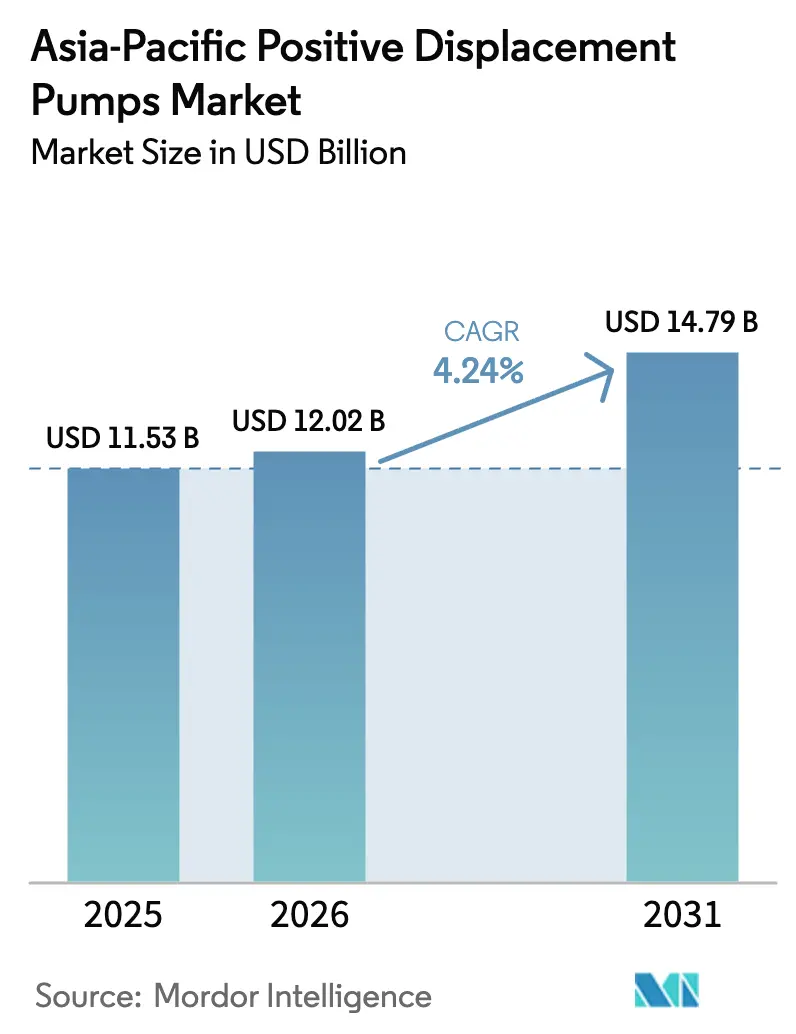
| Base Year Market Size (2025) | USD 11.53 Billion |
| Market Size (2026) | USD 12.02 Billion |
| Market Size (2031) | USD 14.79 Billion |
| Growth Rate (2026 - 2031) | 4.24% CAGR |
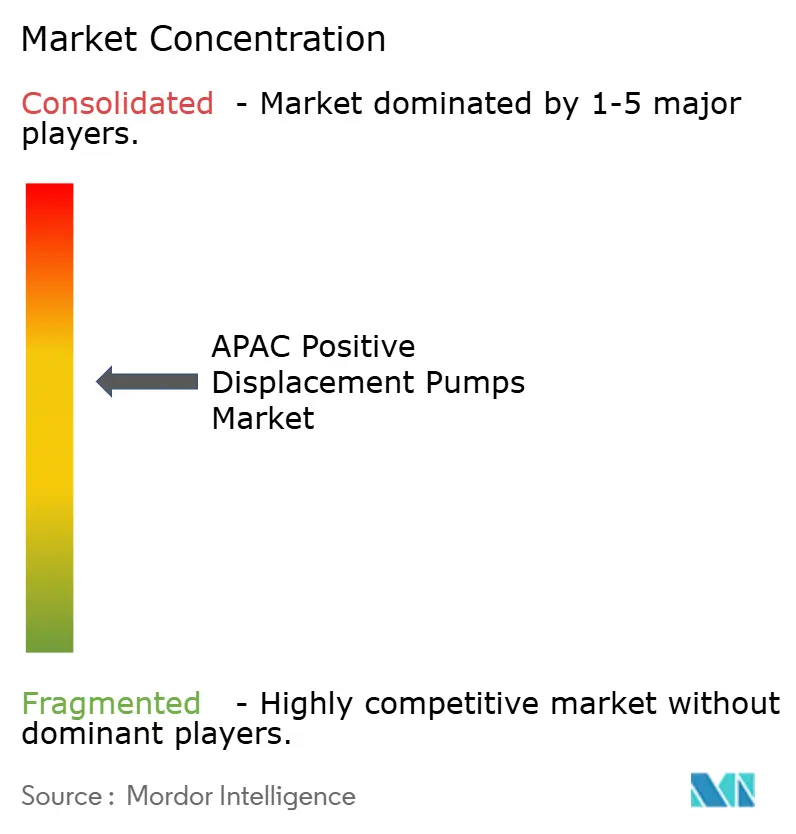
| Market Concentration | Medium |
Major Players *Disclaimer: Major Players sorted in no particular order Image © Mordor Intelligence. Reuse requires attribution under CC BY 4.0. | |
Asia-Pacific Positive Displacement Pumps Market Analysis by Mordor Intelligence
The APAC positive displacement pumps market size was valued at USD 11.53 billion in 2025 and estimated to grow from USD 12.02 billion in 2026 to reach USD 14.79 billion by 2031, at a CAGR of 4.24% during the forecast period (2026-2031). The measured expansion of the APAC positive displacement pumps market is grounded in a structural pivot toward digitized, environmentally compliant industrial ecosystems that favor low-emission and smart-sensor technologies.[1]International Energy Agency, “Southeast Asia Energy Outlook 2024,” iea.org Demand intensifies as municipalities across China, India and Southeast Asia accelerate wastewater infrastructure programs, while chemical processors in Jiangsu, Shandong and Guangdong provinces adopt seal-less configurations to comply with volatile organic compound (VOC) limits. Offshore electrification projects in Australia, Malaysia and Indonesia further reinforce the APAC positive displacement pumps market, because low-shear rotary and twin-screw designs minimize emulsion damage during multiphase hydrocarbon handling. Meanwhile, India’s Bureau of Indian Standards (BIS) modernization and expanding pharmaceutical capacity underpin the fastest national growth rate, embedding stringent certification into procurement cycles. Cost inflation in stainless steel and copper, coupled with a scarcity of skilled maintenance labor for progressive cavity systems, tempers growth but also accelerates adoption of predictive-maintenance solutions.
Key Report Takeaways
- By pump type, rotary units led with 51.12% revenue share in 2025; peristaltic systems are projected to expand at a 7.06% CAGR through 2031.
- By driving method, electric-motor systems held 63.21% of the APAC positive displacement pumps market share in 2025, while solar-powered models record the highest projected CAGR at 9.32% through 2031.
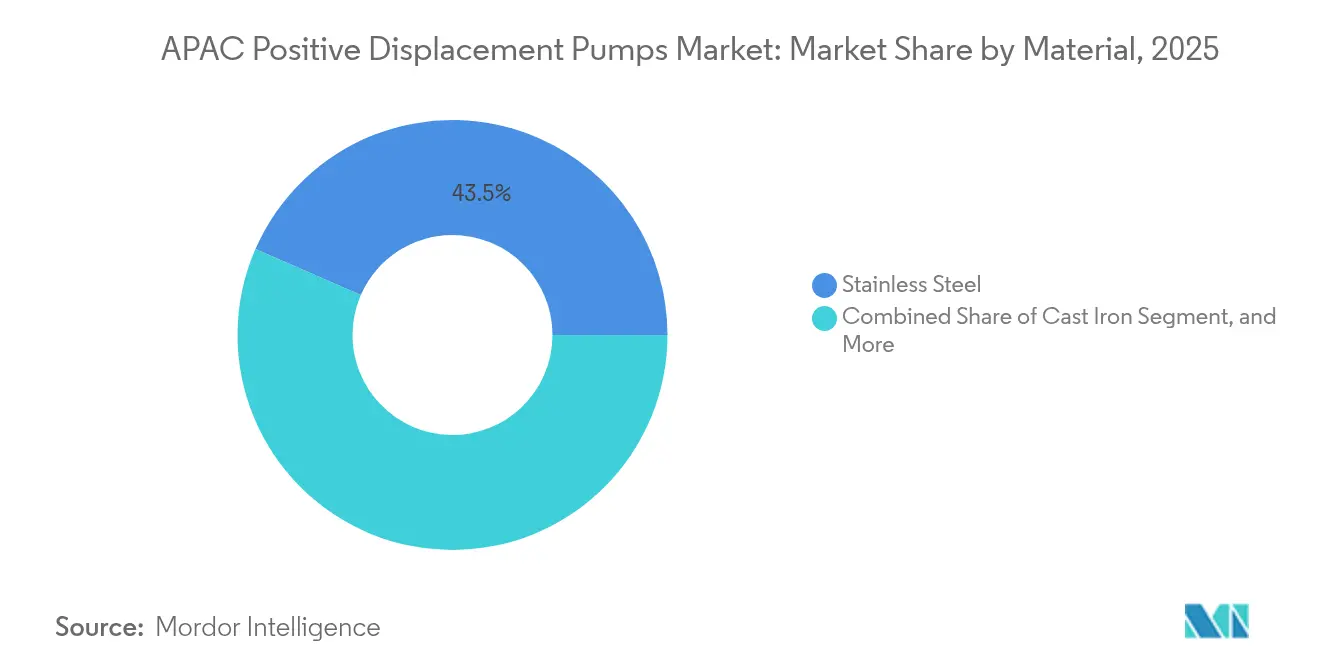
- By material, stainless steel commanded 43.45% of the APAC positive displacement pumps market size in 2025; duplex and exotic alloys are set to grow at a 6.34% CAGR between 2026-2031.
- By end-user industry, oil and gas accounted for 28.84% of demand in 2025, whereas pharmaceutical and biotech applications advance at an 8.63% CAGR to 2031.
- By geography, China held 42.35% of 2025 revenue; India is forecast to lead growth with a 6.16% CAGR through 2031.
Note: Market size and forecast figures in this report are generated using Mordor Intelligence’s proprietary estimation framework, updated with the latest available data and insights as of 2026.
Asia-Pacific Positive Displacement Pumps Market Trends and Insights
Drivers Impact Analysis*
| Driver | (~) % Impact on CAGR Forecast | Geographic Relevance | Impact Timeline |
|---|---|---|---|
| Rapid build-out of Asia’s municipal wastewater infrastructure | +0.8% | China, India, Southeast Asia core markets | Medium term (2-4 years) |
| Tightening VOC discharge limits in China’s specialty-chemicals clusters | +0.6% | China primary, spillover to Vietnam, Thailand | Short term (≤ 2 years) |
| Electrification of offshore platforms raises demand for low-shear pumps | +0.4% | Australia, Malaysia, Indonesia offshore regions | Long term (≥ 4 years) |
| Mini-bulk biopharma facilities adopting single-use peristaltic skids | +0.7% | India, Singapore, South Korea biotech hubs | Medium term (2-4 years) |
| OEM shift to smart sensor-enabled rotary pumps | +0.5% | Japan, South Korea, advanced APAC markets | Medium term (2-4 years) |
| Capex rebound in F&B processing lines | +0.4% | Regional, concentrated in Thailand, Vietnam | Short term (≤ 2 years) |
| Source: Mordor Intelligence | |||
Rapid Build-out of Asia’s Municipal Wastewater Infrastructure
Expanding municipal wastewater networks spur recurring orders for progressive cavity and screw units that handle viscous sludges with stable flow, making these pumps a preferred choice for biological treatment and chemical dosing.[2]NETZSCH Pumps & Systems, “What You Need to Know about Progressing Cavity Pumps,” pumps-systems.netzsch.com China and India allocate significant stimulus to decentralized plants, and Southeast Asian nations seek modular skid packages that can be deployed quickly in peri-urban areas. Progressive cavity suppliers therefore bundle monitoring sensors to flag wear on rotors and stators, reducing on-site service calls. Local fabricators in Indonesia and Vietnam also scale up cast iron models for budget-sensitive municipalities, but stainless variants continue to dominate lifecycle assessments. The APAC positive displacement pumps market benefits as water utilities anchor long-term service agreements that guarantee throughput performance across 10-year concessions.
Tightening VOC Discharge Limits in China’s Specialty-Chemicals Clusters
Stringent rules mandating leak detection thresholds below 2,000 ppm push processors to specify magnetic-drive and hermetically sealed designs, creating a material premium yet reducing fugitive emissions liability. Pump makers integrate dual mechanical seals with sensor-enabled pressure compensation to ensure regulatory audits pass on first inspection. Compliance deadlines intensify replacement cycles in Jiangsu, Shandong and Guangdong complexes, positioning the APAC positive displacement pumps market for retrofit revenue. Companies offering VOC-monitoring analytics secure framework agreements with specialty polymer producers that require real-time reporting to local environmental bureaus.
Electrification of Offshore Platforms Raises Demand for Low-Shear Pumps
Hybrid renewable power systems on floating production units mandate equipment that operates reliably under variable frequency drives and fluctuating torque. Progressive cavity and twin-screw pumps exhibit stable performance at partial speeds, reducing shear and preserving fluid integrity.[3]Asia-Pacific Economic Cooperation, “APEC Energy Overview 2024,” aperc.or.jp Australian operators pioneer digital twins that simulate pump behavior under grid-connected and battery-only modes, informing predictive replacement schedules. Vendors deliver corrosion-resistant duplex alloys to withstand seawater ingress and sour gas exposure. This long-term trend drives higher service-based revenue streams within the APAC positive displacement pumps market as remote monitoring contracts extend beyond typical OEM warranties.
Mini-Bulk Biopharma Facilities Adopting Single-Use Peristaltic Skids
India, Singapore and South Korea expand biologics capacity using modular, single-use equipment; peristaltic units eliminate cross-contamination and support quick batch changeovers. Tube material innovation—advanced silicone and fluoropolymers—extends sterility cycles and enhances chemical compatibility. Suppliers preload sensors that record cumulative tube flex, enabling pharmaceutical quality teams to forecast tubing replacement proactively. Cleanroom-packaged units ship pre-validated, shortening facility commissioning timelines and escalating peristaltic market penetration across the APAC positive displacement pumps market.
Restraints Impact Analysis*
| Restraint | (~) % Impact on CAGR Forecast | Geographic Relevance | Impact Timeline |
|---|---|---|---|
| Volatile stainless-steel and copper prices inflate pump BOM cost | -0.7% | Regional, particularly affecting China, India manufacturing | Short term (≤ 2 years) |
| Skilled-labor shortage for complex progressive-cavity pump MRO | -0.5% | Japan, South Korea, Australia developed markets | Long term (≥ 4 years) |
| Rising preference for seal-less mag-drive centrifugals in pharma | -0.4% | India, Singapore, South Korea pharmaceutical hubs | Medium term (2-4 years) |
| Lengthy BIS certification cycle delays India roll-outs | -0.3% | India primary, spillover to regulatory-sensitive markets | Short term (≤ 2 years) |
| Source: Mordor Intelligence | |||
Volatile Stainless-Steel and Copper Prices Inflate Pump BOM Cost
Raw materials account for up to 60% of finished-pump cost; a 15% spike in stainless price can cut gross margins by 300 bps if not passed through swiftly. Suppliers diversify into duplex or low-molybdenum grades and redesign housings to reduce wall thickness without compromising pressure ratings. Larger OEMs lock annual contracts with mills, while smaller fabricators risk cash-flow tightness, prompting consolidation within the APAC positive displacement pumps market. Design-for-cost engineering accelerates the transition to composite polymer components in non-critical housings, easing volatility exposure.
Skilled-Labor Shortage for Complex Progressive-Cavity Pump MRO
Rotor-stator alignment and elastomer selection require specialized technicians; retirements in Japan and Australia shrink the talent pool. OEMs respond by embedding augmented-reality service guides and offering remote commissioning support. End-users with limited in-house expertise opt for contract maintenance, transferring capex to opex and marginally lowering lifetime cost comparisons against centrifugal alternatives. The constraint slows adoption of progressive cavity units in new greenfield projects but accelerates digital service adoption inside the APAC positive displacement pumps market.
*Our forecasts treat driver/restraint impacts as directional, not additive. The impact forecasts reflect baseline growth, mix effects, and variable interactions.
Segment Analysis
By Pump Type: Rotary Dominance Faces Peristaltic Disruption
Rotary units contributed 51.12% of 2025 revenue, equating to the largest slice of the APAC positive displacement pumps market size and validating their versatility in chemicals, oil and gas and food handling applications. Peristaltic pumps, however, lead volume growth at a 7.06% CAGR by satisfying single-use bioprocessing protocols and chemical-feed duties where zero contamination is non-negotiable.
Gear and twin-screw products now ship with vibration and pressure sensors that feed OEM cloud dashboards, accelerating predictive-maintenance uptake across the APAC positive displacement pumps market. Lobe designs ride demand from dairy and beverage expansions, while vane variants maintain niche roles in lubrication circuits.
By Driving Method: Electric Motors Lead Solar Surge
Electric-motor models delivered 63.21% of 2025 revenue, underscoring their entrenched role in factory automation and conveying applications across the APAC positive displacement pumps market share. Solar-powered packages, though still a niche, achieve a 9.32% CAGR as agricultural irrigation and remote water supply projects benefit from declining photovoltaic costs.
Variable-frequency drives paired with high-efficiency IE4 motors cut lifecycle energy use, while diesel units retreat to emergency and off-grid roles under tightening emission norms. Pneumatic systems retain a foothold in hazardous environments where intrinsic safety trumps energy efficiency.
By Material: Stainless Steel Dominance Challenged by Exotic Alloys
Stainless steel versions represented 43.45% of 2025 sales, underscoring their balanced cost-to-performance ratio in the APAC positive displacement pumps market. Duplex and other exotic alloys grow at 6.34% CAGR by providing superior chloride stress-crack resistance demanded by offshore and specialty-chemical clients.
OEMs invest in alloy development that reduces nickel use, bolstering cost certainty while meeting mechanical thresholds. Composite housings emerge in metering applications, though brittleness concerns restrict broader uptake.


By End-user Industry: Oil and Gas Leadership Faces Pharma Growth
Oil and gas secured 28.84% of 2025 demand, reflecting upstream multiphase transfer and downstream additive injection operations. Pharmaceutical and biotech entities expand spend at 8.63% CAGR as continuous processing and single-use formats proliferate across the APAC positive displacement pumps market size.
Chemical producers drive specification of low-emission sealed units, while food & beverage processors emphasize CIP compliance and gentle handling to limit shear-induced product degradation.
Geography Analysis
China retained 42.35% revenue in 2025, reinforcing its scale advantage and influencing design standards that increasingly incorporate environmental compliance-especially for VOC control in specialty chemicals. Local manufacturers co-develop magnetic-drive models with European licensors, elevating quality perceptions and supporting export ambitions.
India posts the highest national CAGR at 6.16% through 2031 as BIS reforms shorten certification timelines and encourage multinational investment in local production. Pharmaceutical plant expansions in Hyderabad and Gujarat dominate peristaltic and diaphragm tenders, while smart-city wastewater schemes adopt progressive cavity packages with IoT enablement.
Japan, South Korea and Australia supply stable replacement demand, governed by stringent energy-efficiency rules and aging asset renewals. Australian mines specify abrasion-resistant twin-screw models and demand remote diagnostics given their isolated locales. South Korean semiconductor fabs procure sanitary gear units to support ultra-pure chemical feeds, influencing technology roadmaps for the broader APAC positive displacement pumps market.
Regulatory Landscape
Regulatory requirements for positive displacement pumps across Asia-Pacific are anchored on a mix of national pump standards and cross-cutting safety and environmental compliance rules. In China, GB/T 40077-2021 sets out technical requirements for reciprocating positive displacement pumps and references ISO 16330:2003, shaping procurement specifications and factory acceptance testing for compliant suppliers. In chemical and specialty polymer applications, tightening leak-detection and emissions compliance in industrial clusters supports sealed configurations and verifiable monitoring capability for audit-ready operations.
Regional alignment also progresses through standards harmonization frameworks rather than a single unified ASEAN standard layer. The ASEAN Consultative Committee on Standards and Quality (ACCSQ), supported by ASEAN guidance on standards and conformity assessment, promotes harmonization with international references (ISO/IEC), which helps OEMs scale designs across Southeast Asia with fewer country-to-country deviations. On the digital side, policies such as China’s 2024 National AI Industry Standardisation System Construction Guidelines and the ASEAN Digital Master Plan 2030 (finalized in 2026) support adoption of smart manufacturing and connected equipment practices, influencing how pump makers document software, connectivity, and validation for sensor-enabled packages used in regulated industrial environments.
Value Chain Analysis
The APAC positive displacement pump value chain starts with metals and elastomers (stainless steel, copper-bearing components, and stator and tubing materials) that feed machining, casting, and assembly operations for rotary, progressive cavity, diaphragm, and peristaltic designs. OEMs and regional assemblers then integrate motors, drives, seals, and increasingly sensors and controls for IIoT-enabled monitoring. Certification and test documentation act as a gating step before shipment in several markets, and delays in obtaining required marks or conformity documentation can slow deliveries and commissioning schedules.
Distribution typically runs through a mix of direct OEM key-account sales (oil and gas, chemicals, pharmaceuticals, and major municipal utilities) and authorized distributors and system integrators serving packaged skids and retrofit work. Aftermarket service (spares, stators and rotors, tubing, seals, and condition monitoring) forms a material portion of delivered value, especially for progressive cavity maintenance that depends on specialized alignment and elastomer selection. For higher-spec applications such as semiconductor and ultra-pure chemical feeds, value accrues in application engineering and materials qualification, with buyers emphasizing pulsation control, corrosion resistance, and traceable quality systems as part of supplier approval.
Competitive Landscape
The APAC positive displacement pumps market remains moderately fragmented: the top five suppliers control an estimated 48% of regional turnover, leaving ample share for specialized and domestic challengers. Atlas Copco, Grundfos and Flowserve sustain scale advantages through broad portfolios and integrated service networks, while NETZSCH and Sulzer differentiate on progressive cavity and multi-phase expertise.
Digitalization shapes go-to-market tactics; Grundfos monetizes cloud-based energy-optimization analytics, and Flowserve bundles asset-performance management software with new installations. Global leaders emphasize sustainability messaging, leveraging lower total-cost-of-ownership to counter regional price competition.
Regional firms such as Roto Pumps and Wangen advance by filling application niches—abrasive slurries, biogas digesters—and leveraging proximity advantages to expedite delivery and customization. Strategic collaborations with sensor and automation vendors speed digital retrofits, ensuring feature parity with global incumbents.
Asia-Pacific Positive Displacement Pumps Industry Leaders
The Weir Group PLC
Atlas Copco AB
KSB SE and Co. KGaA
NETZSCH Holding GmbH
Pentair plc
- *Disclaimer: Major Players sorted in no particular order

Market Opportunities and Future Outlook
Localization of manufacturing and quicker lead-time fulfillment are near-term whitespace where end users are tightening compliance requirements while also pushing for faster project execution. A concrete signal is NETZSCH Pumps & Systems inaugurating a 45,000 square meter production facility in Goa, India (March 2026). The site is designed to more than double local capacity across progressing cavity, rotary lobe, multi-screw, and peristaltic product lines, supporting India-focused supply chains and export-ready production for regional projects. This also creates opportunity for component suppliers and integrators around validated skids, instrumentation, and service ecosystems that reduce reliance on long cross-border logistics for high-mix applications.
Another opportunity is the shift from standalone pump supply to engineered, digitally monitored packages in wastewater, chemicals, and biopharma workflows, where buyers specify condition monitoring, leak minimization, and documented performance. Roto Pumps launching its P-Range compact pumps in India (April 2025) with stated FY26 production plans provides evidence of product-line tailoring for space-constrained and cost-sensitive installations while preserving PD performance requirements. Across Southeast Asia, policy support for smart manufacturing, such as Malaysia’s NIMP 2030 and the ASEAN Digital Master Plan 2030, supports demand for pumps with sensor-ready designs and integration into plant systems, opening space for OEMs and partners offering commissioning support, remote diagnostics, and lifecycle service contracts where skilled MRO labor is constrained.
Recent Industry Developments
- June 2026: The Weir Group secured a significant order from Lloyds Metals and Energy Ltd to supply 14 GEHO TZPM 2000 positive displacement pumps with the GEHO Load Reduction System (GLORES) for phase two of a slurry pipeline project at the Surjagarh mine in Maharashtra, India. The project includes a 200 km pipeline extension and adds 16 million tonnes of annual transport capacity, reinforcing long-distance slurry transport as a high-value PD pump use case in the region.
- April 2026: Atlas Copco invested an 8-figure sum in a new regional headquarters and integrated facility in Alam Impian, Shah Alam, Malaysia to support Southeast Asian operations, including a shared finance services center. The move strengthens regional proximity for sales and service coverage and supports faster coordination for industrial customers requiring uptime-focused aftermarket support.
- March 2026: KSB announced the EtaSeco type series, a new generation of hermetically sealed canned motor pumps designed for demanding applications. The launch expands the addressable base for low-emission, leak-minimizing pump configurations in chemical and process industries where compliance and containment requirements influence equipment selection.


Research Methodology Framework and Report Scope
Market Definition and Coverage
For this study, the market covers the value of positive displacement pumps sold and used across Asia-Pacific for industrial and utility fluid-handling duties where steady flow and pressure control are required.
Scope exclusions: We exclude purely consumer or household pumping products and any services-only revenue that is not tied to pump equipment sales.
Segmentation Overview
- By Pump Type
- Reciprocating Pumps
- Piston
- Diaphragm
- Rotary Pumps
- Gear
- Lobe
- Screw
- Vane
- Progressive Cavity
- Peristaltic
- Reciprocating Pumps
- By Driving Method
- Electric Motor
- Diesel/IC Engine
- Pneumatic
- Hydraulic
- Solar
- By Material
- Cast Iron
- Stainless Steel
- Other Materials
- By End-user Industry
- Oil and Gas
- Chemicals
- Food and Beverage
- Waste and Wastewater
- Pharmaceutical and Biotech
- Power Generation
- Pulp and Paper
- Mining and Metals
- Other Industries
- By Country
- China
- Japan
- India
- South Korea
- Australia and New Zealand
- Rest of Asia-Pacific
Data Sources, Market Sizing, and Validation
Desk Research
Desk research was used to set the market boundary, confirm country coverage, and build the first set of demand signals for process pumps. We relied on public and official sources such as UN Comtrade trade statistics, national statistics offices in major Asia-Pacific economies, energy and refinery statistics from agencies such as the IEA, water and wastewater investment references from sources such as the World Bank and national water agencies, and manufacturing and mining indicators from sources such as the World Steel Association and government mining departments.
To connect these macro indicators to pumps demand, we reviewed company filings, investor presentations, product catalogs, and reputable press coverage on capacity additions, environmental upgrades, and plant maintenance cycles. Where available, we also used paid subscriptions focused on company financials and news, patent databases to track technology direction, and an import and export shipment-level database to sanity-check product movement patterns for key pump categories. These desk sources are not exhaustive, and many other references were used for data collection, validation, and research clarification.
Primary Interviews and Surveys
Primary work focused on validating how demand is formed in each major country, and on pressure-testing assumptions that desk sources usually cannot confirm, such as replacement share, typical pricing moves, and procurement behavior by end users. We spoke with a mix of pump manufacturers, component suppliers, distributors, EPCs, and maintenance-focused stakeholders, followed by end-user checks in water and wastewater, oil and gas, chemicals, food and beverage, mining, and power across APAC, so the final numbers reflect practical buying and usage patterns.
Distribution of primary research fieldwork respondents
| Company type | Respondent position | Region |
|---|---|---|
| Top tier: 30% | CXOs: 13% | |
| Mid tier: 48% | Functional/Unit leaders: 41% | |
| Smaller Players: 22% | Managers: 46% |
Market-Sizing & Forecasting
Sizing started from a top-down build where industrial activity and infrastructure spend were translated into a demand pool by country, and then allocated into positive displacement pump usage based on application fit and installed-base intensity. The model was then corroborated with selective bottom-up approximations, including sampled supplier revenue splits by pump family, channel checks on typical order sizes, and an ASP-by-volume build for common pump types. These bottom-up checks were used to adjust totals where gaps appeared.
Inputs used in the model included indicators such as water and wastewater capacity additions, refinery and chemical capacity trends, mining production activity, power and industrial capex cycles, and import and export flows for pump categories that are commonly traded in the region. Pricing and mix assumptions were shaped using interview feedback on material cost pass-through, localization levels, and the shift toward smarter monitoring features, which can move ASPs without a matching rise in unit demand. For forecasting, we used scenario analysis anchored to country-level investment pipelines and industrial output expectations, and then cross-checked the year-by-year path against expert views on replacement timing and project execution slippage. Where bottom-up inputs were incomplete, we filled the gap using proxy ratios from comparable end-user activity and then revalidated the implied pump spend per unit of capacity with respondents.
Data Validation & Update Cycle
Validation was done through triangulation across independent signals so no single data series drives the final outcome. We ran variance checks by country and end-user demand drivers, reviewed outliers such as sudden pricing jumps or unusual trade swings, and then applied multi-step analyst reviews before internal sign-off.
Reports are refreshed annually, and interim updates are triggered when material events occur, such as major policy changes, sharp currency moves, or large capacity announcements that can alter near-term buying. Before delivery, a fresh pass is performed on key assumptions and recent public developments so clients receive the latest updated view.
Mordor Intelligence's Asia Pacific Positive Displacement Pumps Market Estimate Compared With Other Published Estimates
Published market sizes for positive displacement pumps in Asia-Pacific can look far apart because the boundaries are set differently and the demand signals chosen are not always the same. The base year selection, currency conversion timing, and whether replacement demand is treated explicitly also tend to move the final number.
The table shows a clear spread, and in Mordor Intelligence's model the scope counts only positive displacement pump equipment demand across APAC industries, with pricing and mix checked through country interviews rather than applying a single global ASP curve to every end-user segment.
Benchmark comparison
| Source | Market Size | Gaps in Research Methodology |
|---|---|---|
| Mordor Intelligence | USD 11.53 B (2025) | |
| Trade Journal A | USD 9.80 B (2025) | Uses a narrower interpretation that tends to emphasize a limited set of industrial end uses and may undercount water and wastewater and mining related demand, which reduces the addressable spend in APAC. |
| Regional Consultancy B | USD 13.20 B (2025) | Appears to include adjacent pump categories or bundled services in parts of the value chain, and uses more aggressive price progression assumptions that lift revenue faster than unit demand. |
Taken together, the differences mostly come down to what is counted in-scope, and how pricing and replacement cycles are translated into revenue at the country level. Our approach keeps each step traceable to practical demand drivers such as capacity additions, trade movement, and end-user buying behavior, which makes the final market value easier to reproduce and debate.


Key Questions Answered in the Report
What is the current value of the APAC positive displacement pumps market?
The market is valued at USD 12.02 billion in 2026 and is forecast to reach USD 14.79 billion by 2031 at a 4.24% CAGR.
Which pump type leads the APAC positive displacement pumps market?
Rotary pumps hold the largest share at 51.12% of 2025 revenue, while peristaltic pumps grow fastest at 7.06% CAGR.
Why is India the fastest-growing country market?
Modernization of BIS certification, expanding pharmaceutical capacity and infrastructure projects deliver a 6.16% CAGR through 2031.
How are VOC regulations affecting pump procurement in China?
Stricter leak-detection thresholds accelerate adoption of magnetic-drive and hermetically sealed designs in specialty-chemical clusters.
Which material segment is expected to grow fastest?
Duplex and exotic alloys expand at 6.34% CAGR due to superior corrosion resistance demanded in offshore and chemical environments.
What strategic themes dominate recent industry developments?
Acquisitions that reinforce niche technologies, localization to shorten lead times, and digitalization for predictive maintenance are primary themes.
Page last updated on: