
Market Overview
| Study Period | 2020 - 2031 |
|---|---|
| Forecast Data Period | 2026 - 2031 |
| Base Year Market Size (2025) | USD 9.69 Billion |
| Market Size (2026) | USD 11.41 Billion |
| Market Size (2031) | USD 25.94 Billion |
| Growth Rate (2026 - 2031) | 17.82 % |
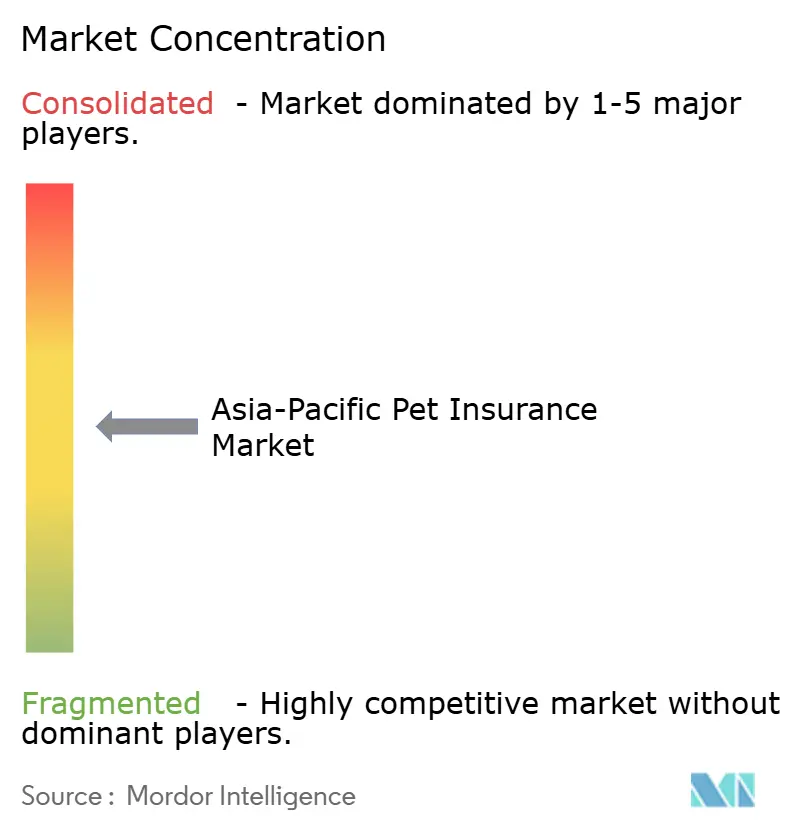
| Market Concentration | Medium |
Major Players.webp) *Disclaimer: Major Players sorted in no particular order Image © Mordor Intelligence. Reuse requires attribution under CC BY 4.0. | |
Asia-Pacific Pet Insurance Market Analysis by Mordor Intelligence
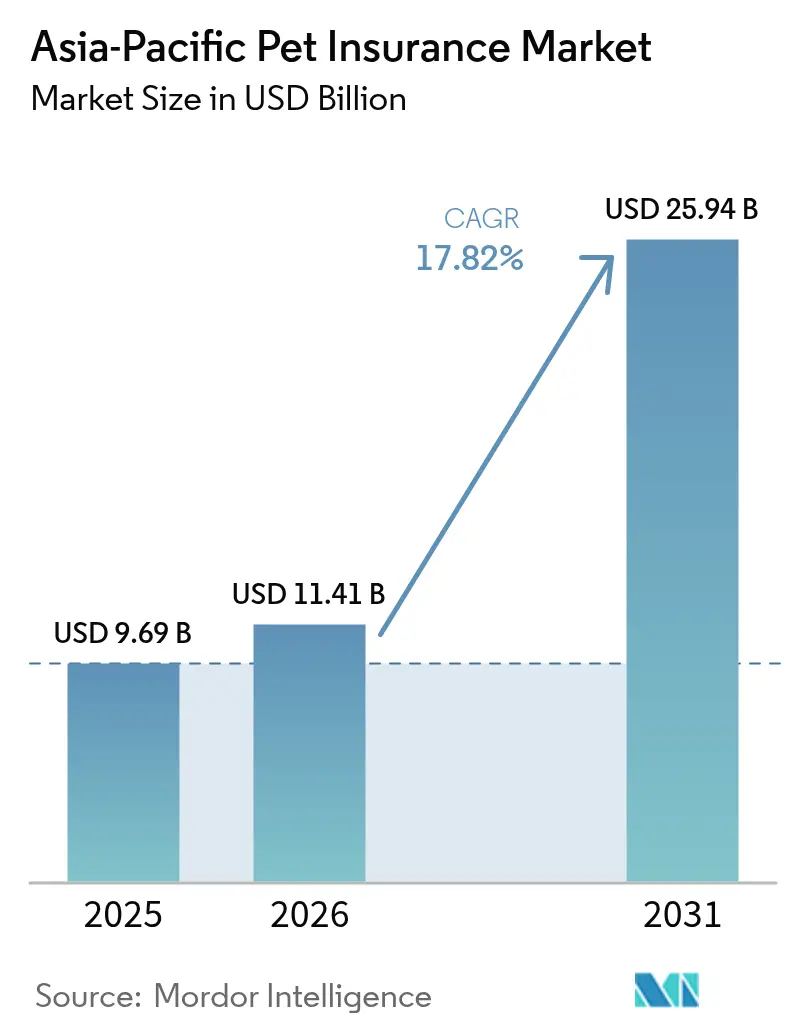
The Asia-Pacific pet insurance market size was valued at USD 9.69 billion in 2025 and estimated to grow from USD 11.41 billion in 2026 to reach USD 25.94 billion by 2031, at a CAGR of 17.82% during the forecast period (2026-2031). Rising disposable income, escalating veterinary bills, and a steady shift toward viewing pets as family members are powering the acceleration. Adoption is spreading from mature territories such as Japan and Australia to high-growth countries including China, India, and key Southeast Asian economies. Mobile-first sales journeys bundled micro-policies on regional e-commerce platforms, and employer-subsidised benefit schemes are lowering acquisition costs and broadening reach. Regulatory moves that mandate liability cover in South Korea and Singapore further normalise the value proposition while insurers respond to infrastructure gaps by funding tele-vet services and preferred-provider networks. Competitive intensity is climbing as legacy carriers, digital insurers, and large retailers race to control data, brand equity, and ecosystem touch-points.
Key Report Takeaways
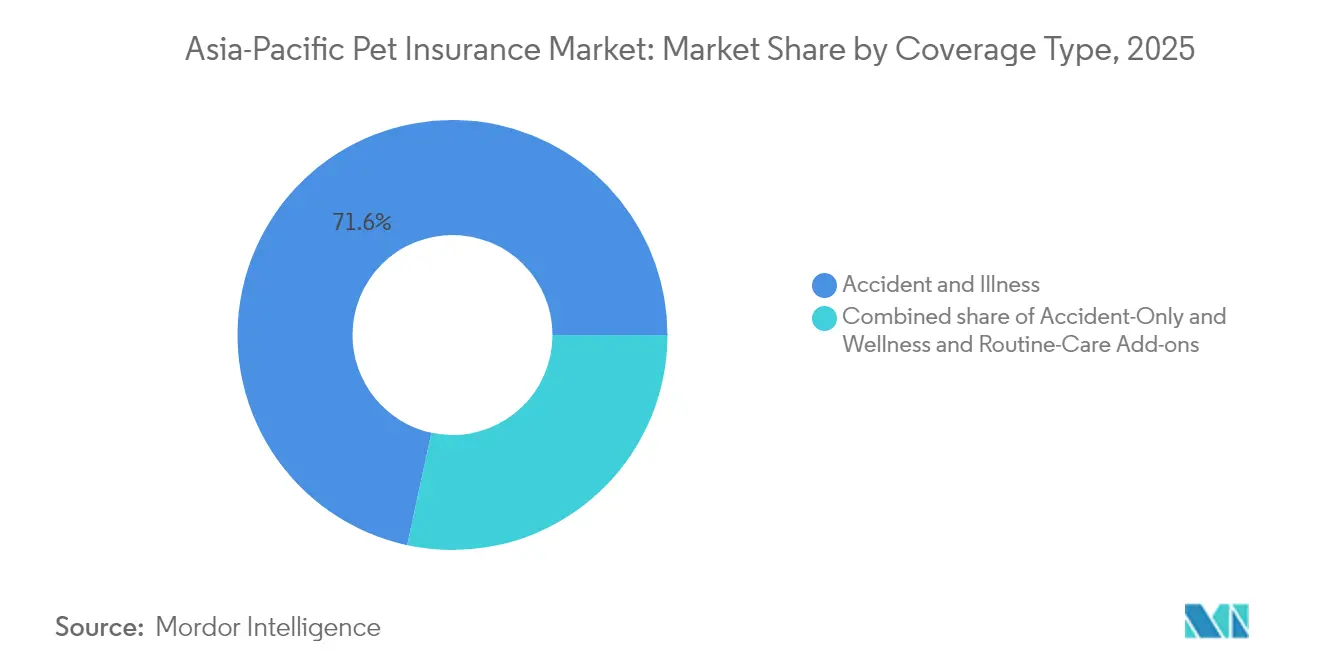
- By coverage type, Accident & Illness led with 71.62% of the APAC pet insurance market share in 2025, while Wellness & Routine-Care Add-ons are projected to grow at an 18.10% CAGR through 2031.
- By animal, dogs accounted for 64.02% share of the APAC pet insurance market size in 2025, whereas cat policies are set to expand at a 13.95% CAGR during 2026-2031.
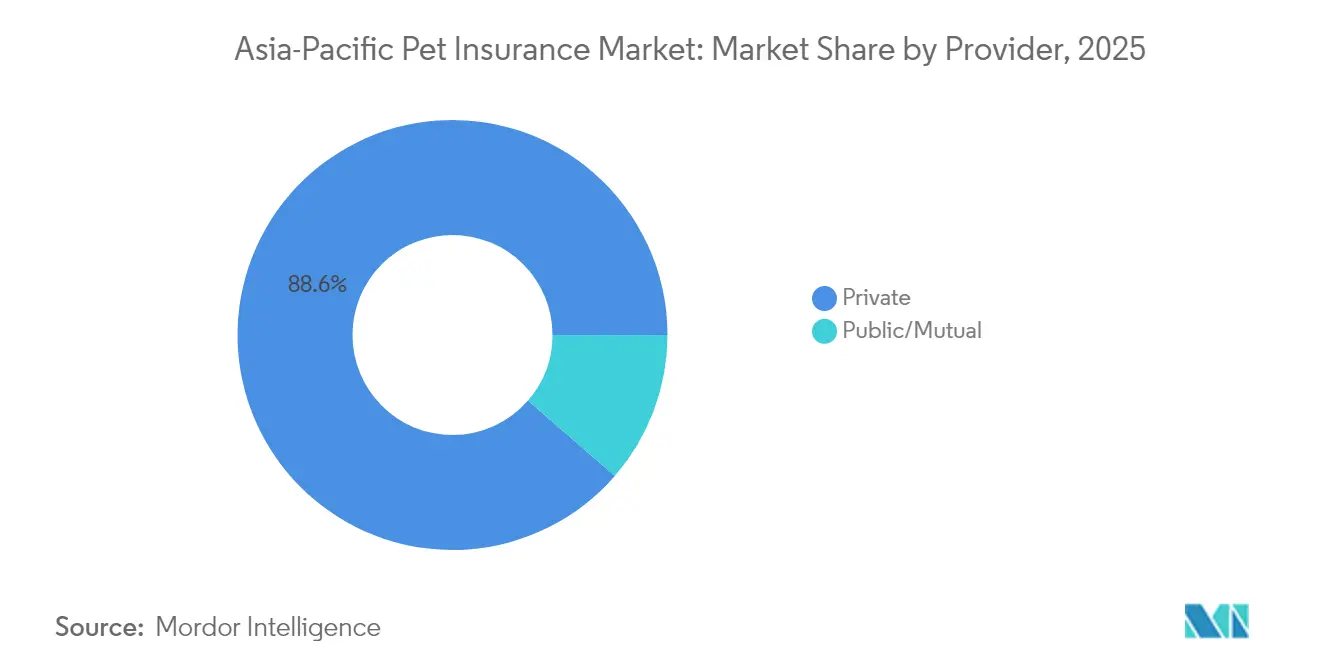
- By provider, private insurers controlled 88.62% revenue share in 2025; the public and mutual segment is advancing at an 10.87% CAGR to 2031.
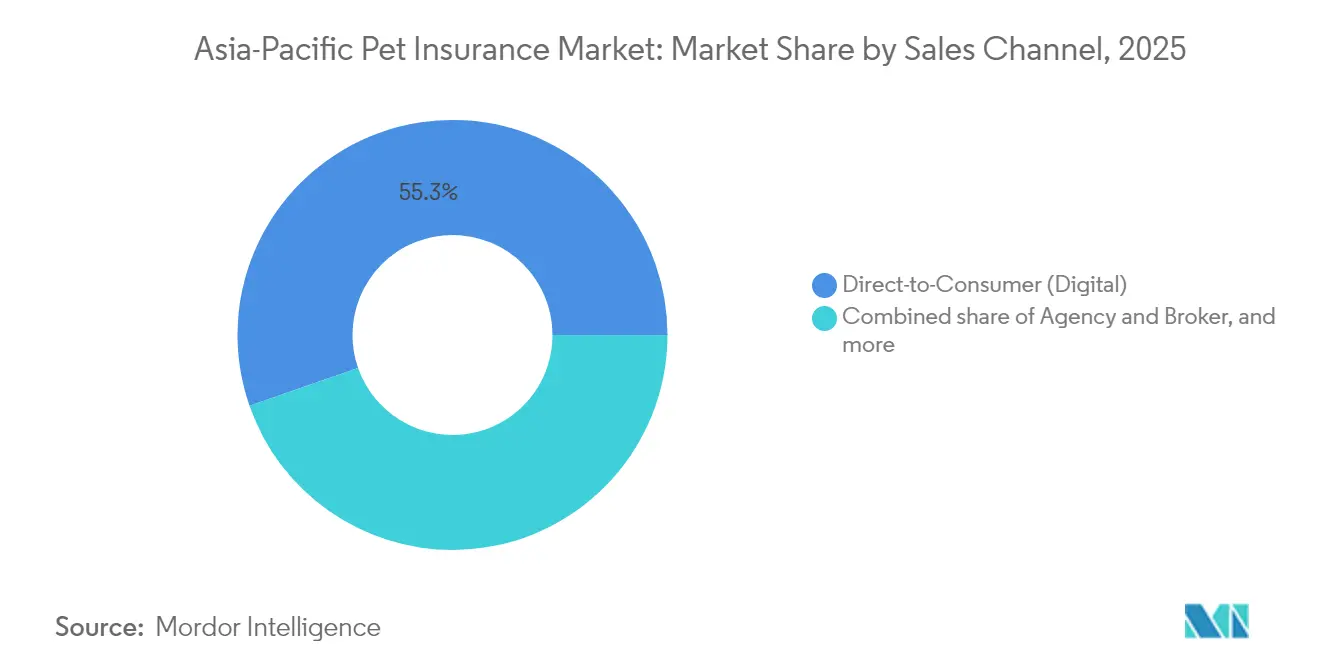
- By sales channel, direct-to-consumer digital platforms captured 55.34% of new policies in 2025; retail and pet-store embedded sales hold the fastest outlook at 19.04% CAGR to 2031.
- By geography, Japan held 31.85% of the APAC pet insurance market share in 2025, while China is poised for the quickest expansion at 18.74% CAGR over the forecast horizon.
Note: Market size and forecast figures in this report are generated using Mordor Intelligence’s proprietary estimation framework, updated with the latest available data and insights as of 2026.
Market Trends and Insights
Drivers Impact Analysis of Asia-Pacific Pet Insurance Market*
| Drivers Impact Analysis | (~) % Impact on CAGR Forecast | Geographic Relevance | Impact Timeline |
|---|---|---|---|
| Pet humanisation in tier-1 Chinese cities | +3.2% | China; spillover to Taiwan and Hong Kong | Medium term (2-4 years) |
| Corporate pet-care benefit programmes | +2.1% | Japan, Australia, Singapore | Short term (≤2 years) |
| Post-COVID companion-animal adoption | +3.8% | India, Southeast Asia | Medium term (2-4 years) |
| Mobile-first insurance platforms | +2.7% | Pan-APAC; strongest in Indonesia, Philippines, Thailand | Short term (≤2 years) |
| ASEAN e-commerce bundling of micro-insurance | +1.9% | Singapore, Malaysia, Thailand, Indonesia, Philippines, Vietnam | Medium term (2-4 years) |
| Regulatory mandates for third-party liability cover | +1.4% | South Korea, Singapore | Short term (≤2 years) |
| Source: Mordor Intelligence | |||
Surging “Pet Humanisation” Spending in Tier-1 Chinese Cities
Average annual veterinary spending in Beijing, Shanghai, and Guangzhou climbed 37.0% in 2024 as millennial and Gen-Z owners redirected 15-20% of discretionary income toward premium pet care[1]. Insurance uptake in these hubs doubled from 8% to 14% year-over-year, and 76% of new policies were purchased via smartphone apps in Q1 2025[2]. These urban consumers demand human-style benefits such as preventative check-ups and mental-health cover, prompting insurers to launch full-stack mobile journeys that close the sale in under three minutes. Enhanced data capture from app usage is now feeding AI underwriting engines, reducing rating errors and improving claims triage. The rising willingness to insure higher-value exotic breeds is also widening the premium pool despite the actuarial challenges linked to limited breed-specific claims history.
Expansion of Corporate Pet-care Benefit Programmes in Japan & Australia
Forty-two percent of Fortune 500 employers across Japan and Australia subsidised pet insurance in 2024, creating a stable, low-lapse distribution vein. Policies sold through human-resources packages showed 28% lower churn than direct-to-consumer contracts, and Anicom Holdings saw corporate-channel premiums jump 34%, representing 22% of its book[3]. Australian market leader Medibank Private signed 17 enterprise deals that collectively insure 85,000 pets, bundling wellness allowances and tele-vet consults to raise utilisation and retention[4]. Employers frame the benefit as a mental-health perk that lowers stress for staff worried about veterinary bills. Insurers, for their part, gain concentrated groups of low-average-age animals whose claim ratios trend below open-market averages, boosting portfolio profitability.
Post-COVID Companion-Animal Adoption across India & Southeast Asia
Pet ownership in urban India and Southeast Asia grew 47.0% between 2020 and 2024 as remote-work lifestyles normalised animal companionship. Veterinary treatment prices rose 22.0% in 2024, creating financial exposure for first-time pet parents who lack established clinic relationships. Digital insurers capitalised on this awareness gap: 68.0% of new Southeast Asian owners researched cover online before visiting a veterinarian. Policy bundles that include vaccination vouchers and 24/7 tele-medicine are resonating, with conversion rates 2.2 times higher than for accident-only products. Insurers are also piloting micro-subscription models that escalate coverage automatically over the pet life-cycle, an approach well-suited to emerging middle-class incomes.
Availability of Mobile-First On-boarding & Claim Apps
Mobile platforms processed 56.0% of APAC pet insurance market sales in 2024. AI-supported claim verification cut average reimbursement times from 14 days in 2022 to under 48 hours in 2024 at leading carriers such as Anicom and Medibank, lifting Net Promoter Scores by double digits. Tele-vet video calls embedded inside claim flows boosted repeat-purchase odds by 27.0%. Consumer expectations now mirror fintech norms: instant policy issuance, real-time tracking, and cashless vet payments via QR code. Newer entrants differentiate on user experience rather than price, pushing incumbents toward aggressive tech investment cycles.
Restraints Impact Analysis of Asia-Pacific Pet Insurance Market*
| Restraint | (~) % Impact on CAGR Forecast | Geographic Relevance | Impact Timeline |
|---|---|---|---|
| Veterinary infrastructure gaps | –2.8% | India, Southeast Asia, China tier-2/3 | Long term (≥4 years) |
| Limited actuarial data for exotic breeds | –1.6% | Pan-APAC; most acute in emerging markets | Medium term (2-4 years) |
| Cultural reluctance toward pet insurance in rural provinces | –0.9% | Rural areas across APAC markets | Long term (≥5 years) |
| High fraudulent claim incidence in certain Chinese provinces | –0.7% | Guangdong, Jiangsu, Zhejiang | Short term (≤2 years) |
| Source: Mordor Intelligence | |||
Cultural Reluctance toward Pet Insurance in Rural Provinces
Pet owners living in rural districts across India, China, and Indonesia frequently rely on home remedies or informal community veterinarians, leaving little perceived need for formal insurance. A 2024 survey by China’s Ministry of Agriculture and Rural Affairs showed that only 1.5% of pet owners in county-level areas carried any form of cover, compared with 12.6% in adjacent prefecture-level cities. Similar patterns are visible in India, where the Department of Animal Husbandry found that 68% of rural households view veterinary costs as too low or too infrequent to justify premiums. Cultural traditions also favor natural remedies and barter-based care, reducing trust in written policies and digital claim processes. Limited smartphone penetration compounds the gap because most insurers distribute policies through mobile apps. As a result, rural uptake lags urban centers by more than a decade, forcing insurers to tailor grassroots awareness campaigns and micro-premium products that match seasonal income cycles.
High Fraudulent Claim Incidence in Certain Chinese Provinces
Guangdong, Jiangsu, and Zhejiang recorded a 4.6% fraudulent-claim ratio in 2024, more than double the national average, according to the China Banking and Insurance Regulatory Commission. Common schemes include collusion between clinics and policyholders to inflate invoices or submit duplicate bills for routine procedures. These practices raise loss ratios and force insurers to load extra premiums on policies issued in high-risk postal codes, reducing affordability for honest owners. Carriers have responded by piloting blockchain-based invoice verification that cut falsified submissions by 92% in early trials. Yet fraud rings quickly adapt, shifting to smaller claims that evade algorithmic red flags and still erode underwriting margins. Persistent fraud discourages new entrants and slows product rollout in affected regions, limiting overall market expansion until tighter inter-agency data sharing and stiffer penalties take hold.
*Our forecasts treat driver/restraint impacts as directional, not additive. The impact forecasts reflect baseline growth, mix effects, and variable interactions.
Asia-Pacific Pet Insurance Market Segment Analysis
By Coverage Type:
Wellness Add-ons Disrupting Traditional ModelsAccident & Illness policies captured 71.62% of the APAC pet insurance market share in 2025 as they remain the default response to unpredictable, high-cost events. The segment enjoys deep adoption in Japan and Australia where a single cruciate-ligament surgery can cost more than USD 5,000. Insurers continue to refine sub-limits and deductible ladders to manage claim volatility while maintaining perceived value. Wellness & Routine-Care Add-ons are the growth engine, advancing at 18.10% CAGR and appealing to millennials who view preventative check-ups and dental cleanings as essential. Roughly 64% of new customers opted for at least one wellness rider in 2024. The APAC pet insurance market size for accident-only cover remains relevant in price-sensitive pockets such as India, Indonesia, and Thailand, where it functions as a low-premium entry gate. Innovative stepped-coverage designs now auto-upgrade accident-only policies to broader benefits after claim-free periods, boosting retention without requiring active customer decisions.
Second-generation products include behavioural therapy subsidies, lost-pet recovery services, and mental-health consultations for owners managing chronic pet conditions. These additions fight commoditisation and create upsell paths. Insurers report that bundles featuring at least one non-traditional perk show 1.6-times higher cross-sell rates into lifetime policies. As more data emerges that preventative spend lowers catastrophic outlay, underwriting margins are predicted to widen by mid-decade.

By Animal:
Dogs Dominate While Cat Coverage AcceleratesDogs accounted for 64.02% of the APAC pet insurance market size in 2025, fuelled by higher average vet bills and regulatory scrutiny around canine ownership. Breed-specific plans in Japan cover hereditary issues in Shiba Inus and Dachshunds, allowing refined pricing that mitigates anti-selection. The cat segment’s 28.77% share is expanding quickly at 13.95% CAGR as space-constrained apartment dwellers across Hong Kong, Singapore, and mainland China favour felines. Premiums for cats run 30-40% below canine equivalents, inviting first-time buyers. Exotic birds, rabbits, and reptiles make up 7.21% of policies but show niche promise: Pet Insurance Australia’s February 2024 exotic-bird product sold out an initial 3,000-policy allocation in two months. The actuarial restraint noted earlier still inflates exotic-breed premiums, yet specialised carriers are investing in micro-cohorts to collect claims evidence and unlock under-served value.
Urban demographic changes underpin segment momentum. In Japan’s ageing society, small-breed dogs and cats match limited living space and owner mobility. Mainland China’s millennial cohort is now adopting cats at a faster absolute rate than dogs according to the 2024 Pet Industry White Paper. Higher feline adoption tilts portfolio risk profiles toward lower-severity claims, improving combined ratios and freeing capital for product experimentation.
By Provider:
Private Insurers Innovate While Public Options Expand AccessPrivate carriers wrote 88.62% of 2025 premiums, leaning on digital underwriting, behavioural data, and embedded sales partnerships. In Japan, the top five companies command 78.0% of the private segment, yet in India none exceed 12.0%—a structural divergence that pressures global players to tailor entry strategies. Ecosystem integration is the new differentiation: 43.0% of private providers now run in-house tele-vet clinics and e-commerce pet shops. Public and mutual programmes remain small at 11.38% share but are important catalysts for financial inclusion. South Korea’s National Pet Insurance Programme, launched April 2024, subsidises basic cover for low-income households and has already enrolled 60,000 animals. Mutual co-operatives in Taiwan and Thailand trim administrative overheads by 22.0%, enabling lower premiums that appeal to cautious first-timers. As public schemes generate credible loss data, they will likely migrate up-market in partnership with commercial reinsurers.
By Sales Channel:
Digital Dominance Amid Channel DiversificationDirect-to-consumer online routes delivered 55.34% of all new APAC pet insurance market policies in 2025 thanks to customer acquisition costs that average 42% below agency channels. High smartphone penetration in Indonesia, Philippines, and Vietnam magnifies this edge. Embedded retail and pet-store channels are scaling fastest at 19.04% CAGR. Instant QR-code activation at checkout boosts conversion among impulse adopters and secures an early role in the pet ownership journey. Agency and broker models still service complex lifetime policies, preserving 28.27% share and 14% higher commission yields. Bancassurance and affinity tie-ups with credit-card issuers or airlines control 16.39% of production, posting conversion rates 2.3 times higher than stand-alone digital ads because of trust transfer from established financial brands. Future distribution success hinges on omnichannel orchestration rather than channel supremacy.
By Policy Term:
Lifetime Coverage Gains Strategic PriorityLifetime contracts dominated at 57.45% in 2025, prized for guaranteed continuity of chronic-condition coverage and resulting 87.0% retention. Australian market leader Medibank created a no-exclusion renewal guarantee in March 2024 that immediately resonated with owners of senior pets. Lifetime products improve risk pooling by retaining healthy animals into older, claim-intensive years. Annual or non-lifetime plans hold 42.55% share, operating as gateway offerings for budget-sensitive households. Modular coverage launched by Japan’s ipet Insurance lets buyers dial benefits up or down at renewal without switching insurers, increasing account stickiness. As predictive analytics sharpen lapse-risk scoring, carriers are expected to nudge more customers toward lifetime options via gamified loyalty credits and wellness cashbacks.
Geography Analysis
Japan Pet Insurance Market
Japan retained 31.85% of the APAC pet insurance market in 2025 on the back of sophisticated veterinary networks and a penetration rate of 14.3%. Growth is moderating to an 8.33% CAGR through 2031 as early adopters saturate; consequently, incumbents focus on integrating tele-health, genetic testing, and activity tracking into holistic wellness ecosystems. Anicom’s February 2024 health-platform launch boosted cross-sell ratios by 23% within six months.
China Pet Insurance Market
China accounted for 16.38% of 2025 premiums yet is forecast to expand at 18.74% CAGR, the fastest across the region. Penetration remains low at 3.2%, so upside is considerable. Urban tier-1 and tier-2 cities host most of the veterinary capacity capable of supporting comprehensive cover. Ping An’s March 2024 platform issued 120,000 policies in its first quarter by integrating with the group’s broader financial-services super-app.
Australia, Singapore and Hong Kong Pet Insurance Market
Australia represented 17.12% of the APAC pet insurance market size in 2025. The 9.41% CAGR outlook stems from niche innovation such as usage-based pricing and exotic-pet riders. Medibank’s April 2024 activity-monitor product, which varies premiums monthly, is closely watched by Singaporean and Hong Kong insurers that face similar affluent urban demographics.
APAC Pet Insurance Market
Collectively, India and Southeast Asia delivered 10.41% and 13.66% shares respectively in 2025. They are projected to post 15.92% and 17.31% CAGRs as digital insurers leapfrog physical distribution constraints. Bajaj Allianz reported 78% mobile-initiated sales in 2024, signalling a digital default path. South Korea’s 4.78% share reflects a liability-led ecosystem that is already converting one-third of mandatory buyers into health-policy holders within six months. The remaining 5.80% of premiums come from Taiwan, Hong Kong, and New Zealand, each exhibiting unique regulatory and demographic drivers yet sharing high willingness to pay for advanced care.
Regulatory Landscape
Pet insurance across Asia-Pacific is shaped primarily by each market's insurance licensing and conduct regime, with wider differences between mature and emerging jurisdictions. In Japan, the Insurance Business Act governs pet insurance, requiring providers to operate as licensed insurers or as small-amount and short-term insurers (SASIs). This framework influences product design, solvency expectations, and distribution oversight. Australia also adds a consumer-protection layer via access to the Australian Financial Complaints Authority (AFCA) for disputes involving policy definitions, exclusions, and claim caps, reinforcing standards for disclosure and claims handling.
Regulation is also extending into veterinary-data infrastructure, which affects claims economics. In South Korea, the Ministry of Agriculture, Food and Rural Affairs (MAFRA) launched the Animal Medical System Improvement Task Force on April 29, 2026, to standardize veterinary medical data, alongside an approach that uses incentives for clinics adopting standardized fee codes rather than direct price mandates. Across the region, mandates or requirements for third-party liability cover in markets such as South Korea and Singapore are helping normalize pet-related insurance behaviors, while enforcement and data-sharing initiatives increasingly link to fraud control and faster adjudication.
Competitive Landscape
Competition varies sharply across the APAC pet insurance market. Japan operates as an oligopoly where Anicom, ipet, and Rakuten General command 67.2% of premium volume, enabling economies of scale in claims data and tech investment. Mature-market leaders focus on ecosystem-wide stickiness: Anicom’s AI underwriting cut loss-ratio variance by 34.0%, while ipet’s modular plans created a 20% uplift in optional-rider take-up. In contrast, India and Southeast Asia remain fragmented; no single player exceeds 12% share, so customer acquisition leadership is still contestable.
E-commerce conglomerates are a rising force. Rakuten captured 8.2% share in Japan within three years by cross-selling from its loyalty programme. Indonesia’s Tokopedia pilots micro-policies bundled with pet-food subscriptions, slashing acquisition costs by 68% relative to display ads. Traditional multiline carriers such as Sompo Japan and Mitsui Sumitomo are injecting risk-management know-how and reinsurance capacity, especially for high-severity canine claims.
Data mastery is the new strategic moat. Anicom’s 15-year database underpins predictive fraud screening, while Australia’s Medibank patented an AI photo-triage engine in March 2024 that authenticates pet identity and grades wound severity for lightning-fast approvals. Niche specialists chase underserved white spaces: Pet Insurance Australia scaled exotic-bird cover by partnering with avian vets, and India’s Pawtect focuses solely on senior-dog plans. Consolidation is anticipated in mid-tier markets once regulatory clarity improves and actuarial tables mature.
Asia-Pacific Pet Insurance Industry Leaders
-
Anicom Holdings Inc
-
ipet Insurance Co., Ltd.
-
The Hollard Insurance Company Ltd
-
Rakuten General Insurance
-
Sompo Japan Insurance Inc.
- *Disclaimer: Major Players sorted in no particular order
Asia-Pacific Pet Insurance Market Companies Covered in this Report
- Anicom Holdings, Inc.
- ipet Insurance Co., Ltd.
- Rakuten General Insurance Co., Ltd.
- Sompo Japan Insurance Inc.
- Mitsui Sumitomo Insurance (MS&AD)
- Tokio Marine & Nichido Fire Insurance Co.
- The New India Assurance Company
- Oriental Insurance
- Guide Dogs Pet Insurance (Australia)
- Medibank Private Ltd.
- Pet Insurance Australia Pty Ltd.
- The Hollard Insurance Company Ltd
- Bajaj Allianz General Insurance
- Future Generali India Insurance
Market Opportunities and Future Outlook
Distribution-led whitespace is concentrated in embedded and affinity pathways that lower acquisition costs and improve persistency. The 2025 channel mix already shows direct-to-consumer digital as the largest entry route (55.34% of new policies), while the fastest scaling format is retail and pet-store embedded distribution, supported by checkout activation mechanics and bundling with pet-food subscriptions on e-commerce platforms. Corporate pet-care benefit programmes are also a practical scale lever in Japan and Australia, where employer-subsidized offerings have shown lower churn and support higher-coverage tiers, including wellness riders.
Product and infrastructure opportunities are converging around higher medical-cost ceilings, preventative care, and improved clinical connectivity, particularly where veterinary capacity is uneven. In South Korea, Kakao Pay Insurance launched a pet medical insurance product in March 2026 with up to 40 million won in annual medical coverage and surgery day plans, reflecting movement toward higher coverage limits. In Australia, Zurich entered via a distribution partnership with Honey Insurance and BOQ Group (March 2026), and RSPCA Pet Insurance moved to a new partnership with Pacific International Insurance, with policies launched from 1 April 2026. These updates sit alongside parallel efforts to standardize veterinary medical data, including South Korea's MAFRA task force launched in April 2026, which can support cashless workflows, faster claims, and broader preferred-provider networks in tier-2 and tier-3 cities where infrastructure gaps have constrained comprehensive cover.
Recent Industry Developments in Asia-Pacific Pet Insurance Market
- July 2026: Anicom Holdings announced that its Doubutsu Kenpo pet insurance service surpassed 1.4 million active contracts as of July 2026. The milestone reinforces the scale advantage of incumbents in Japan, where large contract bases improve pricing precision and claims analytics. Larger in-force books also support expansion of app-based servicing and preventative-care adjacent features without relying solely on new customer acquisition.
- May 2026: Anicom Holdings announced an initiative centered on the co-evolution of insurance and medical care, using gut microbiota and clinical data to visualize preventative care and analyze links between early chronic conditions and later severe illnesses. The move signals deeper integration of diagnostics and underwriting, aiming to shift engagement from reimbursement to health management. Such data-led programs can reshape product differentiation, particularly for wellness add-ons and chronic-condition pathways.
- April 2026: ipet Insurance Co., Ltd. changed its trade name to Daiichi ipet Insurance Co., Ltd. effective April 1, 2026, reflecting closer integration with the Dai-ichi Life Group. The rebranding aligns the pet insurer more directly with a large life-insurance parent, supporting broader cross-sell and operational leverage. In parallel, RSPCA Pet Insurance policies ceased being underwritten by The Hollard Insurance Company effective April 1, 2026, marking an underwriting shift for a prominent Australian welfare-linked brand and underscoring active reshaping of carrier-partner structures in the channel.
Asia-Pacific Pet Insurance Market Report Scope and Research Methodology
Market Definition and Coverage
For this study, the market includes premiums earned from pet insurance policies sold across Asia Pacific to cover veterinary care costs for companion animals. This covers accident, illness, and wellness add-ons when they are bundled into the policy price.
Scope exclusions: We exclude livestock and farm-animal insurance, kennel or breeder liability products, and small embedded pet benefits that sit inside broader non-pet insurance plans.
Segments Covered in This Report
- By Coverage Type
- Accident & Illness
- Accident-Only
- Wellness & Routine-Care Add-ons
- By Animal
- Dog
- Cat
- Other Companion Animals (Birds, Rabbits, etc.)
- By Provider
- Private
- Public / Mutual
- By Sales Channel
- Direct-to-Consumer (Digital)
- Agency & Broker
- Bancassurance & Affinity Partnerships
- Retail & Pet-store Embedded
- By Policy Term
- Lifetime
- Annual / Non-lifetime
- Geography
- China
- Japan
- Australia
- India
- South Korea
- Southeast Asia (Indonesia, Thailand, Malaysia, Vietnam, Philippines, Singapore)
- Rest of APAC (Hong Kong, Taiwan, New Zealand, Pakistan, Sri Lanka, etc.)
Data Sources, Market Sizing, and Validation
Desk Research
Desk research is used to set the right boundaries and anchor key demand signals before we start modeling. We rely on public and official sources, including national insurance regulators and statistical offices, central bank releases and inflation publications, veterinary association materials, animal welfare sources, and pet registration datasets where available. We also review peer-reviewed veterinary health and economics journals.
In parallel, we review insurer annual reports, investor presentations, and credible press coverage to understand product design changes, digital distribution momentum, and claims inflation pressure. Where needed, we supplement with paid subscriptions for insurer financials and news intelligence, plus patent databases to track claims automation and underwriting tools that can shift operating cost and pricing. These sources are illustrative only, and we use additional references for data collection, validation, and clarification.
Primary Interviews and Surveys
Primary work is used to pressure-test desk findings and fill gaps that are not visible in public data, especially around average premium levels, renewal patterns, and product mix by channel. We conduct interviews with insurers, brokers and aggregators, veterinary networks, and other local experts across APAC, so assumptions stay realistic across more mature and early-stage country markets.
Distribution of primary research fieldwork respondents
| Company type | Respondent position |
|---|---|
| Top tier: 25% | CXOs: 16% |
| Mid tier: 57% | Functional/Unit leaders: 36% |
| Smaller Players: 18% | Managers: 48% |
Market-Sizing & Forecasting
Market size is built mainly through a top-down approach, where insurance premium pools are reconstructed using country insurance indicators and pet-health spending signals, and then filtered into the portion that is actually insured. To keep totals grounded, we add selective bottom-up checks using sampled premium-by-policy levels and policy-volume cues from interviews, then adjust for channel mix and product type.
A few practical inputs that shape the model include insured pet penetration by country, average annual premium (separately for accident-only versus accident and illness, with wellness add-ons treated carefully), veterinary cost inflation and procedure price pressure, renewal and lapse behavior, and the split between direct digital sales and broker-led sales. Where granular country numbers are missing, gaps are handled through proxy markets with similar pet ownership and insurance maturity, followed by a recheck with local respondents so the implied premium per insured pet does not drift.
For forecasting, we use scenario analysis anchored on expected changes in pet adoption, veterinary price inflation, and insurer appetite for expanding coverage limits. The scenario ranges are refined through interview consensus, so the final forecast does not overreact to short-term spikes in claims severity or marketing-driven policy growth.
Data Validation & Update Cycle
Outputs are validated through cross-checks against independent signals, including reported premium growth trends, insurer combined ratio commentary, and the implied premium per insured pet versus what practitioners see in-market. Any sharp year-to-year jumps are reviewed, and assumptions are revisited until the drivers explain the movement in a simple and traceable way.
Before sign-off, a second analyst review is done to test the math flow, currency handling, and country roll-ups. We re-contact experts when a key input changes beyond an expected band. Reports refresh annually, with interim updates when material events occur, such as regulatory rule changes or a step-change in claims inflation. Before delivery, an analyst performs a fresh pass so clients receive the latest updated view.
Mordor Intelligence's Asia Pacific Pet Insurance Market Sizing Compared With Other Published Estimates
Published market sizes for pet insurance in Asia Pacific often do not match, even when the growth story sounds similar. Differences usually come from how premium is counted, which countries are included, and whether the estimate is refreshed with the latest currency and pricing signals.
When exchange rates are taken from a different point in time, and when average premium is assumed to rise faster than claims reality, the total can swing a lot in USD terms. By rechecking premium-per-policy ranges, renewal behavior, and local currency conversion timing during each refresh cycle, Mordor Intelligence keeps the 2025 value tied to observable premium pools instead of stretching totals with aggressive ASP progression.
Benchmark comparison
| Source | Market Size | Gaps in Research Methodology |
|---|---|---|
| Mordor Intelligence | USD 9.69 B (2025) | |
| Trade Journal A | USD 2.56 B (2025) | Built from an APAC share-of-global shortcut, which can undercount large domestic premium pools and does not explain country coverage, currency timing, or premium-per-policy logic. |
| Industry Publication B | USD 9.70 B (2030) | Reported as a forward-year revenue point and presented without a clear base-year bridge, so it blends forecast assumptions into a single number and is not directly comparable to a current-year premium pool. |
The spread is mainly explained by whether the figure is constructed from country premium pools versus a regional share assumption, and whether the number is a base-year value or a later-year projection. Our approach is easier to audit because it ties market totals to penetration, premium levels, and renewal behavior, and then checks that the implied values still fit what practitioners see across key APAC markets.
Key Questions Answered in the Report
What is the current size of the APAC pet insurance market?
The APAC pet insurance market size is USD 11.41 billion in 2026 and is projected to climb to USD 25.94 billion by 2031.
Which country leads the APAC pet insurance market in 2025?
Japan leads with 31.85% market share thanks to mature veterinary networks and a 14.3% penetration rate.
How fast is China’s pet insurance segment growing?
China is expanding at a 18.74% CAGR between 2026 and 2031, the fastest in the region.
Why are wellness add-ons gaining popularity?
Millennials prefer preventative care, and insurers find that including wellness benefits lowers long-term claim costs and raises retention.
What distribution channel sells the most pet insurance across APAC?
Direct-to-consumer digital platforms account for 55.34% of new policy sales due to lower acquisition costs and superior user experience.
How do regulatory mandates affect growth?
Required third-party liability cover in South Korea and Singapore introduces owners to the concept of pet insurance, and one-third subsequently buy health policies within six months.