Market Overview
| Study Period | 2019 - 2031 |
|---|---|
| Forecast Data Period | 2026 - 2031 |
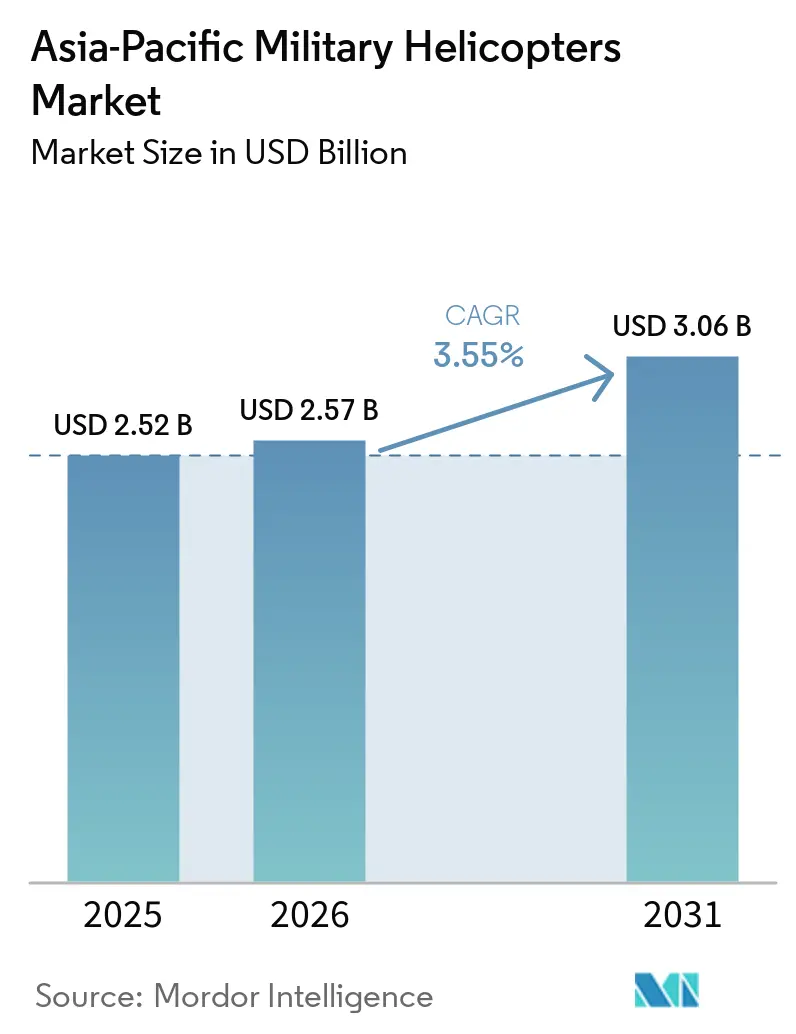
| Base Year Market Size (2025) | USD 2.52 Billion |
| Market Size (2026) | USD 2.57 Billion |
| Market Size (2031) | USD 3.06 Billion |
| Growth Rate (2026 - 2031) | 3.55 % |
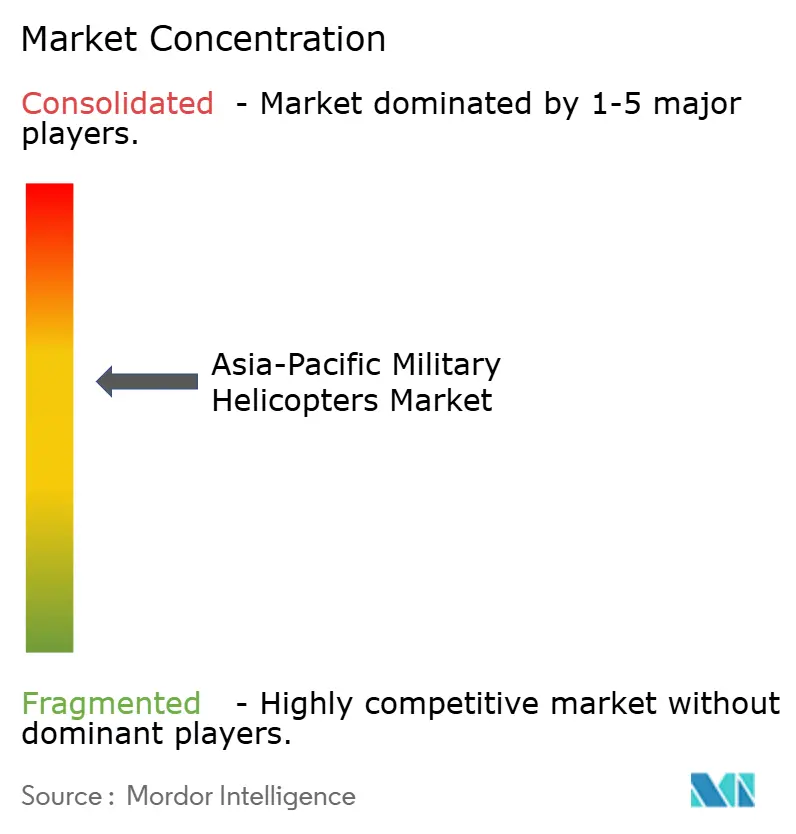
| Market Concentration | Medium |
Major Players *Disclaimer: Major Players sorted in no particular order Image © Mordor Intelligence. Reuse requires attribution under CC BY 4.0. | |
Asia-Pacific Military Helicopters Market Analysis by Mordor Intelligence
The Asia-Pacific military helicopters market size was valued at USD 2.52 billion in 2025 and is forecast to grow from USD 2.57 billion in 2026 to USD 3.06 billion by 2031, registering a 3.55% CAGR between 2026 and 2031. Rising defense expenditure provides the market with a firmer procurement base, particularly as governments replace aging fleets or add naval aviation capacity. The operating demands are unusually varied, ranging from maritime surveillance and island logistics to high-altitude deployment and disaster response. These missions favor adaptable aircraft, but they also require buyers to balance performance, domestic production, and lifetime support costs. The Asia-Pacific military helicopters market is therefore developing on two tracks, with high-capability Western platforms serving specific operational gaps while national manufacturers build their domestic positions. Data-sovereignty rules, certification requirements, and export controls are likely to keep contract schedules long even when budget commitments are clear.
Key Report Takeaways
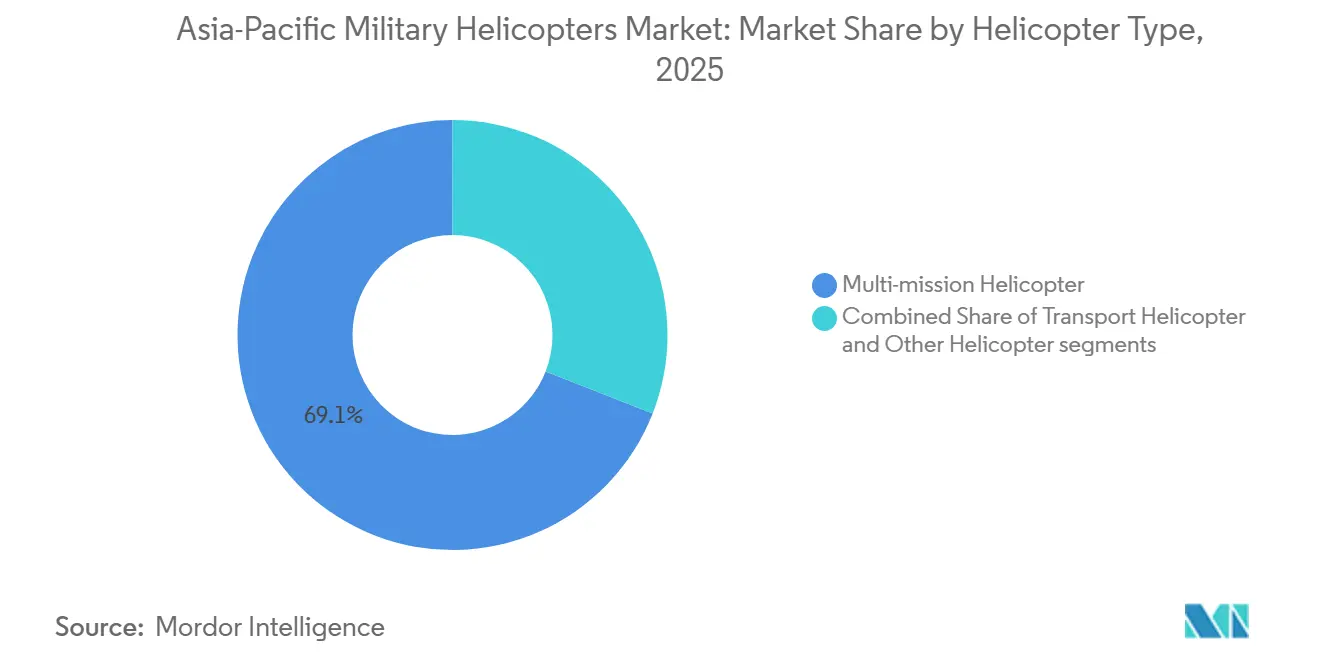
- By helicopter type, multi-mission helicopters held 69.06% of the Asia-Pacific military helicopters market share in 2025, while other helicopters are forecast to grow at a 5.02% CAGR through 2031.
- By end-user service, Army Aviation held 46.56% of the Asia-Pacific military helicopters market share in 2025, while Naval/Marine Corps Aviation is forecast to grow at a 4.83% CAGR through 2031.
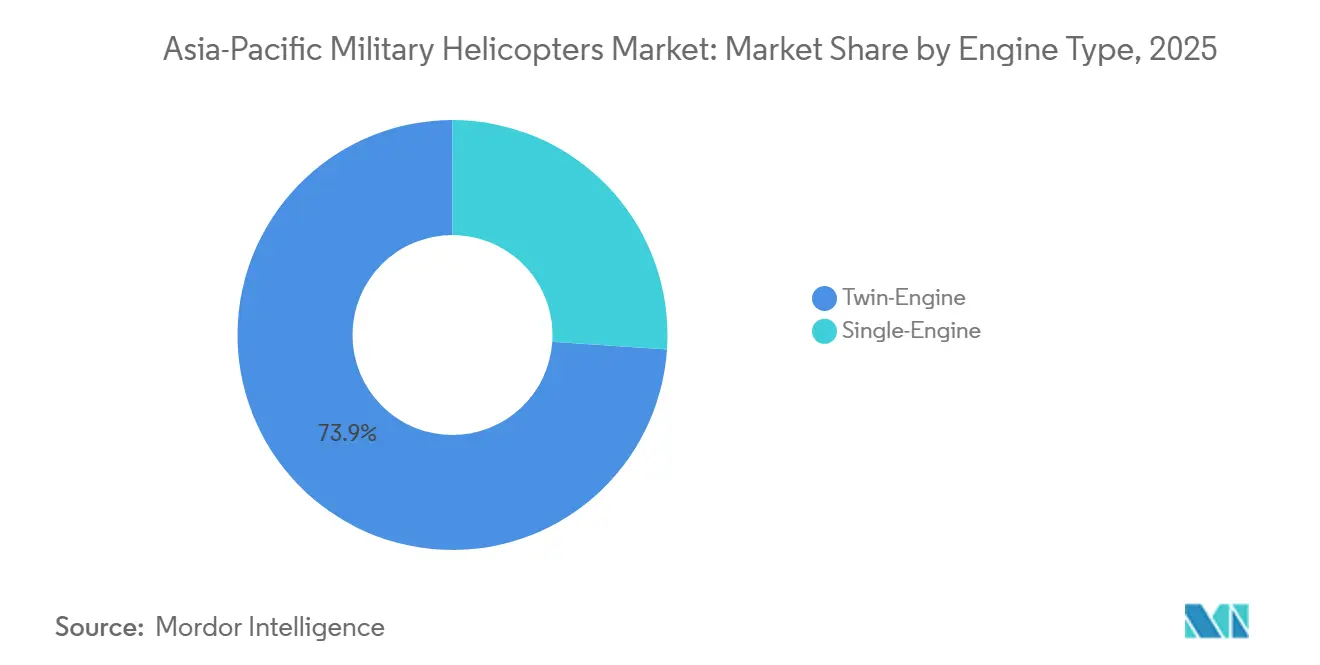
- By engine type, twin-engine helicopters held 73.93% of the Asia-Pacific military helicopters market share in 2025, while single-engine helicopters are forecast to grow at a 4.94% CAGR through 2031.
- By application, troop transport accounted for 40.72% of the Asia-Pacific military helicopters market share in 2025, while humanitarian and disaster relief is forecast to grow at a 5.16% CAGR through 2031.
- By geography, China held 39.78% of the Asia-Pacific military helicopters market share in 2025, while India is forecast to grow at a 5.46% CAGR through 2031.
Note: Market size and forecast figures in this report are generated using Mordor Intelligence’s proprietary estimation framework, updated with the latest available data and insights as of January 2026.
Asia-Pacific Military Helicopters Market Trends and Insights
Drivers Impact Analysis*
| Driver | (~) % Impact on CAGR Forecast | Geographic Relevance | Impact Timeline |
|---|---|---|---|
| Rising maritime security and naval aviation demand | +0.80% | Asia-Pacific core, including Japan, South Korea, India, Australia, and ASEAN | Long term (≥ 4 years) |
| Fleet renewal and replacement of aging platforms | +0.70% | Global, concentrated in Australia, Japan, India, and South Korea | Medium term (2-4 years) |
| Indigenous rotorcraft development and technology transfer | +0.60% | India, South Korea, China, and Indonesia | Long term (≥ 4 years) |
| Multi-mission medium-utility platform demand | +0.50% | Global, with elevated demand in India and Southeast Asia | Medium term (2-4 years) |
| High-altitude rotorcraft requirements in Himalayan and plateau environments | +0.40% | China and India, concentrated in Himalayan border areas | Long term (≥ 4 years) |
| Distributed shipboard operations and island logistics | +0.30% | Philippines, Indonesia, Japan, Australia, and Pacific Islands | Medium term (2-4 years) |
| Source: Mordor Intelligence | |||
Fleet Renewal and Replacement of Aging Platforms
Fleet replacement is creating a dependable baseline for the Asia-Pacific military helicopters market through the late 2020s. Australia received its first 2 of 29 AH-64E Apache helicopters in October 2025 as part of Project Land 4503, replacing the Tiger fleet.[1] Boeing also received a 7-year support contract for the Australian Apache fleet, covering maintenance, engineering, training, and logistics. Japan moved from the SH-60K to the SH-60L, keeping naval helicopter renewal active even after the earlier program had matured. The April 2024 collision involving 2 Japanese SH-60K helicopters also showed how safety events can heighten the urgency of planned replacement decisions. The market benefits when operators convert these maintenance and availability concerns into funded procurement programs.
Rising Maritime Security and Naval Aviation Demand
Maritime security needs are moving naval aviation ahead of other end-user groups in the Asia-Pacific military helicopters market. South Korea approved its Maritime Operational Helicopter-II project in September 2026 to replace aging Westland Lynx aircraft and expand anti-submarine warfare (ASW) capacity. India continued its MH-60R induction program, while the US approved a potential Foreign Military Sale (FMS) of 5 MH-60R helicopters to New Zealand in June 2026. Warship programs create a related requirement because frigates and destroyers need to be equipped with embarked rotary-wing aircraft for surveillance, ASW, and logistics. This connection between shipbuilding and aviation gives the market a demand that is less dependent on a single annual budget decision. It also favors aircraft with established maritime support systems and shipboard operating records.
Indigenous Rotorcraft Development and Technology Transfer
Domestic production policies are changing access to the Asia-Pacific military helicopters market. India’s Defense Acquisition Council approved the procurement of additional Advanced Light Helicopters in September 2026 as part of a capital acquisition package that prioritized domestic industry. HAL also secured a March 2026 contract for 6 ALH Mk-III maritime-role helicopters for the Indian Coast Guard, including performance-based logistics support. South Korea has followed a similar path with the Marine Attack Helicopter program, built around the Surion airframe. The program completed its maiden flight in December 2024 and was expected to complete development in late 2026. These programs narrow direct-import opportunities but create larger and more durable domestic production and support requirements.
Multi-Mission Medium-Utility Platform Demand
Multi-mission aircraft are central to procurement planning because they can support transport, search and rescue, disaster relief, and special operations from a common platform. The Philippines completed its acquisition of 32 S-70i Black Hawk helicopters in August 2026, bringing its fleet to 47 aircraft. India’s 2025 requests for information covered 276 helicopters for reconnaissance, surveillance, and naval utility, with long-term support and domestic production as key considerations. Indonesia also tested an H225M Caracal, co-produced by Airbus and PT Dirgantara Indonesia, in September 2025. The Asia-Pacific military helicopters market is therefore rewarding designs that can deliver broader mission coverage without forcing operators to establish several separate fleets. These requirements are also raising expectations for mission systems, payload, and sustainment capability in the medium-utility class.
Restraints Impact Analysis*
| Restraint | (~) % Impact on CAGR Forecast | Geographic Relevance | Impact Timeline |
|---|---|---|---|
| Long procurement cycles and budget constraints | -0.50% | Global, most acute in Southeast Asia | Medium term (2-4 years) |
| Export controls and technology-transfer restrictions | -0.40% | Asia-Pacific-wide, especially India-US and ASEAN-West transactions | Long term (≥ 4 years) |
| High lifecycle sustainment costs for small and mixed fleets | -0.30% | Indonesia, Philippines, and Rest of Asia-Pacific | Medium term (2-4 years) |
| Certification, data sovereignty and mission-system integration complexity | -0.20% | India, Australia, and South Korea | Long term (≥ 4 years) |
| Source: Mordor Intelligence | |||
Long Procurement Cycles and Budget Constraints
Government contracting timelines limit how quickly identified demand becomes delivered aircraft. Nepal agreed in June 2026 to accept 6 Bell utility helicopters from the US after extended internal discussion. Thailand inducted 4 UH-60M Black Hawks in September 2026, following a procurement process linked to an earlier US contract modification. Smaller defense budgets can be particularly constrained by the operating cost of advanced platforms. Their aircraft programs often require lengthy approval, financing, training, and infrastructure decisions before delivery begins. As a result, revenue in the Asia-Pacific military helicopters market may lag the value implied by public announcements. This timing gap is especially important for suppliers that rely on a small group of emerging operators.
Export Controls and Technology-Transfer Restrictions
Export-control rules continue to constrain the transfer of high-value military helicopter technologies. US regulations govern the transfer of engines, avionics, and mission systems associated with FMS. These rules can limit how much maintenance, upgrading, and component production an importing country can perform independently. China’s development of the Turboshaft-10 for the Z-20T underscores its commitment to reducing reliance on imported propulsion components.[2] The same restrictions can make Chinese aircraft more attractive, where Western technology-transfer approvals take longer. This does not remove certification, integration, or sustainment challenges, but it can change the relative appeal of competing suppliers.
*Our forecasts treat driver/restraint impacts as directional, not additive. The impact forecasts reflect baseline growth, mix effects, and variable interactions.
Segment Analysis
By Helicopter Type: Multi-Mission Platforms Drive Volume, Training Types Gain Pace
Multi-mission helicopters accounted for 69.06% of the Asia-Pacific military helicopters market share in 2025. Their lead reflects a preference for aircraft that can move troops, support special operations, conduct maritime operations, and respond to emergencies under a single acquisition program. China’s Z-20 family illustrates this approach through utility, naval, assault, and high-altitude variants that share a common platform. The Z-20T made its public debut at the 7th China Helicopter Exposition in October 2025. Transport helicopters remain important for operators who need dedicated logistics, medical evacuation, and heavy-lift capabilities. These missions can require specialized designs because multi-mission compromises are not always suitable for large loads or long-range support. The market thus continues to require both adaptable medium aircraft and focused transport platforms.
Other helicopters are forecast to grow at a 5.02% CAGR through 2031, making them the fastest-growing category. This grouping includes light reconnaissance helicopters and dedicated training aircraft. Expanding fleets require more pilots, and training demand rises as armed forces add combat, utility, and maritime aircraft. Smaller helicopters can provide lower-cost flight hours for basic rotary-wing instruction and routine utility roles. They can also meet island logistics and border-surveillance requirements where mission risk is lower than for frontline naval operations. Japan’s broader SH-60L transition creates a need for reliable training and support capacity around naval aviation. Suppliers that can meet certification standards and provide simple maintenance support may find opportunities in these narrower roles.

By End-User Service: Army Dominance Persists, Naval Aviation Disrupts the Pace
Army Aviation accounted for 46.56% of the Asia-Pacific military helicopters market in 2025. China, India, and South Korea operate large army aviation forces with continuing requirements across attack, reconnaissance, utility, and transport missions. India’s order pipeline includes 156 Prachand light combat helicopters and 34 Dhruv aircraft, supporting long-term domestic production planning. South Korea completed delivery of its 245-unit Surion fleet to the Republic of Korea Army in 2024, providing a substantial base for support and future upgrades. Army helicopters remain essential for rapid deployment across land borders, through difficult terrain, and in areas with limited ground access. Their broad mission range helps preserve the Army’s market position.
Naval and Marine Corps Aviation is forecast to grow at a 4.83% CAGR through 2031. The segment is supported by concurrent ASW requirements in South Korea, India, New Zealand, and Australia. The US approval for New Zealand’s potential acquisition of 5 MH-60R helicopters shows that smaller maritime operators are also replacing older naval aircraft. Naval fleets need aircraft that can carry sensors, weapons, and rescue equipment while operating from ships. New frigates and destroyers, therefore, create a related aviation requirement that extends beyond a single helicopter contract. Air Force, Paramilitary and Coast Guard, and Joint/Special Operations users create additional demand for special operations, transport, and maritime enforcement. This service mix provides the Asia-Pacific military helicopters market with several demand channels, even when army orders are uneven.
By Engine Type: Twin-Engine Reliability Prevails, Single-Engine Economics Accelerate
Twin-engine helicopters accounted for 73.93% of the Asia-Pacific military helicopters market share in 2025. Their position is tied to missions where redundancy is important, including over-water patrols, shipboard operations, and high-altitude flights. Maritime aircraft often need the payload margin to carry sensors, communications systems, weapons, and rescue equipment. India’s ALH Mk-III maritime aircraft, Indonesia’s H225M, and Japan’s SH-60L reflect these demanding operating conditions. PT Dirgantara Indonesia’s H225M testing in September 2025 highlighted the country’s interest in a capable medium helicopter with domestic industrial participation.[3] Twin-engine designs will remain important where the consequences of engine failure are severe.
Single-engine helicopters are forecast to grow at a 4.94% CAGR through 2031. Their economics suit pilot training, routine utility work, and selected island or border missions. These aircraft generally offer lower operating costs when their payload and redundancy limits fit the task. This makes them useful for forces trying to expand pilot capacity without assigning more costly operational aircraft to basic training. The category can also support surveillance and logistics missions in lower-risk settings. The split between single- and twin-engine aircraft is therefore closely linked to mission risk, terrain, and fleet economics. The market will continue to require both configurations rather than moving toward a single standard architecture.
By Application: Troop Transport Anchors Share, Humanitarian Demand Moves Fastest
Troop transport accounted for 40.72% of the Asia-Pacific military helicopters market share in 2025. Rapid movement of personnel remains important across mountain borders, island chains, and areas with limited road access. China’s scale of domestic helicopter production supports its large transport and utility requirements. India, Australia, and South Korea also need rotorcraft capable of quickly deploying troops and supplies. Transport missions can include casualty evacuation, resupply, special operations support, and disaster response. These overlapping uses make troop transport a durable core application for the market. They also reinforce demand for aircraft that can be operated and maintained from dispersed bases.
Humanitarian and disaster relief is forecast to grow at a 5.16% CAGR through 2031. Governments increasingly use civil-defense functions to support helicopter procurement decisions. The Philippines described its expanded S-70i fleet as an asset for transport, humanitarian response, and search-and-rescue missions across the archipelago. The first 2 Bell 412EPX aircraft were inducted into the Philippine Air Force in May 2026, adding a separate utility option to the fleet. Combat and close-air-support demand is also progressing through Australian Apache deliveries, South Korea’s Marine Attack Helicopter program, and India’s Prachand order. Training demand grows alongside these fleet additions because aircrew availability must keep pace with aircraft deliveries. Humanitarian missions now play a practical role in acquisition planning by strengthening the case for platforms with military utility.
Geography Analysis
China held 39.78% market share in the Asia-Pacific military helicopters market in 2025. Its position reflects procurement volumes that remain larger than those of other regional operators. The Z-20 family gives China a common domestic platform for utility, naval, assault, and high-altitude missions. The Z-20T’s 2025 presentation showed continued expansion of this family into specialized combat roles. This approach can reduce supply-chain fragmentation while allowing distinct mission variants. China’s domestic scale also supports a broader industrial base for production, engines, parts, and sustainment. These advantages make China the primary volume center in the market.
India is forecast to grow at a 4.46% CAGR through 2031. SIPRI reported that India’s military expenditure rose 8.9% to USD 92.10 billion in 2025. The country has confirmed HAL orders for Dhruv and Prachand helicopters, as well as continuing interest in a much larger group of reconnaissance, surveillance, and naval utility aircraft. India’s procurement policy places strong emphasis on domestic manufacturing and long-term support. This policy supports HAL while restricting the role of direct platform imports. Foreign suppliers retain opportunities in areas where specialized naval, heavy-lift, or advanced-attack capabilities are required. India will remain an important source of both domestic production and partnership activity in the market.
Japan and South Korea are technically advanced buyers with strong naval and industrial requirements. Japan continues to transition its naval fleet to the SH-60L and maintains a broader defense buildup to support maritime readiness. South Korea’s Maritime Operational Helicopter-II project and Marine Attack Helicopter program cover both naval and amphibious requirements. Indonesia combines domestic industrial participation with medium and heavy-lift modernization, including the H225M effort and AW189 procurement. Australia is replacing its Tiger fleet with 29 AH-64E Apaches, with initial operating capability expected in the second half of 2027. The Philippines, Thailand, New Zealand, and Nepal form a meaningful group of smaller buyers, often using US FMS or allied support arrangements. These countries create a steady demand for utility, maritime, and disaster-response aircraft, even when their individual orders are modest.
Competitive Landscape
The Asia-Pacific military helicopters market is moderately consolidated at the original equipment manufacturer level. Airbus, Leonardo, Lockheed Martin, Sikorsky, and Boeing remain important in high-capability Western programs. HAL, KAI, AVIC, Kawasaki, and Mitsubishi Heavy Industries are strengthening their positions in domestic procurement. The competitive balance varies by mission because naval ASW, heavy-lift, training, and medium utility aircraft each have distinct performance requirements. The MH-60R has been selected or considered in several regional maritime programs, including those involving India and New Zealand. AVIC’s Z-20 family has strategic importance because domestic scale supports several military variants. National production policies mean suppliers must compete on industrial participation, service commitments, and aircraft capability.
Boeing’s Australian Apache support contract is an example of service-led competition in the region. The arrangement covers maintenance, engineering, training, and logistics throughout the early years of the fleet. KAI is building its position through the Surion platform and the Marine Attack Helicopter program, which reduces development risk by using a proven airframe. HAL’s Coast Guard ALH Mk-III contract also included performance-based logistics support, showing the importance of availability commitments. These examples show that aircraft suppliers increasingly need to offer maintenance, training, parts, and engineering support as part of the core proposal. This favors companies with local partners, installed fleets, and long-term service infrastructure. It also raises the cost of entering an established national program with a platform-only offer.
The Asia-Pacific military helicopters market still offers replacement opportunities for lighter utility aircraft. Aging Chetak, Bell 206, and Alouette-derived fleets create a requirement for practical replacement options in several countries. However, cost, local assembly, and sustainment terms will be as important as the aircraft itself. Western suppliers retain a position in specialized capability niches, particularly advanced maritime, heavy-lift, and high-end attack helicopters. National manufacturers have an advantage where policy requires local content, technology transfer, or assured domestic support.
Asia-Pacific Military Helicopters Industry Leaders
-
The Boeing Company
-
Airbus SE
-
Aviation Industry Corporation of China, Ltd.
-
Lockheed Martin Corporation
-
Hindustan Aeronautics Limited
- *Disclaimer: Major Players sorted in no particular order
Recent Industry Developments
- September 2026: South Korea's Defense Acquisition Program Administration (DAPA) approved a major Maritime Operational Helicopter-II project to procure approximately 20 Lockheed Martin MH-60R Seahawks for the Republic of Korea Navy, replacing aging Westland Lynx frames. The program is scheduled to run through 2032 and expand the Republic of Korea Navy's ASW capability.
- September 2026: India's Defense Acquisition Council accorded Acceptance of Necessity for Advanced Light Helicopters as part of a total INR 1.10 lakh crore (USD 11.14 billion) capital acquisition package, with 98% of procurements to be sourced from Indian industry.
- August 2026: The Philippine Air Force completed the delivery milestone of its 32 Sikorsky S-70i Black Hawk helicopters, bringing the Philippines to 47 aircraft in service. The fleet supports troop transport, humanitarian response, and search-and-rescue missions.
Asia-Pacific Military Helicopters Market Report Scope
Military helicopters are rotary-wing aircraft designed for defense and security missions across land and maritime domains. Equipped with mission-specific avionics, weapon systems, survivability features, and advanced propulsion systems, they support tactical, strategic, and humanitarian operations, including combat support, troop transport, reconnaissance, search and rescue, logistics, and disaster relief in diverse and contested environments.
The Asia-Pacific military helicopters market is segmented by helicopter type, end-user service, engine type, application, and geography. By helicopter type, the market is segmented into multi-mission, transport, and other helicopters. By end-user service, the market is segmented into air force, army aviation, naval/marine corps aviation, joint/special operations, and paramilitary and coast guard. By engine type, the market is segmented into single-engine and twin-engine helicopters. By application, the market is segmented into combat and close air support, troop transport, humanitarian and disaster relief, and pilot training. The report also covers the market sizes and forecasts for the Asia-Pacific military helicopters market in six countries across the region. For each segment, the market size is provided in terms of value (USD).
By Helicopter Type
| Multi-mission Helicopter |
| Transport Helicopter |
| Other Helicopter |
By End-User Service
| Air Force |
| Army Aviation |
| Naval/Marine Corps Aviation |
| Joint/Special Operations |
| Paramilitary and Coast Guard |
By Engine Type
| Single-Engine |
| Twin-Engine |
By Application
| Combat and Close Air Support |
| Troop Transport |
| Humanitarian and Disaster Relief |
| Pilot Training |
By Geography
| China |
| India |
| Japan |
| South Korea |
| Indonesia |
| Australia |
| Rest of Asia-Pacific |
| By Helicopter Type | Multi-mission Helicopter |
| Transport Helicopter | |
| Other Helicopter | |
| By End-User Service | Air Force |
| Army Aviation | |
| Naval/Marine Corps Aviation | |
| Joint/Special Operations | |
| Paramilitary and Coast Guard | |
| By Engine Type | Single-Engine |
| Twin-Engine | |
| By Application | Combat and Close Air Support |
| Troop Transport | |
| Humanitarian and Disaster Relief | |
| Pilot Training | |
| By Geography | China |
| India | |
| Japan | |
| South Korea | |
| Indonesia | |
| Australia | |
| Rest of Asia-Pacific |
Market Definition
- Aircraft Type - All the military rotorcraft which are used for various applications are included in this study.
- Sub-Aircraft Type - For this study, all the military helicopters based on their application are considered.
- Body Type - Multi-Mission Helicopters, Transport Helicopters, Training Helicopters and various other rotorcraft are considered in this study.
| Keyword | Definition |
|---|---|
| IATA | IATA stands for the International Air Transport Association, a trade organization composed of airlines around the world that has an influence over the commercial aspects of flight. |
| ICAO | ICAO stands for International Civil Aviation Organization, a specialized agency of the United Nations that supports aviation and navigation around the globe. |
| Air Operator Certificate (AOC) | A certificate granted by a National Aviation Authority permitting the conduct of commercial flying activities. |
| Certificate Of Airworthiness (CoA) | A Certificate Of Airworthiness (CoA) is issued for an aircraft by the civil aviation authority in the state in which the aircraft is registered. |
| Gross Domestic Product (GDP) | Gross domestic product (GDP) is a monetary measure of the market value of all the final goods and services produced in a specific time period by countries. |
| RPK (Revenue Passenger Kilometres) | The RPK of an airline is the sum of the products obtained by multiplying the number of revenue passengers carried on each flight stage by the stage distance - it is the total number of kilometers traveled by all revenue passengers. |
| Load Factor | The load factor is a metric used in the airline industry that measures the percentage of available seating capacity that has been filled with passengers. |
| Original Equipment Manufacturer (OEM) | An original equipment manufacturer (OEM) traditionally is defined as a company whose goods are used as components in the products of another company, which then sells the finished item to users. |
| International Transportation Safety Association (ITSA) | International Transportation Safety Association (ITSA) is an international network of heads of independent safety investigation authorities (SIA). |
| Available Seats Kilometre (ASK) | This metric is calculated by multiplying Available Seats (AS) in one flight, defined above, multiplied by the distance flown. |
| Gross Weight | The fully-loaded weight of an aircraft, also known as “takeoff weight,” which includes the combined weight of passengers, cargo, and fuel. |
| Airworthiness | The ability of an aircraft, or other airborne equipment or system, to operate in flight and on the ground without significant hazard to aircrew, ground crew, passengers or to other third parties. |
| Airworthiness Standards | Detailed and comprehensive design and safety criteria applicable to the category of aeronautical product (aircraft, engine or propeller). |
| Fixed Base Operator (FBO) | A business or organization that operates at an airport. An FBO provides aircraft operating services like maintenance, fueling, flight training, charter services, hangaring, and parking. |
| High Net worth Individuals (HNWIs) | High Net worth Individuals (HNWIs) are individuals with over USD 1 million in liquid financial assets. |
| Ultra High Net worth Individuals (UHNWIs) | Ultra High Net worth Individuals (UHNWIs) are individuals with over USD 30 million in liquid financial assets. |
| Federal Aviation Administration (FAA) | The division of the Department of Transportation is concerned with aviation. It operates Air Traffic Control and regulates everything from aircraft manufacturing to pilot training to airport operations in the United States. |
| EASA (European Aviation Safety Agency) | The European Aviation Safety Agency is a European Union agency established in 2002 with the task of overseeing civil aviation safety and regulation. |
| Airborne Warning and Control System (AW&C) aircraft | Airborne Warning and Control System (AEW&C) aircraft is equipped with a powerful radar and on-board command and control center to direct the armed forces. |
| The North Atlantic Treaty Organization (NATO) | The North Atlantic Treaty Organization (NATO), also called the North Atlantic Alliance, is an intergovernmental military alliance between 30 member states – 28 European and two North American. |
| Joint Strike Fighter (JSF) | Joint Strike Fighter (JSF) is a development and acquisition program intended to replace a wide range of existing fighter, strike, and ground attack aircraft for the United States, the United Kingdom, Italy, Canada, Australia, the Netherlands, Denmark, Norway, and formerly Turkey. |
| Light Combat Aircraft (LCA) | A light combat aircraft (LCA) is a light, multirole jet/turboprop military aircraft, commonly derived from advanced trainer designs, designed for engaging in light combat. |
| Stockholm International Peace Research Institute (SIPRI) | Stockholm International Peace Research Institute (SIPRI) is an international institute that provides data, analysis, and recommendations for armed conflict, military expenditure, and arms trade as well as disarmament and arms control. |
| Maritime Patrol Aircraft (MPA) | A maritime patrol aircraft (MPA), also known as maritime reconnaissance aircraft is a fixed-wing aircraft designed to operate for long durations over water in maritime patrol roles, in particular, anti-submarine warfare (ASW), anti-ship warfare (AShW), and search and rescue (SAR). |
| Mach Number | The Mach number is defined as the ratio of true airspeed to the speed of sound at the altitude of a given aircraft. |
| Stealth Aircraft | Stealth is a Common term applied to low observable (LO) technology and doctrine, that makes an aircraft near invisible to radar, infrared or visual detection. |
Research Methodology
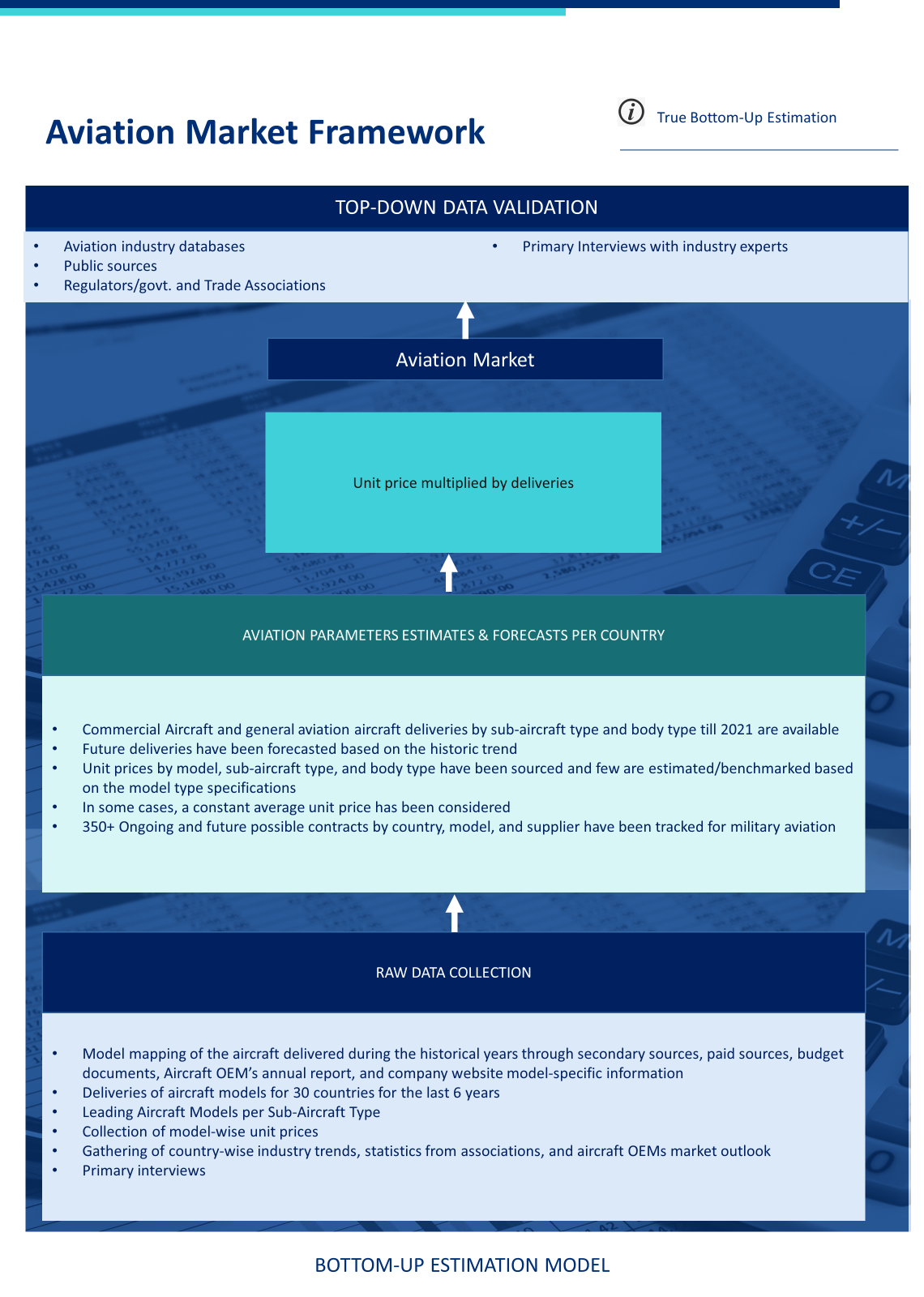
Mordor Intelligence follows a four-step methodology in all our reports.
- Step-1: Identify Key Variables: In order to build a robust forecasting methodology, the variables and factors identified in Step-1 are tested against available historical market numbers. Through an iterative process, the variables required for market forecast are set and the model is built on the basis of these variables.
- Step-2: Build a Market Model: Market-size estimations for the historical and forecast years have been provided in revenue and volume terms. For sales conversion to volume, the average selling price (ASP) is kept constant throughout the forecast period for each country, and inflation is not a part of the pricing.
- Step-3: Validate and Finalize: In this important step, all market numbers, variables and analyst calls are validated through an extensive network of primary research experts from the market studied. The respondents are selected across levels and functions to generate a holistic picture of the market studied.
- Step-4: Research Outputs: Syndicated Reports, Custom Consulting Assignments, Databases & Subscription Platforms