
Asia-Pacific Medical Tourism Market Size and Share
Market Overview
| Study Period | 2020 - 2031 |
|---|---|
| Forecast Data Period | 2026 - 2031 |
| Historical Data Period | 2020 - 2024 |
| Market Size (2026) | USD 70.77 Billion |
| Market Size (2031) | USD 145.66 Billion |
| Growth Rate (2026 - 2031) | 15.53 % |
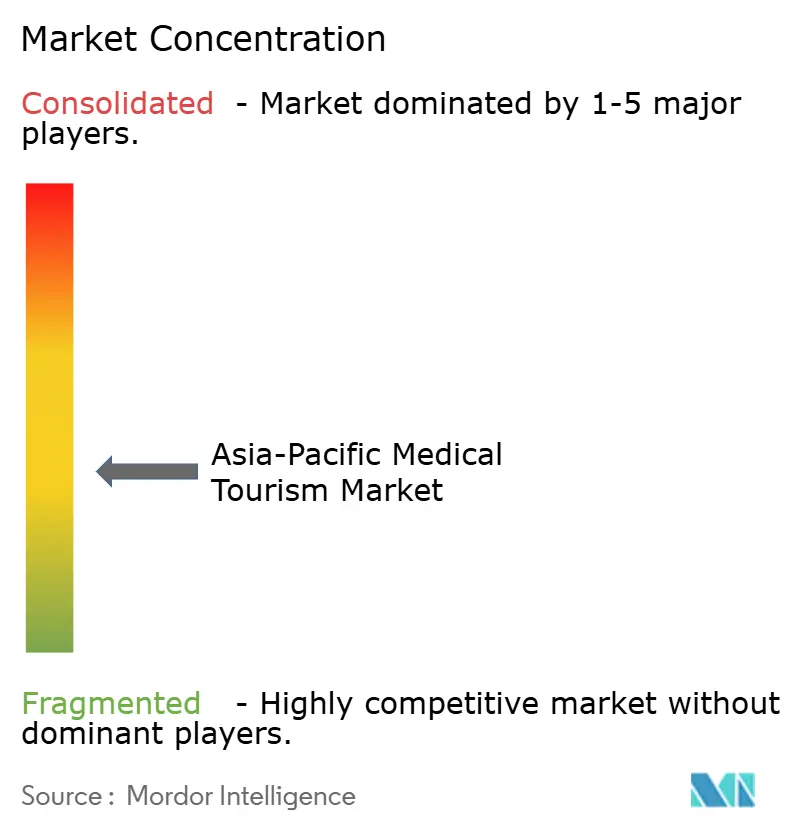
| Market Concentration | Medium |
Major Players *Disclaimer: Major Players sorted in no particular order Image © Mordor Intelligence. Reuse requires attribution under CC BY 4.0. | |
Asia-Pacific Medical Tourism Market Analysis by Mordor Intelligence
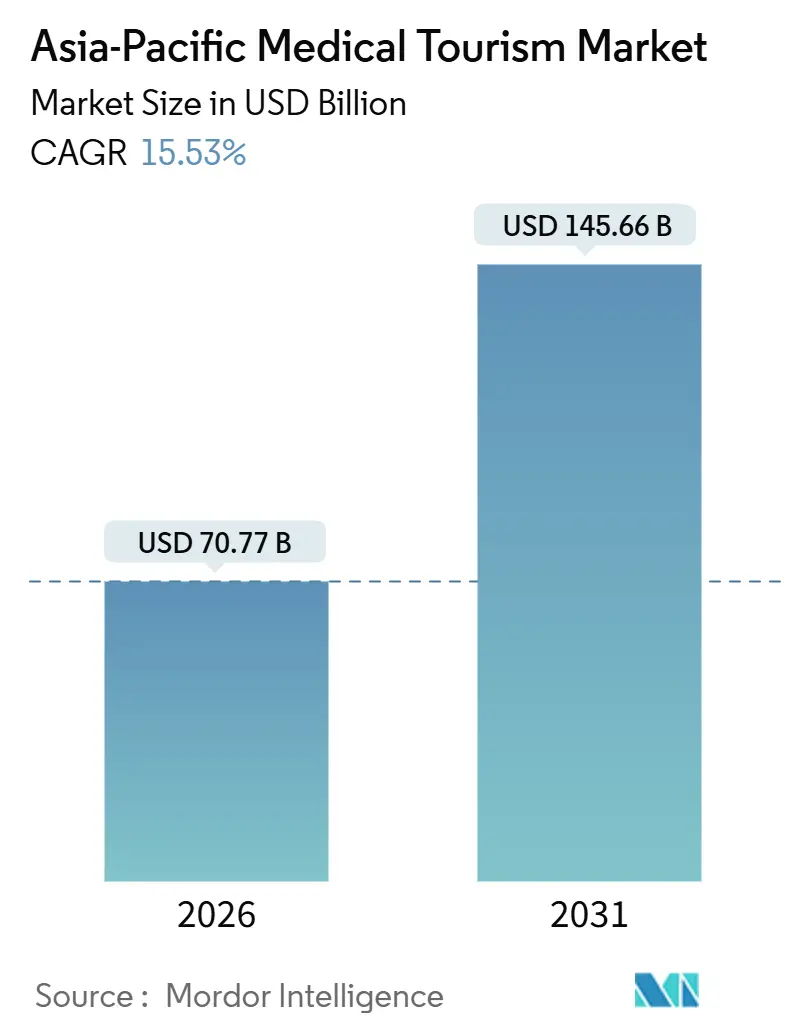
The Asia-Pacific Medical Tourism Market size is estimated at USD 70.77 billion in 2026, and is expected to reach USD 145.66 billion by 2031, at a CAGR of 15.53% during the forecast period (2026-2031).
Demand rests on a structural 40%–80% cost advantage over OECD providers, an expanding network of more than 1,100 Joint Commission International (JCI)-accredited hospitals, and rapid adoption of surgical robotics that narrows perceived quality gaps. Private hospital chains continue to invest in specialized oncology, fertility, and robotic orthopedic suites, while ASEAN cross-border insurance pilots and visa liberalization reduce administrative friction for patients. Mid-tier facilities in Vietnam and Malaysia are scaling capacity to serve middle-income travelers who now access partial insurance reimbursement for overseas care. Conversely, travel-health concerns and medical inflation of 5%–8% annually temper the cost arbitrage that underpins patient flows.
Key Report Takeaways
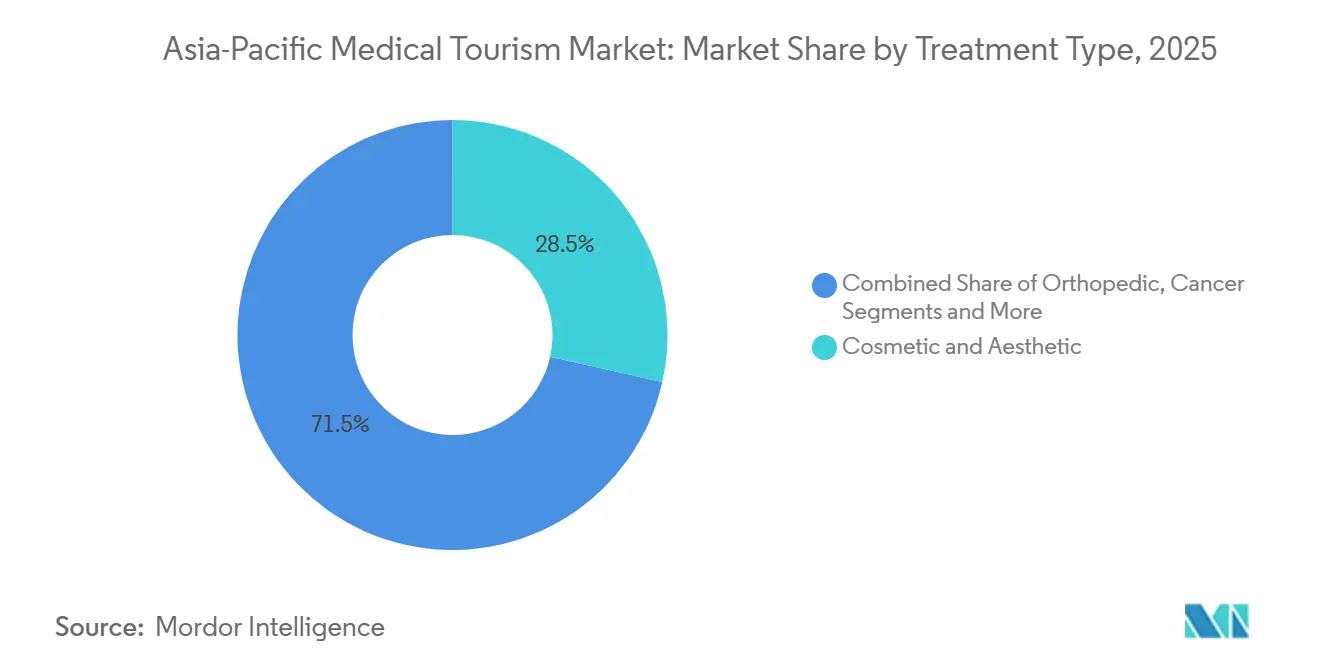
- By treatment type, cosmetic and aesthetic procedures held 28.55% revenue share of the Asia-Pacific medical tourism market in 2025, while orthopedic surgery is forecast to grow at an 18.25% CAGR to 2031.
- By service provider, private hospitals captured 60.53% of the Asia-Pacific medical tourism market share in 2025, whereas ambulatory surgical centers record the fastest projected CAGR at 19.85% through 2031.
- By country, India accounted for 25.13% of the Asia-Pacific medical tourism market size in 2025 and Vietnam is advancing at an 18.51% CAGR to 2031.
Note: Market size and forecast figures in this report are generated using Mordor Intelligence’s proprietary estimation framework, updated with the latest available data and insights as of January 2026.
Worldwide, activity is shaped by contributions from multiple regions, with Asia representing one of the more structurally developed among them. The global report on medical tourism market by Mordor Intelligence reflects how these regional layers combine into a single system.
Market Trends and Insights
Drivers Impact Analysis of Asia-Pacific Medical Tourism Market*
| Driver | (~) % Impact on CAGR Forecast | Geographic Relevance | Impact Timeline |
|---|---|---|---|
| Cost differential versus OECD countries | +3.2% | India, Thailand, Vietnam, Malaysia | Long term (≥4 years) |
| Rising middle-class affluence & insurance portability | +2.8% | Thailand, Malaysia, Vietnam, India, China | Medium term (2-4 years) |
| Government visa & promotion schemes | +2.1% | India, Thailand, Vietnam, Malaysia, South Korea | Short term (≤2 years) |
| Proliferation of JCI-accredited hospitals | +2.5% | Thailand, Singapore, India, South Korea | Medium term (2-4 years) |
| Adoption of surgical robotics & advanced tech | +3.0% | South Korea, Japan, Singapore, India, China | Long term (≥4 years) |
| ASEAN cross-border insurance frameworks | +1.7% | ASEAN member states | Medium term (2-4 years) |
| Source: Mordor Intelligence | |||
Cost Differential Versus OECD Countries
Elective procedures in Bangkok or Chennai cost 40%–80% less than in the United States, United Kingdom, or Australia[1]. A knee replacement in Thailand averages USD 12,000 against USD 50,000 in the United States, and cosmetic rhinoplasty in Seoul runs USD 3,500 compared with USD 15,000 in Sydney. Lower physician salaries, subsidized medical-device production under India’s Production Linked Incentive scheme, and cheaper real-estate underpin the advantage. Malaysia’s “Year of Medical Tourism 2026” bundles treatment and hotel packages priced 60% below home-country rates for Gulf patients.
Rising Middle-Class Affluence & Insurance Portability
ASEAN added 50 million middle-income households between 2020 and 2024, lifting discretionary healthcare budgets. Cross-border insurance pilots now allow Thai citizens to obtain orthopedic or cardiac care in Malaysia with up to 70% reimbursement. Fertility tourism benefits most: Malaysia attracts Indonesian couples seeking halal-compliant IVF protocols, while Singapore draws Chinese and Indian patients for premium genetic screening.
Government Visa & Promotion Schemes
India’s Medical Visa processed 635,000 entries in 2023, up 40% on 2022, and offers triple-entry stays of 60 days[2]. Thailand grants 90-day medical visas with caregiver access, and Vietnam’s 2024 e-visa cut processing from 15 to 3 days. Malaysia earmarked USD 15 million for global marketing in 2026, emphasizing halal food and prayer facilities.
Proliferation of JCI-Accredited Hospitals
Regional JCI accreditations rose from 800 in 2020 to more than 1,100 in 2025, lifting international-patient confidence. Thailand leads with over 60 certified facilities, and Vietnam added five in 2024 alone. Bumrungrad International now holds direct billing with 500+ insurers, an outcome tied to its accreditation status.
Restraints Impact Analysis of Asia-Pacific Medical Tourism Market*
| Restraint | (~) % Impact on CAGR Forecast | Geographic Relevance | Impact Timeline |
|---|---|---|---|
| Travel-health uncertainty & pandemic after-effects | −2.3% | Japan, Australia, China | Short term (≤2 years) |
| Perceived quality / safety variability | −1.8% | Vietnam, Philippines, Indonesia | Medium term (2-4 years) |
| Post-operative continuity-of-care gaps | −1.5% | Global | Long term (≥4 years) |
| Medical inflation eroding price advantage | −1.9% | India, Thailand, Malaysia, Vietnam | Long term (≥4 years) |
| Source: Mordor Intelligence | |||
Travel-Health Uncertainty & Pandemic After-Effects
Outbound travel from Japan and Australia recovered to only 70% of 2019 levels in 2024, reflecting lingering infection fears and higher insurance premiums[3]. China’s outbound trips stayed subdued at 300,000 because of visa lags and capital-control scrutiny. Booking lead times for Bangkok hospitals stretched to 12 weeks as patients requested multiple teleconsults before traveling.
Perceived Quality / Safety Variability
Singapore publishes annual infection and readmission data, bolstering trust. Vietnam and the Philippines rely on voluntary audits, leading to rare but publicized adverse-event reports. Liability awards remain low, USD 50,000-100,000 in Thailand, versus multi-million-dollar U.S. settlements, which deters risk-averse patients.
*Our forecasts treat driver/restraint impacts as directional, not additive. The impact forecasts reflect baseline growth, mix effects, and variable interactions.
Asia-Pacific Medical Tourism Market Segment Analysis
By Treatment Type:
Orthopedics Re-shapes Demand MixCosmetic and aesthetic procedures held 28.55% of the Asia-Pacific medical tourism market in 2025, underpinned by 705,044 dermatology patients in South Korea and Thailand’s booming device market. In contrast, orthopedic surgery is projected to expand at an 18.25% CAGR, the highest among segments, driven by robotic joint replacements and long public wait times in Japan and Australia. The Asia-Pacific medical tourism market size for dental treatments is climbing on Thailand’s USD 4.2 billion forecast by 2031, with travelers saving up to 70% on implants. Cardiovascular, oncology, fertility, and neurological procedures collectively broaden the regional case-mix as proton therapy and advanced IVF labs open across the region.
Technological parity with OECD centers is narrowing. Proton therapy availability in India and South Korea, together with AI-enabled diagnostic imaging, elevates clinical confidence among high-acuity patients. Meanwhile, bundled wellness add-ons, such as post-operative rehabilitation in Thai resorts or Ayurvedic recovery in Kerala, enhance perceived value. The Asia-Pacific medical tourism industry consequently attracts both cost-sensitive and outcome-driven travelers, balancing elective cosmetics with life-saving oncology and cardiac interventions.

By Service Provider:
Ambulatory Centers Capture Day-Case MigrationPrivate hospitals generated 60.53% of 2025 revenue as multilingual staff and insurer tie-ups funnel patients toward full-service campuses. Ambulatory surgical centers (ASCs), however, are growing 19.85% annually by accommodating low-complexity day cases, particularly ophthalmology and aesthetic procedures in Seoul’s Gangnam district and Singapore’s Novena corridor. The Asia-Pacific medical tourism market share for ASCs is expected to widen as regulators issue streamlined licenses to relieve public-hospital backlogs.
Hospital chain consolidation adds scale efficiencies. IHH Healthcare’s 80-facility network standardizes protocols and centralizes device procurement, trimming costs by up to 20%. Specialty clinics (fertility, dental, eye-care) extend into Tier-2 cities where real-estate and labor are cheaper, offering resilient domestic demand that buffers international volatility. Collectively, these dynamics reinforce patient choice, diversify supply, and encourage price competition.
Geography Analysis
India Medical Tourism Market
India controlled 25.13% of 2025 regional revenue, buoyed by 635,000 arrivals in 2023 and a 2 million-arrival target for 2030. The Asia-Pacific medical tourism market size for India is set for double-digit growth as Apollo, Fortis, and Max invest USD 500 million to add 2,000 beds and 15 cath labs, and as the domestic SSI Mantra robot lowers entry costs for Tier-2 hospitals. Cardiac surgery prices of USD 8,000 and 45 JCI-accredited hospitals preserve India’s competitive edge.
Thailand Medical Tourism Market
Thailand welcomed 1.2 million patients in 2024, generating USD 850 million in revenue. Over 60 JCI hospitals, a 90-day medical visa, and USD 20 million in 2024 marketing spend underscore state support. Cosmetic and IVF volumes climb as Thailand’s aesthetic devices market approaches USD 7.51 billion by 2027, helped by Korean and Chinese demand.
Vietnam and South Korea Medical Tourism Market
Vietnam posts the fastest country CAGR at 18.51% through 2031, propelled by Vinmec’s 10-hospital expansion and Resolution 06/NQ-CP visa liberalization. FV Hospital’s JCI accreditation in 2024 elevates quality perception, while government targets 1 million medical tourists by 2030. South Korea received 1.17 million foreign patients in 2024, with dermatology representing 56.6% of volume, and designated six medical cities that offer tax breaks to high-volume hospitals.
APAC Medical Tourism Market
Malaysia returned to pre-pandemic levels with 1.2 million arrivals in 2023 and seeks USD 2.7 billion revenue by 2030 through its 2026 promotional campaign. Singapore positions itself at the premium end, treating 30,000 foreign oncology and cardiac patients in 2024 at average case values above USD 25,000. China remains a major source market but is also expanding inbound robotics centers, while Australia primarily sends patients abroad to sidestep long orthopedic and dental queues.
Mordor Intelligence provides coverage of the medical tourism market across other key regional markets, including Europe, each with their regulatory frameworks and demand patterns. Detailed country-level analysis extends to India, Japan, Turkey, and Spain incorporating local coverage and market participation, as required.
Regulatory Landscape
Regulation for medical tourism across Asia-Pacific is centered on healthcare-provider licensing, patient-safety and quality reporting, and travel facilitation measures that reduce entry friction for international patients. India runs dedicated medical-visa pathways (with 635,000 medical-visa entries in 2023) and established the National Medical and Wellness Tourism Promotion Board (NMWTB) under the Ministry of Tourism to coordinate stakeholders and standardize promotion. Quality signaling also increasingly depends on global accreditation, with more than 1,100 JCI-accredited hospitals in the region by 2025, alongside country-level transparency requirements such as Singapore Ministry of Health (MOH) submissions by private hospitals that include quarterly surgical complication rates and patient satisfaction metrics.
Several markets are adding program-style frameworks that affect how providers package services for inbound patients. Viet Nam is running a Ministry of Health project for 2025-2030 aimed at developing high-quality medical services with criteria for hospitals serving international patients, aligned with the broader push to meet international standards (JCI or equivalent) for a defined set of hospitals. At the regional level, ASEAN workstreams have assessed gaps in health and wellness tourism, reinforcing the role of cross-border coordination alongside national rules. By contrast, Japan has been characterized as lacking a single dedicated inbound medical-tourism law (as of September 2025), and it relies on compliance under existing sector statutes such as the Medical Practitioners Act and the Travel Agency Act.
Competitive Landscape
The top groups, IHH Healthcare, Bangkok Dusit Medical Services (BDMS), Apollo Hospitals, Bumrungrad International, and Raffles Medical, collectively account for a relatively small share of regional revenue, confirming a fragmented arena ripe for niche specialists. IHH leverages its 80-hospital footprint across 10 countries to cross-refer oncology and cardiac cases, reducing device costs via bulk procurement. BDMS operates 50 hospitals in Thailand, Cambodia, and Myanmar, channeling complex cases to Bangkok flagships equipped with proton therapy suites. Apollo’s 71-facility network services underserved South Asian and African patients, aided by a telemedicine platform spanning 140 countries.
Competitive strategy centers on technology and insurer partnerships. Bumrungrad International maintains 500+ direct-billing agreements that insulate revenue from currency swings. Robotic-surgery installations correlate with 20%–30% upticks in overseas inquiries within a year. Emerging disruptors include Vinmec in Vietnam, which added 1,500 beds and secured three JCI accreditations since 2023, and Gangnam’s high-volume cosmetic clinics, each performing 10,000+ annual rhinoplasties at 30% below full-service hospital prices.
Asia-Pacific Medical Tourism Industry Leaders
-
Apollo Hospital Enterprise Limited
-
Bumrungrad International Hospital
-
Fortis Healthcare Limited
-
KPJ Healthcare Berhad
-
Aditya Birla Memorial Hospital
- *Disclaimer: Major Players sorted in no particular order
Asia-Pacific Medical Tourism Market Companies Covered in this Report
- Aditya Birla Memorial Hospital
- Apollo Hospitals
- Asian Heart Institute
- Bangkok Dusit Medical Services
- Bangkok Hospital
- Bumrungrad International Hospital
- Fortis Healthcare Ltd.
- Gleneagles Hospital Kuala Lumpur
- IHH Healthcare Berhad
- KPJ Healthcare Berhad
- LV Prasad Eye Institute
- Mount Elizabeth Hospital
- Penang Adventist Hospital
- Prince Court Medical Centre
- Raffles Medical Group
- Samitivej Sukhumvit Hospital
- Seoul Samsung Medical Center
- Sunway Medical Centre
- Yanhee Hospital
Market Opportunities and Future Outlook
Government-backed capacity building and service-integration programs are creating whitespace for scaled, standardized international-patient pathways beyond flagship hospitals. India Union Budget 2026 called for five Regional Medical Hubs that integrate medical services, education, and research, and it also introduced a 2026-27 pilot to upskill 10,000 guides across 20 iconic tourist sites, which supports end-to-end patient journeys (navigation, interpretation, and local support) rather than only clinical capacity. In ASEAN, the gap assessment on health and wellness tourism points to opportunities for providers, insurers, and facilitators to reduce friction in pre-travel information, continuity of care, and cross-border coordination.
Provider-led expansion and platform plays in key destinations are also widening addressable segments such as fertility, mother and child, and tertiary specialties that benefit from packaged care and brand trust. KPJ Healthcare has allocated RM 5 billion in capex for 2026-2030 to add 2,200 beds and expand to 15 Centres of Excellence, supporting larger intake capacity and specialty depth in Malaysia. Viet Nam has an explicit target tied to international standards (JCI or equivalent) for at least 15 hospitals (including five public facilities) by 2030, creating room for hospital operators, accreditation consultants, and medical-travel facilitators to build internationally oriented service lines. On the demand-capture side, large networks are investing in distribution and digitally enabled engagement, including Apollo Hospitals planning a demerger of its pharmacy and digital health businesses with a potential listing by Q4 FY27, which aligns with the need for teleconsults, follow-ups, and payment and pharmacy support around cross-border episodes of care.
Recent Industry Developments in Asia-Pacific Medical Tourism Market
- June 2026: Bumrungrad International Hospital recognized as one of the Best Specialized Hospitals in Asia Pacific 2026 by Newsweek across 10 medical specialties. The accolade underscores its specialized care portfolio and supports cross-border patient trust and inbound inquiries.
- May 2026: Apollo Hospitals Enterprise Limited inaugurated its 76th hospital, a 400-bed smart hospital in the Financial District of Hyderabad, Telangana. The expansion adds capacity in a key APAC medical tourism hub and enhances the company\'s regional footprint and access to high-end surgical and clinical services.
- May 2026: Fortis Healthcare Limited acquired the 100-bedded People Tree Hospital in Yeshwanthpur, Bengaluru, for INR 43 Crore. The acquisition expands the hospital network and bed capacity in a key Indian market, strengthening regional scale and service mix in private healthcare.
Asia-Pacific Medical Tourism Market Report Scope and Research Methodology
Market Definition and Coverage
This market covers spending linked to patients traveling across borders into Asia-Pacific to receive planned medical treatments, where the service is delivered by hospitals or similar providers and paid by international patients or their sponsors.
Scope exclusions: local domestic care without cross-border travel and non-medical leisure travel spending are not counted.
Segments Covered in This Report
- By Treatment Type
- Dental
- Cosmetic & Aesthetic
- Cardiovascular
- Orthopedic
- Neurological
- Oncology (Cancer)
- Fertility & Reproductive
- Other Treatments
- By Service Provider
- Public Hospitals
- Private Hospitals
- Specialty Clinics
- Ambulatory Surgical Centers
- By Country
- China
- Japan
- Australia
- India
- South Korea
- Vietnam
- Rest of Asia-Pacific
Data Sources, Market Sizing, and Validation
Desk Research
Desk research was used to set the base structure of the demand pool and anchor country assumptions to public signals. We reviewed official arrivals and travel purpose series where available, alongside health system capacity and pricing context, to keep both volumes and value aligned with observable conditions.
Sources consulted included public datasets and publications such as UNWTO tourism indicators, World Bank and IMF macro series, OECD health statistics, World Health Organization health system indicators, and national tourism ministries and immigration dashboards across key Asia-Pacific destinations. We also used provider websites, annual reports, and reputable press to track treatment mix changes and marketing focus. In addition, we referenced paid subscriptions for company financials and intelligence, and another for shipment-level trade flows when it helped validate medical device intensity in destination hubs. The sources listed here are not exhaustive, and other public references were used to collect, validate, and clarify inputs.
Primary Interviews and Surveys
We speak with healthcare providers, medical travel facilitators, tourism officials, insurers, and hospital managers across Asia-Pacific. Their feedback is used to validate patient flows, treatment mix, average spending, capacity changes, visa effects, and gaps in public data. Interviews and surveys also help test the final country estimates before sign-off.
Distribution of primary research fieldwork respondents
| Company type | Respondent position |
|---|---|
| Top tier: 30% | CXOs: 15% |
| Mid tier: 50% | Functional/Unit leaders: 30% |
| Smaller Players: 20% | Managers: 55% |
Market-Sizing & Forecasting
Market sizing starts from a top-down demand pool build where travel and patient-flow indicators, treatment mix, and typical price bands are used to reconstruct total spend by destination. This is then checked using selective bottom-up approximations, such as sampled average procedure price times estimated international case volumes for major provider clusters, followed by channel checks with intermediaries to adjust for leakage and double counting.
Key inputs used in the model include international patient arrivals (or proxy series where reporting is limited), destination country capacity markers like private hospital beds and accredited centers, treatment mix shifts toward higher value procedures, average procedure pricing and discounting patterns for self-pay patients, and currency movements that change affordability for inbound patients. For the forecast, we rely on scenario-based modeling guided by expert views on travel frictions, visa and policy changes, and hospital expansion plans, and then translated into annual patient and revenue trajectories. When bottom-up signals are missing in smaller destinations, gaps are handled through peer country ratios and then revisited in interviews to avoid overstating underserved markets.
Data Validation & Update Cycle
Validation is done through multiple checks so the final numbers remain traceable to real-world signals. Model outputs are compared against independent indicators like inbound travel rebounds, hospital capacity expansion, and reported medical travel program targets, and then reviewed for outliers at country and treatment level.
If large variances show up, we re-check pricing logic, currency conversions, and the implied patient volumes, and then re-contact sources where clarification is needed. Each report is refreshed annually, and interim updates are added when a material event changes demand or supply. Before delivery, a final analyst pass is completed so clients receive an updated view rather than an older snapshot.
Mordor Intelligence's Asia Pacific Medical Tourism Market Size Measured Against Other Published Estimates
Published market numbers for Asia-Pacific medical tourism can differ even when the topic sounds identical, because each publisher draws the line differently on what spending counts and which years and exchange rates are applied. Another driver is how heavily some estimates rely on a single proxy like arrivals, while others build value from treatment economics and provider capacity.
Leisure tourism add-ons like hotels, local transport, and sightseeing packages sit outside Mordor Intelligence's scope, which tends to narrow the total to medical-service revenue that can be tied back to patient flows and procedure pricing. Differences also come from whether estimates assume aggressive post-pandemic catch-up in inbound patients, whether they smooth average prices across treatments, and how often the model is refreshed for policy shifts, currency moves, and capacity additions in key destinations.
Benchmark comparison
| Source | Market Size | Gaps in Research Methodology |
|---|---|---|
| Mordor Intelligence | USD 70.77 B (2026) | |
| Industry Association A | USD 83.20 B (2026) | Often expands the spending basket to include non-clinical travel items and companion spend, and then applies broad averages that can overstate value in lower-price destinations. |
| Regional Consultancy B | USD 61.40 B (2026) | Commonly uses conservative inbound recovery assumptions and limited treatment pricing updates, and may undercount higher-value procedures that are growing faster than overall arrivals. |
The spread across the three values mainly tracks what is counted as medical tourism revenue and how quickly prices and inbound volumes are updated after shocks. By keeping the estimate tied to procedure-led value and cross-checking implied patient volumes against capacity and travel signals, the resulting number stays easier to audit and repeat year to year.
Key Questions Answered in the Report
How large is the Asia-Pacific medical tourism market today?
The Asia-Pacific medical tourism market size is USD 70.77 billion in 2026 and is forecast to reach USD 145.66 billion by 2031.
Which treatment type is growing fastest across the region?
Orthopedic surgery leads with an 18.25% CAGR through 2031, propelled by robotic joint-replacement demand and long public-system wait times.
Why do patients choose Asia over OECD countries for medical care?
Key reasons are 40%-80% lower procedure costs, fast visa processing, and more than 1,100 JCI-accredited hospitals that assure quality.
Which country captured the largest share in 2025?
India held 25.13% of regional revenue after processing 635,000 medical visas in 2023 and expanding hospital capacity in 2024-2025.
What role do ambulatory surgery centers play?
ASCs are the fastest-growing provider category at 19.85% CAGR because they handle low-complexity day cases at 40%-50% lower operating costs than full-service hospitals.