
Market Overview
| Study Period | 2020 - 2031 |
|---|---|
| Forecast Data Period | 2026 - 2031 |
| Base Year Market Size (2025) | USD 287.01 Billion |
| Market Size (2026) | USD 300.24 Billion |
| Market Size (2031) | USD 376.10 Billion |
| Growth Rate (2026 - 2031) | 4.61 % |
| Market Concentration | Medium |
Major Players *Disclaimer: Major Players sorted in no particular order Image © Mordor Intelligence. Reuse requires attribution under CC BY 4.0. | |
Asia-Pacific Life And Annuity Insurance Market Analysis by Mordor Intelligence
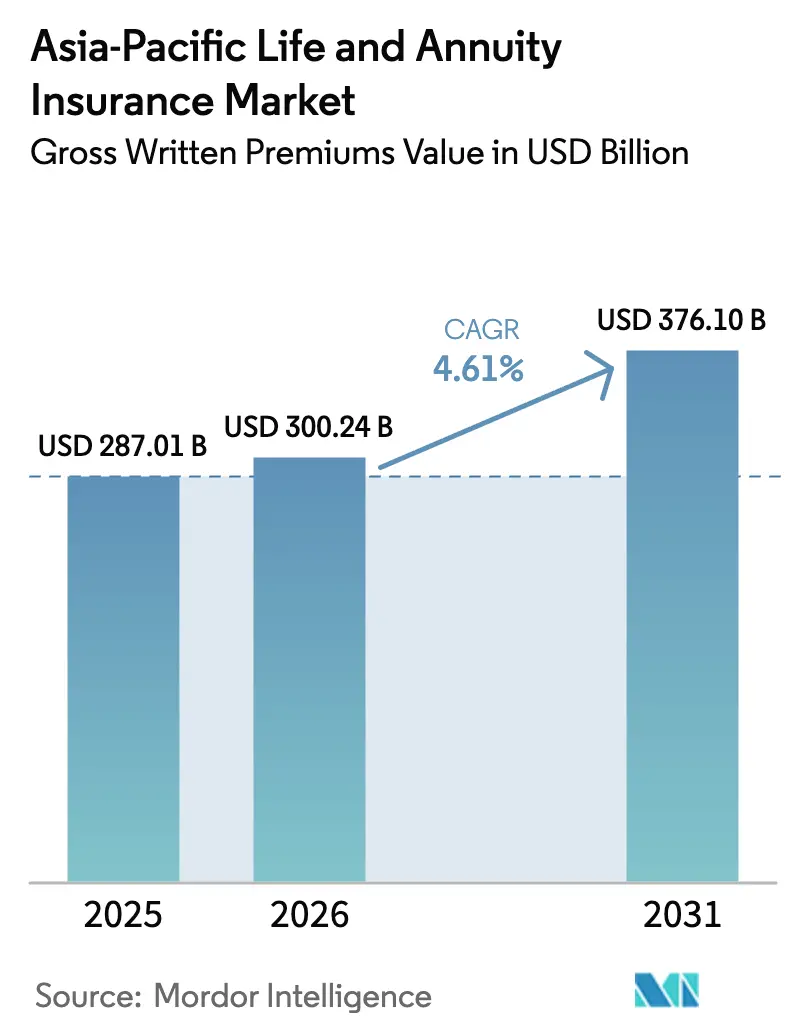
The Asia-Pacific Life And Annuity Insurance Market size in terms of gross written premiums value is projected to expand from USD 287.01 billion in 2025 and USD 300.24 billion in 2026 to USD 376.10 billion by 2031, registering a CAGR of 4.61% between 2026 to 2031.
Rapid population aging is increasing demand for retirement income solutions, prompting consumers to seek products that provide long-term financial security. At the same time, the widespread adoption of digital tools is reducing acquisition costs and streamlining distribution, making it easier for insurers to reach a broader customer base. Regulatory reforms across the region are also fostering market expansion by encouraging product innovation, opening up capital access, and facilitating more flexible distribution channels. Shifts in product design are further fueling growth, as insurers move away from traditional savings-focused endowments toward risk-oriented term life and annuity products that balance solvency, earnings stability, and consumer preferences for decumulation income. Rising longevity and retirement protection gaps are driving lifetime income features into the mainstream, reflecting increasing consumer awareness of long-term financial needs. Additionally, ecosystem partnerships and embedded distribution models are simplifying market entry for first-time buyers, while insurers’ focus on speed-to-market, data integration, and operational automation is enhancing competitiveness and enabling scalable, profitable growth.
Key Report Takeaways
- By insurance type, life insurance led with 63.5% of the Asia-Pacific life and annuity insurance market share in 2025 and is projected to expand at a 7.82% CAGR through 2031.
- By distribution channel, brokers and agents held 28.8% of the Asia-Pacific life and annuity insurance market share in 2025, while brokers and agents recorded the highest projected CAGR at 5.67% through 2031.
- By geography, India accounted for 34.2% of the Asia-Pacific life and annuity insurance market share in 2025 and is advancing at a 7.86% CAGR through 2031.
Note: Market size and forecast figures in this report are generated using Mordor Intelligence’s proprietary estimation framework, updated with the latest available data and insights as of January 2026.
Market Trends and Insights
Drivers Impact Analysis of Asia-Pacific Life And Annuity Insurance Market*
| Driver | (~) % Impact on CAGR Forecast | Geographic Relevance | Impact Timeline |
|---|---|---|---|
| Demographic Aging and Retirement Security Demand | +0.9% | Global APAC, highest intensity in Japan, South Korea, Singapore, and China | Long term (≥ 4 years) |
| Rising Disposable Incomes in Emerging APAC Economies | +1.2% | India, Vietnam, Indonesia | Medium term (2-4 years) |
| Improving Financial Literacy and Retirement Awareness | +0.5% | Global APAC, particularly emerging markets (India, Indonesia, rural China) | Long term (≥ 4 years) |
| Increasing Life Expectancy and Longevity Risk | +0.7% | Global APAC, spill-over concentration in Hong Kong, Singapore, and mature Northeast Asia | Long term (≥ 4 years) |
| Digitalization of Insurance and Investment Products | +0.7% | APAC core: China, Singapore, South Korea; spill-over to India, Southeast Asia | Short term (≤ 2 years) |
| Regulatory and Government-Led Financial Inclusion Initiatives | +0.8% | India, Indonesia, Vietnam, Thailand; selective gains in China (pension reforms) | Medium term (2-4 years) |
| Source: Mordor Intelligence | |||
Demographic Aging and Retirement Security Demand
Asia-Pacific is experiencing unprecedented population aging, which is driving a significant shift in demand for retirement and health-linked insurance products. As of 2023, the Asia‑Pacific region has approximately 697 million people aged 60 and over (14.8 % of the total population), including 489 million aged 65+ and 89 million aged 80+. The older population is projected to rise rapidly to 885 million by 2030 and 1.34 billion by 2050, with the 60+ share increasing to 25.9 %. This demographic transformation is fueled by declining fertility rates (1.9 births per woman) and rising life expectancy of 74.9 years, resulting in a growing cohort of longer-living seniors[1]. The accelerated aging trend is increasing demand for retirement income solutions, annuities, and health-linked protection, as individuals face longer post-retirement periods and rising pressure on public pension systems. Governments are emphasizing policies that support healthy aging and extended working lives, such as China’s goal to increase average life expectancy to around 80 years by 2030, which aligns with expanding retirement security needs.
Rising Disposable Incomes in Emerging APAC Economies
Rising household incomes across emerging Asia are expanding the pool of first-time buyers and deepening demand for both protection and savings-linked products. In India, the insurance sector has benefited directly from this trend: the market has grown at a ~17 % CAGR over the past two decades and is projected to reach ₹19,30,290 crore (USD 222 billion) by FY26, driven by higher premiums, growing middle-class participation, and rising per capita premium levels, reflecting higher disposable income and affordability[2]. Nationwide inclusion goals and digital platforms are broadening access, channeling new middle-class purchasing power into formal insurance, while modest penetration relative to population size means that even small increases in awareness and income can translate into significant premium growth. Consumer surveys indicate strong demand for flexible solutions combining life and health features, particularly among younger buyers entering the market who seek bundled benefits rather than single-purpose coverage. Emerging cities and smaller towns are becoming increasingly important sources of new business, as distribution expands beyond metropolitan centers and digital engagement complements traditional advice-led sales.
Digitalization of Insurance and Investment Products
Digital adoption is reshaping how policies are designed, distributed, and serviced across the region. Asia Insurance on 8 Oct 2025 adopted CoverGo’s digital health insurance platform to digitise policy and claims processing, speed product launches, expand digital distribution, and improve customer and partner experience[3]. Insurers are shortening product cycles and improving underwriting speed as cloud-native platforms and AI automation scale across core processes for the Asia-Pacific life and annuity insurance market. Reported performance gains include faster product launches, material reductions in case handling times, and higher straight-through processing in underwriting and claims. At the same time, digital claims capabilities, intelligent assistants, and omnichannel service are boosting customer satisfaction while bending the operations cost curve. The resulting speed and convenience are enabling broader access to smaller-ticket policies that suit first-time buyers and micro-savers as embedded coverage becomes more common in daily financial journeys. These technology gains support balanced growth by raising service quality, increasing conversion, and unlocking new pockets of demand in both developed and emerging markets.
Regulatory and Government-Led Financial Inclusion Initiatives
Policy actions around inclusion, taxation, and market access are expanding the addressable base and improving affordability. In India, the removal of GST on individual life and health policies and the approval of 100% foreign direct investment are reinforcing long-term inclusion objectives and catalyzing partnerships to reach semi-urban and rural households. The IAIS promotes financial inclusion by guiding regulators to improve access to affordable, responsible insurance. Initiatives focus on capacity building, inclusive regulations, and digital innovation, supporting broader insurance penetration in the Asia-Pacific[4]. This mix of regulatory clarity and national platforms is drawing more capital to the sector and giving insurers a wider set of tools to serve underserved segments at lower cost. As solvency, risk-based frameworks, and customer protection policies advance across the region, insurers are retooling product portfolios and redesigning distribution to align with higher standards. The net effect is a healthier operating environment that rewards transparent pricing, prudent risk management, and data-driven service. The Asia-Pacific life and annuity insurance market stands to benefit as reforms enhance trust, encourage innovation, and allow scale players to invest for multi-year growth.
Restraints Impact Analysis of Asia-Pacific Life And Annuity Insurance Market*
| Restraint | (~) % Impact on CAGR Forecast | Geographic Relevance | Impact Timeline |
|---|---|---|---|
| Low Financial Literacy and Trust Deficits | -0.8% | Rural India, Indonesia, Vietnam, and pockets of rural China | Long term (≥ 4 years) |
| High Cost Perception and Affordability Constraints | -0.6% | Emerging markets (price-sensitive segments); medical inflation pressure in Hong Kong, Singapore | Medium term (2-4 years) |
| Regulatory Complexity and Compliance Burden | -0.4% | Highly regulated markets such as Japan, South Korea, Singapore | Medium term (2-4 years) |
| Limited Product Awareness and Digital Divide | -0.3% | Rural and semi-urban areas across Southeast Asia, smaller towns in China | Long term (≥ 4 years) |
| Source: Mordor Intelligence | |||
Low Financial Literacy and Trust Deficits
Awareness gaps and trust barriers slow conversion from interest to purchase in many communities across emerging Asia. Penetration remains modest in large markets where significant shares of the population still rely on informal mechanisms and short planning horizons for financial security. Consumer research indicates a clear preference for bundled life and health propositions rather than pure life policies, which means traditional single-purpose protection products can underperform against customer expectations. The shortfall in long-term planning is visible in protection gap measures that show both mortality and health shortfalls, with a high concentration in emerging markets where advice and guidance are limited. Efforts to close these gaps rely on trusted advice, simple product narratives, and transparent servicing that reinforce confidence at the point of need. The Asia-Pacific life and annuity insurance market continues to see positive outcomes when consumer education, distribution quality, and product relevance improve together.
High Cost Perception and Affordability Constraints
Perceived affordability remains a core barrier to uptake even as awareness rises. Medical cost inflation runs near 10% in some hubs such as Hong Kong, while headline inflation has remained much lower, which pressures benefit adequacy and premium affordability for health-linked riders in life policies. Protection gap estimates for health indicate a large premium-equivalent shortfall across major Asian markets, with a significant portion of the gap concentrated in emerging economies where out-of-pocket spending is heavy. Several markets are addressing price sensitivity through tax changes and inclusion policies that reduce the all-in cost of purchase and increase product flexibility. Preference continues to shift toward severity-based and staged benefit structures that align payout with need and reduce headline premiums for younger and lower-income buyers. Over time, affordability interventions and product redesign support steadier growth in the Asia-Pacific life and annuity insurance market by broadening access while improving alignment with household cash flows.
*Our forecasts treat driver/restraint impacts as directional, not additive. The impact forecasts reflect baseline growth, mix effects, and variable interactions.
Asia-Pacific Life And Annuity Insurance Market Segment Analysis
By Insurance Type:
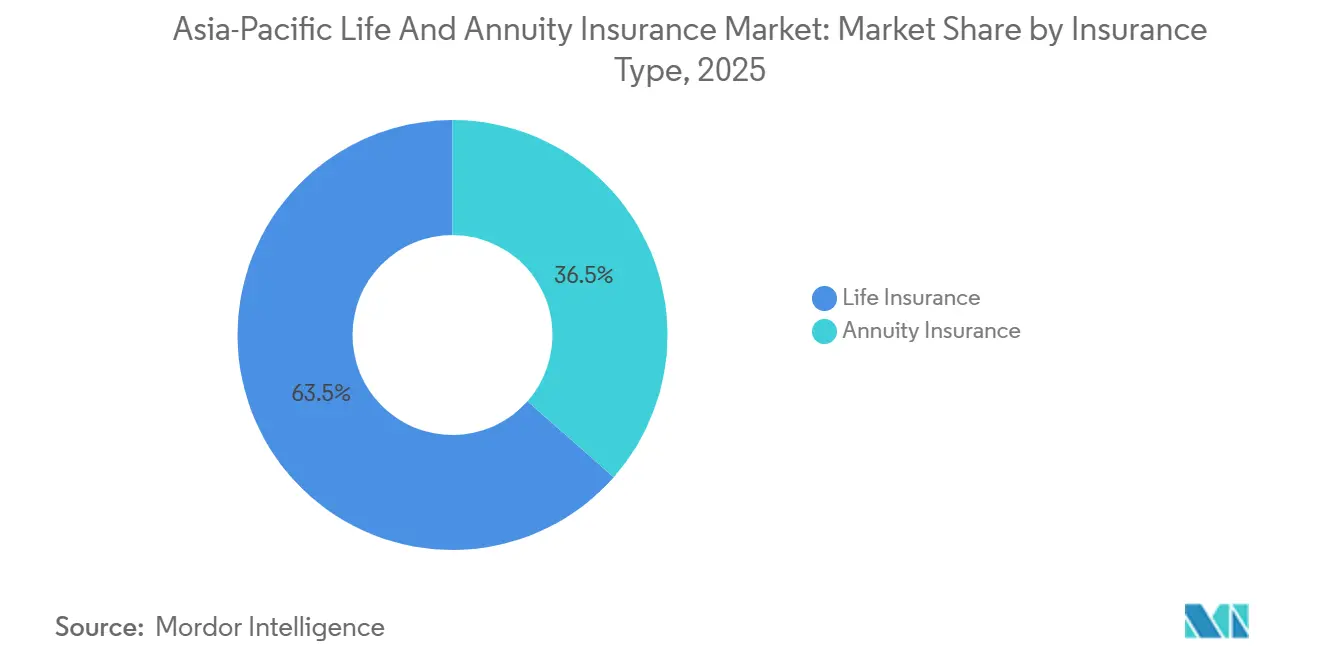
Carriers Pivot from Savings Endowments to Risk-Focused AnnuitiesLife insurance commanded a 63.5% share in 2025 and is projected to expand at a 7.82% CAGR through 2031, setting the pace among product categories in the Asia-Pacific life and annuity insurance market. This momentum reflects a deliberate shift in product mix toward risk-focused offerings with income features that help policyholders manage longevity risk and sequence-of-returns risk in retirement. As populations age, lifetime income options and care-linked features become central to household planning, and customer surveys show a strong tilt toward integrated solutions over standalone protection. Leading carriers are also weaving care and service ecosystems into annuity-linked propositions to support aging at home, faster claims, and personalized service. With retirement security rising as a primary goal for more households, the Asia-Pacific life and annuity insurance industry is repositioning product architecture around reliable income, transparent guarantees, and service quality that holds up over time.
The depth of the retirement income need is visible in longevity gap indicators, and in the way senior-focused products are now positioned at the center of advisory conversations. Income features that blend guaranteed payouts with measured exposure to growth assets are emphasized in wealth planning for the region’s mass affluent and high-net-worth customers. Product innovation highlights include flexible income start dates, inflation-aware payout options, and healthcare riders that adapt coverage as medical needs evolve with age. Global groups in Asia are building broader platforms to serve decumulation, estate planning, and cross-border financial goals, tying insurance with asset management capabilities. This evolution supports stable growth for the Asia-Pacific life and annuity insurance market as more households convert savings to sustainable income streams with built-in protection.
By Distribution Channel:
Agency Networks Transition to AI-Augmented Hybrid AdvisorsBrokers and agents retained a 28.8% share in 2025 and are projected to grow at a 5.67% CAGR through 2031, reflecting the continued relevance of advice-led distribution in the Asia-Pacific life and annuity insurance market. Agency distribution remains the single largest channel, with intermediary-led models favored for complex needs such as retirement income and estate planning that require tailored guidance. Leading insurers report productivity lifts from targeted recruitment, continuous training, and the integration of AI-based tools that enhance needs analysis, illustration, and service. Performance models now rely more on quality metrics and lifetime value rather than volume, which aligns incentives with customer outcomes and regulatory expectations. This steady upgrade of the advisory channel is central to reaching new buyers and supporting higher-value conversations that match longer-term financial goals.
Banks are deepening their role in life and retirement distribution across Southeast Asia as customers adopt combined wealth and protection conversations. In ASEAN markets, bancassurance premium pools are rising at double-digit rates through the decade, with life products dominating the mix and Thailand holding a significant regional share. New business flows in select bank partnerships have grown sharply, showing that structured wealth and retirement propositions resonate with customers who prefer to transact inside trusted financial relationships. Direct-to-consumer and digital channels are also growing at a healthy clip, aided by embedded journeys and straight-through processing that reduce friction for simpler products. These channel dynamics support broad-based expansion of the Asia-Pacific life and annuity insurance industry while maintaining focus on advice where complexity and long-horizon decisions demand it.
Geography Analysis
India Life and Annuity Insurance Market
India opened 2026 with a strong policy tailwind, holding a 34.2% share in 2025 and a projected 7.86% CAGR to 2031, making it the fastest-growing major geography in the Asia-Pacific life and annuity insurance market. The national agenda to extend coverage and improve affordability includes removing GST on individual life and health policies and approving 100% foreign direct investment, which together expand access and catalyze capital formation. Penetration is still low relative to the country's size, and inclusion efforts now reach deeper into smaller cities and towns, where a majority of new premiums have been generated. Distribution partnerships between insurers and financial institutions are scaling to reach new customers, while digital platforms support streamlined onboarding and service. With continued policy support and a large working-age population, India is positioned to contribute a large share of incremental growth in the Asia-Pacific life and annuity insurance market.
China Life and Annuity Insurance Market
China remains a central pillar for regional growth, supported by its large base, rising longevity, and a policy focus on healthy aging. National targets call for higher life expectancy by 2030 with expanded senior care services, which encourages product designs that blend income, care, and protection benefits. Leading carriers are investing in agency quality upgrades, data-driven service, and bancassurance partnerships to deliver wealth and retirement solutions at scale. Fast claims processing and AI-enabled service are reshaping customer expectations and cost structures, strengthening competitiveness in a market where trust and convenience are decisive. As investors and households prioritize long-term security, participating and income-focused policies gain prominence in household portfolios. The Asia-Pacific life and annuity insurance market benefits as China advances health and elder-care initiatives that complement private coverage with public programs.
APAC Life and Annuity Insurance Market
Mature markets like Japan, South Korea, Singapore, and Australia have reoriented toward senior-focused solutions as longevity rises and household planning shifts toward income and legacy needs. Policy dialogues around solvency, risk-based capital, and systemic importance continue to shape product, investment, and distribution strategies for large groups with regional hubs. Insurers are introducing lifetime income features and health-linked riders that meet the needs of retirees who want reliable payouts and support for care over longer horizons. Banks and advisers in financial centers support complex cases for high-net-worth clients, while digital service and automation improve speed for simpler decisions. This balanced approach sustains steady growth in developed markets and complements higher-volume gains in emerging economies, keeping the Asia-Pacific life and annuity insurance market on a durable growth path.
Regulatory Landscape
Regulation across Asia-Pacific life and annuity markets is tightening around risk-based, market-consistent capital and valuation frameworks, affecting product design, asset-liability management, and sales conduct. Japan implemented its economic-value-based solvency approach (J-ICS/Economic Solvency Ratio regime) in March 2026, increasing emphasis on interest-rate and market risk in long-duration liabilities typical of annuities. Australia advanced prudential settings for longevity products through APRA amendments effective July 2026, aligning capital treatment more closely with longevity risk characteristics for retirement income solutions.
Regulators are also reinforcing product governance and sales practices to improve consumer outcomes for long-horizon products. In India, IRDAI continued to govern life products through its Master Circular on Life Insurance Products, which standardizes product governance and permits defined annuity structures (including joint life annuities and return-of-purchase-price variants) within regulatory parameters. In Hong Kong, the Insurance Authority consulted on amendments to the Insurance (Valuation and Capital) framework in 2026, including mechanisms such as matching adjustments for certain life business, which aim to better align long-term assets to insurance liabilities within a controlled capital framework.
Value Chain Analysis
The Asia-Pacific life and annuity insurance value chain spans product development and pricing (including actuarial design, reinsurance support, and investment strategy), underwriting and policy administration, and then distribution via tied agents, brokers, bancassurance partners, and direct digital channels. Advice-led intermediation remains central for retirement income and annuity needs, while digital tools increasingly shorten product launch cycles, automate underwriting, and improve servicing. Technology vendors and insurtech platforms also sit upstream of distribution and operations by enabling straight-through processing, customer onboarding, and claims workflows that reduce acquisition and servicing costs.
Capital and compliance operate as a key layer across the chain, shaping which products can be scaled profitably and which customer segments are prioritized. The region-wide shift toward risk-based capital regimes (including Japan's economic-value-based solvency changes effective March 2026) increases the importance of asset-liability management, hedging, and long-duration investment capabilities, particularly for annuities and other guaranteed products. As insurers adjust, partnerships are becoming more prominent across the chain, with carriers, banks, and digital ecosystems working together to acquire customers, while reinsurers and asset managers support risk transfer and yield solutions that fit stricter capital and valuation rules.
Competitive Landscape
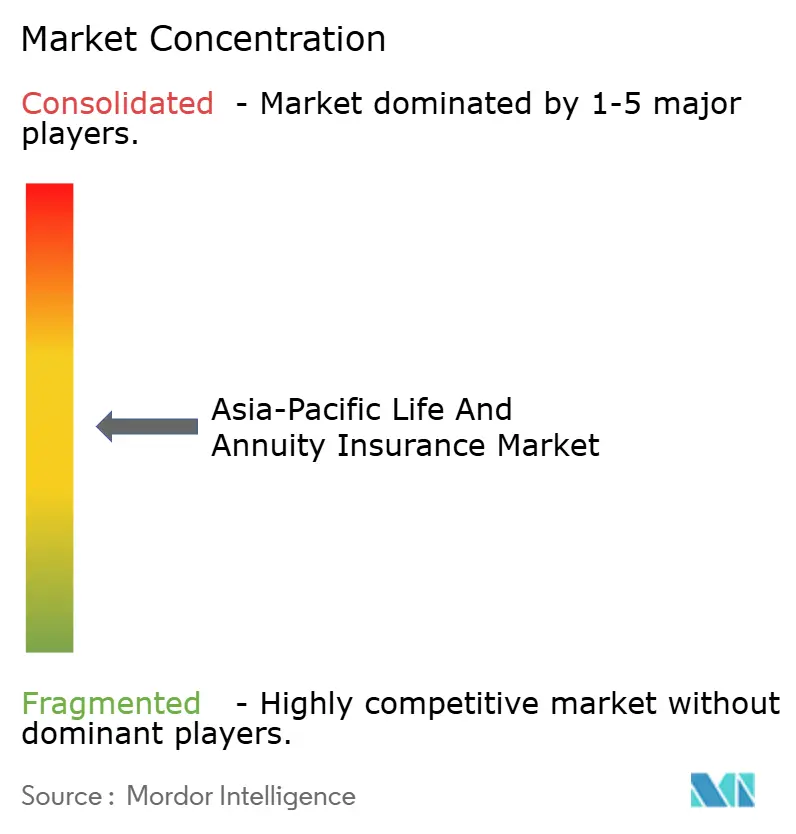
The Asia-Pacific life and annuity insurance market remains moderately concentrated, with the top five carriers accounting for around half of total premiums. Competitive intensity is increasing as technology becomes a core differentiator in speed-to-market, underwriting efficiency, servicing quality, and claims performance. Insurers are reporting meaningful improvements in product launch timelines, underwriting cycle times, and automation rates across customer service functions. Generative AI and cloud-native platforms are now deployed in production, supporting marketing, sales enablement, and frontline service use cases. As digital capabilities, data, and distribution converge, the advantage increasingly favors players that combine advice-led models with embedded and direct digital journeys.
Market leaders are pursuing a wide range of strategic operating models to strengthen positioning and sustain growth. Integrated ecosystems that connect finance, health, and care are enabling faster decisions and improved post-sale service through AI-enabled workflows. High-performing agency franchises are enhancing productivity through targeted recruitment, advanced training, and digital toolkits that support consultative selling. Bancassurance partnerships continue to scale structured wealth and retirement solutions, with several groups reporting strong new business value growth under revised partnership economics. Cross-border expansion and capability development in asset management, health services, and retirement platforms are widening addressable markets and supporting multi-country operating leverage.
Market structure is further evolving as partnerships and M&A reshape distribution reach, product breadth, and operating scale. In Singapore, a planned majority acquisition of a leading composite insurer is expected to strengthen a global player’s regional footprint, subject to regulatory approvals. In India, inclusion-focused policy reforms are enabling new bancassurance, digital, and reinsurance initiatives in anticipation of sustained long-term growth. Reinsurers and carriers are introducing advanced underwriting and medical assessment solutions to reduce processing times and improve risk selection. Japanese insurers are expanding international platforms and investment capabilities to diversify earnings and strengthen governance, reinforcing the shift toward capital-efficient, technology-enabled, and customer-centric models.
Asia-Pacific Life And Annuity Insurance Industry Leaders
-
AIA Group
-
Nippon Life Group
-
Life Insurance Corporation of India (LIC)
-
China Life Insurance Group
-
Muang Thai Life Assurance Group
- *Disclaimer: Major Players sorted in no particular order
Asia-Pacific Life And Annuity Insurance Market Companies Covered in this Report
- AIA Group
- Nippon Life Group
- Life Insurance Corporation of India (LIC)
- China Life Insurance Group
- Muang Thai Life Assurance Group
- Prudential plc
- Manulife Financial Group
- Dai-ichi Life Group
- Meiji Yasuda Life Group
- Tokio Marine Group
- MS&AD Insurance Group
- Samsung Life Insurance Group
- HDFC Life Group
- Sun Life Financial Group
- HSBC Life Group
- Aviva Group
- TAL Group
- AMP Group
- Ping An Insurance Group
- Hong Leong Financial Group
Read Analysis of Asia-Pacific Life And Annuity Insurance Companies
Market Opportunities and Future Outlook
Retirement income and longevity-oriented product whitespace is expanding across Asia-Pacific as aging accelerates and public systems face pressure. The region had about 697 million people aged 60+ in 2023 (14.8% of the population), supporting a large and rising need for annuities and lifetime-income features, particularly in mature markets such as Japan, South Korea, Singapore, and China. Regulatory actions that sharpen capital recognition of longevity and market risks, including Japan's March 2026 economic-value-based solvency implementation and APRA's July 2026 longevity-product capital amendments in Australia, are prompting insurers to refine annuity structures, guarantees, and hedging approaches rather than rely on savings-heavy designs.
Distribution and operating-model modernization is a second opportunity area, driven by hybrid advice supported by automation and embedded journeys for first-time and mass-market buyers. Evidence of insurer-led digitization includes Asia Insurance adopting CoverGo's platform in October 2025 to digitize policy and claims processing and speed product launches. In parallel, Singapore's MAS opened a 2026 consultation on a Protected Cell Company (PCC) framework (comments open until 7 August 2026), indicating active work on alternative risk transfer structures that can broaden how certain risks are housed and managed within regulated frameworks. These changes support product innovation, faster issuance, and improved servicing quality, while also raising expectations for data foundations, product governance, and sales conduct across channels.
Recent Industry Developments in Asia-Pacific Life And Annuity Insurance Market
- April 2026: AIA Group reported 13% growth in value of new business for the first quarter ended 31 March 2026 on a constant exchange rate basis, with strong performance in Mainland China and Hong Kong. The update reinforced the importance of diversified multi-market franchises and execution in core Asian hubs where life and savings needs intersect with retirement planning.
- December 2025: India approved an increase in the foreign direct investment limit in insurance companies to 100%. The change broadened access to foreign capital and strengthened the runway for cross-border partnerships and investments in distribution and digital capabilities across life and annuity products.
- June 2024: IRDAI issued a press release outlining reforms in the life insurance business aimed at improving ease of doing business, product governance, and market development. The measures supported faster product responsiveness while keeping customer-protection and compliance expectations central to how insurers design and distribute long-term policies.
Asia-Pacific Life And Annuity Insurance Market Report Scope and Research Methodology
Market Definition and Coverage
For this study, the market covers total gross written premiums generated from life insurance and annuity insurance products across Asia-Pacific, reported in USD and counted for the period in which premiums are written.
Scope exclusions: Reinsurance premiums and non-life insurance lines are not counted in this market value.
Segments Covered in This Report
- By Insurance Type
- Life Insurance
- Annuity Insurance
- By Distribution Channel
- Brokers/Agents
- Banks
- Direct Sales
- Other Channels
- By Country
- China
- India
- Japan
- Singapore
- Australia
- Rest of APAC
Data Sources, Market Sizing, and Validation
Desk Research
Desk research was used to build the basic demand pool and to keep the model anchored to publicly visible insurance activity in Asia-Pacific. We leaned on sources such as IMF and World Bank macro indicators, national insurance regulators and statistical bureaus in the region, OECD and UN population and aging datasets, and central bank publications on interest rate direction and household savings.
We also reviewed insurer annual reports and investor presentations, industry association dashboards, and business press coverage to understand product-mix shifts between life versus annuity and changes in distribution. Where helpful, company financials and intelligence databases were used to standardize premium line items and currency conversions across countries. This desk-source list is illustrative only, and many other public references were reviewed for data collection, validation, and clarifications.
Primary Interviews and Surveys
Primary work focused on validating how premiums are booked, how annuity products are treated across markets, and what drives mix changes between protection and savings-style policies in Asia-Pacific. We spoke with insurers, intermediaries, bancassurance stakeholders, and independent industry experts across APAC, so the assumptions on premium growth, distribution shares, and product persistency could be checked and adjusted based on how they are reported in practice.
Distribution of primary research fieldwork respondents
| Company type | Respondent position |
|---|---|
| Top tier: 33% | CXOs: 16% |
| Mid tier: 45% | Functional/Unit leaders: 32% |
| Smaller Players: 22% | Managers: 52% |
Market-Sizing & Forecasting
The core sizing starts with a top-down build where country-level premium pools are reconstructed from reported life insurance and annuity gross written premiums, then consolidated to the Asia-Pacific total using consistent currency and timing rules. To keep the total realistic, we corroborate it with selective bottom-up approximations, such as sampled insurer premium disclosures, channel checks on bancassurance contribution, and sanity tests on implied premium per active policyholder where data is available.
Key inputs that shape the model include the life versus annuity product mix, distribution channel split (agents and brokers, banks, direct sales, and other channels), interest rate direction and savings behavior, population aging signals, and country-level insurance penetration and income levels. Forecasts are produced using scenario analysis supported by expert views, where base case assumptions on premium growth are flexed for rate cycles, regulatory tightening, and changes in retirement product demand. When bottom-up signals are missing for smaller markets, the gap is handled by applying penetration and mix ratios from comparable markets and then re-tested against macro and premium growth constraints.
Data Validation & Update Cycle
Outputs are cross-checked against independent signals, including country insurance premium trends, macro indicators tied to savings and retirement demand, and reported distribution shifts that can move premium flows. If a country total moves outside reasonable bounds, assumptions are re-opened, and respondents are re-contacted when the variance looks driven by definitional issues rather than growth.
Before sign-off, the model is reviewed in multiple steps so calculation logic, conversions, and trend direction remain consistent across countries and years. Reports are refreshed annually, with interim updates when material events occur, and a final pre-delivery pass is completed so the latest public releases and market signals are reflected.
Mordor Intelligence's Asia Pacific Life Annuity Insurance Market Size Compared Against Other Published Estimates
It is normal to see different published market sizes for the same insurance market, even when the geography sounds identical. In practice, gaps usually come from what premium definition is used, how annuity products are classified, and whether the year and currency conversion timing are aligned.
By tracking gross written premiums consistently across the covered countries and refreshing currency timing assumptions each update, Mordor Intelligence avoids mixing broader insurance lines into the total, and keeps the estimate tied to reported premium pools rather than loosely defined market value.
Benchmark comparison
| Source | Market Size | Gaps in Research Methodology |
|---|---|---|
| Mordor Intelligence | USD 287.01 B (2025) | |
| Trade Publisher A | USD 1.22 T (2024) | Uses a much broader premium pool for Asia-Pacific life and annuity, and the definition appears to align with total life and related products in GWP terms, which inflates the figure versus a narrower counted set and a different base year. |
| Industry Report Outlet B | USD 1.51 T (2030) | Reports a forward year value and may apply aggressive premium growth and product expansion assumptions without clearly separating life versus adjacent lines or stating currency conversion timing, which can widen the total in USD terms. |
Overall, the spread is mainly explained by scope and timing. Once the premium measure, included product set, and year basis are kept consistent, the market total becomes easier to trace back to clear country premium drivers and repeatable calculation steps.
Key Questions Answered in the Report
What is the current size and projected growth of the Asia-Pacific life and annuity insurance market?
The Asia-Pacific life and annuity insurance market size reached USD 300.24 billion in 2026 and is projected to reach USD 376.1 billion by 2031 at a 4.61% CAGR.
Which product segment leads and which grows fastest through 2031?
Life insurance led with a 63.5% share in 2025 and is projected to expand at a 7.82% CAGR through 2031, setting the pace among product categories.
Which distribution channel is expected to be the growth leader?
Brokers and agents held a 28.8% share in 2025 and are projected to grow at a 5.67% CAGR, supported by AI-augmented advisory models and productivity gains.
Which geography contributes the most to future growth?
India held a 34.2% share in 2025 and is projected to grow at a 7.86% CAGR through 2031, supported by inclusion policies and capital access.
What are the most impactful growth drivers?
Demographic aging, rising incomes in emerging markets, accelerated digitalization of underwriting and claims, and inclusion-focused policies are the strongest contributors to multi-year expansion.