
Market Overview
| Study Period | 2020 - 2031 |
|---|---|
| Forecast Data Period | 2026 - 2031 |
| Base Year Market Size (2025) | USD 4.57 Billion |
| Market Size (2026) | USD 5.01 Billion |
| Market Size (2031) | USD 7.93 Billion |
| Growth Rate (2026 - 2031) | 9.62 % |
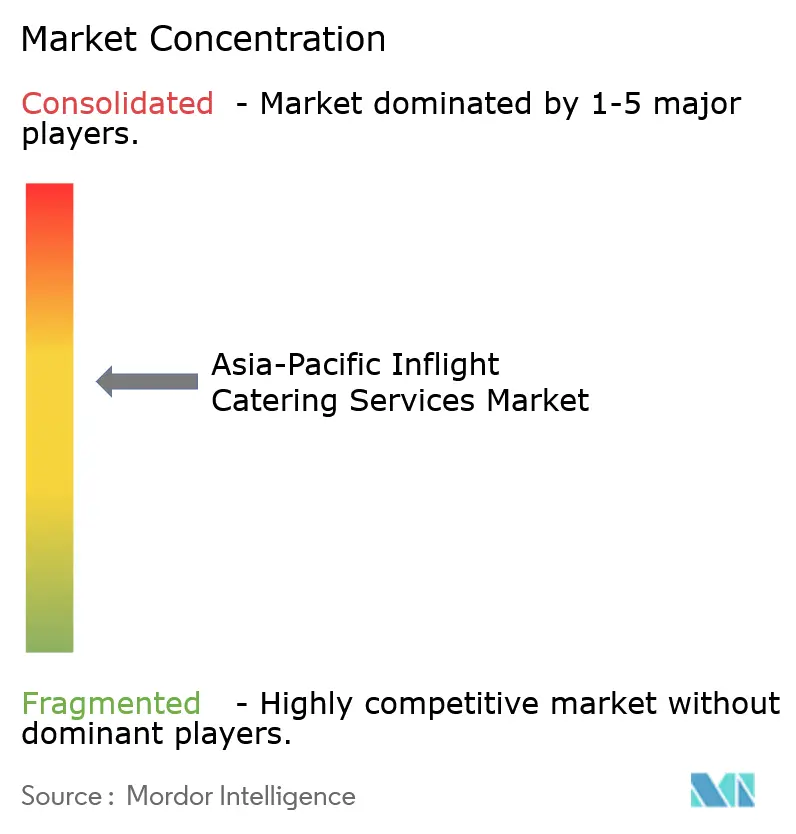
| Market Concentration | Medium |
Major Players *Disclaimer: Major Players sorted in no particular order Image © Mordor Intelligence. Reuse requires attribution under CC BY 4.0. | |
Asia-Pacific Inflight Catering Services Market Analysis by Mordor Intelligence
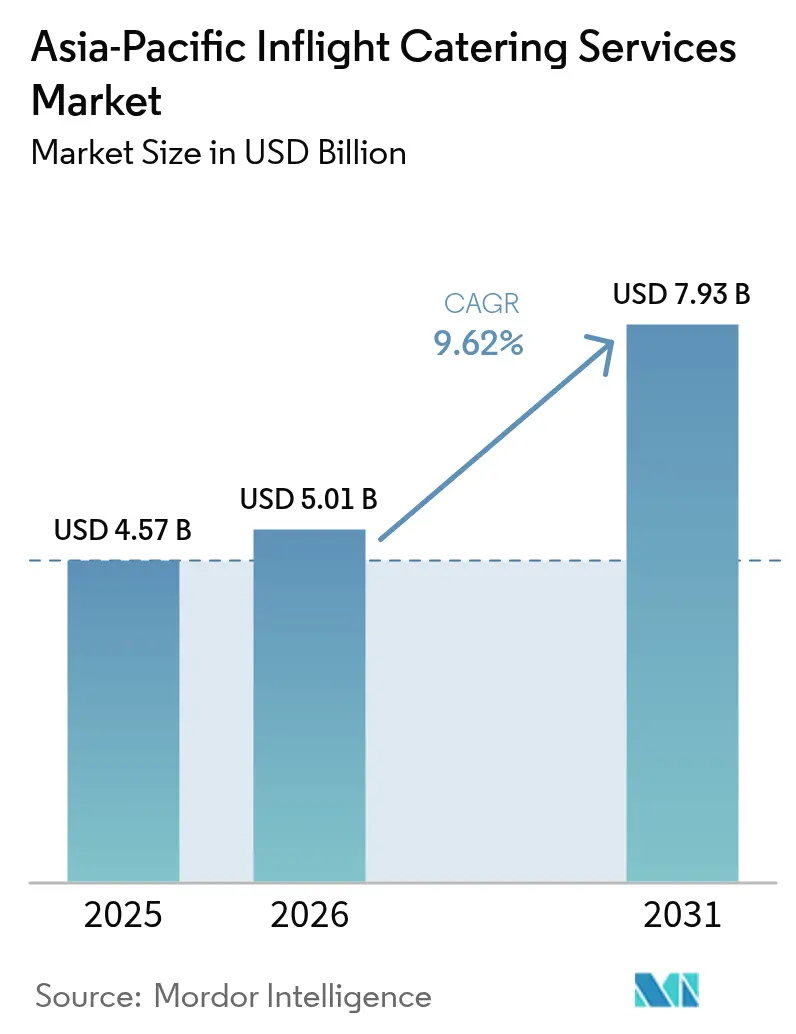
The Asia-Pacific Inflight Catering Services Market size is expected to grow from USD 4.57 billion in 2025 to USD 5.01 billion in 2026 and is forecast to reach USD 7.93 billion by 2031 at 9.62% CAGR over 2026-2031.
The rising emphasis on customer-centric food menus is driving the Asia-Pacific inflight catering services market, as most airlines are adding new items to their menus to provide better quality food to passengers by keeping their preferences in mind. The aftermath of the pandemic led many catering companies in the region to implement newer methods of providing in-flight catering to attract new air travelers and improve the inflight dining experience. In recent years, various airlines have partnered with world-renowned chefs to delight and enhance the in-flight dining experience of the passengers. Several companies are also focusing on providing a curated menu to their customers. For instance, in April 2023, Air India announced that they had remapped how they serve meals onboard the aircraft to attract its customers.
However, the growing operational challenges in the coming years will hamper the market’s growth during the forecast period. The increasing number of air passengers led to increased operational challenges, with caterers facing difficulties such as last-minute requests, sometimes 15 minutes before aircraft departure, short turnaround times, aircraft changes, delays, airport operational limitations, and timely food delivery according to customer specifications. Despite this, with the increasing air travel in this region, the induction of new destinations and new long-haul flights may create future opportunities for the Asia-Pacific inflight catering market. Such factors are expected to drive the market positively during the forecast period.
Note: Market size and forecast figures in this report are generated using Mordor Intelligence’s proprietary estimation framework, updated with the latest available data and insights as of 2026.
Asia-Pacific Inflight Catering Services Market Trends and Insights
The Meals Segment is Projected to Occupy the Largest Market Share During the Forecast Period
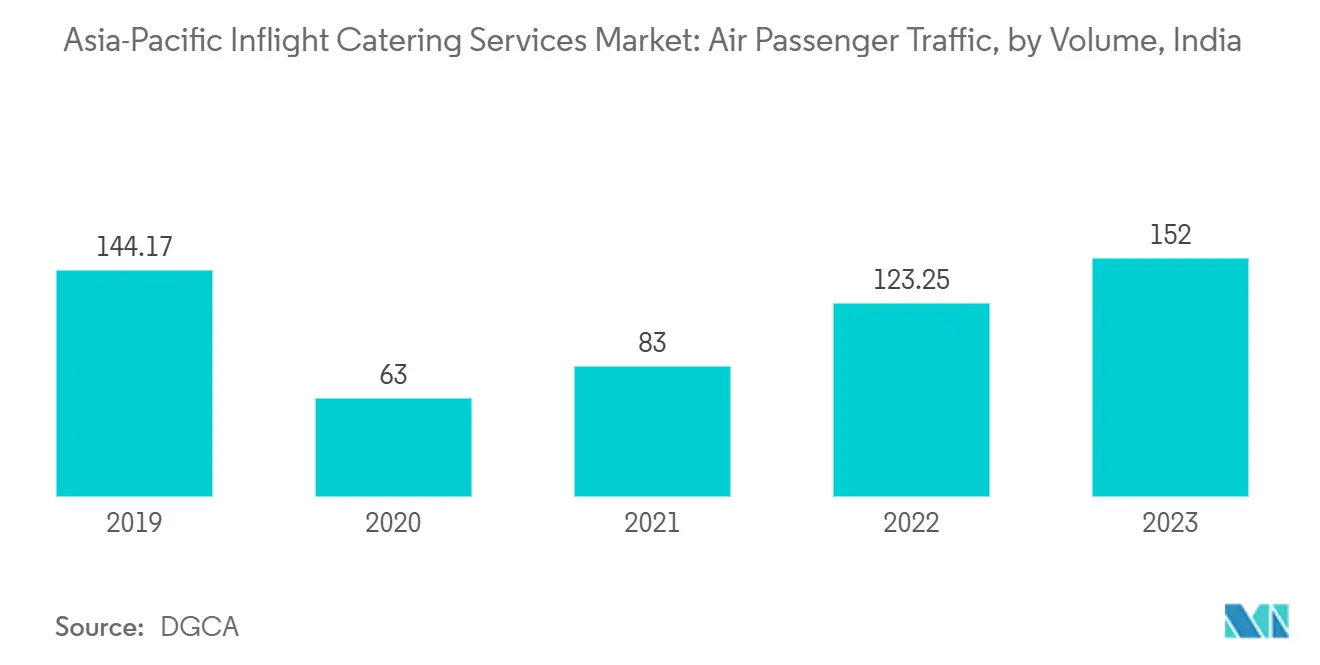
During air travel, inflight food plays a significant role in shaping passengers' perceptions of airline service. Airlines in Asia-Pacific have recognized this and made concerted efforts to cater to their passengers' diverse dietary needs and preferences. As a result, the availability and quality of meals offered by airlines in the region have grown significantly in recent years.
The region's demand for the meals segment is driven by the annual rising air passenger traffic growth as more air travel leads to more food sales on board. Additionally, the inflight dinners for most regional airlines include meat, a salad or vegetable, a small roll, and a dessert. A cooked breakfast or lighter continental-style meal may be an option during morning flights. For instance, in March 2024, Malaysia Airlines launched its new Best of Asia menu. The airline launched this menu to provide passengers with an enhanced in-flight dining experience.
Moreover, the growth of the vegan and vegetarian population is increasing rapidly in the region due to factors such as altruism, environmental concerns, etc. The trend of growing vegetarianism has increased the demand for vegan or vegetarian meals. Moreover, the growth of health-conscious people has resulted in the growing popularity of gluten-free and low-salt meals, as they are becoming the major food offerings under the special meals for airlines. For instance, in January 2024, Emirates announced that a significant increase in vegan meal consumption was noted on its flight routes to China, Japan, and the Philippines. The airline also mentioned that there was a demand for plant-based meals in Southeast Asia, as the airline saw a growth of 5% in 2023 for plant-based meals compared to 2022. Such factors are expected to drive the demand for this segment in the region during the forecast period.
The Inflight Catering Market in India May Experience the Highest Growth
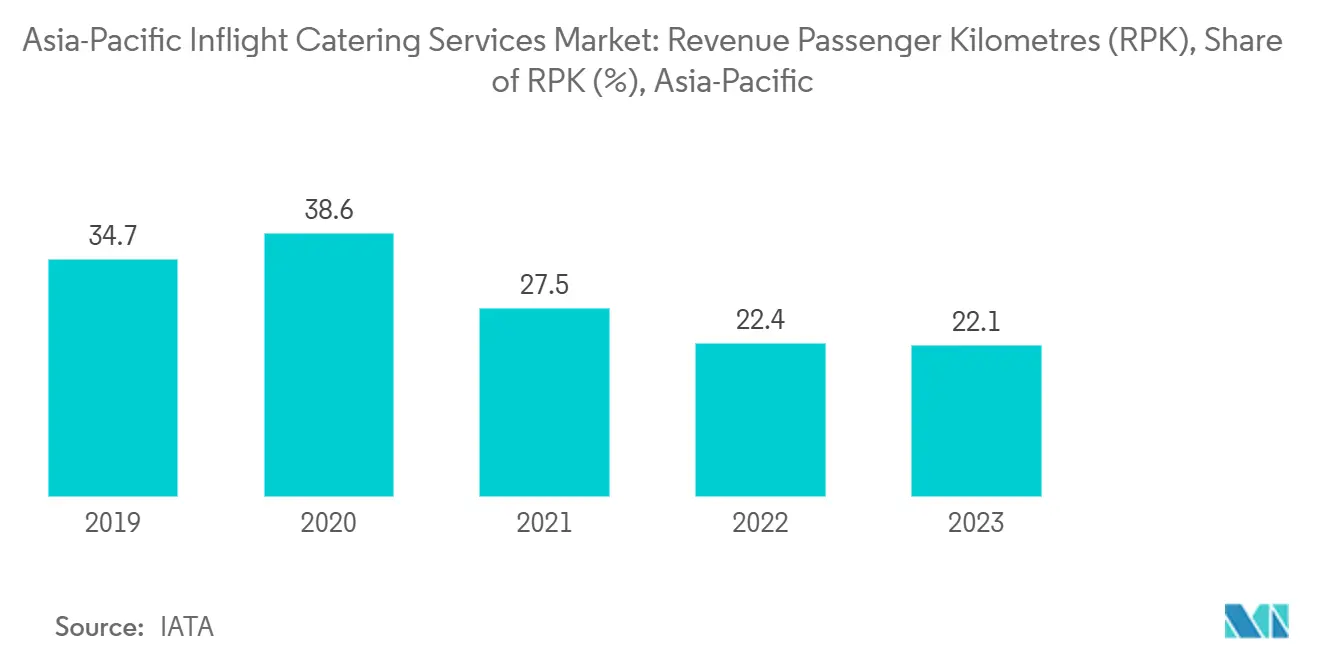
The Indian inflight catering market is expected to grow at the highest rate during the forecast period, owing to the growing aviation market in the country. The boom in air travel in India is adding a new dimension to the inflight catering services business. Around 20 million people used domestic airline services, and around 10 million passengers used international airline services in the country.
With an expected increase in traffic of 20% over the next two years, the inflight meal business is poised to register significant growth. Besides, the entry of domestic airlines into intercontinental routes is expected to create competition among caterers, forcing them to be innovative. Vistara is offering a "Chef On-board" program in partnership with the airline's caterers, Taj SATS Air Catering Limited. According to the company, Chef On-board is an innovative and first-of-its-kind initiative in India, where chefs will take direct and instant customer feedback on the new menu introduced across the network. Such efforts to enhance the inflight catering experience may help the growth of the players in the country.
Nevertheless, the largest inflight catering market in the region currently belongs to China due to the country's high aviation activity. To cater to the growing aviation demand, airlines in China are procuring new aircraft and introducing new routes. To maintain their competitiveness, Chinese airlines are re-designing their inflight menus to increase their profitability while maintaining food quality. In the Chinese market, due to the high competition in the airline market and low-profit growth of small- and medium-sized air carriers from additional supporting services, airlines have been dropping the idea of providing complimentary inflight meals to economy-class passengers, which is expected to reduce the growth of the market during the forecast period.
Competitive Landscape
The market for inflight catering services in the Asia-Pacific is semi-consolidated, with few players accounting for the majority share of the market. Gate Gourmet (Gate Group), LSG Sky Chefs (LSG Group), SATS, Cathay Pacific Catering Services (HK) Limited, and Emirates Flight Catering Company LLC are prominent players with a strong presence in the Asia-Pacific inflight catering services market.
These companies are increasing their geographic presence in the market by introducing innovative food options. This includes new menu items and a more comprehensive range of choices, such as vegetarian and gluten-free options, to cater to a diverse range of travelers. For instance, in October 2022, ANA started offering new vegan, vegetarian, and gluten-free meals on international flights. Similarly, Singapore Airlines and other airlines have taken initiatives to provide services similar to those of ANA. With a few key players dominating the market, competition is high, and companies are constantly looking for new ways to differentiate themselves and provide a better travel experience for their passengers.
Asia-Pacific Inflight Catering Services Industry Leaders
-
Gate Gourmet (Gate Group)
-
LSG Sky Chefs (LSG Group)
-
SATS
-
Cathay Pacific Catering Services (H.K.) Limited
-
Emirates Flight Catering Company LLC
- *Disclaimer: Major Players sorted in no particular order
Market Opportunities and Future Outlook
Network recovery and menu differentiation across Asia-Pacific are creating room for caterers that can scale both premium and special-meal offerings while handling tight airport turnarounds. Capacity and capability build-out is visible in recent expansions, including SATS Food Solutions India opening a 221,000 sq. ft Bengaluru facility in March 2024 with capacity of 40,000 kg of ready-to-eat products per day, aimed at supporting broader airline demand for consistent, branded meal components across domestic and long-haul flying.
Opportunities are also emerging around hub-adjacent production expansion and tighter supply-chain control. TajSATS opened a 45,000 sq. ft in-flight kitchen at Noida International Airport in June 2026, targeting output of over 20,000 meals per day. dnata has been expanding its Melbourne Airport catering facility, announced in January 2025, to add 5,700 sq. m and raise the site to over 16,000 sq. m, with 25 million meals annual capacity targeted for operations in September 2026. On the ownership and platform side, SATS increased its stake in Nanjing Weizhou Airline Food Corporation to 90% in May 2026, reflecting a move toward consolidated control of frozen aviation meal operations in China. Alongside physical expansion, Airbus is piloting Smart Catering tooling for consumption tracking and waste reduction, and airline demand shifts toward plant-based meals on routes across Asia are reinforcing the near-term value of forecasting, pre-ordering, and food-waste management as differentiators for catering contracts.
Recent Industry Developments
- June 2026: Bluspring Enterprises Limited signed a definitive agreement to acquire 100% of LSG Sky Chefs (India) Private Limited from AURELIUS, adding aviation catering facilities at Bengaluru and Hyderabad airports. The transaction changes ownership for a scaled in-flight catering platform in India and supports competitive repositioning as airlines expand networks and seek higher service consistency.
- July 2025: Emirates Flight Catering broke ground on a new AED 160 million laundry facility at Dubai Investment Park to increase capacity by over 50%, with modular units designed for a combined throughput of 142 tons per day. The investment is intended to improve turnaround and service reliability for high-frequency operations, aligning with catering workflows at a major regional hub.
- March 2024: SATS Food Solutions India opened its largest Innovative Food Solutions facility in Bengaluru, a 221,000 sq. ft site with production capacity of 40,000 kg of ready-to-eat food products per day. The facility expands industrial-scale prepared-food capability in India, helping caterers standardize components and support both premium and special-meal requirements across airline customers.
Research Methodology Framework and Report Scope
Market Definition and Coverage
This market covers the value of in-flight catering services delivered to airlines across Asia Pacific, including preparation and supply of onboard food and beverages that are served to passengers during flights.
Scope exclusions: This sizing does not count airport retail food sales, lounge catering, or ground handling services that are not part of onboard meal and beverage provisioning.
Segmentation Overview
- Food Type
- Meals
- Bakery and Confectionery
- Beverages
- Other Food Types
- Flight Type
- Full-service Carriers
- Low-cost Carriers
- Aircraft Seating Class
- Economy Class
- Business Class
- First Class
- Geography
- India
- China
- Japan
- South Korea
- Rest of Asia-Pacific
Data Sources, Market Sizing, and Validation
Desk Research
Desk research was used to frame the demand pool and the operating reality of airline catering in Asia Pacific before any model assumptions were locked. Public aviation traffic series and airport disclosures helped us understand passenger throughput shifts, route additions, and the practical pace of capacity recovery.
We also reviewed materials such as civil aviation regulator statistics, airport authority annual reports, airline annual reports and investor presentations, tourism and trade statistics, and food safety and aviation catering guidelines published by official bodies. For cross-checking market structure and supplier presence, we referred to association websites and reputed press coverage, and then validated financial context using paid subscriptions focused on company financials and news, along with patent databases where packaging and food handling innovation trends were relevant. These desk sources are illustrative and not exhaustive, and many other public and paid references were used to collect data, validate assumptions, and clarify gaps.
Primary Interviews and Surveys
Primary work focused on interviews and surveys with airline procurement and inflight product teams, catering operations managers, and food production stakeholders to confirm how often meals are uplifted and how pricing changes by cabin, flight type, and menu mix. Since practices vary widely across Asia Pacific, inputs were taken across major travel hubs and developing markets to test assumptions on load factors, service intensity, and outsourcing versus in-house models.
Distribution of primary research fieldwork respondents
| Company type | Respondent position |
|---|---|
| Top tier: 39% | CXOs: 16% |
| Mid tier: 45% | Functional/Unit leaders: 33% |
| Smaller Players: 16% | Managers: 51% |
Market-Sizing & Forecasting
Sizing starts with a top-down build where passenger traffic and flight activity by country are translated into an addressable meal and beverage uplift pool, and then converted to value using service intensity and average catering spend per passenger. To keep the output realistic, selective bottom-up checks are applied, such as sampled catering rate cards and airline menu programs mapped to expected volumes, followed by adjustments where coverage is thin.
Key inputs used in the model include passenger volumes on domestic and international routes, the split of full-service carriers versus low-cost carriers, cabin mix (economy, business, and first), load factor direction, and the share of flights where full meals versus lighter service is typically provided. Where meal uplift data could not be consistently observed, gaps were handled by using proxy ratios derived from similar route lengths and airline business models, which were then verified through primary feedback.
For forecasting, scenario analysis was used to reflect different growth paths in flight capacity and service levels, with the most likely case anchored to expected aircraft utilization and gradual menu normalization. Assumptions around price progression were kept transparent by linking them to input cost direction and airline service strategy, and then stress-tested in interviews.
Data Validation & Update Cycle
Validation is done in steps, beginning with consistency checks across countries so that the modeled catering value tracks with known flight capacity and passenger indicators. After that, outliers are reviewed, including abrupt shifts in spend per passenger, unusual cabin mix impacts, and country-level variances that do not match route structure or airline mix.
Before sign-off, the model is reviewed by another analyst and the most sensitive assumptions are re-checked with selected respondents when movements look too sharp. Reports are refreshed annually, and if a material event occurs (such as a sudden capacity change, a regulatory shift affecting onboard service, or a major airline policy change), interim updates are made. Right before delivery, a final pass is completed so clients receive the latest updated view.
Mordor Intelligence's Flight Catering Services Asia Pacific Market Size Measured Against Other Published Estimates
Published market sizes for Asia-Pacific in-flight catering services often differ because the definition of what counts as onboard catering is not consistent, and the assumed service level per passenger can move totals quickly. Differences also come from the year selected as the base, how currency is converted, and whether the model follows actual passenger and flight activity signals.
The biggest gaps usually show up when one estimate bundles adjacent activities like airport retail food sales or lounge catering, or when pricing is pushed forward using broad inflation rather than menu and cabin specific uplift patterns. Some models also apply a single spend-per-passenger number across the region, which can overstate markets where low-cost carriers dominate and understate markets with a larger premium cabin mix, a spread reduced by tying meal uplift rates and cabin mix to country-level flight patterns before converting to value, as done by Mordor Intelligence.
Benchmark comparison
| Source | Market Size | Gaps in Research Methodology |
|---|---|---|
| Mordor Intelligence | USD 4.57 B (2025) | |
| Global Publisher A | USD 7.07 B (2025) | This figure is presented as an Asia Pacific regional number and may include a wider set of inflight food and beverage activities, with less visible controls for low-cost carrier service intensity and country-level cabin mix when converting traffic into value. |
| Regional Publisher B | USD 3.55 B (2024) | This estimate uses an earlier base year and a slower growth profile, which can understate markets where capacity and onboard service levels normalized faster, especially if meal uplift and pricing are applied more uniformly across countries. |
The spread is mainly explained by what is included as catering and by how spend per passenger is built across full-service and low-cost operations. By keeping the demand pool tied to flight activity and then checking it against service intensity signals, the final value stays traceable to clear steps that can be repeated at each refresh.
Key Questions Answered in the Report
How big is the Asia-Pacific Inflight Catering Market?
The Asia-Pacific Inflight Catering Market size is expected to reach USD 5.01 billion in 2026 and grow at a CAGR of 9.62% to reach USD 7.93 billion by 2031.
What is the current Asia-Pacific Inflight Catering Market size?
In 2026, the Asia-Pacific Inflight Catering Market size is expected to reach USD 5.01 billion.
Who are the key players in Asia-Pacific Inflight Catering Market?
Gate Gourmet (Gate Group), LSG Sky Chefs (LSG Group), SATS, Cathay Pacific Catering Services (H.K.) Limited and Emirates Flight Catering Company LLC are the major companies operating in the Asia-Pacific Inflight Catering Market.
What years does this Asia-Pacific Inflight Catering Market cover, and what was the market size in 2024?
In 2024, the Asia-Pacific Inflight Catering Market size was estimated at USD 4.12 billion. The report covers the Asia-Pacific Inflight Catering Market historical market size for years: 2019, 2020, 2021, 2022, 2023 and 2024. The report also forecasts the Asia-Pacific Inflight Catering Market size for years: 2026, 2027, 2028, 2029, 2030 and 2031.