
Market Overview
| Study Period | 2021 - 2031 |
|---|---|
| Forecast Data Period | 2026 - 2031 |
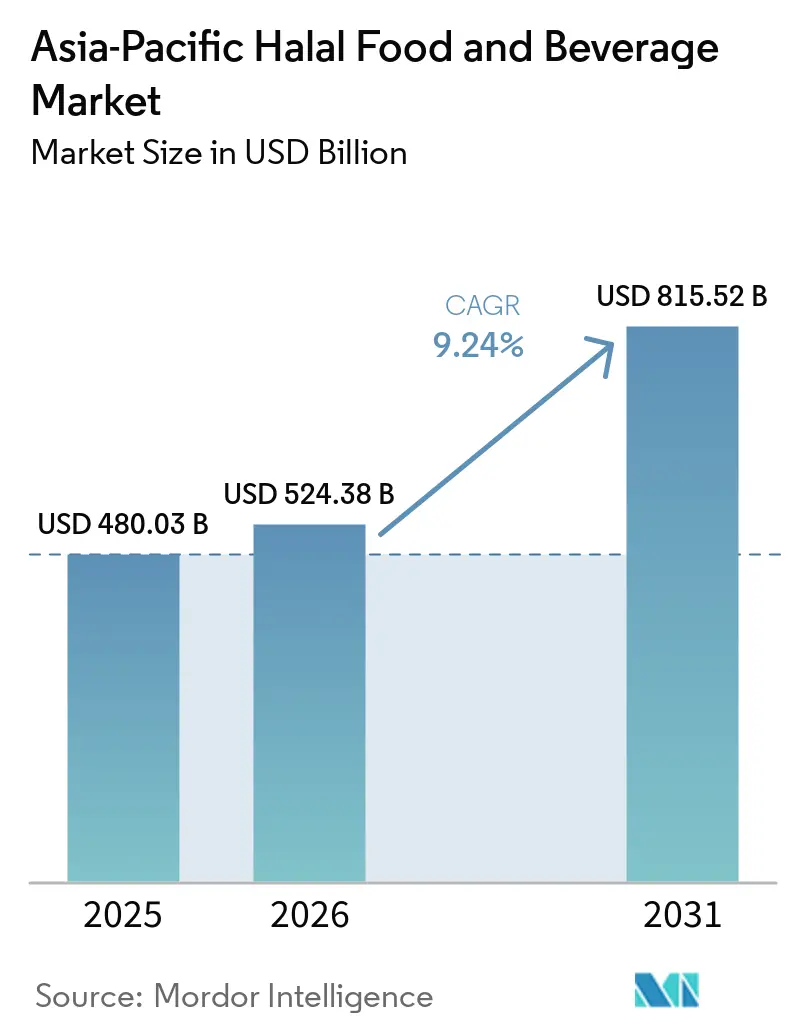
| Base Year Market Size (2025) | USD 480.03 Billion |
| Market Size (2026) | USD 524.38 Billion |
| Market Size (2031) | USD 815.52 Billion |
| Growth Rate (2026 - 2031) | 9.24 % |
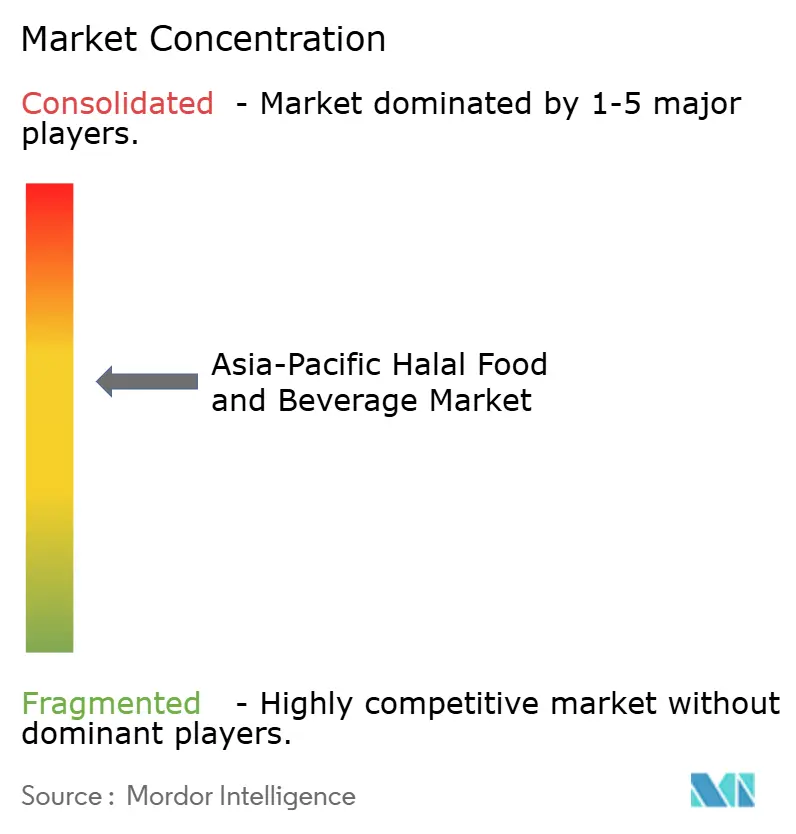
| Market Concentration | Medium |
Major Players *Disclaimer: Major Players sorted in no particular order Image © Mordor Intelligence. Reuse requires attribution under CC BY 4.0. | |
Asia-Pacific Halal Food and Beverage Market Analysis by Mordor Intelligence
Asia-Pacific halal food and beverage market size in 2026 is estimated at USD 524.38 billion, growing from 2025 value of USD 480.03 billion with 2031 projections showing USD 815.52 billion, growing at 9.24% CAGR over 2026-2031. This trajectory reflects structural demand anchored in demographic momentum rather than cyclical consumption patterns. Indonesia commanded 36.10% of regional revenue in 2025, yet Malaysia will outpace all peers with a 10.07% CAGR through 2031, driven by its government's systematic push to position the nation as a global halal hub through JAKIM's mutual recognition agreements with 85 certifying bodies worldwide. The growth differential between these neighbors illustrates how regulatory sophistication, not just Islamic population size, determines market velocity. Headline risks center on certification fragmentation and counterfeit labeling. Despite ASEAN's 2024 push for mutual recognition, divergent standards across Indonesia (BPJPH), Malaysia (JAKIM), Thailand (CICOT), and Singapore (MUIS) force exporters to maintain parallel compliance systems, inflating costs according to industry consultations. Counterfeit halal logos proliferate in markets with weak enforcement, eroding consumer trust and creating reputational hazards for legitimate brands. Meanwhile, non-halal alternatives priced 15-25% below certified products tempt cost-sensitive buyers in India and China, where Islamic minorities lack the purchasing power to consistently absorb halal premiums. Functional beverages, plant-based proteins, and ready meals outpace legacy staples as urban consumers swap lengthy preparation for convenience. Divergent national standards, however, inflate multi-market compliance costs and create white-space opportunities for agile suppliers that can navigate regulatory fragmentation faster than multinationals.
Key Report Takeaways
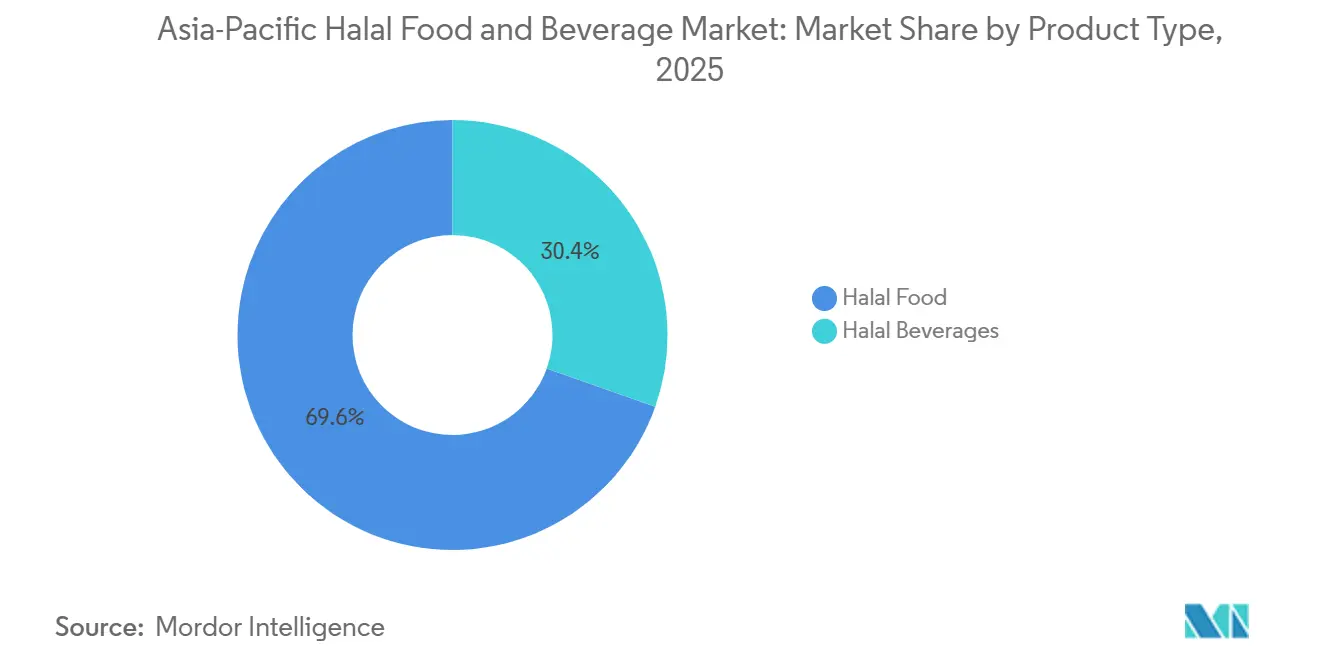
- By product type, halal food captured 69.58% of 2025 revenue, while beverages are forecast to expand at a 9.52% CAGR through 2031.
- By price range, mass-market goods held 70.68% of 2025 sales; premium products are projected to grow at a 10.05% CAGR.
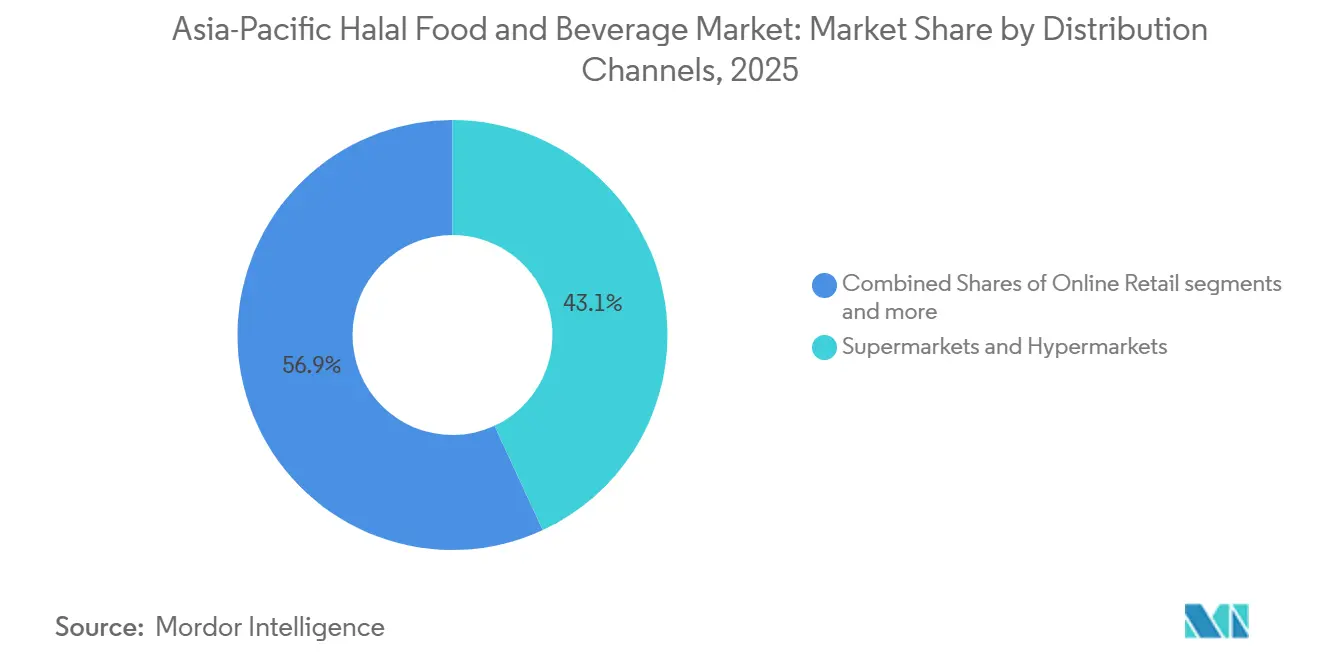
- By distribution channel, supermarkets and hypermarkets retained 43.10% of 2025 spending, whereas online retail is set to rise at a 9.63% CAGR.
- By geography, Indonesia accounted for 36.10% of 2025 revenue; Malaysia is expected to post the fastest 10.07% CAGR to 2031.
Note: Market size and forecast figures in this report are generated using Mordor Intelligence’s proprietary estimation framework, updated with the latest available data and insights as of 2026.
Market Trends and Insights
Drivers Impact Analysis of Asia-Pacific Halal Food and Beverage Market*
| Driver | (~) % Impact on CAGR Forecast | Geographic Relevance | Impact Timeline |
|---|---|---|---|
| Growing Islamic population boosts halal product demand | +2.1% | Indonesia, Malaysia, India, Bangladesh, with spillover to Singapore and Australia | Long term (≥ 4 years) |
| Halal-compliant ready meals and dairy alternatives expansion | +1.5% | Urban centers across Indonesia, Malaysia, Singapore, and Japan (Islamic-friendly tourism) | Medium term (2-4 years) |
| Growing consumer demand for safe, quality-assured foods | +1.3% | APAC (Asia-Pacific)core (Indonesia, Malaysia, Singapore), expanding to China and India | Medium term (2-4 years) |
| Improved supply-chain traceability via blockchain and technology solutions | +0.9% | Indonesia (SiHalal), Malaysia (HalalChain pilots), Singapore (smart logistics hubs) | Short term (≤ 2 years) |
| Modern retail expansion improves halal accessibility region-wide | +1.2% | Indonesia, Malaysia, India, China (tier-2 cities), Australia (multicultural suburbs) | Medium term (2-4 years) |
| Diversified halal product range across many food categories | +1.4% | APAC, with innovation clusters in Malaysia, Singapore, and Japan | Long term (≥ 4 years) |
| Source: Mordor Intelligence | |||
Growing Islamic Population Boosts Halal Product Demand
Demographic momentum underpins the 9.35% CAGR as Asia-Pacific's Islamic population expands from 1.1 billion in 2024 toward 1.3 billion by 2030, per UN population projections[1]. Indonesia alone houses 237 million Islamics, while India's 200 million Islamic minority represents the world's third-largest Islamic population. This scale creates a captive base for halal-certified staples, yet purchasing power varies dramatically: Indonesian per-capita halal spending reached USD 420 in 2024, versus USD 180 in India, per government trade data. The gap explains why Indonesia's 36.54% market share dwarfs India's despite comparable Islamic populations. Malaysia's proactive halal industrialization strategy, codified in its 2024-2030 National Halal Masterplan, positions the country to capture diaspora demand across Singapore, Brunei, and Southern Thailand, leveraging JAKIM's brand equity as a gold-standard certifier.
Halal-Compliant Ready Meals and Dairy Alternatives Expansion
Urbanization and dual-income households drive demand for convenient, shelf-stable halal meals. Indonesia's ready-meal segment grew year-on-year in 2024, fuelled by e-commerce penetration and cold-chain infrastructure upgrades funded by government logistics initiatives. Plant-based dairy alternatives, oat milk, almond yogurt, are gaining traction among health-conscious Islamics who view them as inherently halal, bypassing certification complexities tied to animal-derived ingredients. Nestlé's 2024 launch of halal-certified plant-based condensed milk in Malaysia signals multinational recognition of this shift. Japan's halal ready-meal market, though niche, expanded in 2024 as tourism rebounds and Islamic visitors seek certified convenience foods at airports and train stations, per Japan Halal Association data.
Growing Consumer Demand for Safe, Quality-Assured Foods
Halal certification has evolved beyond religious compliance into a proxy for food safety and ethical sourcing, appealing even to non-Islamic consumers. A 2024 survey by Indonesia's BPJPH found that 18% of halal-certified product buyers were non-Islamics attracted by perceived quality assurance. This halo effect amplifies market potential, particularly for exports to China, where food safety scandals have eroded trust in domestic brands. Malaysia's halal-certified baby food exports to China surged in 2024, per Malaysian External Trade Development Corporation data, as Chinese parents equate JAKIM certification with rigorous safety protocols [2]. The trend suggests halal positioning can command premium pricing beyond Islamic-majority markets, provided brands invest in consumer education.
Diversified Halal Product Range Across Many Foods Categories
Beyond meat and poultry, halal certification now spans confectionery, bakery, savory snacks, sauces, and baby food. Malaysia's Secret Recipe launched halal-certified cakes in 15 new flavors in 2024, targeting gifting occasions during Ramadan and Eid. Indonesia's Ramly introduced halal-certified frozen seafood, capitalizing on coastal demand for convenient protein. Japan's Bourbon Corporation obtained halal certification for select biscuit lines in 2024, aiming to capture Islamic tourist spending at convenience stores. This category proliferation diversifies revenue streams and insulates the market from single-category shocks, such as avian flu outbreaks that periodically disrupt poultry supply.
Restraints Impact Analysis of Asia-Pacific Halal Food and Beverage Market*
| Restraint | (~) % Impact on CAGR Forecast | Geographic Relevance | Impact Timeline |
|---|---|---|---|
| Fragmented halal certification standards vary across countries | -1.2% | ASEAN core (Indonesia, Malaysia, Thailand, Singapore), with export friction to China, Japan, and Australia | Medium term (2-4 years) |
| Risk of mislabelling or counterfeit halal certification | -0.8% | Indonesia, India, China (weak enforcement zones), with reputational spillover across APAC | Short term (≤ 2 years) |
| Competition from cheaper non-halal or uncertified alternatives | -1.0% | India, China, Philippines (price-sensitive Islamic minorities) | Medium term (2-4 years) |
| Supply-chain complexity challenges halal integrity maintenance | -0.7% | Multi-country supply chains (Indonesia-Malaysia-Singapore trade corridors), cold-chain gaps in rural areas | Long term (≥ 4 years) |
| Source: Mordor Intelligence | |||
Fragmented Halal Certification Standards Vary Across Countries
Despite ASEAN's 2024 mutual recognition framework, practical harmonization remains elusive. Indonesia's BPJPH mandates on-site slaughter audits, while Malaysia's JAKIM accepts video documentation, creating procedural mismatches that delay cross-border approvals. Thailand's CICOT and Singapore's MUIS impose distinct labeling requirements, forcing exporters to redesign packaging for each market. According to studies, it was found that certification costs for a single product across four ASEAN markets averaged USD 45,000, versus USD 12,000 for a single-country certification. This fragmentation disproportionately burdens small and medium enterprises, consolidating market share among multinationals with dedicated regulatory teams. Compliance with JAKIM and BPJPH standards, the region's most stringent, has become a de facto prerequisite for pan-ASEAN distribution, marginalizing producers who lack resources to meet dual benchmarks.
Risk of Mislabeling or Counterfeit Halal Certification
Counterfeit halal logos proliferate in markets with weak enforcement infrastructure. Indonesia's BPJPH conducted 1,200 raids in 2024, seizing products bearing fake halal stamps, per Ministry of Religious Affairs reports. India's lack of a centralized halal authority enables rogue certifiers to issue dubious approvals, eroding consumer confidence. A 2024 investigation documented Chinese manufacturers affixing halal logos to non-compliant products destined for Southeast Asian markets, exploiting lax customs inspections. These incidents trigger brand crises: when a Malaysian retailer unknowingly stocked mislabeled Indonesian snacks in 2024, social media backlash forced a nationwide recall, costing the distributor an estimated USD 3 million. Blockchain traceability systems promise mitigation, but adoption remains nascent outside Singapore and Malaysia.
*Our forecasts treat driver/restraint impacts as directional, not additive. The impact forecasts reflect baseline growth, mix effects, and variable interactions.
Asia-Pacific Halal Food and Beverage Market Segment Analysis
By Product Type:
Beverages Outpace Traditional Food GrowthHalal food commanded 69.58% of 2025 revenues, anchored by staples like meat, poultry, dairy, and bakery products that form the dietary core for Islamic households. Within this segment, ready meals and dairy alternatives are expanding rapidly as urbanization shortens meal preparation time and plant-based diets gain cultural acceptance. Meat, poultry, and seafood remain the largest subsegment, driven by high per-capita consumption in Indonesia and Malaysia, yet face margin pressure from volatile feed costs and avian flu outbreaks that periodically constrain supply. Confectionery and savory snacks benefit from impulse purchasing and gifting traditions during Islamic festivals, while baby food enjoys premiumization as middle-class parents prioritize nutrition and halal assurance. Bakery products and condiments serve as everyday essentials, offering stable but low-growth revenue streams.
Halal beverages, forecast to grow at 9.52% CAGR through 2031, are capturing share from traditional food categories as functional drinks, cold-pressed juices, and plant-based milk alternatives resonate with health-conscious millennials. Malaysia's F&N Holdings launched a halal-certified collagen drink in 2024, targeting beauty-conscious Islamic women, while Indonesia's Orang Tua Group introduced a halal energy drink fortified with date extract, blending tradition with modern wellness trends. Japan's halal beverage market, though small, is expanding as convenience stores stock certified options for Islamic tourists and residents. The beverage segment's faster growth reflects lower certification complexity, most drinks avoid animal-derived ingredients, and higher margins compared to commodity food items.
By Price Range:
Premium Gains as Incomes RiseMass-market products held 70.68% of 2025 revenues, serving price-sensitive buyers who prioritize affordability over brand prestige. This segment includes unbranded staples, private-label offerings, and economy packs sold through traditional grocery stores and wet markets. Indonesia's dominance in the mass segment reflects its large lower-middle-class population, where halal certification is expected but premium pricing is unaffordable. India's halal market skews heavily toward mass offerings, as Islamic minorities face income constraints that limit discretionary spending.
Premium halal products, forecast to grow at 10.05% CAGR through 2031, cater to affluent urbanites who equate halal with organic, ethically sourced, and artisanal qualities. Malaysia's Kawan Food introduced a premium line of halal-certified frozen dim sum in 2024, priced 35% above standard offerings, targeting expatriates and upper-income locals. Singapore's halal premium segment benefits from high per-capita incomes and a cosmopolitan consumer base willing to pay for provenance and sustainability certifications alongside halal compliance. Australia's halal-certified grass-fed beef, exported to Malaysia and Indonesia, commands a 40% premium over grain-fed alternatives, per Australian Meat Processor Corporation data. The premium segment's faster growth underscores a broader shift: halal is transitioning from a baseline religious requirement to a lifestyle choice that signals health, ethics, and quality.
By Distribution Channel:
Online Retail Disrupts Traditional ModelsSupermarkets and hypermarkets captured 43.10% of 2025 sales, leveraging scale, convenience, and promotional firepower to dominate halal distribution. Indonesia's Alfamart and Indomaret, Malaysia's Aeon and Giant, and Singapore's FairPrice anchor this channel, offering dedicated halal sections and private-label products. Convenience and grocery stores serve neighborhood demand, particularly in rural areas where modern retail penetration remains low. These outlets stock fast-moving halal staples but lack the SKU breadth of hypermarkets.
Online retail stores, forecast to grow at 9.63% CAGR through 2031, are reshaping halal commerce as e-commerce platforms like Shopee, Lazada, and Tokopedia integrate halal filters and certification badges into search interfaces. Indonesia's halal e-commerce sales surged in 2024, driven by pandemic-induced digital adoption and improved cold-chain logistics that enable fresh and frozen halal product delivery. Malaysia's Salaam Market, a dedicated halal e-commerce platform, reported year-on-year growth in 2024, attracting brands seeking direct-to-consumer channels. Singapore's RedMart and Australia's Coles Online expanded halal-certified SKUs in 2024, responding to multicultural demand for home delivery. The online channel's faster growth reflects its ability to aggregate niche halal products that lack shelf space in physical stores, serving long-tail demand for specialty items like halal-certified supplements, gourmet sauces, and imported confectionery.

Geography Analysis
Indonesia Halal Food and Beverage Market
Indonesia claimed 36.10% of 2025 revenues, a dominance rooted in its 237 million Islamics and mandatory halal certification law that took full effect in October 2024. Law 33/2014 and its implementing regulation (GR 42/2024) compel every food and beverage manufacturer, domestic and foreign, to secure BPJPH approval, creating a compliance moat that favors established players with certification expertise. Indonesia's halal market is bifurcated: urban centers like Jakarta and Surabaya exhibit premiumization trends, while rural areas remain price-sensitive and reliant on traditional retail. The government's 2024 launch of the SiHalal blockchain platform aims to streamline certification, reducing approval timelines from 6 months to 8 weeks, which could democratize market access for small and medium enterprises. Indonesia's halal exports, particularly instant noodles and palm oil-based products, reached USD 8.2 billion in 2024, per Ministry of Trade data, positioning the country as a regional halal manufacturing hub.
Malaysia and Singapore Halal Food and Beverage Market
Malaysia, forecast to grow at 10.07% CAGR through 2031, leverages JAKIM's global brand equity to attract halal-conscious consumers and investors. The government's 2024-2030 National Halal Masterplan targets USD 12 billion in halal exports by 2030, up from USD 7.1 billion in 2024, through tax incentives for halal-certified manufacturers and R&D grants for halal innovation. Malaysia's halal logistics infrastructure, including dedicated halal ports and warehouses, ensures segregation and traceability that command premium pricing in export markets. The country's halal pharmaceutical and cosmetics sectors are expanding alongside food, creating cross-category synergies. Singapore, though small, serves as a regional halal entrepôt, leveraging its port infrastructure and regulatory clarity to facilitate intra-ASEAN halal trade. MUIS certification is recognized across Southeast Asia, enabling Singapore-based brands to scale regionally with minimal friction.
APAC and Oceania Halal Food and Beverage Market
China, Japan, India, and Australia represent emerging halal markets with distinct growth drivers. China's 25 million Islamics, concentrated in Xinjiang and Ningxia, are increasingly affluent, driving demand for halal-certified imports, particularly Malaysian baby food and Indonesian snacks. Japan's halal market, though niche, expanded in 2024 as Islamic tourism rebounded post-pandemic and convenience stores stocked certified options. India's 200 million Islamics represent latent demand constrained by income levels and fragmented certification, yet urban centers like Delhi and Hyderabad are witnessing premiumization. Australia's halal-certified meat exports to Indonesia and Malaysia reached USD 1.8 billion in 2024, per Australian Meat Processor Corporation data, underscoring the country's role as a halal protein supplier rather than a domestic consumption market. The Rest of Asia-Pacific, including Bangladesh, Pakistan, and the Philippines, contributes fragmented demand shaped by local certification regimes and income disparities.
Competitive Landscape
The Asia-Pacific halal food and beverages market operates at a moderate concentration, where multinational corporations coexist with regional specialists and local incumbents. Nestlé, Cargill, and Unilever deploy global supply chains and R&D budgets to secure halal certifications across multiple jurisdictions, yet face agility constraints when navigating Indonesia's BPJPH or Malaysia's JAKIM protocols. Regional players like Kawan Food, QL Resources, and Ramly leverage deep local knowledge and established certifier relationships to outmaneuver multinationals in speed-to-market. Competitive strategies center on certification portfolio breadth, traceability transparency, and premiumization.
Firms that secure dual JAKIM-BPJPH approvals unlock pan-ASEAN distribution, while those investing in blockchain traceability systems differentiate on authenticity and food safety. Opportunities abound in halal-certified functional foods, plant-based proteins, and e-commerce-exclusive SKUs that bypass traditional retail gatekeepers. Emerging disruptors include halal-focused direct-to-consumer brands that leverage Instagram and TikTok for customer acquisition, bypassing supermarket slotting fees.
Technology adoption varies: Singapore-based firms integrate IoT and AI for supply-chain optimization, while Indonesian SMEs rely on manual processes, creating a digital divide that shapes competitive positioning. Compliance with ISO 22000 (food safety management) and HACCP (hazard analysis) standards is becoming table stakes, as retailers demand third-party audits alongside halal certification to mitigate reputational risk.
Asia-Pacific Halal Food and Beverage Industry Leaders
-
Nestlé S.A.
-
Unilever PLC
-
Cargill, Incorporated
-
BRF S.A.
-
QL Foods Sdn Bhd (QL Resources)
- *Disclaimer: Major Players sorted in no particular order
Asia-Pacific Halal Food and Beverage Market Companies Covered in this Report
- Nestle S.A.
- Cargill, Incorporated
- Kawan Food Berhad
- QL Resources Berhad (QL Foods)
- BRF S.A.
- Unilever Plc
- OldTown Berhad
- Secret Recipe Cakes & Caf� Sdn Bhd
- Marrybrown International
- Siamfoodtech Co., Ltd.
- Max Oceans Co., Ltd.
- Inno4 Co., Ltd.
- Ramly Food Processing Sdn Bhd
- Haoyue Group (China)
- Pampanga�s Best, Inc.
- American Halal Company, Inc.
- Prima?Agri?Products
- Ecolite Biotech Manufacturing Sdn Bhd
- Nema Food Company
- Allanasons Pvt. Ltd.
Read Analysis of Asia-Pacific Halal Food and Beverage Companies
Scope and Methodology
Regulatory enforcement and digitization are creating whitespace for suppliers that can industrialize halal assurance across ingredients, manufacturing, and cross-border distribution. Indonesia's mandatory halal framework and the approaching October 18, 2026 requirement for imported food and beverage products to comply concentrate near-term opportunity on compliance-enabled trade and faster certification throughput, supported by initiatives such as SiHalal intended to compress approval timelines. Malaysia is pairing export ambition with capability-building and ingredient security through policy execution under HIMP 2030, with 23 initiatives reported as implemented as of May 30, 2026 to reduce reliance on imported critical halal ingredients. This opens opportunities in local ingredient production, validated supplier networks, and data-enabled ingredient registries, including the MyHALALINGREDIENTS system implemented in August 2025.
Investment and channel developments provide clearer routes to scale for halal brands and ingredient suppliers. In May 2026, Mahsuri Food Sdn. Bhd. opened a state-of-the-art production facility in Bandar Enstek to expand production capacity and support growth across Southeast Asia, the Middle East, and India, indicating continued capacity addition aligned to export corridors. On the demand and distribution side, Lulu Group's May 2026 plan to procure about USD 100 million worth of Malaysian halal products for its global supermarket network strengthens a direct offtake pathway for certified manufacturers. Meanwhile, Nestle Malaysia's May 2026 collaboration with JAKIM (Synergy Halal Nestle Malaysia) highlights supply chain capability-building investments across suppliers, co-manufacturers, and logistics partners. Together, these proof points support opportunities in halal-certified ready meals, functional beverages, and traceability-backed products that can win shelf space in modern retail and online channels under rising enforcement scrutiny.
Recent Industry Developments in Asia-Pacific Halal Food and Beverage Market
- July 2026: Nestle Thailand secured approval from the Thailand Board of Investment (BOI) for a USD 688 million investment to build a smart factory and distribution center in Samut Prakan. The project adds regional manufacturing and fulfillment capacity and strengthens compliance-ready production systems that support halal and broader quality requirements across ASEAN supply routes.
- October 2025: Nestle Indonesia signed an MoU with Indonesias Halal Product Guarantee Agency (BPJPH) to provide technical support and business development to help up to 5,000 MSMEs obtain halal certification. The program expands the certified supplier base feeding modern retail and e-commerce, and it aligns multinational procurement ecosystems with Indonesias mandatory halal framework.
- August 2024: Cargill opened a new blending facility at its Pandaan site in Indonesia for starches, sweeteners, and texturizers tailored to local requirements, including halal assurance needs. The added local formulation capability helps shorten lead times for processed food and beverage manufacturers and reduces reliance on imported specialty ingredients in a market tightening certification enforcement.
Asia-Pacific Halal Food and Beverage Market Report Scope and Research Methodology
Market Definition and Coverage
This market covers the value of halal-certified food and beverage products sold across Asia-Pacific, where compliance is based on recognized halal standards and certification practices. The sizing reflects consumer and foodservice consumption through common retail and online routes, reported in USD value terms.
Scope exclusions: We exclude non-certified products that are only marketed as ethical or clean label, and we also exclude halal cosmetics, pharmaceuticals, and other non-food categories.
Segments Covered in This Report
- Product Type
- Halal Food
- Dairy and Dairy Alternatives
- Confectionery
- Bakery Products
- Savory Snacks
- Meat, Poultry and Seafood
- Red Meat
- Seafood
- Poultry
- Baby Food
- Ready Meals
- Condiments and Sauces
- Other Product Types
- Halal Beverages
- Halal Food
- Price Range
- Mass
- Premium
- Distribution Channel
- Hypermarkets/Supermarkets
- Convenience/Grocery Stores
- Online Retail Stores
- Other Distribution Channels
- Geography
- China
- Japan
- India
- Australia
- Indonesia
- Malaysia
- Singapore
- Rest of Asia-Pacific
Data Sources, Market Sizing, and Validation
Desk Research
Desk research was used to build the fact base around halal standards, trade flows, and food consumption patterns across Asia-Pacific, and then to sanity-check the model totals. Public sources were reviewed such as national statistics offices for food CPI and household expenditure, customs and tariff portals for import and export direction, and agriculture and fisheries ministries for production context.
We also referred to halal certification bodies and government-led halal agencies for rules updates and certification coverage changes, along with FAO food balance sheets and selected peer-reviewed journals on halal supply chains and consumer behavior. For company-level context, we used annual reports, investor decks, and reputable press. A few paid subscriptions were used selectively for company financials and intelligence, plus shipment-level trade visibility when country trade tables lacked sufficient detail. These are illustrative examples only, and many other sources were used to collect data, validate assumptions, and clarify unclear points.
Primary Interviews and Surveys
Primary work focused on validating what qualifies as halal-ready sales in each country, how certification and labeling are applied in real procurement, and how channel mix is shifting between modern trade and online. We spoke with manufacturers, ingredient and certification ecosystem participants, distributors, and retail or foodservice decision-makers across APAC, so the desk findings could be corrected when on-ground practices differed.
Distribution of primary research fieldwork respondents
| Company type | Respondent position |
|---|---|
| Top tier: 36% | CXOs: 16% |
| Mid tier: 48% | Functional/Unit leaders: 27% |
| Smaller Players: 16% | Managers: 57% |
Market-Sizing & Forecasting
Sizing starts with a top-down build where national food and non-alcoholic beverage spending pools are reconstructed, and then adjusted using halal penetration assumptions that reflect certification reach and purchase intent by country. To keep the totals realistic, the outputs are cross-checked with selective bottom-up approximations, such as sampled category volumes multiplied by typical retail price bands, plus distributor and retailer channel checks, and the totals are tuned when gaps are found.
Key inputs include Muslim population and urbanization trends, per capita packaged food and beverage spend, modern trade and e-commerce share shifts, relative price movement using food CPI, and the observed pace of halal certification adoption across major categories. Because data quality differs by country, missing indicators are handled through proxy variables, for example using close peer markets with similar income and dietary mix, before being reviewed with interview feedback.
For forecasting, we use scenario analysis supported by multivariate regression signals at the country level, where growth is linked to income, population, and channel expansion, and then stress-tested for certification policy changes and inflation-driven price shifts. Forecast assumptions are kept explicit so a junior analyst can rerun the model when new population or food spend series are released.
Data Validation & Update Cycle
Validation is done by comparing modeled values against independent signals like category-level growth rates, trade intensity for relevant food groups, and channel expansion indicators, and then checking if the implied per capita halal spend stays within plausible ranges. When unusual jumps show up, the driver is traced back to either price, penetration, or mix, and the assumption is revisited before results are signed off.
A multi-step internal review is followed so the same logic is applied across countries, and re-contacts are triggered when a policy change, certification update, or sharp macro movement can materially shift demand. Reports are refreshed annually, and interim updates are made when large events impact the market. Right before delivery, a final pass is completed to ensure clients receive the latest updated view.
Mordor Intelligence's Asia Pacific Halal Food and Beverages Market Size Compared With Other Published Estimates
Published values for this market can differ widely, mainly because analysts do not always count the same product scope, the same geography set, or the same definition of what qualifies as halal sales. Differences also show up when one study uses retail sales value, while another leans on broader consumption or trade-led signals.
The biggest gap comes from whether non-certified but Muslim-targeted foods are included, where Mordor Intelligence counts value only when products are treated as halal through recognized certification and then mapped to APAC category and channel demand signals. Forecast spreads also happen when price growth is applied as a flat uplift, versus using food CPI and category mix shifts, and when older base-year currency assumptions are carried forward without a refresh.
Benchmark comparison
| Source | Market Size | Gaps in Research Methodology |
|---|---|---|
| Mordor Intelligence | USD 480.03 B (2025) | |
| Global Consultancy A | USD 731.00 B (2024) | Uses a different base year and often applies a broader product bucket with end-user splits, which can bring in sales that are not consistently tied back to certification coverage by country and channel. |
| Industry Publisher B | USD 1220.00 B (2025) | Reports a much wider estimate that appears closer to a broad halal food and beverage consumption view, which can inflate totals when certification and retail channel boundaries are not applied consistently across APAC. |
Taken together, the spread is mainly explained by scope and counting rules, rather than a disagreement that demand is rising. By keeping the variables traceable to country food spend, halal penetration, price movement, and channel mix, our estimate stays easier to replicate and simpler to audit when assumptions need updating.
Key Questions Answered in the Report
How large is the Asia-Pacific halal food market in 2026?
It is valued at USD 524.38 billion with a 9.24% CAGR outlook to 2031.
Which country contributes the most revenue?
Indonesia leads with 36.10% of 2025 regional sales under BPJPH mandates.
Which product segment is expanding fastest?
Halal beverages, driven by functional and plant-based launches, forecast a 9.52% CAGR to 2031.
What is the market concentration?
The Asia-Pacific halal food and beverages market operates at a moderate concentration, with regional and global players are dominating the market.