
Market Overview
| Study Period | 2021 - 2031 |
|---|---|
| Forecast Data Period | 2026 - 2031 |
| Base Year Market Size (2025) | USD 6.18 Billion |
| Market Size (2026) | USD 6.66 Billion |
| Market Size (2031) | USD 9.65 Billion |
| Growth Rate (2026 - 2031) | 7.72 % |
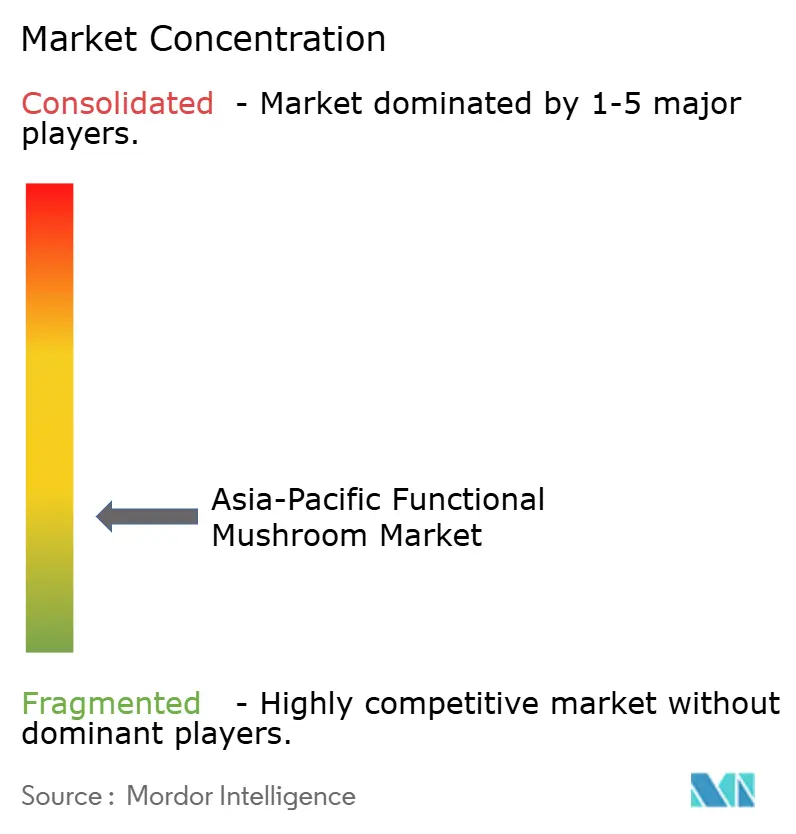
| Market Concentration | Low |
Major Players *Disclaimer: Major Players sorted in no particular order Image © Mordor Intelligence. Reuse requires attribution under CC BY 4.0. | |
Asia-Pacific Functional Mushroom Market Analysis by Mordor Intelligence
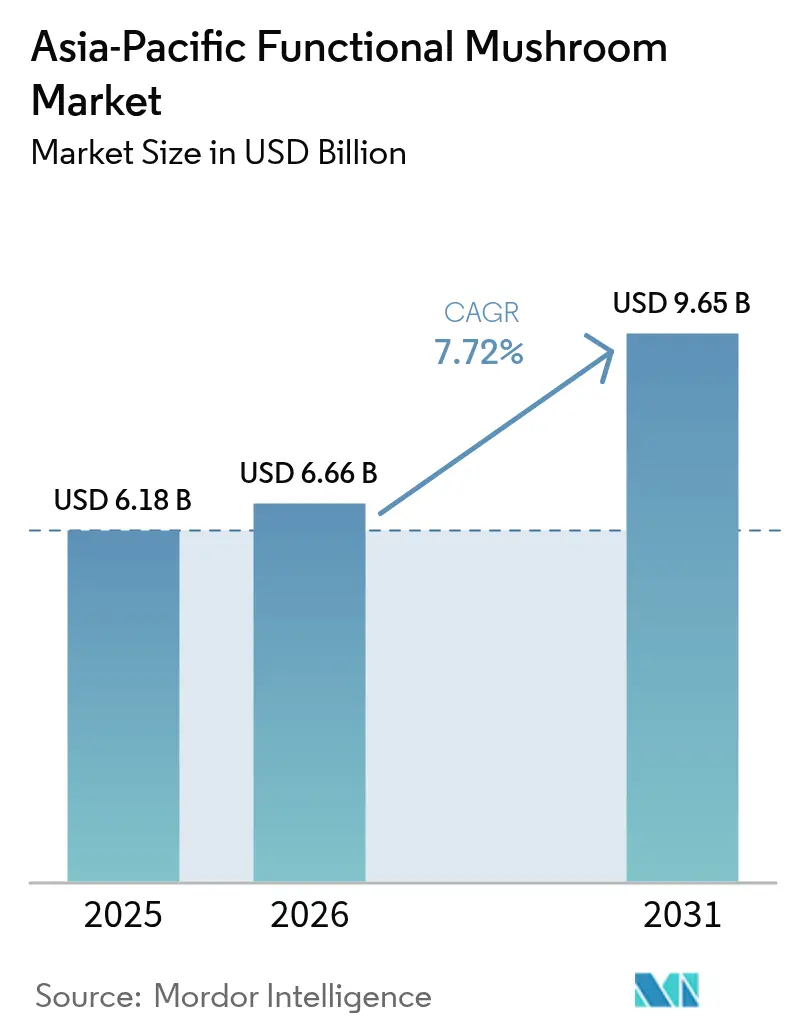
The Asia-Pacific functional mushroom market size is expected to grow from USD 6.18 billion in 2025 to USD 6.66 billion in 2026 and is forecast to reach USD 9.65 billion by 2031 at 7.72% CAGR over 2026-2031. Demand accelerates as the region blends deep historical use of medicinal fungi with modern nutraceutical science. China’s 75% share of global mushroom output anchors raw-material security, while Japan and Malaysia speed commercialization through clear functional-food rules and biotech tax incentives. Brands extend beyond conventional powders into ready-to-drink lattes, gummies, and skincare serums that solve taste, dosage, and convenience barriers for first-time buyers. Supply-side investments in automated fermentation and CRISPR strain improvement are narrowing the cost gaps for vitamins, positioning fungi as a versatile, plant-based protein and adaptogen source for sports, beauty, and healthy-aging segments.
Key Report Takeaways
- By type, Reishi led the Asia-Pacific functional mushroom market with a 34.72% share in 2025; Cordyceps is forecast to grow at an 8.59% CAGR through 2031.
- By nature, conventional products accounted for 70.12% of the Asia-Pacific functional mushroom market size in 2025, while organic variants are expected to expand at a 10.23% CAGR through 2031.
- By form, powders captured 60.62% of the Asia-Pacific functional mushroom market size in 2025; however, liquid extracts are projected to rise at a 9.38% CAGR through 2031.
- By application, dietary supplements held a 37.08% share of the Asia-Pacific functional mushroom market in 2025; meanwhile, the personal care and cosmetics segment is projected to advance at a 9.52% CAGR through 2031.
- By geography, China generated 39.22% of the 2025 revenue and is expected to grow at an 8.40% CAGR through 2031.
Note: Market size and forecast figures in this report are generated using Mordor Intelligence’s proprietary estimation framework, updated with the latest available data and insights as of 2026.
Asia-Pacific Functional Mushroom Market Trends and Insights
Drivers Impact Analysis*
| Driver | (~) % Impact on CAGR Forecast | Geographic Relevance | Impact Timeline |
|---|---|---|---|
| Demand for immune-boosting mushroom supplements | +1.8% | Global, with concentration in China, Japan, South Korea | Medium term (2-4 years) |
| Rising adoption of adaptogenic ingredients in RTD beverages and coffees | +1.5% | Urban centers across China, Japan, Australia, Singapore | Short term (≤ 2 years) |
| Adoption of mushrooms in plant-based diets | +1.2% | Australia, India, urban China, South Korea | Medium term (2-4 years) |
| Rise of mushrooms in sports performance nutrition | +0.9% | Japan, South Korea, Australia, urban Southeast Asia | Medium term (2-4 years) |
| Popularity of convenient mushroom-infused beverages | +1.1% | China, Japan, Malaysia, Thailand, Singapore | Short term (≤ 2 years) |
| Government research grants for mycelium biotechnology | +0.7% | China, Japan, Singapore, Malaysia | Long term (≥ 4 years) |
| Source: Mordor Intelligence | |||
Demand for Immune-Boosting Mushroom Supplements
Peer-reviewed trials confirm that Reishi and Turkey Tail polysaccharides stimulate natural killer cells and elevate interferon-gamma, strengthening the case for these fungi as evidence-based immune aids. Japanese and Korean consumers insist on labels showing ≥20% beta-glucan, prompting brands to adopt dual extraction methods using both hot water and ethanol. China’s regulator cleared 127 new immune-health SKUs in 2024, signaling policy comfort after decades of post-market surveillance. Pandemic-era habits persist in Indonesia and Thailand, where pharmacy sales increased by 35-40% year-over-year. Yet, differing test protocols, Japan uses AOAC 995.16 while China follows GB/T 5009.124, still create cross-border label confusion that undercuts trust.
Rising Adoption of Adaptogenic Ingredients in RTD Beverages and Coffees
Cordyceps and Lion’s mane are migrating from capsules to ready-to-drink coffees that sit next to energy drinks in convenience stores. DXN’s Lion’s Mane Coconut Latte sells at roughly USD 0.96 per sachet, undercutting imports while delivering 300 mg of dual-extracted mycelium per serving[1]. Four Sigmatic localizes flavors, matcha in Japan, turmeric in India, and now serves eight Asia-Pacific markets. Beverage formats mask earthy notes, boosting trial rates among younger shoppers. Japan’s IFIA/HFE 2024 expo showcased 12 new mushroom drinks, confirming that liquid innovation is outpacing capsule development.
Adoption of Mushrooms in Plant-Based Diets
Shiitake and Oyster mushrooms add umami and fiber to vegan burgers that previously relied on soy and pea isolates. Australia’s plant-based food sector, valued at USD 124 million in 2024, now features mycelium in patties that retain moisture during grilling, according to Food Standards Australia New Zealand (FSANZ). India’s vegan urbanites choose Cordyceps powders that align with Ayurvedic sattvic principles. South Korea has earmarked USD 11.3 million to scale organic substrates, hoping that local production will reduce soy imports. Cost parity remains a hurdle: mycelium protein costs USD 12-18 per kg, compared to USD 3-4 for soy isolate.
Rise of Mushrooms in Sports Performance Nutrition
Clinical trials have shown that Cordyceps militaris supplementation can increase VO2 max by up to 11% in trained athletes, according to the Taylor and Francis Group. Japanese brands added Cordyceps to 18 new SKUs in 2024, touting natural ergogenic support accepted by anti-doping agencies. Australia classifies Cordyceps as a complementary medicine, requiring batch-to-batch consistency of cordycepin, which favors cultivated militaris over the variable wild sinensis. South Korean e-sports players use Lion’s mane for sustained focus during marathon gaming sessions. Sports channels command 15-25% price premiums over general nutrition, covering added quality-testing costs.
Restraints Impact Analysis*
| Restraint | (~) % Impact on CAGR Forecast | Geographic Relevance | Impact Timeline |
|---|---|---|---|
| Fragmented Asia-Pacific regulations on novel foods and health claims | -1.3% | Indonesia, Thailand, Vietnam, Philippines, India | Medium term (2-4 years) |
| High price premium versus conventional supplements | -1.0% | Price-sensitive markets: India, Indonesia, Philippines, Vietnam | Short term (≤ 2 years) |
| Raw material supply volatility | -0.8% | China (substrate sourcing), wild-harvested species across APAC | Medium term (2-4 years) |
| Storage and shelf-life limitations of mushroom products | -0.6% | Tropical climates: Southeast Asia, India | Short term (≤ 2 years) |
| Source: Mordor Intelligence | |||
Fragmented Asia-Pacific Regulations on Novel Foods and Health Claims
Each country sets its own dossier, safety test, and labeling demands, adding USD 50,000–150,000 and 12-18 months per entry. Indonesia requires separate filings for every species in a blended SKU according to the Indonesian Food and Drug Monitoring Agency[2]. Thailand blocks health claims until three years of surveillance have passed, while Vietnam’s tiered system treats Cordyceps as a top novel, despite centuries of use. Australia insists on full safety data even for Reishi. This patchwork forces brands to run parallel formulations and hire multiple regulatory consultants, eroding scale economies.
High Price Premium Versus Conventional Supplements
Organic Reishi bottles sell for USD 35-50, compared to USD 12-18 for multivitamins, which limits their reach in India and Indonesia, where per-capita incomes are low, according to the Reserve Bank of India[3]. Slow, climate-controlled fermentation plus dual extraction drive costs. Certified organic substrates are scarce in Asia, so many firms import at 40–60% uplifts. Until yields improve and equipment amortization occurs, fungi will remain a premium wellness choice rather than a mass vitamin replacement.
*Our forecasts treat driver/restraint impacts as directional, not additive. The impact forecasts reflect baseline growth, mix effects, and variable interactions.
Segment Analysis
By Type: Reishi Leads While Cordyceps Accelerates
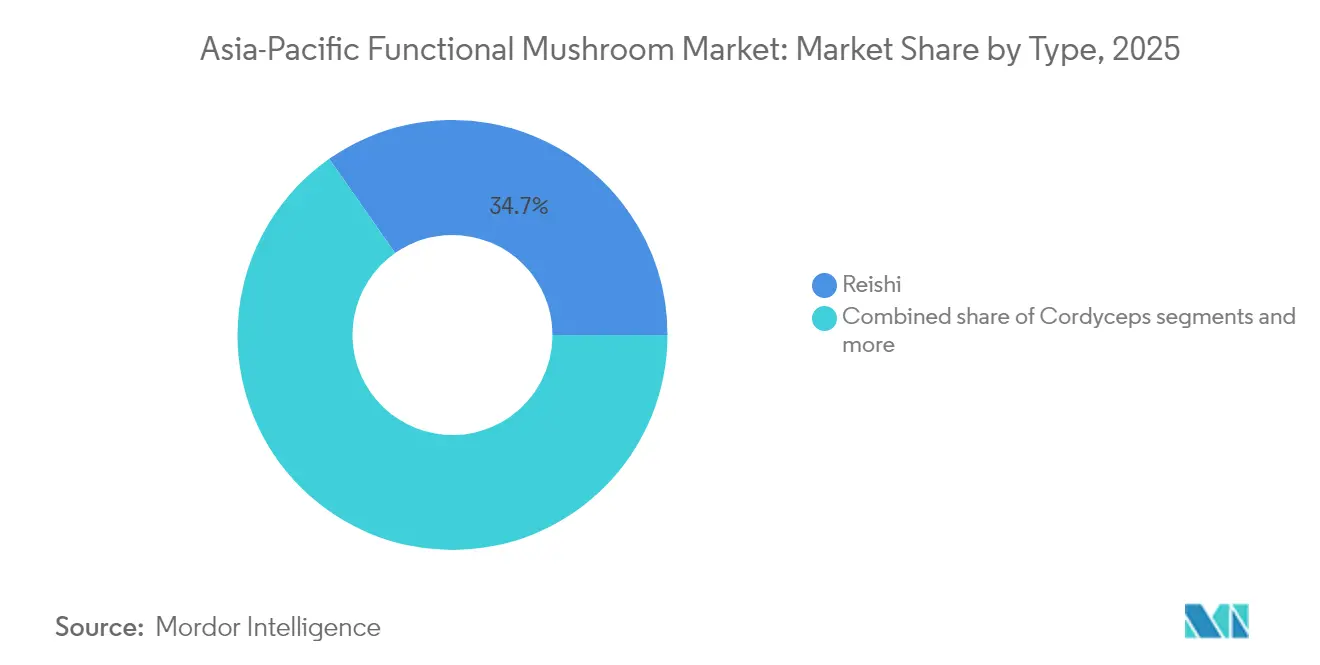
Reishi retained a 34.72% share of the Asia-Pacific functional mushroom market in 2025, thanks to its 2,000-year history of medicinal use and extensive clinical support. Cordyceps is growing at 8.59% CAGR because endurance athletes prize its ATP-boosting cordycepin. The Asia-Pacific functional mushroom market size for Lion’s Mane cognitive formulas is increasing in aging Japan and South Korea, while Shiitake maintains steady demand for food and broth. Turkey Tail’s PSK enjoys formal cancer-therapy reimbursement in Japan, significantly increasing its value far above the price of supplements. Lesser-known species, such as Tremella and Chaga, collectively hold a nearly 20% share in the beauty and antioxidant niches, according to the Pharmaceuticals and Medical Devices Agency (PMDA), Japan .
Continued multi-species blending signals commoditization of single strains. Regulatory clarity is uneven; cultivated Cordyceps militaris bypasses CITES limits on wild sinensis, supporting a steady supply. Higher-potency extracts and cross-functional positioning in beauty, sports, and immunity help maintain resilient average selling prices, even as volumes grow.

By Nature: Conventional Scale Meets Organic Momentum
Conventional products accounted for 70.12% of the Asia-Pacific functional mushroom market share in 2025, driven by mega-farms in Fujian and Zhejiang that utilize automated substrate inoculation and fruiting processes. Organic SKUs are scaling at a 10.23% CAGR, driven by concerns over heavy metals and trust marks such as JAS and NASAA. The Asia-Pacific functional mushroom market size for certified organic lines remains constrained by limited clean substrate supply and higher inspection costs.
Governments help: South Korea subsidized 240 organic farms in 2024, and India’s Himalayan regions enjoy natural low-pollution advantages. Brands add blockchain QR codes that link field data to test reports, providing retailers with assurance. As testing costs decline, more mid-tier brands are expected to migrate to organic, although price premiums of 25–35% are likely to persist.
By Form: Powder Dominates, Liquid Innovates
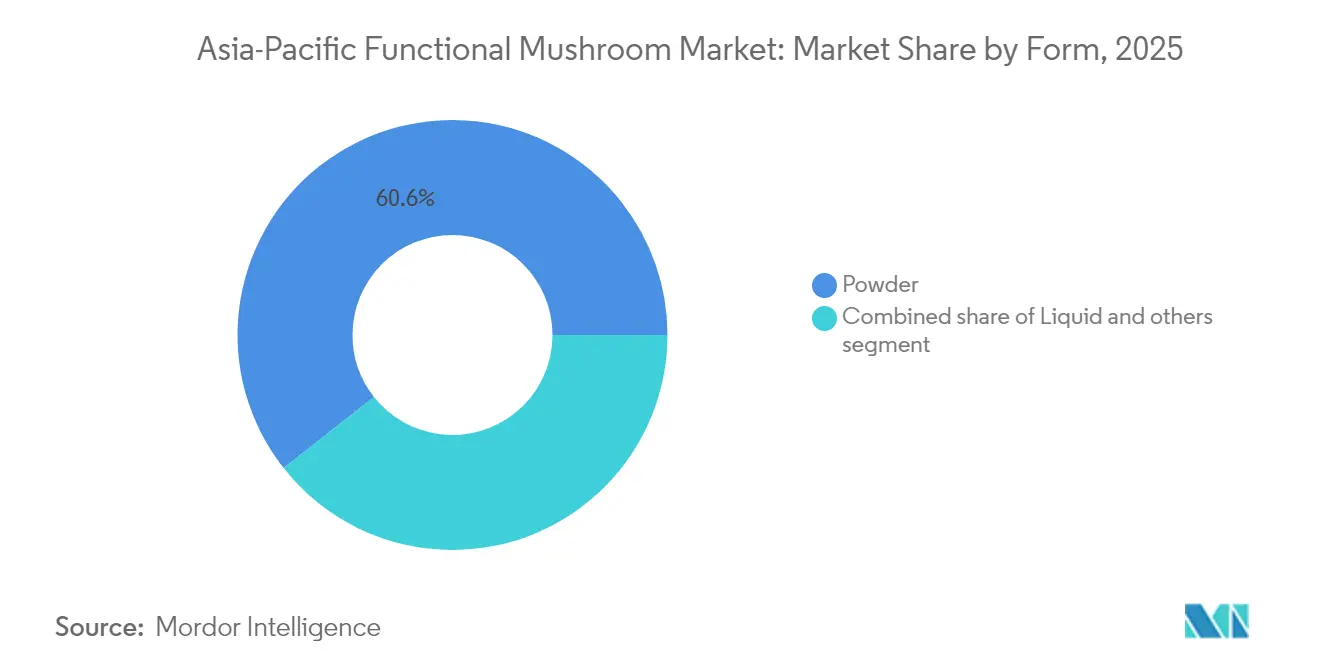
Powders captured 60.62% of the 2025 Asia-Pacific functional mushroom market share because they are inexpensive to fill capsules and blend well into shakes. Liquids are the fastest growing category at 9.38% CAGR, as RTD lattes solve taste barriers. Dual-extracted tinctures demonstrate 30-40% higher beta-glucan absorption than powders, which helps brands justify price points of USD 3-5 per serving, according to American Chemical Society Publications.
Capsules remain popular in Japan and South Korea, where pharmacy shoppers value dosage precision. Gummies appeal to Gen Z snackers and support impulse purchases in convenience stores. Alcohol limits for halal certification in Malaysia and Indonesia cap liquid formats, so spray-dried micro-powders may bridge the gap by matching bioavailability while avoiding ethanol.
By Application: Supplements Lead, Cosmetics Accelerate
Supplements held a 37.08% share in 2025, thanks to mature MLM and pharmacy networks in China, Malaysia, and Japan. The Asia-Pacific functional mushroom market size for skincare is growing at the fastest rate, with a 9.52% CAGR, as Tremella mimics hyaluronic acid and Shiitake contains kojic acid, which brightens the skin. Food and beverage usage spans instant coffees and protein bars priced for grab-and-go consumers.
Prescription channels continue in Japan, where Turkey Tail PSK is eligible for insurance coverage. Animal feed and crop biostimulants are nascent but promise volume growth by valorizing extraction by-products. Cosmetics enjoy gross margins of 65-75%, underscoring why beauty players are investing in R&D for topical and ingestible forms.
Geography Analysis
China produced 8.9 million tons of mushrooms in 2024 and held 39.22% of regional revenue while expanding at an 8.40% CAGR. Subsidies under the five-year biotech plan fund CRISPR strain work and fermentation lines that are expected to cut Cordyceps costs by 30%, according to the Ministry of Science and Technology (MOST), China. Domestic e-commerce sales reached 180 million supplement units in 2024, indicating that internal demand now surpasses export volumes. Provincial approval silos remain a hurdle, requiring brands to navigate up to 31 local processes.
Japan commands premium prices through its Foods with Function Claims framework, allowing companies to self-certify clinical data and reach the market quickly. Aging demographics drive Lion’s Mane memory formulations. Hokkaido Reishi supplies 64 export countries, leveraging 60% beta-glucan potency validated by national laboratories, as per the Ministry of Agriculture, Forestry and Fisheries (MAFF), Japan.
India, Australia, South Korea, and Southeast Asia collectively account for roughly 35% of regional value and are posting mixed growth. India’s market grows double-digit as Ayurveda overlaps with fungi science and government training uplifts small farmers. Australia enforces strict complementary-medicine testing, pushing quality over volume. South Korea’s K-beauty wave drives ingestible beauty demand. Southeast Asia faces regulatory fragmentation but rising middle-class incomes push combined sales toward USD 845 million by 2031.
Regulatory Landscape
Regulation across Asia-Pacific remains fragmented, with functional mushroom products falling under a mix of food standards, novel food frameworks, and health-functional or therapeutic regimes. In China, national food safety standards such as GB 2760-2024 (implemented in 2025) govern permitted additive uses across food categories relevant to edible fungi, while product-facing health food oversight still requires species-specific substantiation and consistent specifications for actives such as polysaccharides. South Korea regulates many functional mushroom offerings under the Health Functional Food Act administered by MFDS, reinforcing expectations around standardized quality and claim substantiation.
Australia and New Zealand provide a technical-standards pathway that has been opening up specific use cases for mushroom-derived inputs in mainstream foods. In July 2025, FSANZ gazetted changes to the Food Standards Code to permit a fermented preparation of Lentinula edodes (shiitake) mycelia as a processing aid for fermentation of pea and rice protein preparations (with New Zealand opting out), showing how targeted approvals for mycelium-derived processing aids can accelerate entry for food and beverage applications, even as broader claim frameworks remain country-specific.
Value Chain Analysis
The value chain starts with cultivation and raw biomass supply, supported by large-scale farms and cultivation clusters in China (notably provinces such as Fujian and Zhejiang referenced in the report context), where scale enables cost-competitive throughput for reishi, cordyceps (cultivated militaris), lion's mane, and shiitake. Upstream inputs include hardwood sawdust and agricultural by-products for substrates, spawn and strain development, and climate-control infrastructure. Strain improvement and controlled fermentation are increasingly important for raising active yields (for example, cordycepin) and for managing heavy-metal and contaminant risks.
Midstream processing centers on cleaning, drying, extraction (including dual extraction where used), concentration, and standardization into powders, liquids, and intermediate extracts for B2B ingredient customers and branded supplement houses. Downstream channels split between (i) contract or OEM supply serving supplement, beverage, and cosmetics brands and (ii) branded go-to-market via pharmacies, e-commerce, and MLM-style networks. Regional scientific and industry bodies such as the Asian Mycological Association and the Functional Food Association of India support knowledge transfer and standards awareness, while trade interfaces (for example, China Mushroom Days) facilitate OEM matchmaking and cross-border sourcing for standardized extract grades.
Competitive Landscape
The Asia-Pacific functional mushroom market remains moderately concentrated, with the top five players controlling a 40-45% share. DXN’s 17.1 million members drove USD 383 million in revenue in FY 2024, proving the scale of MLM distribution. Yukiguni Maitake and Hokkaido Reishi specialize in high-potency extracts that meet Japan’s stringent test standards. Naturalin and Lianfeng leverage China’s low-cost cultivation to supply global brands.
Strategic focus spans three themes: deeper penetration of lower-income ASEAN markets, new delivery forms such as gummies and RTD coffees, and organic certification. Disruptors like Four Sigmatic utilize direct-to-consumer channels while showcasing independent test certificates, capturing the attention of health-conscious millennials. Technology adoption divides incumbents and laggards; leaders deploy CRISPR to increase cordycepin output and utilize blockchain QR codes for traceability.
Patent activity surged with 180 mycelium-related filings in 2024; however, enforcement remains uneven outside Japan and China. Switching costs stay high because MLM networks and long-term pharmacy contracts lock in distributors. Premium organic brands now command 15–20% of incremental growth, showing room for challenger brands that marry transparency with niche positioning.
Asia-Pacific Functional Mushroom Industry Leaders
-
DXN Holdings Berhad
-
Yukiguni Maitake Co., Ltd.
-
Hokkaido Reishi Co., Ltd.
-
Naturalin Bio-Resources Co., Ltd.
-
Mitoku Company Ltd.
- *Disclaimer: Major Players sorted in no particular order
Market Opportunities and Future Outlook
Food and beverage formulation is opening a clearer commercialization lane for mushroom-derived processing aids and additives, complementing the established supplement channel. In 2025, FSANZ issued ingredient-specific approvals that broaden use cases, including authorization for a fermented preparation of Lentinula edodes (shiitake) mycelia as a processing aid for fermentation of pea and rice proteins (A1279) and approval of mushroom (Agaricus bisporus) chitosan as a food additive (preservative) across a range of foods and beverages (A1315). These actions create practical whitespace for suppliers that can provide standardized, regulator-ready specifications for derivatives used in mainstream product matrices, rather than relying only on health-claim-led supplement launches.
On the supply side, controlled-environment capacity additions in Southeast Asia support a more localized, quality-controlled raw material base for ganoderma-led portfolios, which is relevant to both domestic consumption and cross-border distribution where traceability and consistency are required. In January 2026, Gano Excel Industries expanded operational capacity to over 100 greenhouses in Jitra, Malaysia, scaling Ganoderma lucidum (lingzhi) production using block-based cultivation. Alongside ASEAN-level Maximum Use Levels guidance for food additives and continued country-by-country claim and novel food requirements, the opportunity set centers on manufacturers that can align dossiers, testing, and labeling across markets while offering formats that lower adoption barriers (RTD beverages, gummies, and cosmetically positioned actives such as Tremella-derived hydration ingredients referenced in the report context).
Recent Industry Developments
- April 2026: DXN Industries (M) Sdn Bhd, a subsidiary of DXN Holdings Berhad, entered into a 60-year lease agreement with Perbadanan Kemajuan Negeri Kedah for five industrial lots in Bukit Kayu Hitam, Kedah, with total consideration of RM27.83 million. The lease supports a longer-horizon buildout of nutraceutical manufacturing capacity that can absorb higher volumes of standardized mushroom-based inputs and finished products across regional channels.
- January 2025: DXN Holdings Berhad completed construction of a new Ganoderma cultivation and extraction facility in Telangana, India, with an initial annual capacity of 1,200 metric tons. The USD 22 million project added automated substrate inoculation and spray-drying capability to produce standardized extracts, strengthening in-region supply for both domestic sales and export-oriented volumes.
- August 2024: Four Sigmatic expanded distribution into eight Asia-Pacific markets (China, Hong Kong, India, Japan, Malaysia, Singapore, Thailand, and New Zealand) via partnerships with regional e-commerce platforms and specialty health food retailers. Broader availability across multiple markets supported faster trial of mushroom coffee and beverage formats and increased competitive pressure on local brands to match convenience-led delivery forms.
Research Methodology Framework and Report Scope
Market Definition and Coverage
This market covers the sales value of functional mushrooms in Asia-Pacific, including ingredients and finished formats used for health and wellness benefits across food, supplements, personal care, and related uses.
Scope exclusions: We exclude psychedelic mushrooms and non-functional culinary mushrooms sold only for taste without an added functional positioning.
Segmentation Overview
- By Type
- Reishi
- Cordyceps
- Lion’s Mane
- Shiitake
- Turkey Tail
- Chaga
- Other Types (Maitake, Tremella, Enoki, etc.)
- By Nature
- Conventional
- Organic
- By Form
- Powder
- Liquid
- Others
- By Application
- Dietary Supplements
- Food and Beverage
- Personal Care and Cosmetics
- Pharmaceutical/Clinical
- Other Applications
- By Country
- China
- Japan
- India
- Australia
- South Korea
- Philippines
- Indonesia
- Thailand
- Malaysia
- Rest of Asia-Pacific
Data Sources, Market Sizing, and Validation
Desk Research
Desk research was used to map the demand pool, align category definitions, and set realistic ranges for volumes, pricing, and trade flows before assumptions were tested. In mushroom production context, we leaned on public and official sources such as FAOSTAT, trade direction inputs from UN Comtrade, and series from national statistics offices on food and supplement spending. For product eligibility, we also tracked food safety and labeling updates from relevant regulators.
To keep the view usable for buyers, we reviewed company annual reports, investor decks, product catalogs, and reputable press coverage showing launches and positioning changes across the region. Where available, we used paid subscriptions for company financials and intelligence, plus shipment-level import and export data to sanity-check large movements in reported values. The desk sources listed are illustrative only, and additional public documents were used for data collection, validation, and clarification.
Primary Interviews and Surveys
We use expert interviews and surveys across Asia-Pacific with producers, ingredient suppliers, distributors, retailers, and health-product specialists. Respondents help test demand, channel margins, product prices, claim acceptance, and unreported sales, while their views also validate secondary data and fill country-level gaps. Analysts triangulate these findings before finalizing the model.
Distribution of primary research fieldwork respondents
| Company type | Respondent position |
|---|---|
| Top tier: 30% | CXOs: 15% |
| Mid tier: 45% | Functional/Unit leaders: 35% |
| Smaller Players: 25% | Managers: 50% |
Market-Sizing & Forecasting
Sizing started with a top-down build where production, trade direction, and consumption signals were used to reconstruct a region-level demand pool for functional mushrooms, and then it was translated into value using pricing bands by form and application. After that structure was set, we corroborated totals with selective bottom-up checks, including sampled brand revenue disclosures, distributor channel checks, and ASP times volume approximations for key countries, which helped adjust outliers.
The model used inputs that show up consistently in this market, including functional mushroom penetration within dietary supplements, growth in functional food and beverage launches, typical extract and powder price movements, country-level import dependence for certain forms, and shifts in application mix between supplements and food. For forecasting, we ran scenario analysis with year-by-year assumptions discussed with industry participants, so adoption, pricing, and supply tightness stayed within plausible bounds. When bottom-up signals were thin in smaller markets, we used proxy indicators like trade intensity and income-driven supplement demand, then rechecked the result with expert feedback.
Data Validation & Update Cycle
Outputs were validated through triangulation across independent indicators, including trade movement, price direction, and reported demand shifts by application, followed by checks for unusual jumps at the country level. If a variance could not be explained by a clear factor like a form shift or a pricing reset, assumptions were revisited and, when needed, respondents were re-contacted for clarification.
Before sign-off, the model goes through multiple analyst reviews to keep definitions consistent across years and geographies. Reports are refreshed annually, with interim updates when material events occur, such as regulation changes or sharp pricing moves. Before delivery, an analyst performs a fresh pass so clients receive the latest updated view.
Mordor Intelligence's Asia Pacific Functional Mushroom Market Size Versus Other Published Estimates
Published market values for functional mushrooms in Asia-Pacific can look far apart because the boundary is not always the same, and pricing assumptions are handled differently across forms like powders and liquid extracts. The starting year also matters, since product premiumization and mix shifts can change value even when volumes are steady.
By tracking country-level application mix and refresh timing, Mordor Intelligence keeps the estimate anchored to what is sold as functional mushrooms in food, supplements, and personal care, rather than blending in broader mushroom categories or adjacent wellness ingredients.
Benchmark comparison
| Source | Market Size | Gaps in Research Methodology |
|---|---|---|
| Mordor Intelligence | USD 6.18 B (2025) | |
| Regional Consultancy A | USD 8.86 B (2025) | This figure appears to use a broader definition that can fold in wider mushroom categories and more aggressive premium pricing, which lifts the value even if the functional-only demand pool is smaller. |
| Trade Journal B | USD 0.25 B (2029) | This estimate is reported as a narrow subset and may reflect only supplements or a limited set of mushroom types, and it is also stated in a later year which makes direct comparison to a 2025 baseline uneven. |
Taken together, the spread is mainly explained by how narrowly the category is defined, whether pricing is treated as a blended premium ASP, and whether the stated year aligns with the same cycle of demand and mix. Our approach stays repeatable because each assumption is tied back to country demand signals, form-level pricing bands, and a clear inclusion rule that can be rechecked during updates.
Key Questions Answered in the Report
How big is the Asia-Pacific functional mushroom market today?
The Asia-Pacific functional mushroom market size reached USD 6.66 billion in 2026.
Which mushroom type dominates present sales?
Reishi leads with 34.72% share thanks to long-standing traditional use and triterpene research support.
Which form is growing fastest?
Liquid extracts, especially RTD coffees and lattes, are advancing at a 9.38% CAGR through 2031.
Why are prices higher than common vitamins?
Slow fermentation, dual extraction, and limited organic substrates push production costs 2–3 times above conventional supplements.
Which country offers the strongest growth outlook?
China pairs the largest production base with rising domestic demand and is forecast at an 8.40% CAGR through 2031.