
Market Overview
| Study Period | 2021 - 2031 |
|---|---|
| Forecast Data Period | 2026 - 2031 |
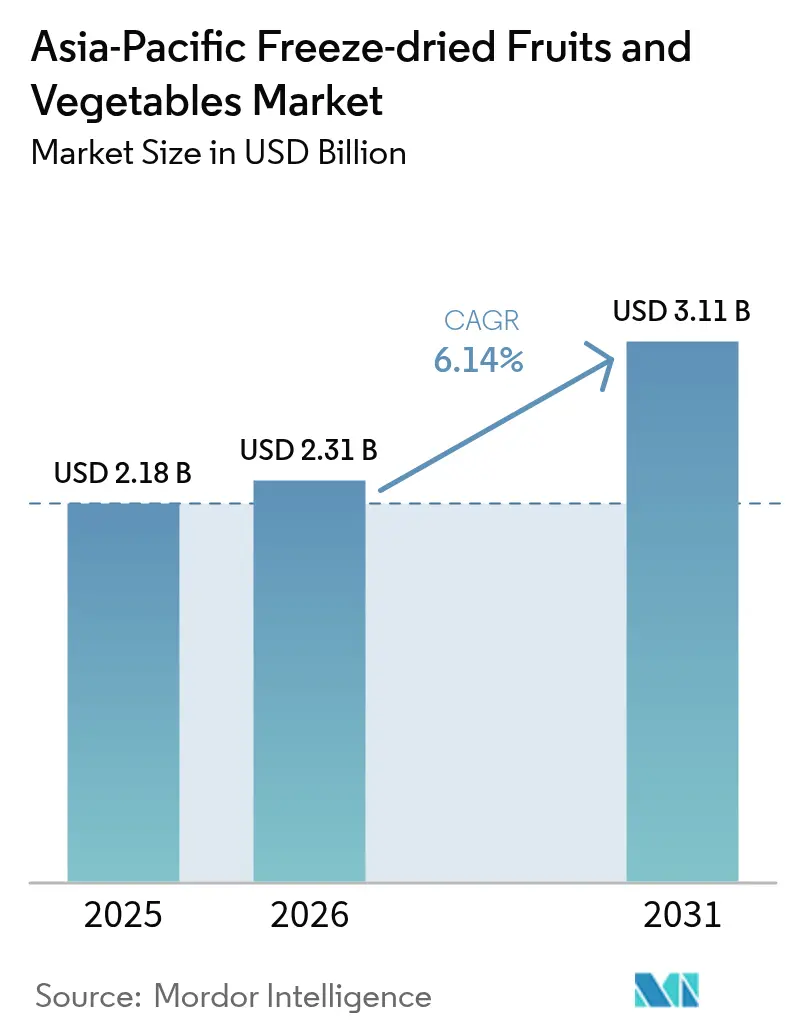
| Base Year Market Size (2025) | USD 2.18 Billion |
| Market Size (2026) | USD 2.31 Billion |
| Market Size (2031) | USD 3.11 Billion |
| Growth Rate (2026 - 2031) | 6.14 % |
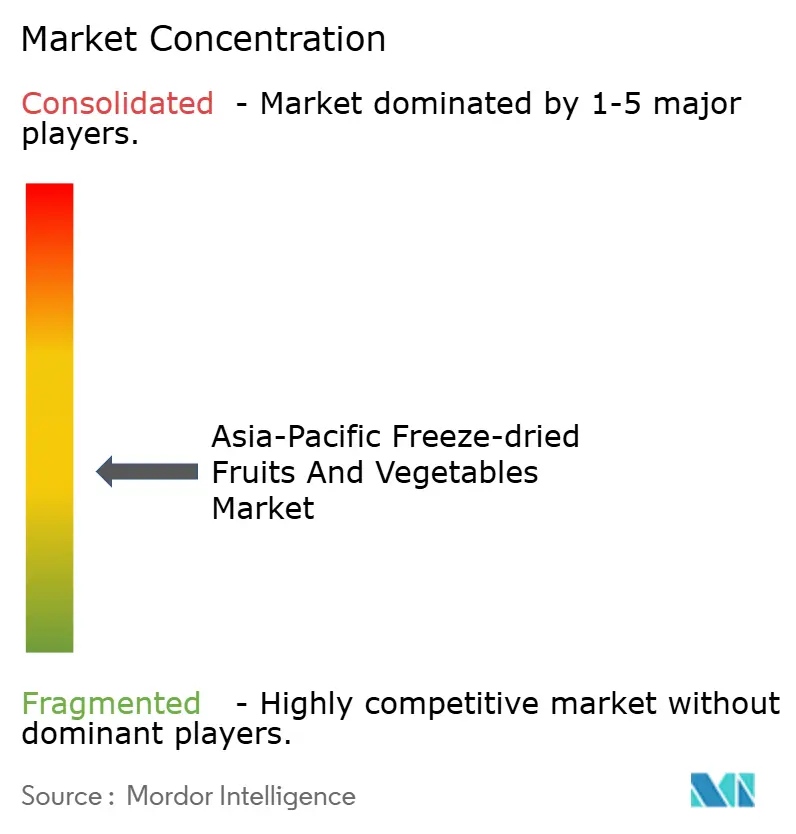
| Market Concentration | Medium |
Major Players *Disclaimer: Major Players sorted in no particular order Image © Mordor Intelligence. Reuse requires attribution under CC BY 4.0. | |
Asia-Pacific Freeze-dried Fruits And Vegetables Market Analysis by Mordor Intelligence
The Asia-Pacific freeze-dried fruits and vegetables market size is expected to grow from USD 2.18 billion in 2025 to USD 2.31 billion in 2026 and is forecast to reach USD 3.11 billion by 2031 at 6.14% CAGR over 2026-2031. Rapid urbanization, tight cooking schedules, and limited cold-chain capacity are pushing households and processors toward preservation methods that lock in nutrition without refrigeration. Government incentives for processing infrastructure, stricter traceability rules, and the expanding reach of e-commerce have further lifted demand. Multinational brands are reformulating cereals, soups, and snacks with freeze-dried inclusions to satisfy clean-label goals, while hotel, restaurant, and café operators now specify freeze-dried ingredients to standardize portions and cut spoilage. As technology upgrades trim drying cycles and energy use, mid-sized Asian producers are entering export supply chains, reshaping competitive dynamics across the region.
Key Report Takeaways
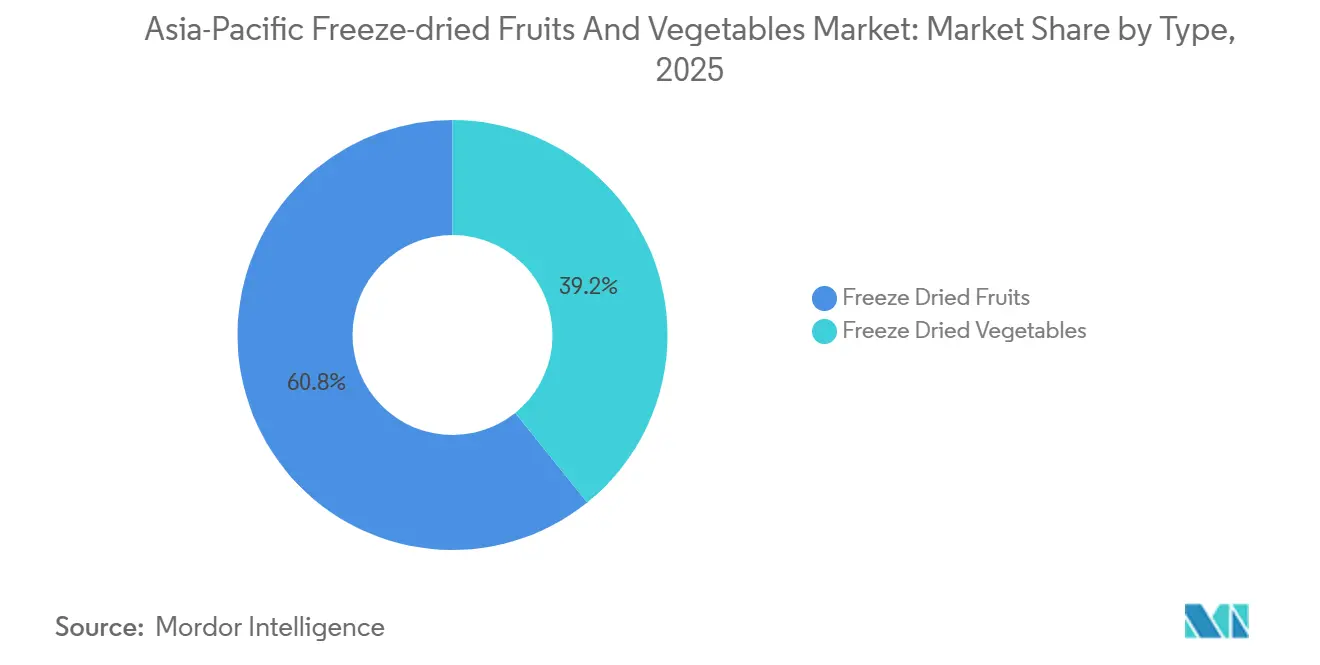
- By product type, fruits led with 60.79% of the Asia-Pacific freeze-dried fruits and vegetables market share in 2025, while vegetables are projected to post the fastest growth at 7.37% CAGR through 2031.
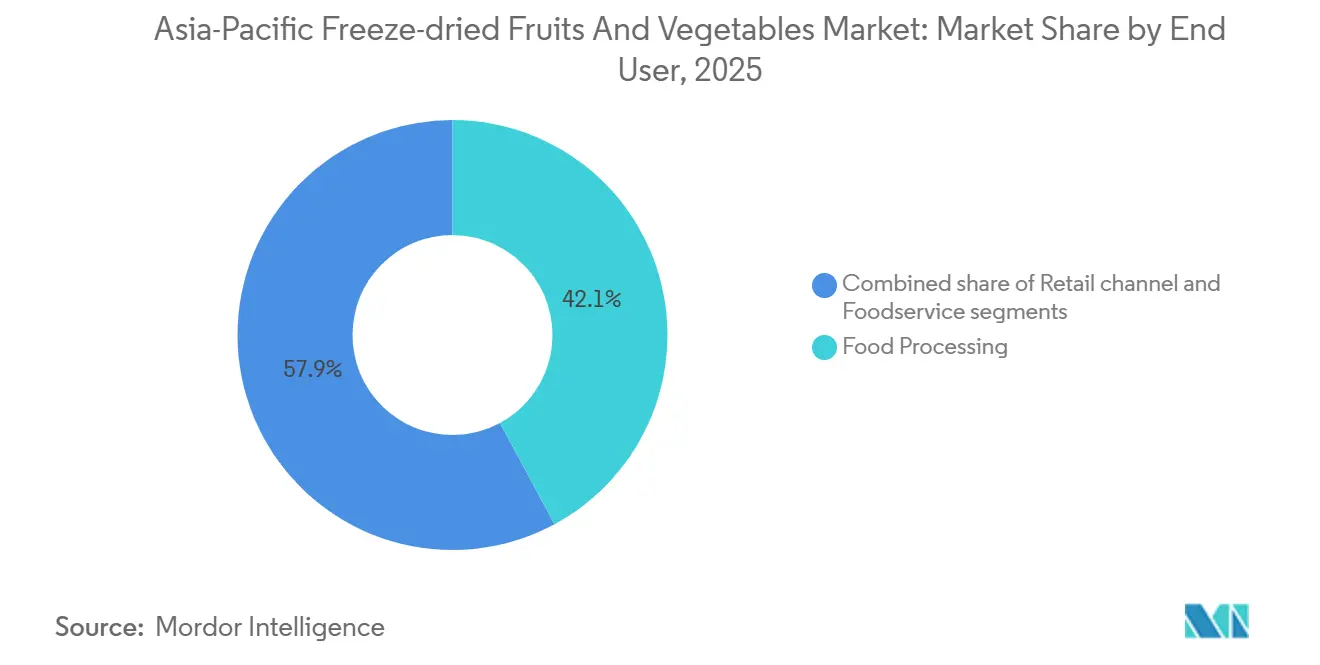
- By end user, food processing held 42.14% revenue in 2025; retail is set to expand at 7.79% CAGR to 2031 on the back of online platforms that already generate about 60% of incremental sales.
- Geographically, China controlled 35.32% of 2025 value, yet India registers the highest growth outlook at 8.11% CAGR to 2031 as subsidy-backed capacity comes on line.
Note: Market size and forecast figures in this report are generated using Mordor Intelligence’s proprietary estimation framework, updated with the latest available data and insights as of 2026.
Market Trends and Insights
Drivers Impact Analysis of Asia-Pacific Freeze-dried Fruits And Vegetables Market*
| Driver | (~) % Impact on CAGR Forecast | Geographic Relevance | Impact Timeline |
|---|---|---|---|
| Rising demand for convenient and ready-to-eat foods | +1.2% | China, Japan, South Korea, urban India | Short term (≤ 2 years) |
| Growing health consciousness and preference for natural snacks | +1.0% | Australia, Japan, urban China, South Korea | Medium term (2-4 years) |
| Longer shelf life reducing food wastage | +0.8% | India, Indonesia, China, Rest of Asia-Pacific | Medium term (2-4 years) |
| Rising vegan and plant-based diet trends | +0.7% | Australia, Japan, South Korea, urban China | Long term (≥ 4 years) |
| Growing demand from outdoor and travel food segments | +0.6% | China, Japan, Australia, South Korea | Short term (≤ 2 years) |
| Technological advancements in freeze-drying processes | +0.9% | China, India, Japan, Australia | Long term (≥ 4 years) |
| Source: Mordor Intelligence | |||
Rising demand for convenient and ready-to-eat foods
The growing preference for convenient and ready-to-eat foods is a major driver for the Asia-Pacific freeze-dried fruits and vegetables market. Busy urban lifestyles, coupled with the need for nutritious yet easy-to-prepare meals, are increasing the adoption of lightweight and long-shelf-life food products. In Japan, the trend is particularly pronounced, as the Ministry of Internal Affairs and Communications reported that in 2024, 36.25 million people were aged 65 and above, accounting for 29.3% of the population[1]. This aging demographic favors freeze-dried fruits and vegetables because they are easy to store, simple to rehydrate, and reduce the physical effort involved in cooking. Beyond elderly consumers, on-the-go snacking, meal kits, and emergency food supplies are also contributing to market growth. The minimal storage requirements and nutrient retention of freeze-dried products make them appealing to health-conscious and time-strapped consumers alike.
Growing health consciousness and preference for natural snacks
Rising health awareness and a growing preference for natural snacks are key factors driving the Asia-Pacific freeze-dried fruits and vegetables market. Consumers are increasingly seeking nutrient-dense, low-calorie, and preservative-free options to support balanced diets and overall wellness. Freeze-dried fruits and vegetables are particularly appealing because they retain most of their natural vitamins, minerals, and flavor, providing a healthier alternative to conventional processed snacks. This trend is reinforced by increasing concerns over lifestyle-related health issues, such as obesity, cardiovascular diseases, and diabetes. In fact, the International Diabetes Federation reported that in 2024, approximately 107 million individuals in Southeast Asia are living with diabetes, highlighting the rising need for healthier, low-sugar snack alternatives[2]. Urban populations and millennials are also gravitating toward clean-label, minimally processed foods, further boosting demand.
Longer shelf life reducing food wastage
The long shelf life of freeze-dried fruits and vegetables is a significant driver for the Asia-Pacific market, as it helps reduce food wastage and improves supply chain efficiency. By removing moisture while retaining nutrients and flavor, freeze-drying preserves products for extended periods without the need for refrigeration, making them ideal for both domestic consumption and export. This is particularly important in markets that rely on imports of perishable produce, such as Australia, which imported tropical fruits worth USD 73.6 million in 2024, according to the Observatory of Economic data[3]. Longer-lasting products reduce spoilage during transportation and storage, benefiting retailers, distributors, and consumers alike. The ability to stock freeze-dried fruits and vegetables for extended periods also supports convenience-driven consumption, meal planning, and emergency food supplies. Moreover, reduced wastage contributes to sustainability goals, appealing to environmentally conscious consumers.
Rising vegan and plant-based diet trends
The rising popularity of vegan and plant-based diets is a major driver of the Asia-Pacific freeze-dried fruits and vegetables market. Increasing consumer awareness of health, environmental sustainability, and ethical food choices is encouraging more people to adopt plant-based lifestyles. Freeze-dried fruits and vegetables offer convenient, nutrient-rich, and shelf-stable options that align well with vegan diets, providing essential vitamins, minerals, and fiber without animal-derived ingredients. The growth of plant-based protein products, dairy alternatives, and meat substitutes further complements demand for freeze-dried ingredients in meal kits, snacks, and culinary applications. Urban consumers and millennials, in particular, are seeking natural, clean-label foods that support healthy eating and sustainable consumption. Additionally, the export potential of freeze-dried products to regions with high vegan demand, such as Europe and North America, is attracting investment from manufacturers.
Restraints Impact Analysis of Asia-Pacific Freeze-dried Fruits And Vegetables Market*
| Restraint | (~) % Impact on CAGR Forecast | Geographic Relevance | Impact Timeline |
|---|---|---|---|
| High production and processing costs | -0.7% | India, Indonesia, Rest of Asia-Pacific | Medium term (2-4 years) |
| Supply chain volatility for raw fruits and vegetables | -0.6% | China, India, Indonesia, Rest of Asia-Pacific | Short term (≤ 2 years) |
| Stringent food safety and export regulations | -0.4% | China, Japan, Australia, South Korea | Long term (≥ 4 years) |
| Limited awareness in price-sensitive rural markets | -0.3% | India, Indonesia, Rest of Asia-Pacific | Long term (≥ 4 years) |
| Source: Mordor Intelligence | |||
High production and processing costs
High production and processing costs remain a significant restraint for the Asia-Pacific freeze-dried fruits and vegetables market. Freeze-drying is an energy-intensive and capital-heavy process that requires specialized equipment, controlled temperature and vacuum conditions, and skilled labor, all of which contribute to elevated manufacturing expenses. The initial investment for setting up freeze-drying facilities, along with ongoing operational costs, can be a barrier for small and medium-sized producers in the region. These high costs are often reflected in the final product prices, making freeze-dried fruits and vegetables less affordable compared to conventional or minimally processed alternatives. Additionally, fluctuations in energy prices and raw material availability can further increase operational expenses. Limited cost efficiency may also restrict the scalability of production and slow market penetration in price-sensitive segments.
Supply chain volatility for raw fruits and vegetables
Supply chain volatility for raw fruits and vegetables is a notable restraint for the Asia-Pacific freeze-dried fruits and vegetables market. The availability and quality of raw produce are heavily influenced by seasonal variations, unpredictable weather patterns, and natural disasters, which can disrupt consistent supply. Additionally, dependence on imports for certain tropical or exotic fruits exposes manufacturers to international trade fluctuations, currency volatility, and logistical delays. Transportation and storage challenges further complicate the timely procurement of fresh produce, impacting production schedules and operational efficiency. Price fluctuations of raw materials can increase production costs, reducing profitability for freeze-dried product manufacturers. Limited access to reliable cold chain infrastructure in some regions adds another layer of risk, particularly for maintaining freshness prior to processing.
*Our forecasts treat driver/restraint impacts as directional, not additive. The impact forecasts reflect baseline growth, mix effects, and variable interactions.
Asia-Pacific Freeze-dried Fruits And Vegetables Market Segment Analysis
By Product Type:
Fruits Dominate, Vegetables AccelerateIn 2025, freeze-dried fruits held a commanding 60.79% share of the market, with strawberries, blueberries, and mangoes leading the charge as premium toppings for breakfast cereals, yogurt, and ice cream. Strawberries, favored for their vibrant color retention and widespread consumer recognition, topped the fruit category. Meanwhile, blueberries and raspberries are carving out a niche in health-centric snack bars and trail mixes, celebrated for their antioxidant properties. Mangoes, long a staple in tropical Asia-Pacific, are now making waves in export markets, where their freeze-dried form boasts logistical advantages over fresh or frozen counterparts. While cranberries and blackberries hold smaller market shares, they're witnessing growth as manufacturers pivot to include these 'superfruits' in line with the rising clean-label trend.
Vegetables, despite a smaller market share, are projected to grow at a robust 7.37% CAGR through 2031. This surge is largely attributed to food processors incorporating freeze-dried corn, peas, beans, tomatoes, and mushrooms into instant soups, noodles, and ready-to-eat meals. Corn and peas lead in volume, thanks to their mild flavors and versatility in various dishes. Mushrooms, on the other hand, are carving out a premium niche, finding their way into plant-based meat alternatives and gourmet camping meals. Tomatoes and beans are gaining traction in institutional food services, with chefs appreciating the quick rehydration and consistent portions that freeze-dried formats offer. This growing preference for vegetables underscores a broader industry consensus: freeze-drying better preserves texture and flavor than methods like air-drying or drum-drying. Such preservation is crucial for applications where vegetables are enjoyed whole, rather than being pureed or sauced.

By End User:
Food Processing Leads, Retail SurgesIn 2025, the food processing sector claimed a 42.14% share of the market, underscoring its dependence on freeze-dried ingredients to adhere to clean-label standards and minimize artificial additives. Leading the charge, breakfast cereal producers harness freeze-dried strawberries, blueberries, and raspberries, setting their premium SKUs apart and commanding a price premium of 20% to 30% over standard offerings. Following closely are soups and snacks, with instant noodle manufacturers in China, Japan, and South Korea infusing freeze-dried vegetables to bolster nutritional value and cater to health-conscious consumers. The ice cream and dessert sector is witnessing a shift, as producers swap out artificial fruit flavors for freeze-dried pieces, ensuring genuine taste and visual allure. While still niche, the use of freeze-dried fruits is on the rise in the bakery and confectionery realm, especially as decorative toppings and flavor enhancers in artisan chocolates and gourmet pastries.
Retail channels, projected to grow at a 7.79% CAGR through 2031, are reaping the rewards of e-commerce platforms, which now contribute to about 60% of incremental sales. These platforms empower direct-to-consumer brands, allowing them to sidestep traditional distribution hurdles. Supermarkets and hypermarkets dominate the retail landscape, capitalizing on shelf space and promotional efforts to mainstream freeze-dried products. Catering to both outdoor enthusiasts and health-conscious shoppers, specialty stores present a curated selection of organic and single-origin freeze-dried fruits and vegetables. Meanwhile, online retail emerges as the fastest-growing channel, fueled by subscription models and social media campaigns targeting millennials and Gen Z, who value convenience and transparency.
Geography Analysis
China Freeze-dried Fruits and Vegetables Market
China accounted for the largest share of the Asia-Pacific freeze-dried fruits and vegetables market in 2025, contributing 35.32% of the total market value. The country’s dominant position is supported by its well-established food processing industry, extensive raw material availability, and strong export-oriented manufacturing base. Large-scale production facilities and continuous investments in advanced freeze-drying technologies have enabled Chinese manufacturers to maintain competitive pricing and consistent product quality. Rising domestic demand for convenient and long-shelf-life food products, particularly among urban consumers, has further strengthened market expansion. In addition, the rapid growth of e-commerce and packaged food consumption has increased the accessibility of freeze-dried products across multiple consumer segments.
India Freeze-dried Fruits and Vegetables Market
India represents the fastest-growing market in the Asia-Pacific freeze-dried fruits and vegetables sector, projected to expand at a CAGR of 8.11% through 2031. The country’s growth is primarily driven by government subsidies and incentives aimed at strengthening food processing capacity and reducing post-harvest losses. Expansion of cold chain infrastructure and increasing investments in food preservation technologies are enabling local manufacturers to scale production efficiently. Rising consumer awareness regarding healthy snacking and natural food ingredients is also contributing to increased adoption of freeze-dried products. Furthermore, India’s abundant agricultural output provides a strong raw material base, supporting cost-effective production and export opportunities.
APAC Freeze-dried Fruits and Vegetables Market
Other Asia-Pacific countries such as Japan, Australia, and South Korea also play important roles in shaping regional market dynamics, although their market shares remain comparatively smaller. Japan’s market is driven by high demand for premium-quality, convenient, and nutritionally preserved food products, particularly among aging and health-conscious consumers. In Australia, growth is supported by strong export demand and increasing use of freeze-dried ingredients in health foods, outdoor nutrition products, and specialty snacks. South Korea benefits from a highly developed food innovation ecosystem, where freeze-dried ingredients are widely used in instant meals, functional foods, and premium snack categories.
Regulatory Landscape
Freeze-dried fruits and vegetables sold in Australia and New Zealand must comply with the Australia New Zealand Food Standards Code, under the Legislation Act 2003 and administered by Food Standards Australia New Zealand (FSANZ). For imported products, border controls and inspections led by Australia’s Department of Agriculture, Fisheries and Forestry (DAFF) and New Zealand’s Ministry for Primary Industries (MPI) reinforce documentation, labeling, and safety compliance across the supply chain.
In China, requirements for dried fruit and vegetable products are still evolving through national standard-setting. A draft National Food Safety Standard for Dried Fruit and Dried Vegetable was notified to the World Trade Organization (WTO) in July 2024. In parallel, draft guidance for freeze-dried foods highlights process controls and alignment of finished-product labeling, including GB 7718 for general labeling and GB 28050 for nutrition labeling, which raises the importance of label accuracy, traceability, and test documentation for domestic circulation and export readiness across Asia-Pacific.
Value Chain Analysis
The value chain starts with growers and aggregators supplying fresh fruits and vegetables, then moves through sorting, washing, cutting, and pre-treatment before freezing and vacuum freeze-drying. After that, packaging (often moisture- and oxygen-barrier formats), warehousing, and distribution support food processing users (cereals, soups, snacks, desserts, and bakery) and retail channels, where e-commerce contributes a large share of incremental sales growth across the region.
Most of the constraints sit in the conversion step. Freeze-drying remains capital intensive and energy heavy, with throughput constrained by long cycle times and power-cost exposure, which is more acute where grids are unreliable outside major industrial zones. Processors respond by tightening upstream sourcing through contract farming and cooperative tie-ups, adding automation and monitoring at intake and during process control, and adopting newer equipment or hybrid approaches to reduce drying time and energy per batch. These steps also support more consistent quality for export-oriented buyers that require standardized specifications and documentation, in line with labeling and packaging standards such as GB 7718 general labeling and GB 28050 nutrition labeling.
Competitive Landscape
The Asia-Pacific freeze-dried fruits and vegetables market exhibits a moderately fragmented competitive structure, characterized by the presence of numerous regional and local manufacturers alongside a limited number of large multinational players. No single company holds a dominant share across the entire region, as market dynamics vary significantly by country based on raw material availability, technological capabilities, and export orientation. Domestic processors in China and India account for a substantial portion of production capacity, leveraging cost advantages and proximity to agricultural sources. Meanwhile, developed markets such as Japan, South Korea, and Australia are home to technologically advanced players focusing on premium product positioning.
Competition within the market is primarily driven by pricing strategies, product quality, technological efficiency, and distribution reach. Chinese manufacturers often compete on economies of scale and export competitiveness, while companies in developed Asia-Pacific economies differentiate themselves through innovation, quality certifications, and clean-label offerings. Increasing consumer demand for natural, preservative-free, and nutrient-retaining food products has pushed companies to invest in advanced freeze-drying equipment and research and development capabilities. Strategic collaborations with agricultural cooperatives and contract farming models are also common, ensuring consistent supply of high-quality raw materials. Additionally, private label expansion by retail chains has intensified competitive pressure, particularly in urban markets.
Mergers, acquisitions, and capacity expansion initiatives are gradually reshaping the regional competitive landscape. Larger players are seeking to strengthen their footprint through strategic investments in high-growth markets such as India and Southeast Asia. At the same time, small and medium enterprises are targeting export opportunities in North America and Europe, capitalizing on Asia-Pacific’s cost advantages. Technological upgrades aimed at improving energy efficiency and reducing production costs are becoming a key differentiator in maintaining profitability. Sustainability considerations, including waste reduction and responsible sourcing, are also gaining importance as buyers increasingly prioritize environmentally compliant suppliers.
Asia-Pacific Freeze-dried Fruits And Vegetables Industry Leaders
-
Nagatanien Co., Ltd.
-
Mercer Foods LLC
-
Totally Pure Fruits Pty Ltd.
-
Van Drunen Farms
-
Saraf Foods Ltd
- *Disclaimer: Major Players sorted in no particular order
Asia-Pacific Freeze-dried Fruits And Vegetables Market Companies Covered in this Report
- Mercer Foods LLC
- Totally Pure Fruits Pty Ltd.
- Nagatanien Co., Ltd
- Van Drunen Farms
- Saraf Foods Ltd
- Chaucer Foods Ltd
- European Freeze Dry Ltd.
- OFD Foods LLC
- Asahi Group Holdings Ltd
- Paradise Fruits Solutions GmbH & Co. KG
- Kanegrade Ltd.
- Lianfu Food Co. Ltd.
- Dole Food Company Inc.
- Lyo Food Sp. z o.o.
- Harmony House Foods Inc.
- Seawind Foods
- Fujian Lixing Foods Co. Ltd
- Vikas Agro Product Ltd
- Jingkun Food Co. Ltd
- Milne MicroDried
Read Analysis of Asia-Pacific Freeze-dried Fruits And Vegetables Companies
Market Opportunities and Future Outlook
Processing capacity closer to farm gates is a visible whitespace across parts of Asia-Pacific where post-harvest losses and limited cold-chain capacity increase raw-material risk for freeze-dried manufacturers. India is one example: Avio Smart Market Stack (ASMS) signed an MoU with the Government of Tripura in July 2026 to set up a freeze-drying facility for fruits and vegetables. The project is positioned around reducing post-harvest losses and creating local processing employment, which supports a shift toward origin-adjacent conversion rather than shipping perishables to distant processors.
Export and premium domestic demand reward suppliers that can show internationally recognized food safety systems and consistent quality for packaged foods. Vietnam also shows investment and industrialization momentum: Food Empire announced a USD 80 million investment (September 2024) in a new freeze-dried soluble coffee facility in Binh Dinh province, with construction scheduled to start from Q1 2025. Separately, Vietnam’s Nature Foods Company (NFC) has highlighted multi-standard compliance (HACCP, ISO 22000, BRCGS, FDA, HALAL) alongside expanded freeze-dried portfolios, pointing to opportunity in co-manufacturing and ingredient supply for multinational and regional food processors seeking clean-label inclusions with documented compliance.
Recent Industry Developments in Asia-Pacific Freeze-dried Fruits And Vegetables Market
- July 2026: Avio Smart Market Stack (ASMS) signed an MoU with the Government of Tripura to establish a freeze-drying facility for fresh fruits and vegetables. The project has been positioned to reduce post-harvest losses and create about 1,300 direct and indirect jobs, supporting origin-adjacent processing capacity that can improve raw-material utilization for freeze-dried ingredient supply chains.
- August 2025: Vietnam’s Nature Foods Company (NFC) expanded its freeze-dried portfolio, including applications such as soup broths and yoghurt, and emphasized production aligned with multiple food safety schemes (HACCP, ISO 22000, BRCGS, FDA, and HALAL). This strengthens the region’s ability to serve export-oriented and multinational buyers that require auditable quality systems for freeze-dried inclusions.
- September 2024: Food Empire announced a USD 80 million investment in a new freeze-dried soluble coffee manufacturing facility in Binh Dinh province, Vietnam, with construction scheduled to begin in Q1 2025 and completion targeted for early 2028. The buildout adds to Vietnam’s freeze-drying industrial base, supporting wider equipment adoption, skilled labor development, and supplier ecosystem depth relevant to freeze-dried food applications.
Asia-Pacific Freeze-dried Fruits And Vegetables Market Report Scope and Research Methodology
Market Definition and Coverage
This market counts the value of freeze-dried fruits and freeze-dried vegetables sold across Asia-Pacific for food and ingredient use, across retail, foodservice, and food processing demand. Values reflect product sales in the region, reported in USD for the study year and forecast window.
Scope exclusions: Fresh, frozen, air-dried, spray-dried, drum-dried, and dehydrated fruits and vegetables are excluded, and powdered drink mixes are excluded unless the underlying fruit or vegetable ingredient is freeze-dried.
Segments Covered in This Report
- By Product Type
- Fruits
- Strawberry
- Blueberry
- Raspberry
- Blackberry
- Cranberry
- Mango
- Other Fruit Types
- Vegetables
- Beans
- Corn
- Peas
- Tomato
- Mushroom
- Other Vegetable Types
- Fruits
- By End User
- Foodservice/HoReCa
- Food Processing
- Breakfast Cereal
- Soups and Snacks
- Ice Cream and Desserts
- Bakery and Confectionery
- Others
- Retail
- Supermarkets/Hypermarkets
- Specialty Stores
- Online Retail
- Other Distribution Channels
- By Geography
- India
- China
- Japan
- Australia
- South Korea
- Indonesia
- Rest of Asia-Pacific
Data Sources, Market Sizing, and Validation
Desk Research
Desk research was used to build the base demand context and to pin down the processing and trade signals that usually move this market. Public sources, such as FAOSTAT, UN Comtrade, national agriculture and horticulture ministries, customs and quarantine bulletins, and Codex or national food standards, were reviewed to understand raw-material seasonality, cross-border flows, and labeling rules.
We also reviewed company filings, investor presentations, reputable press coverage, and association websites tied to dried fruits, processed foods, and food ingredients to map supply routes and typical customer groups. Where it helped with consistency checks, we used paid subscriptions for company financials and intelligence, news and financials, import and export shipment-level data, and patent databases to validate timelines for capacity additions and product-form trends. These desk sources are not exhaustive, and many other references were used to collect data, validate it, and clarify open questions.
Primary Interviews and Surveys
Primary work focused on checking the size drivers that desk sources cannot confirm cleanly, such as how much volume is contracted into food processing versus sold as consumer packs, and how pricing moves by form and origin. We spoke with distributors, ingredient buyers, contract packers, processors, and retail category teams across major Asia-Pacific markets so assumptions could be adjusted and then rechecked with a second set of respondents.
Distribution of primary research fieldwork respondents
| Company type | Respondent position |
|---|---|
| Top tier: 39% | CXOs: 13% |
| Mid tier: 40% | Functional/Unit leaders: 34% |
| Smaller Players: 21% | Managers: 53% |
Market-Sizing & Forecasting
Sizing starts with a top-down build where processed fruit and vegetable output, trade intensity, and freeze-drying penetration are used to reconstruct the addressable spend in Asia-Pacific. The model is then tightened through selective bottom-up checks, such as sampled average selling prices by product form and buyer type, distributor throughput discussions, and a short list of supplier revenue cross-checks where disclosures are available.
Key inputs used in the market workbook include: freeze-drying capacity additions and utilization ranges, export and import movements for relevant dried produce codes as a directional signal, raw fruit and vegetable price swings by season, mix shift between pieces and powders used by food processors, and channel shift toward e-commerce and modern retail. Where product forms blur (for example, fine powders used as ingredients), we handled gaps by applying interview-backed inclusion rules and conservative conversion assumptions before totals were finalized.
For forecasting, scenario analysis was used, with demand anchors tied to convenience food launches, foodservice recovery patterns, and ingredient substitution trends stated by buyers. Short-term pricing was smoothed using recent raw-material and energy cost direction, and volume growth was guided by expected processing investments and the pace of export access changes in key markets.
Data Validation & Update Cycle
Outputs were checked against independent signals so the totals do not drift away from practical market realities, such as trade direction, processor capacity commentary, and observed price bands in key countries. When a country result looked too high or too low versus these signals, the driver assumptions were re-opened and then validated again through follow-up calls.
A multi-step review is followed internally, where calculations, conversions, and currency handling are checked before sign-off. Reports are refreshed annually, and interim updates are made when there are material events like policy changes, major capacity announcements, or sharp commodity movements. Before delivery, we complete a fresh pass so clients receive the latest updated view.
Mordor Intelligence's Asia Pacific Freeze Dried Fruits and Vegetables Market Size Compared Against Other Published Estimates
Published market values for freeze-dried fruits and vegetables in Asia-Pacific can look far apart because the scope line is drawn differently, and then prices and channel mixes are handled in different ways. The year used as the base, the currency conversion timing, and whether volumes are translated into value using ingredient-grade or retail-grade pricing also tend to move the final number.
Spray-dried and drum-dried fruit and vegetable powders are often blended into some estimates, but they sit outside Mordor Intelligence's scope, which keeps the count limited to freeze-dried formats sold into retail, foodservice, and food processing demand. Differences also come from whether exports produced in Asia-Pacific are counted only when sold within the region, how aggressive the assumed shift toward powders is, and how frequently pricing and capacity utilization assumptions are refreshed.
Benchmark comparison
| Source | Market Size | Gaps in Research Methodology |
|---|---|---|
| Mordor Intelligence | USD 2.18 B (2025) | |
| Global Consultancy A | USD 13.24 B (2023) | Uses a much broader value pool that appears to include additional dried formats and wider product-form coverage, and it also anchors on a different base year with a different price and channel mix. |
| Industry Portal B | USD 2.15 B (2025) | Close in timing, but small differences can come from country coverage, rounding, and how mixed-use powders and bulk ingredient pricing are treated versus packaged retail pricing. |
The comparison shows that the biggest spread is usually explained by what gets included as freeze-dried versus other drying methods, and by the year and price basis used for conversion into USD. By keeping the variables tied to observable supply and demand signals and then rechecking them with buyer and seller feedback, the final number stays traceable and repeatable for planning.
Key Questions Answered in the Report
How large will the Asia-Pacific freeze-dried fruits and vegetables market be by 2031?
It is projected to reach USD 3.11 billion in 2031, expanding at 6.14% CAGR from 2026.
Which product type holds the dominant position?
Freeze-dried fruits led with 60.79% share in 2025, driven by strawberries, blueberries, and mangoes.
Which country is growing quickest?
India shows the strongest outlook with an 8.11% CAGR to 2031, aided by subsidy-backed processing projects.
What is the main cost challenge for processors?
High energy consumption, representing up to 50% of operating expenses, raises overall production costs, especially where power tariffs are volatile.
Why are retailers investing in online sales channels?
E-commerce already generates about 60% of incremental retail sales, allowing brands to bypass traditional distribution and reach urban consumers directly.