Market Overview
| Study Period | 2020 - 2031 |
|---|---|
| Forecast Data Period | 2026 - 2031 |
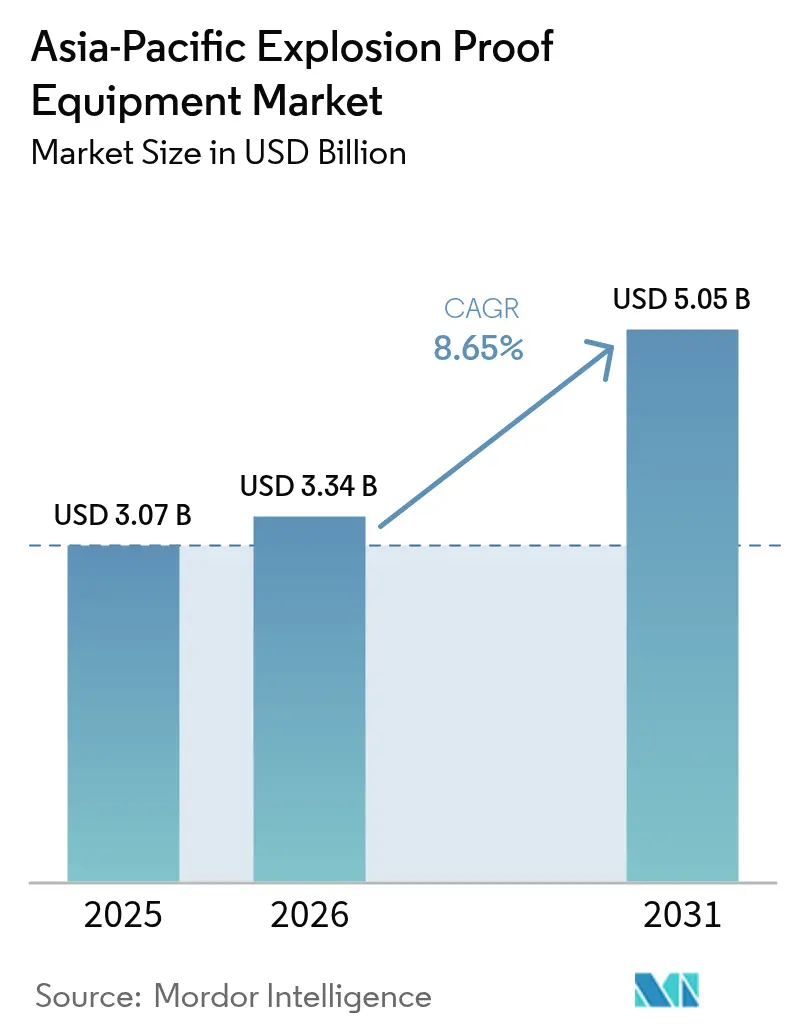
| Base Year Market Size (2025) | USD 3.07 Billion |
| Market Size (2026) | USD 3.34 Billion |
| Market Size (2031) | USD 5.05 Billion |
| Growth Rate (2026 - 2031) | 8.65% CAGR |
| Market Concentration | Medium |
Major Players *Disclaimer: Major Players sorted in no particular order Image © Mordor Intelligence. Reuse requires attribution under CC BY 4.0. | |
Asia-Pacific Explosion Proof Equipment Market Analysis by Mordor Intelligence
The Asia-Pacific explosion-proof equipment market size is expected to grow from USD 3.07 billion in 2025 to USD 3.34 billion in 2026 and is forecast to reach USD 5.05 billion by 2031 at 8.65% CAGR over 2026-2031. Heightened regulatory scrutiny, accelerating industrial automation, and rapid pharmaceutical capacity additions underpin this expansion. China’s manufacturing dominance and India’s large-scale greenfield projects provide a strong demand base, while oil and gas modernization, mining electrification, and food-grade safety mandates broaden the customer pool. Technology advances—especially intrinsic safety, pressurization, and Ethernet-APL connectivity—are reshaping buyer preferences, shifting value from purely mechanical flameproof designs toward digitally enabled, predictive-maintenance-ready solutions. Competitive intensity is moderate as global incumbents transition from hardware-centric to integrated digital offerings, while rising Chinese suppliers leverage cost advantages and local certifications to scale regionally. Supply chain cost spikes in copper and rare-earth magnets, coupled with shortages of IECEx-certified technicians, have tempered profit margins but not derailed long-term growth momentum.
Key Report Takeaways
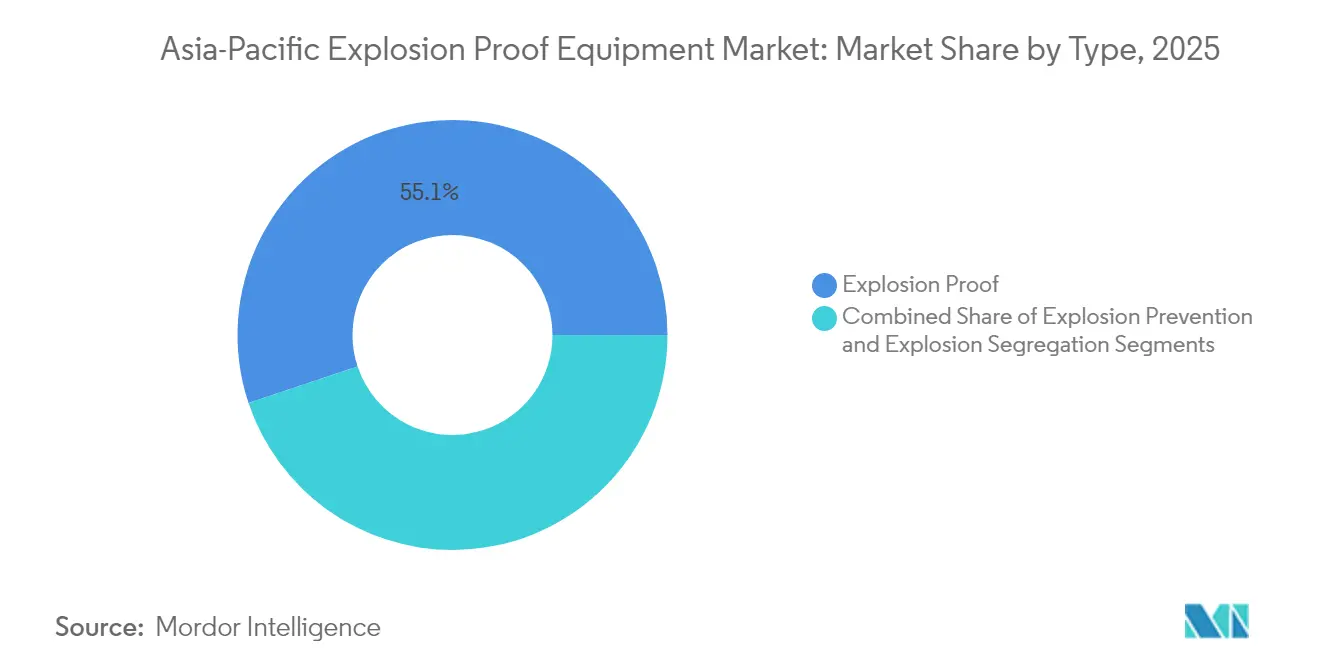
- By type, explosion-proof designs led with a 55.12% share of the Asia-Pacific explosion-proof equipment market in 2025, while prevention methods are projected to expand at a 10.05% CAGR through 2031.
- By zone, Zone 1 installations accounted for 33.45% of the Asia-Pacific explosion-proof equipment market size in 2025; Zone 20 applications are forecasted to grow at a 11.35% CAGR through 2031.
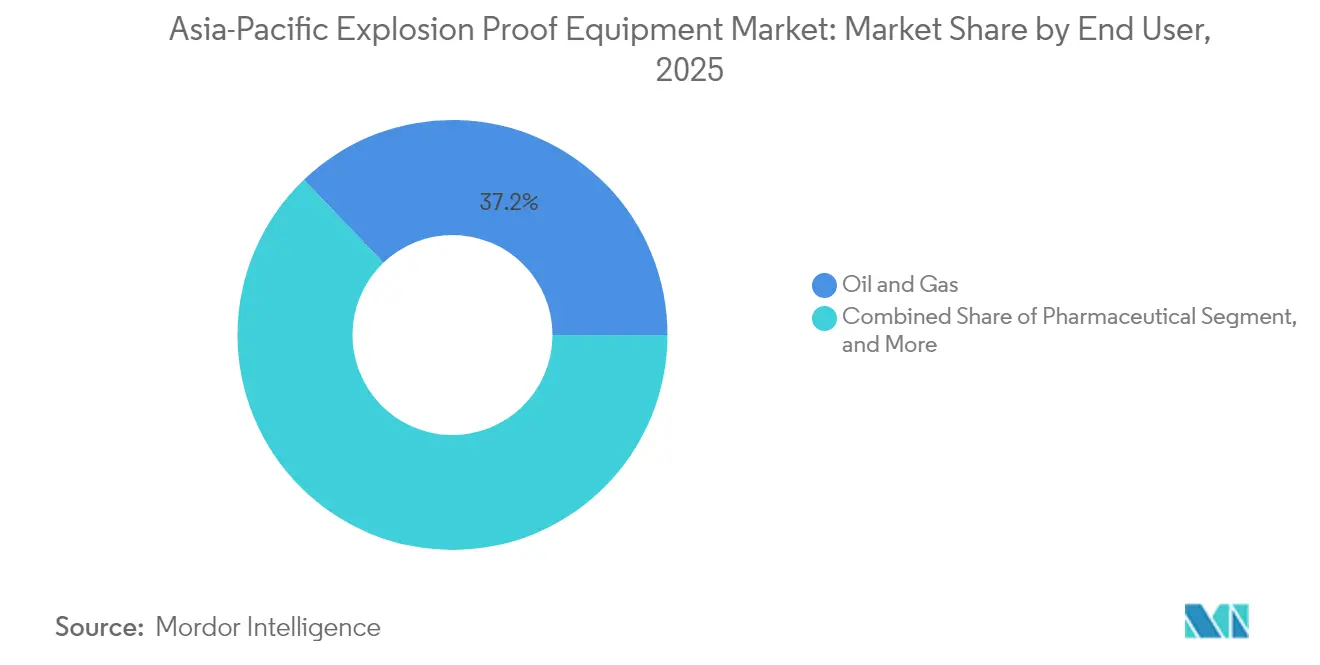
- By end user, the oil and gas sector accounted for 37.15% of revenue of the Asia-Pacific explosion-proof equipment market in 2025, whereas the pharmaceuticals sector is expected to register the fastest growth of 11.02% CAGR through 2031.
- By system, motors and drives held a 29.65% share of the Asia-Pacific explosion-proof equipment market size in 2025; however, automation and control systems are expected to rise at a 10.86% CAGR over the outlook period.
- By country, China dominated the Asia-Pacific explosion-proof equipment market, with a 38.05% revenue share in 2025. In contrast, India is poised to grow at a 10.92% CAGR from 2025 to 2031.
Note: Market size and forecast figures in this report are generated using Mordor Intelligence’s proprietary estimation framework, updated with the latest available data and insights as of 2026.
Asia-Pacific Explosion Proof Equipment Market Trends and Insights
Drivers Impact Analysis*
| Driver | (~) % Impact on CAGR Forecast | Geographic Relevance | Impact Timeline |
|---|---|---|---|
| Stricter regulatory enforcement across hazardous zones (ATEX/IECEx, IEC 60079 series, China GB-3836 upgrade) | +2.1% | Global, with strongest impact in China, India, Southeast Asia | Medium term (2-4 years) |
| Rising oil, gas and mining capacity expansions in emerging Asian economies | +1.8% | Asia Pacific core, particularly Indonesia, Vietnam, Australia | Long term (≥ 4 years) |
| Accelerating shift toward explosion-proof LED lighting and smart sensors | +1.4% | Global, with early adoption in Japan, South Korea, Singapore | Short term (≤ 2 years) |
| Rapid industrial automation driving demand for intrinsically-safe control systems | +1.6% | China, India, Thailand manufacturing hubs | Medium term (2-4 years) |
| Localisation of certification labs reducing approval lead-times | +0.9% | National, with gains in major industrial centers | Short term (≤ 2 years) |
| Booming Asia-Pacific pharmaceutical manufacturing clusters needing GMP-compliant Ex equipment | +1.2% | India, China, Singapore pharmaceutical corridors | Long term (≥ 4 years) |
| Source: Mordor Intelligence | |||


Stricter Regulatory Enforcement Across Hazardous Zones
ATEX and IECEx compliance have expanded from a narrow focus on oil and gas to a broader mandate encompassing pharmaceuticals, food processing, and battery materials. China’s GB-3836 upgrade in 2024 imposed higher protection levels for Zone 0 and Zone 20, prompting widespread retrofits.[1]GB Standards Committee, “GB 3836 Explosive Atmospheres,” China National Standards, gb688.cn India’s PESO regime tightened import approvals, accelerating replacement cycles for legacy gear. Australia and New Zealand have aligned the ANZEx with IECEx, easing multi-country certifications for multinationals. The convergence reduces engineering complexity, enabling regional product platforms that lower development costs and accelerate time-to-market. As plants seek recertification of equipment installed before 2020, the Asia-Pacific explosion-proof equipment market records sizable repeat orders.
Rising Oil, Gas and Mining Capacity Expansions in Emerging Asian Economies
Indonesia’s Pertamina has earmarked USD 20 billion for upstream projects through 2030, necessitating robust flameproof motors, pressurized analyzer shelters, and Ex p ventilation skids.[2]Pertamina Corporate Strategy, “Upstream Investment Program 2024-2030,” Pertamina, pertamina.com Vietnam’s Long Son petrochemical hub and Australia’s critical minerals rush add large Zone 1 and Zone 20 footprints, respectively. Extended supply lines in offshore rigs and remote mines amplify the need for low-maintenance, condition-monitored Ex lighting and drives. Projects often bundle multi-system packages, such as motors, controls, cameras, and gas detectors, which boosts average order values and deepens vendor lock-in.
Accelerating Shift Toward Explosion-Proof LED Lighting and Smart Sensors
Energy policies and carbon targets prompt end users to switch from fluorescent fixtures, which consume 70% more power, to LED variants offering 100,000-hour lifespans. Integrated vibration, temperature, and gas sensors inside Ex luminaires feed data to cloud dashboards via LoRaWAN, cutting unscheduled downtime. Japanese and South Korean firms are pioneering explosion-proof IoT gateways that normalize multi-protocol sensor streams and push analytics to enterprise platforms, opening up service-revenue avenues. Payback periods of under two years fuel rapid capex sign-offs even for mid-sized factories.
Rapid Industrial Automation Driving Demand for Intrinsically-Safe Control Systems
Industry 4.0 projects in China, India, and Thailand require Ethernet-APL-ready PLCs inside Ex d enclosures that maintain high data rates without compromising safety. Pharmaceutical continuous-manufacturing lines necessitate dual compliance with IEC 60079 and GMP validation, which increases documentation complexity, favoring vendors offering digital twin models linked to certification files. In chemical export zones, government subsidies for smart factories offset 20-30% of automation capex, accelerating order volumes. As control logic shifts to edge devices, sales of compact Ex i I/O modules outpace traditional barrier boards.
Restraints Impact Analysis*
| Restraint | (~) % Impact on CAGR Forecast | Geographic Relevance | Impact Timeline |
|---|---|---|---|
| High CAPEX and installation cost of explosion-proof equipment | -1.3% | Global, particularly affecting smaller enterprises in emerging markets | Long term (≥ 4 years) |
| Shortage of certified Ex installation and maintenance talent | -0.9% | Asia Pacific emerging markets, rural industrial locations | Medium term (2-4 years) |
| Proliferation of counterfeit/non-certified devices eroding buyer confidence | -0.7% | China, India, Southeast Asian markets | Short term (≤ 2 years) |
| Volatile copper and rare-earth magnet prices inflating motor costs | -0.8% | Global supply chain impact, affecting all regions | Short term (≤ 2 years) |
| Source: Mordor Intelligence | |||
High CAPEX and Installation Cost of Explosion-Proof Equipment
Explosion-proof motors, drives, and control panels cost 150–300% more than their general-purpose equivalents. Additionally, certified installation, rigid metallic conduit, and pressurization hardware increase project budgets by an extra 40–60%.[3]ABB Motion, “Explosion-Proof Motors and Drives,” ABB, abb.com SMEs in emerging economies often defer upgrades until inspectors issue notices, causing demand spikes rather than steady growth. Currency swings against the USD raise import bills, especially for sensor and chipset components sourced from the U.S. and Europe. Financing gaps remain acute despite government credit lines, as the uptake among cash-constrained processors slows.
Shortage of Certified Ex Installation and Maintenance Talent
Fewer than 15,000 IECEx CoPC-qualified technicians serve the entire Asia-Pacific region, with most concentrated in metropolitan areas. Projects in hinterlands face multi-week delays as contractors fly in qualified personnel, inflating labor costs by 25–40%. Maintenance backlogs jeopardize equipment uptime, prompting some operators to run uncertified repairs that void warranties and regulatory approvals.
*Our forecasts treat driver/restraint impacts as directional, not additive. The impact forecasts reflect baseline growth, mix effects, and variable interactions.
Segment Analysis
By Type: Prevention Methods Gain Traction
Explosion-proof enclosures retained 55.12% of the Asia-Pacific explosion-proof equipment market share in 2025, driven by entrenched oil and gas usage. Still, intrinsic safety and pressurization drive a vigorous 10.05% CAGR through 2031, lifting their contribution to the Asia-Pacific explosion-proof equipment market size, particularly in data-intensive control rooms and sensor networks. Manufacturers exploit semiconductor miniaturization to embed higher power levels into Ex i circuits without exceeding thermal limits, broadening applicability to valve actuators and small motors. Pressurization systems are gaining ground in analyzer houses that handle multiple gas streams; centralized air-purge skids protect several cabinets simultaneously, reducing lifecycle costs compared to per-device enclosures. Encapsulation and powder-fill solutions carve out niches in high-voltage drives and precision instruments, prized for their contamination-free design, especially in clean-room pharmaceuticals.
Second-generation prevention solutions integrate micro-controllers that log pressure, temperature, and purge cycles, transmitting diagnostics to SCADA platforms. Firmware updates enable remote calibration, eliminating the need for site visits and ensuring audit readiness. Service models shift from parts replacement to outcome-based contracts guaranteeing leak-rate thresholds. Competitors are exploring additive-manufactured housings that optimize airflow and reduce weight by up to 25%, thereby lowering crane and footing costs during installation.


By Zone: Zone 1 Dominates While Zone 20 Shows Promise
Zone 1 retained 33.45% revenue as operators prioritized equipment for areas with frequent gas-vapor presence, sustaining steady retrofits in mature refineries. Conversely, dust-heavy Zone 20 posts the market’s fastest 11.35% CAGR, propelled by tablet coating, flour milling, and battery-materials grinding lines that redefine hazardous-area priorities. Several lithium-processing plants in Australia specify hybrid Ex t/Ex p protection for ball mills, which has spurred innovations in dual-rating designs. Equipment makers develop universal mounting kits compliant with both IEC 60079-31 (dust) and 60079-2 (pressurization), enabling single-SKU stocking across varied plant zones.
Zone 0 remains a specialist zone, limited to constant-exposure environments, such as storage tank interiors. New ultrasonic thickness sensors rated Ex ia allow in-service tank-roof inspections, reducing hot-work permits and downtime. Zone 2 retains widespread appeal where intermittent risk suffices; OEMs focus on cost-optimized enclosures that balance compliance and price to counter grey-market imports.
By End User: Pharmaceuticals Accelerate Past Traditional Leaders
Oil and gas sustained 37.15% revenue in 2025, but green-field capex is tilting toward LNG regasification and refinery petrochemicals, which require advanced control room pressurization and flameproof diesel generators. Pharmaceuticals stride ahead at an 11.02% CAGR, lifting their slice of the Asia-Pacific explosion-proof equipment market size through 2031. Batch-to-continuous manufacturing migration and solvent-rich environments necessitate the broad adoption of stainless-steel, easy-clean Ex devices that can withstand 24/7 operation and rigorous validation. Regulatory audits now extend to auxiliary systems, such as HVAC and weight-check stations, thereby widening the scope of equipment per site.
Mining contributes a steady volume, especially for flameproof longwall shearers and intrinsically safe communication nodes in coal and hard rock mining scenes. Food processors upgrade bucket elevators and silo aeration systems with dust-ignition-proof gear, driven by insurance premium discounts tied to IECEx compliance. Growth in fine chemicals and bio-based materials fuels demand for Ex reactors and spray dryers, adding another layer of opportunity for multidisciplinary vendors.
By System: Automation Leads Digital Transformation
Motors and drives accounted for 29.65% of 2025 revenue, yet face margin pressure due to copper cost volatility. OEMs respond by embedding temperature and vibration sensors into motor windings, enabling predictive analytics via cloud dashboards. Permanent-magnet synchronous motors with IP66 flameproof housings reduce energy consumption by 8–12%, justifying the higher upfront cost in continuous processes. Automation and control systems outpace all others at an 10.86% CAGR, propelled by Ethernet-APL adoption that extends 10 Mbit/s data rates into Zone 0 intrinsically safe loops.
Surveillance and monitoring lines incorporate 4K day-night cameras inside Ex d housings with AI edge chips that flag unsafe behaviors, reducing operator exposure. Advanced gas-detection arrays integrate laser dispersion and electrochemical technologies, providing ppm-level accuracy for hydrogen and ammonia detection. Power supply modules utilize conformal coatings and encapsulation to meet the requirements of high-humidity, tropical installations in Southeast Asia. Lighting systems benefit from LED price declines and universal-input drivers that accept 100–277 VAC, thereby simplifying regional inventory management.
Geography Analysis
China maintained a commanding 38.05% share of the Asia-Pacific explosion-proof equipment market in 2025, driven by its vast petrochemical, mining, and pharmaceutical clusters. Harmonization of GB-3836 with IECEx lowers export friction, enabling domestic suppliers such as Warom to win overseas contracts. Provincial subsidies cover up to 15% of capex for safety upgrades in chemical parks, stimulating bulk orders for Ex motors and IoT sensors. Carbon-neutrality goals trigger investment in Ex equipment for hydrogen electrolyzers and battery-recycling centers.
India is the growth pacesetter with an 10.92% CAGR through 2031. Pharmaceutical mega-parks in Telangana and Gujarat require comprehensive GMP documentation packages, favoring global brands with validated device libraries. PESO’s stricter import checks are spurring localized assembly under the Make-in-India initiative, with foreign OEMs forming joint ventures to shorten lead times. Coal and iron-ore mechanization projects in Jharkhand and Odisha require flameproof conveyors and intrinsically safe signaling networks, broadening vendor portfolios beyond process industries.
Japan and South Korea retain mature, high-specification niches in semiconductor chemicals and offshore wind power, emphasizing explosion-proof systems with digital twins for remote islands. Australia’s critical minerals boom drives demand for transportable, pressurized substations and wireless Ex sensors that can withstand abrasive dust and 50 °C ambient temperatures. Across Southeast Asia, Indonesia, Vietnam, and Thailand are accelerating industrial estate expansions; local governments are coupling FDI incentives with mandatory IECEx compliance, thereby expanding the addressable demand for mid-tier suppliers.
Regulatory Landscape
Explosion-proof equipment demand in Asia-Pacific is shaped by a combination of IECEx-based conformity pathways and country-specific rules for hazardous-area electrical installations. The IEC 60079 series continues to be the main design and selection reference across the region through IECEx certification (supported by ExTR and QAR documentation), while ATEX compliance remains a practical reference point for multinationals exporting into and out of the market. In China, the GB 3836 family continues to tighten technical expectations, with GB 3836.15-2024 issued in July 2024 and moving into implementation from August 1, 2025. This update reinforces requirements around design, selection, and installation for explosive atmospheres, driving faster replacement of legacy equipment.
Australia and New Zealand use the ANZEx framework aligned to the IEC 60079 series, which supports multi-country certification strategies for OEMs supplying across Oceania and other Asia-Pacific project hubs. In Australia, state-level bodies such as NSW TestSafe provide Ex product certificates and assess manufacturers against ISO/IEC 80079-34 quality requirements, increasing the importance of factory quality systems alongside product testing. In India, hazardous-area selection and installation practices are guided by IS 5571:2009, with additional import and approvals rigor applied via PESO for relevant equipment categories. This encourages OEMs to strengthen local compliance documentation and qualification support for EPCs and end users.
Value Chain Analysis
The value chain starts with upstream inputs (castings, stainless steel and aluminum housings, copper windings, cable glands, seals, coatings, and electronic components for sensors and gateways) and moves into design engineering that maps protection concepts (Ex d, Ex i, Ex p, Ex t) to zone classifications and end-user requirements. OEM manufacturing and assembly is then coupled to certification, including hazardous-area testing and ongoing quality audits, which act as a gating step before equipment can be shipped for installation. Product flows are also shaped by country certification schemes, including China's compulsory certification approach for explosion-proof electrical products under CNCA-C23-01-2019 and the ANZEx system used in Australia and New Zealand for certified equipment acceptance.
Downstream, EPCs, panel builders, and specialized system integrators assemble motors and drives, junction boxes, lighting, control stations, and Ex-rated sensors into complete packages tied to DCS/PCS, PLC/SCADA, and CCTV or gas-detection architectures. Regional suppliers such as MAM Explosion-Proof Technology (Shanghai), Nanyang Yitong Explosion proof Electric, and Shenhai Explosion-Proof Technology (China), together with integrators such as Supermec (Singapore), operate across product supply, commissioning, and maintenance. Service activities are increasingly central to value capture, spanning hazardous-area installation, inspection, recertification documentation, remote monitoring, and digital asset management that connects device identity to certification records and maintenance history.
Competitive Landscape
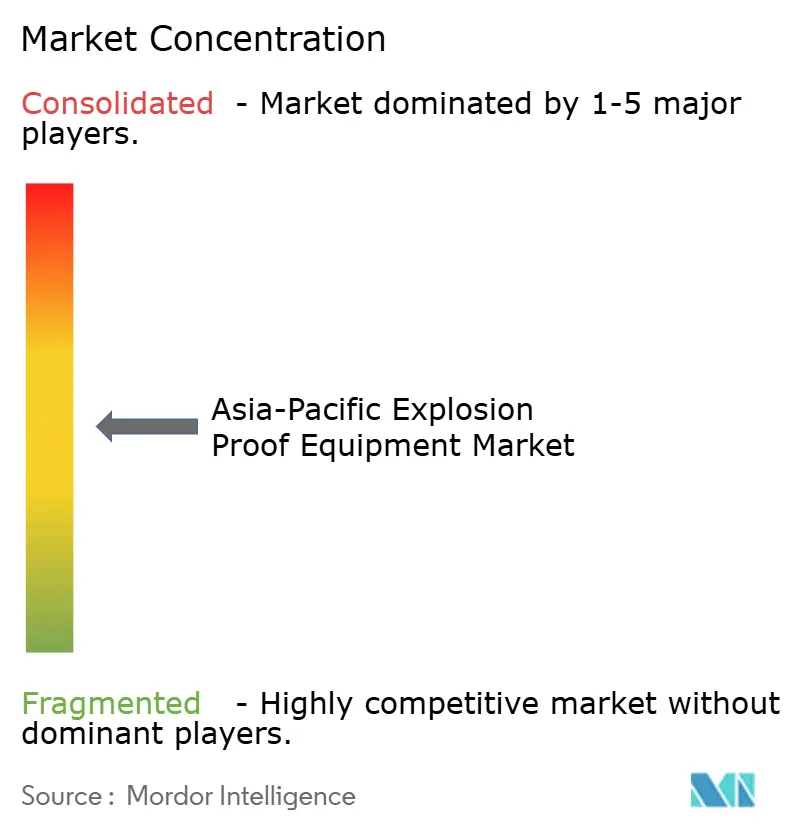
The Asia-Pacific explosion-proof equipment market is moderately fragmented, with the top five players collectively holding roughly 35–40% of the revenue, leaving space for regional challengers. European and U.S. majors retain leadership in automation, analytics, and high-throughput drives, but Chinese vendors dominate the low-to-mid-end market for lighting, junction boxes, and cable glands through aggressive pricing and rapid GB/IECEx dual approvals. Digital differentiation now outweighs metal thickness: suppliers embed cloud gateways, edge AI, and blockchain-verified certification files, commanding 10–20% price premiums despite material cost inflation.
Strategic moves underscore this pivot. ABB rolled out Ethernet-APL-enabled variable frequency drives with SIL2 safety layers, targeting solvent recovery towers and continuous API production lines. Pepperl+Fuchs partnered with WANTAI to create 5G intrinsically safe routers for underground mines, merging explosion protection with ultra-low-latency communication. Eaton boosted Thai motor capacity by 25%, hedging against single-country supply risk while leveraging ASEAN free-trade benefits.
Patent filings related to explosion-proof IoT devices surged 340% between 2022 and 2024, signaling an intensification of the arms race for wireless sensor networks, power-harvesting circuits, and AI-assisted safety analytics. M&A activity concentrates on niche specialists: larger vendors acquire firmware houses and analytics start-ups to shorten time-to-solution and broaden recurring-revenue pools. Meanwhile, counterfeit clampdown initiatives utilize QR-code tracking, but grey markets persist, prompting brand owners to shift from part to module sales, where tampering is more difficult.
Asia-Pacific Explosion Proof Equipment Industry Leaders
ABB Ltd.
Eaton Corporation plc
R. Stahl AG
Pepperl+Fuchs SE
Warom Technology Inc.
- *Disclaimer: Major Players sorted in no particular order

Market Opportunities and Future Outlook
A key opportunity is standards-driven upgrade and recertification activity that pulls through both hardware refresh and engineering services as international and national rules tighten around explosive atmospheres. IEC 60079-0:2026 (released June 16, 2026) updates the general requirements baseline that many OEM platforms reference, while China implemented GB 46031-2025 (February 1, 2026) for explosion protection in combustible dust processing systems and GB/T 24626-2025 (May 1, 2026) for explosion resistant equipment. Together, these updates create specific triggers for dust-hazard retrofits in battery materials, food processing, and other powder-handling environments. The changes also increase the value of vendors that can deliver auditable documentation sets, faster requalification, and standardized product families that map across zones and protection concepts.
There is additional upside in energy-efficiency and digitalization upgrades inside hazardous areas, particularly where high-utilization motors, lighting, and automation are being modernized alongside compliance. ABB's extension of its low-voltage flameproof motor ranges manufactured in India to meet PESO requirements, and the company's introduction of a magnet-free IE6 motor for hazardous areas (ATEX and IECEx certified), point to end-user focus on lifecycle energy and maintenance economics rather than enclosure-only differentiation. In parallel, higher-capacity purge and pressurization capabilities, such as the 6000 Series enhancements from Pepperl+Fuchs, support control-cabinet modernization. This broadens demand from discrete devices toward integrated cabinets and analyzer or control-room solutions that combine Ex protection with connectivity and diagnostics.
Recent Industry Developments
- May 2026: ABB introduced what it described as the world's first magnet-free IE6 hyper-efficiency synchronous reluctance motor certified for hazardous areas under ATEX and IECEx. The launch strengthens the premium end of the hazardous-area motor segment by pairing explosion protection with energy-efficiency positioning for continuous-duty plants. It also raises performance benchmarks that can shift procurement from standard Ex motors toward efficiency-led upgrades.
- May 2026: Pepperl+Fuchs revealed a high-current enhancement for the Electronic Processing Control Unit used with its 6000 Series purge and pressurization system, increasing the enclosure contact rating from 8 A to 12 A. The update supports larger or more power-dense control cabinets in Zone 1 and dust-hazard installations where pressurization is used to protect standard automation components. It expands headroom for integrators designing modernized control rooms and analyzer shelters without redesigning the entire Ex protection approach.
- February 2025: ABB India extended its low-voltage flameproof motor range, with units manufactured at its Bengaluru facility and positioned for safe operations in hazardous environments under PESO-linked requirements. The move improves local availability and shortens lead times for Indian end users in oil and gas, chemicals, and process industries that rely on flameproof motors at higher power ratings. It also reinforces a local-for-local model that can reduce total installed cost compared with imported Ex motor options.


Research Methodology Framework and Report Scope
Market Definition and Coverage
This market covers revenue generated from explosion-proof equipment used to reduce ignition risk in hazardous industrial environments across Asia-Pacific, counted when equipment is sold for use in classified areas and compliant installations.
Scope exclusions: We exclude non-certified standard electrical products that are not designed and sold for hazardous area use.
Segmentation Overview
- By Type
- Explosion Proof (Flameproof/Ex d)
- Explosion Prevention (Intrinsic Safety/Ex i, Pressurisation/Ex p)
- Explosion Segregation (Encapsulation/Ex m, Powder-filling/Ex q)
- By Zone
- Zone 0
- Zone 1
- Zone 2
- Zone 20
- Zone 21
- Zone 22
- By End User
- Oil and Gas
- Chemical and Petrochemical
- Energy and Power
- Mining
- Pharmaceutical
- Food Processing
- Other End Users
- By System
- Power Supply Systems (Transformers, Switchgear)
- Material Handling (Hoists, Conveyors)
- Motors and Drives
- Automation and Control Systems (PLC, SCADA)
- Surveillance and Monitoring (Cameras, Gas Detectors)
- Lighting Systems (LED, Fluorescent)
- By Country
- China
- India
- Japan
- South Korea
- Australia
- Indonesia
- Thailand
- Vietnam
- Malaysia
- Rest of Asia Pacific
Data Sources, Market Sizing, and Validation
Desk Research
Desk research was used to frame the demand map and to keep assumptions tied to observable industrial activity across Asia-Pacific. We reviewed public sources, including national statistics offices in the region, industrial safety and electrical standards bodies, energy and mining ministries, and trade and customs statistics portals that indicate equipment import and export movement.
We also used company annual reports, investor presentations, and press releases to confirm product positioning, major plant projects, and capacity additions that can shift near-term demand. Alongside paid subscriptions for company financials and news coverage, we used patent databases to cross-check product innovation cycles and investment timing. These desk sources are not exhaustive, and we also relied on additional public references for data collection, validation, and clarification.
Primary Interviews and Surveys
Primary interviews focused on what gets counted as explosion-proof equipment revenue in practice, including how distributors and EPCs classify shipments into hazardous-area categories. We also used this input to adjust desk assumptions on pricing and replacement demand. Respondents included manufacturers, distributors, EPC and project specialists, and end users from process industries across APAC, and the feedback was used to triangulate adoption rates, channel mix, and country-level growth patterns.
Distribution of primary research fieldwork respondents
| Company type | Respondent position | Region |
|---|---|---|
| Top tier: 36% | CXOs: 16% | |
| Mid tier: 47% | Functional/Unit leaders: 28% | |
| Smaller Players: 17% | Managers: 56% |
Market-Sizing & Forecasting
Sizing starts with a top-down build where industrial activity and hazardous-area intensity are used to reconstruct the demand pool by country, and then it is allocated into equipment categories based on typical installation patterns. To keep this grounded, we corroborated totals with selective bottom-up checks, such as sampled supplier revenues in the region, channel checks on distributor throughput, and volume times ASP approximations for commonly purchased items.
Key inputs we tracked (illustrative) include oil and gas and petrochemical project activity, refinery and chemical capacity additions, mining output and new site development, industrial manufacturing expansion indicators, and the split of demand across new installations versus replacement and maintenance cycles. Price and mix were adjusted using interview feedback on certification costs, enclosure and lighting specification shifts, and country-specific procurement behavior.
For forecasting, we applied scenario analysis around project cycle timing and industrial capex, then tuned scenario paths using consensus expectations captured in interviews. When bottom-up signals were missing for smaller countries or niche applications, gaps were handled using proxy indicators (like industrial output growth and hazardous site counts), followed by a reasonableness check against import trends and known project announcements.
Data Validation & Update Cycle
Outputs are checked through triangulation across independent indicators, then variance flags are reviewed before sign-off. We compare the model results against signals such as large-project pipelines, trade flows, and supplier commentary, and we trace any outliers back to a specific assumption (price, mix, adoption, or timing) and correct where needed.
A multi-step analyst review is followed, and re-contact is triggered when a country estimate shifts sharply or when a new regulation or major project changes equipment specifications. Reports are refreshed annually, with interim updates for material events, and a final fresh pass is done before delivery so clients receive the latest updated view.
Mordor Intelligence's Asia Pacific Explosion Proof Equipment Market Market Size Versus Other Published Estimates
Different published values for this market can look far apart, even when they are all talking about explosion-proof equipment in Asia-Pacific. The main reasons usually come down to what each source counts as in-scope equipment, which year is treated as the base, and how pricing and project timing are handled across countries.
The biggest gap driver is scope around what gets counted as explosion-proof revenue versus adjacent hazardous-area electrical categories. Mordor Intelligence counts only certified equipment tied to classified-area use, and keeps non-certified standard electrical products outside the total. Differences also show up when studies lean heavily on a single base year, use broad currency conversion timing, or apply one region-wide ASP curve without country-level channel checks and replacement-cycle adjustments.
Benchmark comparison
| Source | Market Size | Gaps in Research Methodology |
|---|---|---|
| Mordor Intelligence | USD 3.07 B (2025) | |
| Regional Consultancy A | USD 2.91 B (2024) | Uses an earlier base year and typically reflects a project-cycle view that can undercount late-stage commissioning spend, which shifts revenue recognition into later years in some countries. |
| Global Consultancy B | USD 2.08 B (2024) | Often groups protection-method segments with conservative pricing and slower replacement assumptions, and may apply a uniform regional growth path that does not fully capture faster ramp-ups in high-capex process hubs. |
Overall, the spread is explained by scope cutoffs, base-year choice, and how country-level pricing and project timing are translated into revenue. By keeping the model tied to observable industrial activity and then stress-testing with interviews and channel checks, the final number stays transparent and repeatable with clear steps.


Key Questions Answered in the Report
What is the projected value of the Asia-Pacific explosion proof equipment market by 2031?
The market is expected to reach USD 5.05 billion by 2031, expanding at a 8.65% CAGR.
Which segment is growing fastest within the region?
Automation and control systems are forecast to rise at an 10.86% CAGR, driven by Industry 4.0 adoption.
Why is pharmaceutical manufacturing boosting demand for explosion-proof equipment?
Solvent-rich processes and GMP validation mandates require Ex-rated motors, controls, and sensors that ensure both safety and hygiene compliance.
How do evolving regulations influence purchasing decisions?
Stricter ATEX, IECEx, GB-3836, and PESO rules force operators to replace or upgrade legacy equipment, driving steady, compliance-led orders.
Which country offers the biggest growth runway after China?
India is set to record an 10.92% CAGR through 2031, backed by pharma clusters, oil and gas infrastructure, and mining modernization.
How are vendors differentiating their offerings?
Suppliers integrate IoT sensors, Ethernet-APL connectivity, and cloud analytics into traditional flameproof or intrinsic-safety hardware to deliver predictive-maintenance and compliance documentation services.
Page last updated on: