
Market Overview
| Study Period | 2020 - 2031 |
|---|---|
| Forecast Data Period | 2026 - 2031 |
| Base Year Market Size (2025) | USD 25.69 Billion |
| Market Size (2026) | USD 26.41 Billion |
| Market Size (2031) | USD 30.31 Billion |
| Growth Rate (2026 - 2031) | 2.79 % |
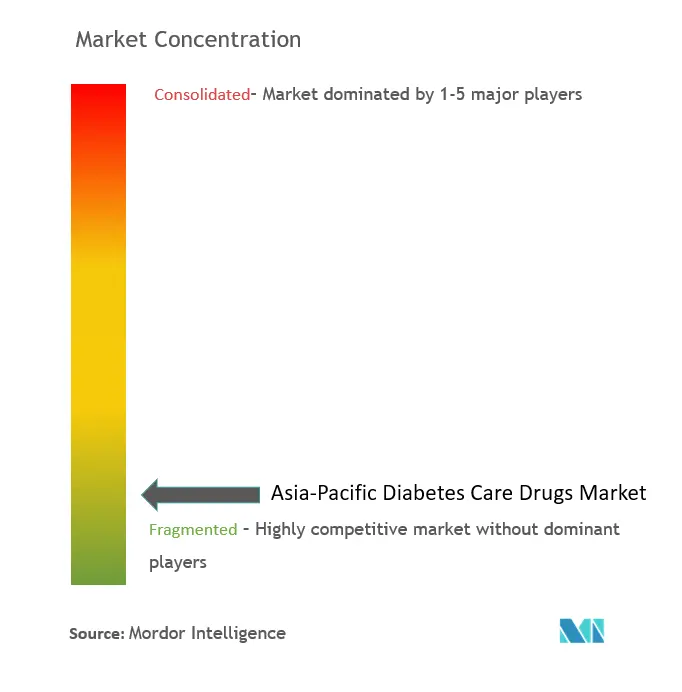
| Market Concentration | Low |
Major Players *Disclaimer: Major Players sorted in no particular order Image © Mordor Intelligence. Reuse requires attribution under CC BY 4.0. | |
Asia-Pacific Diabetes Drugs Market Analysis by Mordor Intelligence
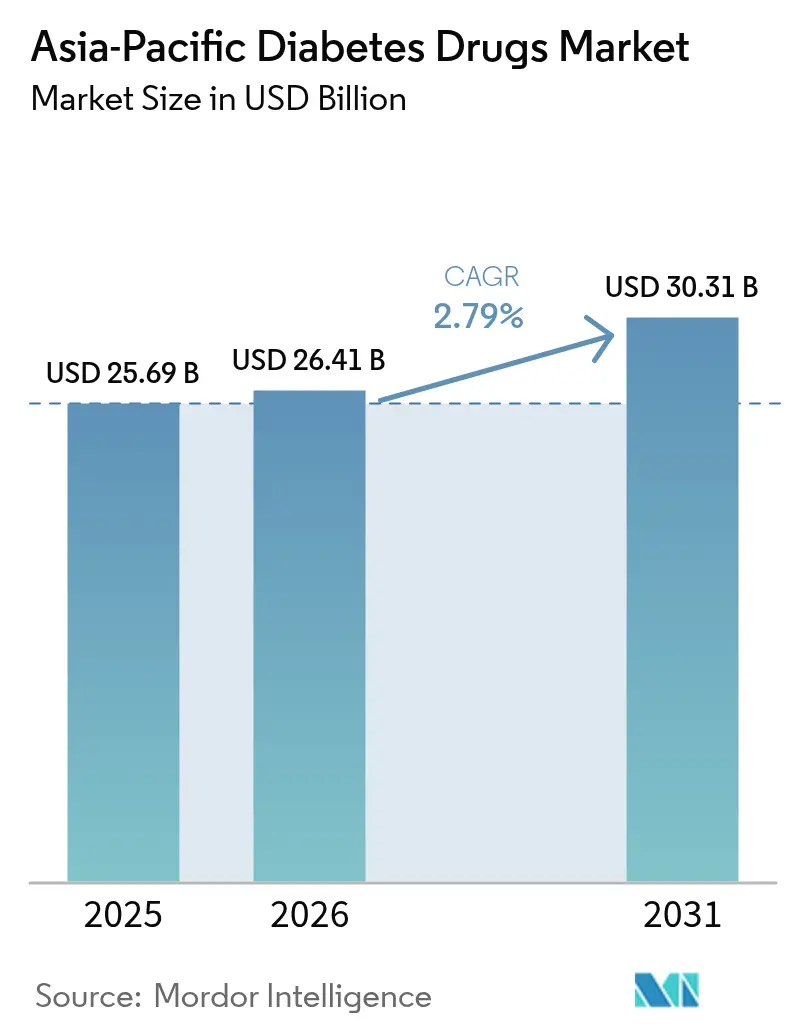
Asia-Pacific Diabetes Drugs Market size in 2026 is estimated at USD 26.41 billion, growing from 2025 value of USD 25.69 billion with 2031 projections showing USD 30.31 billion, growing at 2.79% CAGR over 2026-2031.
Over the past few decades, Asian countries have witnessed a rapid increase in diabetes patients, especially those with type 2 diabetes. Developing countries have more than 70% of the global diabetes population. The Asia -Pacific is anticipated to experience considerable growth due to a more geriatric population and rising prevalence of diabetes mainly due to the enhanced stress level, sedentary lifestyles, smoking, and excessive consumption of alcohol that elevates the body's sugar levels have led to the growth of the market.
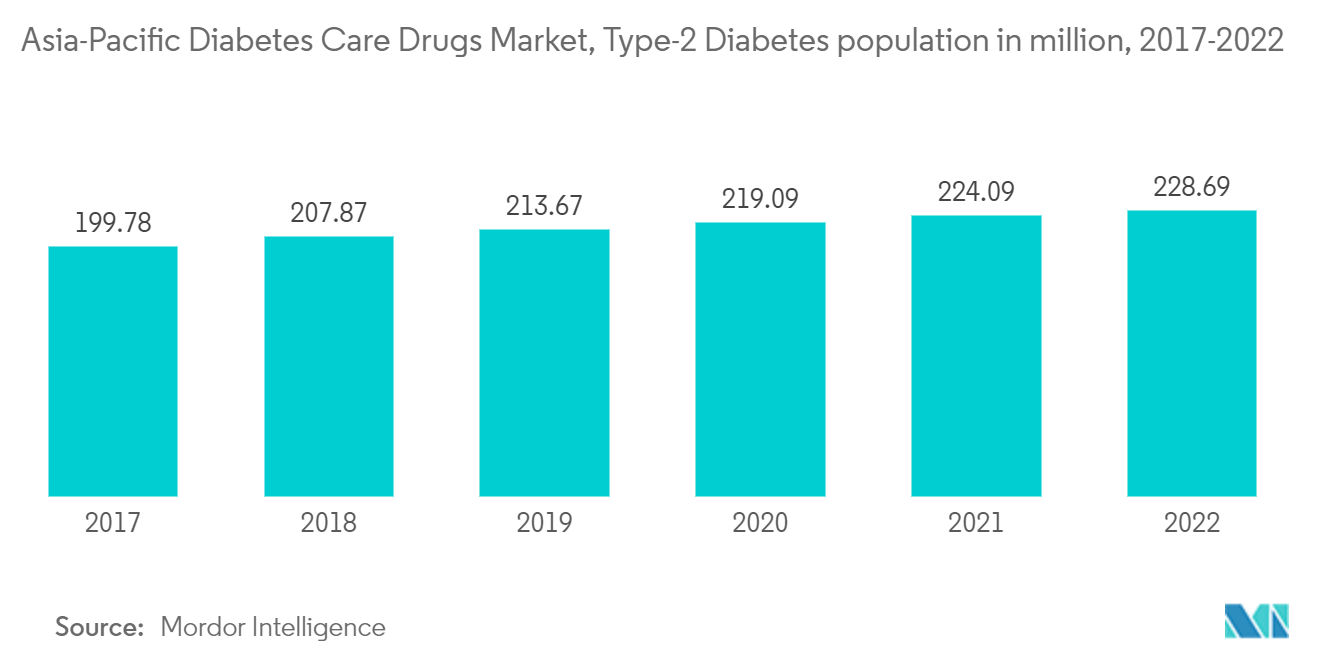
Moreover, the production basis of certain antidiabetic drug companies in the region also boosted the market growth. However, the increasingly high cost of drugs is considered one of the major restraining factors for the market. According to the OECD iLibrary in Asia-Pacific, about 227 million people live with type 2 diabetes and about half of them are undiagnosed and unaware of developing long-term complications.
Therefore, owing to the aforementioned factors the studied market is anticipated to witness growth over the analysis period.
Note: Market size and forecast figures in this report are generated using Mordor Intelligence’s proprietary estimation framework, updated with the latest available data and insights as of 2026.
Asia-Pacific Diabetes Drugs Market Trends and Insights
Oral Anti-Diabetes Drugs Segment occupies the highest market share in the Asia-Pacific Diabetes Drugs Market in the current year
The oral anti-diabetes drug segment occupied the highest market share in the Asia-Pacific diabetes drug market in the current year and is expected to register a CAGR of about 3.1% over the forecast period.
Oral anti-diabetic drugs have been available internationally and are recommended for use when escalation of treatment for type-2 diabetes is required along with lifestyle management. Oral agents are typically the first medications used in the treatment of type-2 diabetes due to their wide range of efficacy, safety, and mechanisms of action. Antidiabetic drugs help diabetes patients keep their condition under control and lower the risk of diabetes complications. People with diabetes may need to take antidiabetic drugs for their whole lives to control their blood glucose levels and avoid hypoglycemia and hyperglycemia.
Oral anti-diabetic agents present the advantages of easier management and lower cost, so they became an attractive alternative to insulin with better acceptance, which enhances adherence to the treatment. The use of oral anti-diabetes drugs is rising since new-generation oral drugs, such as DPP-4 and SGLT-2, reduce the rate of CV risk in diabetes patients. SGLT-2 and GLP-1 are linked to lowering the mortality rate more effectively than DPP-4 inhibitors. Meglitinide and sulfonylureas are oral hypoglycemic drugs that directly arouse the discharge of insulin from pancreatic beta cells.
The Asia-Pacific region has witnessed an alarming increase in the prevalence of diabetes in recent years. In developing countries such as China and India, the rate of diabetes is at an all-time high. Patients with diabetes require many corrections throughout the day for maintaining normal blood glucose levels, such as oral anti-diabetic medication or the ingestion of additional carbohydrates, by monitoring their blood glucose levels. Leading manufacturers are focusing on technological innovations and the development of advanced products to gain a substantial share of the market.
Thus, owing to the above-mentioned factors, it is expected to drive segment growth over the forecast period.
China holds the highest market share in the Asia-Pacific Diabetes Drugs Market in the current year
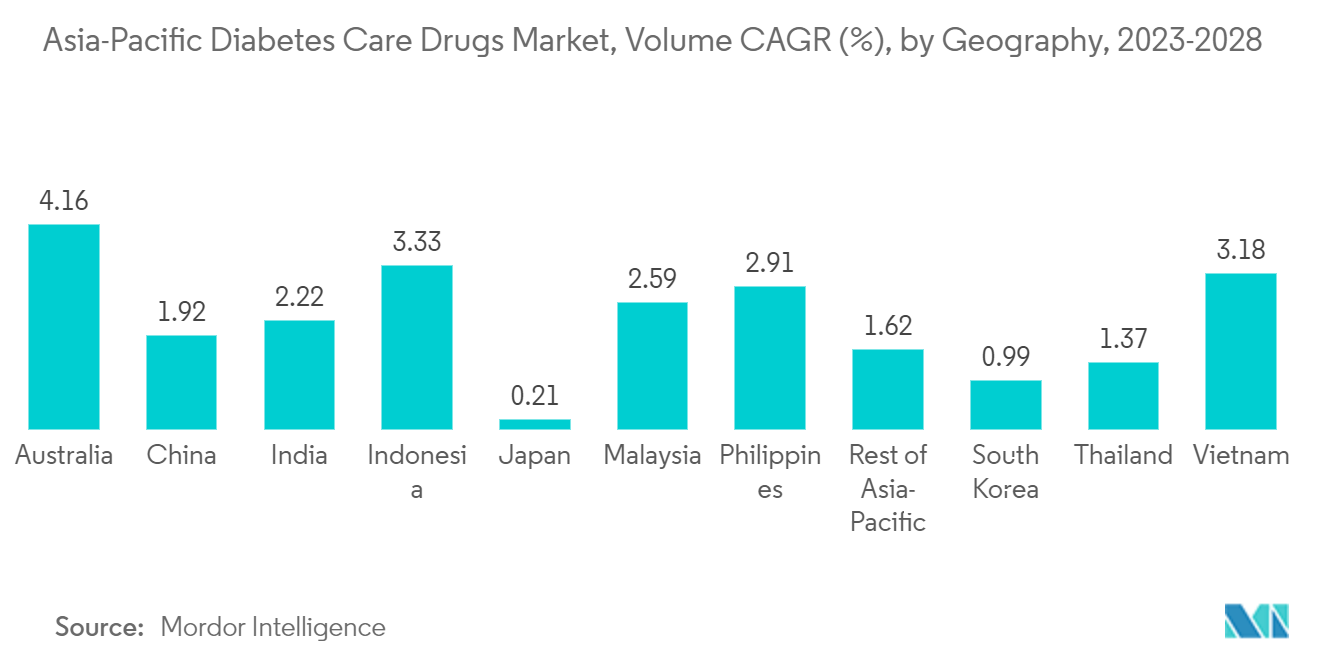
In the Asia-Pacific region, China has been recognized as a potential developing market due to the growing diabetic population in this region. China is a mature market with some associated challenges, like slow economic growth, an aging population, and increased competition. In this region, there is a growing preference for oral anti-diabetics among type-2 diabetic patients, thereby leading to the growth of the market studied.
China has the highest market share and contributes significantly to the global diabetes drug market. The country is witnessing a significant increase in the number of generic drug manufacturers. Furthermore, the leading global players in the market studied are facing intense competition from regional players.
Patients can get medicines directly from the hospital pharmacy without a referral. Despite the implementation of national health insurance and its universal coverage, a large proportion of outpatient drugs are still required to be paid for. To reduce the burden on patients, China began implementing a National Essential Medicine System, which aims to guarantee the use of drugs by patients.
As per the National Health Commission, China has taken steps to reduce diabetic patients' medical expenses by reimbursing outpatients for more than half of their medication costs. According to a national metabolic disease clinical research center, more hospitals in China will establish National Metabolic Management Centers (MMC) as part of their exploration of a new model of diabetes treatment, giving a boost to the market over the analysis period.
Competitive Landscape
The Asia-Pacific diabetes care drug market is fragmented, with a few key manufacturers gaining a presence in major countries while the remaining market comprises other local or region-specific manufacturers. Mergers and acquisitions that happened between players in the recent past helped companies strengthen their market presence as well as drive innovation.
Asia-Pacific Diabetes Drugs Industry Leaders
-
Astrazeneca
-
Boehringer Ingelheim
-
Novo Nordisk A/S
-
Eli Lilly and Company
-
Sanofi Aventis
- *Disclaimer: Major Players sorted in no particular order
Market Opportunities and Future Outlook
The market opportunity set in Asia-Pacific is being shaped by two parallel shifts: (i) a faster cadence of regulatory and submission modernization in select hubs, and (ii) active investment into regional manufacturing and fill-finish capacity for diabetes injectables. Singapore Health Sciences Authority (HSA) moved to an eCTD submission format effective 1 April 2026, which supports faster and more standardized dossier handling for companies managing multi-country filings. India is also seeing portfolio broadening in incretin-based therapies, with CDSCO approval for Dr. Reddy’s Laboratories to manufacture and sell generic oral semaglutide tablets (April 2026). This expands competition and can widen access pathways through large-volume channels.
On the supply side, companies are placing capital and partnerships into Asia-based production networks for insulins and injection-device assembly, creating room for contract manufacturing, device components, and localized packaging and logistics. Novo Nordisk announced a 200 million yuan investment (June 2026) to expand its Tianjin, China production base for injection pens and related drug assembly, while Biocon received EMA approval (July 2026) for a new insulin fill-finish line at its Malaysia facility, reinforcing the region’s role in export-grade manufacturing. Public procurement is also reinforcing locally anchored supply, as shown by Duopharma Biotech securing RM225 million in insulin supply contracts from Malaysia’s Ministry of Health (July 2026), which points to demand for reliable, compliant regional manufacturing and distribution. Beyond medicines access, programmatic care models add another angle for manufacturers to pair therapies with service delivery, with WHO featuring Thailand’s national Diabetes Remission Programme (February 2026) as an example of comprehensive metabolic care that can support uptake of combination regimens and supportive therapies within public systems.
Recent Industry Developments
- June 2026: Novo Nordisk announced an additional 200 million yuan investment to expand capacity at its Tianjin, China manufacturing site, with focus on injection pens and related drug assembly. This strengthens local production scalability for injectable diabetes therapies and supports faster regional supply replenishment for high-volume markets.
- December 2025: Novo Nordisk launched Ozempic (semaglutide) in India, expanding access to a leading GLP-1 therapy in one of the region’s largest diabetes populations. The launch raises competitive intensity in incretin-based treatments and increases attention on cold-chain, distribution, and patient support capabilities needed for injectables.
- April 2024: Sanofi made its diabetes drug Soliqua available in India, adding another fixed-ratio combination option to the market. Broader availability of combination therapies supports regimen intensification pathways and increases competitive pressure across basal insulin and GLP-1 anchored portfolios.
Research Methodology Framework and Report Scope
Market Definition and Coverage
For this study, the Asia-Pacific diabetes drugs market covers prescription medicines used to manage type 1 and type 2 diabetes across major APAC countries. The market value is captured at manufacturer selling prices in USD, and it includes key oral therapies, insulin products, and non-insulin injectables.
Scope exclusions: Devices, diagnostics, and non-drug diabetes care supplies are not counted, and inpatient procedure costs are kept outside the market value.
Segmentation Overview
- Oral Anti-diabetic Drugs
- Biguanides
- Metformin
- Alpha - Glucosidase Inhibitors
- Alpha - Glucosidase Inhibitors
- Dopamine -D2 Receptor Agonist
- Bromocriptin (Cycloset)
- Sodium-glucose Cotransport -2 (SGLT-2) Inhibitor
- Invokana (Canagliflozin)
- Jardiance (Empagliflozin)
- Farxiga/Forxiga (Dapagliflozin)
- Suglat (Ipragliflozin)
- Dipeptidyl Peptidase - 4 (DPP-4) Inhibitors
- Januvia (Sitagliptin)
- Onglyza (Saxagliptin)
- Tradjenta (Linagliptin)
- Vipidia/Nesina (Alogliptin)
- Galvus (Vildagliptin)
- Sulfonylureas
- Sulfonylureas
- Meglitinides
- Meglitinides
- Biguanides
- Insulins
- Basal or Long Acting Insulins
- Lantus (Insulin Glargine)
- Levemir (Insulin Detemir)
- Toujeo (Insulin Glargine)
- Tresiba (Insulin Degludec)
- Basaglar (Insulin Glargine)
- Bolus or Fast Acting Insulins
- NovoRapid/Novolog (Insulin Aspart)
- Humalog (Insulin Lispro)
- Apidra (Insulin Glulisine)
- Traditional Human Insulins
- Novolin/Actrapid/Insulatard
- Humulin
- Insuman
- Biosimilar Insulins
- Insulin Glargine Biosimilars
- Human Insulin Biosimilars
- Basal or Long Acting Insulins
- Combination drugs
- Insulin combinations
- NovoMix (Biphasic Insulin Aspart)
- Ryzodeg (Insulin Degludec and Insulin Aspart)
- Xultophy (Insulin Degludec and Liraglutide)
- Oral Combinations
- Janumet (Sitagliptin and Metformin)
- Insulin combinations
- Non-Insulin Injectable drugs
- GLP-1 receptor agonists
- Victoza (Liraglutide)
- Byetta (Exenatide)
- Bydureon (Exenatide)
- Trulicity (Dulaglutide)
- Lyxumia (Lixisenatide)
- Amylin Analogue
- Symlin (Pramlintide)
- GLP-1 receptor agonists
- By Route of Administration
- Oral
- Subcutaneous
- Intravenous
- Geography
- Australia
- China
- India
- Indonesia
- Japan
- Malaysia
- Philippines
- South Korea
- Thailand
- Vietnam
- Rest of Asia-Pacific
Data Sources, Market Sizing, and Validation
Desk Research
Desk work starts by building the demand pool and treatment mix for each key country, and then aligning it with how diabetes medicines are actually used and reimbursed. We rely on public health and epidemiology sources such as the World Health Organization, the International Diabetes Federation country facts, and government health statistics portals in large APAC markets to ground prevalence and diagnosed population patterns.
To shape the product and pricing context, we also review regulator and policy materials such as drug-approval databases, national reimbursement lists, and public tender notices where available, followed by company filings, investor presentations, and reputable press coverage for commercial signals. In parallel, we use paid subscriptions for company financials and news intelligence, patent databases for pipeline direction, and an import-export shipment-level database in select cases to sanity check cross-border insulin and API flows. These examples are illustrative only, and many other public and proprietary sources were also referred to during data collection and clarification.
Primary Interviews and Surveys
Primary discussions are used to confirm therapy shares, pricing movement, and near-term demand signals that desk sources do not explain cleanly, especially when policy changes affect access. We speak with a mix of manufacturers, distributors, hospital and retail channel participants, and diabetes-focused clinicians across APAC so assumptions on adoption, switching, and affordability can be checked country by country.
Distribution of primary research fieldwork respondents
| Company type | Respondent position |
|---|---|
| Top tier: 37% | CXOs: 18% |
| Mid tier: 41% | Functional/Unit leaders: 32% |
| Smaller Players: 22% | Managers: 50% |
Market-Sizing & Forecasting
Sizing is built using a top-down approach where country diabetes prevalence, diagnosed share, treated share, and therapy mix are translated into a value pool for oral drugs, insulin, and non-insulin injectables. Because pricing differs by molecule class and access route, the model uses a set of practical inputs such as the split between type 1 and type 2 treatment, penetration of newer classes, tender versus private market weighting, and typical annual therapy costs that are then expressed in USD.
Once totals are formed, selective bottom-up approximations are used to corroborate the output, including sampled ASP times volume checks for major classes, distributor channel checks, and supplier revenue alignment where disclosures allow. When a country has limited published detail, gaps are handled by using proxy indicators (like comparable reimbursement structure and similar therapy mix) and then re-tested through primary feedback before finalizing. For forecasting, we typically use scenario analysis supported by a light multivariate regression overlay, where drivers like diagnosed population growth, access expansion, and class-level price erosion are adjusted based on what interviewees expect in the next few years.
Data Validation & Update Cycle
Validation is done through repeated cross-checks so that a single input does not drive the final number. We compare model outputs with independent signals such as country medicine spending trends, policy timing, and visible changes in therapy adoption, and then outliers are reviewed before sign-off.
A multi-step analyst review is followed, and respondents are re-contacted when a large variance is seen across countries or when an assumption shifts materially (for example, a reimbursement expansion or a major price cut). The report is refreshed annually, and interim updates are made when meaningful events occur, after which a final fresh pass is completed before delivery so clients receive the latest view.
Mordor Intelligence's Asia Pacific Diabetes Drugs Market Size Measured Against Other Published Estimates
Published market values for Asia-Pacific diabetes drugs can look far apart, even when the topic sounds the same, because firms do not always count the same drug set, years, and pricing points. Differences also come from how treatment uptake is assumed in large countries, and whether price erosion in tender channels is modeled explicitly.
Some estimates lean heavily on high-growth assumptions for newer drug classes, while others blend in broader diabetes treatment spending that can pull the number upward. Currency conversion timing, the choice of base year, and how combination therapies are counted (as single products or split into components) also create visible gaps in the final totals.
Benchmark comparison
| Source | Market Size | Gaps in Research Methodology |
|---|---|---|
| Mordor Intelligence | USD 25.69 B (2025) | |
| Global Consultancy A | USD 24.50 B (2024) | Uses a different base year and appears to apply an aggressive growth path to later years, which can overstate totals if tender-driven price declines are not modeled country by country. |
| Industry Publisher B | USD 30.77 B (2024) | Likely blends broader diabetes treatment spend with drug revenues in some countries, which can lift the value if non-drug care elements or wider therapy costs are partially included. |
The table shows a meaningful spread that is largely explained by year alignment and what is counted as a drug sale versus broader treatment value. In Mordor Intelligence's model, the market is tied to diabetes medicines only across listed APAC countries, and totals are checked through therapy mix and access assumptions so the number stays traceable to clear demand and pricing inputs.
Key Questions Answered in the Report
How big is the Asia-Pacific Diabetes Care Drugs Market?
The Asia-Pacific Diabetes Care Drugs Market size is expected to reach USD 26.41 billion in 2026 and grow at a CAGR of 2.79% to reach USD 30.31 billion by 2031.
What is the current Asia-Pacific Diabetes Care Drugs Market size?
In 2026, the Asia-Pacific Diabetes Care Drugs Market size is expected to reach USD 26.41 billion.
Who are the key players in Asia-Pacific Diabetes Care Drugs Market?
Astrazeneca, Boehringer Ingelheim, Novo Nordisk A/S, Eli Lilly and Company and Sanofi Aventis are the major companies operating in the Asia-Pacific Diabetes Care Drugs Market.
What years does this Asia-Pacific Diabetes Care Drugs Market cover, and what was the market size in 2025?
In 2025, the Asia-Pacific Diabetes Care Drugs Market size was estimated at USD 25.69 billion. The report covers the Asia-Pacific Diabetes Care Drugs Market historical market size for years: 2019, 2020, 2021, 2022, 2023, 2024 and 2025. The report also forecasts the Asia-Pacific Diabetes Care Drugs Market size for years: 2026, 2027, 2028, 2029, 2030 and 2031.