
Asia-Pacific Cashew Market Analysis by Mordor Intelligence
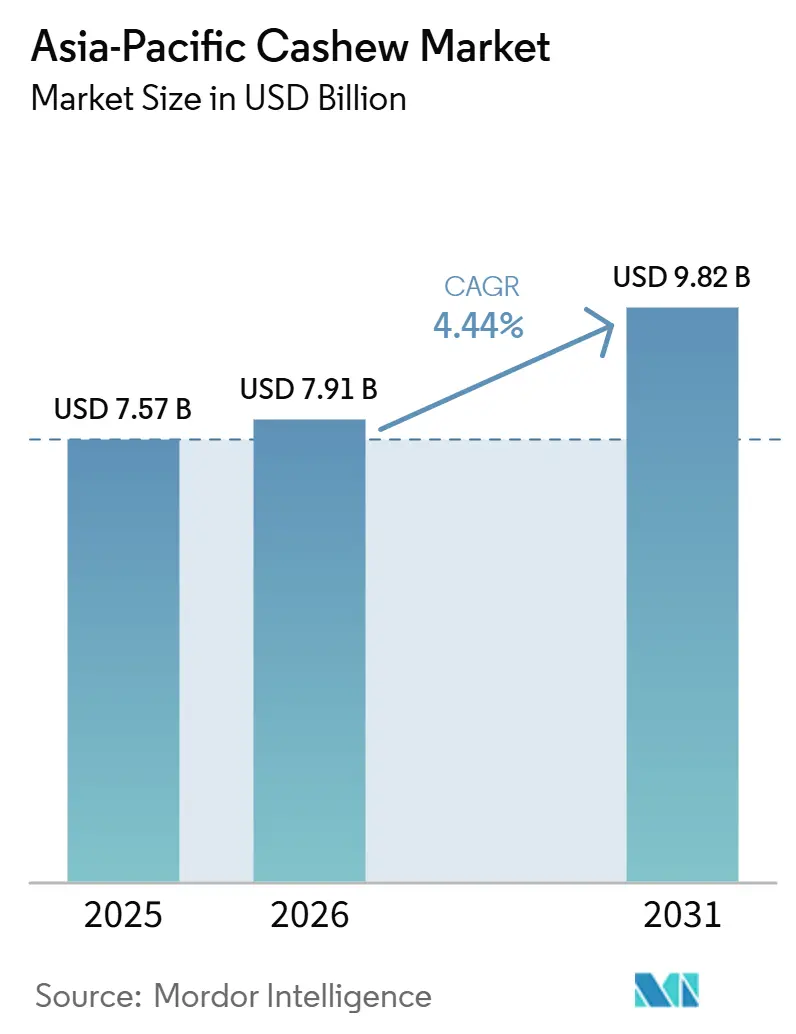
The Asia-Pacific cashew market was valued at USD 7.57 billion in 2025 and is forecast to grow from USD 7.91 billion in 2026 to USD 9.82 billion by 2031, at a 4.44% CAGR from 2026 to 2031. Recent market growth has been supported by a shift in cashew processing capacity toward Southeast Asia, with Vietnamese plants now handling roughly 80% of the world’s kernel exports, even though the country produces only a fraction of the raw nuts it processes. At the same time, tighter export controls in Benin and Burkina Faso during 2025 constrained African raw-nut supply and pushed average FOB prices for WW320 kernels to USD 7.25–7.50 per kilogram in the first half of 2025. These supply pressures have encouraged farmers in Cambodia, Côte d’Ivoire, and Tanzania to ship raw nuts to Vietnam’s processing facilities. At the processing and distribution stages, labor shortages in Kerala and Tamil Nadu, tighter aflatoxin regulations in China and Japan, and higher refrigerated freight rates are weighing on processor margins. Collectively, these developments are reshaping regional supply chains and deepening integration among raw-nut origins, processing hubs, and fast-growing consumer markets.
Key Report Takeaways
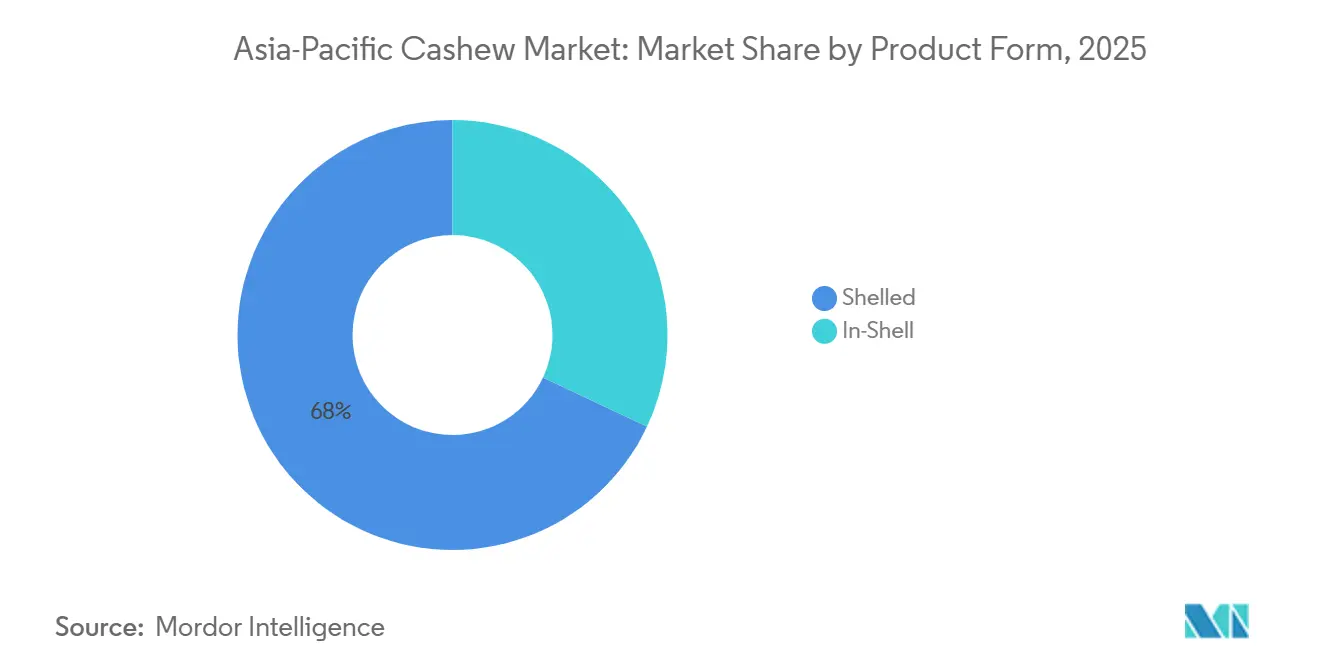
- By product form, shelled cashews were the largest segment and accounted for 68.0% of the Asia-Pacific cashew market share in 2025, while in-shell cashews are the fastest-growing segment and are forecast to expand at a 5.4% CAGR from 2026 to 2031.
- By geography, China was the largest market and accounted for 36.8% of the Asia-Pacific cashew market size in 2025, while Vietnam is the fastest-growing market and is forecast to expand at a 7.2% CAGR from 2026 to 2031.
Note: Market size and forecast figures in this report are generated using Mordor Intelligence’s proprietary estimation framework, updated with the latest available data and insights as of January 2026.
Asia-Pacific Cashew Market Trends and Insights
Drivers Impact Analysis*
| Driver | (~) % Impact on CAGR Forecast | Geographic Relevance | Impact Timeline |
|---|---|---|---|
| Robust Shift Toward Plant-Based Protein Snacks | +1.2% | China, Japan, South Korea, Australia, and urban Southeast Asia | Medium term (2-4 years) |
| Rise in Intra-Asia Processing Clusters (Vietnam-Cambodia-Laos Corridor) | +1.4% | Vietnam, Cambodia, Laos, spillover to Thailand and Myanmar | Long term (≥4 years) |
| Digitization of Farm-Gate Procurement Platforms | +0.8% | India, Vietnam, Indonesia, Cambodia | Short term (≤2 years) |
| Government Replanting Subsidies in India and Indonesia | +1.0% | India (Kerala, Karnataka, and Tamil Nadu) and Indonesia (Sulawesi and East Java) | Long term (≥4 years) |
| Growing Demand for Cashew Shell Liquid in Bio-Polyols | +0.6% | Global demand led by China, Japan, and South Korea | Medium term (2-4 years) |
| Near-shoring of Japanese roasters to Vietnam | +0.5% | Vietnam and Japan | Short term (≤2 years) |
| Source: Mordor Intelligence | |||
Robust Shift Toward Plant-Based Protein Snacks
Urban consumers in China, Japan, and South Korea are replacing meat snacks with tree nuts to achieve health and sustainability goals. China imported more than 150,000 metric tons of Vietnamese kernels in 2025, accounting for more than 20% of Vietnam’s exports[1]. Millennials and Generation Z drive this demand, favoring clean-label ingredients and transparent origin stories. Australia's per-capita cashew consumption has increased significantly over the past decade, reflecting growing consumer demand. Together, these trends are anticipated to sustain mid-single-digit growth in the Asia-Pacific cashew market despite stabilizing price volatility.
Rise in Intra-Asia Processing Clusters (Vietnam-Cambodia-Laos Corridor)
According to the Cashew Nut Association of Cambodia, Cambodia exported 1 million metric tons of raw cashew nuts valued at USD 1.5 billion in 2025, of which 90-95% were shipped tariff-free to Vietnam under ASEAN rules[2]. Vietnamese shellers achieve higher yields and lower overhead than African peers, reinforcing their status as the largest exporters. Cambodia’s National Cashew Policy aims to process 25% of domestic nuts by 2027, supported by a 400-hectare industrial park and new factories totaling 60,000 metric tons capacity opening in 2026[3]. Laos also contributes to the regional processing corridor by supplying raw cashew nuts to Vietnam's major processing hubs. The integrated supply chain improves raw material availability, enhances processing efficiency, and strengthens the competitiveness and resilience of the Asia-Pacific cashew market.
Digitization of Farm-Gate Procurement Platforms
Blockchain-enabled and mobile platforms are connecting growers directly with processors in India, Vietnam, Indonesia, and Cambodia, improving price realization for farmers through greater supply chain transparency. India's Agricultural and Processed Food Products Export Development Authority drives this shift through TraceNet, offering instant payments, real-time quality grading, and a data trail for fintech lenders to provide short-term credit. Vietnamese processing facilities complement these efforts by integrating IoT sensors into storage depots to monitor temperature and humidity, helping ensure aflatoxin compliance for exports to Japan and China. In March 2026, Cambodia's Men Sarun MDR secured a USD 35 million annual supply agreement with Chinese importers using QR-coded traceability, demonstrating how digital procurement platforms enhance buyer confidence, strengthen export opportunities, and accelerate the adoption of transparent and traceable cashew supply chains across the Asia-Pacific market.
Government Replanting Subsidies in India and Indonesia
The adoption of high-yielding cashew varieties and government-supported orchard rejuvenation programs across Indonesia and India is improving long-term productivity and farm sustainability. Indonesia continues to encourage new plantation development and orchard maintenance through financial support for smallholders, while India has strengthened sapling survival through improved soil management and pest control practices. Although rejuvenated orchards require several years to reach commercial production, higher survival rates and improved yields are anticipated to expand raw cashew nut supplies over the long term, supporting regional trade and easing raw material price pressures in the Asia-Pacific cashew market.
Restraints Impact Analysis*
| Restraint | (~) % Impact on CAGR Forecast | Geographic Relevance | Impact Timeline |
|---|---|---|---|
| Increasing Labor Shortages During Peak Harvest in Coastal India | −0.7% | India (Kerala, Tamil Nadu, and Andhra Pradesh) | Short term (≤2 years) |
| El Nino-linked Yield Volatility in Southeast Asia | −0.9% | Vietnam, Indonesia, Cambodia, Myanmar, and Thailand | Medium term (2-4 years) |
| Stringent Aflatoxin Limits in China and Japan | −0.5% | Exporters to China, Japan, and South Korea | Long term (≥4 years) |
| Rising Freight Rates for Refrigerated Kernel Exports | −0.6% | Vietnam-China, Vietnam-European Union, and India-Middle East routes | Short term (≤2 years) |
| Source: Mordor Intelligence | |||
Increasing Labor Shortages During Peak Harvest in Coastal India
Cashew processing hubs in Kerala and Tamil Nadu continue to face labor shortages during the peak harvest season, increasing processing costs and limiting operational efficiency. Rising wages for skilled workers, coupled with continued migration of younger workers to urban areas, have intensified labor constraints. At the same time, the slower adoption of automation compared to competing processing countries such as Vietnam has reduced the competitiveness of India's cashew processing industry. As a result, export competitiveness has weakened, with persistent labor shortages reducing profit margins and constraining India's ability to expand its share of the Asia-Pacific cashew market.
El Niño-Linked Yield Volatility in Southeast Asia
El Niño cycles reduce rainfall during the flowering phase in Vietnam, Indonesia, and Cambodia, leading to a 15-25% decrease in yields in affected cashew orchards. This has compelled Vietnamese processors to import 3.12 million metric tons of raw cashew nuts, valued at USD 4.66 billion in 2025, to maintain shelling operations. Similarly, Indonesia's Sulawesi region experiences drought-induced supply disruptions, shifting the country from a net exporter to a net importer, thereby tightening regional supply. Cambodia faces heightened vulnerability, as 90% of its 700,000 hectares of cashew plantations lack irrigation infrastructure, exacerbating production fluctuations that impact procurement channels in Vietnam and China. These recurring weather shocks contribute to price volatility, extend working capital cycles for processors, and emphasize the importance of diversified sourcing strategies within the Asia-Pacific cashew market.
*Our forecasts treat driver/restraint impacts as directional, not additive. The impact forecasts reflect baseline growth, mix effects, and variable interactions.
Segment Analysis
By Product Form, Shelled cashew drove the Asia-Pacific cashew market growth.
Shelled cashew nuts commanded the largest share, accounting for 68% of the Asia-Pacific cashew market size in 2025, easily exceeding one-half of the Asia-Pacific cashew market size, as ready-to-eat formats dominated supermarket, bakery, and food-service shelves in China, Japan, and Australia. In-shell cashew nuts, while still the smaller of the two forms, are forecast to grow at the fastest CAGR of 5.4% from 2026 to 2031, as health-conscious consumers increasingly roast nuts at home to avoid added oils and verify freshness. Vietnamese processors now set aside specific in-shell lots for premium export channels, capturing price uplifts that run 15-20% above equivalent kernel grades. This simultaneous scale advantage for shelled kernels and growth momentum for in-shell products shapes a two-speed expansion path for the category.
Shelled cashews remain the industry workhorse, from which most enter confectionery, snack, and food-ingredient pipelines in China, the United States, and the European Union. Flavor innovation supports further gains, roasted and seasoned variants already account for a rising share of outbound shipments and attract 20-30% premiums over raw kernels in top Asian retail chains. By contrast, in-shell nuts appeal to niche channels such as organic stores and direct-to-consumer platforms, where shoppers pay extra for minimal processing and the theater of home roasting. As both forms extend reach one through convenience and the other through experiential consumption, the product-form landscape will continue to broaden market share opportunities for suppliers.

Geography Analysis
China is the largest consumer of cashews in the region, accounting for 36.8% of the market share in 2025 and shaping procurement trends across the Asia-Pacific cashew market. Vietnam is the fastest-growing consumer among the listed countries, with domestic cashew consumption forecast to expand at a 7.2% CAGR from 2026 to 2031 as urban households trade up to roasted and flavored kernels. Chinese e-commerce giants widen direct-to-consumer channels, while Vietnamese processors increasingly reserve premium grades for their own market to meet rising café and convenience-store demand. This twin dynamic blends China's scale with Vietnam’s acceleration to anchor regional growth.
India’s consumption ranks second in absolute volume, but price sensitivity keeps annual growth in the low single digits, despite the government reintroducing subsidies to ease long-term supply pressures. Indonesia follows a similar path, where rising middle-class incomes lift snacking adoption but El Niño-driven yield swings temper expansion outlooks. Australia remains a niche yet premium destination, and it is being repackaged for Pacific Island tourism and health-food channels. Sri Lanka and Cambodia register smaller domestic bases. Cambodia channels most production to export markets, while Sri Lankan demand stays limited to gifting seasons.
Looking ahead, China is anticipated to retain its largest status by leveraging cross-border logistics that shorten delivery times and sustain freshness, and Vietnam’s fastest trajectory should persist as processors add value-added lines and café chains popularize cashew lattes. India and Indonesia aim to unlock higher growth once new high-yield orchards mature and mechanization lowers processing costs. Australia will continue carving out value through organic and fair-trade positioning, whereas Cambodia’s domestic market may expand as disposable incomes rise alongside planned industrial park developments. Collectively, these country-specific strategies are set to widen the Asia-Pacific cashew commodity market and intensify intra-regional trade linkages.
Competitive Landscape
The Asia-Pacific cashew market is characterized by the presence of integrated processors, exporters, and value-added product manufacturers that compete across procurement, processing, and international trade. Olam International Limited is one of the leading participants, operating an integrated supply chain that spans raw cashew sourcing, processing, and global distribution. Vietnam Lafooco Joint Stock Company and Long Son Joint Stock Company are prominent processors in Vietnam, leveraging the country's strong processing infrastructure and access to raw cashew nuts from Cambodia and other producing countries to supply export markets. PT Bumi Sari Prima plays a significant role in Indonesia's processing industry through kernel production and the utilization of cashew by-products, while MWT Foods Pty Ltd strengthens Australia's position in value-added processing and premium packaged cashew products.
Competition in the market is driven by companies' ability to secure raw cashew nut supplies, improve processing efficiency, and meet stringent quality and food safety standards in key export destinations. Leading players continue to strengthen procurement networks, invest in processing facilities, and expand value-added product portfolios, including roasted, flavored, organic, and certified cashew products, to enhance margins and strengthen their presence in domestic and international markets.
As processing capacity expands across major producing countries, competition for raw cashew nuts is anticipated to intensify, encouraging greater investments in automation, traceability, sustainability certifications, and downstream product development. These strategies are anticipated to improve supply chain efficiency, enhance export competitiveness, and support the long-term growth of the Asia-Pacific cashew market.
Recent Industry Developments
- June 2026: The Directorate of Cashew Research (DCR) under the Indian Council of Agricultural Research (ICAR) has developed two new hybrid cashew varieties, which are set to be released in 2027. The varieties aim to improve yield, nut quality, and climate resilience. The new hybrids are expected to enhance farm productivity and strengthen India's position in the global cashew market. Their commercialization is anticipated to support long-term growth through improved varietal adoption and higher orchard efficiency.
- September 2025: Cambodia’s Men Sarun MDR signed a USD 35 million annual traceable-nut agreement with Chinese buyers, using QR-coded packaging. The premium earned on verified origin elevates earnings potential for compliant suppliers and accelerates the adoption of digital traceability across the region, thereby enhancing cashew market growth.
- May 2024: India’s Ministry of Agriculture and Farmers Welfare introduced INR 20 000 (USD 240) per hectare replanting subsidies across 50,000 hectares in Kerala, Karnataka, and Tamil Nadu. By raising future raw-nut output, the scheme will reduce India’s import dependence and inject additional volume into regional trade, supporting stable long-term expansion of the Asia-Pacific cashew commodity market.
Asia-Pacific Cashew Market Report Scope
Cashew nuts are edible, kidney-shaped nuts belonging to the Anacardiaceae family, rich in oil and protein, and are roasted and shelled before being eaten. Oil extracted from the shells is used as a lubricant in the production of plastics. The Asia-Pacific Cashew Market Report is Segmented by Form (Shelled and In-shelled), by Country (Vietnam, India, China, Sri Lanka, Japan, Australia, Indonesia, and the Philippines). The Report Includes Production Analysis (Volume), Consumption Analysis (Value and Volume), Export Analysis (Value and Volume), Import Analysis (Value and Volume), Wholesale Price Trend Analysis, and More. The Market Forecasts are Provided in Terms of Value (USD) and Volume (Metric Tons).
By Form (Value)
| In-Shell |
| Shelled (Kernels) |
By Geography
| Asia-Pacific | China | Production Analysis (Area Harvested, Yield, and Production Volume) |
| Consumption Analysis (Consumption Value and Volume) | ||
| Import Market Analysis (Import Value, Volume, and Key Supplying Markets) | ||
| Export Market Analysis (Export Value, Volume, and Key Destination Markets) | ||
| Wholesale Price Trend Analysis and Forecast | ||
| Regulatory Framework | ||
| List of Key Players | ||
| Logistics and Infrastructure | ||
| Seasonality Analysis | ||
| India | Production Analysis (Area Harvested, Yield, and Production Volume) | |
| Consumption Analysis (Consumption Value and Volume) | ||
| Import Market Analysis (Import Value, Volume, and Key Supplying Markets) | ||
| Export Market Analysis (Export Value, Volume, and Key Destination Markets) | ||
| Wholesale Price Trend Analysis and Forecast | ||
| Regulatory Framework | ||
| List of Key Players | ||
| Logistics and Infrastructure | ||
| Seasonality Analysis | ||
| Thailand | Production Analysis (Area Harvested, Yield, and Production Volume) | |
| Consumption Analysis (Consumption Value and Volume) | ||
| Import Market Analysis (Import Value, Volume, and Key Supplying Markets) | ||
| Export Market Analysis (Export Value, Volume, and Key Destination Markets) | ||
| Wholesale Price Trend Analysis and Forecast | ||
| Regulatory Framework | ||
| List of Key Players | ||
| Logistics and Infrastructure | ||
| Seasonality Analysis | ||
| Vietnam | Production Analysis (Area Harvested, Yield, and Production Volume) | |
| Consumption Analysis (Consumption Value and Volume) | ||
| Import Market Analysis (Import Value, Volume, and Key Supplying Markets) | ||
| Export Market Analysis (Export Value, Volume, and Key Destination Markets) | ||
| Wholesale Price Trend Analysis and Forecast | ||
| Regulatory Framework | ||
| List of Key Players | ||
| Logistics and Infrastructure | ||
| Seasonality Analysis | ||
| Indonesia | Production Analysis (Area Harvested, Yield, and Production Volume) | |
| Consumption Analysis (Consumption Value and Volume) | ||
| Import Market Analysis (Import Value, Volume, and Key Supplying Markets) | ||
| Export Market Analysis (Export Value, Volume, and Key Destination Markets) | ||
| Wholesale Price Trend Analysis and Forecast | ||
| Regulatory Framework | ||
| List of Key Players | ||
| Logistics and Infrastructure | ||
| Seasonality Analysis | ||
| Philippines | Production Analysis (Area Harvested, Yield, and Production Volume) | |
| Consumption Analysis (Consumption Value and Volume) | ||
| Import Market Analysis (Import Value, Volume, and Key Supplying Markets) | ||
| Export Market Analysis (Export Value, Volume, and Key Destination Markets) | ||
| Wholesale Price Trend Analysis and Forecast | ||
| Regulatory Framework | ||
| List of Key Players | ||
| Logistics and Infrastructure | ||
| Seasonality Analysis | ||
| By Form (Value) | In-Shell | ||
| Shelled (Kernels) | |||
| By Geography | Asia-Pacific | China | Production Analysis (Area Harvested, Yield, and Production Volume) |
| Consumption Analysis (Consumption Value and Volume) | |||
| Import Market Analysis (Import Value, Volume, and Key Supplying Markets) | |||
| Export Market Analysis (Export Value, Volume, and Key Destination Markets) | |||
| Wholesale Price Trend Analysis and Forecast | |||
| Regulatory Framework | |||
| List of Key Players | |||
| Logistics and Infrastructure | |||
| Seasonality Analysis | |||
| India | Production Analysis (Area Harvested, Yield, and Production Volume) | ||
| Consumption Analysis (Consumption Value and Volume) | |||
| Import Market Analysis (Import Value, Volume, and Key Supplying Markets) | |||
| Export Market Analysis (Export Value, Volume, and Key Destination Markets) | |||
| Wholesale Price Trend Analysis and Forecast | |||
| Regulatory Framework | |||
| List of Key Players | |||
| Logistics and Infrastructure | |||
| Seasonality Analysis | |||
| Thailand | Production Analysis (Area Harvested, Yield, and Production Volume) | ||
| Consumption Analysis (Consumption Value and Volume) | |||
| Import Market Analysis (Import Value, Volume, and Key Supplying Markets) | |||
| Export Market Analysis (Export Value, Volume, and Key Destination Markets) | |||
| Wholesale Price Trend Analysis and Forecast | |||
| Regulatory Framework | |||
| List of Key Players | |||
| Logistics and Infrastructure | |||
| Seasonality Analysis | |||
| Vietnam | Production Analysis (Area Harvested, Yield, and Production Volume) | ||
| Consumption Analysis (Consumption Value and Volume) | |||
| Import Market Analysis (Import Value, Volume, and Key Supplying Markets) | |||
| Export Market Analysis (Export Value, Volume, and Key Destination Markets) | |||
| Wholesale Price Trend Analysis and Forecast | |||
| Regulatory Framework | |||
| List of Key Players | |||
| Logistics and Infrastructure | |||
| Seasonality Analysis | |||
| Indonesia | Production Analysis (Area Harvested, Yield, and Production Volume) | ||
| Consumption Analysis (Consumption Value and Volume) | |||
| Import Market Analysis (Import Value, Volume, and Key Supplying Markets) | |||
| Export Market Analysis (Export Value, Volume, and Key Destination Markets) | |||
| Wholesale Price Trend Analysis and Forecast | |||
| Regulatory Framework | |||
| List of Key Players | |||
| Logistics and Infrastructure | |||
| Seasonality Analysis | |||
| Philippines | Production Analysis (Area Harvested, Yield, and Production Volume) | ||
| Consumption Analysis (Consumption Value and Volume) | |||
| Import Market Analysis (Import Value, Volume, and Key Supplying Markets) | |||
| Export Market Analysis (Export Value, Volume, and Key Destination Markets) | |||
| Wholesale Price Trend Analysis and Forecast | |||
| Regulatory Framework | |||
| List of Key Players | |||
| Logistics and Infrastructure | |||
| Seasonality Analysis | |||
Key Questions Answered in the Report
How large will the Asia-Pacific cashew commodity market be by 2031?
The Asia-Pacific cashew commodity market size is forecast to reach USD 9.82 billion by 2031, expanding at a 4.44% CAGR from 2026 to 2031.
Which country is the largest producer in the region?
China accounted for the largest share of regional output at 36.8% in 2025, although much of its processing relies on imported raw nuts.
Which origin is expanding production the fastest?
Vietnam's domestic cashew consumption is forecast to expand at a 7.2% CAGR from 2026 to 2031, supported by rising urban consumption and growing demand for roasted and flavored kernels.
What is the biggest risk to regional supply growth?
El Niño-linked droughts that cut yields by up to 25% across Vietnam, Indonesia, and Cambodia pose the biggest supply risk, lowering potential output and tightening raw-nut availability.