
Market Overview
| Study Period | 2020 - 2031 |
|---|---|
| Forecast Data Period | 2026 - 2031 |
| Base Year Market Size (2025) | USD 8.31 Billion |
| Market Size (2026) | USD 9.20 Billion |
| Market Size (2031) | USD 15.26 Billion |
| Growth Rate (2026 - 2031) | 10.66 % |
| Market Concentration | Medium |
Major Players *Disclaimer: Major Players sorted in no particular order Image © Mordor Intelligence. Reuse requires attribution under CC BY 4.0. | |
Asia Pacific Automotive Infotainment Systems Market Analysis by Mordor Intelligence
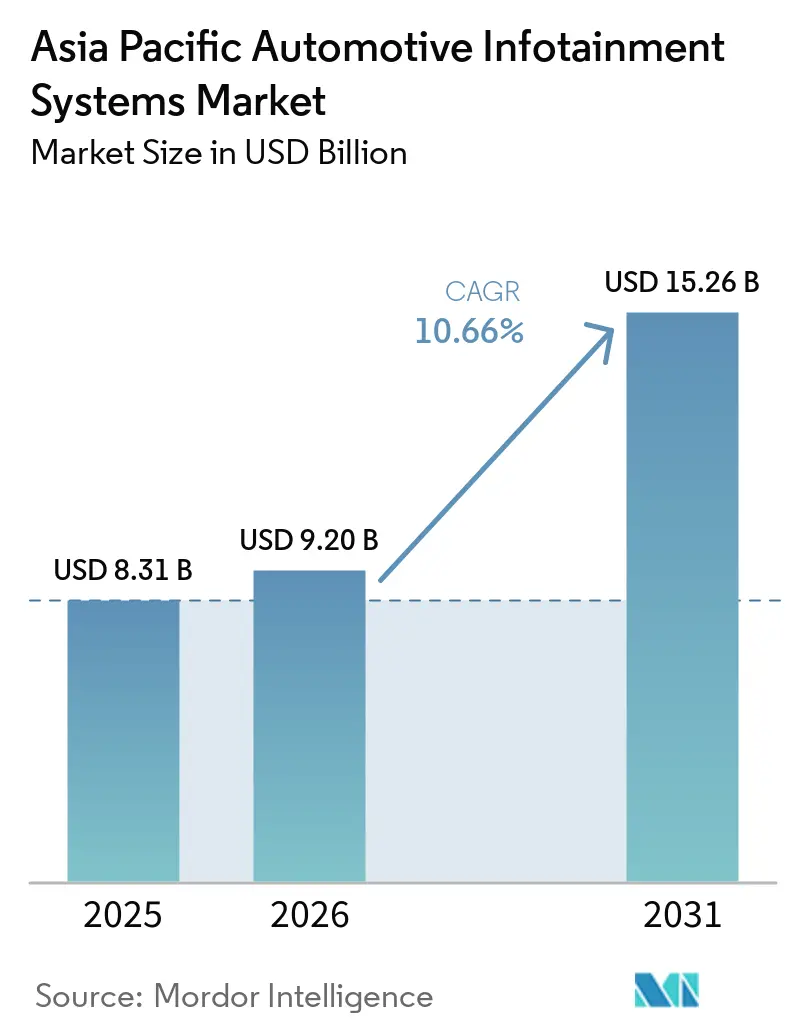
The Asia-Pacific Automotive Infotainment System market size was valued at USD 8.31 billion in 2025 and estimated to grow from USD 9.2 billion in 2026 to reach USD 15.26 billion by 2031, at a CAGR of 10.66% during the forecast period (2026-2031). Growth stems from rising connected-car penetration, fast 4G-to-5G migration, and the pivot toward software-defined cockpits that monetize over-the-air upgrades. Hardware is commoditizing, so recurring revenue from app stores, navigation subscriptions, and feature unlocks is now central to OEM strategy. China anchors demand yet faces share dilution as India and ASEAN scale entry-level electrification, while regulatory mandates for eCall and telematics compress life cycles for non-connected head units. Competitive dynamics are shifting as tech platforms extend Android Automotive OS, Automotive Grade Linux, and bespoke cloud services directly into vehicle programs, eroding the historical moat of tier-one suppliers.
Key Report Takeaways
- By installation type, in-dash infotainment led with 77.65% revenue share in 2025, while rear-seat systems are projected to expand at a 12.04% CAGR through 2031.
- By vehicle type, passenger cars accounted for 71.78% of the Asia-Pacific Automotive Infotainment System market share in 2025, whereas light commercial vehicles are forecasted to grow at a 11.55% CAGR through 2031.
- By component, displays and touchscreens captured a 43.28% share of the Asia-Pacific Automotive Infotainment System market size in 2025, and operating-system software, along with apps, is advancing at a 13.18% CAGR during the outlook period.
- By propulsion type, internal-combustion engine vehicles accounted for 79.65% of installations in 2025, while battery electric vehicles are set to increase at a 13.62% CAGR through 2031.
- By connectivity generation, 4G LTE commanded 60.62% share in 2025, whereas 5G connectivity is rising at a 13.05% CAGR toward 2031.
- By operating system, Linux-based platforms secured a 46.85% share in 2025, while Android Automotive OS is expected to expand at a 12.01% CAGR to 2031.
- By sales channel, OEM-installed systems dominated with an 82.85% revenue share in 2025; however, aftermarket solutions are projected to post a 11.91% CAGR during the same period.
- By country, China captured 48.35% of the Asia-Pacific Automotive Infotainment System market share in 2025, while India is forecast to expand at a 12.49% CAGR through 2031.
Note: Market size and forecast figures in this report are generated using Mordor Intelligence’s proprietary estimation framework, updated with the latest available data and insights as of 2026.
Market Trends and Insights
Drivers Impact Analysis of Asia Pacific Automotive Infotainment Systems Market*
| Driver | (~) % Impact on CAGR Forecast | Geographic Relevance | Impact Timeline |
|---|---|---|---|
| Growing Demand for Connected-Car Services | +2.3% | China, India, South Korea | Medium term (2-4 years) |
| Shift to OTA-Upgradeable Software-Defined Vehicles | +2.1% | China, Japan, South Korea, Australia | Medium term (2-4 years) |
| OEM–Tech Giant Platform Partnerships | +1.9% | China, Japan, South Korea | Short term (≤2 years) |
| Regulatory Mandates for eCall and Telematics | +1.6% | Japan, South Korea, China, India | Long term (≥4 years) |
| Low-Cost SoC Penetration in Entry-Level Cars | +1.4% | India, China | Short term (≤2 years) |
| Localized OTT and Navigation Ecosystems | +1.1% | India, China | Medium term (2-4 years) |
| Source: Mordor Intelligence | |||
Growing Demand for Connected-Car Services
Fleet operators and ride-hailing aggregators now view infotainment as a critical tool for enhancing operational efficiency rather than a mere cabin luxury. The integration of telematics enables more efficient routing, provides insights into driver behavior, and supports predictive maintenance, all of which contribute to noticeable reductions in fuel consumption. In markets such as India and South Korea, usage-based insurance pilots are encouraging the adoption of connectivity-enabled head units by offering tailored incentives. Furthermore, the use of cloud-based traffic prediction has streamlined operations by eliminating the need for embedded maps, thereby reducing the overall Bill of Materials (BOM) and improving cost efficiency.
Shift to OTA-Upgradeable, Software-Defined Vehicles
In 2024, Volkswagen Group China introduced over-the-air (OTA) updates for a significant number of vehicles [1]. At the same time, Hyundai and Kia plan to extend OTA updates to the majority of their upcoming models for the following year. Furthermore, BMW's iDrive 9.0 incorporates hypervisors to enable independent updates for cockpit systems. These advancements in faster iteration cycles are driving growth in subscription-based revenue streams while simultaneously reducing costs associated with vehicle recalls.
OEM–Tech Giant Platform Partnerships
Toyota has integrated Tencent's WeChat voice messaging into its models manufactured in China. Nissan is utilizing Baidu's Apollo APIs to effectively merge advanced driver-assistance systems (ADAS) and entertainment features through unified domain controllers. At the same time, LG Electronics and MediaTek are focusing on expanding their presence in the automotive market by offering a comprehensive webOS-Dimensity stack designed specifically for tier-two original equipment manufacturers (OEMs), aiming to achieve significant adoption in the years to come [2].
Low-Cost SoC Penetration in Entry-Level Cars
Qualcomm's Snapdragon Auto 4100 and MediaTek's MT8676 have significantly reduced infotainment BOM costs, making it more affordable for entry-level cars in India to include touchscreen features. This advancement has enabled Tata Motors to integrate the platform into its Tiago and Punch models during the current year. At the same time, NXP's i.MX 8 has become a preferred choice in China's automotive market, particularly for budget-friendly vehicles within the lower price range.
Restraints Impact Analysis of Asia Pacific Automotive Infotainment Systems Market*
| Restraint | (~) % Impact on CAGR Forecast | Geographic Relevance | Impact Timeline |
|---|---|---|---|
| High BOM Cost in Price-Sensitive Markets | -1.7% | India, China tier-3 | Short term (≤2 years) |
| Software Fragmentation and Cybersecurity Risks | -1.3% | Global, esp. China, India | Medium term (2-4 years) |
| Patchy 5G Coverage Outside Metro Areas | -1.0% | India, rural China | Long term (≥4 years) |
| Head-Unit Shortages from Chip Supply Shocks | -0.9% | Japan, South Korea, Australia, China | Short term (≤2 years) |
| Source: Mordor Intelligence | |||
High BOM Cost in Price-Sensitive Markets
Display modules, connectivity ICs, and SoCs account for a major portion of the infotainment bill of materials. Due to cost constraints in India's mass-market cars, original equipment manufacturers are compelled to ship head units with simplified features to maintain affordability. Furthermore, import tariffs imposed by ASEAN countries significantly increase the overall cost of semiconductors. Meanwhile, local manufacturing capabilities in India remain limited, focusing primarily on the production of wiring harnesses and performing basic assembly tasks.
Patchy 5G Coverage Outside Metro Areas
5G services in India expanded significantly, covering numerous cities; however, rural areas saw minimal progress, with coverage remaining limited [3]. Similar challenges persist in Indonesia and Vietnam, where gaps in network expansion restrict the monetization of advanced services such as cloud navigation and HD streaming. These limitations reduce consumer interest in subscribing to premium plans, thereby impacting revenue potential.
*Our forecasts treat driver/restraint impacts as directional, not additive. The impact forecasts reflect baseline growth, mix effects, and variable interactions.
Asia Pacific Automotive Infotainment Systems Market Segment Analysis
By Installation Type:
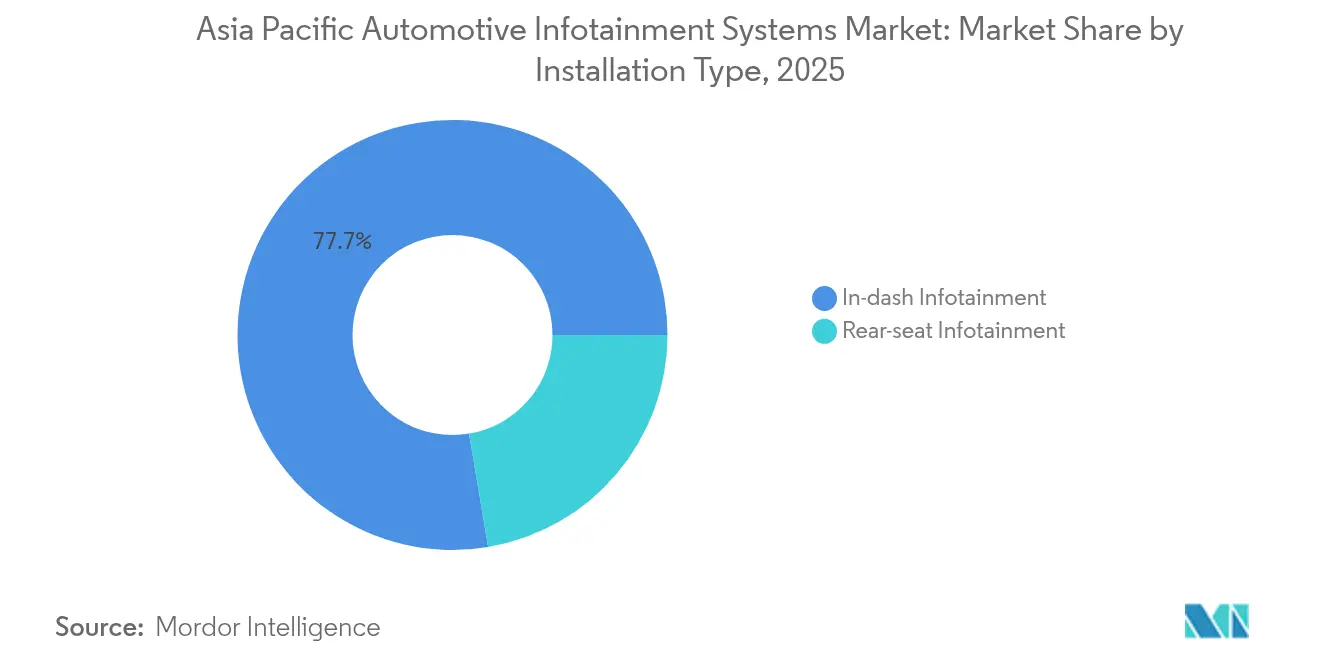
Rear-Seat Systems Gain TractionRear-seat entertainment revenue is climbing at 12.04% CAGR, even as in-dash units dominated 77.65% of 2025 sales. Curved multi-zone displays from Continental reduce wiring weight and enable independent streaming for passengers. Chauffeur-driven cultures in China and South Korea accelerate demand, whereas cost-sensitive India and ASEAN remain in-dash centric. Premium EV brands, such as NIO, now bundle rear-seat screens as a baseline, moving a former luxury feature into mid-segment expectations.
Greater cabin screen real estate supports targeted advertising, unlocking fresh revenue for OEM app stores. The Asia-Pacific Automotive Infotainment System market, therefore, sees rear-seat uptake influencing supplier roadmaps toward modular domain controllers that independently power multiple displays—a critical differentiation frontier heading to 2031.

By Vehicle Type:
Commercial Fleets Accelerate AdoptionPassenger cars account for 71.78% of revenue, yet they are pivoting to subscription models for navigation and ADAS upgrades. Light commercial vehicles deliver 11.55% CAGR, leveraging telematics-enabled infotainment for route optimization and driver analytics. Mahindra’s Treo Zor embeds fleet APIs accessible via cabin touchscreens, illustrating how logistics operators convert infotainment into a mission-critical dashboard.
Fleet buyers prioritize uptime and TCO, so ruggedized screens, remote diagnostics, and FOTA are vital. OEMs offer tiered SaaS plans that are packaged at the time of purchase, locking in multi-year data contracts. The Asia-Pacific Automotive Infotainment System market accrues incremental recurring revenue beyond the showroom, underpinning strategic focus on LCVs for suppliers.
By Component:
Software Margins Eclipse HardwareDisplays secured a 43.28% value share in 2025, as OLEDs replace LCDs in premium tiers. Samsung Display’s 100,000:1-contrast automotive OLED enables augmented-reality overlays and microsecond response times. Yet, operating-system software and apps lead growth at a 13.18% CAGR, signaling a margin migration.
Domain controllers now integrate cockpit, cluster, and rear-seat logic into a single SoC, significantly reducing the bill of materials. With the shift to subscription-based economics, original equipment manufacturers retain a larger share of app-store revenues compared to traditional phone platforms. Consequently, the Asia-Pacific Automotive Infotainment System market increasingly benefits suppliers that adapt from focusing solely on hardware delivery to offering end-to-end software lifecycle services.
By Propulsion Type:
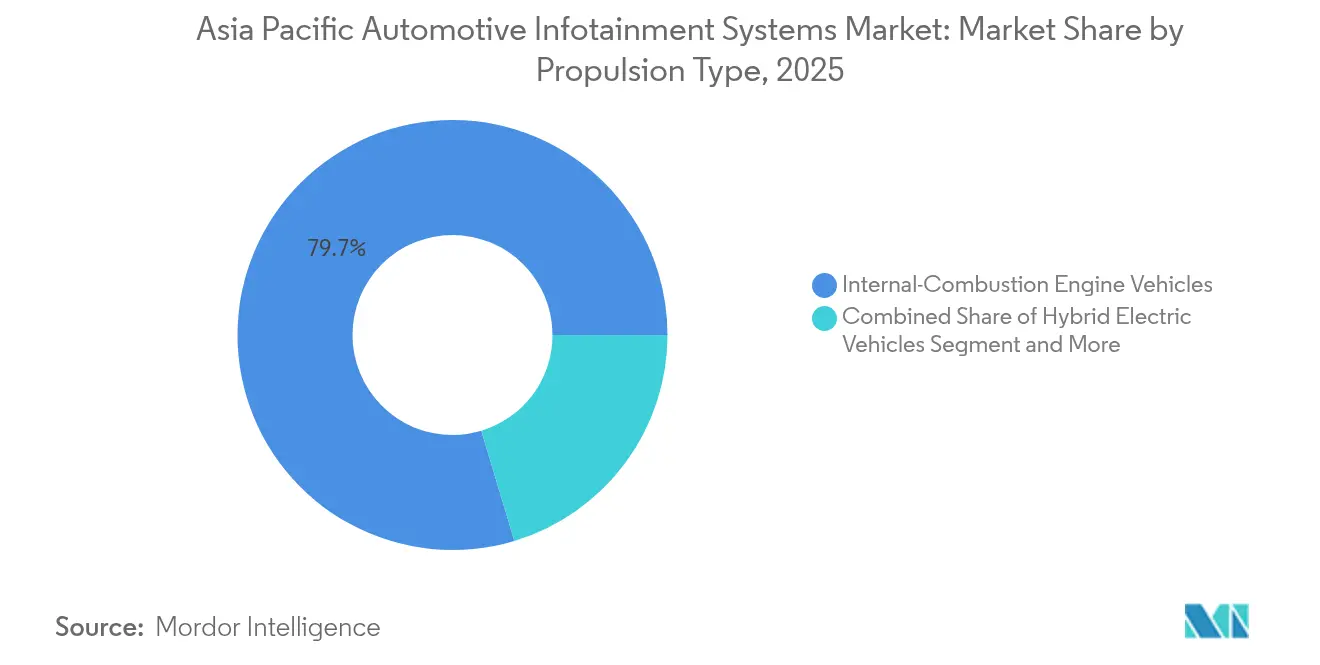
BEVs Demand Integrated EcosystemsBattery electric vehicles will expand at a 13.62% CAGR. BYD’s DiLink embeds charging-network APIs and range-optimized routing, improving efficiency. BEV infotainment doubles as a vehicle-control panel, replacing physical buttons with haptic-feedback screens.
ICE models focus on cost-efficient navigation and media. Hybrid cars sit between, displaying power-flow diagrams that educate drivers. The Asia-Pacific Automotive Infotainment System market supports unique UI-UX paths per propulsion archetype, challenging suppliers to design adaptable software layers.
By Connectivity Generation:
5G Rollout Accelerates4G LTE still leads with 60.62% share in 2025, yet 5G connectivity climbs 13.05% CAGR on HD maps and V2X demand. RedCap 5G modules trim cost and power, making next-gen modems viable for mid-tier segments.
Premium marques leverage 5G low-latency streaming and cloud gaming in China, Japan, and South Korea. India follows swiftly as telecoms subsidize in-vehicle data to stimulate network usage. The Asia-Pacific Automotive Infotainment System market thus expects 5G share to overtake 4G near 2028, subject to rural coverage build-out.
By Operating System:
Android Automotive OS Gains MomentumLinux stacks account for 46.85% share, with Android Automotive OS tracking 12.01% CAGR. Hyundai and Google plan to deploy 20 million vehicles by 2030, mainstreaming native Google Maps, Assistant, and Play Store features. QNX remains indispensable for safety-critical clusters, leading to hybrid architectures where QNX governs real-time tasks and Android handles infotainment.
Chinese OEMs advance domestic platforms like Banma AliOS, reflecting their sovereignty goals, yet the app ecosystem depth lags behind Android. The Asia-Pacific Automotive Infotainment System market, therefore, exhibits a dual-track between open global ecosystems and protected regional stacks.
By Sales Channel:
Aftermarket Retrofits Aging FleetsOEM factory fitment accounts for 82.85% of sales, but aftermarket demand grows at a 11.91% CAGR as Japan and Australia retrofit vehicles built before 2018 with wireless CarPlay and Android Auto. Pioneer and Alpine expand 7-9 inch screen product lines to serve older fleets.
Complex wiring and warranty concerns restrict do-it-yourself installs, so professional channels flourish. OEM systems retain seamless integration with steering-wheel buttons and ADAS data buses. The Asia-Pacific Automotive Infotainment System market supports coexistence, as factory systems cater to new-car buyers, while aftermarket solutions extend the digital life of legacy vehicles. Globally, the in-car infotainment system market size for Linux distributions remains steady as tier-1 suppliers adapt bespoke flavors for truck fleets and specialty vehicles.
Geography Analysis
China Automotive Infotainment Systems Market
China supplied 48.35% of 2025 regional revenue on the back of the world’s largest auto market and rapid electrification. Proprietary smart-cockpit platforms from BYD, NIO, and Xpeng integrate voice assistants, over-the-air updates, and payment apps, cementing software-defined differentiation. Mandatory GB standards, practical in 2026, further accelerate connected upgrades.
India Automotive Infotainment Systems Market
India is the fastest-growing geography at 12.49% CAGR through 2031, fueled by localization mandates and low-cost SoCs from Qualcomm and MediaTek. Tata Motors offers sub-$200 touchscreens in entry-level cars, expanding the addressable volume. Draft telematics legislation poised for 2025 will mandate emergency-call functions, driving another retrofit wave.
APAC Automotive Infotainment Systems Market
Japan and South Korea exhibit slower overall growth, but a high density of innovation. Sony Honda Mobility’s Afeela EV centers offer more than horsepower, signaling a future of infotainment-driven value propositions. Hyundai Mobis invests in holographic HUDs and AR navigation for luxury lines. Australia, with an aging fleet, stimulates aftermarket installations.
Regulatory Landscape
Across Asia-Pacific, infotainment architectures are increasingly shaped by cybersecurity, software update governance, and operating-system standardization tied to connected-vehicle programs. China advanced in-vehicle OS requirements through national standards GB/T 47341-2026 and GB/T 47351-2026, both effective July 1, 2026, which tighten test methods and technical requirements for intelligent connected vehicle operating systems and their control OS layers. In parallel, MIIT published its 2026 key tasks for automotive standardization, emphasizing vehicle-road-cloud integration and vehicle operating systems, reinforcing compliance pressure on cockpit domain controllers, OTA-capable head units, and the software stacks running them.
For suppliers serving multi-country platforms, alignment with UNECE WP.29 cybersecurity and software update expectations (notably R155/R156) is increasingly shaping engineering processes, documentation, and lifecycle support for infotainment and telematics functions. In India, the Automotive Industry Standards pathway for CSMS has been formalized via AIS-189 publication and related institutional steps, signaling a shift toward structured cybersecurity compliance for connected and OTA-enabled vehicles. These changes raise requirements for secure boot, intrusion detection, software bill of materials discipline, and auditable OTA workflows across OEM-installed systems and connected aftermarket retrofits.
Value Chain Analysis
The Asia-Pacific automotive infotainment value chain runs from semiconductor IP and silicon (SoCs, connectivity ICs, memory) through display modules and HMI components, embedded OS and middleware, and head unit or cockpit domain controller integration. It then extends to validation and homologation, followed by OEM factory fitment and a smaller but growing professional aftermarket installation channel. Tier-one integrators (for example, Panasonic, Harman, Bosch, Denso, Continental, and Visteon) coordinate multi-sourcing for displays, compute, audio, and connectivity, while software platforms and engineering services firms are increasingly positioned upstream of hardware as software-defined cockpits and OTA-enabled feature monetization move closer to OEM planning cycles.
Localization and resilience efforts are reshaping regional flows of parts and assembly. Qualcomm and Tata Electronics announced a February 2026 partnership to manufacture Qualcomm Automotive Modules at Tata Electronics OSAT facility in Jagiroad, Assam, while Tata Electronics and ROHM signed an agreement to assemble and test automotive-grade Si MOSFETs in India with a mass production target in 2026, supporting India-bound infotainment and telematics electronics. On the software side, VW Cariad and ThunderSoft set up a China-focused joint venture for connectivity and infotainment software development (ThunderSoft holding 51%), showing how OEM software units are building regionally anchored development capacity. Supply risk management remains a key operational theme, highlighted by 2025 disruptions linked to wafer shipment issues at Nexperia, which encouraged inventory buffers and geographic diversification across infotainment-related electronics.
Competitive Landscape
Traditional tier-one players, such as Panasonic, Harman, Denso, Bosch, and Continental, collectively dominate a significant portion of the market revenue. However, their stronghold on hardware is increasingly under threat as OEMs shift toward ecosystems developed by technology leaders such as Google, Alibaba, and Tencent. For instance, Hyundai is advancing its plans with Android Automotive OS, while LG-MediaTek's webOS platform is also gaining traction; each aims to integrate its systems into millions of vehicles, effectively bypassing conventional supply chains.
Smaller engineering firms, including ThunderSoft and Tata Elxsi, are gaining momentum by offering customized open-source solutions tailored to the needs of budget-conscious OEMs. In this evolving landscape, cybersecurity has emerged as a critical differentiator. Companies like BlackBerry QNX and Aptiv are incorporating advanced features, such as secure boot and intrusion detection, into their architectures to comply with ISO/SAE 21434 standards. Additionally, segments like commercial-vehicle telematics and aftermarket retrofits present significant growth opportunities, as established players often lack the specialized focus required to address these areas effectively.
In the current market, factors such as cost efficiency, software flexibility, and the ability to offer a comprehensive ecosystem have become more critical than traditional considerations, including display resolution and CPU performance. Consequently, the Asia-Pacific Automotive Infotainment System market is increasingly favoring suppliers who evolve from being mere hardware providers to becoming integrators of robust and versatile platforms.
Asia Pacific Automotive Infotainment Systems Industry Leaders
-
Panasonic Corporation
-
Harman International Inc.
-
Robert Bosch GmbH
-
Visteon Corporation
-
Denso Corporation
- *Disclaimer: Major Players sorted in no particular order

Asia Pacific Automotive Infotainment Systems Market Companies Covered in this Report
- Panasonic Corporation
- Harman International Inc. (Samsung)
- Denso Corporation
- Robert Bosch GmbH
- Visteon Corporation
- Continental AG
- Alpine Electronics Inc.
- JVCKenwood Corporation
- Mitsubishi Electric Corporation
- Aptiv PLC
- Hyundai Mobis
- Garmin Ltd.
- Sony Group Corporation
- BlackBerry QNX
Read Analysis of Asia Pacific Automotive Infotainment Systems Companies
Market Opportunities and Future Outlook
Compliance-driven cockpit OS standardization in China creates openings for suppliers that can deliver testable and auditable in-vehicle operating-system stacks and domain-controller platforms aligned to GB/T 47341-2026 and GB/T 47351-2026 (effective July 1, 2026). This favors offerings that bundle virtualization, OTA tooling, cybersecurity engineering, and validation services alongside head units and cockpit domain controllers, especially as OEMs consolidate infotainment, clusters, and HUDs into centralized compute.
Manufacturing localization and smart-cockpit integration programs are also expanding addressable routes beyond traditional tier-one hardware supply. In July 2026, Malaysia-based MCE Holdings Bhd launched a RM50 million advanced manufacturing hub in Serendah, Selangor, with SMT and assembly lines positioned for infotainment systems and smart cockpit solutions, signaling broader ASEAN capacity build-out for electronics integration. In China, Toyota Boshoku and Huaqin Technology formed a July 2026 joint venture focused on smart cockpit control products and software, pointing to demand for integrated cockpit modules that combine HMI, electronics, and software. In South Korea, the July 2026 Kakao Mobility and Renault Korea partnership around high-precision mapping and software-defined infotainment supports opportunity in localized navigation, mapping data services, and connected features that can be packaged into subscription and fleet use cases where connectivity-enabled infotainment is treated as an operational tool rather than a cabin add-on.
Recent Industry Developments in Asia Pacific Automotive Infotainment Systems Market
- July 2026: Panasonic Automotive Systems announced its cockpit domain controller was selected for the all-new Mazda CX-5, consolidating infotainment, HUD, and instrument cluster functions with OTA update capability. This supports the shift toward centralized cockpit compute in Asia-Pacific programs and raises the importance of software lifecycle and update tooling alongside hardware integration.
- October 2025: Harman (Samsung) committed INR 3.45 billion (USD 42 million) to expand its automotive electronics manufacturing facility in Chakan, Pune, India, targeting higher output of car audio components, infotainment units, and telematics control units by 2027. The expansion strengthens local supply for OEM-installed systems in India and supports a broader move toward localized electronics manufacturing for connected features.
- November 2024: Panasonic Automotive Systems introduced a production-ready in-vehicle infotainment platform emphasizing tighter integration between cockpit software and vehicle functions. The launch reinforced the market direction toward software-defined cockpits where infotainment platforms act as the delivery layer for connected services and feature upgrades.
Asia Pacific Automotive Infotainment Systems Market Report Scope and Research Methodology
Market Definition and Coverage
This market covers the revenues generated from in-vehicle infotainment systems supplied for vehicles across Asia Pacific, including factory-fit and aftermarket installations, where the system delivers media, navigation, connectivity, and related user-interface functions.
Scope exclusions: We exclude standalone mobile devices and apps that are not sold as part of an automotive infotainment system, and we also exclude pure telematics control units that do not include an infotainment interface.
Segments Covered in This Report
- By Installation Type
- In-dash Infotainment
- Rear-seat Infotainment
- By Vehicle Type
- Passenger Cars
- Light Commercial Vehicles
- Medium and Heavy Commercial Vehicles
- By Component
- Display / Touch-screen Module
- Head Unit / Domain Controller
- Operating-System Software and Apps
- Connectivity ICs and Antenna Modules
- By Propulsion Type
- Internal-Combustion Engine Vehicles
- Hybrid Electric Vehicles
- Battery Electric Vehicles
- By Connectivity Generation
- 4G LTE
- 5G
- Legacy 2G/3G
- By Operating System
- Linux-Based (AAOS, AGL, etc.)
- QNX
- Android Automotive OS
- Others (Proprietary, RTOS)
- By Sales Channel
- OEM-Installed
- Aftermarket
- By Country
- China
- Japan
- India
- South Korea
- Australia
- Rest of Asia-Pacific
Data Sources, Market Sizing, and Validation
Desk Research
Desk research was used to set the Asia Pacific region boundary, understand vehicle production and sales patterns, and map the feature adoption curve that drives infotainment content. We relied on public sources such as national transport ministries and statistical offices across major APAC countries, the International Organization of Motor Vehicle Manufacturers, UN Comtrade for trade flows of relevant electronics categories, and standards and regulatory references published by bodies such as UNECE.
We also reviewed company annual reports, earnings decks, and product brochures to understand typical system bundles, pricing direction, and OEM fitment trends over time. In addition, paid subscriptions covering company financials and import-export shipments were used selectively to cross-check company exposure and country-level movement signals. The desk sources listed here are not exhaustive, and we consulted many other public and paid references during data collection, validation, and clarification.
Primary Interviews and Surveys
Primary work focused on validating how quickly infotainment features are being added across vehicle price bands and countries, and how OEM versus aftermarket pricing is shifting as displays become larger and software content expands. We spoke with a mix of OEM ecosystem participants, component suppliers, distributors, and service partners across key APAC auto markets so gaps from public data could be closed and assumptions rechecked before finalizing the model.
Distribution of primary research fieldwork respondents
| Company type | Respondent position |
|---|---|
| Top tier: 37% | CXOs: 14% |
| Mid tier: 42% | Functional/Unit leaders: 28% |
| Smaller Players: 21% | Managers: 58% |
Market-Sizing & Forecasting
The core sizing logic starts with a top-down demand pool build, where vehicle production and sales by country are converted into an addressable installed base, then filtered by infotainment fitment rates for OEM and aftermarket channels. Once that demand base is formed, average system value is applied using price bands that reflect display-size trends, operating system choices, connectivity capability (4G versus 5G), and the mix shift between passenger and commercial vehicles.
To keep the output grounded, we corroborated totals with selective bottom-up approximations, such as sampling supplier shipment cues, checking channel markups where aftermarket is meaningful, and using ASP-times-volume checks for major countries. Where country or channel splits were thin, the gap was handled by using proxy indicators like vehicle parc growth, import dependence of key components, and the share of higher-trim variants, followed by a recheck with interview feedback. Forecasts were built using scenario analysis around the pace of connected cockpit adoption, the APAC vehicle production outlook, and expected ASP progression. The scenario weights were adjusted based on what primary respondents considered the most likely path.
Data Validation & Update Cycle
Validation was done through several cross-checks so the final numbers do not depend on any single dataset. We compared model outputs against independent signals like country vehicle sales trends, trade movement direction for relevant modules, and public announcements on new model launches that change infotainment fitment levels.
Before sign-off, anomalies such as sudden jumps in ASP or fitment penetration were reviewed by another analyst, then re-tested by revisiting the underlying assumptions and, when needed, re-contacting primary sources for clarification. The report is refreshed annually, and interim updates are triggered when material events occur, such as major regulation changes, sudden currency swings, or large OEM platform shifts. Right before delivery, a fresh review pass is done so clients receive the latest updated view.
Mordor Intelligence's Asia Pacific Automotive Infotainment Systems Market Sizing Compared With Other Published Estimates
Published market sizes for APAC automotive infotainment systems often differ because the year used, the product boundary, and the pricing logic are not the same across sources, even when the title looks similar. The differences usually show up when one estimate treats the market as only the head unit, while another groups clusters, HUDs, and passenger displays into the same revenue pool.
Key gap drivers also come from how OEM versus aftermarket revenues are treated, how fast display sizes are assumed to move up, and whether currency conversion is done using a single-year average or a longer smoothing approach. The table shows a wide spread, and in Mordor Intelligence's model the total is counted for Asia Pacific infotainment system revenues across both OEM and aftermarket, with pricing tied to a country-level mix of vehicle types, connectivity, and operating system adoption rather than using one regional blended ASP.
Benchmark comparison
| Source | Market Size | Gaps in Research Methodology |
|---|---|---|
| Mordor Intelligence | USD 8.31 B (2025) | |
| Global Consultancy A | USD 8.84 B (2025) | Uses an in-vehicle infotainment scope that commonly bundles adjacent cockpit display revenues and retrofit coverage into the same line item, which can lift the total versus a narrower infotainment-only definition. |
| Regional Consultancy B | USD 2.10 B (2023) | Anchors on an earlier base year and tends to emphasize embedded head-unit type systems, which can undercount broader infotainment revenues captured through higher-trim packages and channel mix in later years. |
Overall, the spread is mainly explained by scope boundaries and timing, and then by how pricing and feature mix are carried forward in the forecast. By tying the estimate to vehicle sales pools, fitment rates, and country-level ASP bands that are checked in interviews, the final number stays traceable to clear inputs and repeatable steps.
Key Questions Answered in the Report
What is the current size and forecast for the Asia-Pacific Automotive Infotainment System market?
The Asia-Pacific Automotive Infotainment System market size is USD 9.2 billion in 2026 and is projected to reach USD 15.26 billion by 2031, growing at a 10.66% CAGR.
How are OEMs partnering with tech giants?
Automakers such as Hyundai and Toyota integrate Android Automotive OS, Google Maps, and Tencent WeChat to shorten development cycles and access mature app ecosystems.
Which vehicle segment is driving commercial-fleet growth?
Light commercial vehicles are growing at 11.55% CAGR, as last-mile delivery operators adopt telematics-enabled infotainment for route optimization and driver monitoring.
Why is software revenue outpacing hardware?
Operating-system software and apps expand at 13.18% CAGR, as OEMs monetize subscriptions, over-the-air updates, and app-store revenue that hardware alone cannot deliver.