
Market Overview
| Study Period | 2021 - 2031 |
|---|---|
| Forecast Data Period | 2026 - 2031 |
| Base Year Market Size (2025) | USD 61.45 Billion |
| Market Size (2026) | USD 67.52 Billion |
| Market Size (2031) | USD 108.16 Billion |
| Growth Rate (2026 - 2031) | 9.88 % |
| Market Concentration | Medium |
Major Players *Disclaimer: Major Players sorted in no particular order Image © Mordor Intelligence. Reuse requires attribution under CC BY 4.0. | |
Asia-Pacific Athletic Footwear Market Analysis by Mordor Intelligence
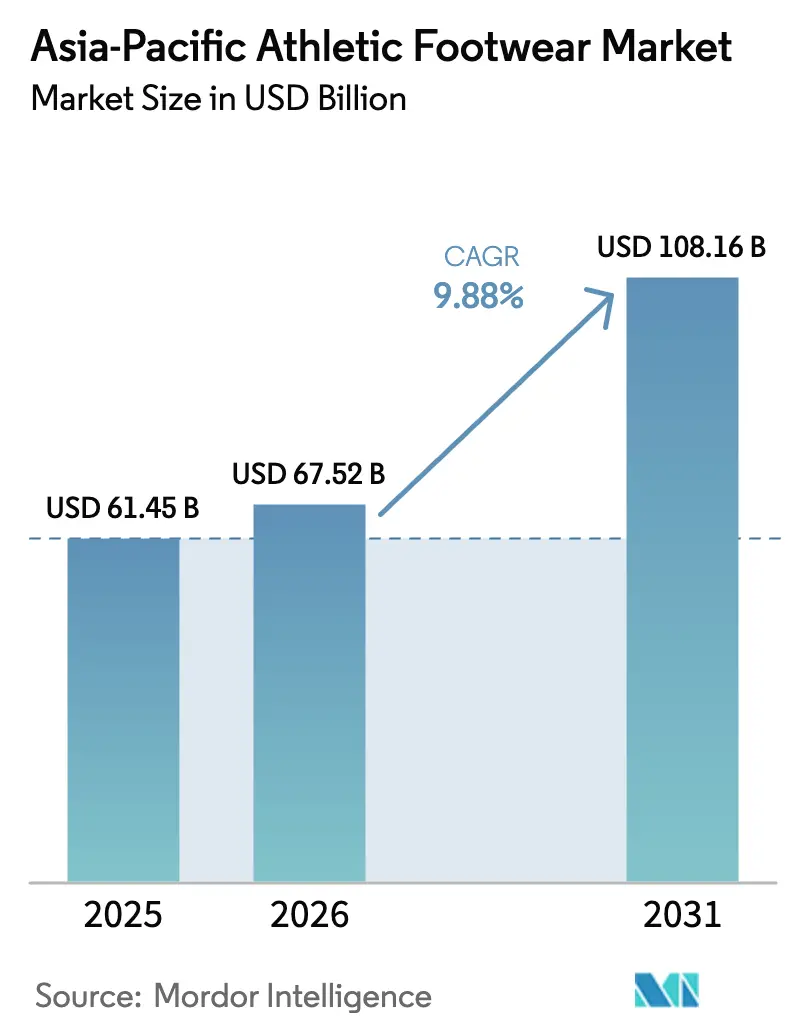
The Asia-Pacific athletic footwear market size is expected to grow from USD 61.45 billion in 2025 to USD 67.52 billion in 2026 and is forecast to reach USD 108.16 billion by 2031 at 9.88% CAGR over 2026-2031. China anchors regional performance by contributing 59.27% of 2024 sales, while India and Southeast Asian economies add incremental volume through expanding middle-class populations and improving sports infrastructure. Lifestyle changes following the pandemic push consumers toward routine physical activity, which sustains demand for versatile running and athleisure shoes. Premiumization gathers pace as shoppers look for lightweight cushioning, recycled uppers, and brand authenticity. Digital channels reshape purchase journeys, and leading brands raise research budgets to speed up product cycles and limit share losses to agile regional challengers.
Key Report Takeaways
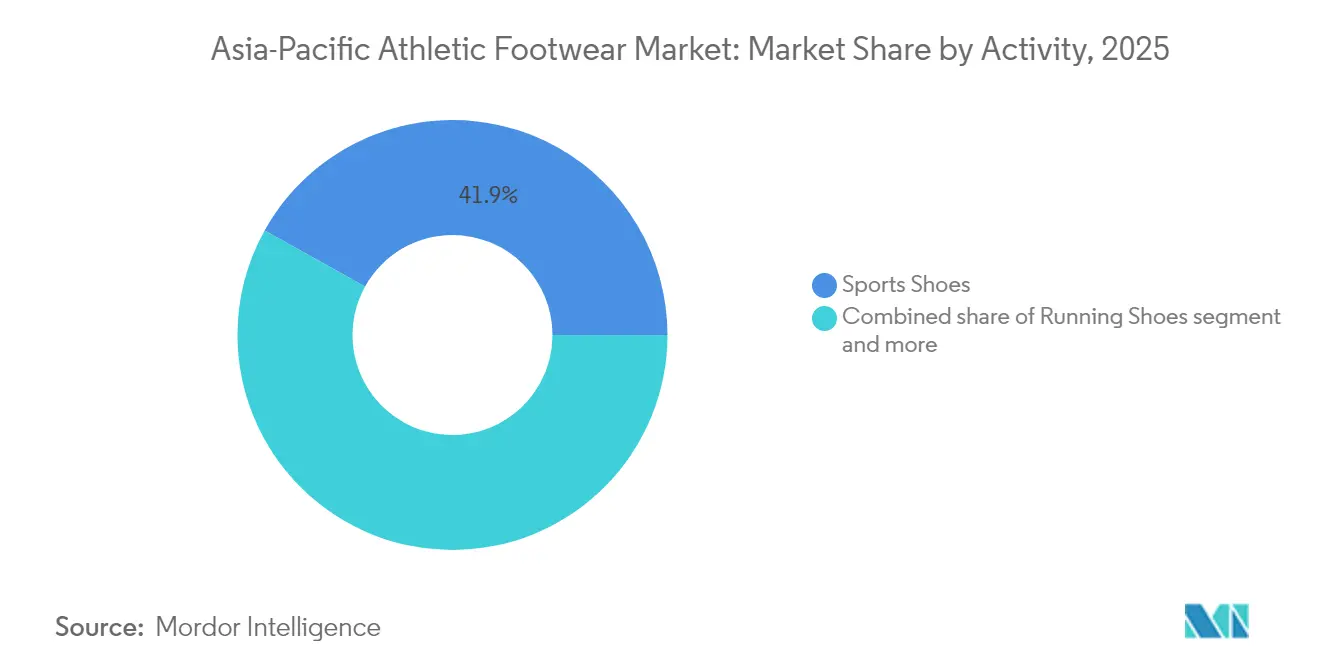
- By activity, sports shoes led with a 41.92% market share in 2025, while running shoes are projected to grow at a 10.34% CAGR through 2031.
- By product type, shoes commanded 86.68% of the Asia-Pacific athletic footwear market share in 2025; boots are expected to expand at a 10.11% CAGR by 2031.
- By end user, men accounted for 67.62% share in 2025, whereas the kids segment is advancing at a 10.58% CAGR for 2026-2031.
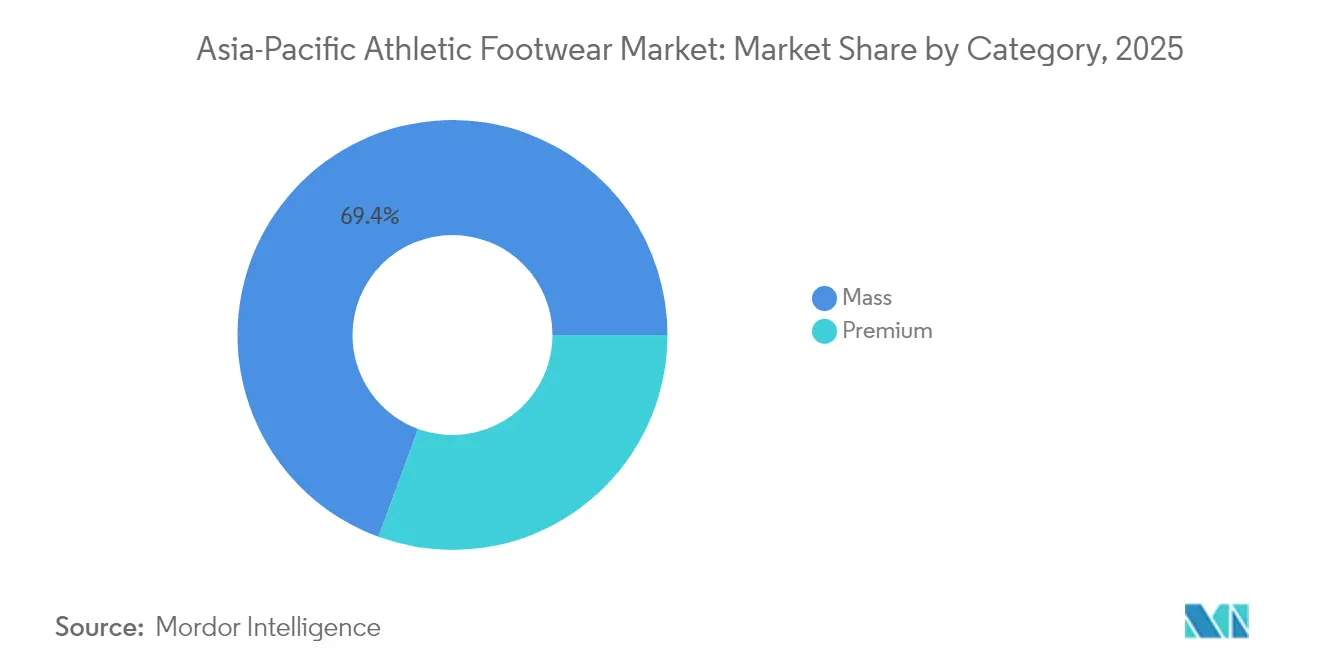
- By category, mass-market lines held 69.41% of 2025 shares; premium offerings are forecast to grow at 10.76% CAGR.
- By distribution channel, sports and athletic goods stores captured a 53.88% share in 2025, while online retail is set to post an 11.21% CAGR over the outlook period.
- By geography, China dominated with a 58.64% market share in 2025, whereas India is poised for the fastest 11.52% CAGR to 2031.
Note: Market size and forecast figures in this report are generated using Mordor Intelligence’s proprietary estimation framework, updated with the latest available data and insights as of 2026.
Market Trends and Insights
Drivers Impact Analysis of Asia-Pacific Athletic Footwear Market*
| Driver | (~) % Impact on CAGR Forecasts | Geographic Relevance | Impact Timeline |
|---|---|---|---|
| Favourable Government Initiatives to Boost Sports Culture | +1.8% | China, India, Indonesia, Vietnam | Medium term (2-4 years) |
| Aggressive Marketing By Reputed Brands | +1.5% | Regional, with emphasis on China and India | Short term (≤ 2 years) |
| Significant Growth in Women Sports Participation Rate | +1.2% | Australia, Japan, China | Medium term (2-4 years) |
| Consumers Inclination Towards Sustainable Products | +1.0% | Japan, Australia, urban China | Long term (≥ 4 years) |
| Youth Population and Influencer Culture | +2.1% | China, India, Southeast Asia | Short term (≤ 2 years) |
| Rising Health and Fitness Awareness | +1.6% | Asia-Pacific, strongest in developed markets | Medium term (2-4 years) |
| Source: Mordor Intelligence | |||
Favorable Government Initiatives to Boost Sports Culture
Government initiatives across Asia-Pacific drive athletic footwear demand through infrastructure development and sports participation programs. China's policies encourage financial institutions to support the sports industry by promoting integrated business models combining sports with tourism and healthcare while supporting sports companies' access to corporate bonds and stock markets. India's National Sports Policy 2024 incorporates sports into economic development, focusing on equipment manufacturing and startup ecosystems that increase footwear demand, as reported by the Department of Sports, Ministry of Youth Affairs and Sports [1]. Indonesia implements the Sport Development Index to improve infrastructure for athlete performance, while Vietnam's Hanoi strategy aims to achieve 50% regular physical activity participation by 2030, according to the Law Library of Vietnam. These policy frameworks create cascading effects, with government investment in facilities and programs fostering sustained public participation in sports. Hong Kong's Culture, Sports, and Tourism Bureau strengthens community engagement and elite sports programs through enhanced sports facilities, contributing to footwear consumption.
Aggressive Marketing By Reputed Brands
Brand marketing strategies in Asian markets prioritize localized content creation and strategic athlete partnerships to capture and expand market share. Digital engagement platforms and tools have become fundamental components for acquiring and retaining consumers. Following the pandemic period, which emphasized direct-to-consumer sales approaches, companies are implementing comprehensive innovation initiatives, signaling the commencement of a multiyear innovation cycle. Major international events, particularly the Paris Olympics, are anticipated to enhance brand visibility and penetration in specialized market segments. In Asian consumer engagement strategies, the implementation of authentic local content and development of strong community connections have demonstrated superior effectiveness compared to conventional celebrity marketing approaches. This shift reflects a deeper understanding of regional consumer preferences and behavioral patterns.
Significant Growth in Women Sports Participation Rate
Women's sports participation is increasing across Asia-Pacific markets due to infrastructure investments and cultural changes following major sporting events, creating opportunities in female-focused athletic footwear segments. Australia's investment in facilities and programs after the 2023 FIFA Women's World Cup shows its commitment to women's sports development. The 2024 Olympic Games achieved gender equality milestones, resulting in increased commercial success for women's leagues and a shift toward long-term growth investments. Current investment strategies prioritize infrastructure and grassroots programs, with transparent financial reporting becoming crucial for sustainable development. The market reflects a growing preference for social, nature-based activities over performance-focused sports, increasing demand for comfortable, versatile footwear. This transition from elite-focused to inclusive participation models expands market opportunities for brands in recreational and lifestyle women's athletic footwear segments.
Youth Population and Influencer Culture
The Asia-Pacific region's young population and extensive social media influence continue to drive athletic footwear adoption, particularly among younger consumers who are increasingly active on digital platforms. In China, trail running has gained significant popularity among youth demographics who value social experiences and community connections more than competitive performance metrics. Sports brands achieve higher engagement rates through localized social media content and community-driven campaigns compared to traditional celebrity endorsements. Consumers in the region demonstrate strong preferences for competitive pricing, extensive product variety, and efficient delivery systems. They also show increasing interest in sustainable products, environmentally conscious manufacturing processes, and personalized shopping experiences enabled by AI and data analytics. Companies that effectively combine social commerce strategies with authentic community engagement approaches are well-positioned to capture substantial growth opportunities in this dynamic market.
Restraints Impact Analysis of Asia-Pacific Athletic Footwear Market*
| Restraint | (~) % Impact on CAGR Forecasts | Geographic Relevance | Impact Timeline |
|---|---|---|---|
| Proliferation of Counterfeit Products | -1.3% | China, Southeast Asia, Philippines | Short term (≤ 2 years) |
| High Cost of Premium Footwear | -0.9% | India, Southeast Asia developing markets | Medium term (2-4 years) |
| Intense Market Competition | -1.1% | Asia-Pacific, particularly China | Short term (≤ 2 years) |
| Fluctuating Raw Material Prices | -0.8% | Manufacturing hubs: Vietnam, China, Indonesia | Medium term (2-4 years) |
| Source: Mordor Intelligence | |||
Proliferation of Counterfeit Products
The counterfeit athletic footwear market negatively impacts legitimate market growth by diverting revenue and diluting brand value. Recent enforcement actions have revealed extensive illicit operations across Asian markets. In Pampanga, the Philippines' Criminal Investigation and Detection Group seized counterfeit footwear worth USD 2.69 million, including over 45,000 pairs with the 'Crocs' trademark [2]. This seizure demonstrates the significant economic and safety risks posed by counterfeit goods. The counterfeit market particularly affects premium footwear segments, where high-profit margins incentivize illegal production. This forces legitimate manufacturers to allocate resources toward authentication technologies and legal enforcement instead of product innovation. The concentration of counterfeiting operations near legitimate manufacturing facilities in Asia enables sophisticated replication methods that make it difficult for consumers to identify fake products.
Intense Market Competition
The athletic footwear market faces heightened competition as global brands encounter challenges from regional players and direct-to-consumer brands, affecting profit margins and market positioning. Nike experienced a USD 27.5 billion decline after reducing its presence in third-party retail channels, which decreased both physical and online brand visibility. This created opportunities for competitors like Hoka and On to gain market share. PUMA reported a 4.7% sales decrease to USD 507.39 million in the Asia-Pacific region during Q1 2025, primarily due to weak performance in Greater China. However, PUMA's overall footwear sales grew by 2.4%, supported by growth in Running, Basketball, and Sportstyle categories. The market's evolution has prompted established companies to shift from broad market strategies to more focused, community-oriented approaches as challenger brands continue to capture market share through specialized offerings.
*Our forecasts treat driver/restraint impacts as directional, not additive. The impact forecasts reflect baseline growth, mix effects, and variable interactions.
Asia-Pacific Athletic Footwear Market Segment Analysis
By Activity:
Sports Shoes Dominate Market Share While Running Segment Shows Rapid GrowthSports shoes hold a dominant market share of 41.92% in 2025, while running shoes exhibit the highest growth rate at 10.34% CAGR through 2031. This growth stems from increased health awareness and recreational fitness activities. Sports shoes' market leadership reflects consumer preference for multipurpose athletic footwear that adapts to various activities, from daily wear to exercise, especially in urban Asian markets where athletic footwear integration into daily life continues to increase. Running shoes' growth aligns with higher participation in recreational running and trail activities, with Japan experiencing its third trail running expansion phase led by young people and women seeking outdoor social activities. Adventure sports shoes occupy specific market segments, particularly in developed markets like Australia and Japan, where outdoor activities gain traction, while other categories serve specialized needs in court sports and training.
Product innovation creates distinct market segments as companies develop advanced models for specific performance requirements. In May 2025, ASICS launched the Gel-Trabuco 13 trail running shoe, incorporating FF Blast Plus Eco midsole cushioning, a protective rock plate, and ASICS Grip technology, with emphasis on sustainability and reduced stack height for improved agility. In May 2025, HOKA introduced the Mafate X trail running shoe for ultra-trail runners, featuring dual-layer midsole construction, carbon fiber plate integration, and durable lightweight upper materials. These product launches demonstrate the industry's focus on performance improvement, sustainability, and specialized functionality, supporting premium segment expansion in activity-specific categories.

By Product Type:
Shoes Dominate Market Share While Boots Show Rapid GrowthShoes hold 86.68% market share in 2025, demonstrating strong consumer preference for traditional athletic footwear. The boots segment is growing at 10.11% CAGR through 2031, driven by increasing outdoor activity participation. The shoes segment includes running, training, basketball, and lifestyle athletic footwear that meets both performance and casual wear requirements across Asian markets. The boots segment growth stems from increased adventure sports participation and outdoor recreation, particularly in Japan's trail running resurgence and Australia's outdoor activity-driven footwear demand. This trend indicates consumer preference for versatile footwear suitable for hiking, trail running, and outdoor activities.
Boot manufacturers focus on integrating athletic performance features with outdoor durability. Teva's Aventrail Shoe exemplifies this trend, developed through athlete collaboration and combining sandal comfort with running shoe functionality. Ultra-runner Mike Wardian tested the closed-toe design on the Appalachian Trail, confirming its effectiveness in lightweight construction, water drainage, grip, and cushioning. The product incorporates SPIDER RUBBER technology for enhanced grip and comfort, demonstrating the industry's focus on technical advancements that improve outdoor performance while maintaining user comfort. This integration of athletic and outdoor features enables brands to address the growing adventure sports market and meet consumer demand for multi-purpose footwear.
By End User:
Men's Segment Dominates While Children's Category Shows Fastest GrowthThe men's segment holds the largest market share at 67.62% in 2025, reflecting established athletic participation patterns and purchasing behaviors. Meanwhile, the children's segment demonstrates the highest growth rate at 10.58% CAGR through 2031, driven by increased youth sports participation and growing parental focus on children's health. The men's segment dominance is attributed to higher sports participation rates, larger shoe sizes requiring more material usage, and traditional sports participation patterns across Asian markets.
The 2024 Olympic Games achieved gender parity in sports participation, contributing to increased commercial success of women's leagues and redirecting investments toward female sports infrastructure. The children's segment growth is supported by increasing disposable incomes among Asian middle-class families and cultural emphasis on education and physical development. The large youth populations in India and Southeast Asia generate consistent demand for children's athletic footwear. In contrast, aging populations in developed markets like Japan influence product development toward comfort-focused designs for adult segments.
By Category:
Mass Market Dominance with Growing Premium SegmentMass market products hold a 69.41% share in 2025, serving price-conscious consumers across Asian economies. Meanwhile, the premium segment shows the fastest growth at 10.76% CAGR through 2031, driven by consumers seeking advanced performance and sustainability features. The mass market's strong position reflects economic conditions in developing Asian markets, where price sensitivity influences purchasing decisions. This is particularly evident in regions like India and Southeast Asia, where expanding middle-class populations create opportunities for affordable athletic footwear.
Consumer preferences for sustainable and technologically advanced products support premium segment growth across major markets. Studies show increased consumer willingness to pay higher prices for footwear made from vegan and recycled materials, with environmental awareness influencing purchase decisions. For example, ASICS introduced the NIMBUS MIRAI running shoe, designed with end-of-life recycling capabilities. The shoe features a uniform polyester upper for recycling efficiency and a midsole containing 24% renewable materials, aligning with ASICS's goal of achieving net-zero carbon emissions by 2050. This innovation demonstrates how premium positioning enables manufacturers to implement sustainable technologies while maintaining higher margins through environmentally conscious consumers.
By Distribution Channel:
Online Retail Transforms Traditional SalesSports and athletic goods stores dominate the distribution landscape with a 53.88% market share in 2025. These stores maintain their leadership through specialized product expertise and personalized fitting services. The online retail channel is experiencing the fastest growth at 11.21% CAGR through 2031, driven by evolving consumer shopping preferences. Traditional retail stores retain their strength due to consumers' preference for physically trying athletic footwear, especially for performance products where proper fit directly impacts user satisfaction. These specialized retailers provide expert guidance, extensive brand selection, and immediate product availability. Supermarkets and hypermarkets cater to convenience-oriented consumers who purchase basic athletic footwear alongside other items, while alternative distribution channels, including brand-owned stores and specialty outdoor retailers, serve specific market segments.
The digital transformation in retail continues through improved customer experiences and technological advancements that address traditional online shopping limitations. ASICS implemented a unified e-commerce platform that connects various backend systems across its brands using MuleSoft's Anypoint Platform. This implementation achieved 2.5 times faster development speed, completing the platform launch within 4 weeks. The system enables ASICS to prioritize customer experience while utilizing shared code across applications, reducing both development duration and system complexity.
Geography Analysis
China Athletic Footwear Market
China dominates the Asia-Pacific athletic footwear market with a 58.64% share in 2025, driven by its vast population base, robust manufacturing ecosystem, and rising consumer spending on sports and fitness products. The country’s dominance is further reinforced by government-backed sports industry development programs that encourage public-private partnerships and integrated business models. China's strong domestic consumption and export capacity continue to anchor its leadership position in the region.
Japan Athletic Footwear Market
Japan’s market emphasizes technological innovation and performance, responding to trends such as an aging demographic and the rising popularity of outdoor recreational activities like trail running. Younger consumers and women are driving growth in this segment, with increasing interest in socially engaging fitness pursuits. Brands like ASICS are capitalizing on these trends, with the company targeting USD 6.4 billion in sales by 2030 through an aggressive focus on running shoes in Japan, among others.
India Athletic Footwear Market
India emerges as the fastest-growing market in the region, projected to expand at a CAGR of 11.52% through 2031. Growth is driven by a combination of factors including a young and increasingly urbanized population, expanding middle class, and supportive government policies. The National Sports Policy 2024, spearheaded by the Ministry of Youth Affairs and Sports, promotes sports as a tool for economic development and national well-being. It also supports domestic athletic footwear manufacturing, startups, and integration of sports into the education system via the National Education Policy . These initiatives, coupled with rising fitness awareness and increasing brand penetration, are accelerating India’s ascent in the regional market.
Regulatory Landscape
Regulatory requirements across Asia-Pacific are tightening around product quality and traceability, which increases compliance intensity for athletic footwear sold through both offline and online channels. China applies SAMR-administered GB standards covering physical safety and chemical content in footwear. Vietnam also introduced 2026 amendments to its Law on Products and Goods Quality, with a three-tier risk classification and a digital product passport regime effective 1 January 2026, which adds new documentation and monitoring expectations for brands and e-commerce sellers.
India is using quality-control enforcement as both a manufacturing and consumer-safety lever, while also creating room for innovation. DPIIT amended footwear Quality Control Orders in June 2026, including R&D-oriented exemptions (up to 4,500 pairs per year) and extending compliance timelines for certain footwear QCOs to 31 July 2027, which shifts the near-term compliance calendar for importers and domestic producers. Other country-level rules continue to shape market access, including Indonesia's Ministry of Industry Regulation No. 5 of 2024 requiring trademark certificates for API-U import licensing in relevant cases, and Malaysia's SIRIM/DOSH labeling requirements for workplace safety footwear, which affect how performance and protective variants are specified and labeled.
Competitive Landscape
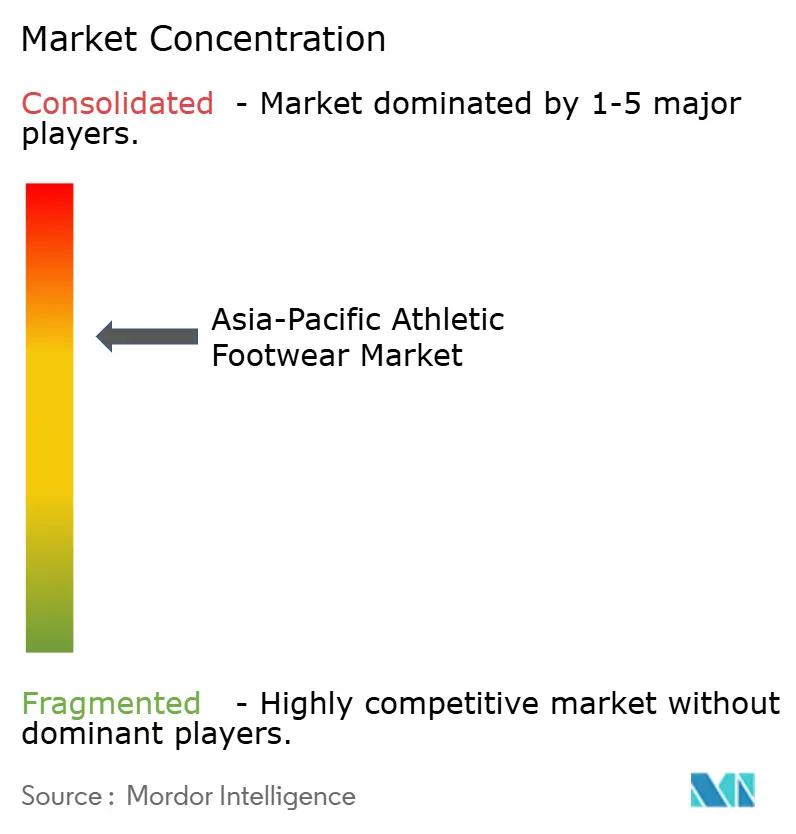
The Asia-Pacific athletic footwear market is moderately consolidated, marked by competition between global and regional brands. While Nike, Adidas, and Puma maintain a significant presence, Chinese companies like ANTA and Li-Ning have gained substantial market share through their local market expertise and government backing. Market leaders employ differentiated strategies ranging from innovation-focused approaches to localized community engagement, with success increasingly dependent on authentic regional connections rather than traditional celebrity endorsements.
The market presents growth opportunities in performance-specific segments and sustainable product lines, with companies competing to develop eco-friendly innovations. New entrants such as On Running are securing market positions through specific technologies and focused market strategies. Companies protect their innovations through patents, as seen with Nike's 'Zoom Air' and Adidas' 'Boost' technologies. Competition increasingly centers on technological advancement, with investments in materials research, biomechanics, and digital features to create products with demonstrable performance benefits that command higher prices.
White-space opportunities exist in specialized segments including adventure sports footwear, sustainable materials integration, and direct-to-consumer digital platforms that bypass traditional retail limitations. Strategic partnerships and joint ventures, exemplified by Li-Ning's collaboration with HongShan for global expansion, enable regional brands to compete with international incumbents through enhanced market access and expertise sharing
Asia-Pacific Athletic Footwear Industry Leaders
-
Nike Inc
-
Adidas AG
-
Puma SE
-
ASICS Corporation
-
Under Armour Inc
- *Disclaimer: Major Players sorted in no particular order
Asia-Pacific Athletic Footwear Market Companies Covered in this Report
- Nike Inc
- Adidas AG
- Puma SE
- ASICS Corporation
- Under Armour Inc
- Li-Ning Company Ltd
- ANTA Sports Products Ltd
- Skechers USA Inc
- Fila Holdings Corp
- New Balance Athletics Inc
- Mizuno Corp
- Berkshire Hathaway Inc.
- Xtep International Holdings Ltd
- 361 International Ltd
- Peak Sport Products Co Ltd
- Decathlon SA (Kiprun/Quechua)
- Deckers Outdoor Corp (Hoka One One)
- On Holding AG (On Running)
- Columbus Shoes
- Authentic Brands Group (Reebok)
Market Opportunities and Future Outlook
Compliance-linked product governance is creating whitespace for brands and manufacturers that can scale testing, traceability, and documentation, particularly for online-first distribution. Vietnam's digital product passport requirement effective 1 January 2026 raises the bar for item-level information management and post-market monitoring, favoring companies with stronger digital compliance infrastructure and coordinated brand-to-marketplace controls. In India, the June 2026 DPIIT amendments to footwear QCOs, including R&D exemptions up to 4,500 pairs per year and extended timelines to 31 July 2027 for certain orders, create a clearer lane for pilot runs, athlete testing, and faster iteration within the quality-control framework.
On the demand side, government sports-promotion programs and manufacturing policy are intersecting more directly with footwear category development. India's National Sports Policy 2024 explicitly links sports participation with equipment manufacturing and startup ecosystems, supporting localized product development and supply chains for both mass and premium athletic footwear. Industry coordination platforms also point to operational opportunities in the regional manufacturing base, including Indonesia's Indonesia Footwear Summit 2026, which focused on industry development and competitiveness and signals continued attention to capability upgrades and export readiness among local producers and associations.
Recent Industry Developments in Asia-Pacific Athletic Footwear Market
- July 2026: Adidas commenced construction of a new footwear manufacturing plant in Karur, Tamil Nadu, India (JV between Evervan Group and Kothari Industrial Corporation) with 40 million pairs annual capacity and 15,000 jobs. The launch expands regional production capacity in a high-growth market and diversifies Adidas' Asia footprint. It strengthens local supply chains and scale in India.
- June 2026: Nike launched the Tigers of Asia capsule collection in South Korea, collaboration with G-Dragon and Korea Football Association Cryoshot sneaker. The release creates a high-visibility product moment in a key APAC market. Brands use regional collaborations to bolster premiumization and youth appeal in Asia, potentially lifting ASPs and demand momentum.
- May 2026: Nike announced BTS World Tour ARIRANG customization experience and merchandise partnership Nike By You with activations across Asia. The initiative connects experiential retail with APAC consumer engagement. Strengthens direct-to-consumer and personalization appeal by leveraging cross-cultural fan bases to drive traffic and brand affinity.
Asia-Pacific Athletic Footwear Market Report Scope and Research Methodology
Market Definition and Coverage
This market covers revenue generated from athletic footwear sold across Asia-Pacific for sports and fitness-related use, counting purchases through offline and online channels at the point of sale in the region.
Scope exclusions: We exclude non-athletic fashion footwear, formal shoes, and protective industrial footwear that is mainly bought for workplace safety needs.
Segments Covered in This Report
- By Activity
- Running Shoes
- Sports Shoes
- Adventure Sports Shoes
- Other Activities
- By Product Type
- Shoes
- Boots
- By End User
- Men
- Women
- Kids/Children
- By Category
- Premium
- Mass
- By Distribution Channel
- Sports and Athletic Goods Stores
- Supermarkets/Hypermarkets
- Online Retail Stores
- Other Distribution Channels
- By Geography
- China
- Japan
- India
- Australia
- Rest of Asia-Pacific
Data Sources, Market Sizing, and Validation
Desk Research
Desk research starts with building a clean demand and trade context for athletic footwear in Asia-Pacific, so the model is anchored to what can be observed and cross-checked. We review public sources such as UN Comtrade for trade flows, World Bank and IMF indicators for macro drivers, and national statistics offices for retail and household spending signals where available.
This is complemented with association and standards bodies and industry publications, for example World Footwear, footwear federation websites, and customs or tariff documentation, to clarify product boundaries and movements. Company annual reports, investor presentations, and audited filings are used to read how brands discuss category growth, distribution shifts, and pricing, which helps shape realistic assumptions. Select paid subscriptions are used only to speed up company financial checks, patent and design-intensity checks, and shipment or trade-level triangulation where public granularity is thin. The sources listed here are illustrative, and many more were used during data collection, clarification, and cross-verification.
Primary Interviews and Surveys
Primary interviews and surveys are used to pressure-test what we see in desk research and to fill gaps around channel mix, pricing ranges, and how demand changes by activity type and end user. We speak with regional distributors, retailers, brand-side category teams, and industry specialists across major Asia-Pacific markets, so assumptions on volumes and average selling prices can be tuned to what is happening on the ground.
Distribution of primary research fieldwork respondents
| Company type | Respondent position |
|---|---|
| Top tier: 27% | CXOs: 13% |
| Mid tier: 55% | Functional/Unit leaders: 36% |
| Smaller Players: 18% | Managers: 51% |
Market-Sizing & Forecasting
Sizing is built using a top-down and bottom-up approach, where regional consumption is reconstructed from country-level demand signals and then cross-checked with selective supplier and channel rollups. On the top-down side, we start from country totals that reflect footwear spending and sports participation direction, then apply athletic-footwear shares refined using trade patterns and retail channel structures.
To keep the model practical, a small set of market fingerprints are tracked and updated each cycle, such as category mix between mass and premium, average selling price movement by channel, online share progression, and demand shifts tied to running and multi-sport participation. Import and export trends and currency timing are also reviewed because they can change the visible value line even when unit demand is steady. Where bottom-up inputs are used, they are applied as reasonableness checks, for example by sampling a set of brand and retailer revenue disclosures, calibrating typical price bands, and validating implied volumes. When coverage is uneven in smaller markets, gaps are handled through proxy ratios from similar markets, followed by validation calls before values are finalized.
Forecasts use scenario analysis supported by simple trend projections on the same drivers, so the forecast stays explainable and repeatable. We build a base case that reflects expected pricing, channel shifts, and participation changes, then stress it with upside and downside cases that reflect faster premiumization or slower discretionary spending, which are reconciled back to expert feedback.
Data Validation & Update Cycle
Validation happens in layers so the final numbers do not rely on one dataset or one assumption. We compare outputs against independent signals like trade value direction, retail momentum cues, and the implied price and volume relationship, then investigate outliers before the model is accepted.
A second analyst review is completed to confirm math integrity, consistency of definitions, and that the drivers used are aligned with what respondents described in interviews. When a large variance shows up, we re-contact sources and re-check the assumption that caused it, which usually relates to pricing, channel mix, or country coverage. Reports are refreshed annually, and interim updates are made when material events shift demand, supply, or pricing. Before delivery, a final pass is done so clients receive the most current view based on the latest available inputs.
Mordor Intelligence's Asia Pacific Athletic Footwear Market Size Versus Other Published Estimates
Published market sizes for Asia-Pacific athletic footwear can differ even when the topic name looks similar, because the included products, country list, and price basis are not always aligned. Differences also come from how teams treat online sales, premium versus mass pricing, and how often assumptions are refreshed when currencies and demand shift.
By tracking channel mix, pricing bands, and country coverage rules, Mordor Intelligence keeps the 2025 value tied to an Asia-Pacific demand pool that excludes non-athletic fashion footwear and avoids double counting across cross-border flows. In some estimates, adjacent categories like casual sneakers are blended in, or a broader Asia definition is used, which can raise totals. In other cases, conservative scenarios may be reported as the main number, or the currency conversion timing may not match the base year being quoted, which can compress or inflate the stated value.
Benchmark comparison
| Source | Market Size | Gaps in Research Methodology |
|---|---|---|
| Mordor Intelligence | USD 61.45 B (2025) | |
| Regional Consultancy A | USD 58.20 B (2025) | Uses a narrower country cut and applies conservative ASP assumptions for premium products, and it also appears to dampen online growth which reduces value capture. |
| Trade Journal B | USD 66.90 B (2025) | Blends athletic footwear with broader lifestyle sneakers in parts of the region and relies more heavily on shipment value proxies without fully adjusting for re-exports and channel margins. |
The spread in values is mainly explained by what gets counted as athletic footwear, which countries are included under Asia-Pacific, and how pricing and trade flows are treated in the base year. Our approach stays traceable because the main levers are visible and can be checked, such as channel shares, price bands, and country totals, and then adjusted when validation points disagree.
Key Questions Answered in the Report
What is the current size of the Asia-Pacific athletic footwear market?
The market is valued at USD 67.52 billion in 2026 and is projected to reach USD 108.16 billion by 2031.
Which country holds the largest share in the region?
China leads with 58.64% of 2025 sales, driven by large population and robust manufacturing capacity.
Which segment is growing the fastest?
Running shoes are forecast to post the highest 10.34% CAGR between 2026 and 2031.
How fast is online retail expanding?
Online channels are expected to advance at an 11.21% CAGR as social-commerce adoption widens.