
Market Overview
| Study Period | 2021 - 2031 |
|---|---|
| Forecast Data Period | 2026 - 2031 |
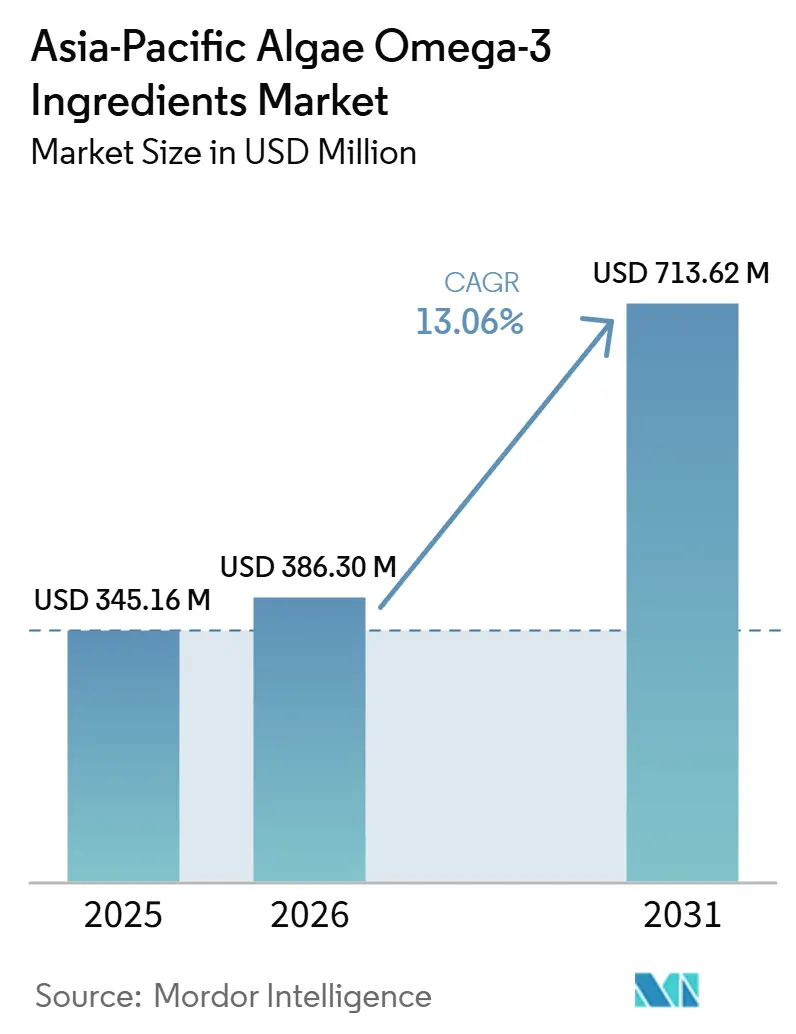
| Base Year Market Size (2025) | USD 345.16 Million |
| Market Size (2026) | USD 386.30 Million |
| Market Size (2031) | USD 713.62 Million |
| Growth Rate (2026 - 2031) | 13.06 % |
| Market Concentration | Medium |
Major Players *Disclaimer: Major Players sorted in no particular order Image © Mordor Intelligence. Reuse requires attribution under CC BY 4.0. | |
Asia-Pacific Algae Omega-3 Ingredients Market Analysis by Mordor Intelligence
The Asia-Pacific algae omega-3 ingredient market was valued at USD 345.16 million in 2025 and is forecast to reach USD 713.62 million by 2031, growing at a CAGR of 13.06% during 2026-2031. Demand is shifting from fish oil toward algae-derived long-chain polyunsaturated fatty acids because fermentation supports traceability, controlled production, and plant-based product positioning. China’s inclusion of DHA algae oil in the 2023 Health Food Raw Materials Directory reduced a regulatory barrier for eligible products and supported a faster filing route. Infant, maternal, and adult nutrition products remain important demand centers, while hospital nutrition creates a higher-specification outlet for algal oils. Suppliers are responding through strain development, fermentation improvements, concentrated formats, and application-specific delivery systems. Regulatory differences, cultivation contamination, long lead times, and intellectual property disputes continue to affect production planning and market entry.
Key Report Takeaways
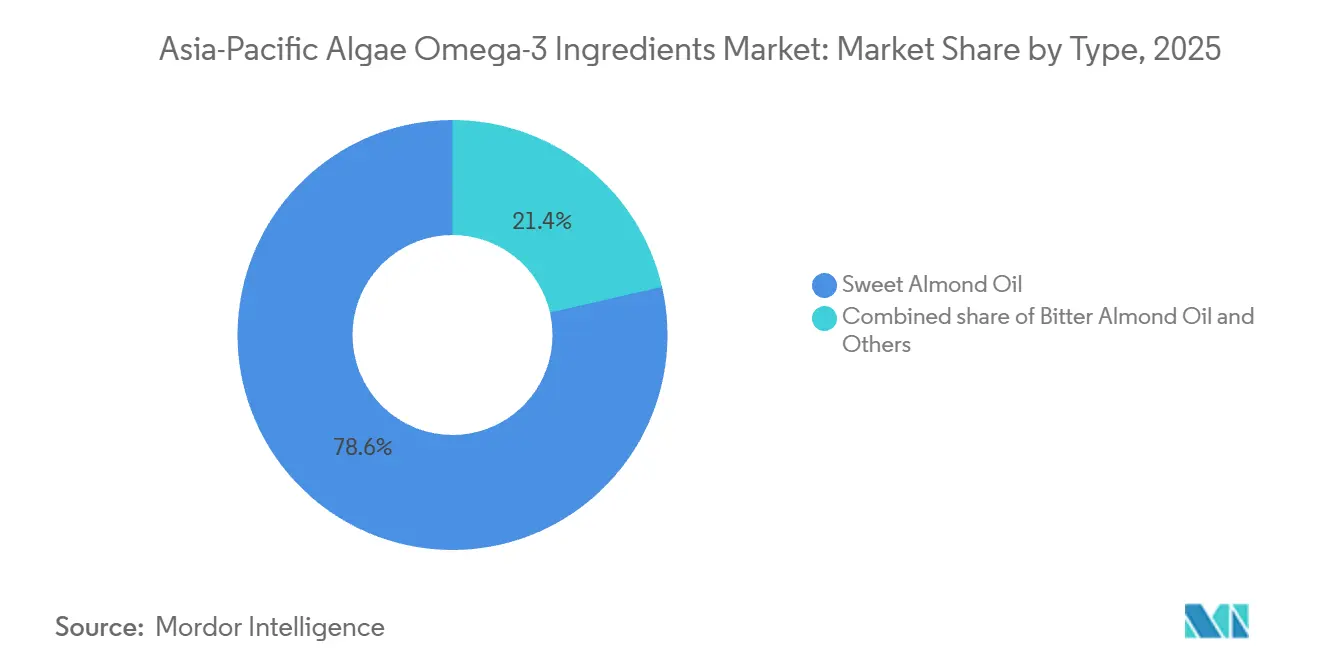
- By type, DHA held 43.5% of the Asia-Pacific algae omega-3 ingredient market share in 2025, while EPA/DHA blends are forecast to grow at a CAGR of 14.2% through 2031.
- By application, dietary supplements accounted for 36.7% of the Asia-Pacific algae omega-3 ingredient market share in 2025, while clinical nutrition is forecast to advance at a CAGR of 15.4% through 2031.
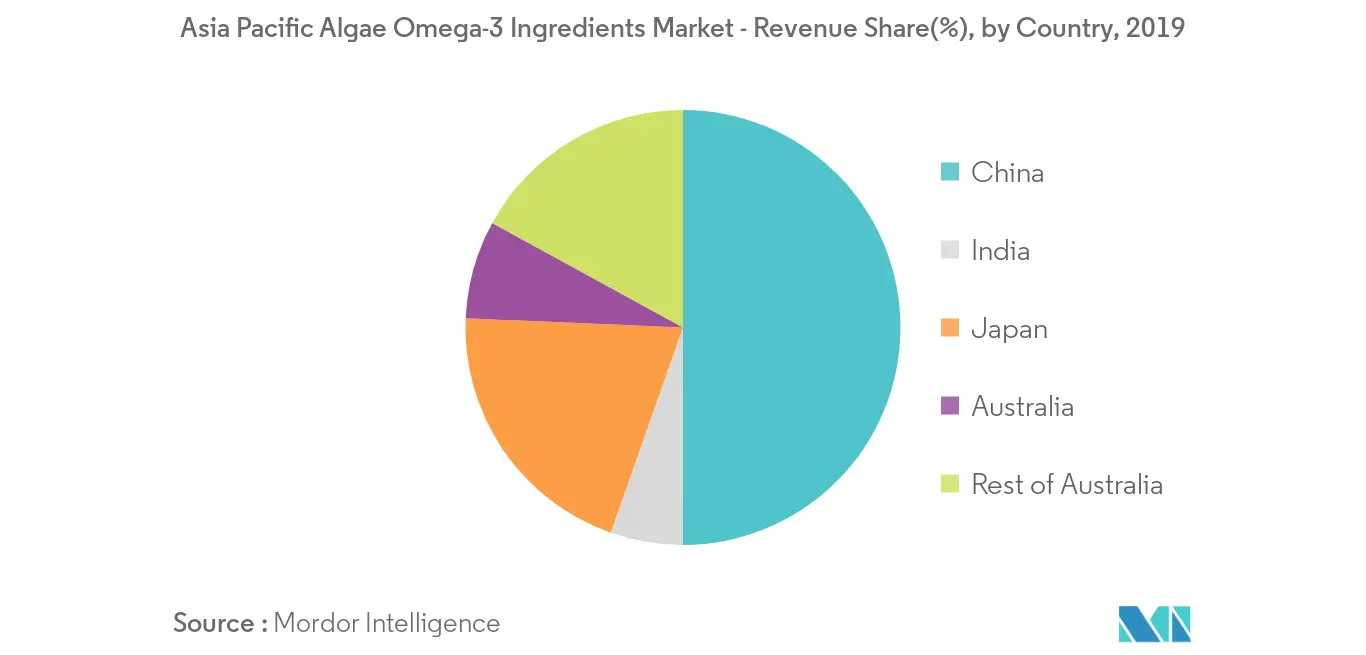
- By geography, China held 28.4% of revenue in 2025, while Australia is forecast to record the highest CAGR of 14.8% through 2031.
Note: Market size and forecast figures in this report are generated using Mordor Intelligence’s proprietary estimation framework, updated with the latest available data and insights as of January 2026.
Market Trends and Insights
Drivers Impact Analysis of Asia-Pacific Algae Omega-3 Ingredients Market*
| Drivers | (~) % Impact on CAGR Forecast | Geographic Relevance | Impact Timeline |
|---|---|---|---|
| Growing preference for plant-based nutrition | +2.8% | Global, concentrated in China, India, Australia | Short term (≤ 2 years) |
| Sustainability concerns versus fish oil | +2.1% | Global, with highest pull in Australia and Japan | Medium term (2–4 years) |
| Expansion of functional foods and supplements | +2.3% | China, Japan, India, Rest of Asia-Pacific | Short term (≤ 2 years) |
| Growth in prenatal and maternal nutrition | +1.9% | China, India, Australia, Japan | Medium term (2–4 years) |
| Technological advances in cultivation and extraction | +2.4% | China, Australia, Japan; spill-over to ASEAN | Long term (≥ 4 years) |
| Product suitability across multiple applications | +1.6% | Global, with gains across all geographies | Medium term (2–4 years) |
| Source: Mordor Intelligence | |||
Growing Preference for Plant-Based Nutrition
Plant-based nutrition has become a key demand driver for the Asia-Pacific algae omega-3 ingredient market, as more consumers in the region choose vegetarian, vegan, and sustainable nutrition products. Algae-derived omega-3 offers a direct alternative to fish-derived omega-3 and helps brands address concerns related to marine contamination, odor, taste, and limited supply chain transparency in fish oil. It also supports cleaner-label positioning, which is becoming important in supplements, infant nutrition, and functional food products. In China, supplement manufacturers are expected to increase the use of algal oil DHA in 2025, especially in children’s, maternal, and adult nutrition products. In India, the food regulator continues to review novel algae-derived ingredient filings in 2024, with related activity expected to continue into 2025. These developments are encouraging formulators to use algal DHA as a mainstream ingredient in supplements and infant nutrition rather than as a niche or specialist addition[1]Source: Food Safety and Standards Authority of India, “Food Safety and Standards Authority of India”, fssai.gov.in.


Sustainability Concerns Versus Fish Oil
Climate risks in the conventional fish oil supply are shaping sourcing decisions in the Asia-Pacific algae omega-3 ingredient market. Fish-based omega-3 supply depends on catch availability, which can change due to weather conditions and disruptions in fisheries. This volatility is encouraging infant formula and supplement manufacturers to reduce supply risk by using algae-derived DHA and EPA as an additional source. China is expected to export 1,200 metric tons of algal DHA oil in 2025, up 26.7%, reflecting growing confidence in its domestic fermentation capacity. In Australia, compositional guidance recognizes DHA-rich and DHA/EPA-rich Schizochytrium algal oils for listed medicines, supporting their use in regulated health products. These developments position algae oil as a reliable omega-3 supply source that is less dependent on fishery cycles.
Expansion of Functional Foods and Supplements
Functional foods and supplements provide a broad commercial route for the Asia-Pacific algae omega-3 ingredient market and its algae-derived DHA and EPA offerings. Clean-label, non-GMO, and vegan claims support their use in modern retail and e-commerce formats. Japan’s Foods with Function Claims framework gives companies a route to make substantiated functional claims without using the FOSHU pathway. China’s health-food framework also permits DHA algae oil products to use the filing route when they meet the relevant requirements[2]Source: Consumer Affairs Agency, “Foods with Function Claims”, caa.go.jp. CABIO Biotech opened its Wuhan Synthetic Biology Innovation Hub in November 2025, expanding its research and production base for nutrition ingredients. The expansion reflects manufacturers’ focus on serving both local functional-food demand and international customers.
Growth in Prenatal and Maternal Nutrition
Maternal nutrition is a demand area that supports the Asia-Pacific algae omega-3 ingredient market through clinical, regulatory, and commercial factors. DHA supplementation during lactation increased breast milk DHA concentration and was associated with infant growth measures in a 2026 study of urban and rural populations in Punjab, India. This evidence supports the use of DHA in maternal nutrition products and institutional programs. China’s infant formula requirements make consistent DHA supply important for premium product positioning. India remains relevant to maternal nutrition demand because of its large consumer base and continuing novel-ingredient activity. The Asia-Pacific algae omega-3 ingredient market therefore benefits from demand that spans prenatal supplements, infant formula, and postnatal nutrition.
Restraints Impact Analysis of Asia-Pacific Algae Omega-3 Ingredients Market*
| Restraint | (~) % Impact on CAGR Forecast | Geographic Relevance | Impact Timeline |
|---|---|---|---|
| Regulatory hurdles for novel ingredients | -0.8% | India, Rest of Asia-Pacific, Australia | Medium term (2–4 years) |
| Contamination risk in cultivation systems | -0.6% | China, India, Rest of Asia-Pacific | Short term (≤ 2 years) |
| Supply inconsistency and long lead times | -0.5% | Global, concentrated in ASEAN and India | Medium term (2–4 years) |
| Intellectual property and strain patent barriers | -0.3% | Global | Long term (≥ 4 years) |
| Source: Mordor Intelligence | |||
Regulatory Hurdles for Novel Ingredients
Regulatory requirements vary across Asia-Pacific, making regional launch plans more complex in the Asia-Pacific algae omega-3 ingredient market. Each country follows a different approval process for ingredients, health claims, labeling, and product formats. Australia applies novel food rules and ingredient guidance, while India follows ingredient-specific approval pathways for new food formats. China is expected to have 142 validly registered DHA-class health food products by June 2026, with algae-sourced products accounting for 39.4%. Japan requires strong scientific substantiation for product claims, which can be challenging for mid-sized producers with limited clinical research budgets. As a result, companies cannot rely on one regulatory strategy for the entire region. These differences can delay product launches, increase compliance costs, and raise the value of suppliers that already hold approvals across multiple countries.
Intellectual Property and Strain Patent Barriers
Patent ownership plays a key role in shaping processing decisions and market access for suppliers in the Asia-Pacific algae omega-3 ingredient market. Companies entering the market face ongoing risks from patent disputes, protected processing technologies, and proprietary strain development. These issues can affect how suppliers produce, refine, and commercialize algae-based omega-3 ingredients. Corbion’s AlgaPrime DHA LS liquid suspension is an example of proprietary product development in the market. Smaller suppliers often need to develop independent production processes, secure licenses, or manage the risk of infringement-related costs. High-DHA Schizochytrium strains remain an important focus area for proprietary development because they support efficient DHA production. As a result, these barriers favor companies with strong strain research capabilities, legal resources, and scaled fermentation capacity.
*Our forecasts treat driver/restraint impacts as directional, not additive. The impact forecasts reflect baseline growth, mix effects, and variable interactions.
Asia-Pacific Algae Omega-3 Ingredients Market Segment Analysis
By Type:
DHA Leads Current Demand and EPA/DHA Blends Grow FastestDHA accounted for 43.5% of the Asia-Pacific algae omega-3 ingredient market size in 2025. Its position rests on infant formula, cognitive-health supplements, and maternal nutrition. China’s infant formula requirements increase the need for consistent, high-purity DHA inputs. Fermentation-controlled algal DHA also addresses concerns about contaminants associated with fish-derived materials. CABIO Biotech produces algal DHA as oil, microcapsule powder, and biomass powder from its Wuhan operations. These formats serve the infant formula and supplement applications that support DHA demand.
EPA/DHA blends are projected to grow at a CAGR of 14.2% from 2026 to 2031, the fastest rate among product types. Fermentalg launched OMEGA ΩRIGINS EPA/DHA in April 2026 using its Schizochytrium sp. FCC-3204 fermentation process. The product provides 40% EPA and 20% DHA without a concentration step. Blended formulations respond to demand for cardiovascular and neurodevelopmental positioning in one ingredient. EPA-only algal oils occupy a smaller but developing role in clinical nutrition and pharmaceutical applications. NTT reported in July 2026 that it had bred diatom strains with higher DHA, EPA, and other functional fatty acids, with concentrations up to 1.8 times the parent strain. This work points to future production methods that improve the fatty-acid profile at the biomass stage.


By Application:
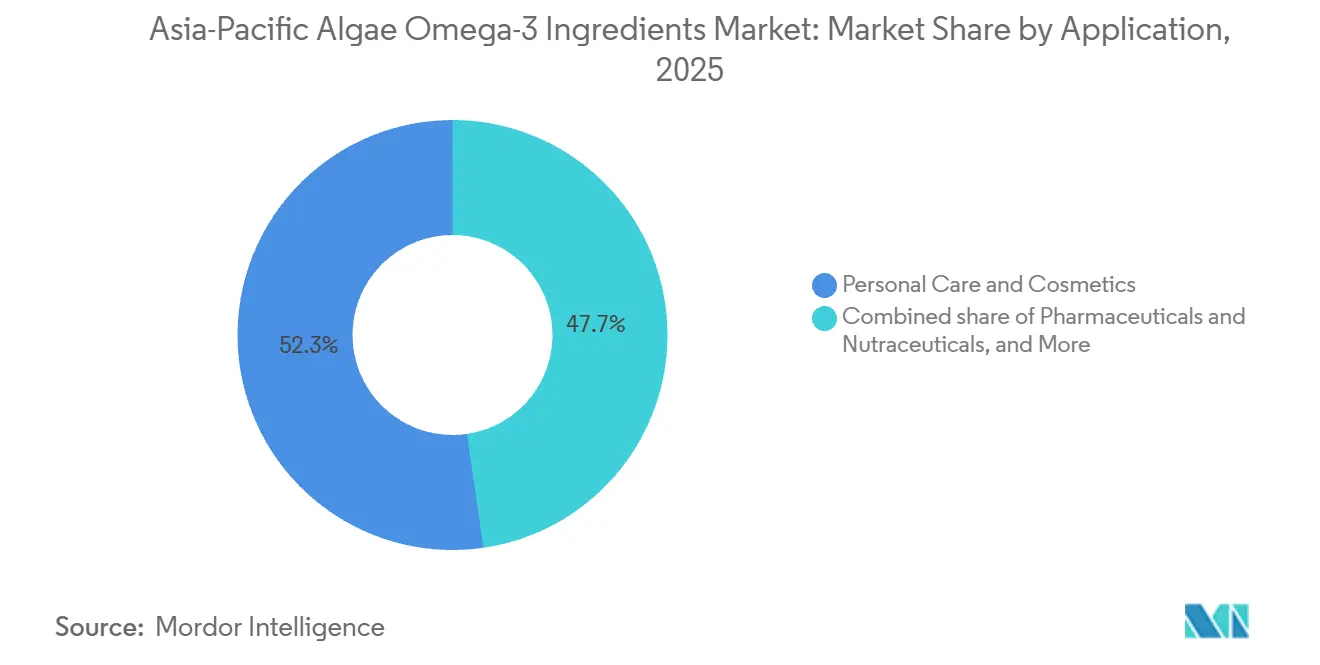
Dietary Supplements Lead and Clinical Nutrition Expands QuicklyDietary supplements accounted for 36.7% of the Asia-Pacific algae omega-3 ingredient market share in 2025. China’s e-commerce systems and Japan’s established supplement consumption support this position. Online channels in China represented 57% of domestic algal DHA terminal sales in 2025. Gummy products made up 62% of algal DHA finished-product volumes in China during the same year. These formats address dosage convenience and sensory preferences. dsm-firmenich launched life’sDHA B54-0100 in October 2024 with 545 mg DHA and 80 mg EPA per gram. The ingredient supports smaller capsule formats while maintaining a high nutrient concentration.
Clinical nutrition is forecast to grow at a CAGR of 15.4% through 2031. Hospital nutrition protocols, aging populations, and higher quality specifications support this growth. Japan’s aging population increases interest in nutrition products aimed at cognitive and cardiovascular health. Pharmaceutical-grade algal DHA requires batch-level verification and heavy-metal screening beyond food-grade practices. This creates an opportunity for producers with advanced quality systems. Food and beverages, infant formula, pharmaceuticals, and other uses complete the application base. Infant formula retains strategic importance because of DHA requirements in China. Other uses include animal nutrition and premium functional formats.
Geography Analysis
APAC Algae Omega-3 Ingredients Market
China held 28.4% of the Asia-Pacific algae omega-3 ingredient market share in 2025. Infant formula requirements, domestic production capacity, and health-food rules support its regional position. The General Administration of Customs granted approvals for algae-derived DHA products by mid-2025. Corbion received GACC registrations in July 2025 for AlgaPrime DHA and AlgaVia DHA for human and animal nutrition applications. China’s algal DHA oil exports reached 1,200 metric tons in 2025 after increasing 26.7%. Japan remained an important geography, supported by functional food claims and population aging. India also contributed through a growing nutraceutical base and continued novel-ingredient filings.
Australia Algae Omega-3 Ingredients Market
Australia is forecast to grow at a CAGR of 14.8% in the Asia-Pacific algae omega-3 ingredient market from 2026 to 2031. The country offers defined pathways for DHA-rich and DHA/EPA-rich Schizochytrium oils in listed medicines. Biomedica Nutraceuticals received registration in February 2026 for an Algal DHA+EPA product, ARTG ID 523825. Young Living Essential Oils received registration in March 2026 for Omega-3 302.5 mg Soft Capsules, ARTG ID 524926. High supplement expenditure and demand for vegan products support algae-derived alternatives. These conditions encourage suppliers to develop premium and sustainability-focused offerings.
ASEAN Algae Omega-3 Ingredients Market
Rest of Asia-Pacific includes ASEAN markets that are at an earlier development stage. Functional-food regulation is becoming more aligned across parts of the bloc. Middle-class growth is also supporting preventive-health spending. Requirements remain different among countries, which adds short-term complexity for suppliers. Companies with approvals in several jurisdictions can gain a distribution advantage. This geographic diversity means that the Asia-Pacific algae omega-3 ingredient market needs country-specific regulatory planning rather than a uniform regional approach.
Competitive Landscape
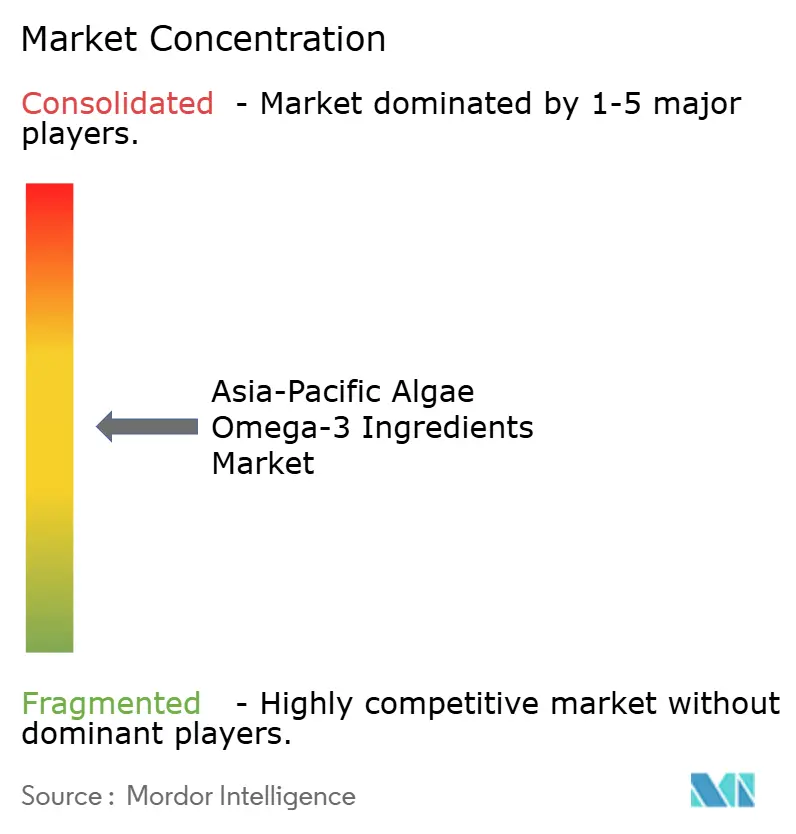
The Asia-Pacific algae omega-3 ingredient market has a concentration score of 5 out of 10, as global suppliers hold strong positions while regional manufacturers compete on price, scale, and specialized applications. dsm-firmenich, Corbion, and CABIO Biotech are key participants. Xiamen Huison Biotech and Fermentalg also compete through production capabilities and product positioning. Competition increasingly depends on strain development, fermentation expertise, and application design. Strong process knowledge creates barriers that capacity investment alone cannot replicate.
Proprietary technologies in liquid suspensions and fermentation processes show how intellectual property supports market access and licensing decisions. Processing-patent disputes can also affect licensing and market entry. Smaller producers focus on pharmaceutical-grade ingredients and clinical nutrition to avoid direct competition in standard algal DHA. They also develop gummies and microencapsulated powders that match regional dosage preferences. A 2025 study is expected to show that multi-factor acclimation in Aurantiochytrium sp. PKU#Mn16 improves DHA production by altering metabolic pathways, supporting further efficiency gains.
Digital retail gives direct-to-consumer supplement brands another way to reach customers in China while improving speed and margins. CABIO Biotech’s Wuhan hub supports capacity expansion and research for its nutrition ingredient portfolio. Fermentalg’s planned April 2026 launch is expected to add a higher-EPA algal option for supplements, functional foods, and pet nutrition. Corbion’s expected 2025 Chinese registrations are set to expand supply to human and animal nutrition customers. These developments show how technology, regulatory access, and format innovation shape competition.
Asia-Pacific Algae Omega-3 Ingredients Industry Leaders
dsm-firmenich
Corbion N.V.
Archer Daniels Midland Company
BASF SE
Nordic Naturals
- *Disclaimer: Major Players sorted in no particular order
Asia-Pacific Algae Omega-3 Ingredients Market Companies Covered in this Report
- dsm-firmenich
- Corbion N.V.
- CABIO Biotech
- Archer Daniels Midland Company
- BASF SE
- Polaris SA
- Veramaris V.O.F.
- Fermentalg SA
- Mara Renewables Corporation
- Qualitas Health
- Cellana Inc.
- Algatechnologies Ltd.
- AlgaeCytes Ltd.
- Solutex GC S.L.
- Neptune Wellness Solutions Inc.
- Nordic Naturals Inc.
- Novotech Nutraceuticals Inc.
- Qponics Limited
- Xiamen Huison Biotech Co. Ltd.
- SIMRIS ALG AB
- Cargill Incorporated
- ADM Onavita
Read Analysis of Asia-Pacific Algae Omega-3 Ingredients Companies

Recent Industry Developments in Asia-Pacific Algae Omega-3 Ingredients Market
- April 2026: Fermentalg launched OMEGA ΩRIGINS™ EPA/DHA, a new-generation algal oil range using a patented fermentation process on its proprietary Schizochytrium sp. FCC-3204 strain that achieves 40% EPA + 20% DHA, the world's first algal oil to reach this EPA concentration without a concentration step, targeting dietary supplements, functional foods, and pet nutrition globally, including APAC distribution channels.
- February 2026: Biomedica Nutraceuticals Pty Ltd received TGA registration (ARTG ID 523825) for Algal DHA+EPA, a medicine containing DHA-rich oil from Schizochytrium sp., as the Therapeutic Goods Administration continued to approve algal omega-3 products for the Australian therapeutics market.
- November 2025: CABIO Biotech inaugurated its new Global Headquarters and Wuhan Synthetic Biology Innovation Hub, marking a major capacity and R&D expansion that positions the company to scale its algal DHA, ARA, and HMO ingredient portfolio for global supply chains, including APAC-focused infant formula and adult supplement customers.


Asia-Pacific Algae Omega-3 Ingredients Market Report Scope
The Asia-Pacific algae omega-3 ingredients market is segmented by type into EPA, DHA, and EPA/DHA. The market is segmented by application into food and beverages, dietary supplements, pharmaceuticals, animal nutrition, and other applications. The market is segmented by concentration into high concentrated, medium concentrated, and low concentrated. The report also provides the geographical analysis of the market.
By Type
| Eicosapentaenoic Acid (EPA) |
| Docosahexaenoic Acid (DHA) |
| EPA / DHA Blends |
By Application
| Food and Beverages |
| Dietary Supplements |
| Infant Formula |
| Pharmaceuticals |
| Clinical Nutrition |
| Others |
By Geography
| China |
| India |
| Japan |
| Australia |
| Rest of Asia-Pacific |
| By Type | Eicosapentaenoic Acid (EPA) |
| Docosahexaenoic Acid (DHA) | |
| EPA / DHA Blends | |
| By Application | Food and Beverages |
| Dietary Supplements | |
| Infant Formula | |
| Pharmaceuticals | |
| Clinical Nutrition | |
| Others | |
| By Geography | China |
| India | |
| Japan | |
| Australia | |
| Rest of Asia-Pacific |


Key Questions Answered in the Report
What is the forecast growth rate for algae omega-3 ingredients in Asia-Pacific?
The category is forecast to grow at a CAGR of 13.06% between 2026 and 2031 and reach USD 713.62 million by 2031.
Which algae omega-3 type has the largest demand in Asia-Pacific?
DHA led with 43.5% share in 2025 because of its use in infant formula, maternal nutrition, and cognitive-health supplements.
Why are EPA/DHA blends gaining adoption?
EPA/DHA blends are forecast to grow at 14.2% through 2031 as formulators seek combined cardiovascular and neurodevelopmental positioning.
Which country leads regional demand for algae omega-3 ingredients?
China held 28.4% of regional revenue in 2025, supported by infant formula demand, manufacturing capacity, and health-food rules.
Page last updated on:


 Your data is secure and never sold or shared.


