
Market Overview
| Study Period | 2019 - 2031 |
|---|---|
| Forecast Data Period | 2026 - 2031 |
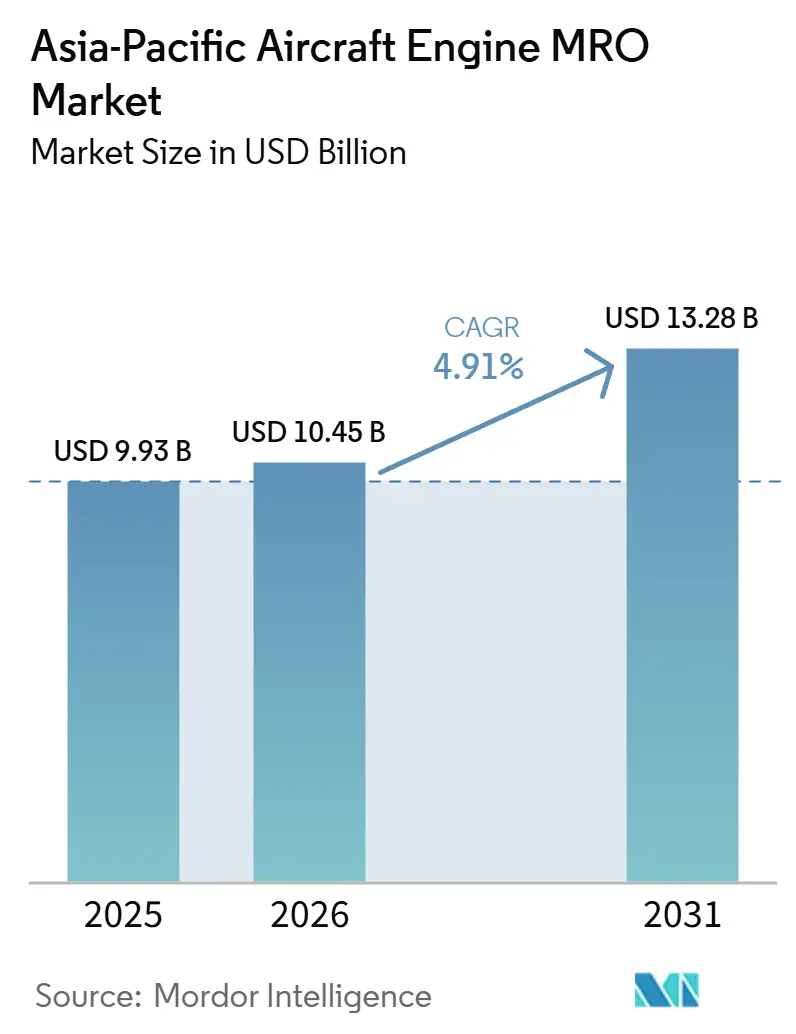
| Base Year Market Size (2025) | USD 9.93 Billion |
| Market Size (2026) | USD 10.45 Billion |
| Market Size (2031) | USD 13.28 Billion |
| Growth Rate (2026 - 2031) | 4.91 % |
| Market Concentration | Medium |
Major Players *Disclaimer: Major Players sorted in no particular order Image © Mordor Intelligence. Reuse requires attribution under CC BY 4.0. | |
Asia-Pacific Aircraft Engine MRO Market Analysis by Mordor Intelligence
The Southeast Asia aircraft MRO market size is expected to grow from USD 9.93 billion in 2025 to USD 10.45 billion in 2026 and is forecast to reach USD 13.28 billion by 2031 at a 14.91% CAGR over 2026-2031. This growth reflects sustained fleet expansion, regulatory incentives that encourage localized heavy maintenance, and OEM strategies that co-locate overhaul shops near rapidly growing carriers. Narrowbody deliveries continue to dominate demand, while early-life reliability issues in LEAP and GTF engines intensify short-term shop-visit volumes. OEM-affiliated facilities are widening their lead through proprietary data ecosystems and expertise in hot-section restoration. However, independent providers remain competitive on legacy CFM56 and V2500 platforms by leveraging used, serviceable materials and offering aggressive turnaround-time guarantees. Policymaker support in India, China, and Singapore, combined with investments in advanced coatings and digital twin diagnostics, further underpins the positive outlook for the Asia-Pacific aircraft engine MRO market.
Key Report Takeaways
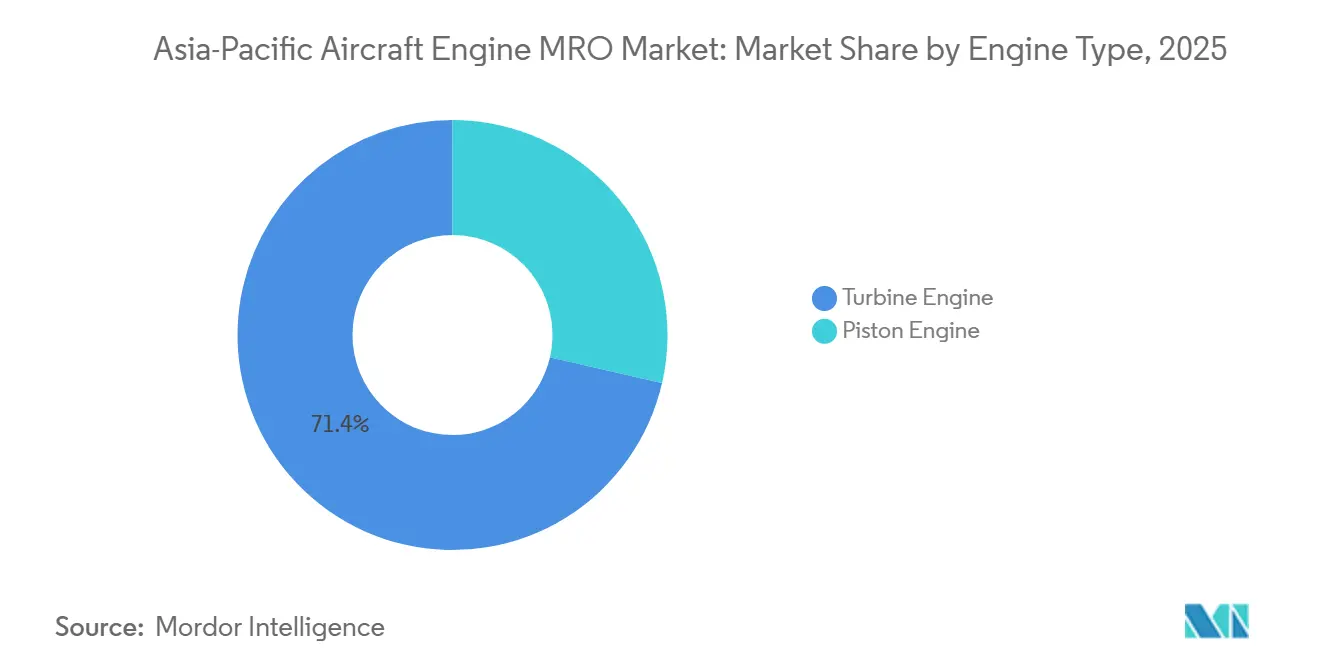
- By engine type, turbine engines held 71.41% of the Asia-Pacific aircraft engine MRO market share in 2025, and the segment is projected to grow at a 5.37% CAGR through 2031.
- By aviation segment, commercial aviation accounted for 63.20% of the Asia-Pacific aircraft engine MRO market size in 2025, while UAV propulsion is forecast to advance at a 7.20% CAGR through 2031.
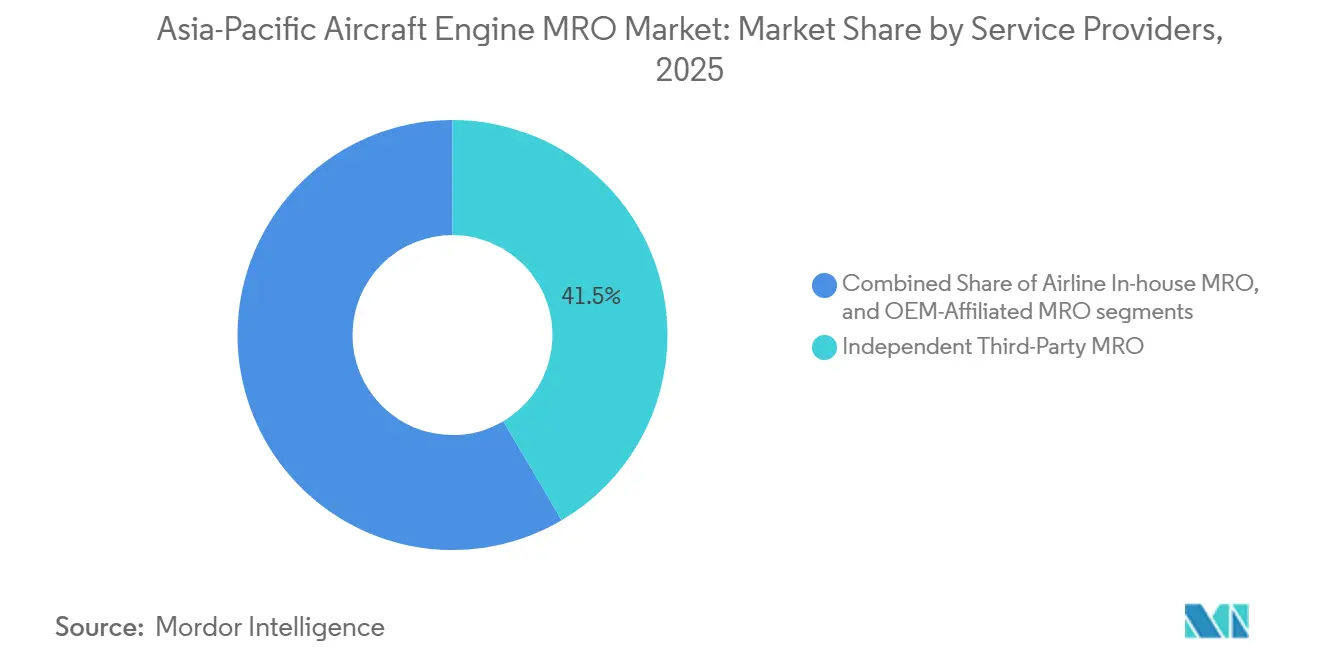
- By service provider, independent MROs controlled 41.52% of the Asia-Pacific aircraft engine MRO market share in 2025; however, OEM-affiliated facilities are forecast to expand at a 5.55% CAGR through 2031.
- By geography, China led the Asia-Pacific aircraft engine MRO market, accounting for 48.78% of the market size in 2025. In contrast, India is projected to grow at a 6.54% CAGR through 2031, following the reduction of GST and the full liberalization of foreign investment.
Note: Market size and forecast figures in this report are generated using Mordor Intelligence’s proprietary estimation framework, updated with the latest available data and insights as of January 2026.
Asia-Pacific Aircraft Engine MRO Market Trends and Insights
Drivers Impact Analysis*
| Driver | (~) % Impact on CAGR Forecast | Geographic Relevance | Impact Timeline |
|---|---|---|---|
| Fleet expansion and new aircraft deliveries | +1.2% | China, India, Southeast Asia; spillover to Japan, Australia | Medium term (2-4 years) |
| Aging narrowbody fleet requiring mid-life shop visits | +0.9% | China, India, Indonesia | Long term (≥ 4 years) |
| OEM and joint-venture capacity investments across APAC hubs | +0.7% | Singapore, Malaysia, China, India | Medium term (2-4 years) |
| Early-life reliability issues in LEAP and GTF engines | +1.1% | India, China, Southeast Asia | Short term (≤ 2 years) |
| Government incentives for indigenous MRO and supply chains | +0.6% | India, China, Singapore | Long term (≥ 4 years) |
| Growing used-serviceable-material trading networks | +0.4% | India, Indonesia, Philippines | Medium term (2-4 years) |
| Source: Mordor Intelligence | |||
Fleet Expansion And New Aircraft Deliveries
Asia-Pacific carriers continue to receive unprecedented numbers of new narrowbody jets, and each delivery sets off a future maintenance event. Between January and September 2025, Airbus and Boeing placed 229 A320neo and B737 MAX aircraft in regional fleets, adding the same number of LEAP powerplants that will age into their first performance-restoration visit around 2032.[1] Lessors sustain the pipeline: BOC Aviation alone holds orders exceeding 500 aircraft, with six out of every ten units earmarked for China or India, effectively clustering future shop demand in these regions.[2] Low-cost airlines such as Vietjet and Akasa already protect margins through long-term power-by-the-hour contracts, sidelining independent overhaulers.
Aging Narrow-Body Fleet Requiring Mid-Life Shop Visits
Asia-Pacific’s vast CFM56 fleet is entering the high-cost middle of its life cycle. Of the region’s 4,200 engines in service, roughly 1,800 have been in operation for more than 15 years and are approaching their second or third shop visits, which can cost USD 3 million each. Chinese majors, such as China Southern and Air China, have increased on-wing intervals by 500 flight hours to defer these expenses. Still, this strategy increases the risk of unscheduled removal and reduces the number of available dock slots. Independent shops in Guangzhou and Jakarta exploit the squeeze, promising two-week faster turnarounds and discounting invoices by integrating certified used parts purchased through expanding digital marketplaces across Asia.
OEM And Joint-Venture Capacity Investments Across APAC Hubs
OEMs are doubling down on Asia-Pacific production hubs to secure lucrative aftermarket streams. Rolls-Royce and SIA Engineering have earmarked USD 242 million to increase Singapore Aero Engine Services’ Trent overhaul throughput by 40%, addressing the A350 and A330neo wave. GE Aerospace’s USD 75 million upgrade in Singapore and Malaysia includes laser-coating booths and automated borescopes, which reduce inspection cycles by 30%. Pratt & Whitney followed with a 50-visit annual increase at Eagle Services Asia to tackle GTF backlogs. These investments cement Singapore’s regulatory trifecta approval status, yet India and Indonesia still bear high ferry costs because surplus capacity there remains limited.
Early-Life Reliability Issues In LEAP And GTF Engines
Unexpected reliability shortfalls are causing new-generation engines to be removed from wings sooner than planned. Pratt & Whitney’s powder-metal defect grounded 350 aircraft in 2026, sidelining seventy IndiGo A320neos and forcing expensive wet-leases of older jets. Simultaneously, CFM ordered borescope inspections of LEAP engines flown in dusty conditions following three uncontained failures, adding labor hours for Indian and Southeast Asian carriers. Flagship airlines now deploy GE Flight Deck analytics to transition from rigid calendar-based removals to condition-based planning, reducing unnecessary shop visits by approximately 15%. Such digital tools favor OEM-affiliated centers that have complete data access, thereby widening the capability gap with independent centers.
Restraints Impact Analysis*
| Restraint | (~) % Impact on CAGR Forecast | Geographic Relevance | Impact Timeline |
|---|---|---|---|
| Skilled-technician shortage and wage inflation | −0.8% | Singapore, India, China urban hubs | Medium term (2-4 years) |
| Supply-chain bottlenecks for critical engine parts | −0.6% | All APAC; severe for titanium forgings | Short term (≤ 2 years) |
| Capacity clustering causing ferry-cost penalties | −0.3% | Indonesia, Philippines, Vietnam, Tier-2 India cities | Long term (≥ 4 years) |
| OEM control over engine-health data limits independents | −0.5% | Independent shops across APAC | Medium term (2-4 years) |
| Source: Mordor Intelligence | |||
Skilled-Technician Shortage And Wage Inflation
The region’s talent pipeline is drying up just as demand for shop visits accelerates. IATA forecasts that the Asia-Pacific region will need 1.8 million new aviation professionals by 2037, yet the current training output covers barely two-thirds of that requirement.[3] Singapore’s turbine specialists earned SGD 85,000 (USD 66,045) in 2025, a 12% annual jump that squeezed independent shops’ margins while failing to curb attrition. India certified only 1,200 maintenance engineers in 2024, one-third of the forecasted demand, prompting airlines to import expatriate mechanics at a 40% wage premium. Australia’s mining boom siphons off technicians with higher pay and more predictable schedules, underscoring how cross-sector competition severely compounds the labor crunch.
Supply-Chain Bottlenecks For Critical Engine Parts
Chronic shortages of critical forgings and castings are lengthening turnaround times despite healthy labor and dock availability. Powder-metal disk output at Pratt & Whitney’s North Carolina plant lags pre-pandemic norms, forcing operators to ground GTF-powered jets for up to three months while waiting for spares. Safran’s six-week strike in France in 2025 delayed 140 LEAP engines, resulting in missed delivery slots at Singapore’s SAESL. Lead times for titanium forgings and single-crystal blades hover around thirty months, compelling shops to carry USD 100 million in inventory to meet performance guarantees. China is investing heavily in domestic forgings, yet it remains 60% dependent on imports.
*Our forecasts treat driver/restraint impacts as directional, not additive. The impact forecasts reflect baseline growth, mix effects, and variable interactions.
Segment Analysis
By Engine Type: Turbofan Dominance Anchors Narrow-Body Cycle
Turbine engines held 71.41% of the Asia-Pacific aircraft engine MRO market share in 2025 and are forecasted to achieve a 5.37% CAGR through 2031, sustained by 6,800 CFM56, LEAP, and PW1000G units flying across the region. The Asia-Pacific aircraft engine MRO market size for this segment is expected to grow, with 320 LEAP engines scheduled for their first removals in 2026 and 580 in 2027, testing whether OEM-affiliated capacity can keep pace. Independent providers that secure portable tooling licenses and develop high-pressure turbine refurbishment skills stand to capture overflow demand.
Although widebody powerplants require fewer but more costly events, the installed base of 780 aircraft translates into 110 annual removals, volumes that are most efficiently handled by established hubs in Singapore and Hong Kong. Turboprop and turboshaft engines collectively account for 20% of the Asia-Pacific aircraft engine MRO market. They remain underserved, presenting green-field opportunities in Hyderabad and Surabaya, where regional and helicopter fleets are dense. Piston engines retain a modest share as training fleets migrate toward hybrid and electric propulsion.
By Aviation Segment: UAV Propulsion Emerges As High-Growth Niche
Commercial aviation accounted for 63.20% of the Asia-Pacific aircraft engine MRO market size in 2025, reflecting the dominance of narrowbody passenger operations. UAV propulsion is forecast to see the fastest growth, at a 7.20% CAGR through 2031. China already operates more than 2,000 military drones, such as the Wing Loong II, each of which requires turboprop overhauls every 1,500 hours, a service now supported by AECC at its new Chengdu center.
Narrowbody fleets account for 70% of commercial demand, with LEAP shop-visit intervals averaging around 10 years. In contrast, widebody engines, despite longer intervals, command double the invoice value per visit. Regional jets and military helicopters provide steady niche volumes, sustaining specialized shops in Japan and South Korea. Battery refurbishment for electric logistics drones is emerging outside the scope of traditional turbine MRO but could converge through hybrid-electric models by the early 2030s.
By Service Provider: OEM Affiliates Gain Share Through Data Lock-In
Independent providers captured 41.52% of the Asia-Pacific aircraft engine MRO market share in 2025, maintaining price leadership for legacy engines by achieving 18-day average turnaround times. However, OEM-affiliated shops are growing at a faster rate, with a 5.55% CAGR, by bundling power-by-the-hour contracts that guarantee 95% dispatch reliability and by controlling engine health telemetry. Airline in-house shops such as SIA Engineering and HAECO together account for 32%. They must decide whether to invest USD 100 million or more in next-generation tooling or pivot to component repair.
Access to digital twins and integrated parts supply enables OEM affiliates to reduce shop-visit duration by 20%, a metric that airlines increasingly value. Independents are forming consortia to negotiate collective data access through ICAO, yet progress remains slow. The competitive gap will widen as LEAP and GTF fleets mature, requiring advanced coatings and additive-manufactured spares.
Geography Analysis
China led the Asia-Pacific aircraft engine MRO market with a 48.78% share in 2025, anchored by AMECO and MTU Zhuhai, which completed more than 280 and 200 shop visits, respectively, that year. While China’s scale remains unrivaled, its growth moderates as fleet maturity levels off and regulators push for indigenous support on the CJ-1000A for the C919 aircraft. India is the fastest-growing geography, with a 6.54% CAGR to 2031, fueled by the GST cut to 5%, Air India’s 470-aircraft order, and Safran-Tata’s LEAP module shop, slated for 2027.
Singapore, despite only a 12% share, remains the quality benchmark because SAESL, ST Engineering, and SIA Engineering collectively hold certifications for 18 engine types and all major authority approvals. Japan and South Korea maintain niche specializations in CF34 and CF6 engines, respectively, with IHI and Korean Air Aerospace expanding to accommodate Embraer and GE90 fleets. Indonesia’s GMF AeroAsia is positioning Jakarta as a LEAP-1B hub by 2027, a move that could save LCCs tens of millions in ferry costs. Australia continues to evaluate outsourcing large-engine work to Singapore as rising labor costs challenge domestic economics. Secondary markets in Thailand, Malaysia, the Philippines, and Vietnam collectively generate a 12% share and will likely depend on distributed capacity projects materializing over the next decade.
Regulatory Landscape
Aircraft engine MRO in Asia-Pacific is primarily governed through national Part 145 frameworks, with approvals and surveillance handled by each National Aviation Authority (NAA). Key anchors include CAAS (Singapore) under SAR-145, CAAC (China) under CCAR-145, CAAM (Malaysia) under CAD 8601, and CAAT (Thailand) under TCAR 8. These regimes set requirements for organization approval, manuals and procedures (including Maintenance Organisation Exposition equivalents), personnel authorization, tooling and calibration control, quality systems, and continuing oversight for engine and module-level maintenance.
Cross-border maintenance activity is supported through bilateral technical arrangements for maintenance (TA-M) and recognition pathways that reduce duplicative audits when an MRO already holds equivalent approvals. China also provides an accelerated route for OEM-owned or OEM-controlled MRO entities through a simplified CAAC approval process when equivalent local aviation authority certification is demonstrated, which can shorten certification timelines for new engine-service capabilities. In Thailand, CAAT issued updated TCAR 8 Part 145 compliance checklists in February 2026 (including PAPSI and MOE review templates), reinforcing procedural expectations for applicants and adding compliance structure for new entrants and expanded repair stations.
Value Chain Analysis
The Asia-Pacific aircraft engine MRO value chain spans engine OEMs and licensed or approved repair ecosystems (technical data, tooling, and branded service agreements), airlines and lessors (maintenance planning, PBH contracts, and asset strategy), and MRO providers (airline in-house, independent, and OEM-affiliated) that deliver quick-turn work, module repair, and full performance-restoration shop visits. Key material and capability inputs include LLPs and life-limited hardware, hot-section parts (blades, disks, combustor hardware), specialized coatings and heat treatment, test cell capacity, and supporting services such as NDT, calibration, logistics, and records and traceability systems. The downstream output is a certified release to service under the relevant NAA approval, supported by returns management for removed modules and increasing trading and teardown of used serviceable material (USM) to manage cost and availability.
Recent actions underscore how contracting and joint ventures influence slot access and work flows across borders. In June 2026, SIA Engineering Company and Safran Aircraft Engines signed a joint venture to build a full LEAP-1A/1B shop in Singapore, integrating existing quick-turn operations and tightening the OEM-to-MRO-to-airline loop for next-generation engines. On the demand side, multi-year agreements such as HAECO Engine Services (Xiamen) supporting GE90 overhauls for National Airlines (April 2026) and Lufthansa Technik extending engine MRO coverage for Cebu Pacific (July 2026) show airlines locking in capacity amid prolonged turnaround times. Part shortages remain a core constraint, especially for hot-section components, which pushes greater reliance on module swaps and higher acceptance of USM and PMA where permitted by operators and regulators.
Competitive Landscape
Innovation and Integration Drive Future Success
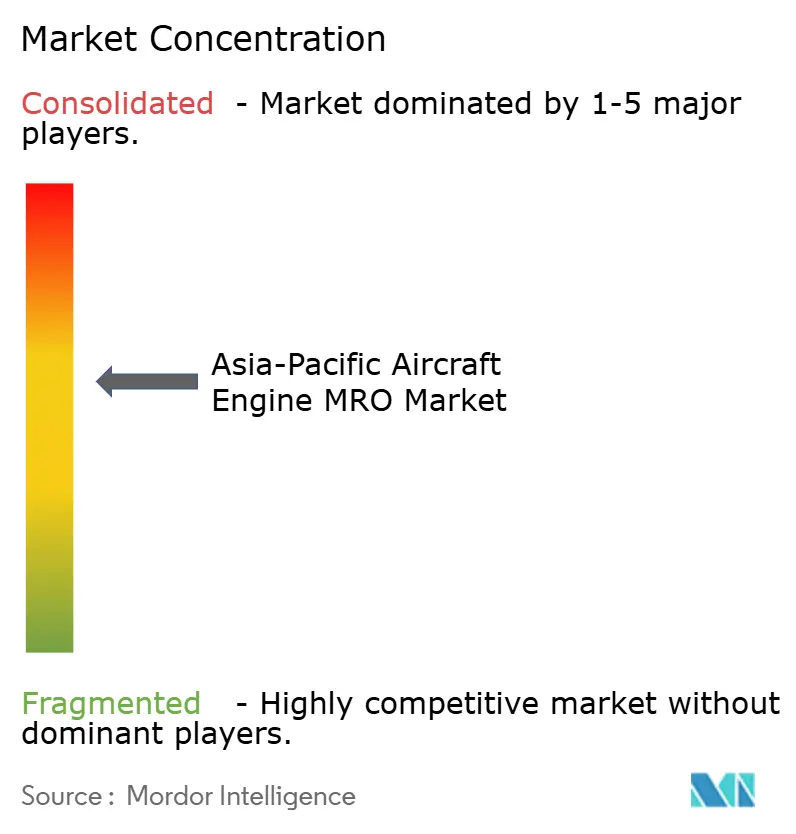
The Asia-Pacific aircraft engine MRO market is moderately concentrated, with key players including GE Aerospace, SIA Engineering, ST Engineering, Hong Kong Aircraft Engineering Company Limited, GMF AeroAsia, and SAESL. OEMs deepen vertical integration through equity stakes: Rolls-Royce owns 50% of SAESL, while GE and Safran partner with ST Engineering to secure aftermarket margin. Independents compete through aggressive pricing and turnaround-time guarantees; GMF AeroAsia undercuts OEM affiliates by 40% on CFM56 work by integrating certified USM rotables and focusing on volume.
Data control is the new battleground. GE’s Flight Deck and Rolls-Royce’s Engine Health Management give OEM shops predictive capabilities that independents cannot match without regulatory intervention. Lufthansa Technik’s 2024 purchase of a 26% stake in Air India Engineering marks a likely consolidation wave as OEMs and global MROs acquire stakes in key Asian facilities ahead of the LEAP and GTF shop-visit surge. Blockchain-authenticated USM platforms, such as Aerfin, further disrupt pricing by enabling transparent and traceable part transactions that meet the standards of CAAC and DGCA.
White-space opportunities include Part-145 shops in Tier-2 Indian cities to eliminate ferry costs for IndiGo’s 500-aircraft fleet, as well as dedicated turboprop and turboshaft overhaul lines for the underserved regional and helicopter markets. The interplay of policymaker incentives, OEM data governance, and supply chain fragility will determine whether the Asia-Pacific secures its anticipated 60% share of global engine shop visits by the mid-2030s.
Asia-Pacific Aircraft Engine MRO Industry Leaders
-
Safran SA
-
Hong Kong Aircraft Engineering Company Limited
-
GE Aerospace (General Electric Company)
-
Singapore Aero Engine Services Private Limited
-
Singapore Technologies Engineering Ltd.
- *Disclaimer: Major Players sorted in no particular order
Market Opportunities and Future Outlook
The clearest opportunity is expanding in-region capacity for next-generation narrowbody engines as airlines weigh early-life reliability issues and long shop queues against the cost of ferrying engines to more distant hubs. The June 2026 joint venture between SIA Engineering Company and Safran Aircraft Engines to establish a full CFM LEAP-1A/1B shop in Singapore, with a stated USD 118 million investment and integration of quick-turn operations, is a direct signal of where capital is being deployed to capture LEAP-related work scope. Parallel investments in Singapore also point to productivity and component-repair whitespace: GE Aerospace announced a multi-year plan of up to USD 300 million to expand engine repair capabilities in Singapore, including an AI Center of Excellence and enhanced LEAP module repair capacity, aimed at shortening turnaround time under constrained material supply.
Outside large turbofan work, underserved segments support facility and capability plays in turboprop and rotorcraft engines, particularly where regional fleets operate far from major overhaul bases. Pratt & Whitney Canada expanding its Singapore facility in April 2026 to add full overhaul services for PT6C-67C helicopter engines and PW127XT regional turboprop engines highlights increased attention to these platforms and supports more localized coverage for operators in Southeast Asia. Capacity additions at established hubs also create supplier-side opportunities in coatings, hot-section repair, and parts pools. SIA Engineering Company has disclosed that SAESL expansion works are tracking toward FY2026/27 completion to raise throughput from 300 to 400 engines per year, which increases pull-through demand for skilled labor, test cell access, and repairable-part supply chains that can meet Part 145 traceability expectations across multiple authorities.
Recent Industry Developments
- June 2026: SIA Engineering Company and Safran Aircraft Engines signed a joint venture agreement to establish a full CFM LEAP-1A and LEAP-1B engine MRO facility in Singapore, with Safran holding 51% and SIAEC 49%. The planned USD 118 million program also integrates existing quick-turn operations at the Changi North facility, strengthening Singapore’s role as a core hub for next-generation narrowbody engine shop visits.
- May 2026: HAECO Engine Services (Xiamen) completed its first CF34-10A engine overhaul for Chengdu Airlines (first engine output dated 28 April 2026). As the sole GE Branded Service Agreement license holder for CF34-10A in Greater China, this milestone expands in-region capability for regional-jet engines and supports fleet availability with localized overhaul capacity.
- February 2026: GE Aerospace announced a multi-year investment plan of up to USD 300 million to expand engine repair capabilities in Singapore, including a new AI Center of Excellence and upgraded module repair capability for CFM LEAP-1A/1B engines. Backing from the Singapore Economic Development Board supports the program’s plan to lift throughput and inspection productivity, directly addressing regional turnaround-time pressure linked to material and capacity constraints.
Research Methodology Framework and Report Scope
Market Definition and Coverage
This market covers the value of aircraft engine maintenance, repair, and overhaul services delivered in Asia Pacific, measured in USD for work performed on in-service aircraft engines.
Scope exclusions: We exclude new engine manufacturing sales and routine airframe-only maintenance that does not involve engine MRO work.
Segmentation Overview
- By Engine Type
- Turbine Engine
- Turbofan Engine
- Turboprop Engine
- Turboshaft Engine
- Turbojet Engine
- Piston Engine
- Turbine Engine
- By Aviation
- Commercial Aviation
- Narrowbody
- Widebody
- Regional Jets
- Military Aviation
- Combat
- Transport
- Special Mission
- Helicopters
- General Aviation
- Business Jets
- Commercial Helicopters
- Unmanned Aerial Vehicles (UAVs)
- Commercial Aviation
- By Service Providers
- Airline In-house MRO
- Independent Third-Party MRO
- OEM-Affiliated MRO
- By Geography
- China
- India
- Japan
- Singapore
- Indonesia
- South Korea
- Australia
- Rest of Asia-Pacific
Data Sources, Market Sizing, and Validation
Desk Research
Desk research is used to set the fact base and to keep the model anchored to observable aviation activity in Asia Pacific. We typically start with fleet, traffic, and maintenance signal data from public sources such as ICAO air transport statistics, IATA traffic and fleet updates, national civil aviation authority publications, airport statistics releases, and safety and airworthiness guidance from regulators such as EASA and FAA.
Next, we review open literature that helps translate fleet activity into engine shop workload, such as maintenance interval references, engine removal drivers, and utilization patterns reported in reputable aviation press, peer reviewed aerospace journals, and association publications. Company annual reports, investor presentations, and public contract awards are also used to cross-check service capacity additions and regional footprint changes. Where required, we use paid aerospace and aviation databases selectively to validate installed base and program mix for aircraft and engines. The sources listed above are illustrative only, and many other public and paid references were used to collect data, test assumptions, and clarify open questions.
Primary Interviews and Surveys
Primary work focuses on validating how engine MRO demand is actually triggered and priced across Asia Pacific, and which workloads stay within-country versus being handled through cross-border shop visits. We speak with airline engineering teams, independent MRO leaders, parts and repair specialists, and procurement managers to confirm removal rates, typical shop-visit mixes, and near-term capacity constraints across key sub-regions.
Insights from these discussions are then used to adjust secondary inputs, fill gaps where public data is thin, and align assumptions on labor rates, turnaround times, and the share of work performed by in-house versus third-party providers.
Distribution of primary research fieldwork respondents
| Company type | Respondent position |
|---|---|
| Top tier: 32% | CXOs: 20% |
| Mid tier: 48% | Functional/Unit leaders: 28% |
| Smaller Players: 20% | Managers: 52% |
Market-Sizing & Forecasting
Our sizing starts from a top-down build where regional fleet activity and utilization are translated into expected engine shop visits and on-wing maintenance demand, then converted to value using observed price bands for key event types. To keep totals practical, we use variables such as installed fleet by aircraft category, average annual flight hours and cycles, expected engine removal drivers (scheduled and unscheduled), shop-visit frequency by engine family maturity, and the split between overhaul, repair, and module-level work.
After the first cut, we run selective bottom-up checks using service-provider capacity signals, announced line and shop expansions, and sampled revenue productivity assumptions (typical event value times plausible annual event volume) to ensure the market is not overstated in smaller countries where demand routes through nearby hubs. Where bottom-up inputs are incomplete, gaps are handled using regional averages constrained by fleet mix and validated through follow-up calls.
For forecasting, we use scenario analysis supported by trend smoothing on the core drivers, so growth stays consistent with fleet deliveries, utilization recovery, and maintenance cycle timing. Final year-by-year outputs are adjusted only after expert feedback confirms that assumptions on labor inflation, material availability, and turnaround time trends align with realistic operating conditions.
Data Validation & Update Cycle
Validation is done in steps, starting with internal consistency checks so fleet, utilization, and shop-visit calculations do not conflict. We compare the resulting market totals against independent signals such as regional traffic trends, known engine program penetration, and reported capacity utilization direction, and then investigate any outliers before sign-off.
A second analyst reviews the workbook logic and key assumptions, and re-contacts are triggered when an input moves materially, such as a major fleet grounding, a large MRO facility expansion, or a change in engine maintenance guidance. Reports are refreshed annually, and interim updates are made when major events occur. Before delivery, an analyst does a fresh pass so clients receive the latest updated view.
Mordor Intelligence's Asia Pacific Aircraft Engine MRO Market Size Versus Other Published Estimates
Published market values for aircraft engine MRO in Asia Pacific can look different because the boundary of what counts as engine work is not always handled in the same way, and the time base can also vary. Differences usually come from what engine event types are included, whether military and general aviation are counted, and how the country coverage inside Asia Pacific is treated.
Key gaps also come from pricing logic and refresh timing, since shop-visit values change with material costs and turnaround constraints. By tracking fleet mix, utilization, and shop-visit drivers, then refreshing price-per-event assumptions through validated regional interviews, Mordor Intelligence keeps the estimate tied to what is serviceable in-country versus work exported to nearby engine hubs.
Benchmark comparison
| Source | Market Size | Gaps in Research Methodology |
|---|---|---|
| Mordor Intelligence | USD 9.93 B (2025) | |
| Trade Journal A | USD 7.98 B (2022) | Uses an earlier base year and is typically framed around commercial engine MRO only, which can leave out military and general aviation engines and understate the full regional demand pool. |
| Industry Data Service B | USD 10.45 B (2026) | Often reports a current-year snapshot without clearly separating engine MRO performed inside Asia Pacific from cross-border shop visits, and pricing updates may lag short-term material and labor changes. |
The comparison shows that the spread is mostly explained by year alignment and the exact scope counted as engine MRO work. Once the same country set, engine categories, and event pricing logic are applied consistently, the resulting market size is easier to trace back to clear drivers and to repeat in future updates.
Key Questions Answered in the Report
How large is the Asia-Pacific aircraft engine MRO market in 2026?
The Asia-Pacific aircraft engine MRO market size stands at USD 10.45 billion in 2026.
What is the forecast CAGR for Asia-Pacific engine maintenance through 2031?
The market is expected to grow at a 4.91% CAGR to reach USD 13.28 billion by 2031.
Which engine type commands the largest share of shop-visit spending?
Turbine engines, especially CFM56, LEAP, and PW1000G turbofans, held 71.41% of market share in 2025.
Why is India the fastest-growing geography for engine MRO?
Policy reforms that cut GST to 5% and allow 100% foreign investment are attracting new facilities and repatriating work previously sent abroad.
How are OEM-affiliated shops gaining competitive advantage?
They bundle power-by-the-hour contracts with exclusive access to engine-health data and advanced coating technologies, reducing turnaround time by about 20%.
What opportunities exist for new entrants in Asia-Pacific MRO?
Establishing Part-145 shops in Tier-2 Indian cities and setting up dedicated turboprop and turboshaft overhaul lines can tap underserved demand.