
Market Overview
| Study Period | 2021 - 2031 |
|---|---|
| Forecast Data Period | 2026 - 2031 |
| Base Year Market Size (2025) | USD 5.92 Billion |
| Market Size (2026) | USD 6.29 Billion |
| Market Size (2031) | USD 8.49 Billion |
| Growth Rate (2026 - 2031) | 6.18 % |
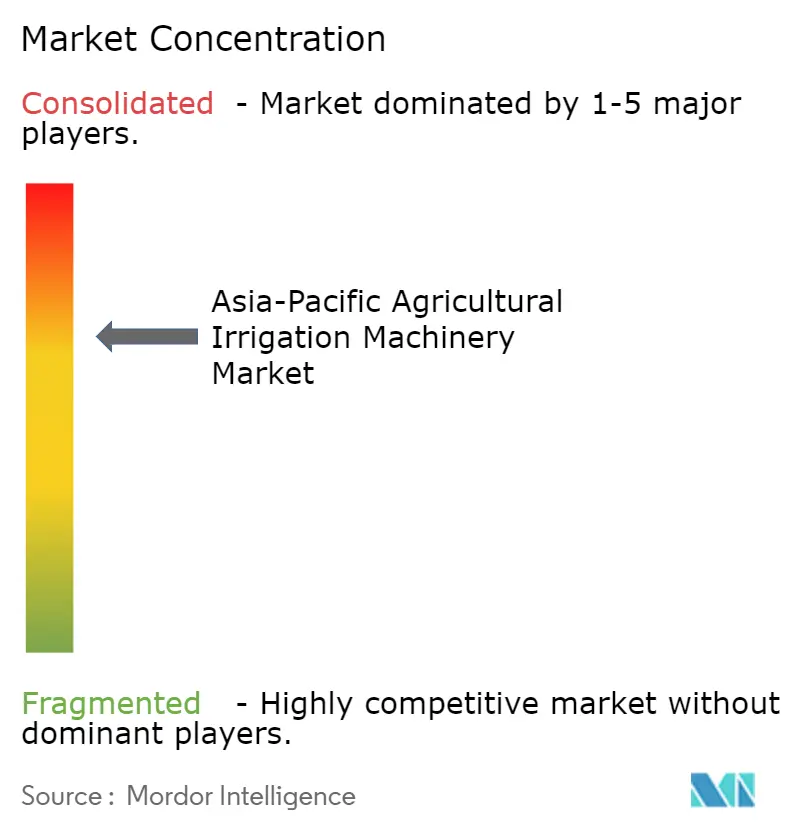
| Market Concentration | Medium |
Major Players *Disclaimer: Major Players sorted in no particular order Image © Mordor Intelligence. Reuse requires attribution under CC BY 4.0. | |
Asia-Pacific Agricultural Irrigation Machinery Market Analysis by Mordor Intelligence
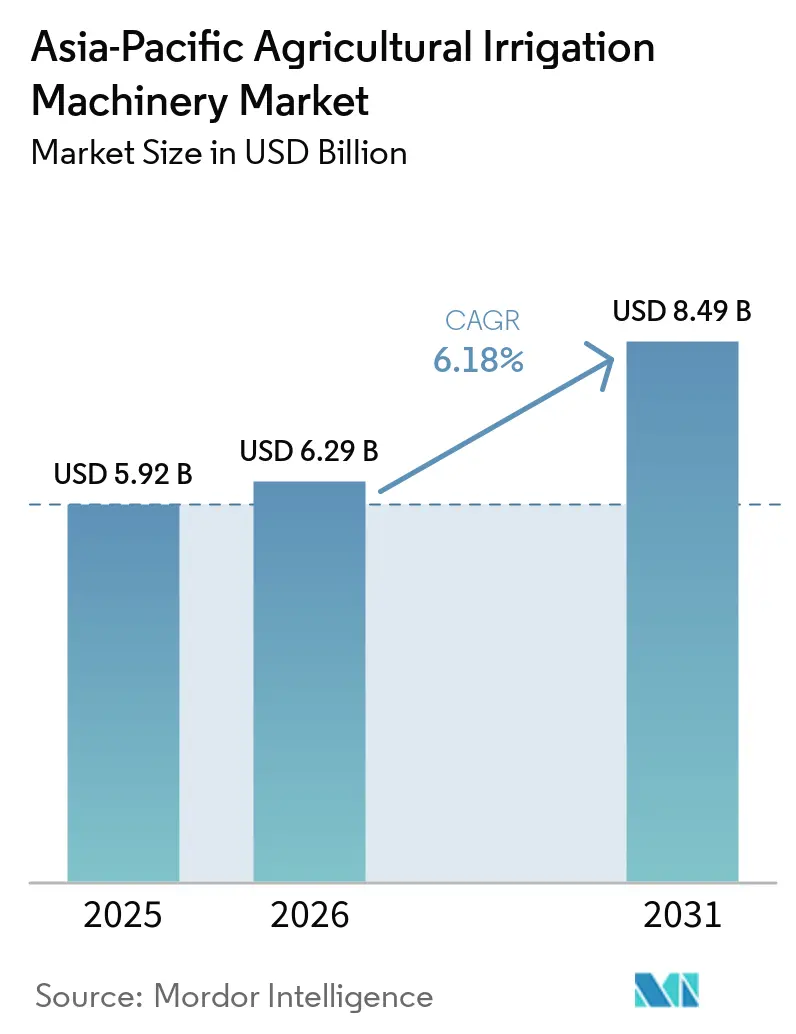
The Asia-Pacific agricultural irrigation machinery market size was valued at USD 5.92 billion in 2025 and is forecast to grow from USD 6.29 billion in 2026 to USD 8.49 billion by 2031, at a CAGR of 6.18% from 2026 to 2031. According to the Food and Agriculture Organization (FAO), agriculture accounts for 70% of freshwater withdrawals across Asia-Pacific, while regional water demand is projected to exceed supply by 40% by 2030. This gap is driving farmers and public agencies away from flood-and-furrow methods toward systems that manage water at the field level. Policy support, water pricing, and demand from commercial horticulture are supporting irrigation machinery purchases across the region. Suppliers are responding through locally manufactured systems, subsidy-linked distribution, and irrigation packages that include filtration, automation, and farm advisory support. However, adoption remains uneven, as capital costs, small farm sizes, and water quality issues continue to affect system performance in several countries.
Key Report Takeaways
- By irrigation type, drip irrigation accounted for the largest Asia-Pacific agricultural irrigation machinery market share, at 46.5, and is projected to grow at the fastest CAGR of 13.1% from 2026 to 2031.
- By application type, grains and cereals accounted for the largest share at 37.5% in 2025, while the Asia-Pacific agricultural irrigation machinery market size for fruits and vegetables is projected to grow at the fastest CAGR of 8.4% from 2026 to 2031.
- By geography, China accounted for the largest share at 24.0% in 2025, while India is projected to grow at the fastest CAGR of 8.3% from 2026 to 2031.
Note: Market size and forecast figures in this report are generated using Mordor Intelligence’s proprietary estimation framework, updated with the latest available data and insights as of January 2026.
Asia-Pacific Agricultural Irrigation Machinery Market Trends and Insights
Drivers Impact Analysis*
| Driver | (~) % Impact on CAGR Forecast | Geographic Relevance | Impact Timeline |
|---|---|---|---|
| Increasing Demand for Efficient Water Management in Agriculture | 1.40% | China, India, and Southeast Asia | Long term (≥ 4 years) |
| Government Subsidies and Water-Saving Irrigation Programs | 1.20% | India, China, Cambodia, and Japan | Medium term (2-4 years) |
| Expansion of High-Value Crops and Protected Cultivation | 0.90% | India, China, Vietnam, and the Rest of Asia-Pacific | Medium term (2-4 years) |
| Precision Agriculture and Connected Irrigation Adoption | 0.80% | Japan, Australia, China, and India | Long term (≥ 4 years) |
| Climate-Driven Irrigation Reliability Requirements | 0.70% | Asia-Pacific and Southeast Asia | Long term (≥ 4 years) |
| Local Manufacturing and Dealer-Led Affordability Improvements | 0.50% | China and India | Medium term (2-4 years) |
| Source: Mordor Intelligence | |||
Increasing Demand for Efficient Water Management in Agriculture
Growing demand for efficient water management is driving the adoption of irrigation machinery, as water-stressed farming systems seek precise water delivery methods. The Asian Development Bank (ADB) reported in 2025 that, in a case study in the Ningxia Hui Autonomous Region, China, switching to drip irrigation could reduce water use by 60%[1]. This supports the resource-efficiency case for drip irrigation in farms facing water constraints and pressure to produce more with available supplies. As a result, demand for water-efficient irrigation equipment is contributing to market growth across Asia-Pacific agricultural production systems.
Government Subsidies and Water-Saving Irrigation Programs
Government-backed irrigation programs are supporting machinery demand by funding infrastructure that enables modern irrigation systems and improves water-use efficiency. In April 2025, the Government of India approved the Modernization of Command Area Development and Water Management sub-scheme under Pradhan Mantri Krishi Sinchayee Yojana (PMKSY) with a total outlay of INR 1,600 crore (USD 192 million)[2]. The program includes underground pressurized piped irrigation and micro-irrigation infrastructure from established water sources to farm gates. This policy support broadens opportunities for irrigation machinery suppliers and strengthens machinery adoption across Indian agricultural systems.
Precision Agriculture and Connected Irrigation Adoption
The adoption of precision agriculture and connected irrigation is driving demand for machinery that integrates sensors, automation, and data-driven water management. In 2025, the Organization for Economic Co-operation and Development (OECD) reported that Japan's Ministry of Agriculture, Forestry, and Fisheries allocated JPY 4,500 million (USD 29.72 million) to promote smart agricultural technologies in 2024. This funding supports technologies that address resource efficiency and productivity through digital agriculture. Greater policy support for connected farming strengthens investment in automated irrigation systems, sensors, and controllers, supporting the adoption of precision irrigation machinery across Asia-Pacific agricultural production systems.
Climate-Driven Irrigation Reliability Requirements
Increasing climate-driven water variability is raising demand for reliable irrigation systems that help farms manage drought conditions and maintain crop production. In March 2025, the Food and Agriculture Organization of the United Nations (FAO) reported that only 26% of cultivated land in Vietnam's Central Highlands was irrigated, highlighting infrastructure gaps in a drought-prone agricultural region[3]. This limited irrigation coverage increases the need for reliable water-delivery infrastructure and supports investment in irrigation machinery. Recurring drought exposure and uneven access to irrigation are therefore strengthening demand for dependable irrigation systems across Asia-Pacific agricultural production.
Restraints Impact Analysis*
| Restraint | (~) % Impact on CAGR Forecast | Geographic Relevance | Impact Timeline |
|---|---|---|---|
| High Initial Cost and Payback Uncertainty | -1.20% | Southeast Asia and smallholder markets | Medium term (2-4 years) |
| Limited Awareness and Technical Support Among Smallholder Farmers | -0.80% | Cambodia, Indonesia, Myanmar, and the Rest of Asia-Pacific | Long term (≥ 4 years) |
| Fragmented Landholdings and Difficult System Standardization | -0.70% | Japan, Cambodia, Indonesia, and parts of India | Long term (≥ 4 years) |
| Clogging, Water Quality, and Maintenance Burden | -0.50% | Asia-Pacific and Southeast Asia | Medium term (2-4 years) |
| Source: Mordor Intelligence | |||
High Initial Cost and Payback Uncertainty
High upfront costs and uncertain payback periods can limit the adoption of irrigation machinery among smallholder farmers, particularly where access to agricultural finance is limited. The Asian Development Bank (ADB) reported in 2025 that smart drip irrigation in China involves high upfront costs, energy requirements, and maintenance expenses, creating financial barriers to adoption. These costs can extend investment recovery periods and increase the financing burden for farmers with limited capital and variable agricultural income. As a result, affordability constraints, limited financing options, and uncertain returns can delay purchases of irrigation machinery and restrict broader market expansion across smallholder farming systems in the Asia-Pacific.
Fragmented Landholdings and Difficult System Standardization
Fragmented landholdings can increase the complexity of irrigation system design and installation, as irrigation system layouts must accommodate smaller operating units and varying field boundaries. The National Institute of Statistics of Cambodia (NIS) reported in 2025 that 64.0% of household agricultural holdings had less than 2 hectares of agricultural land. The prevalence of small holdings can limit the deployment of standardized irrigation machinery and increase site-specific design requirements, particularly for systems that require coordinated field layouts. As a result, fragmented agricultural structures can increase installation complexity, constrain deployment scalability, and limit the adoption of agricultural irrigation machinery across Cambodia and the broader Asia-Pacific market.
*Our forecasts treat driver/restraint impacts as directional, not additive. The impact forecasts reflect baseline growth, mix effects, and variable interactions.
Segment Analysis
By Irrigation Type: Drip Irrigation Leads the Market
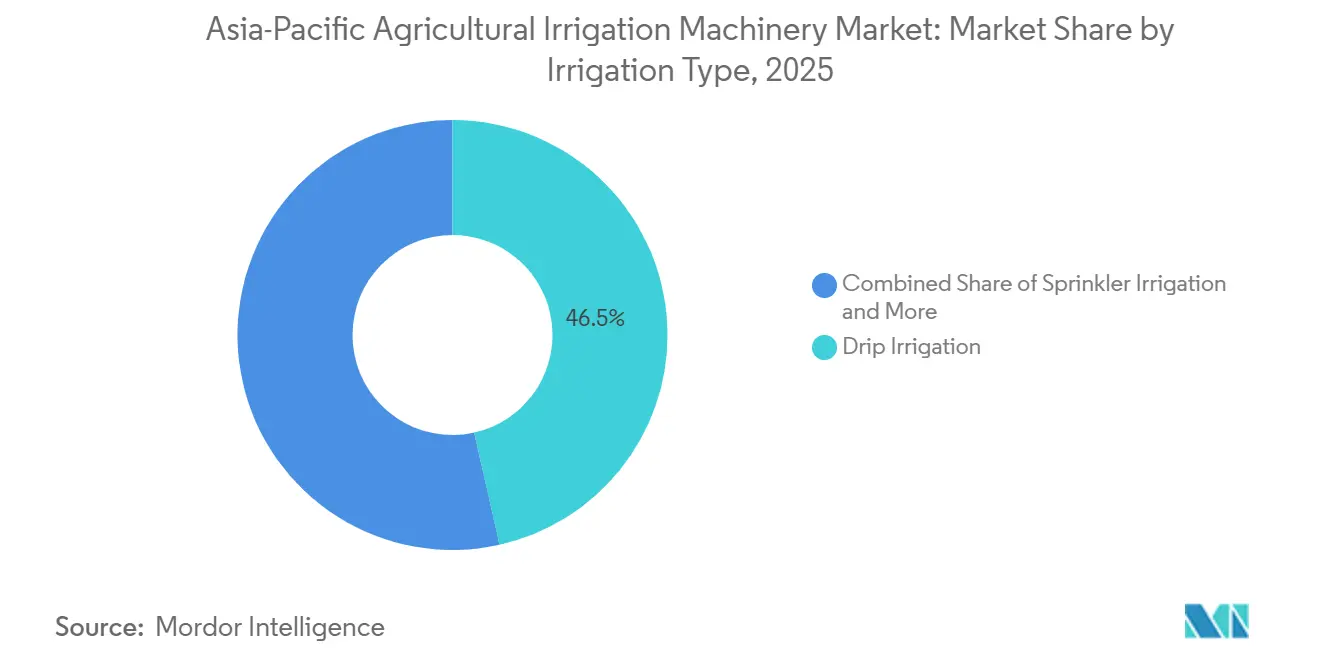
Drip irrigation accounted for the largest Asia-Pacific agricultural irrigation machinery market share in 2025, at 46.5%, and is projected to grow at the fastest CAGR of 13.1% from 2026 to 2031. Its modular configuration enables controlled water delivery through emitters, tubing, filters, valves, and pressure regulators across diverse crops and field sizes. Integration with fertigation, sensors, controllers, and automation further expands its functionality. These capabilities support precise water management, flexible system deployment, and resource-efficient production, driving the adoption of drip irrigation across diverse agricultural systems in the Asia-Pacific.
Sprinkler irrigation supports broad agricultural applications where uniform overhead water distribution is appropriate, including grains and cereals, as well as selected horticultural systems. Pivot irrigation provides mechanized field coverage and is particularly relevant to larger commercial agricultural operations where field layouts support mobile irrigation machinery. Other irrigation types, including subsurface and subirrigation systems, serve agricultural production environments where soil conditions, crop requirements, water availability, and local infrastructure influence irrigation system selection. These irrigation methods address specific agricultural conditions and production requirements across the Asia-Pacific region.

By Application Type: Grains and Cereals Segment Leads, While Fruits and Vegetables Expand
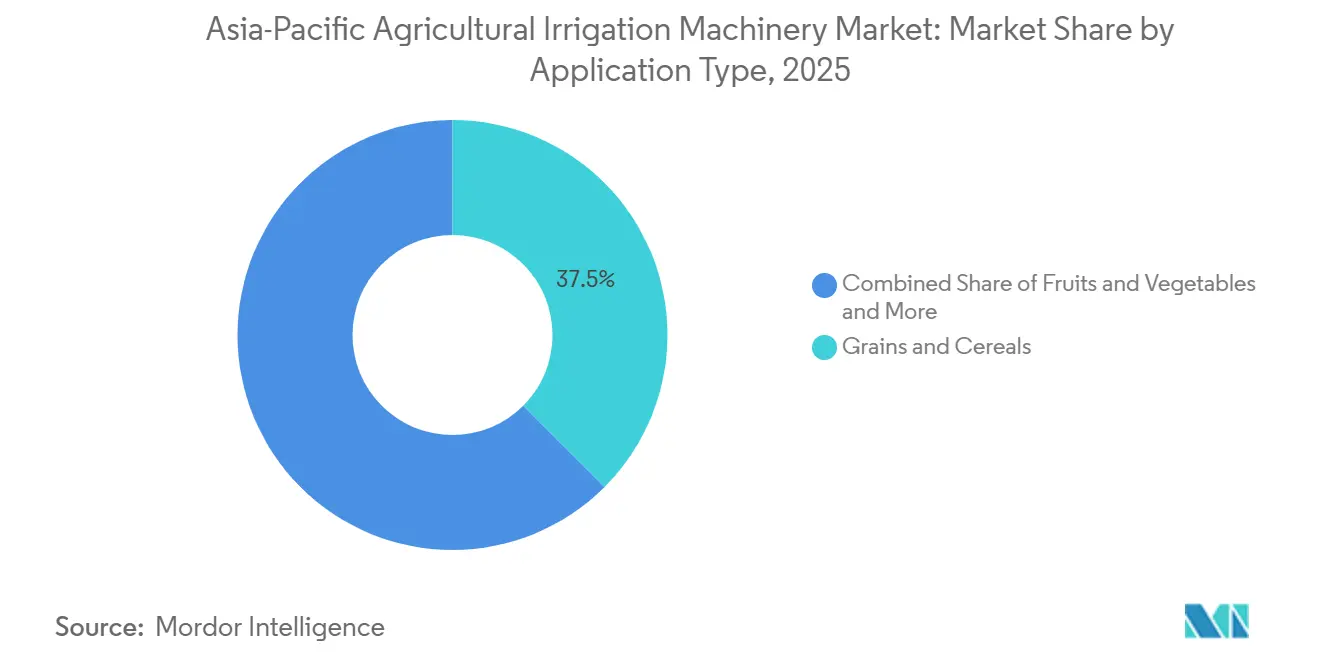
The Asia-Pacific agricultural irrigation machinery market size for grains and cereals accounted for the largest segment in 2025, at 37.5%, driven by the extensive cultivation of rice, wheat, maize, and other staple crops across the Asia-Pacific region. Irrigation requirements vary by crop, climate, soil, and production system, generating demand for different irrigation system configurations. Rice production relies on controlled water management throughout the growing cycle, while cereal and grain farms use sprinkler, drip, or other irrigation systems depending on crop water requirements, field conditions, and local irrigation infrastructure. Large cultivated areas and recurring seasonal production sustain demand for irrigation machinery and systems for water delivery, distribution, and control, with grains and cereals as the largest application category.
Fruits and vegetables are projected to grow at the fastest CAGR of 8.4% from 2026 to 2031, driven by rising demand for precise irrigation and nutrient management in high-value crop production. Drip systems and fertigation equipment deliver controlled amounts of water and nutrients according to crop requirements, supporting uniform growth and efficient resource management. Protected cultivation further increases the relevance of automated irrigation, filtration, pressure regulation, and monitoring components. Diverse horticultural production across China, India, Southeast Asia, and other regional markets creates opportunities for specialized irrigation configurations. These factors support faster growth in fruits and vegetables applications.
Geography Analysis
China accounted for the largest share at 24.0% in 2025, supported by extensive irrigated agriculture, large-scale farmland modernization, and continued development of water management infrastructure. Government programs emphasize high-standard farmland, efficient irrigation, and modernization of agricultural production systems. These priorities support demand for irrigation machinery and systems spanning water delivery, filtration, pressure management, automation, and field irrigation infrastructure. The country's diverse crop base also creates varied irrigation requirements across northern grain regions, western agricultural areas, and horticultural production zones. Continued infrastructure development and technology integration reinforce China's dominant position in regional demand for irrigation machinery
India is projected to grow at the fastest CAGR of 8.3% from 2026 to 2031, supported by the expansion of micro-irrigation adoption, public irrigation programs, and the modernization of agricultural water infrastructure. Diverse crop production across irrigated and semi-arid regions creates demand for irrigation machinery tailored to different farm sizes and water conditions. Government-backed programs further improve access to irrigation infrastructure and encourage efficient water application. These factors support sustained deployment of irrigation machinery and faster growth across India's agricultural production systems.
Japan's demand for irrigation machinery is shaped by farm modernization, labor constraints, and the increasing integration of smart agricultural infrastructure. The Ministry of Agriculture, Forestry and Fisheries (MAFF) reported in 2025 that the average cultivated area per agricultural management entity was 3.7 hectares. This farm structure supports demand for irrigation systems that can be configured for varied operating scales and integrated with automated water management. Digital controls, remote monitoring, and automated water delivery can help improve operational efficiency where agricultural labor is constrained. These conditions support continued adoption of irrigation machinery and connected water management technologies in Japan and nearby markets.
Competitive Landscape
The Asia-Pacific agricultural irrigation machinery market is moderately consolidated in 2025. Major players include Jain Irrigation Systems Limited, Netafim Ltd. (Orbia Advance Corporation, S.A.B. de C.V.), Rivulis Irrigation Ltd. (Temasek Holdings Private Limited and Jain Irrigation Systems Limited), Dayu Irrigation Group Co., Ltd., and Valmont Industries, Inc. These companies compete across drip, sprinkler, pivot, and automated irrigation systems. Their market positions are shaped by technology portfolios, distribution networks, project capabilities, and service coverage. Competition varies by irrigation type, farm structure, application requirements, and government-supported irrigation programs across Asia-Pacific agricultural markets.
Competitive differentiation is increasingly focused on smart irrigation, integrated irrigation systems, and solutions adapted to regional production conditions. Suppliers are expanding beyond individual irrigation components toward integrated systems that combine irrigation machinery, digital monitoring, fertigation, and automation. This approach allows companies to address diverse requirements related to water efficiency, crop management, system control, and operational performance. Suppliers with broader technology portfolios and stronger integration capabilities can differentiate their offerings through customized irrigation solutions, technical support, and service capabilities, strengthening their competitive positions across diverse agricultural production systems in the Asia-Pacific.
Product innovation is intensifying competition through improvements in water efficiency, material performance, and system functionality. In December 2025, The Toro Company launched Aqua-Traxx Azul REvive, a drip tape manufactured with recycled resins for agricultural irrigation applications. The product expands the supplier's precision irrigation offering while addressing sustainability considerations in agricultural plastics. Innovation in drip materials, filtration, controls, and application technologies allows suppliers to differentiate irrigation machinery beyond basic water delivery. As growers seek systems that combine performance with resource efficiency, product development is becoming an important competitive factor across irrigation machinery categories and regional farming applications.
Asia-Pacific Agricultural Irrigation Machinery Industry Leaders
-
Jain Irrigation Systems Limited
-
Netafim Ltd. (Orbia Advance Corporation, S.A.B. de C.V.)
-
Rivulis Irrigation Ltd. (Temasek Holdings Private Limited and Jain Irrigation Systems Limited)
-
Dayu Irrigation Group Co., Ltd.
-
Valmont Industries, Inc.
- *Disclaimer: Major Players sorted in no particular order
Recent Industry Developments
- May 2026: Dayu Irrigation Group Co., Ltd. signed a strategic cooperation agreement with Yunding Planting, a Genting Plantations entity, covering smart irrigation, fertigation, and agricultural digitalization for tropical plantation operations in Malaysia, Indonesia, and Southeast Asia.
- January 2026: Hunter Industries, Inc. introduced the Senninger i-Wob2 Part-Circle sprinkler for center-pivot irrigation, designed for uniform water distribution at low operating pressures. The product expands the company's agricultural irrigation portfolio by improving application efficiency and supporting water delivery across commercial farming systems.
- September 2025: Netafim Ltd. (Orbia Advance Corporation, S.A.B. de C.V.) partnered with McCain Foods in China to expand drip irrigation and fertigation in potato cultivation. The collaboration supports adoption among contract growers, strengthening demand for water-efficient irrigation and nutrient management systems.
Asia-Pacific Agricultural Irrigation Machinery Market Report Scope
Agricultural irrigation machinery includes equipment for distributing water to crops via sprinklers, drip systems, and pivots. It supports uniform water application, improves water-use efficiency, maintains crop growth, and enhances agricultural productivity across diverse farming conditions.
The Asia-Pacific agricultural irrigation machinery market is segmented by irrigation type (sprinkler irrigation, drip irrigation, pivot irrigation, and other irrigation types), by application type (grains and cereals, pulses and oilseeds, fruits and vegetables, and other applications), and by geography (China, India, Japan, Cambodia, and the rest of Asia-Pacific). The market forecasts are provided in terms of value (USD).
By Irrigation Type
| Sprinkler Irrigation |
| Drip Irrigation |
| Pivot Irrigation |
| Other Irrigation Types |
By Application Type
| Grains and Cereals |
| Pulses and Oilseeds |
| Fruits and Vegetables |
| Other Applications |
By Geography
| China |
| India |
| Japan |
| Cambodia |
| Rest of Asia-Pacific |
| By Irrigation Type | Sprinkler Irrigation |
| Drip Irrigation | |
| Pivot Irrigation | |
| Other Irrigation Types | |
| By Application Type | Grains and Cereals |
| Pulses and Oilseeds | |
| Fruits and Vegetables | |
| Other Applications | |
| By Geography | China |
| India | |
| Japan | |
| Cambodia | |
| Rest of Asia-Pacific |
Key Questions Answered in the Report
What is the projected Asia-Pacific agricultural irrigation machinery market size?
The market size is estimated at USD 6.29 billion in 2026 and is forecast to reach USD 8.49 billion by 2031.
Which irrigation system leads regional demand?
Drip irrigation accounted for the largest share in 2025, at 46.5%, and is forecast to grow at the fastest CAGR of 13.1% from 2026 to 2031.
Which crop application is growing fastest?
Fruits and vegetables are forecast to grow at the fastest CAGR of 8.4% from 2026 to 2031.
Which country is growing fastest for agricultural irrigation machinery ?
India is forecast to grow at the fastest CAGR of 8.3% from 2026 to 2031.