
AI In Accounting Market Size and Share
Market Overview
| Study Period | 2020 - 2031 |
|---|---|
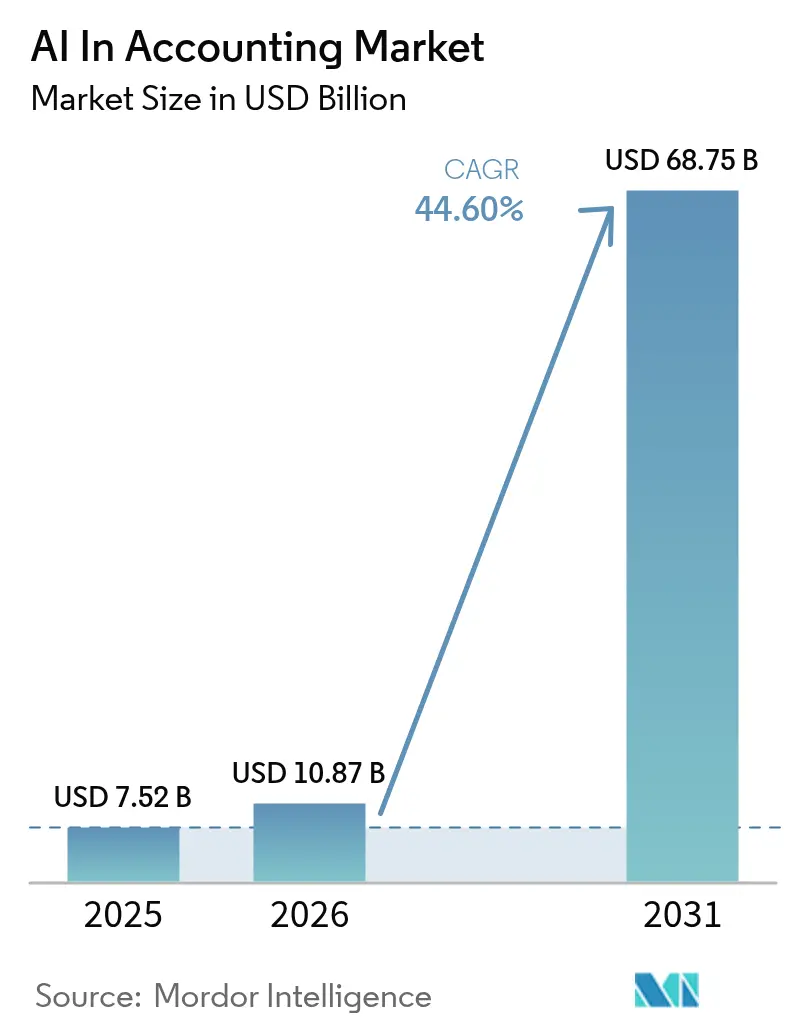
| Market Size (2026) | USD 10.87 Billion |
| Market Size (2031) | USD 68.75 Billion |
| Growth Rate (2026 - 2031) | 44.60 % |
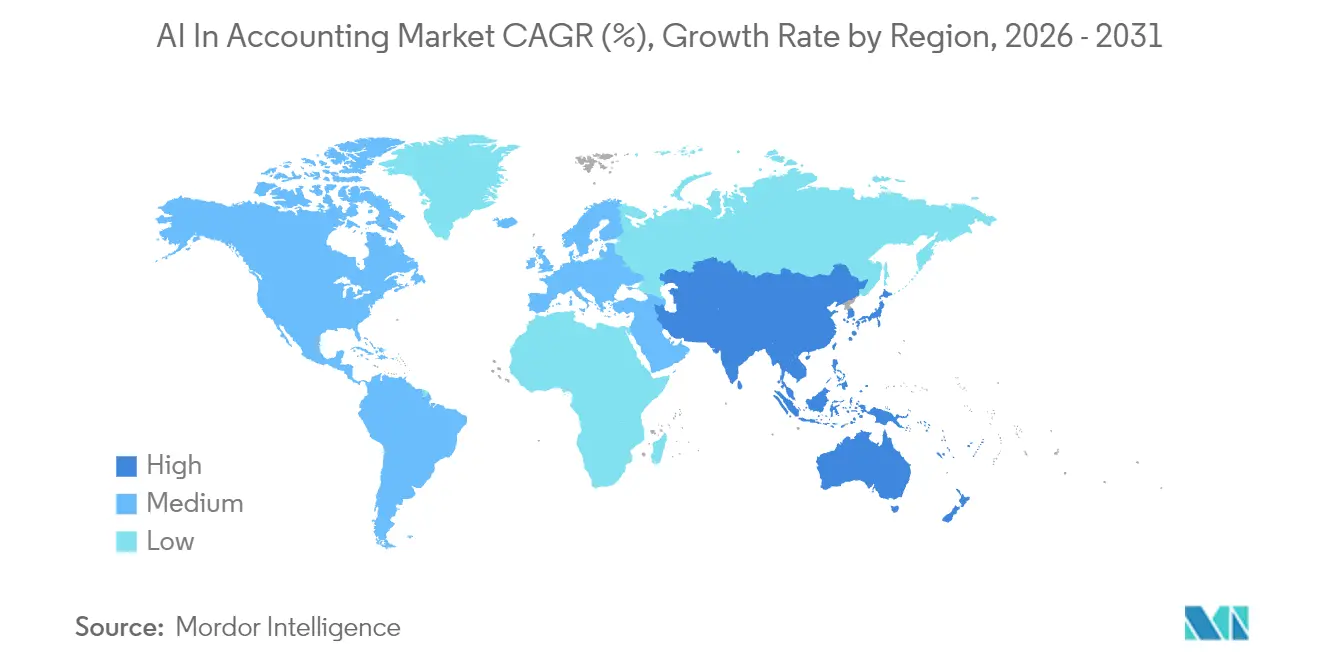
| Fastest Growing Market | Asia Pacific |
| Largest Market | North America |
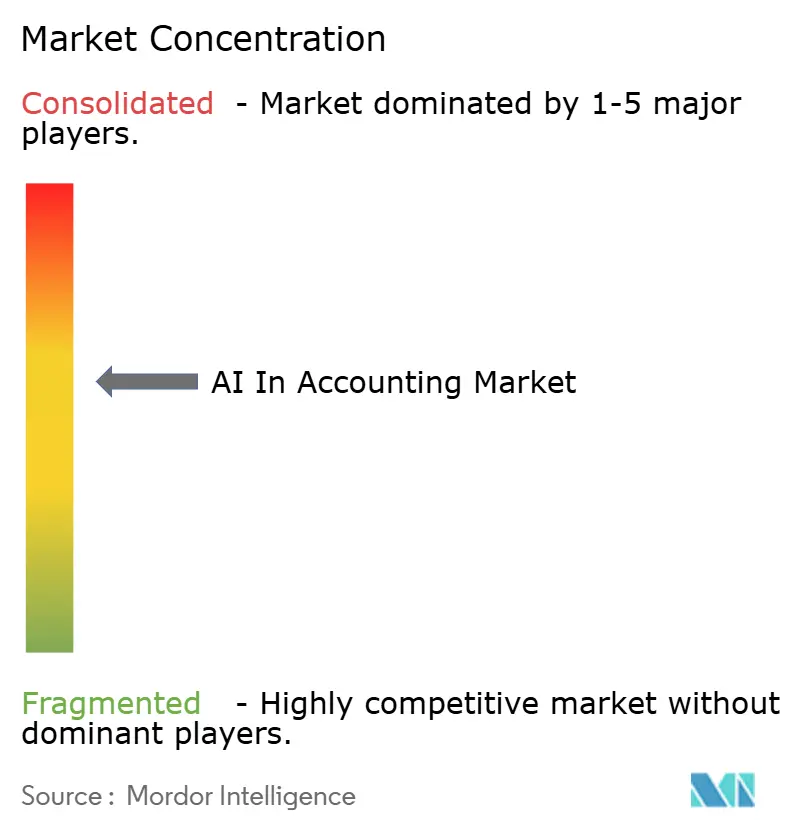
| Market Concentration | Medium |
Major Players *Disclaimer: Major Players sorted in no particular order Image © Mordor Intelligence. Reuse requires attribution under CC BY 4.0. | |
AI In Accounting Market Analysis by Mordor Intelligence
AI in Accounting market size in 2026 is estimated at USD 10.87 billion, growing from 2025 value of USD 7.52 billion with 2031 projections showing USD 68.75 billion, growing at 44.6% CAGR over 2026-2031. This rapid trajectory is powered by the convergence of generative AI breakthroughs, mandatory digitization rules for invoicing and tax submissions, and enterprise-wide cloud migrations that collectively automate labor-intensive financial workflows. Software layers ranging from optical character recognition (OCR) to large-language-model (LLM) copilots now translate unstructured invoices and receipts into structured ledger entries, allowing controllers to finalize month-end close tasks in hours instead of days. Simultaneously, scalable cloud infrastructure brings enterprise-grade AI to small and medium enterprises (SMEs) that previously lacked the computational footing for machine-learning workloads. These intertwined forces are rewriting accounting’s operating model, shifting human effort away from data entry toward anomaly resolution, variance analysis, and strategic cash-flow guidance. Vendors that combine embedded AI with tight ERP integration and jurisdiction-specific compliance updates are the most likely to capture upsell and cross-sell opportunities in the next five years. [1]
Key Report Takeaways
- By component, software held 74.05% of the AI in Accounting market share in 2025, while services are projected to expand at a 45.3% CAGR through 2031.
- By deployment mode, cloud captured 61.72% of the 2025 base and is forecast to grow at a 45.8% CAGR during the outlook period of the AI in Accounting market.
- By organization size, large enterprises commanded 75.35% value in 2025 of the AI in Accounting market, yet SMEs are set to record the fastest growth at a 45.2% CAGR to 2031.
- By application, fraud and risk management led with 33.58% revenue share in 2025 of the AI in Accounting market; automated bookkeeping is expected to surge at a 46.1% CAGR.
- By end-user industry, BFSI contributed 29.15% of spending in 2025 of the AI in Accounting market, whereas professional services and accounting firms are poised for a 45.9% CAGR.
- By geography, North America dominated with a 38.74% share in 2025 of the AI in Accounting market, while Asia-Pacific is on track for the quickest expansion at a 46.2% CAGR.
Note: Market size and forecast figures in this report are generated using Mordor Intelligence’s proprietary estimation framework, updated with the latest available data and insights as of 2026.
Market Trends and Insights
Drivers Impact Analysis of AI In Accounting Market*
| Driver | (~) % Impact on CAGR Forecast | Geographic Relevance | Impact Timeline |
|---|---|---|---|
| NLP accuracy for unstructured invoice data | +8.2% | Global, led by North America and Europe | Medium term (2-4 years) |
| Cloud-first ERP migrations among mid-market firms | +9.1% | Global, strongest in Asia-Pacific and North America | Short term (≤ 2 years) |
| SME demand for real-time cash-flow dashboards | +7.8% | Global, concentrated in emerging markets | Medium term (2-4 years) |
| Regulatory push for e-invoicing and digital taxes | +6.4% | Europe and Asia-Pacific core, spill-over to Americas | Long term (≥ 4 years) |
| Gen-AI copilots for audit workflows | +7.9% | North America and Europe, expanding to APAC | Short term (≤ 2 years) |
| Autonomous AI agents for month-end close | +6.8% | Global, led by developed-market enterprises | Medium term (2-4 years) |
| Source: Mordor Intelligence | |||
Accelerating NLP accuracy for unstructured invoice data
Natural-language models now extract key fields from invoices, contracts, and receipts at accuracy levels exceeding 95%, effectively eliminating the keyboard bottlenecks that have long stalled accounts-payable teams. Oracle’s Bill Capture module, embedded in NetSuite since 2024, showcases how pretrained models convert PDF bills into categorized expense entries automatically. Beyond extraction, rules-based engines route transactions for approval, flag duplicates, and trigger exception workflows, driving a documented 30% reduction in processing times across early adopters. The downstream payoff appears in faster vendor payments, early-payment-discount capture, and improved supplier satisfaction outcomes that reinforce the business case for further AI investments. Because structured ledgers also feed analytical dashboards, CFOs gain near-real-time visibility into working-capital positions, increasing demand for predictive treasury modules that ride on the same data backbone.
Pervasive cloud-first ERP migrations among mid-market firms
Mid-market companies are abandoning on-premise ledgers in favor of multi-tenant SaaS suites that bake AI into every journal step. Microsoft’s Copilot for Finance exemplifies the shift: controllers can generate flux analyses simply by typing plain-language prompts, leaving the LLM to query sub-ledgers, calculate variances, and draft commentary. [2] Such capabilities have redefined total cost-of-ownership equations: firms now weigh subscription fees against avoided upgrade projects, faster close cycles, and reduced audit adjustments. Cloud deployments further guarantee the underlying infrastructure for compute-intensive models, freeing finance teams from capacity planning. Because updates roll out automatically, customers continuously inherit algorithm gains without disruptive version migrations—an attribute that accelerates market penetration in sectors with lean IT staff.
SME demand for real-time cash-flow forecasting dashboards
Volatile macro conditions prompt SMEs to seek forward-looking, granular visibility into liquidity. AI-native ERP vendors such as Rillet are responding with dashboards that ingest bank-feed APIs, payment-provider data, and seasonal sales patterns to deliver week-level cash-position forecasts. Investor enthusiasm echoes the market’s urgency: Rillet raised USD 25 million in May 2025 to deepen machine-learning engines tailored to mid-market chart-of-accounts structures. Results are pronounced: trial customers trimmed idle cash balances by an average of 12% while avoiding unexpected overdraft fees. Because the functionality ships in a SaaS wrapper, SMEs avoid heavy integration lifts, fueling word-of-mouth referrals that shrink traditional sales cycles. As datasets compound, models improve continuously, reinforcing first-mover advantages among cloud-native fintech vendors.
Regulatory push for e-invoicing and digital tax submissions
Jurisdictions from India to the European Union mandate real-time invoice reporting and automated tax filings, pressuring organizations to modernize ledger infrastructures. India’s Goods and Services Tax Network requires e-way bill uploads at shipment time, compelling even small traders to adopt compliant software. In the EU, new VAT reporting rules demand standardized XML formats and near-instant validation. AI platforms excel at mapping disparate source documents to these formats, auto-calculating tax liabilities, and adjusting tax-rate logic as regulations update. Enterprises thus avoid late-filing penalties, while auditors gain a transparent trail of algorithmic logic. Over time, governments benefit from better compliance data, creating a virtuous cycle of tighter standards that further entrench AI solutions.
Restraints Impact Analysis of AI In Accounting Market*
| Restraint | (~) % Impact on CAGR Forecast | Geographic Relevance | Impact Timeline |
|---|---|---|---|
| Shortage of AI-literate accounting talent | –4.3% | Global, acute in developed markets | Long term (≥ 4 years) |
| Data-privacy and residency regulations tightening | –3.8% | Europe and Asia-Pacific, spreading globally | Medium term (2-4 years) |
| Legacy on-premise systems hindering AI integration | –5.2% | North America and Europe, large enterprises | Short term (≤ 2 years) |
| Algorithmic bias in anomaly-detection models | –2.9% | Global, concentrated in regulated industries | Medium term (2-4 years) |
| Source: Mordor Intelligence | |||
Shortage of AI-literate accounting talent
The profession faces a widening skills gap as legacy curricula lag behind automation realities. Recruiters report salary premiums of up to 20% for candidates who combine CPA credentials with Python proficiency. Firms unable to fill data-science-hybrid roles delay AI rollouts, undermining projected ROI. Professional bodies tackle the deficit with certificate courses in prompt engineering and ethics, yet the supply pipeline remains constrained. High attrition further compounds pressures, since technologists often migrate to higher-paying fintech roles. In the long run, vendors that embed low-code configuration tools may circumvent talent shortages by minimizing specialized scripting requirements.
Data-privacy and residency regulations tightening
Global privacy frameworks such as GDPR, Brazil’s LGPD, and the forthcoming EU AI Act impose strict rules on personal and financial data processing. KPMG surveys list data-sovereignty compliance as the top AI adoption barrier for 59% of CFOs. Multi-tenant SaaS providers respond by offering regional data pods and zero-knowledge encryption, but legal uncertainties persist, particularly around model training on accounting data that may include personally identifiable information. Enterprises risk fines and reputational damage if algorithms leak sensitive details, prompting conservative rollout schedules in healthcare, defense, and public-sector finance. As regulators home in on explainability, vendors must demonstrate model logic, a requirement that favors interpretable algorithms over opaque deep-learning black boxes.
*Our forecasts treat driver/restraint impacts as directional, not additive. The impact forecasts reflect baseline growth, mix effects, and variable interactions.
AI In Accounting Market Segment Analysis
By Component:
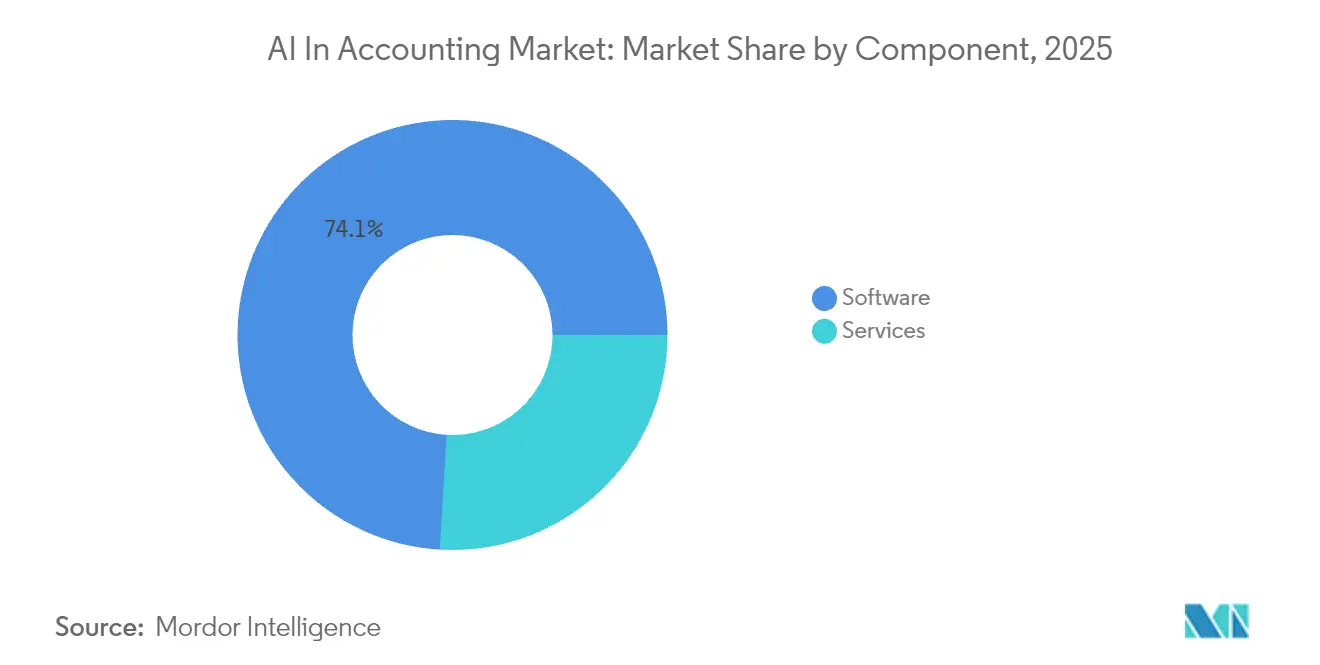
Services Surge Despite Software DominanceSoftware captured 74.05% of the AI in the Accounting market share in 2025, reflecting the indispensable nature of core ERP platforms, OCR engines, and intelligent document processing modules. These offerings provide the foundational algorithms that parse invoices, match purchase orders, and recommend accruals. Major providers such as SAP, Oracle, and Microsoft continually embed new LLM logic into their suites, cementing customer stickiness through annual subscription renewals. Nonetheless, services revenue outpaces product sales, expanding at a 45.3% CAGR as clients purchase implementation, integration, and change-management expertise. Enterprises face complex legacy landscapes, necessitating consulting partners that map bespoke workflows to standardized AI pipelines, migrate historical data sets, and calibrate models for industry-specific taxonomies.
The services uptick indicates that AI in the Accounting market size gains increasingly hinge on human advisory layers that translate abstract AI capabilities into tangible business outcomes. Training packages, managed-services retainers, and continuous optimization contracts now drive annuity streams for system integrators and boutique consultancies. Because platform updates roll out quarterly, clients need ongoing tuning and governance checks tasks that bolster the long-term services outlook. Meanwhile, software vendors explore revenue-sharing alliances with consulting ecosystems, underscoring the symbiotic evolution of product and service value pools within the broader AI in Accounting market.

By Deployment Mode:
Cloud Supremacy AcceleratesCloud solutions represented 61.72% value in 2025 and remain on a 45.8% CAGR curve, highlighting a decisive shift toward multi-tenant architectures optimized for AI workloads. Elastic compute layers enable on-demand model training, inference, and retraining cycles that on-premise servers cannot match without significant capex. Vendors push weekly algorithm refreshes, instantly propagating enhancements such as improved invoice-line-item extraction or outlier-detection heuristics to all tenants. These factors underpin the AI in Accounting market size growth among SMB segments that leverage cloud entry-level plans to bypass costly data-center expansions.
On-premise deployments decline steadily, clinging primarily to defense contractors, utilities, and public agencies bound by data-residency mandates. Hybrid models serve as interim bridges, rerouting sensitive ledgers to private clouds while offloading less-critical workloads to public infrastructure. Yet maintenance overhead for hybrid stacks often proves higher than anticipated, nudging laggards toward full SaaS adoption over the forecast horizon. The net result reinforces cloud’s leadership, consolidating vendor roadmaps around subscription monetization and platform extensibility.
By Organization Size:
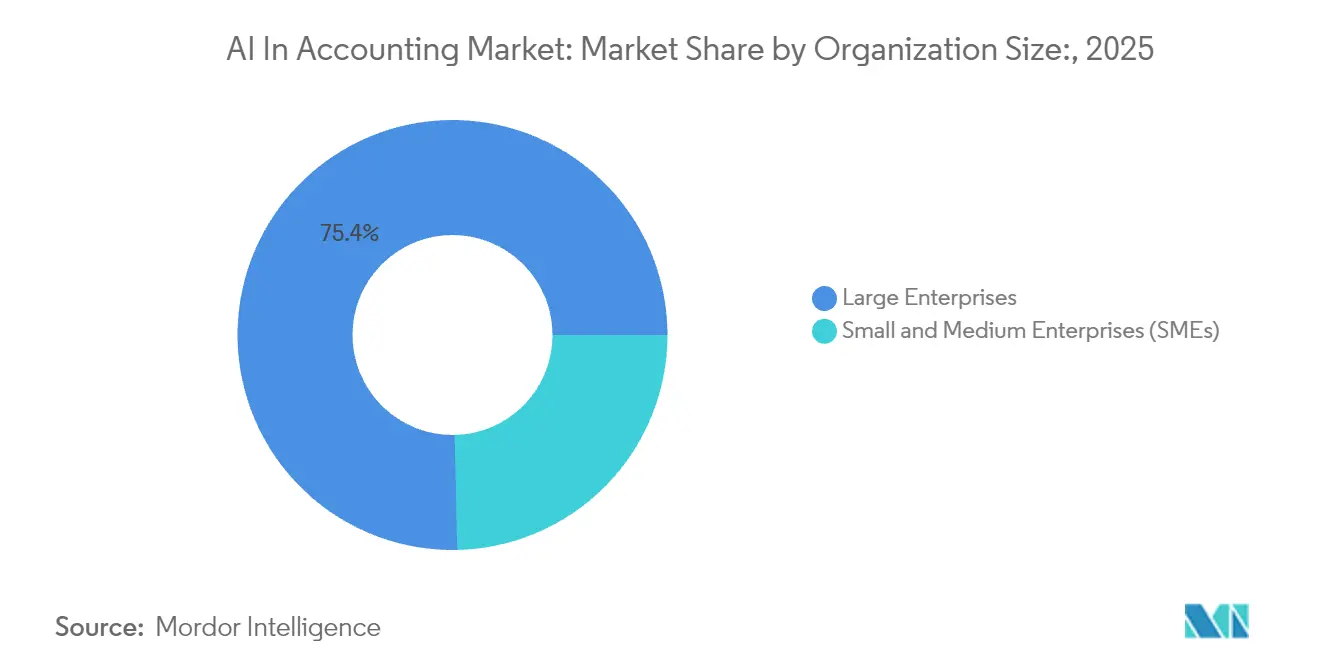
SME Growth Disrupts Enterprise DominanceLarge enterprises controlled 75.35% of spending in 2025, leveraging scale to negotiate multi-year enterprise-license agreements covering global subsidiaries. However, SME adoption accelerates at a 45.2% CAGR as intuitive AI tooling and affordable pay-as-you-go pricing erode historical entry barriers. Low-code interfaces let non-technical accountants train custom classification models without writing Python, democratizing capabilities once reserved for Fortune 500 IT teams. The diffusion broadens the AI in Accounting market footprint, injecting fresh competitive vigor into traditionally siloed regional bookkeeping arenas.
SME enthusiasm carries strategic implications: as smaller firms automate reconciliations and variance analyses, they can allocate freed labor to advisory services, compressing cycle times and competing head-to-head with larger incumbents. Cloud providers court this segment with freemium tiers and marketplace apps that plug into bank APIs within minutes. Because SMEs collectively represent millions of potential seats, they constitute the largest untapped reservoir for recurring revenue, ensuring continued market-share rebalancing through 2031.
By Application:
Automation Overtakes Risk ManagementFraud and risk management dominated 2025 allocations at 33.58%, anchored by sophisticated anomaly-detection routines that banks deploy to flag suspicious transfers in real time. Yet automated bookkeeping will outpace all other segments, climbing at a 46.1% CAGR as businesses prioritize daily transaction throughput efficiency. Template-free invoice capture, autonomous ledger postings, and AI-generated journal entries shrink close cycles and boost data freshness, confidently steering management away from hindsight reporting toward predictive steering.
The rise of automated bookkeeping underscores how core processing tasks, once perceived as too granular for AI investment, now deliver the clearest ROI via labor-hour savings and error-reduction metrics. Vendors bundle bookkeeping micro-services into modular APIs, enabling customers to cherry-pick features, an approach that accelerates penetration across verticals. Over time, these services feed upstream analytics, feeding cash-flow forecasting and budgeting modules, further fueling AI in the Accounting market share dynamics.
By End-user Industry:
Professional Services Accelerate Past BFSIBFSI institutions accounted for 29.15% spending in 2025, a logical outcome given banking’s high transaction volumes and tight anti-money-laundering standards. However, professional services and accounting firms will clock the fastest 45.9% CAGR through 2031, propelled by engagement economies of scale: one AI-enabled accountant can now manage upward of 200 client entities instead of 20. This multiplier effect disrupts traditional billable-hour models, allowing firms to introduce fixed-fee advisory packages without cannibalizing margins.
Other verticals follow differentiated adoption arcs. Manufacturers integrate AI accounting with IoT telemetry to align inventory valuation with production line output, while healthcare providers exploit AI for payer reconciliation and regulatory reporting. Government agencies embrace AI to uplift transparency, meet statutory audit cycles, and combat procurement fraud. Collectively, these cross-industry deployments enrich the addressable AI in the Accounting market size, widening its horizontal scope.
Geography Analysis
North America AI in Accounting Market
North America retained 38.74% of 2025 revenue, underpinned by deep venture-capital pools, mature cloud infrastructure, and early regulatory experimentation with digital tax regimes. North America’s leadership rides on the presence of ERP giants such as Microsoft, Oracle, and Intuit, abundant venture capital, and an innovation-friendly regulatory climate. Funding flows illustrate momentum: Numeric secured USD 28 million in 2024 to refine its generative-AI close-automation tools. U.S. enterprises integrate AI deeply into enterprise-grade ERPs, while Canadian and Mexican firms focus on SME-tailored solutions that simplify cross-border VAT reconciliation. Regulators encourage adoption via guidance on acceptable AI audit-trail standards, reducing legal uncertainty and clearing procurement backlogs.
APAC AI in Accounting Market
Still, Asia-Pacific exhibits a blistering 46.2% CAGR, driven by national AI roadmaps, fast-scaling digital-payments ecosystems, and government e-invoicing mandates. India stands out: 73% of businesses plan AI deployment in accounting workflows by 2025, eclipsing the global average of 52%. China’s manufacturing modernization and Japan’s productivity-focused corporate reforms further amplify demand. Asia-Pacific’s surge is multi-faceted. India’s Institute of Chartered Accountants debuted CA GPT to arm 70,000 practitioners with AI-driven annual report analytics, signaling official endorsement of technology refresh. China pairs AI accounting with its vast manufacturing base, letting finance teams link production telemetry to real-time cost-of-goods-sold calculations. Tech-forward economies such as Singapore and Australia function as integration hubs, hosting regional data centers that satisfy sovereignty constraints and accelerate onboarding for neighboring markets.
EMEA and LATAM AI in Accounting Market
Europe, while smaller in absolute AI in the Accounting market size, wields a hefty influence on standards. The EU AI Act forces vendors to document model provenance, bias checks, and fallback procedures. Germany’s industrial champions upgrade finance stacks to comply with upcoming machine-readable e-invoice mandates. France commands attention through unicorns like Pennylane, which closed successive funding rounds to offer full-stack AI bookkeeping services. Smaller economies embrace pan-European SaaS platforms that alleviate tax-compliance complexity across 27 member states. Collectively, these conditions establish Europe as a crucible for responsible-AI practices that ripple into global vendor roadmaps. Latin America and the Middle East, and Africa progress at more measured paces, but targeted cloud-datacenter expansions and fintech sandboxes position these regions for catch-up growth later in the decade.
Regulatory Landscape
AI in accounting deployments are increasingly shaped by extensions of existing tax, audit, privacy, and AI governance regimes rather than a single accounting-specific AI rulebook. In the United States, the IRS Office of Professional Responsibility issued Alert 2026-19 in June 2026, clarifying that Treasury Circular 230 duties (including due diligence, competence, and confidentiality) apply unchanged when practitioners use AI in tax work. The guidance reinforces firm obligations to supervise AI outputs and protect taxpayer data. Professional guidance also tightened around technology-enabled audits through the AICPA Technical Questions and Answers (TQAs) 8400.01-8400.08 released in January 2026, which provide nonauthoritative direction on risk assessment and the use of automated tools within financial statement audits.
In Europe, the EU AI Act (Regulation (EU) 2024/1689) and its phased implementation raise transparency, documentation, and oversight expectations for AI tools used in regulated financial contexts. European Commission guidance on AI Act transparency obligations under Article 50 becomes enforceable in August 2026, which pushes vendors and deployers to operationalize disclosures, human oversight processes, and governance artifacts that finance and audit stakeholders can evidence during assurance and procurement. Alongside GDPR and other data protection frameworks, these requirements reinforce demand for regional data residency options, traceable model behavior (audit trails), and controls that align AI-enabled accounting processes with established internal control over financial reporting practices.
Value Chain Analysis
The AI in accounting value chain begins with data generation and ingestion (invoices, receipts, contracts, bank feeds, payment rails, and ERP subledgers), then moves through normalization and extraction layers such as OCR and intelligent document processing. After that, model-led classification, reconciliation, anomaly detection, and narrative generation feed general-ledger posting, reporting, and compliance workflows. Foundational infrastructure suppliers (cloud compute and model providers) support application vendors, including ERP suites and specialist tools for close, AP, and audit, while system integrators and advisory firms deliver implementation, integration, change management, and managed services that adapt models and controls to client-specific charts of accounts, policies, and tax rules.
Distribution and monetization typically occur through SaaS subscriptions, marketplaces, and partner ecosystems, with a growing emphasis on API-level integration into general ledger and productivity tools to reduce workflow friction. Recent ecosystem moves reflect a shift from point automation toward agentic execution across the chain. Deloitte expanded connected agentic capabilities within its Deloitte Omnia audit platform in June 2026, and KPMG entered a global alliance with Anthropic in May 2026 to deploy Claude-enabled workflows through its Digital Gateway, strengthening the link between model providers and professional services. Emerging AI-native vendors also increasingly sit in the execution layer, including July 2026 launches from Rational (AI employees for accounting firms) and Puzzle (AI Close within an AI suite), pointing to a wider set of specialist suppliers between the model layer and the end-user firm.
Competitive Landscape
The AI in Accounting market blends entrenched ERP conglomerates and agile AI-native challengers. SAP, Oracle, and Microsoft capitalize on installed customer bases, embedding LLM assistants into flagship suites and bundling AI extensions within existing contracts. Meanwhile, verticalized startups such as Rillet, Candis, and Vic.ai carve foothold by targeting specific pain points invoice capture, spend controls, or multi-entity consolidation, and showcasing time-to-value metrics unattainable in heavyweight ecosystems. Consolidation intensifies as incumbents snap up niche specialists to enrich product portfolios and preempt competitive encroachment.
Strategic investment themes emphasize interoperability, security, and explainability. BlackLine’s Studio360, launched in January 2025, integrates AI across the entire close-to-disclose continuum, positioning the firm as a finance-transformation orchestrator. [4] FloQast’s agent-driven platform opts for ISO/IEC 42001 compliance to reassure audit committees that AI adheres to ethical guidelines. Investment in proprietary foundation models remains limited; rather, vendors fine-tune open-source LLMs with domain-specific ledgers to control costs while preserving differentiation through proprietary training data.
Regionally, North American players dominate enterprise segments, but Europe and Asia produce competitive upstarts that excel in localized compliance content. Market concentration hovers in mid-range territory: the top five vendors control roughly 55% of revenue, leaving ample runway for challenger brands. Looking ahead, competitive intensity will likely pivot on governance tooling, user-experience simplicity, and partner-ecosystem breadth rather than raw algorithmic horsepower, a shift that could favor companies adept at bundling AI utilities into cohesive accounting-process narratives.
AI In Accounting Industry Leaders
-
Intuit Inc.
-
Xero Limited
-
Sage Group plc
-
SAP SE
-
Oracle Corporation (NetSuite)
- *Disclaimer: Major Players sorted in no particular order
AI In Accounting Market Companies Covered in this Report
- Intuit Inc.
- Xero Limited
- Sage Group plc
- SAP SE
- Oracle Corporation (NetSuite)
- Microsoft Corporation
- Google LLC
- IBM Corporation
- Epicor Software Corporation
- Zoho Corporation Pvt Ltd.
- SMACC GmbH
- Botkeeper Inc.
- VIC.AI Inc.
- FreshBooks Invoice Software Inc.
- Tipalti Solutions Ltd.
- BlackLine Inc.
- Docyt Inc.
- Datarails Ltd.
- AppZen Inc.
- Receipt Bank Ltd. (Dext Software)
- KarbonHQ Pty Ltd.
- MindBridge Analytics Inc.
- Validis Holdings Ltd.
- Inflo Limited
- CaseWare International Inc.
Market Opportunities and Future Outlook
A key whitespace is governance-first AI that fits professional accountability requirements while still delivering automation, particularly for tax, close, and audit workflows where traceability matters. The IRS Office of Professional Responsibility Alert 2026-19 (June 2026) reinforces that practitioners remain responsible for AI-assisted work under Circular 230, which creates a buying criterion for platforms that provide auditable prompts and outputs, supervisory workflows, and data protection features aligned with confidentiality obligations. In parallel, Europe-specific productization around EU AI Act transparency obligations (enforceable from August 2026 under Article 50 guidance) supports opportunities for vendors that ship prebuilt documentation, disclosure tooling, and monitoring capabilities that finance leaders can operationalize without bespoke compliance programs.
Another opportunity zone is the transition from copilots to human-in-the-loop agents that execute multi-step accounting processes, especially for resource-constrained accounting firms and SME finance teams. Evidence of adoption through 2026 shows this direction taking shape: EY began a global roll-out of agentic AI within EY Canvas in April 2026 for audit work at scale. Vendors have also launched workflow-embedded systems aimed at close and tax execution rather than standalone chat interfaces, including Ramp (Ramp Stack, June 2026), Canopy (tax workflow automation, July 2026), and Puzzle (AI Close, July 2026). As these offerings expand, integration depth into core ledgers and practice management systems, along with controls for human review and exception handling, is becoming a practical differentiation lever for both incumbents and AI-native entrants.
Recent Industry Developments in AI In Accounting Market
- July 2026: Xero announced new AI innovations at Xerocon London, including deeper integrations with Microsoft 365 Copilot that let users work with live Xero financial data inside common productivity apps. The update reduces context switching for SMB owners and accountants and reinforces Xero’s position as a workflow hub rather than a standalone accounting system.
- May 2026: Intuit announced enhancements to Intuit Enterprise Suite for mid-market businesses, including capabilities that support more complex, multi-entity finance operations and tighter process automation. This expands Intuit’s reach beyond small business bookkeeping into higher-value, close-intensive environments where AI-led consolidation and controls are central to buying decisions.
- November 2025: Intuit and OpenAI announced a collaboration aimed at advancing personalized financial intelligence experiences across Intuit’s products. The partnership signals continued investment in integrating frontier-model capabilities into consumer and business finance workflows, raising the competitive bar for embedded generative AI across accounting-adjacent use cases.
AI In Accounting Market Report Scope and Research Methodology
Market Definition and Coverage
For this methodology, the market includes AI-enabled software and related services that help automate, assist, or improve accounting work such as bookkeeping, close, reporting, compliance, and controls across organizations.
Scope exclusions: We exclude broader enterprise AI spending that is not tied to accounting workflows, and we do not count general IT infrastructure spend unless it is packaged with an AI accounting solution.
Segments Covered in This Report
- By Component
- Software
- Core Platforms
- Point Solutions (OCR, RPA etc.)
- Services
- Implementation and Integration
- Training and Managed Services
- Software
- By Deployment Mode
- On-Premise
- Cloud
- Hybrid
- By Organization Size
- Small and Medium Enterprises (SMEs)
- Large Enterprises
- By Application
- Fraud and Risk Management
- Invoice Classification and Approvals
- Reporting and Compliance
- Automated Bookkeeping
- Forecasting and Budgeting
- Other Applications
- By End-user Industry
- BFSI
- Professional Services and Accounting Firms
- Retail and E-commerce
- Manufacturing
- Healthcare
- Government and Public Sector
- Other End-user Industries
- By Geography
- North America
- United States
- Canada
- Mexico
- South America
- Brazil
- Argentina
- Chile
- Rest of South America
- Europe
- Germany
- United Kingdom
- France
- Italy
- Spain
- Rest of Europe
- Asia-Pacific
- China
- India
- Japan
- South Korea
- Malaysia
- Singapore
- Australia
- Rest of Asia-Pacific
- Middle East and Africa
- Middle East
- United Arab Emirates
- Saudi Arabia
- Turkey
- Rest of Middle East
- Africa
- South Africa
- Nigeria
- Rest of Africa
- Middle East
- North America
Data Sources, Market Sizing, and Validation
Desk Research
Desk research was used to set the market boundaries and to gather the background numbers needed to build the demand pool. We relied on public and official sources such as the US Bureau of Economic Analysis (industry output), US Census Bureau (business and payroll indicators), OECD (digitalization and productivity indicators), Eurostat (enterprise ICT usage), and World Bank (macro and SME indicators) to keep inputs consistent across countries.
We also reviewed audited financial filings, investor presentations, product documentation, and reputable press coverage to understand how AI features are sold and bundled in accounting tools. For hard-to-verify corporate revenue splits and ownership linkages, we used paid subscriptions focused on company financials and intelligence, plus patent databases to track where innovation is moving in document capture, anomaly detection, and financial forecasting. The sources listed here are illustrative, and we used other public documents as cross-checks during the research process.
Primary Interviews and Surveys
Primary work was used to verify adoption patterns and pricing logic across cloud, on-premise, and hybrid deployments, and then to sense-check the pace of feature upgrades that can affect average contract values. We spoke with a mix of software providers, implementation partners, and end users (finance leaders and accounting teams) across APAC, EMEA, and the Americas, so the final assumptions were not driven by one geography or one buyer type.
Distribution of primary research fieldwork respondents
| Company type | Respondent position | Region |
|---|---|---|
| Top tier: 28% | CXOs: 16% | APAC: 41% |
| Mid tier: 56% | Functional/Unit leaders: 30% | EMEA: 33% |
| Smaller Players: 16% | Managers: 54% | Americas: 26% |
Market-Sizing & Forecasting
The sizing model starts with a top-down build that reconstructs the addressable accounting automation pool by linking enterprise and SMB counts, finance function digitization signals, and the portion of accounting work being shifted to AI-assisted workflows. Once that demand pool was formed, it was converted into spend by applying adoption levels and typical price ranges for software and services, then adjusted by deployment mix since cloud subscriptions and implementation services scale differently.
To keep the totals realistic, we corroborated the output using selective bottom-up approximations such as sampled vendor revenue ranges, channel checks with implementers, and a simple volume times average selling price view for key use cases like invoice data capture, close automation, and compliance monitoring. Inputs that mattered most included cloud accounting and ERP migration rates, the share of workflows using OCR and document understanding, average contract value progression as features expand, implementation intensity by organization size, and regional wage pressure that changes the payback case. For forecasting, we leaned on scenario analysis supported by primary feedback, since adoption can shift quickly when new AI features are released or when regulatory reporting pushes digitization. Where bottom-up signals were incomplete, we used conservative proxying based on peer group pricing bands and regional penetration ranges, then rechecked with respondents before finalizing.
Data Validation & Update Cycle
Validation was done in layers so the final values stayed consistent with real-world signals. We compared model outputs against independent indicators like software subscription growth patterns, enterprise cloud spending direction, and the observed shift toward automated close and compliance routines, and then investigated outliers before sign-off.
Variance checks were run across regions and buyer sizes to ensure assumptions did not drift from what interviewees described. Numbers were also reviewed by another analyst to catch logic breaks and unit errors. Reports are refreshed annually, with interim updates triggered when a material event changes pricing, bundling, regulation, or adoption patterns. Before delivery, a fresh final pass is completed so clients receive the latest updated view.
Mordor Intelligence's Accounting Artificial Intelligence Market Sizing Compared With Other Published Estimates
Published market numbers for AI in accounting often disagree because the scope line is drawn differently, and the same features can be counted in different buckets. Differences also show up when one estimate leans heavily on a single adoption survey, or when pricing is assumed to rise faster than what buyers accept.
The key gap drivers for this market usually come down to whether the estimate includes only dedicated accounting tools, or also counts adjacent finance automation such as payables, procurement workflows, and broader ERP AI add-ons. Another common driver is how hybrid deployments are treated, since some models count all platform spend once any AI feature is enabled, while others count only the AI-enabled accounting module value. In our view, the spread is mostly explained by counting AI accounting spend only when it is attached to defined accounting workflows (like close, reporting, compliance, and bookkeeping), which is the step applied by Mordor Intelligence.
Benchmark comparison
| Source | Market Size | Gaps in Research Methodology |
|---|---|---|
| Mordor Intelligence | USD 10.87 B (2026) | |
| Global Consultancy A | USD 7.52 B (2025) | Uses a different base year and appears to blend broader finance function AI spending with accounting use cases, which can pull in adjacent automation beyond accounting workflows. |
| Regional Consultancy B | USD 1.29 B (2025) | Likely limits the scope to a narrower set of AI accounting software revenues and applies a more conservative adoption curve, which can undercount services and hybrid deployment value. |
The table shows that the biggest swings come from scope expansion into nearby finance processes and from how fast adoption and pricing are assumed to scale. By keeping the inputs tied to clear workflow-based demand signals and validating price and uptake assumptions through repeated checks, the final market size stays traceable and repeatable.
Key Questions Answered in the Report
What is the forecast value of global AI in Accounting by 2031?
The sector is projected to reach USD 68.75 billion by 2031, expanding from USD 10.87 billion in 2026.
Which region is expected to grow the fastest through 2031?
Asia-Pacific is set to record a 46.2% CAGR, outpacing all other regions.
Which application area will see the quickest expansion?
Automated bookkeeping will lead growth with a projected 46.1% CAGR to 2031.
How are SMEs influencing adoption trends?
Affordable cloud SaaS and low-code AI tools are driving SME adoption at a 45.2% CAGR, shifting competitive dynamics.
What are the main barriers to implementation?
The biggest obstacles include a shortage of AI-literate accountants, tighter data-privacy laws, and legacy system constraints.
Which deployment model holds the largest revenue share?
Cloud deployments led with 61.72% share in 2025 and continue to dominate because of scalable compute resources for AI.