
Market Overview
| Study Period | 2018 - 2031 |
|---|---|
| Forecast Data Period | 2026 - 2031 |
| Base Year Market Size (2025) | USD 1.51 Billion |
| Market Size (2026) | USD 1.54 Billion |
| Market Size (2031) | USD 1.73 Billion |
| Growth Rate (2026 - 2031) | 2.26 % |
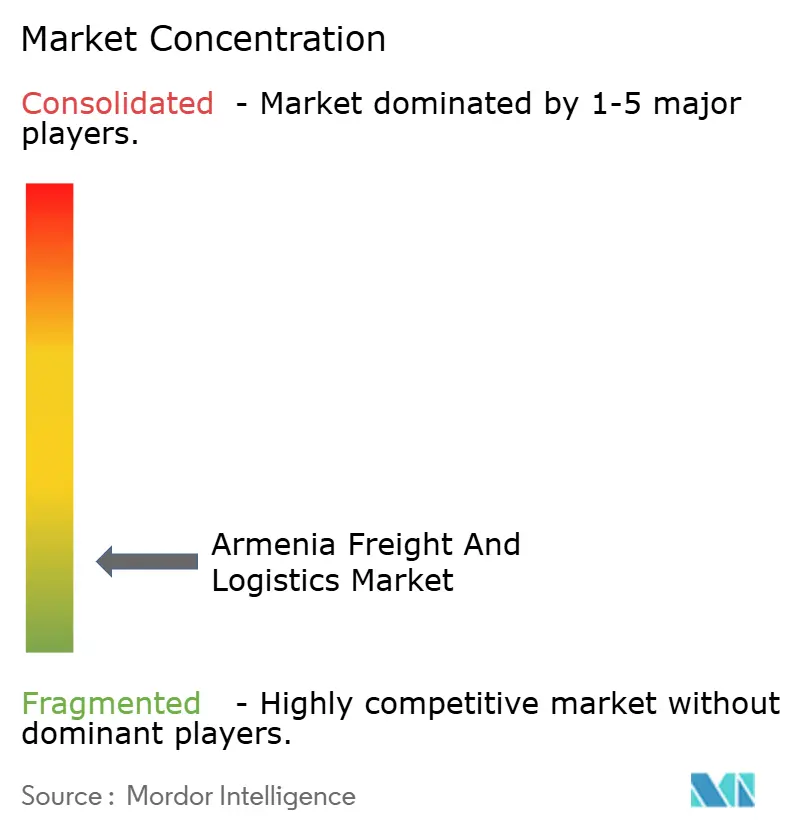
| Market Concentration | Low |
Major Players *Disclaimer: Major Players sorted in no particular order Image © Mordor Intelligence. Reuse requires attribution under CC BY 4.0. | |
Armenia Freight And Logistics Market Analysis by Mordor Intelligence
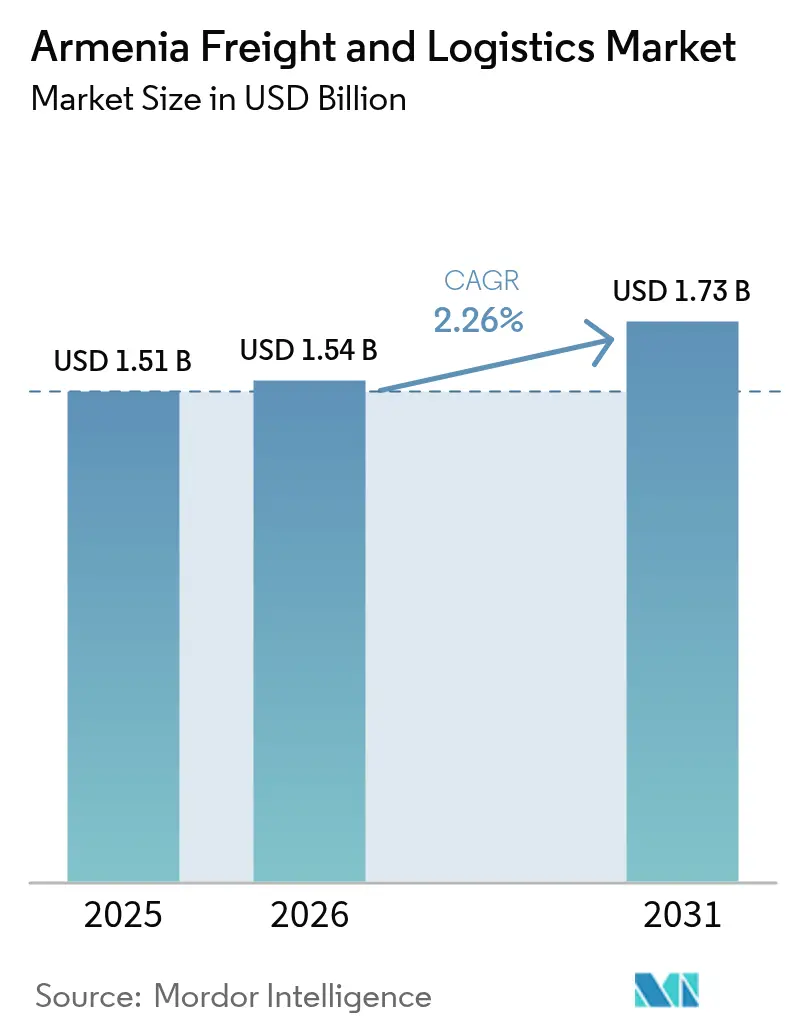
The Armenia freight and logistics market size is expected to grow from USD 1.51 billion in 2025 to USD 1.54 billion in 2026 and is forecast to reach USD 1.73 billion by 2031 at 2.26% CAGR over 2026-2031. Measured growth is anchored in corridor‐focused public spending, a policy mix that aligns Eurasian Economic Union obligations with the Comprehensive and Enhanced Partnership Agreement (CEPA), and the country’s ambition to monetize its location between the Black Sea and the Persian Gulf. Rising transit volumes, particularly Russian cargo moving through the Georgia-Armenia axis, balance headwinds such as import-heavy trade flows, an aging truck fleet, and closed borders with Turkey and Azerbaijan that channel 85% of shipments through Georgian ports. Investments in the North-South Road Corridor, including EUR 236 million (USD 260.45 million) for the Sisian-Kajaran stretch, are shortening domestic haulage times and lifting service reliability. Meanwhile, a USD 37 million dry-port project in Shirak Province aims to process 4.7 million tons of cargo in its first year, signaling the state's intent to build an inland gateway for multimodal flows.
Key Report Takeaways
- By end user industry, wholesale and retail trade captured 30.12% revenue share in 2025, whereas manufacturing is poised to register the quickest 2.39% CAGR in the Armenia freight and logistics market size between 2026-2031.
- By logistics function, freight transport held 46.68% of the Armenia freight and logistics market share in 2025, while courier, express, and parcel (CEP) services are projected to log the fastest 2.61% CAGR between 2026-2031.
- By freight transport mode, road freight held a 75.70% revenue share in 2025; air freight is forecast to expand at the highest 2.50% CAGR between 2026-2031.
- By CEP, domestic deliveries commanded 76.34% of 2025 revenue, while international CEP is expected to advance at a 2.79% CAGR between 2026-2031.
- By warehousing and storage, non-temperature controlled held 81.55% share in 2025; temperature controlled storage is anticipated to grow at a 2.24% CAGR between 2026-2031.
- By freight forwarding mode, air freight forwarding dominated with 77.20% 2025 revenue share and is also projected to be the fastest-growing at a 2.81% CAGR between 2026-2031.
Note: Market size and forecast figures in this report are generated using Mordor Intelligence’s proprietary estimation framework, updated with the latest available data and insights as of 2026.
Armenia Freight And Logistics Market Trends and Insights
Drivers Impact Analysis*
| Driver | (~) % Impact on CAGR Forecast | Geographic Relevance | Impact Timeline |
|---|---|---|---|
| North-South road corridor investment by government has unlocked transit potential | +0.5% | National | Long term (≥ 4 years) |
| Mining-sector capex surge creating oversize/project-cargo opportunities | +0.4% | Syunik and Lori provinces | Medium term (2-4 years) |
| Russian cargo, once diverted by war, now reroutes through Georgia-Armenia corridor | +0.3% | Border crossings with Georgia | Short term (≤ 2 years) |
| Returnees and the diaspora drive SME exports of high-value processed foods | +0.2% | Export-oriented regions | Medium term (2-4 years) |
| EU-Armenia CEPA standards raising demand for certified 3PL services | +0.2% | National | Medium term (2-4 years) |
| Digital trade facilitation platforms streamlining cross-border documentation | +0.1% | National, with focus on border crossings and customs zones | Short term (≤ 2 years) |
| Source: Mordor Intelligence | |||
Mining-Sector Capex Surge Creating Oversize/Project-Cargo Opportunities
Metal mining generated 39.3% of export receipts and 5.4% of state revenue in 2024, with Zangezur Copper-Molybdenum Combine leading output[1]EITI Armenia, “Mining sector revenue contribution report 2024,” eiti.org . New exploration, such as Sagamar LLC’s 5,000 ha Chknagh-Armanis license, drives a flow of equipment consignments weighing hundreds of tons, forcing shippers to deploy multi-axle trailers and escort services. Specialized heavy-haul demand is emerging as a niche where operators with engineering know-how can capture high margins despite the broader industry’s fragmented fleet profile.
Russian Cargo, Once Diverted by War, Now Reroutes Through Georgia-Armenia Corridor
Transit volumes on the Middle Corridor climbed from 1.1 million tons in 2022 to 2 million tons in 2023[2]Caspian Policy Center, “Middle Corridor trade doubles amid war,” caspianpolicy.org . Container traffic expanded 33% over the same span, underscoring Armenia’s role as a buffer route between Russian suppliers and Gulf buyers. Operators gain volume but also shoulder geopolitical risk, as any flare-up in regional relations can quickly redirect flows elsewhere.
North-South Road Corridor Investment by Government has Unlocked Transit Potential
The Kajaran-Agarak leg broke ground in early 2024 and features 17 bridges, two tunnels, and five hubs built to European specifications. By tying Iran’s border to Georgia’s ports, the highway slices door-to-door transit times between Mumbai and Moscow from six weeks to three. Completed segments already register faster customs clearance and smoother axle weight enforcement, raising confidence among foreign forwarders.
Returnees and the Diaspora Drive SME Exports of High-Value Processed Foods
Programs such as iGorts channel diaspora skills and capital into agro-processing ventures that require cold chains and traceability. SMEs selling organic preserves and ready-to-eat specialties rely on temperature-controlled consignments and direct-to-consumer parcel flows targeting Armenian expatriate communities across North America and the EU.
Restraints Impact Analysis*
| Restraint | (~) % Impact on CAGR Forecast | Geographic Relevance | Impact Timeline |
|---|---|---|---|
| Land-locked geography and closed borders with Turkiye/Azerbaijan elevate transit times | -0.6% | National | Long term (≥ 4 years) |
| Import-heavy trade imbalances lead to high empty-backhaul ratios in Armenia | -0.3% | Return journeys from ports | Medium term (2-4 years) |
| Fragmented truck fleet (≥70 % pre-Euro 3) keeps operating costs high | -0.2% | National | Medium term (2-4 years) |
| Rigid EAEU customs procedures slowing digital freight documentation roll-out | -0.1% | Cross-border trade | Short term (≤ 2 years) |
| Source: Mordor Intelligence | |||
Land-Locked Geography and Closed Borders with Turkey/Azerbaijan Elevate Transit Times
Container rates from Far-East ports to Black Sea gateways stand at USD 4,100 per 40-ft box, a premium that filters into domestic retail prices. Dependence on a single Georgian corridor lengthens Europe-bound hauls by 2-3 days versus a hypothetical open Turkish frontier, while the shuttered Azerbaijan border blocks cost-effective Caspian crossings.
Import-Heavy Trade Imbalances Lead to High Empty-Backhaul Ratios in Armenia
Imports reached USD 16.80 billion against exports of USD 13.02 billion in 2024, pushing empty-backhaul rates beyond 40% on European lanes. Carriers recoup losses by raising outbound rates, a cycle that dents the price competitiveness of Armenian exporters.
*Our forecasts treat driver/restraint impacts as directional, not additive. The impact forecasts reflect baseline growth, mix effects, and variable interactions.
Segment Analysis
By End User Industry: Wholesale Trade Leads Diversified Demand
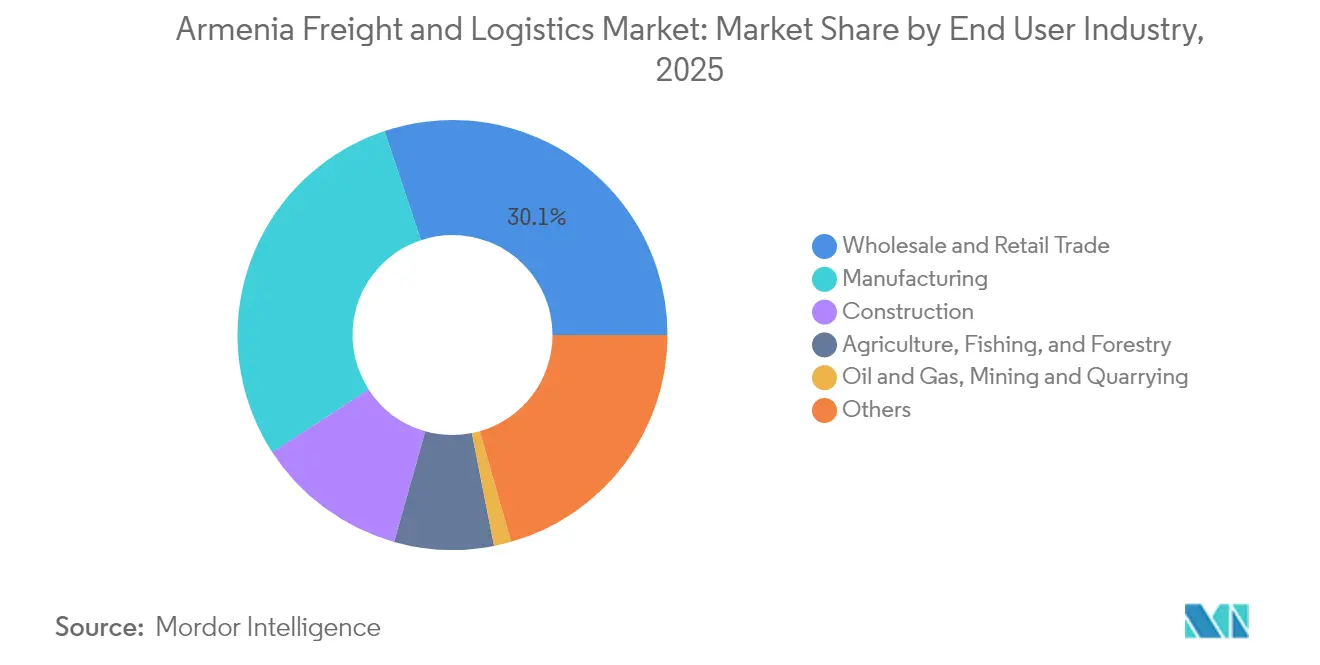
Wholesale and retail trade retained a 30.12% revenue share in 2025 as Armenian distributors absorbed diverted Russian throughput, especially fast-moving consumer goods pivoted from Baltic ports. The Armenia freight and logistics market size derived from this vertical climbed to USD 0.46 billion in the base year, feeding continuous demand for palletized storage and groupage services. Retailers reward 3PLs that deliver 99.5% on-time warehouse receipts, nudging providers to adopt radio-frequency identification for case-level accuracy.
Manufacturing registers the fastest 2.39% CAGR between 2026-2031, aided by diaspora equity in processed foods and electronics sub-assemblies. Plant operators must satisfy CEPA traceability standards, stimulating certified third-party logistics contracts for temperature control, hazardous material handling, and bonded warehousing. Over the forecast horizon, processed food lines targeting the EU could push cold-chain lane utilization above 70%, unlocking scale economies despite Armenia’s relatively modest domestic demand.


By Logistics Function: Freight Transport Dominates Multi-Modal Operations
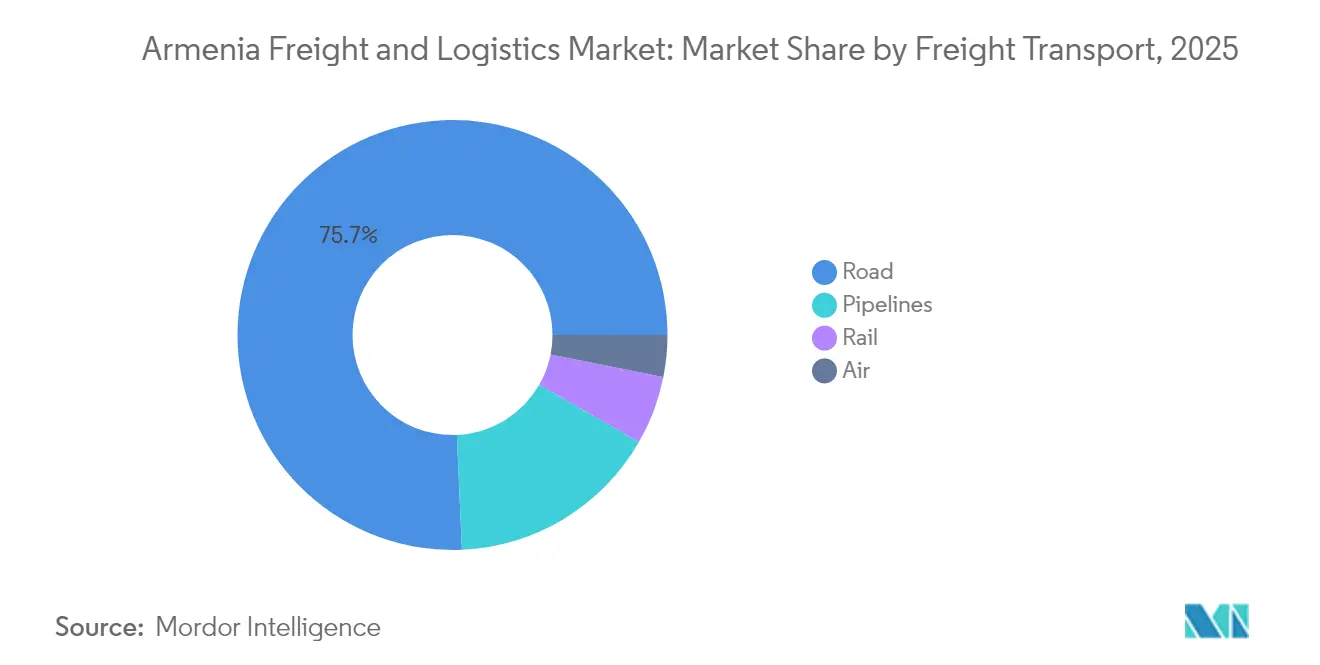
Freight Transport commanded 46.68% of the Armenia freight and logistics market share in 2025. Road freight transport contributed 75.70% of that value, leveraging 377 km of rebuilt Lori Province roads financed with USD 223 million between 2018-2023. Forwarders note that the modality’s flexibility offsets terrain constraints, yet the prevalence of pre-EURO 3 rigs drags average fleet age above 18 years. Rail retains a sub-8% tonnage slice, but niche minerals and bulk cereal flows keep the mode operationally relevant. Air freight’s 0.26% of load picked (tons) share belies its role in high-value electronics and pharmaceuticals, segments willing to pay USD 1.41 per ton-km versus USD 0.12 on road.
Courier, express, and parcel (CEP) services sit at the inflection of e-commerce and diaspora gifting. CEP services are expected to grow at 2.61% CAGR between 2026-2031, underpinned by same-day delivery coverage in Yerevan, Gyumri, and Vanadzor. Automated sorters and micro-fulfillment hubs shrink last-mile costs, while blockchain-anchored smart contracts reduce cash-on-delivery disputes. As international CEP accelerates, carriers are co-loading outbound parcels with high-yield air cargo to smooth space. Government incentives on customs pre-clearance for sub-USD 200 parcels further compress delivery windows to North American destinations.
By Courier, Express, and Parcel Destination: Domestic Growth Outpaces International
Domestic CEP deliveries are sustaining 76.34% market share in the segment in 2025. The e-commerce gross merchandise value (GMV) grew to USD 766.42 million in 2025 and will approach USD 1.08 billion by 2029, sharpening demand for same-day routing algorithms.
International CEP, while smaller, is on a 2.79% CAGR (2026-2031) trajectory as diaspora-linked gifting surges during religious and national holidays. Carriers mitigate Armenia’s landlocked limitations by consolidating Yerevan uplift into 3 weekly Narita-Tbilisi freighters, then trucking to Armenian delivery nodes within 12 hours.
By Warehousing and Storage Temperature Control: Non-Controlled Dominates Operations
Non-Temperature Controlled facilities represented 81.55% of the warehousing and storage segment during 2025 in the Armenia freight and logistics market. Unit economics are attractive, operating cost per m² averages USD 3.20 monthly, half the chilled-storage equivalent.
Yet, temperature-controlled is expected to expand at a 2.24% CAGR (2026-2031), catalyzed by EU-standard food lines and vaccine-grade pharma requiring +2°C to +8°C regimes. The Syunik Customs and Logistics Centre’s EUR 12 million (USD 13.24 million) financing includes modular cold stores sized for 12,000 pallet places, a pivotal benchmark for provincial infrastructure.
By Freight Transport Mode: Road Infrastructure Drives Modal Choice
Road freight undertakings accounted for 75.70% of the Armenia freight transport segment in 2025, moving high freight volumes over a 7,700 km network. The network’s interstate share sits at 1,400 km, with tolling studies under review to finance maintenance without inflating shipper costs. Planned truck weighing stations aim to cut overloading damage, a chronic issue that lifts per-kilometer depreciation.
Air freight, though a 0.26% sliver on load picked (tons), is slated for a 2.50% CAGR (2026-2031), propelled by Zvartnots International Airport’s 60-city connectivity and terminal expansion that lifts annual cargo capacity toward 40,000 tons. Consignments range from pharmaceuticals to IT components, lines where transit time beats price elasticity. Rail stabilizes at around 7.93% of the load picked (tons) share as Georgia-Black Sea bottlenecks limit competitive throughput. Should the discussed Armenia-Iran railway proceed, mineral exporters forecast a modal pivot that halves the distance to Persian Gulf ports.
By Freight Forwarding Mode: Air Services Command Premium Positioning
Air freight forwarding earned 77.20% of forwarding revenues in 2025, buoyed by electronics, precision machinery, and active pharmaceutical ingredients that tolerate freight rates above USD 7.50 per kg.
Air freight forwarding remained the fastest growing sub-segment as well, growing at a 2.81% CAGR between 2026-2031. Freight forwarders leverage the Digital Trade Corridor’s customs-pre-lodgment to shave documentation cycles to under four hours. Multimodal specialists focus on project cargo, orchestrating break-bulk deliveries of 120-ton mine crushers through Poti port, then onto hydraulic dollies across the mountainous Kapan road.
Geography Analysis
Armenia’s 257.6 km of roads per 1,000 km² yields functional domestic reach, yet only the Georgian and Iranian borders are open to trucks year-round, funneling 85% of external trade through Georgian ports. Modernization of the Friendship Bridge doubled axle capacity and provided an alternate passage when Georgian customs intensified checks on Russia-bound loads in 2024. The Armenia freight and logistics market, therefore, balances proximity advantages with political sensitivity, a duality visible every time a policy change in Tbilisi cascades into Yerevan rate sheets.
The North-South Road Corridor’s EUR 236 million (USD 260.45 million) Sisian-Kajaran tranche features gradient cuts and 1.5 km tunnels to secure year-round road availability, lowering accident risk, and freeing oversized carriers from seasonal daylight restrictions. The southern link to Iran’s Norduz crossing is increasingly strategic as discussions on an India-Iran-Armenia multimodal chain progress, potentially shortening Mumbai-Moscow voyages by three weeks.
Shirak Province’s dry port anchors a government plan to create 2,000 direct jobs and an ecosystem of customs brokers, insurers, and 3PLs. Once operational, the site aims to process 4.7 million tons annually. The facility’s rail spur links to the Gyumri-Vanadzor trunk line, offering an inland clearance option that circumvents Yerevan congestion.
Regulatory Landscape
Armenia's freight and logistics operate within Eurasian Economic Union (EAEU) trade rules and CEPA-driven compliance requirements, which raise demand for certified handling and documentation. Domestically, the Ministry of Territorial Administration and Infrastructure (MTAI) oversees road-transport policy and permitting, while the State Revenue Committee (SRC) manages customs and runs the one-stop, one-window approach for border and inland clearance.
Regulatory progress is tied to digitalization and corridor programs. From September 1, 2025, permits for heavy and oversized vehicles moved to a fully electronic process via transport.e-gov.am, alongside online publication of trade regulations and risk-management practices. In 2026, Armenia deepened external technical support for strategic corridors through a June 24, 2026 memorandum involving the European Commission, EIB, and MTAI under the EPIC initiative, and advanced customs-hub planning around the Syunik Customs and Logistics Center, aligned with SRC implementation support and multilateral financing structures.
Value Chain Analysis
Armenia's freight and logistics value chain is corridor-led and road-dominant, with international linehaul typically entering via Georgian ports and border crossings before onward distribution to Yerevan and other cities through local trucking and forwarding SMEs. Upstream enablers include fleet owners and leasing providers, fuel and maintenance services, and permitting and escort operations for heavy haul tied to mining and infrastructure cargo. Midstream actors include freight forwarders, customs brokers, and consolidators, while downstream nodes span distribution centers, non-temperature and temperature-controlled warehouses, CEP operators for domestic and diaspora flows, and consignee networks in wholesale and manufacturing.
Infrastructure works are reshaping where value is captured. The North-South Road Corridor is the central backbone, with Kajaran-Agarak section construction beginning in 2024, loan-funded delivery of the Sisian-Kajaran road program progressing through 2025, and an official opening of an 8 km Tranche 2 bypass section in October 2025. Planned intermodal development, including the Shirak/Gyumri dry port concept and rail connectivity to the Gyumri-Vanadzor line, supports a shift from road-only routing toward inland clearance, consolidation, and value-added warehousing.
Competitive Landscape
The Armenia freight and logistics market is highly fragmented, although DSV’s EUR 14.3 billion (USD 15.78 billion) acquisition of DB Schenker in April 2025 forged the largest global forwarder, able to pair Central European consolidation hubs with Armenia’s thin but rising volumes. The merged entity targets DKK 9 billion (USD 1.33 billion) in cost synergies by 2028, including uniform IT and shared procurement.
Local SMEs retain sub-regional edge through bilingual dispatchers and familiarity with mountainous lanes. However, requirements for ISO 22000 food-safety certification and TAPA-FSR Grade-A warehousing favor capital-rich international firms. Technology is the battleground: Gebrüder Weiss adopted a carrier-identity blockchain that neutralizes double-brokering, reducing fraud risk on Armenian inbound contracts.
White-space opportunities lie in cold chain, mining project cargo, and diasporic e-commerce fulfillment. CEVA’s USD 440 million purchase of Borusan Tedarik widens its Turkish footprint and may channel capacity toward Armenia once the Turkish border reopens. MSC’s standalone East/West network, operational from February 2025, reshapes feeder schedules into Batumi, influencing truck departure windows for Armenian shippers.
Armenia Freight And Logistics Industry Leaders
UNITRANS, Ltd.
DHL Group
Mira Trans
CMA CGM Group (Including CEVA Logistics)
The MSC Group (Including Mediterranean Shipping Company)
- *Disclaimer: Major Players sorted in no particular order

Market Opportunities and Future Outlook
Opportunities are concentrated in services that monetize corridor upgrades and tighter trade compliance. North-South Road Corridor investments are translating into capacity and reliability gains, with the Road Department Fund opening of the 84 km Ashtarak-Gyumri section in April 2026 and the 7.2 km Kajaran Tunnel contract signed in June 2026, key elements for year-round southbound freight movements. This enables more time-definite domestic distribution, supports transit trucking via Georgian port routings, and supports specialized project logistics for mining and construction equipment that needs permits, route engineering, and multi-axle capability.
Customs digitization and new inland hubs expand the services addressable to forwarders and 3PLs. In 2026, the SRC rolled out the ExIm information platform for consolidated trade data, and deployed border monitoring and X-ray inspection integration (CertScan) with external support, which reinforces demand for brokerage, compliance management, and data-enabled visibility services. The Syunik Customs and Logistics Center initiative (EUR 14.4 million) and the planned Foreign Economic Activity Center in Yerevan (EUR 36 million investment structure) point toward centralized clearance and logistics clustering, creating room for bonded warehousing, cold-chain expansion for processed food and pharma, and CEP linehaul consolidation linked to air cargo at Zvartnots and onward trucking connections.
Recent Industry Developments
- June 2026: Armenia signed a contract for construction of the 7.2 km Kajaran Tunnel as a centerpiece of the North-South Corridor. The tunnel improves year-round corridor reliability by reducing exposure to high-altitude bottlenecks on the southbound route. This supports more predictable transit trucking and raises the addressable market for project logistics tied to large infrastructure and mining cargo.
- April 2025: CEVA Logistics completed acquisition of Borusan Tedarik for USD 440 million. The deal adds significant warehousing capacity and a stronger Turkey-centered logistics footprint that can influence Caucasus routing options and service coverage for Armenia-bound freight.
- June 2024: Gebruder Weiss deployed its Carrier Identity platform to tighten truck-freight security across Caucasus lanes. The rollout targets fraud and double-brokering risks in cross-border trucking that affects Armenia's Georgia-linked corridor flows. It raises the bar for digital traceability and can accelerate adoption of platform-based carrier vetting among forwarders serving Armenian importers and exporters.


Research Methodology Framework and Report Scope
Market Definition and Coverage
For this study, the market is defined as the revenue earned from freight movement and logistics services in Armenia, covering transport, freight forwarding, warehousing, and supporting activities tied to moving goods from origin to destination.
Scope exclusions: Passenger transport, pure infrastructure construction value, and internal logistics done in-house without third-party billing are excluded.
Segmentation Overview
- End User Industry
- Agriculture, Fishing, and Forestry
- Construction
- Manufacturing
- Oil and Gas, Mining and Quarrying
- Wholesale and Retail Trade
- Others
- Logistics Function
- Courier, Express, and Parcel (CEP)
- By Destination Type
- Domestic
- International
- By Destination Type
- Freight Forwarding
- By Mode of Transport
- Air
- Others
- By Mode of Transport
- Freight Transport
- By Mode of Transport
- Air
- Pipelines
- Rail
- Road
- By Mode of Transport
- Warehousing and Storage
- By Temperature Control
- Non-Temperature Controlled
- Temperature Controlled
- By Temperature Control
- Other Services
- Courier, Express, and Parcel (CEP)
Data Sources, Market Sizing, and Validation
Desk Research
Desk research was used to set the activity baseline for Armenia and to anchor the model to signals that are visible outside company interviews. We reviewed official statistics and trade series to understand how freight demand tracks with the economy, and how much of the movement is domestic versus cross-border.
Typical public sources we rely on include Armenia national statistics on transport output and turnover, customs and trade releases, and international datasets such as World Bank logistics and other macro indicators, UN Comtrade trade flows, and UNECE transport statistics where available. To add industry color, we also review operator announcements, company filings and audited statements when disclosed, investor presentations, and reputable press coverage. In a few places, our analysts reference paid subscriptions for news and financials, plus freight and logistics supply chain and freight rate datasets, to cross-check price direction and service mix assumptions. The sources listed here are illustrative and not exhaustive, since we review additional references for data collection, validation, and clarification.
Primary Interviews and Surveys
Interviews and surveys with freight carriers, freight forwarders, warehouse operators, shippers, customs specialists, and logistics managers in Armenia clarify pricing, mode mix, route conditions, and service demand. Their feedback is compared with secondary data to fill gaps and triangulate assumptions before final analysis.
Distribution of primary research fieldwork respondents
| Company type | Respondent position |
|---|---|
| Top tier: 30% | CXOs: 15% |
| Mid tier: 50% | Functional/Unit leaders: 30% |
| Smaller Players: 20% | Managers: 55% |
Market-Sizing & Forecasting
The market was sized using top-down and bottom-up logic in a practical sequence. First, a top-down build was done by reconstructing Armenia freight and logistics revenue from the demand pool, using trade and production signals, freight activity indicators, and service intensity assumptions that convert physical movement into billed logistics value. After the total was formed, it was corroborated with selective bottom-up checks from sampled operator revenue ranges, channel checks on typical price bands, and simple volume times average price sanity tests by mode, and then adjustments were made where gaps were repeatedly flagged.
Key model inputs included import and export values and the direction of trade, freight turnover and ton-kilometer trends, mode split (road versus rail and air where relevant), warehouse footprint and utilization cues, and average service pricing plus fuel-linked cost pass-through patterns. Because Armenia has meaningful corridor-driven flows, we also treated transit-related demand indicators and border processing conditions as practical leading signals. For forecasting, scenario analysis was used so growth can flex with macro and trade outcomes, and the variable paths were checked with primary respondents to avoid one-way assumptions. When bottom-up coverage was thin for smaller operators, the model filled gaps by applying validated revenue-per-activity ratios to the residual demand pool, which kept totals consistent without overstating precision.
Data Validation & Update Cycle
Outputs are reviewed through stepwise checks before sign-off, so the final numbers stay consistent with real-world signals. We compare the model against independent indicators such as reported freight turnover, trade direction shifts, and transport sector revenue trends, and then investigate any large variance by revisiting the conversion factors and service mix.
If anomalies remain, respondents are re-contacted to confirm whether the change is structural or temporary, and the assumptions are updated only when the explanation is consistent across multiple viewpoints. Reports are refreshed annually, and interim updates are added when material events affect trade routes, regulations, or price conditions. Before delivery, a final review pass is completed so clients receive the latest updated view rather than an older snapshot.
Mordor Intelligence's Armenia Freight and Logistics Market Size Compared With Other Published Estimates
Published market sizes for Armenia freight and logistics do not always line up, and the gaps usually come from what each source counts as logistics revenue, what year the pricing is normalized to, and how cross-border services are treated. Differences also show up when one estimate leans more on transport-only indicators, while another folds in broader supply chain services without clearly stating the boundary.
By tracking corridor-led trade flow shifts, refreshing service mix and pricing assumptions with field checks, and limiting the counted scope to third-party billed activities inside Armenia, Mordor Intelligence avoids inflating totals with adjacent transport or external revenue that is booked outside the country.
Benchmark comparison
| Source | Market Size | Gaps in Research Methodology |
|---|---|---|
| Mordor Intelligence | USD 1.51 B (2025) | |
| Regional Consultancy A | USD 2.94 B (2026) | Uses a wider services boundary that appears to bundle broader supply chain and value-added activities, and it also starts from a higher growth track that is not clearly tied back to Armenia-specific trade and freight activity indicators. |
| Trade Journal B | USD 1.94 B (2023) | Likely mixes transport sector revenue signals with logistics services without separating third-party billing from in-house activity, and the base year currency and pricing timing are not fully explained, which can shift the USD total. |
Overall, the spread mainly reflects scope and conversion choices, rather than a simple disagreement on Armenia freight demand direction. When service boundaries are stated clearly, and when activity signals like trade and freight turnover are used to sanity check the revenue build, the resulting market size becomes easier to replicate and stress-test for planning.


Key Questions Answered in the Report
What is the current value of the Armenia freight and logistics market?
The Armenia freight and logistics market size stands at USD 1.54 billion in 2026 and is forecast to reach USD 1.73 billion by 2031.
Which logistics function generates the highest revenue?
Freight Transport is the largest logistics function, accounting for 46.68% of 2025 market revenue, with road freight transport making up three-quarters of that segment.
Which end-user industry is growing fastest?
Manufacturing leads growth at a 2.39% CAGR between 2026-2031 due to diaspora investment and CEPA-driven quality standards.
How does Armenia’s geography affect logistics costs?
Landlocked status and closed Turkish and Azerbaijani borders force 85% of cargo through Georgia, inflating haulage costs and lengthening transit times by up to three days.
What infrastructure project will most influence future transit flows?
The North-South Road Corridor, especially the Sisian-Kajaran and Kajaran-Agarak sections, is expected to cut domestic transit times and link Iranian and Georgian gateways, positioning Armenia as a viable segment of the International North-South Transport Corridor.
Which segment of warehousing and storage is expanding fastest?
Temperature Controlled storage is growing at a 2.24% CAGR (2026-2031), driven by higher-value food and pharmaceutical exports that require cold-chain integrity.
Page last updated on:


 Your data is secure and never sold or shared.


