
Market Overview
| Study Period | 2020 - 2031 |
|---|---|
| Forecast Data Period | 2026 - 2031 |
| Base Year Market Size (2025) | USD 5.89 Billion |
| Market Size (2026) | USD 6.19 Billion |
| Market Size (2031) | USD 7.96 Billion |
| Growth Rate (2026 - 2031) | 5.18 % |
| Market Concentration | High |
Major Players *Disclaimer: Major Players sorted in no particular order Image © Mordor Intelligence. Reuse requires attribution under CC BY 4.0. | |
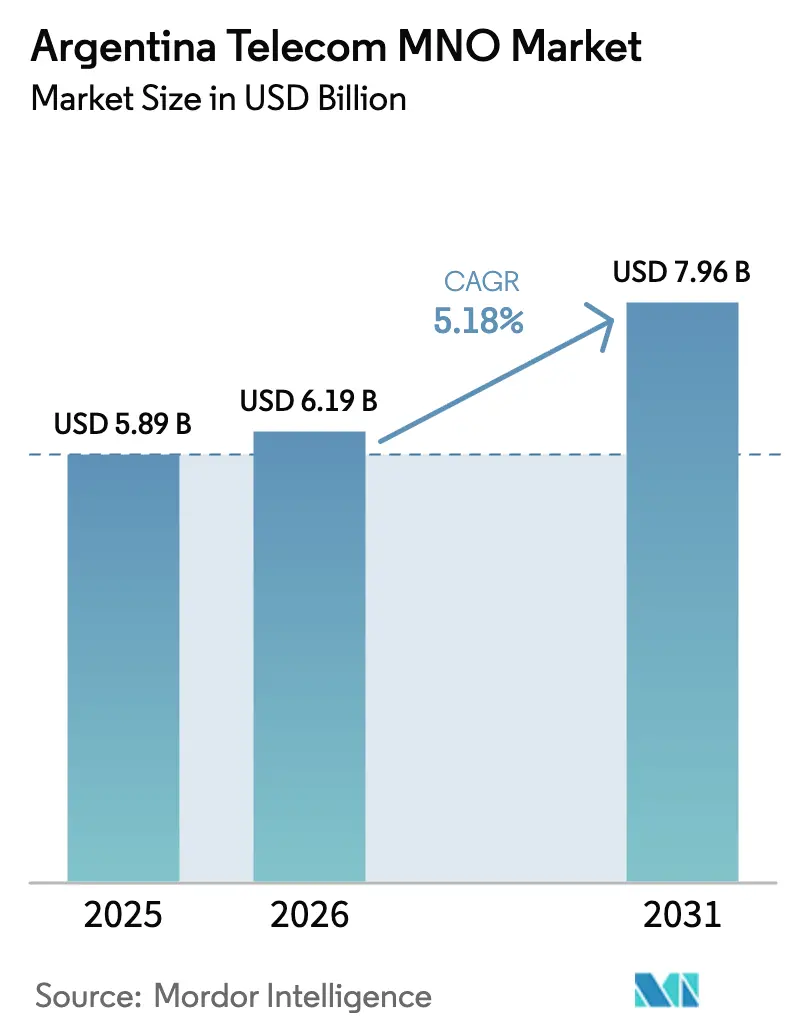
Argentina Telecom MNO Market Analysis by Mordor Intelligence
The Argentina Telecom MNO Market size in 2026 is estimated at USD 6.19 billion, growing from 2025 value of USD 5.89 billion with 2031 projections showing USD 7.96 billion, growing at 5.18% CAGR over 2026-2031.
The current expansion rests on three pillars: rapidly rising mobile-data usage on 4G and 5G networks, renewed tariff flexibility following the repeal of price caps, and a fresh wave of enterprise digitalization programs across agriculture, mining, and manufacturing. Operators have redirected capital toward nationwide fiber backbones and dense radio-access upgrades, a shift that shortens latency, reduces dropped-call ratios, and boosts average data speeds for both urban and rural customers. The Argentina telecom MNO market also benefits from a supportive spectrum roadmap that unlocks contiguous 3.5 GHz blocks and commits public-sector funds to rural coverage, allowing carriers to time their rollouts in line with cash-flow conditions. At the same time, operators face elevated inflation, which erodes ARPU in real terms, yet they mitigate pressure through USD-denominated premium plans and enterprise IoT contracts that preserve hard-currency revenue streams. Convergent quad-play bundles further strengthen retention by integrating fixed broadband, mobile, pay-TV, and VoIP into single bills that cushion households from unpredictable monthly price swings.
Key Report Takeaways
- By service type, data and internet services led with 62.08% of Argentina telecom MNO market share in 2025, while IoT and M2M services are forecast to expand at a 5.32% CAGR through 2031.
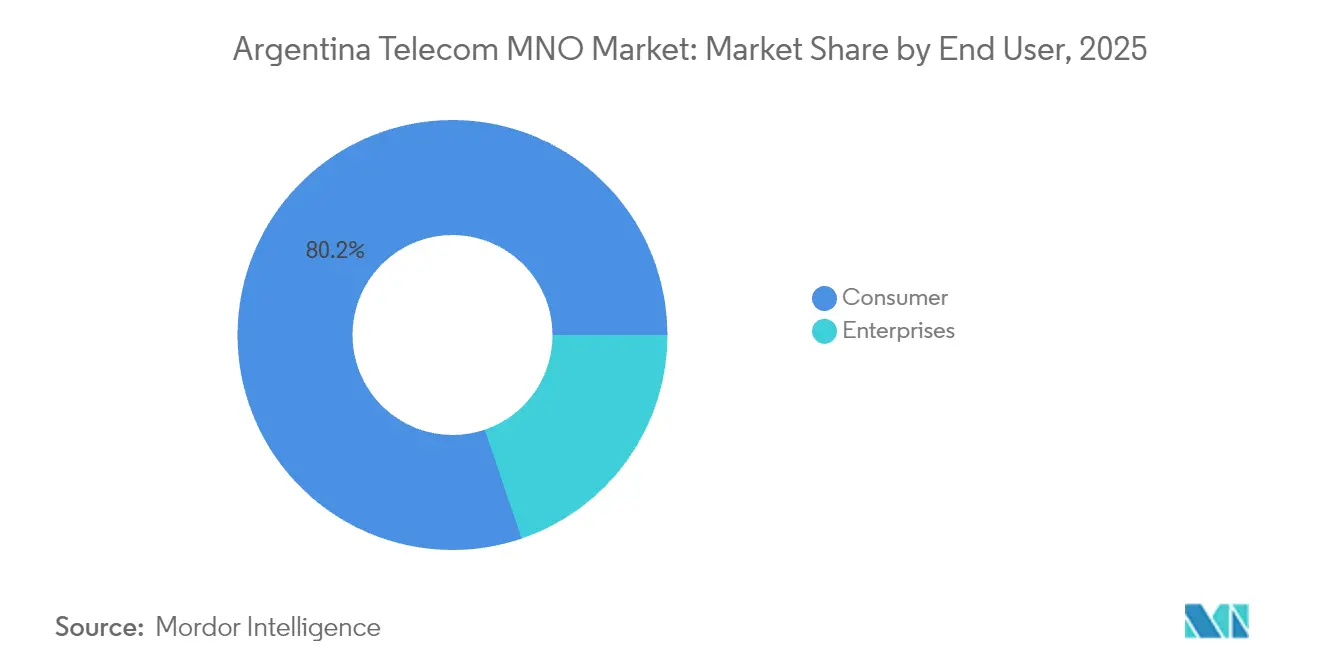
- By end-user, the consumer segment accounted for 80.22% of the Argentina telecom MNO market size in 2025, whereas enterprise connections are projected to grow at a 5.65% CAGR between 2026 and 2031.
Note: Market size and forecast figures in this report are generated using Mordor Intelligence’s proprietary estimation framework, updated with the latest available data and insights as of 2026.
Argentina Telecom MNO Market Trends and Insights
Drivers Impact Analysis*
| Driver | (~) % Impact on CAGR Forecast | Geographic Relevance | Impact Timeline |
|---|---|---|---|
| Explosive mobile-data consumption on 4G/5G | +1.2% | Nationwide; peaks in Buenos Aires, Córdoba, Rosario | Medium term (2 – 4 years) |
| 5G spectrum auctions and fibre backbone build-out | +0.8% | Metro corridors first, then secondary cities | Long term (≥ 4 years) |
| Uptake of convergent quad-play bundles | +0.6% | Country-wide; strongest in dense urban neighborhoods | Medium term (2 – 4 years) |
| Enterprise digitalization and IoT demand | +0.9% | Agriculture belts, mining zones, industrial clusters | Long term (≥ 4 years) |
| USD-denominated premium plans | +0.4% | High-income pockets in all provinces | Short term (≤ 2 years) |
| Passive-infrastructure sharing rules | +0.3% | Under-served rural districts | Medium term (2 – 4 years) |
| Source: Mordor Intelligence | |||
Explosive Mobile-Data Consumption on 4G/5G Networks
Total cellular-data traffic more than doubled between 2023 and 2025 as video streaming, mobile gaming, and agricultural sensor feeds converged on upgraded LTE and early 5G carriers. Median download speeds on Personal’s 5G network hit 432 Mbps, confirming the platform’s ability to support bandwidth-hungry enterprise and consumer applications. Farmland IoT pilots rely on low-power wide-area modules that upload soil-moisture and crop-health readings every fifteen minutes, generating steady, high-margin traffic even during macroeconomic slowdowns. Operators use dynamic spectrum-sharing to re-farm 1,800 MHz bands, squeezing extra capacity out of existing assets while the 3.5 GHz grid densifies in metropolitan corridors. These developments secure data-centric revenue streams and reinforce the long‐term relevance of the Argentina telecom MNO market.
5G Spectrum Auctions and Fibre-Backbone Build-Out
The 2024 spectrum tender released 100 MHz from state-owned ARSAT and an additional 50 MHz from ENACOM, bundling coverage obligations with discounted reserve prices to make deployments financially workable. Winning bidders receive staggered payment schedules and 12-year licenses, enabling cost recovery over a full depreciation cycle. Parallel fiber builds interconnect 1-TBps metro rings with 400-Gbps long-haul links, creating the backhaul headroom needed for massive-MIMO cell sites. Claro alone allocated USD 200 million to extend AI-enabled fiber deeper into edge nodes, accelerating the transition to network-function virtualization and cloud-native cores. Taken together, these infrastructure moves add 0.8 percentage points to the projected CAGR of the Argentina telecom MNO market.
Enterprise Digitalization and IoT Connectivity Demand
Private LTE and early 5G stand-alone networks now underpin drilling automation in Patagonia, autonomous haul-trucks in Santa Cruz gold mines, and smart conveyer lines in automotive plants north of Buenos Aires. Agriculture presents the largest addressable base with 34 million hectares under precision-farming schemes that require GNSS-linked harvesters and real-time pest detection cameras. ARSAT’s satellite-backed narrow-band IoT service fills connectivity gaps in regions where terrestrial footprints remain sparse, ensuring uniform sensor coverage. Government grants under the National Science, Technology and Innovation Plan 2030 subsidize proof-of-concept pilots, accelerating take-up across SMEs and boosting overall enterprise contract value. These forces collectively raise the Argentina telecom MNO market by an estimated 0.9% CAGR contribution. [1]ARSAT, “Proyecto Satelital de Internet de las Cosas,” arsat.com.ar
Uptake of Convergent Quad-Play Bundles
Households facing volatile monthly inflation migrate toward fixed-price service umbrellas that combine unlimited mobile data, symmetrical fiber broadband, and on-demand TV catalogs. Telecentro’s USD 400 million HFC-to-fiber overhaul unlocks gigabit speeds that sit at the heart of its “all-inclusive” offers. Telecom Argentina reports that bundled customers churn 42% less frequently than single-service subscribers, making convergence a defensive and offensive tactic. Operators amplify appeal with loyalty programs, mobile payment wallets, and cloud-storage add-ons that tighten ecosystem lock-in. Even in smaller towns, tower-sharing agreements lower capex, allowing carriers to extend bundles without prohibitive investment, a dynamic that adds 0.6 percentage points to sector growth. [2]Telecom Argentina, “Memoria y Estados Financieros 2024,” telecomargentina.com
Restraints Impact Analysis*
| Restraint | (~) % Impact on CAGR Forecast | Geographic Relevance | Impact Timeline |
|---|---|---|---|
| Hyper-inflation diluting real ARPU | –1.8% | Nationwide; deepest in low-income areas | Short term (≤ 2 years) |
| Tariff freeze / price-cap regulations | –0.7% | Dependent on future policy revisions | Medium term (2 – 4 years) |
| Slow eSIM portability approval for IoT | –0.3% | Country-wide IoT integrators | Medium term (2 – 4 years) |
| High import duties on 5G RAN equipment | –0.5% | All provinces; raises capex burdens | Long term (≥ 4 years) |
| Source: Mordor Intelligence | |||
Hyper-Inflation Diluting ARPU in Real Terms
The consumer-price index rose above 100% in 2024, outpacing nominal tariff hikes and slicing 7.7% off sector revenue once adjusted for inflation. Pre-paid SIMs now represent 61% of all mobile lines, indicating a flight to usage-controlled plans that keep discretionary spend in check. Operators partially insulate margins by pegging premium 5G tiers to the U.S. dollar, thereby shielding higher-income customers from peso volatility. They also broaden wholesale fiber sales and cloud-managed security to stabilize enterprise cash flows. However, the drag on mass-market purchasing power remains the single largest brake on the Argentina telecom MNO market, shaving 1.8 percentage points from forecast growth. [3] Banco Central de la República Argentina, “Informe de Inflación 2024,” bcra.gob.ar
High Import Duties on 5G RAN Equipment
Radio-access components sourced from overseas suppliers face duties of up to 16% in addition to freight-on-board surcharges attributable to port congestion. Since equipment must be paid in USD while revenue is peso-denominated, carriers encounter natural currency mismatches that complicate procurement cycles. To manage exposure, the three nationwide MNOs extend vendor-financing tenors from five to seven years and ramp up tower-sharing pacts that dilute per-site hardware costs. Nonetheless, the higher landed cost of massive-MIMO arrays and millimeter-wave modules delays the full-scale rollout schedule, trimming 0.5 percentage points off the Argentina telecom MNO market CAGR.
*Our forecasts treat driver/restraint impacts as directional, not additive. The impact forecasts reflect baseline growth, mix effects, and variable interactions.
Segment Analysis
By Service Type: Data Dominance Reshapes Revenue Mix
Data and internet services generated 62.08% of Argentina telecom MNO market share in 2025, a proportion that rises steadily as voice minutes migrate to OTT calling and rich-media apps. The segment benefits from nationwide 4G population coverage exceeding 99% and growing 5G pockets that handle immersive video and enterprise sensor streams. In numerical terms, data contracts contributed USD 3.66 billion to the Argentina telecom MNO market size during 2025. IoT and M2M lines posted the fastest expansion, logging a 5.32% CAGR outlook to 2031 on the back of agriculture, mining, and manufacturing automation projects. Operators package data with cloud-storage and edge analytics, converting what was once a commodity pipe into a multi-layer service stack with higher per-connection margins.
Messaging, VAS, and roaming revenues continue to fade as customers adopt app-based communication and remote-work platforms that bypass legacy SMS frameworks. Still, roaming rebounds during outbound tourism spikes, aided by simplified regional rate plans that keep travelers on-net. Pay-TV’s integration into mobile bundles secures incremental stickiness despite intense streaming rivalry. Collectively, the evolving service portfolio underlines the Argentina telecom MNO market’s pivot toward digital solutions capable of monetizing bandwidth, latency, and security rather than pure minutes of use.


By End-User: Enterprise Momentum Accelerates
Enterprises remain the fastest-growing constituency, with connections forecast to climb 5.65% CAGR through 2031, even as consumers hold an 80.22% revenue share today. Private LTE deployments inside mining pits and factory floors drive average-line revenue four times higher than retail smartphone ARPU, lifting overall profitability. An estimated 28,000 agricultural IoT gateways now blanket row-crop regions, feeding analytics platforms that optimize irrigation and fertilizer usage. Manufacturing plants in Córdoba deploy time-sensitive networking over 5G to synchronize robotics and reduce assembly-line downtime. The Argentina telecom MNO market size for enterprise mobile services totaled USD 1.17 billion in 2025 and is on course to double by 2031.
On the consumer side, convergent billing and device-financing plans sustain unit additions despite inflationary headwinds. Government digital-ID and mobile-passport programs deepen engagement, making phones essential for public-service access. Yet low-income users gravitate toward ad-supported data bundles that offer zero-rated social media and messaging, underscoring a bifurcated demand curve. The dual-speed trajectory allows operators to cross-fund suburban 5G densification with enterprise cash flows, aligning investment with both short-term and strategic objectives of the Argentina telecom MNO market.
Geography Analysis
Argentina’s three largest conurbations, Buenos Aires, Córdoba, and Rosario, generate roughly 70% of mobile revenue thanks to dense populations, strong household incomes, and large enterprise campuses. Average downlink speeds exceed 55 Mbps in these corridors, supporting cloud-gaming, UHD video, and real-time industrial control. The Atlantic Coast technology belt enhances this leadership by hosting the nation’s first stand-alone 5G clusters that anchor edge-compute zones servicing port logistics and fisheries. Mid-tier cities such as Mendoza and Salta experience a second wave of fiber overlays, backed by Universal Service Fund grants that lower last-mile build costs. Collectively, metro areas keep the Argentina telecom MNO market size on a solid upward trend as premium-tier consumer plans and enterprise contracts cluster where per-capita GDP is highest.
Rural provinces present contrasting dynamics. Thousands of square miles in La Pampa and Santa Fe rely on NB-IoT modules tethered to silo temperature sensors and livestock trackers, driving a specialized connectivity niche that commands resilient, subscription-like revenue. ENACOM’s National Critical Communications Infrastructure Plan leverages spectrum set-asides and tower-sharing incentives to extend 4G/5G reach, closing digital gaps without burdening any one operator with disproportionate capex. Regional tax incentives further sweeten deployment economics, cutting permit fees and fast-tracking rights-of-way approvals, yet zoning inconsistencies still lengthen site-acquisition timelines in isolated municipalities.
Cross-border trade flows with Chile, Brazil, and Uruguay add a third geographic layer. Roaming agreements and expanded interconnection gateways enable enterprises to run seamless telemetry over contiguous networks, especially valuable for mining and agribusiness firms that straddle frontiers. Satellite backhaul in Patagonia supports oil-field automation and environmental monitoring where terrestrial loops remain commercially unviable. Extreme-weather resilience dictates hardened tower specifications, pushing O-ring sealed antennas and battery-shelter climate control to prevent downtime during heatwaves or snowstorms. These geography-specific investment patterns knit together a cohesive yet nuanced growth fabric for the Argentina telecom MNO market.
Regulatory Landscape
Argentina's telecom MNO market is primarily regulated by ENACOM for sector licensing and oversight, with competition review led by the Autoridad Nacional de la Competencia (ANC) in transactions that can change market structure. In June 2026, the ANC issued Resolution RESFC-2026-38-APN-TDC#ANC, conditioning Telecom Argentina's acquisition of Telefónica Móviles Argentina (Movistar) on structural and conduct remedies, including divestments designed to preserve effective competition and prevent excessive concentration across mobile and fixed broadband footprints.
Institutional oversight tightened in July 2026, when ENACOM was placed under the Jefatura de Gabinete via Decree 581, with Juan Martin Ozores serving as interventor. That same month, ENACOM approved a protocol to accelerate intervention against harmful interference affecting essential services, and it launched a public tender for the National Early Warning System (AlertAR) using cell broadcast technology. Together, these steps reinforce service continuity obligations and add another public-sector demand driver for network capabilities used for mass notification delivery.
Competitive Landscape
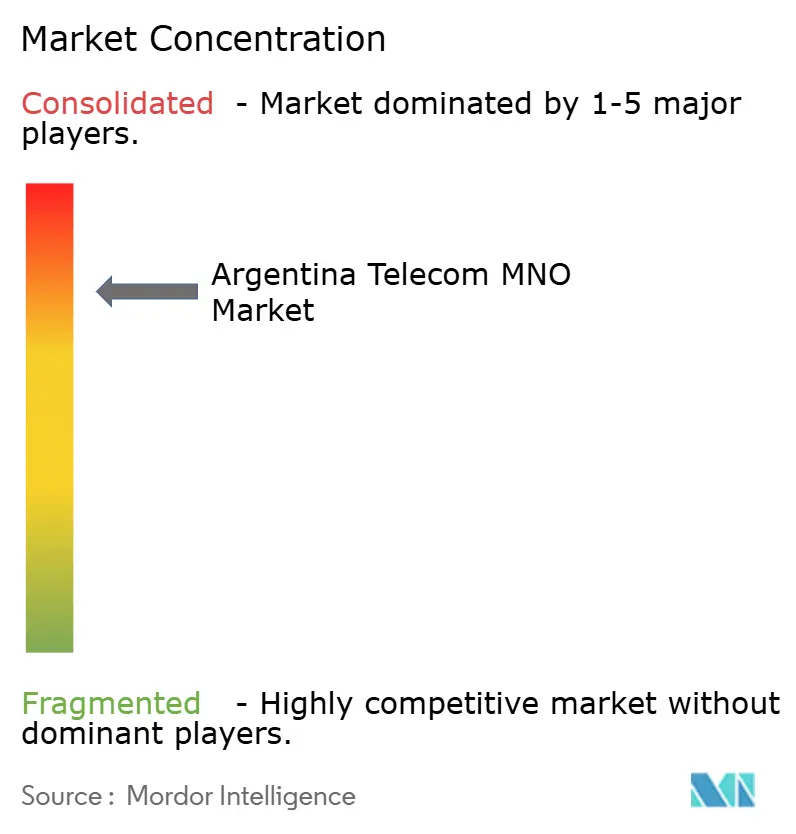
Argentina hosts three full-scale mobile network operators that compete across coverage, technology, and convergent service depth. Telecom Argentina, post-acquisition of Telefónica’s local unit, would command roughly 61% of mobile subscribers and up to 80% of residential broadband in certain districts, pending regulatory clearance. Claro Argentina counters with agile spectrum holdings and AI-driven network-resource orchestration that lifts peak capacity 18% while trimming energy per bit by 14%. Movistar positions itself as the enterprise-transformation partner, offering managed security, multi-cloud orchestration, and software-defined WAN overlays that ride on its nationwide fiber spine.
Technology differentiation remains central. Personal (Telecom) recorded Argentina’s fastest 5G median throughput at 432 Mbps after upgrading to 200-MHz carrier aggregation in the sub-6 GHz band. Claro built 400 5G radio nodes by mid-2025 and expects 60% population coverage by 2028, leveraging Nokia air-scale radios that support future 6 GHz extensions. Movistar’s edge-cloud collaboration with hyperscale partners offers ultra-low latency for VR training simulators in automotive plants. The pace of small-cell densification, use of open-RAN pilots, and nationwide IPv6 migrations provide further axes of competition that enrich the Argentina telecom MNO market.
Strategic moves during 2024-2025 illustrate the spectrum of competitive responses. Telecom Argentina floated a USD 100 million sustainability-linked bond to finance renewable-energy PPAs that quarantine future electricity costs. Claro earmarked USD 200 million for AI-enhanced fiber rollouts, reducing truck rolls through predictive maintenance. Telecentro’s full-fiber conversion underscores the lure of gigabit tiers bundled with 5G mobile lines, showing how fixed assets fortify wireless value propositions. Despite occasional tariff wars, pricing is less dominant than network quality and service integration in shaping share shifts, a reality that aligns with renewed pricing freedom restored when ICT services lost “public-utility” status in 2024.
Argentina Telecom MNO Industry Leaders
Claro Argentina
Movistar Argentina
Personal (Telecom Argentina S.A)
- *Disclaimer: Major Players sorted in no particular order

Market Opportunities and Future Outlook
A near-term opportunity stems from the ANC's June 2026 conditional approval of Telecom Argentina's acquisition of Telefónica Móviles Argentina (Movistar), which requires a sizable divestment package that can seed a new or strengthened independent competitor. The remedy includes transferring six million active mobile customers (four million in the Buenos Aires Metropolitan Area and two million in other areas), along with associated spectrum, contracts, and numbering. It also covers Movistar residential broadband customer bases in 28 locations (about 211,400 subscribers). The ANC additionally required Telecom to provide the buyer temporary access for at least three years to network sharing arrangements (including RAN sharing, national and international roaming, and equipment hosting), which reduces initial coverage and service continuity barriers for an entrant targeting retail mobile, convergent bundles, or enterprise connectivity.
Public-sector programs and operator capex plans add further scope in rural coverage and enterprise-grade platforms. ENACOM's AlertAR cell broadcast tender points to demand for resilient, standards-based messaging delivery at scale, aligning with operator investments in modern cores, dense radio networks, and fiber backhaul that also support IoT/M2M growth in agriculture, mining, and manufacturing. On the supply side, Telecom Argentina's and Claro's combined USD 1.8 billion 2026 investment plans (USD 1.3 billion by Telecom and USD 500 million by Claro) support opportunities in 5G capacity upgrades, fiber migration, and edge-adjacent infrastructure, enabling differentiated service packaging around low-latency enterprise use cases and convergent quad-play propositions.
Recent Industry Developments
- June 2026: ANC conditioned Telecom Argentina’s acquisition of Telefónica Móviles Argentina (Movistar) on June 19, 2026, requiring divestment of 6 million mobile customers and specific FTTH assets to preserve a three-competitor market. This regulatory action maintains competitive landscape and potential share shifts; may influence capex allocation and pricing strategies by remaining players.
- June 2026: Claro Argentina officially opened a 650kW modular data center in Buenos Aires, designed by fibratel and built by DataWaves, following a US$30 million investment plan announced in 2024. The capacity expansion strengthens edge capacity for 5G backhaul and enterprise services; supports faster deployment of convergent bundles and latency-sensitive applications.
- April 2026: Telecom Argentina and Claro announced a combined US$1.8 billion investment plan for 2026, with Telecom committing US$1.3 billion for 5G deployment and fiber optic migration and Claro committing US$500 million for infrastructure projects. The capex boost accelerates network modernization and convergence bets; reinforces competitive differentiation through upgraded coverage and capacity.


Research Methodology Framework and Report Scope
Market Definition and Coverage
For this methodology, the Argentina telecom market is defined as the recurring and usage-based revenues earned from communications services delivered to consumers and enterprises within Argentina, across mobile and fixed networks, and including related digital service add-ons where they are billed as part of telecom service plans.
Scope exclusions: Equipment sales (handsets, routers, and customer devices) and one-time installation or construction contracts are excluded unless they are bundled into a service charge and recognized as service revenue.
Segmentation Overview
- Overall Telecom Revenue and ARPU
- Service Type
- Voice Services
- Data and Internet Services
- Messaging Services
- IoT and M2M Services
- OTT and PayTV Services
- Other Services (VAS, Roaming, Enterprise and Wholesale etc.)
- End-User
- Enterprises
- Consumer
Data Sources, Market Sizing, and Validation
Desk Research
Desk research was used to build the starting demand picture for Argentina, then to separate what can be counted as telecom service revenues versus adjacent digital and device spending. Public series on subscriber base, access lines, ARPU patterns, and service mix were reviewed to understand how revenue is distributed across mobile, fixed broadband, pay TV, and fixed voice.
Key public sources reviewed include official releases and statistics such as ENACOM indicators and market reports, ITU telecom indicators, World Bank macro and population series, and OECD connectivity and broadband context where available, along with peer-reviewed papers that discuss network investment and adoption trends. We also used company filings, investor presentations, and reputable press coverage to understand price resets, promotional intensity, and network rollout timing. Paid subscriptions were used in a limited way for company financials and intelligence, so the model has consistent historical revenue anchors and event timelines. These examples are not exhaustive, and many other sources were also used for data collection, validation, and clarification.
Primary Interviews and Surveys
Primary work was used to pressure test what desk data cannot fully explain, mainly how ARPU moves under inflation, how bundling is reported, and how service revenues are split between consumer and enterprise accounts. We spoke with a mix of operator-side, channel-side, and enterprise buyer respondents across Argentina, and then used follow-up questions to reconcile differences in definitions around OTT add-ons, pay TV packaging, and prepaid versus postpaid revenue recognition.
Distribution of primary research fieldwork respondents
| Company type | Respondent position |
|---|---|
| Top tier: 35% | CXOs: 16% |
| Mid tier: 47% | Functional/Unit leaders: 32% |
| Smaller Players: 18% | Managers: 52% |
Market-Sizing & Forecasting
The market size was first reconstructed using a top-down build that starts from the telecom service revenue pool implied by Argentina service mix indicators, subscriber and access counts, and observed ARPU levels, which are then converted into annual value by service category. Once the totals were obtained, they were corroborated with selective bottom-up approximations, such as sampled tariff checks multiplied by active line estimates, and high-level revenue roll ups from public financial statements, to adjust any obvious under or over counts.
Inputs used in the model include mobile SIM and connection counts, fixed broadband access base, pay TV subscriptions, and fixed telephony lines, along with ARPU and service mix splits where they are published. Inflation-linked price resets, prepaid versus postpaid dynamics, and network upgrade timing (like 4G densification and early 5G launch stages) were also treated as practical levers because they directly affect usage and billed revenue. Where a metric was not reported consistently, proxy steps were applied, such as using trend-consistent ARPU ranges validated through interviews and aligning them to the same time window used for currency conversion.
For forecasting, scenario analysis was used because revenue paths in Argentina can change quickly with tariff regulation, FX availability, and household affordability. We set a base case from consensus interview views and then ran upside and downside cases around ARPU progression, subscriber churn, and broadband net adds, before one final review to keep the trajectory realistic versus recent historical direction.
Data Validation & Update Cycle
Results were triangulated by comparing the final outputs against independent signals, including service mix sanity checks, implied ARPU levels by service, and year over year movement in access and subscriber bases. When a variance looked too large, the underlying driver was traced back to one assumption at a time (for example, a price step change or an exchange-rate timing mismatch) and then corrected after a second analyst review.
Before sign-off, the full model is reviewed in multiple steps so that totals add up across services and the narrative matches the numbers. Reports are refreshed annually, and interim updates are made when material events occur that can shift revenue or adoption trends. Right before delivery, a final pass is completed so the latest updated view reflects newly available public releases and any fresh primary feedback.
Mordor Intelligence's Argentina Telecom Market Sizing Compared With Other Published Estimates
Published market values for Argentina telecom often do not match because the scope can shift between mobile-only, full telecom services, and ICT-like definitions that pull in broader IT spending. Timing also matters here, since currency conversion choices and the month of price resets can change the USD value even when local currency revenues move steadily.
The main gap comes from whether pay TV and OTT add-ons billed by operators are counted as telecom service revenues, and Mordor Intelligence treats those add-ons as in-scope only when they are sold and recognized within operator telecom service plans, rather than as stand-alone digital entertainment spending. Differences also show up when some sources mix nominal and constant currency views, or when they assume aggressive ARPU progression without cross-checking it against access growth and service mix stability.
Benchmark comparison
| Source | Market Size | Gaps in Research Methodology |
|---|---|---|
| Mordor Intelligence | USD 5.89 B (2025) | |
| Trade Journal A | USD 8.90 B (2024) | Often uses regulator-reported total telecom revenues converted to USD at a stated period rate, which can include broader billed categories and can shift materially with FX timing and inflation-linked repricing. |
| Global Consultancy B | USD 6.60 B (2025) | May focus on operator service revenue but apply a faster ARPU ramp and broader inclusion of digital services, with fewer disclosed checks against access base trends and prepaid-postpaid mix shifts. |
The spread across the table is mostly explained by what is included in service revenue, plus how local currency revenues are translated into USD for a given year. By tying the sizing to subscriber and access volumes, service mix, and interview-validated ARPU behavior, we keep a clear and repeatable link between demand indicators and the final market value.


Key Questions Answered in the Report
What is the projected value of the Argentina telecom MNO market in 2031?
The market is expected to reach USD 7.96 billion by 2031, growing at a 5.18% CAGR.
Which service category holds the largest revenue share?
Data and internet services contributed 62.08% of revenue in 2025.
How fast is the enterprise segment expanding?
Enterprise mobile connections are forecast to grow at a 5.65% CAGR through 2031.
What share of connections does consumer prepaid represent?
Pre-paid lines make up 61% of total mobile subscribers as of 2026.
How much additional 3.5 GHz spectrum was released in 2024?
ENACOM opened 150 MHz-100 MHz from ARSAT and 50 MHz from its own allocation.
Page last updated on:


 Your data is secure and never sold or shared.


