
Market Overview
| Study Period | 2020 - 2031 |
|---|---|
| Forecast Data Period | 2026 - 2031 |
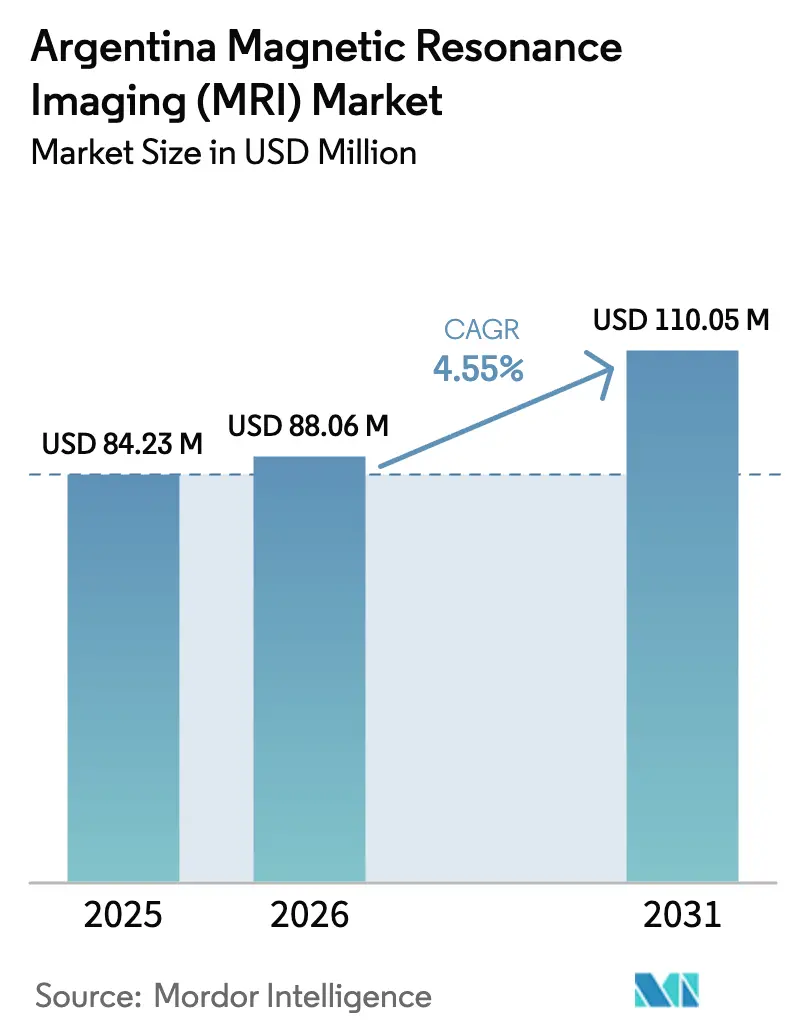
| Base Year Market Size (2025) | USD 84.23 Million |
| Market Size (2026) | USD 88.06 Million |
| Market Size (2031) | USD 110.05 Million |
| Growth Rate (2026 - 2031) | 4.55 % |
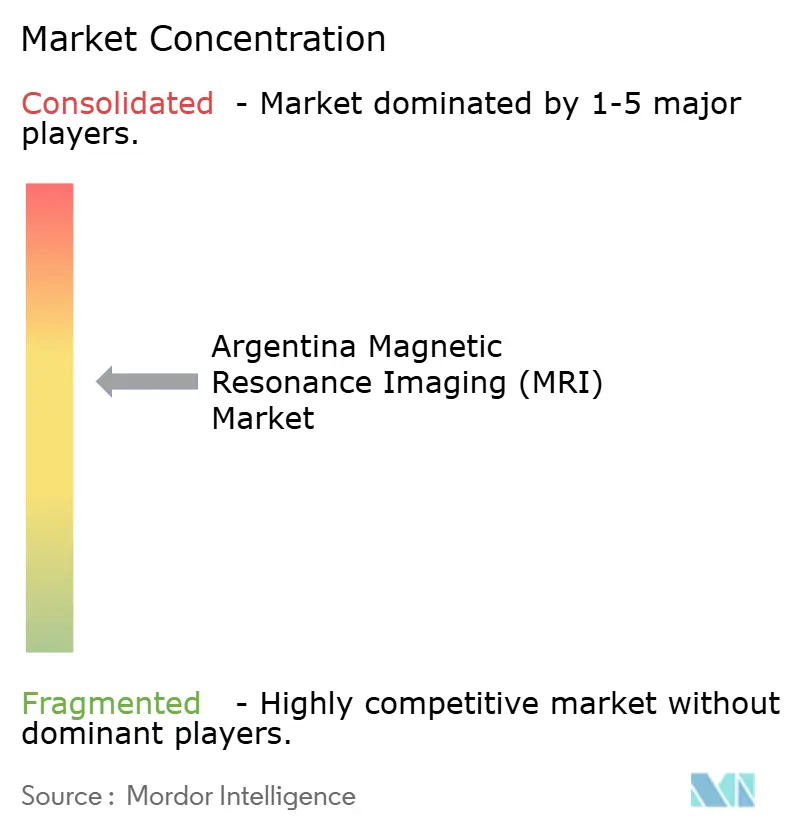
| Market Concentration | Medium |
Major Players
*Disclaimer: Major Players sorted in no particular order Image © Mordor Intelligence. Reuse requires attribution under CC BY 4.0. |
|
Argentina Magnetic Resonance Imaging (MRI) Market Analysis by Mordor Intelligence
The Argentina Magnetic Resonance Imaging (MRI) Market size in 2026 is estimated at USD 88.06 million, growing from 2025 value of USD 84.23 million with 2031 projections showing USD 110.05 million, growing at 4.55% CAGR over 2026-2031. Demand rises as public and private providers upgrade diagnostic infrastructure, supported by import-duty exemptions, faster foreign-currency access, and streamlined customs procedures that lower capital barriers for imaging centers. Growth persists even as health-care costs fluctuate, helped by a three-tier financing model that spreads risk across public insurance, social works, and private plans. Closed-bore installations dominate today, yet open and very-high-field systems are scaling quickly because provincial chains and research institutes seek better patient comfort and sharper neuro-oncology imaging. Ongoing investments in teleradiology and helium-free technology cut operating costs and help alleviate workforce shortages outside Buenos Aires.
Key Report Takeaways
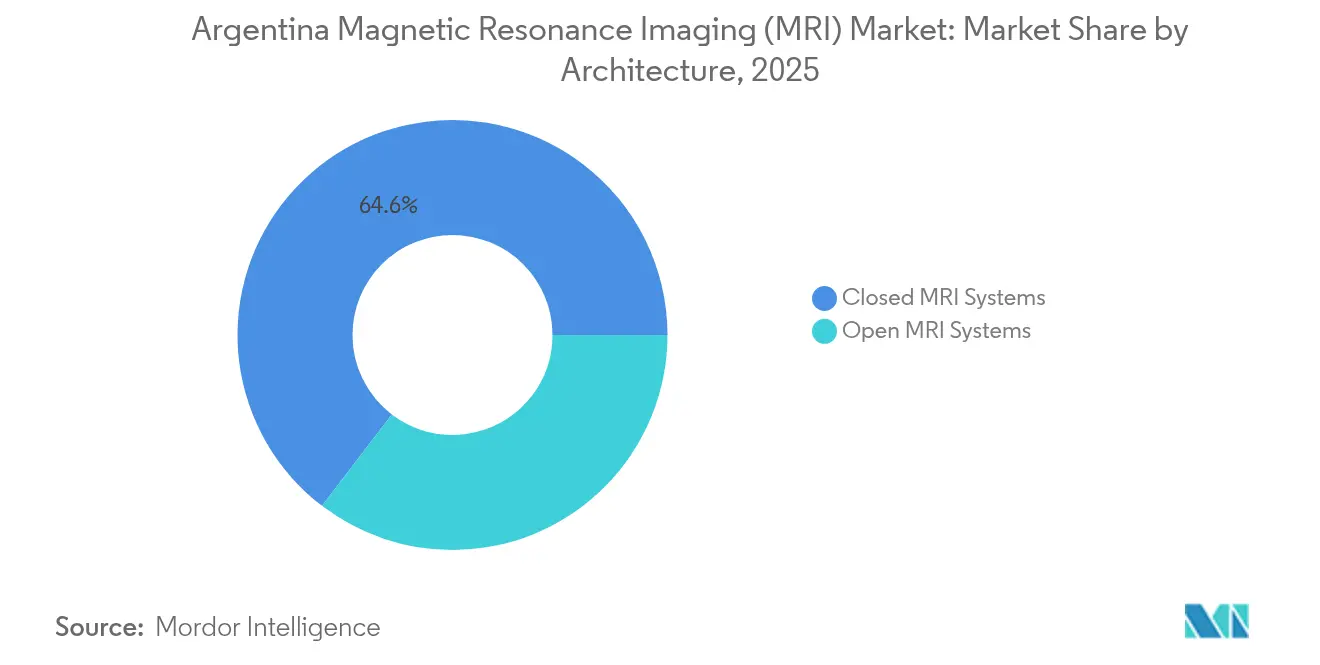
- Closed MRI systems held 64.62% of the Argentina Magnetic Resonance Imaging (MRI) market share in 2025, while open architecture is projected to expand at a 5.02% CAGR through 2031.
- High-field 1.5 T platforms accounted for 63.10% of the Argentina MRI market size in 2025; very-high/ultra-high-field units (3 T and above) show the fastest growth at 5.17% CAGR.
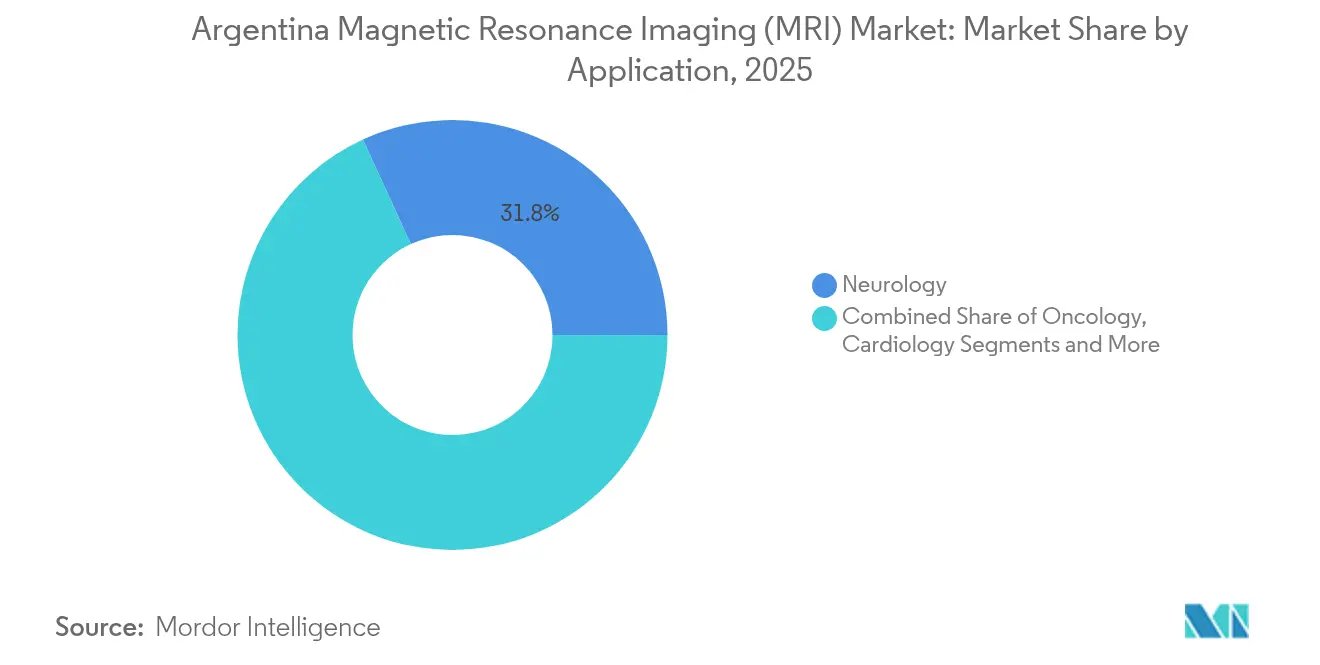
- Neurology led with 31.84% revenue share in 2025, whereas oncology imaging is set to record a 5.44% CAGR to 2031.
Note: Market size and forecast figures in this report are generated using Mordor Intelligence’s proprietary estimation framework, updated with the latest available data and insights as of 2026.
Argentina Magnetic Resonance Imaging (MRI) Market Trends and Insights
Drivers Impact Analysis*
| Driver | ( ~ ) % Impact on CAGR Forecast | Geographic Relevance | Impact Timeline |
|---|---|---|---|
| Increasing prevalence of chronic diseases & rise in geriatric population | +1.2% | Buenos Aires, Córdoba, Santa Fe | Long term (≥ 4 years) |
| Growth in private diagnostic-imaging chains across provincial cities | +0.8% | Mendoza, Tucumán, Mar del Plata | Medium term (2-4 years) |
| Technological advances | +0.7% | National | Medium term (2-4 years) |
| Government import-duty exemptions for advanced medical equipment | +0.6% | National | Short term (≤ 2 years) |
| Expansion of teleradiology networks enabling remote reading | +0.4% | Provincial and rural areas | Medium term (2-4 years) |
| Oncology-focused philanthropic funding & PPP initiatives | +0.3% | Major cancer centers | Long term (≥ 4 years) |
| Source: Mordor Intelligence | |||
Increasing Prevalence of Chronic Diseases & Rise in Geriatric Population
Argentina’s population is aging, and chronic neurological and cardiovascular conditions are rising, which elevates MRI referrals for early detection and disease monitoring. Health-care spending climbed from 8.9% of GDP in 2003 to 10.2% in 2015 and has remained above the Latin American average, sustaining public capacity to fund advanced imaging. The physician density of 4.06 per 1,000 inhabitants supports broad referral networks, while the Sumar Program adds more than 20 million publicly insured beneficiaries who now qualify for reimbursed scans. Ninety-one new public hospitals commissioned since 2024 offer high-complexity services that routinely require cross-sectional imaging. ANMAT’s device-quality oversight further reassures clinicians that modern scanners deliver the accuracy needed for chronic-care pathways [1].
Growth in Private Diagnostic-Imaging Chains Across Provincial Cities
Private operators are entering secondary cities to capture unmet demand beyond the Buenos Aires metro. Swiss Medical’s USD 80 million acquisition program, including Diagnóstico Maipú and Sanatorio Las Lomas, illustrates the momentum in midsized markets where household incomes are rising. Provincial authorities have launched 134 health-care construction projects funded with ARS 10.155 million (USD 24 million), adding 1,415 beds that raise throughput for radiology departments. A simplified import regime under Decree 70/2023 shortens delivery lead times, letting provincial buyers avoid the backlog that previously deterred equipment upgrades. Teleradiology hubs connect local scanners to subspecialty readers in the capital, allowing smaller centers to offer MRI without hiring full-time neuroradiologists.
Technological Advances
Manufacturers now market helium-free magnets, AI-assisted reconstruction, and portable consoles, which match Argentina’s need for lower operating overhead. Siemens Healthineers’ MAGNETOM Flow uses just 0.7 liters of helium and integrates deep-learning algorithms to cut scan times. GE HealthCare’s SIGNA MAGNUS 3 T head-only scanner delivers premium gradient performance for brain research while limiting system footprint. Canon Medical incorporates native neural-network reconstruction that produces higher-resolution studies at equivalent scan durations, valuable where technologist shortages limit throughput efficiency. Such advances reduce per-scan energy consumption and improve patient comfort, two parameters that provincial administrators weigh heavily when approving capital projects.
Government Import-Duty Exemptions for Advanced Medical Equipment
Since 2024 the Statistical Import System (SEDI) has removed non-automatic licensing for medical devices and lets importers pay suppliers in 30–60 days instead of six months, improving cash flow. A parallel bond scheme (BOPREAL) grants pesos-denominated access to U.S. dollars, offsetting peso volatility for distributors. Small consignments worth under USD 3,000 clear through a simplified courier window, which accelerates spare-parts availability and keeps installed scanners online longer. The policy aligns with President Milei’s broader fiscal stabilization, which returned the primary budget to surplus in 2025, reassuring foreign vendors that receivables risk is receding.
Expansion of Teleradiology Networks Enabling Remote Reading
Cloud-based picture-archiving links have expanded from urban trauma centers into provincial clinics, letting local technologists capture images and send them to off-site neuroradiologists who deliver reports within an hour. This model maximizes Argentina’s radiologist pool, of which 45% resides in Buenos Aires, by reallocating after-hours reading capacity nationwide. Diagnostic accuracy remains high because AI triage tools prioritize critical findings, and latency is mitigated by fiber upgrades under the National Connectivity Plan. Provincial governments endorse teleradiology to reduce patient transfers and associated costs, and insurers reimburse remote interpretations at the same tariffs as in-house reads, providing predictable revenue for imaging chains.
Restraints Impact Analysis*
| Restraint | ( ~ ) % Impact on CAGR Forecast | Geographic Relevance | Impact Timeline |
|---|---|---|---|
| High upfront & lifecycle cost of MRI systems | -1.1% | National | Long term (≥ 4 years) |
| Peso volatility & capital-equipment financing constraints | -0.9% | National | Short term (≤ 2 years) |
| Shortage of trained MRI technologists outside Buenos Aires | -0.6% | Provincial and rural areas | Medium term (2-4 years) |
| Customs delays & regulatory bottlenecks for high-tech imports | -0.4% | National | Short term (≤ 2 years) |
| Source: Mordor Intelligence | |||
High Upfront & Lifecycle Cost of MRI Systems
Typical 1.5 T scanners priced above USD 1.5 million test the cash positions of provincial hospitals that have faced a 35% real-term funding drop since 2024. The suspension of VAT-exemption certificates until June 2025 forces importers to prepay taxes, raising working-capital needs by roughly 21% on average[2]. Operating expenses also stay high because helium trades near USD 35 per liter on global markets, and service contracts denominated in U.S. dollars expose buyers to exchange shocks. Although the Regime for Incentive Investments (RIGI) offers accelerated depreciation, few small facilities qualify, leaving larger private chains to absorb the benefit.
Peso Volatility & Capital-Equipment Financing Constraints
The peso depreciated 130% against the U.S. dollar between January 2024 and May 2025, complicating repayment forecasts for loans pegged to foreign currency. Domestic banks quote rates above 60%, rendering peso loans unsuitable for ten-year assets. Multilateral lenders provide cheaper lines but require sovereign guarantees that are time-consuming to arrange. The central bank’s BOPREAL bond program partly mitigates the currency gap, yet buyers still shoulder devaluation risk during the 30-day window before the first supplier payment. This uncertainty can delay purchase orders unless vendors agree to escrow-based pricing.
Shortage of Trained MRI Technologists Outside Buenos Aires
Vacancy rates for MRI technologists exceed 18%, mirroring global shortages but intensified by Argentina’s concentration of talent in the capital[3]. Of the 5,000 medical graduates per year, fewer than 200 pursue radiologic technology, and residency slots fill quickly. Provincial centers therefore rely on traveling technologists, which inflates staffing costs and limits scanner uptime to daytime shifts. Brain drain to North American markets further erodes the talent pool as bilingual technologists accept remote scanning roles abroad. GE HealthCare and Siemens sponsor certificate programs with local universities, yet capacity remains too small to cover projected demand through 2030.
*Our forecasts treat driver/restraint impacts as directional, not additive. The impact forecasts reflect baseline growth, mix effects, and variable interactions.
Segment Analysis
By Architecture: Closed Systems Drive Market Dominance
Closed-bore scanners generated 64.62% of the Argentina Magnetic Resonance Imaging (MRI) Market size in 2025 as tertiary hospitals and high-volume outpatient centers continued to favor their superior signal-to-noise ratio. Patient throughput in sites such as Hospital Italiano frequently exceeds 30 scans daily, making high-duty-cycle magnets economically justifiable. The Argentina MRI market continues to shift, however, as open platforms register a 5.02% CAGR through 2031, spearheaded by provincial diagnostic chains that aim to serve claustrophobic, bariatric, and pediatric cohorts. AI-assisted reconstruction and redesigned gradient coils have narrowed the historical quality gap between open and closed geometries, letting providers deliver neurology and musculoskeletal protocols within reimbursable scan times. Government loans for accessibility upgrades further encourage adoption of wider-bore units in public hospitals.
Operational cost savings also tilt some buyers toward modern open models. Helium-light designs and air-cooling options reduce annual maintenance spending by up to 30% compared with legacy closed scanners. In smaller markets where daily volumes hover near ten scans, break-even calculations now favor open magnets that carry lower acquisition prices. Vendors bundle remote-service diagnostics that predict component failures, minimizing downtime for centers that lack on-site engineers. As patient-centric care gains policy traction, marketing campaigns emphasize comfort advantages, reinforcing adoption momentum across secondary cities.

By Field Strength: 1.5 T Systems Balance Performance and Economics
High-field 1.5 T platforms captured 63.10% of Argentina Magnetic Resonance Imaging (MRI) Market share in 2025 because they meet routine neuro and body imaging needs while staying within hospital power and cryogen limits. Most third-party payers reimburse at tariff levels calibrated to 1.5 T operating costs, sustaining their dominance. The Argentina MRI market is nonetheless transitioning toward 3 T capability, with the very-high/ultra-high segment growing 5.17% per year. Research institutes tied to CONICET adopt 3 T units for functional MRI and spectroscopy, and private cancer centers invest to differentiate services amid competitive pricing pressures.
Equipment vendors facilitate the transition by offering upgrade-friendly platforms that let sites start at 1.5 T and field-upgrade to 3 T with modular gradient amplifiers. Leasing models pegged to exam volume lower upfront exposure for private clinics exploring 3 T installations. Meanwhile, low-field portable systems under 0.5 T address rural outreach programs and sports-medicine practices, but their aggregate contribution to Argentina MRI market size remains small due to limited reimbursement and narrower use cases.
By Application: Neurology Leadership with Oncology Acceleration
Neurology held 31.84% of revenue in 2025 because stroke, epilepsy, and neuro-degeneration protocols represent core indications across Argentina’s referral network. More than 43% of MRI referrals from public hospitals relate to central-nervous-system assessment. By contrast, oncology is projected to post the quickest climb at a 5.44% CAGR, raising its share of the Argentina MRI market size as the Rays of Hope program scales radiation-therapy capacity. National cancer-registry data show incidence climbing 2.1% annually, driving demand for staging and follow-up scans.
Cardiac MRI adoption also grows, albeit from a smaller base, as cardiologists seek non-invasive methods to assess myocarditis and congenital anomalies. GE HealthCare’s manganese-based contrast agent under development could increase repeat-scan safety, benefiting oncologic and cardiac cohorts that require serial imaging. Musculoskeletal and abdominal applications diversify revenue but rise more slowly because CT and ultrasound still suffice for many orthopedic and liver indications under Argentina’s reimbursement codes.
Geography Analysis
Buenos Aires accounts for roughly 40% of installed scanners and delivers the highest exam volume because it hosts the largest concentration of neurologists, oncologists, and research centers. High patient density, comprehensive insurance coverage, and established referral pathways keep utilization above 85% of scanner capacity. Public–private partnerships allow community hospitals in the metro to outsource overflow studies to private chains during peak hours, optimizing system-wide asset use.
Secondary provinces such as Córdoba, Santa Fe, and Mendoza represent the fastest-expanding zones within the Argentina MRI market, adding open and mid-field units to meet rising middle-income demand. Provincial governments co-finance equipment through matching-fund grants tied to service obligations for low-income patients. Connectivity improvements enable these centers to leverage teleradiology for subspecialty reads, mitigating the technologist and radiologist shortages that have historically hampered advanced imaging outside the capital.
Patagonia, the Northwest, and rural Chaco remain underserved, with scanner-to-population ratios under 1 per 100,000 inhabitants. Mobile MRI trailers deployed on seasonal schedules improve access, yet logistical hurdles—long travel distances and limited power infrastructure—cap exam volumes. Public-health planners are evaluating subsidy models that couple low-field portable scanners with cloud reading hubs as a lower-cost alternative to fixed 1.5 T installations.
Regulatory Landscape
Medical imaging systems such as MRI scanners are regulated in Argentina as medical products under the oversight of ANMAT (Administracion Nacional de Medicamentos, Alimentos y Tecnologia Medica), under the Ministry of Health. Device authorization follows a risk-based classification framework aligned with MERCOSUR, and foreign OEMs typically operate through an Authorized Local Representative to hold registrations and manage local regulatory responsibilities, including post-market vigilance.
Compliance and traceability requirements for active medical devices have tightened, including measures such as Decree 226/2024 reinforcing installation reporting and equipment traceability through official electronic channels. ANMAT has also continued digitizing submissions and lifecycle management via platforms such as TAD and HELENA, which shapes how importers, distributors, and service organizations document approvals, changes, and field actions for MRI systems and related software.
Value Chain Analysis
The Argentina MRI value chain is anchored in imported systems from global OEMs (including GE HealthCare, Siemens Healthineers, Philips, Canon Medical, and Fujifilm) that depend on local importers, authorized representatives, and distributor networks to navigate ANMAT registration, customs clearance, and contracting across public, social-works, and private payers. Procurement typically bundles site planning and installation services (power, shielding, cooling), followed by commissioning, operator training, and integration with hospital IT (PACS/RIS) or teleradiology workflows.
After installation, recurring value concentrates in service contracts, parts logistics, helium and cryogen management where applicable, and quality and traceability documentation handled by biomedical engineering and authorized service providers, reflecting technical and metrological traceability requirements. Software layers such as AI reconstruction, workflow tools, and remote monitoring are increasingly delivered through local partners and supported by remote diagnostics, and provincial expansion makes uptime logistics and in-country parts availability a practical differentiator for suppliers outside Buenos Aires.
Competitive Landscape
Global vendors dominate the Argentina MRI market through exclusive distributor partnerships and installed-base service contracts. GE HealthCare, Siemens Healthineers, and Philips collectively control more than 65% of active units, leveraging multi-modality portfolios and financing arms to secure tenders. Canon Medical and Fujifilm are gaining share by promoting AI-ready open systems priced 10–15% below incumbents. Chinese entrant United Imaging sells high-field scanners bundled with five-year service at flat peso rates, appealing to cost-sensitive provincial buyers.
Strategic moves among provider groups also shape demand. Swiss Medical’s bid for Diagnóstico Maipú aims to create a national imaging chain capable of negotiating bulk equipment purchases and unified maintenance agreements. Grupo Olmos is modernizing its provincial clinics with helium-light systems to curb operating costs as utility tariffs rise. Academic centers partner with vendors on research protocols that test AI-based cardiac and functional MRI, accelerating clinical adoption of next-generation applications.
Price competition intensifies as government policies compress reimbursement growth. Vendors respond with productivity-boosting software—auto-positioning, deep-learning reconstruction, and cloud fleet management—that shortens exam slots by 15–20%. Service differentiation, including technician-training scholarships and in-country parts depots, emerges as a deciding factor in tender awards, especially outside Buenos Aires where uptime logistics are critical.
Argentina Magnetic Resonance Imaging (MRI) Industry Leaders
-
Fujifilm Holdings Corporation
-
Koninklijke Philips NV
-
Siemens Healthcare GmbH
-
GE HealthCare
-
Canon Inc. (Canon Medical Systems Corporation)
- *Disclaimer: Major Players sorted in no particular order
Market Opportunities and Future Outlook
Digitization of regulatory and compliance workflows creates whitespace for faster onboarding of imported MRI systems and for add-on software that improves throughput. ANMAT's use of electronic channels and systems such as TAD and HELENA reduces manual friction in registration lifecycle steps, which supports distributors managing multi-site deployments and frequent configuration changes across mixed fleets. That pattern also creates room for vendors and local partners that package equipment, software, and documentation services into turnkey offers for provincial imaging chains and hospital networks.
Traceability and installation reporting requirements under Decree 226/2024 also increase demand for validated biomedical technology services, including documented commissioning, preventive maintenance, and audit-ready equipment histories for active devices such as MRI. On the clinical and operating-cost side, recent in-market placements of low-helium or sealed-magnet designs and AI-enabled reconstruction (for example, 1.5 T installations highlighted by Siemens Healthineers and GE HealthCare at Argentine providers) point to purchasing appetite for platforms that reduce lifecycle exposure and expand usable capacity where technologist availability is constrained.
Recent Industry Developments
- June 2026: Siemens Healthineers Argentina director Mario Amadio reported an installed base of approximately 1,200 medical imaging units in Argentina, with plans for sustained double-digit growth supported by long-term financing schemes. The expansion signals a broadening installed base that strengthens service and capital equipment ecosystems across the country. The move underlines continued investment in diagnostic infrastructure.
- June 2026: Siemens Healthineers - CDC Imágenes in Argentina incorporated the MAGNETOM Flow ACE 1.5 Tesla MRI scanner, featuring AI-integrated image acquisition and a sealed magnet technology that eliminates liquid helium refilling requirements. The new system expands access to AI-enabled imaging while reducing operating costs through helium-free operation. This deployment enhances the provider network's capability to deliver faster, high-quality scans.
- February 2026: GE HealthCare - Clínica Humana de Imágenes in Argentina inaugurated a new SIGNA Victor 1.5 Tesla MRI system featuring AI-based AIR Recon DL imaging software and a low-helium consumption design. The installation strengthens diagnostic capacity in a key market and demonstrates demand for AI-assisted imaging workflows. Availability of lower helium consumption helps manage utility costs and supply resilience.
Research Methodology Framework and Report Scope
Market Definition and Coverage
This market covers the value of MRI systems sold and installed in Argentina, including new equipment purchases and replacement demand across hospitals and imaging centers, measured in USD for the study period.
Scope exclusions: We exclude imaging service revenues (scan fees), contrast agents, radiology software sold separately, and routine after-sales service contracts unless bundled with the system sale.
Segmentation Overview
-
By Architecture
- Closed MRI Systems
- Open MRI Systems
-
By Field Strength
- Low-Field (<0.5 T)
- High-Field (1.5 T)
- Very-High/Ultra-High (3 T and ≥7 T)
-
By Application
- Oncology
- Neurology
- Cardiology
- Other Applications
Data Sources, Market Sizing, and Validation
Desk Research
Desk research was used to build the basic fact base on Argentina healthcare capacity, diagnostic infrastructure, and MRI equipment trade flows, which is important because most MRI hardware is imported. We relied on public and official sources such as the World Bank and IMF for macro indicators, UN Comtrade for trade codes and import values, PAHO/WHO for health system context, and Argentina government health and customs publications where available.
To translate these inputs into a realistic equipment market view, we also reviewed materials such as hospital and clinic announcements, public tenders, peer-reviewed radiology publications that indicate installed base and utilization patterns, and investor and annual filings of listed device manufacturers for regional commentary. Select paid subscriptions were used for company financials and news screening, as well as shipment-level import or tender tracking when public reporting was thin. These desk sources are illustrative, and many other public documents and data points were also reviewed for cross-checking and clarification.
Primary Interviews and Surveys
Primary work focused on validating what the desk data could not fully show, mainly current replacement cycles, typical system configurations, and buying behavior across public hospitals, social insurance networks, and private imaging chains. We spoke with a mix of procurement, biomedical engineering, radiology leadership, and distributor-side participants to confirm assumptions on pricing ranges, installation lead times, and how demand differs between Buenos Aires and other provinces.
Distribution of primary research fieldwork respondents
| Company type | Respondent position |
|---|---|
| Top tier: 25% | CXOs: 15% |
| Mid tier: 57% | Functional/Unit leaders: 27% |
| Smaller Players: 18% | Managers: 58% |
Market-Sizing & Forecasting
Sizing started from a top-down reconstruction of Argentina MRI equipment demand using import and procurement signals, which were then aligned to expected replacement needs from the installed base and observed upgrade trends. Once that demand pool was formed, selective bottom-up checks were applied, such as rolling up a sampled set of supplier and channel feedback on units sold by field strength class, followed by price-band checks to make sure totals stayed plausible.
Key inputs used in the model included MRI unit shipments inferred from customs and tender activity, average selling price ranges by system type (open versus closed) and field strength, public versus private purchasing mix, installation and commissioning lead times, and the expected replacement cycle linked to utilization and uptime needs. For forecasting, scenario analysis was used to reflect different procurement pacing and import constraint outcomes, and then the final path was chosen based on where primary respondents showed the most agreement on budget availability and upgrade priorities. Where unit or price details were missing for smaller provinces, gaps were handled through calibrated ratios based on facility counts and confirmed purchasing patterns, and then rechecked with interview feedback.
Data Validation & Update Cycle
Outputs were checked against independent signals, including year-to-year import value movements, known tender wins, and the implied unit volumes versus realistic installation capacity. Large variances triggered a second review of the assumptions, and follow-up questions were sent to a small subset of primary contacts when any mismatch persisted.
Before sign-off, the model goes through multi-step analyst reviews, including consistency checks across years, currency conversion timing checks, and logic checks between volume and ASP movement. Reports are refreshed annually, with interim updates when material events occur that can shift procurement, imports, or pricing. Right before delivery, a final sweep is completed so clients receive the latest updated view.
Mordor Intelligence's Argentina Magnetic Resonance Imaging Mri Market Size Versus Other Published Estimates
Published market values for MRI equipment can vary because different publishers count different revenue lines, select different base years, and make their own choices on exchange rates and price progression.
The main gap comes from whether service and maintenance revenue is added to the equipment total, since Mordor Intelligence keeps the market focused on MRI system sales value and applies import-linked ASP checks to avoid overstating multi-year contract amounts as upfront equipment revenue.
Benchmark comparison
| Source | Market Size | Gaps in Research Methodology |
|---|---|---|
| Mordor Intelligence | USD 84.23 M (2025) | |
| Regional Consultancy A | USD 78.15 M (2022) | Uses an earlier base year and a narrower capture of replacement demand, and it appears to apply conservative ASP movement without revalidating recent import price and mix shifts. |
| Global Consultancy B | USD 187.40 M (2026) | Likely bundles equipment with service contracts, software, and broader diagnostic imaging spend, and it may assume aggressive upgrade cycles that are not consistent with typical installation lead times and procurement pacing. |
Overall, the spread is mainly explained by scope and timing choices rather than a single math error. By keeping the model tied to observable equipment demand signals (imports, tenders, and validated price bands) and then stress-testing with channel checks, the resulting estimate stays traceable to clear assumptions that can be revisited as conditions change.
Key Questions Answered in the Report
What is the current Argentina Magnetic Resonance Imaging (MRI) Market size?
The sector is projected to generate USD 88.06 million in 2026 and USD 110.05 million in 2031 based on a 4.55% CAGR during 2026-2031.
Who are the key players in Argentina Magnetic Resonance Imaging (MRI) Market?
Fujifilm Holdings Corporation, Koninklijke Philips NV, Siemens Healthcare GmbH, GE HealthCare and Canon Inc. (Canon Medical Systems Corporation) are the major companies operating in the Argentina Magnetic Resonance Imaging (MRI) Market.
Which MRI architecture sells the most units in Argentina?
Closed-bore scanners dominate with 64.62% of 2025 installations thanks to high image quality and throughput.
What field strength is growing fastest across Argentine providers?
Very-high-field systems at 3 T and above are expanding 5.17% per year as research and oncology centers upgrade.