
Argentina Grains Market Analysis by Mordor Intelligence
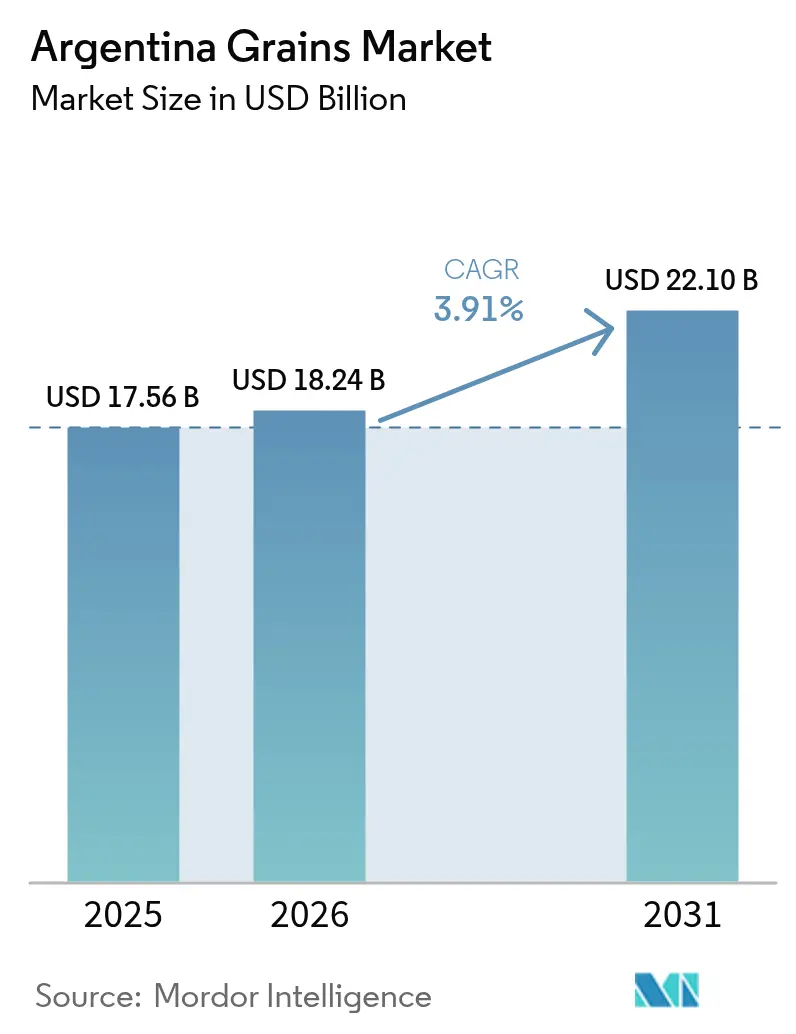
The Argentina grains market size was valued at USD 17.56 billion in 2025 and estimated to grow from USD 18.24 billion in 2026 to reach USD 22.10 billion by 2031, at a CAGR of 3.91% during the forecast period (2026-2031). Similarly, the volume was recorded at 104.45 million metric tons in 2025 and is projected to grow to 107.06 million metric tons in 2026. It is projected to reach 123.0 million metric tons by 2031, registering a CAGR of 2.81%. The country maintains its position as a global agricultural leader with an output of 125 million metric tons and represents 15% of world grain trade[1]Australian Export Grains Innovation Centre, “Argentina Grain Export Overview,” aegic.org.au. Argentina remains one of the world's major maize exporters, playing a crucial role in global food security and trade. According to the FAOSTAT, in 2023, the country's maize production reached 41.4 million metric tons despite experiencing a 29.8% reduction from the previous year due to severe drought. The maize generated USD 6.55 billion in export revenues in 2024, according to the ITC Trade Map, serving as a significant source of foreign exchange and rural employment. The market faces both opportunities and challenges, with biofuel mandates, precision agriculture adoption, and domestic feed industry growth driving demand toward higher-value segments, while climate variability, port infrastructure limitations, and foreign exchange restrictions impact market operations.
Key Report Takeaways
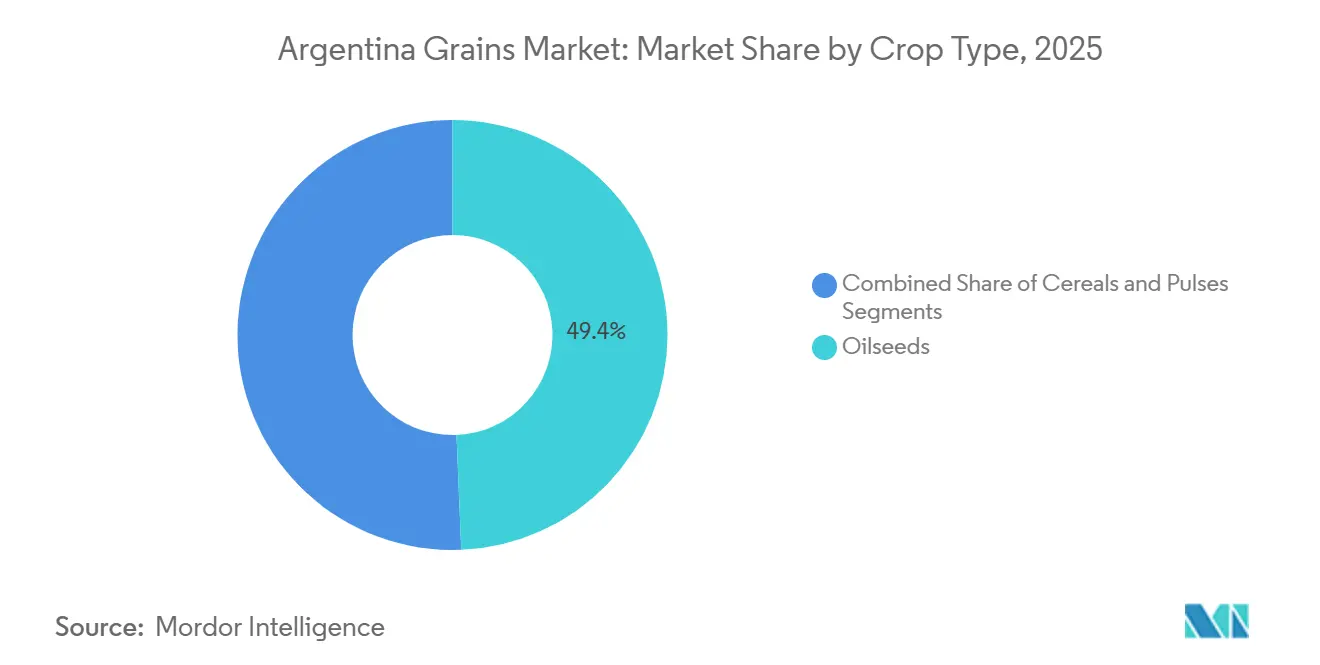
- By crop type, oilseeds held 49.35% of the Argentina grains market size in 2025, while the cereals segment is projected to grow at a CAGR of 4.03% during the forecast period.
Note: Market size and forecast figures in this report are generated using Mordor Intelligence’s proprietary estimation framework, updated with the latest available data and insights as of 2026.
Argentina Grains Market Trends and Insights
Drivers Impact Analysis*
| Driver | (~) % Impact on CAGR Forecast | Geographic Relevance | Impact Timeline |
|---|---|---|---|
| Robust biofuel blending mandates | +1.2% | National, soybean and corn belts | Medium term (2-4 years) |
| Adoption of Precision Ag-tech on mega farms | +0.8% | Pampas region, spreading north | Medium term (2-4 years) |
| Expansion of grain-based animal feed capacity | +0.7% | National, corn-producing clusters | Short term (≤ 2 years) |
| Government support drives growth in grain production | +0.6% | Export-oriented provinces | Short term (≤ 2 years) |
| Capital-funded regenerative grain purchase agreements | +0.4% | Pampas | Medium term (2-4 years) |
| Organic and sustainable farming trends | +0.3% | Scattered, near urban centers | Long term (≥ 4 years) |
| Source: Mordor Intelligence | |||
Robust Biofuel Blending Mandates
Argentina's biodiesel and bioethanol consumption is rising, driven primarily by increased gasoline demand in the agricultural sector for farm machinery. The country's biodiesel production is currently operating at 38% capacity utilization, highlighting the potential for higher soybean oil demand, irrespective of export performance. According to the Secretaría de Energía (Argentina), biodiesel production grew by 40% in 2024 compared to 2023, reaching 1.16 million metric tons. Additionally, the USDA reported that bioethanol consumption reached 1.12 billion liters in 2024, with 60% derived from corn-based production. Higher blending mandates are ensuring steady domestic demand, reducing exposure to global price fluctuations, and creating long-term feedstock premiums in Argentina's grain market. This stability in corn and soybean prices is further reinforced by refiners securing volumes under the increased mandates, leading to stronger prices for farmers.
Adoption of Precision Ag-Tech on Mega Farms
Large-scale row-crop operations in Argentina are implementing precision agriculture technologies, including drones, sensors, and AI-driven prescription maps, to reduce input waste and increase yields. As of 2024, Vuelagro srpays 250 to 370 acres per day, achieving 80-90% reductions in water and chemical usage through targeted applications. The Aapresid Congress 2024 showcased agricultural technology companies, including DeepAgro for AI-based herbicide application, Ucropit for field-level traceability, and Silo Real for humidity monitoring, highlighting the increasing adoption of digital solutions. With soybean receiving suboptimal fertilization, precision agriculture tools present opportunities for yield improvement. These technologies reduce fuel consumption by 27%, decreasing carbon emissions and supporting decarbonization initiatives of major exporters. The implementation of connected agricultural machinery expands the Argentina grains market by improving productivity while controlling operational costs.
Expansion of Grain-Based Animal Feed Capacity
Argentina's livestock integrators are expanding their feed-milling operations, increasing domestic demand for corn and soybean meal. The USDA projects Argentina's corn production to reach 49 million metric tons in 2024/25, with domestic consumption increasing due to growth in poultry and pork feedlot operations [2]U.S. Department of Agriculture, “Argentina Grain and Feed Update,” usda.gov. Processing facilities now handle storage, crushing, and pelleting operations on-site, retaining margins previously captured by international buyers. This vertical integration helps protect operators from export premium volatility, and drives increased cultivation of animal feed-specific corn hybrids. The enhanced feed processing capacity strengthens the Argentina grains market by securing a significant portion of harvest volumes for domestic use.
Government Support Drives Growth in Grain Production
The reduction in export duties on soybeans to 26% and further to 24% by late 2025 and corn and wheat to 9.5% has enhanced the profitability of various planting plans. The USD 100 million loan from the Inter-American Development Bank in 2023 for climate-smart agro-industry improvements will benefit 25,000 rural producers. The fiscal reforms have generated the first primary surplus since 2010, with real GDP projected to grow by 5.5% in 2025[3] International Monetary Fund, “Argentina: Request for Extended Fund Facility Arrangement,” imf.org. These developments facilitate machinery investments and the adoption of high-yield crop varieties, strengthening the Argentina grain market.
Restraints Impact Analysis*
| Restraint | (~) % Impact on CAGR Forecast | Geographic Relevance | Impact Timeline |
|---|---|---|---|
| Volatility in grain prices | -0.7% | Global, export-dependent heartlands | Short term (≤ 2 years) |
| Rising climatic shocks | -0.6% | Nationwide, drought-prone tracts | Long term (≥ 4 years) |
| Infrastructure constraints at ports and railways | -0.5% | Rosario corridor, northern rail | Medium term (2-4 years) |
| Foreign exchange control risks impacting export opportunities | -0.3% | National, exporters relying on hard-currency inflows | Short term (≤ 2 years) |
| Source: Mordor Intelligence | |||
Volatility in Grain Prices
Price volatility affects input budgeting, hedging strategies, and debt management. A Farmdoc survey of 475 agricultural producers across the Pampas, US Midwest, and southern Brazil revealed that Argentine farmers consider price volatility their primary risk. Argentina's food inflation reached 293% year on year in May 2024, increasing working capital requirements[4]World Bank, “Transformational Economic Corridors in Northwest Argentina,” worldbank.org. Global market conditions intensify this volatility, as demonstrated when Chicago corn futures reached an 18-month high following unfavorable South American weather conditions. These market disruptions impact forward-sales contracts, requiring sophisticated price-risk management tools in Argentina's grain market, which smaller producers often struggle to access.
Rising Climatic Shocks
The Buenos Aires Grain Exchange reduced its 2024/25 corn forecast by 1 million metric tons, with only 30% of plantings in good or excellent condition compared to 40% in the previous year[5]Agriculture and Horticulture Development Board, “Argentina Corn Outlook January 2025,” ahdb.org.uk. Climate change impacts could reduce global staple crop production by 2050, particularly affecting water-scarce regions. Drought conditions have already decreased soybean oil production due to the decline in potential yields by 22% in 2025 according to the Buenos Aires Grain Exchange. The Argentina grains market faces constraints on long-term growth as producers invest in drought-resistant seeds and irrigation systems, increasing operational costs.
*Our forecasts treat driver/restraint impacts as directional, not additive. The impact forecasts reflect baseline growth, mix effects, and variable interactions.
Segment Analysis
By Crop Type: Oilseeds Dominate While Cereals Accelerate
Oilseeds dominated the Argentina grain market with a 49.35% share in 2025. The soybean harvest reached 50.3 million metric tons in 2025. Argentina retained its position as the leading exporter of soybean oil in 2024, with exports valued at USD 5.2 billion according to the ITC Trade Map. However, the segment's growth rate remains below the overall market growth. This slower growth stems from increased competition from Brazilian acreage, changing dietary preferences toward alternative oils, and domestic biodiesel consumption. The segment maintains stability through improved local crush margins and new regenerative purchase premiums.
Cereals represent fastest growing segment at a 4.03% CAGR. According to USDA projections, corn production will reach 49 million metric tons in 2024/25, with exports anticipated at 34 million metric tons. Wheat production is projected to achieve 21 million metric tons by 2025, with export potential of 14-15 million metric tons. The segment benefits from increased domestic feed demand, higher ethanol blending requirements, and favorable rainfall patterns improving wheat yields. The reduction in export taxes on corn and wheat to 9.5% has enhanced profit margins, positioning cereals as the fastest-growing segment in the Argentina grain market.


Geography Analysis
The Pampas region remains the primary production center, contributing the majority of oilseed and cereal output due to its deep-topsoil loams, mechanized farming practices, and proximity to Rosario's crushing and port facilities. However, land limitations and climate variability are driving expansion northward into Santiago del Estero and Salta provinces, where adapted crop varieties and no-till farming methods enable the cultivation of new areas. World Bank corridor analyses identify Salta as the primary grain hub in the Northwest region, with potential for increased throughput once rail and road infrastructure improve. The integration of feed mills and crushing plants near livestock centers is increasing, expanding domestic trade flows within the Argentina grain market.
Argentina has recorded substantial growth in grain consumption, particularly wheat, barley, and corn, driven by increased demand in the food and feed sectors. Corn is essential to Argentina's livestock industry, which accounts for 70% of national corn production in 2023, according to USDA data. The growth in livestock production has driven increased maize cultivation, as corn serves as a primary feed component for cattle, poultry, and swine. Domestic feed requirements and ethanol blending consume an increasing portion of corn production, while favorable rainfall has improved the wheat outlook.
The Parana River and Rosario complex remain crucial for Argentina's export logistics, handling most bulk vessel shipments. Low river levels have imposed draft restrictions, reducing loading capacity by up to 12.5% and increasing per-metric ton shipping costs in 2022. The April 2025 strike disrupted grain loading during peak soybean season, highlighting the vulnerability of this transportation corridor. In response, traders are developing alternative transport routes, including trans-Andean truck lanes, and increased shipments through the Bahia Blanca port despite its limited capacity. Climate changes are affecting agricultural geography, with irrigated wheat production moving southward following rainfall patterns, while shorter-cycle corn hybrids improve crop reliability in northern regions. Precision agriculture technology, initially concentrated in the Pampas region, is expanding northward, supported by drone service providers seeking new markets. These changes are reshaping regional growth patterns and diversifying export routes in the Argentina grain market.
Regulatory Landscape
Argentina's grains market operates under a regulatory framework led by SENASA for sanitary and phytosanitary oversight, and the Ministry of Economy and the Secretariat of Agriculture, Livestock and Fisheries for market-access and biotechnology controls. In March 2026, SENASA issued Resolution 199/2026 to establish a formal framework to evaluate GMO food fitness for human and animal consumption. Ministry of Economy Resolution 255/2026 required prior authorization for the release of non-commercialized GMOs into the agroecosystem, tightening the gatekeeping around new traits used in major row crops.
Compliance and trade alignment also advanced for ag inputs and crop protection products that underpin grain production. SENASA Resolution 458/2025 created a National Registry of Phytosanitary Products and updated authorization, import, and labeling procedures aligned to the UN Globally Harmonized System (GHS), while SENASA Resolution 373/2026 adopted GHS classification and labeling for phytosanitary products. In July 2026, SENASA repealed 43 obsolete norms dating from 1964 to 2025, reinforcing a simplification agenda intended to reduce procedural overlap for producers and exporters while maintaining phytosanitary assurance requirements.
Value Chain Analysis
The Argentina grains value chain starts with upstream inputs (seed genetics, fertilizers, and crop protection), moves into production concentrated in the Pampas with expansion northward, and then passes through storage and primary merchandising via elevators, on-farm storage, and cooperative networks. Grain origination is concentrated among large traders and processors, including Cargill, Viterra, Bunge, COFCO, ADM, and Louis Dreyfus Company, which connect farmgate supply to crushing, handling, and export logistics. The Rosario-Parana corridor remains the main outlet for bulk shipments.
Midstream-to-downstream performance depends on inland logistics and export compliance. Road transport carries the majority of terminal freight (commonly cited at about 85% of terminal flows), feeding high truck volumes into Santa Fe port zones, while the Hidrovia (Parana River) remains the dominant export artery for grains and byproducts. Traceability and control have been strengthened through modernization of electronic waybills, with ARCA Joint General Resolution 5821/2026 requiring modernized Electronic Waybills (CPEDG) for grain and derivatives issued by operators registered in SISA. Bottlenecks persist around draft limitations and infrastructure gaps, keeping dredging and governance of the Hidrovia concession in focus for exporters and industry bodies.
Market Opportunities and Future Outlook
Policy-driven margin clarity and logistics modernization are creating near-term whitespace for higher-throughput commercialization and for shifting more volume into organized, traceable channels. In June 2026, Decree 423/2026 reduced export duties for wheat and barley by 2 percentage points, and it also published a multi-year schedule for progressive export tax reductions for key crops starting January 2027. That schedule provides a more explicit timetable for commercial planning across planting, storage, and forward-sales decisions. Separately, ARCA's rollout of modernized Electronic Waybills through SISA registration requirements strengthens documentation and traceability from farm to port, supporting exporters and integrated merchandisers that need auditable movement records.
Capital commitments toward value-added processing and export logistics point to specific pockets of opportunity around established hubs. Louis Dreyfus Company announced a USD 400 million investment for a new sunflower and soybean processing plant at Bahia Blanca, and Molinos Agro and Asociación de Cooperativas Argentinas (ACA) announced a joint USD 500 million investment for a new soybean crushing facility at Timbues, Santa Fe. These projects reinforce demand pull for oilseeds and associated grain origination services (storage, blending, quality control, and inland freight contracting), while also sharpening competitive advantage for corridors with scalable port access and reliable draft, including Bahia Blanca and the Rosario complex.
Recent Industry Developments
- July 2026: Molinos Agro and Asociacion de Cooperativas Argentinas (ACA) announced a joint USD 500 million investment to build a new soybean crushing facility in Timbues, Santa Fe, with a projected capacity of 15,000 tons per day. The scale of the project reinforces the Rosario-area processing cluster and raises the importance of consistent origination, storage, and inbound logistics for oilseed flows in Argentina.
- June 2026: Louis Dreyfus Company announced a USD 400 million investment to construct a new sunflower and soybean processing plant at its Bahia Blanca facility, designed for 4,000 tons per day of crushing capacity. Locating expansion at Bahia Blanca supports an alternative export hub beyond the upriver system and increases demand for traceable, quality-specified oilseed supply from surrounding producing regions.
- April 2025: Louis Dreyfus Company acquired a 22,000-metric-ton grain and oilseed site in Santa Elena with river-barge loading capability of 450 metric tons per hour. The acquisition expands origination and logistics optionality along inland waterways, strengthening the company's ability to aggregate volumes and manage shipment timing into the main export corridors.


Research Methodology Framework and Report Scope
Market Definition and Coverage
For this study, the Argentina grains market is measured as the annual value of major grains and closely traded field crops sold in bulk within Argentina, including volumes meant for export, before they are turned into processed products.
Scope exclusions: We exclude processed derivatives such as flour, edible oils, packaged consumer foods, compound feed, and biofuel products.
Segmentation Overview
- By Commodity Type
- Cereals
- Production Analysis (Volume)
- Overview
- Area Harvested and Yield
- Consumption Analysis (Value and Volume)
- Trade Analysis (Value and Volume)
- Import Market Analysis
- Overview
- Key Supplying Markets
- Export Market Analysis
- Overview
- Key Destinations Markets
- Import Market Analysis
- Wholesale Price Trend Analysis and Forecast
- Seasonality Analysis
- Production Analysis (Volume)
- Pulses
- Production Analysis (Volume)
- Overview
- Area Harvested and Yield
- Consumption Analysis (Value and Volume)
- Trade Analysis (Value and Volume)
- Import Market Analysis
- Overview
- Key Supplying Markets
- Export Market Analysis
- Overview
- Key Destinations Markets
- Import Market Analysis
- Wholesale Price Trend Analysis and Forecast
- Seasonality Analysis
- Production Analysis (Volume)
- Oilseeds
- Production Analysis (Volume)
- Overview
- Area Harvested and Yield
- Consumption Analysis (Value and Volume)
- Trade Analysis (Value and Volume)
- Import Market Analysis
- Overview
- Key Supplying Markets
- Export Market Analysis
- Overview
- Key Destinations Markets
- Import Market Analysis
- Wholesale Price Trend Analysis and Forecast
- Seasonality Analysis
- Production Analysis (Volume)
- Cereals
Data Sources, Market Sizing, and Validation
Desk Research
Desk work begins with building a clean supply and demand picture, so we can anchor the model on observable crop outcomes. We used public agriculture and trade references such as USDA FAS GAIN reports, FAOSTAT, UN Comtrade, national agricultural statistics releases in Argentina, and port or inspection bulletins where available, and then aligned them to marketing year timing used by grain trade.
To translate volumes into values, we referenced public price signals and macro indicators, and then checked them against reported industry context in company filings, investor presentations, association publications, and reputable news coverage. In a few spots, paid subscription access for company financials and news helped us cross-check exporter and handler activity, and a shipment-level trade database helped validate the direction of export flows when public tables were not timely. These examples are not exhaustive, and other sources were also used for data collection, validation, and clarification during the research process.
Primary Interviews and Surveys
Primary work was used to pressure test the desk assumptions that usually create the largest swing in value, mainly crop mix, farm-gate versus export parity pricing behavior, and how much volume is actually marketed through formal channels. We spoke with participants across the chain such as growers, grain elevators and handlers, traders, logistics and port-facing roles, and downstream buyers, and we balanced coverage across Argentina so regional yield and logistics realities were reflected in the final numbers.
Distribution of primary research fieldwork respondents
| Company type | Respondent position |
|---|---|
| Top tier: 37% | CXOs: 14% |
| Mid tier: 46% | Functional/Unit leaders: 33% |
| Smaller Players: 17% | Managers: 53% |
Market-Sizing & Forecasting
Sizing is built using a top-down reconstruction of Argentina grain value, where crop production and trade balances are converted into a marketed volume pool and then priced in USD. That path matters because, in grains, the same harvest can show very different value depending on export share, local basis, and the timing of sales.
Inputs used in the model include harvested area and yield trends, production by key crops, exportable surplus indicators, domestic use shares for feed and food milling, reference prices linked to export parity, and USD to ARS timing for conversions before being normalized back to USD. Where public data is missing or delayed, the gap is handled by carrying forward the last confirmed ratio and then adjusting it using interview signals on planting intentions, weather impacts, and logistics constraints.
We then corroborated totals with selective bottom-up approximations, such as sampled crop volumes times observed price bands and channel checks on export flows, so the total market value stays realistic. Forecasting is mainly scenario analysis, since weather and policy can shift outcomes quickly, and the scenarios are tied to expected acreage, yield ranges, and price direction that primary respondents considered plausible.
Data Validation & Update Cycle
Model outputs are checked against independent signals such as production headlines, export pace, and price movements, and then variances are reviewed until the driver is clearly explained. When a crop-level value looks out of line, we revisit assumptions like marketed share, crop mix, and currency timing, and then re-contact sources if the variance is material.
Before sign-off, the work goes through multiple analyst review steps so calculations, units, and year definitions remain consistent across the series. The report is refreshed annually, and interim updates are made when there are major events such as sharp policy shifts, drought or flood impacts, or sudden export disruptions. Right before delivery, we complete a final pass so clients receive the most current view available.
Mordor Intelligence's Argentina Grains Market Size Versus Other Published Estimates
Published numbers for Argentina grains can vary a lot, even when they sound like they cover the same topic. The spread usually comes from what is counted as "grains," whether value is captured at the bulk commodity stage or after processing, and how pricing and currency timing are applied.
The table highlights that differences are often driven by scope and pricing structure rather than simple math. Some estimates blend in processed categories or end-use value add (like feed, biofuels, or food processing), and others use aggressive price paths that assume faster value growth than volumes support in typical crop cycles.
Benchmark comparison
| Source | Market Size | Gaps in Research Methodology |
|---|---|---|
| Mordor Intelligence | USD 17.56 B (2025) | |
| Regional Consultancy A | USD 34.70 B (2026) | Uses a broader definition that includes end-use value pools such as feed and biofuel demand, and the value capture is closer to downstream market revenue rather than bulk crop value before processing. |
| Trade Publisher B | USD 18.24 B (2026) | Year shift and pricing timing can move the value, since the estimate is reported for 2026 and may apply a different USD conversion point and export parity price reference than a base-year view. |
The table shows a wide split between bulk-crop valuation and downstream revenue style sizing, and in Mordor Intelligence's model the value is tied to bulk cereals, pulses, and oilseeds before processing, which avoids double counting flour, oils, feed, and fuel. With clear crop-volume drivers, traceable price references, and repeatable checks against trade and production signals, the final number stays easier to reconcile year to year.


Key Questions Answered in the Report
What is the current Argentina grain market size?
The Argentina grain market size is USD 18.24 billion in 2026 and is projected to reach USD 22.1 billion by 2031.
Which crop segment is growing fastest in Argentina’s grain market?
Cereals, led by corn and wheat, expand at a 4.03% CAGR, outpacing oilseeds and pulses.
How are biofuel policies influencing grain demand?
A higher biodiesel blend mandate of 7.5% and potential rise to 15% are redirecting more soybeans and corn into domestic fuel production, strengthening internal demand and price floors.
How significant are climate risks to Argentina’s grain output?
Persistent droughts have already reduced corn and soybean yields, and forecasts warn production could fall further without substantial investment in resilient seeds and water management.
What infrastructure projects may ease export bottlenecks?
The Capricorn Bioceanic Corridor, scheduled for completion in 2026–2027, could cut logistics costs by up to 40% and remove 15 days from transit times.
Page last updated on:


 Your data is secure and never sold or shared.


