
Market Overview
| Study Period | 2020 - 2031 |
|---|---|
| Forecast Data Period | 2026 - 2031 |
| Base Year Market Size (2025) | USD 607.21 Million |
| Market Size (2026) | USD 644.39 Million |
| Market Size (2031) | USD 868.02 Million |
| Growth Rate (2026 - 2031) | 6.13 % |
| Market Concentration | Medium |
Major Players *Disclaimer: Major Players sorted in no particular order Image © Mordor Intelligence. Reuse requires attribution under CC BY 4.0. | |
Argentina Diagnostic Imaging Equipment Market Analysis by Mordor Intelligence
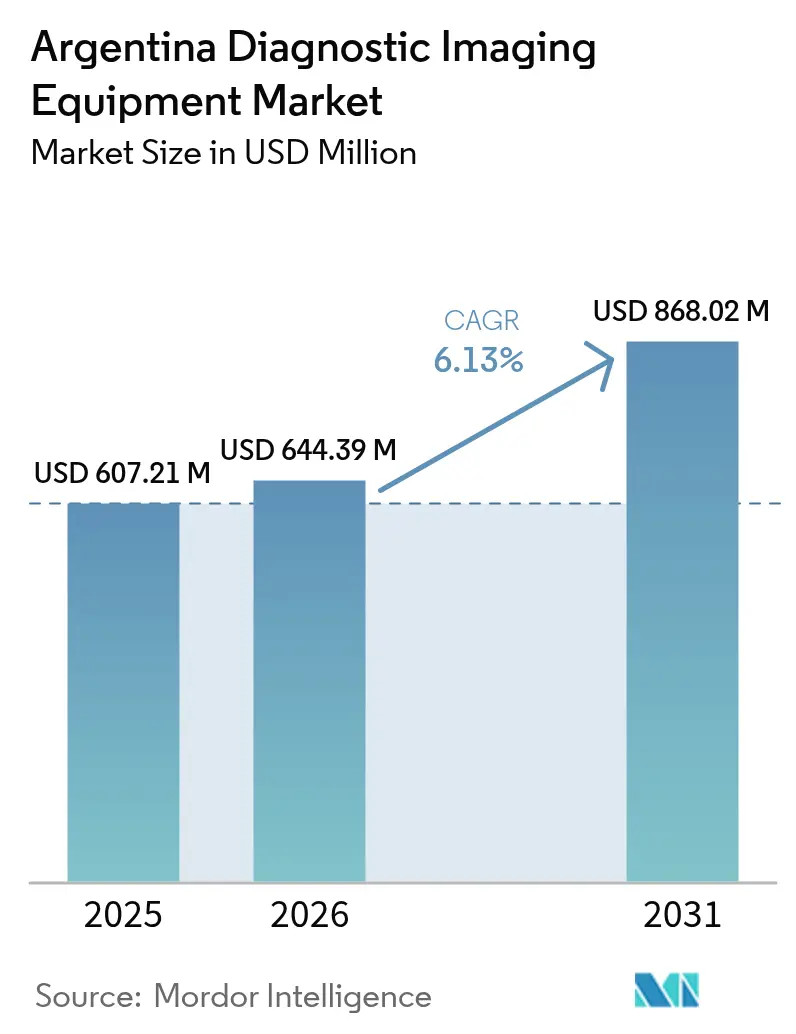
Argentina diagnostic imaging equipment market size in 2026 is estimated at USD 644.39 million, growing from 2025 value of USD 607.21 million with 2031 projections showing USD 868.02 million, growing at 6.13% CAGR over 2026-2031. Growth is driven by private providers upgrading technology to retain urban middle-class patients, the proliferation of AI-enabled modalities that streamline physician workflow, and a nationwide push to diagnose chronic diseases earlier. Import dependence remains high, prompting manufacturers to expand local service networks while policymakers retain a streamlined four-tier device registration pathway that accelerates market entry. Fixed installations in large hospitals still dominate, yet portable systems gain traction as provincial health plans fund mobile outreach programs. Competition is intensifying as global vendors bundle AI software, cloud connectivity, and maintenance into integrated offerings that appeal to Argentina’s price-sensitive buyers.
Key Report Takeaways
- By modality, X-ray systems held 30.12% of Argentina diagnostic imaging equipment market share in 2025, whereas MRI is projected to post the fastest 7.72% CAGR to 2031.
- By portability, fixed systems represented 79.45% of revenue in 2025; mobile and hand-held systems are expanding at a 6.85% CAGR.
- By application, oncology contributed 26.30% revenue in 2025, while cardiology leads future growth at 7.98% CAGR.
- By end user, hospitals captured 63.15% of Argentina diagnostic imaging equipment market size in 2025; dedicated imaging centers are advancing at a 7.5% CAGR.
Note: Market size and forecast figures in this report are generated using Mordor Intelligence’s proprietary estimation framework, updated with the latest available data and insights as of 2026.
Argentina Diagnostic Imaging Equipment Market Trends and Insights
Drivers Impact Analysis*
| Driver | (~) % Impact on CAGR Forecast | Geographic Relevance | Impact Timeline |
|---|---|---|---|
| Rising burden of chronic diseases | +1.2% | National, concentrated in Buenos Aires, Córdoba, Rosario | Medium term (2-4 years) |
| Technological advancements in imaging systems | +1.8% | National, with early adoption in private facilities | Short term (≤ 2 years) |
| Growing geriatric population in Argentina | +0.9% | National, higher impact in urban centers | Long term (≥ 4 years) |
| Expansion of private health-insurance networks | +1.4% | National, strongest in metropolitan areas | Medium term (2-4 years) |
| Rapid uptake of AI-enabled teleradiology services | +0.7% | National, remote areas benefit most | Short term (≤ 2 years) |
| Government initiatives for early diagnosis | +0.3% | National, prioritizing underserved regions | Long term (≥ 4 years) |
| Source: Mordor Intelligence | |||
Rising Burden of Chronic Diseases
Chronic cardiovascular and oncologic conditions now account for the heaviest diagnostic workload in Argentina’s hospitals, propelling procurement of high-resolution CT, MRI, and multimodal X-ray systems. Portable units equipped with AI triage software reached 97% sensitivity for COVID-related lung findings, proving their broader utility in busy emergency rooms. Provincial authorities respond by channeling Sumar Program funds toward imaging upgrades that support early detection campaigns. Combined, these factors sustain long-run equipment demand across urban and rural markets.
Technological Advancements in Imaging Systems
Vendors now tailor AI-driven workflow solutions for emerging economies, reducing contrast use, power, and helium dependency while automating repetitive tasks. A Bariloche research group achieved 89% accuracy in gadolinium-free cardiac fibrosis detection through AI post-processing of routine cine MRI scans. Siemens’ self-driving Ciartic Move C-arm trims surgical imaging time by 50%, a benefit in facilities grappling with personnel shortages. Such innovations shorten learning curves and widen adoption beyond Argentina’s largest centers.
Growing Geriatric Population in Argentina
Older adults seek more musculoskeletal, neurological, and cardiac imaging, pushing high-field MRI usage and spurring interest in proton-based oncology solutions commissioned in Buenos Aires.[1] Portable scanners support outreach to residential facilities, complementing home-care programs that mitigate hospital overcrowding. These demographic shifts ensure durable growth in both premium and point-of-care segments over the forecast horizon.
Expansion of Private Health-Insurance Networks
Price-control removal allows insurers such as OSDE and Swiss Medical to index premiums and earmark capital for state-of-the-art diagnostics that entice affluent members. As private centers proliferate, equipment vendors bundle financing, maintenance, and AI subscriptions to overcome high upfront costs. Yet persistent inflation risks could limit middle-class uptake, leaving premium imaging demand concentrated in major cities.
Restraints Impact Analysis*
| Restraint | (~) % Impact on CAGR Forecast | Geographic Relevance | Impact Timeline |
|---|---|---|---|
| High acquisition & procedure costs | -1.5% | National, most severe in rural provinces | Medium term (2-4 years) |
| Fragmented reimbursement for outpatient imaging | -0.8% | National, varies by insurance provider | Short term (≤ 2 years) |
| Shortage of sub-specialty radiologists | -0.6% | National, critical in remote areas | Long term (≥ 4 years) |
| Stringent regulatory framework | -0.4% | National, affects all market participants | Medium term (2-4 years) |
| Source: Mordor Intelligence | |||
High Acquisition & Procedure Costs
Upfront scanner prices rise roughly 50% once import duties and logistics are added, forcing smaller hospitals to delay upgrades. The government’s BOPREAL (Bonds for the Reconstruction of a Free Argentina) bond offers currency-hedged payment relief, yet maintenance contracts, helium supply, and staff training remain costly.[2] Vendors counter with refurbished models and pay-per-scan financing, although rural facilities still struggle to justify MRI or PET investments given patient throughput constraints.
Fragmented Reimbursement for Outpatient Imaging
Three overlapping payor systems dictate multiple prior-authorization rules that frequently exclude advanced modalities, shifting costs onto patients and discouraging diagnostic centers from installing newer platforms. The Compulsory Medical Plan covers basic X-ray but rarely reimburses AI-assisted CT. Until uniform payment codes emerge, equipment demand risks periodic slowdowns, particularly outside Buenos Aires where disposable income is lower.
*Our forecasts treat driver/restraint impacts as directional, not additive. The impact forecasts reflect baseline growth, mix effects, and variable interactions.
Segment Analysis
By Modality: MRI Acceleration Challenges X-ray Leadership
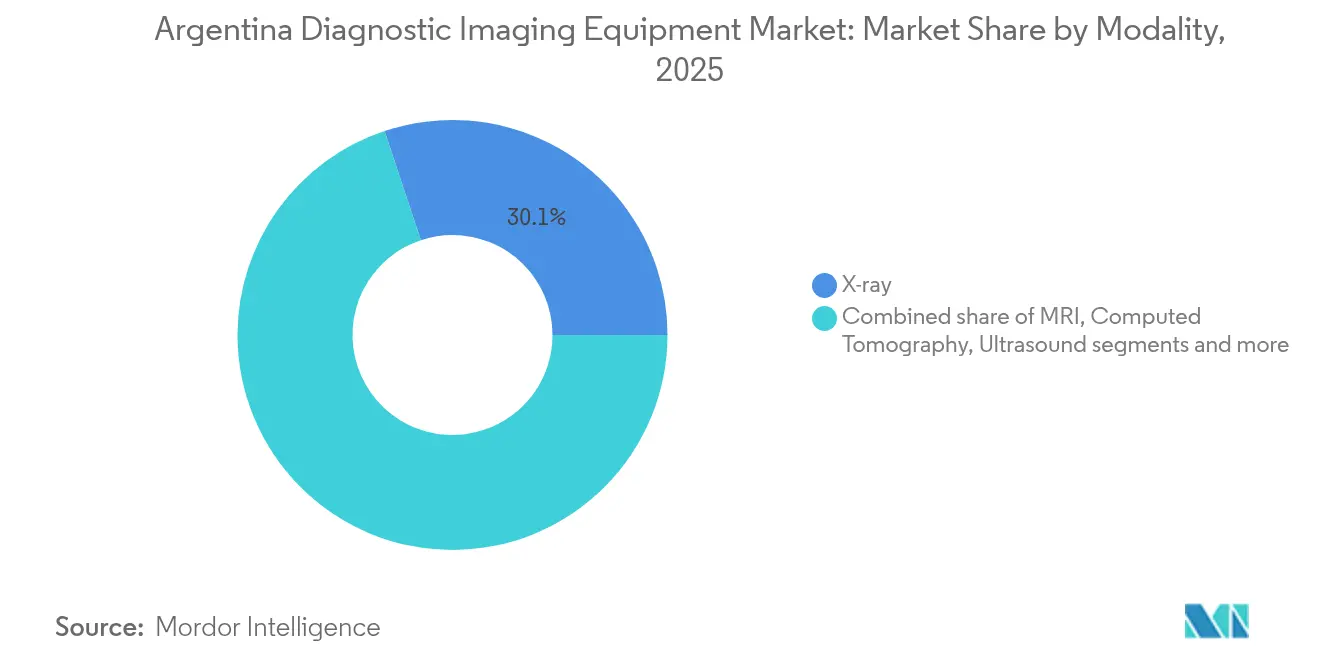
Argentina diagnostic imaging equipment market share for X-ray stood at 30.12% in 2025. Ubiquity, swift scan times, and cost efficiency keep X-ray entrenched in emergency, orthopedic, and pulmonary pathways. However, MRI revenue is growing 7.72% annually, propelled by helium-free magnets. Hospitals adopt AI-accelerated reconstruction that halves scan time and expands daily volume. As reimbursement policies evolve, multi-contrast MRI’s superior soft-tissue characterization positions it for broader oncologic and neurologic use.
Adoption barriers persist, including room-shielding, radiologist availability, and power stability. Yet new cloud-based protocols allow remote protocoling and over-read, mitigating skills gaps. Ultrasound, mammography, and nuclear modalities carve specialized niches, but MRI’s innovation pace suggests its share of Argentina diagnostic imaging equipment market will widen through 2031.

By Portability: Mobile Systems Extend Reach
Fixed systems retain 79.45% market share thanks to embedded CT, angiography, and fluoroscopy suites within tertiary hospitals. High throughput and advanced service contracts justify their dominance. Nonetheless, mobile and hand-held devices are gaining a 6.85% CAGR as provincial health ministries deploy truck-mounted CT and battery-powered ultrasound to remote clinics.
Portable X-ray units with AI triage proved indispensable during the pandemic and now support tuberculosis, trauma, and neonatal screening programs. Cellular data integration permits cloud archiving for centralized reporting, expanding diagnostic capacity despite radiologist shortages.
By Application: Cardiology Gains Momentum
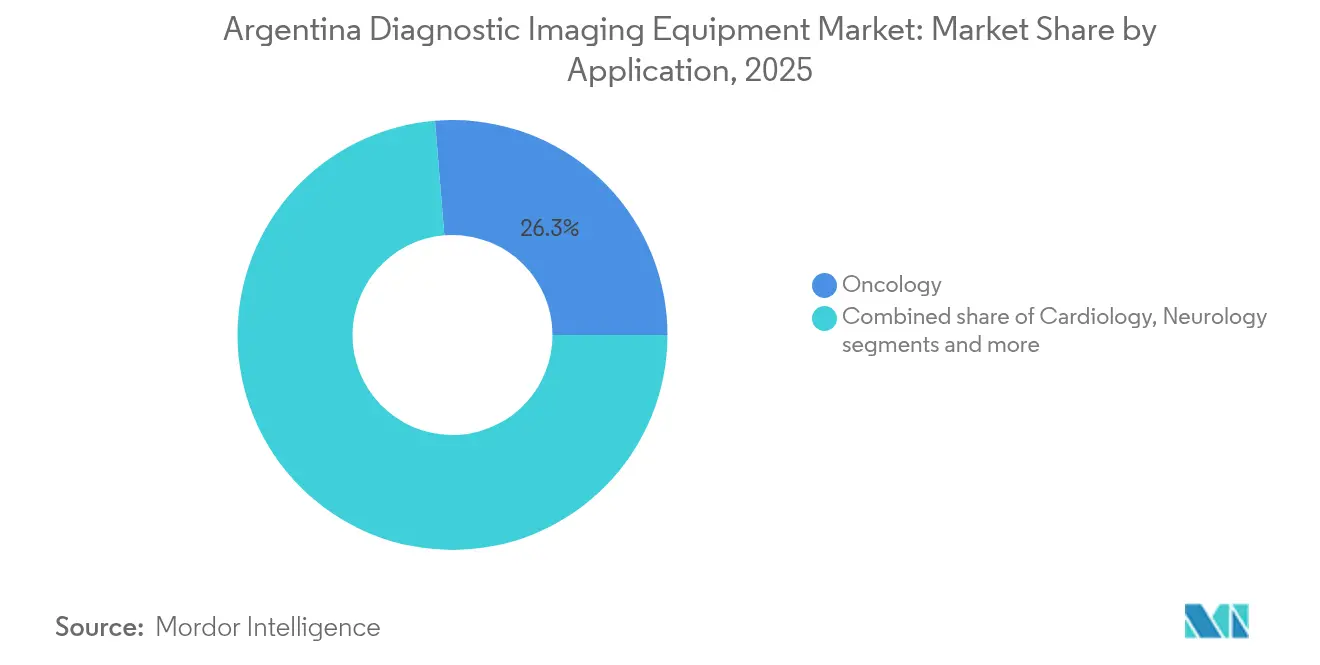
Oncology imaging generated USD 159.68 million in 2025, 26.30% of Argentina diagnostic imaging equipment market. It remains indispensable for staging lung, breast, and colorectal cancers. Yet cardiology is accelerating at 7.98% CAGR as AI algorithms quantify ventricular volume and detect fibrosis without contrast. Rising hypertension and obesity levels, alongside Medicare-style plan expansions, ensure sustained cardiac imaging volumes. Vendors integrate ultrasound, CT, and MRI data into single dashboards that guide interventional decisions, shortening hospital stays and boosting demand for multimodal suites.
Women’s health systems embed tomosynthesis and contrast-enhanced mammography to meet screening mandates, while neurologic and musculoskeletal applications leverage portable ultrasound for sports and stroke triage. Clinical breadth supports the continued diversification of Argentina diagnostic imaging equipment market.
By End User: Imaging Centers Narrow the Gap
Hospitals accounted for 63.15% of revenue in 2025, capitalizing on bundled capital budgets and in-house bio-engineering teams. Their volume throughput supports premium CT and hybrid PET-CT. Diagnostic centers, however, are growing faster at 7.5% CAGR as insurers authorize outpatient scans to reduce inpatient congestion. Lean staffing models, extended hours, and same-day reporting resonate with urban professionals.
Financing partners enable centers to refresh equipment every five years, accelerating technology cycles and pushing hospitals to modernize. Specialty clinics focusing on cardiology, orthopedics, or women’s health adopt compact scanners that align with procedure-based reimbursement, adding resilience to overall market expansion.
Geography Analysis
Buenos Aires metropolitan area houses high-end scanners, supported by Argentina’s densest private insurance base and research hospitals that attract vendor pilot projects. Córdoba and Rosario follow, leveraging university hospitals and growing expatriate communities. In contrast, northern provinces rely on refurbished X-ray and portable ultrasound, yet government programs earmark funds to narrow diagnostic gaps. Patagonia’s sparse population necessitates mobile CT caravans, and Bariloche’s AI cardiac imaging research underscores how regional centers can pioneer innovation even with modest budgets.
Provinces such as Salta, Tucumán, and Jujuy benefit from the Sumar Program, which subsidizes imaging for 20 million low-income residents. These initiatives stimulate modest but steady equipment purchases, particularly for digital radiography and point-of-care ultrasound.
Coastal hubs including Mar del Plata experience seasonal peaks linked to tourism, influencing scanner utilization and replacement cycles. Across geographies, manufacturers that bundle warranty, remote diagnostics, and local parts inventory command loyalty in the Argentina diagnostic imaging equipment market.
Regulatory Landscape
Argentina regulates diagnostic imaging equipment under ANMAT (Administracion Nacional de Medicamentos, Alimentos y Tecnologia Medica). Foreign OEMs must operate through a locally established authorized representative for registrations and ongoing compliance, with registrations and post-market surveillance managed through ANMATs digital systems (including HELENA/GHEMA/THEMIS).
Competitive Landscape
Global majors GE HealthCare, Siemens Healthineers, and Philips collectively command significant revenue through broad modality portfolios, deep AI pipelines, and extensive service networks. Mid-tier contenders—Canon, Fujifilm, United Imaging, Samsung—target value-priced CT, digital radiography, and ultrasound niches, frequently partnering with distributors such as Digimed for nationwide coverage.
Local service capabilities and spare parts stocking remain key differentiators within the Argentina diagnostic imaging equipment market. White-space opportunities persist in tele-radiology platforms, AI decision support, and pay-per-scan leasing models that address persistent capital constraints.
Regulatory familiarity also shapes competition. Firms that streamline ANMAT submissions through the SEDI portal and provide Spanish-language documentation shorten time-to-market. Increasingly, manufacturers bundle cybersecurity features to satisfy new data-protection guidelines, a criterion that Argentine hospitals prioritize when selecting vendors.
Argentina Diagnostic Imaging Equipment Industry Leaders
-
Canon Medical Systems Corporation
-
Fujifilm Holdings Corporation
-
GE HealthCare
-
Koninklijke Philips N.V.
-
Siemens Healthineers AG
- *Disclaimer: Major Players sorted in no particular order

Market Opportunities and Future Outlook
Hospitals and imaging centers continue to face high landed costs for new systems, creating whitespace for OEMs and distributors that package imaging hardware with financing, service, and uptime guarantees while building local parts and field-service coverage. Decree 226/2024 established a traceability regime for active medical devices and supported the strengthening of Biomedical Technology Services, raising the importance of documented maintenance, asset control, and digital readiness across imaging fleets.
Recent Industry Developments
- June 2026: INTEMED reports the installation of a Siemens Healthineers Mammomat Fusion digital mammography system at Hospital Policial Churruca-Visca in Buenos Aires, acquired by the Fundacion Policia Federal Argentina. The project supports modernization of womens imaging capacity in a major urban hospital setting. It also highlights the role of local channel partners in placing premium imaging platforms and sustaining service coverage.
- December 2025: Instituto de Cardiologia de Corrientes installed a GE HealthCare Revolution Apex CT system, expanding access to high-end cardiac and advanced CT capabilities outside Buenos Aires. The deployment illustrates how reference-site placements at specialty institutes influence purchasing decisions among private providers and provincial health systems.
- December 2024: Decree 226/2024 establishes a traceability regime for active medical devices and supports the strengthening of Biomedical Technology Services, highlighting documented maintenance, asset control, and digital readiness across imaging fleets.
Research Methodology Framework and Report Scope
Market Definition and Coverage
This market is defined as the revenue generated from diagnostic imaging equipment sold and installed in Argentina, covering the core modalities used to capture medical images in hospitals, imaging centers, and specialty clinics.
Scope exclusions: service contracts, consumables (including radiopharmaceuticals), refurbished systems, and AI-only software platforms are excluded from this sizing.
Segmentation Overview
- By Modality
- MRI
- Computed Tomography
- Ultrasound
- X-ray
- Nuclear Imaging
- Fluoroscopy
- Mammography
- By Portability
- Fixed Systems
- Mobile and Hand-held Systems
- By Application
- Cardiology
- Oncology
- Neurology
- Orthopedics and Trauma
- Women’s Health
- Other Clinical Applications
- By End User
- Hospitals
- Diagnostic Imaging Centers
- Specialty Clinics and Others
Data Sources, Market Sizing, and Validation
Desk Research
Desk research was used to build the fact base for the Argentina demand environment and to keep assumptions grounded before we spoke with the market. We referred to public health statistics and system availability indicators from sources such as the World Health Organization, the World Bank, and PAHO, then supplemented with Argentina health and trade publications where available.
To understand equipment inflow and pricing direction, we also reviewed customs and tariff references from sources such as UN Comtrade and Argentina trade portals, along with ANMAT information for medical device registration context. Company annual reports, investor presentations, and reputable press were checked to align product mix trends and channel activity. Where needed, paid subscriptions for company financials and shipment-level import-export checks were used to cross-check totals. This list is illustrative, and many additional public sources were also used for data collection, validation, and clarification.
Primary Interviews and Surveys
Primary work focused on validating how much of the installed base is refreshed each year, what purchasing cycles look like, and how modality mix is shifting across public and private care settings in Argentina. We spoke with a balanced set of stakeholders, including hospital procurement leaders, diagnostic imaging center operators, distributors, service partners, and clinical users, then ran follow-up checks to close gaps identified during desk research.
Distribution of primary research fieldwork respondents
| Company type | Respondent position |
|---|---|
| Top tier: 25% | CXOs: 15% |
| Mid tier: 60% | Functional/Unit leaders: 28% |
| Smaller Players: 15% | Managers: 57% |
Market-Sizing & Forecasting
The sizing starts with a top-down build where healthcare spend signals, imaging procedure demand, and equipment replacement behavior are used to reconstruct annual purchasing value for Argentina. From there, selective bottom-up checks are applied using sampled average selling prices and estimated unit volumes for key modalities, plus distributor and channel feedback, which are then used to correct any early overstatement in totals.
Key model inputs include the installed base by modality, typical replacement cycles for X-ray, CT, MRI, and ultrasound systems, facility additions and upgrades in hospitals and stand-alone imaging centers, import intensity for capital equipment, and observed pricing changes linked to FX movements and inflation. When data is missing for a sub-modality or end user, we bridge gaps using proxied shares from interviews and sanity checks against import trends, before rolling results back to the country total.
For forecasting, scenario analysis is used, because demand is sensitive to public budget timing, private investment appetite, and currency-linked price changes. Expert inputs are used to set conservative, base, and upside paths for unit demand and ASP progression, and the final forecast is kept consistent with expected replacement need and realistic procurement capacity.
Data Validation & Update Cycle
Outputs are checked against independent signals such as import direction, reported hospital capex activity, and modality-level adoption stories that repeatedly appear in interviews. Variance checks are run across years to flag sudden changes in units, pricing, or mix, and those exceptions are reviewed and corrected before sign-off.
A second analyst review is completed to confirm that assumptions match the written scope and that calculations are traceable. Reports are refreshed annually, and interim updates are triggered when material events occur, such as policy shifts, sharp currency moves, or major changes in public tenders. Before delivery, we do a final pass to ensure the market view reflects the latest available information.
Mordor Intelligence's Argentina Diagnostic Imaging Equipment Market Estimate Compared With Other Published Estimates
It is common to see different market sizes published for Argentina diagnostic imaging, even when most sources talk about similar modalities. The main reasons are usually boundary choices, what gets counted as equipment versus related spend, and how pricing and currency timing are handled.
By tracking import-linked pricing and installed-base replacement cycles, Mordor Intelligence keeps the estimate tied to new equipment sales only, while some sources lean more on mixed definitions that can shift the total without being obvious. Differences also come from base year selection, whether refurbished systems are counted, and whether values are treated as manufacturer level or include downstream markups.
Benchmark comparison
| Source | Market Size | Gaps in Research Methodology |
|---|---|---|
| Mordor Intelligence | USD 607.21 M (2025) | |
| Global Consultancy A | USD 474.80 M (2024) | Uses a different base year and appears to rely on a narrower modality and application cut, which can undercount smaller installed base refresh cycles outside major centers. |
| Industry Databook B | USD 298.70 M (2024) | Tracks a medical imaging total that is likely defined differently, and the lower value suggests a tighter inclusion set or pricing treatment that may not reflect capital equipment ASP levels in Argentina. |
Across the three values, the spread is mainly explained by what is included in the spend pool, the base year chosen, and how pricing is translated into USD under volatile currency conditions. Our approach stays traceable to equipment-only demand drivers, with cross-checks that link volumes and pricing to observable signals, so the final number can be followed and repeated.
Key Questions Answered in the Report
Which imaging modality sees the widest everyday use across Argentine hospitals?
Digital X-ray remains the workhorse because it is affordable, quick to operate, and versatile for emergency, orthopedic, and chest exams.
How is artificial intelligence changing diagnostic imaging practice in Argentina?
Hospitals and imaging centers are adopting AI algorithms that automate scan positioning, accelerate image reconstruction, and flag suspicious findings, helping radiologists cope with heavy workloads.
Why are portable scanners gaining traction outside Buenos Aires?
Mobile X-ray and ultrasound units allow clinicians to reach rural clinics and bedside patients, addressing the shortage of full-service imaging suites in provincial areas.
In what way does the growth of private health insurance shape equipment purchases?
Insurers compete on premium service levels, prompting private facilities to buy advanced MRI, CT, and AI-ready systems that shorten wait times and attract higher-income members.
What is the key regulatory pathway for bringing new imaging equipment into the country?
Manufacturers register devices through ANMAT’s SEDI portal, submitting technical dossiers and quality certificates that place products into one of four risk classes before approval.
Where do international suppliers find the greatest commercial openings?
Opportunities lie in offering integrated service contracts and financing that ease high import costs, coupled with training programs that build local expertise on advanced platforms.