
Archery Equipment Market Size and Share
Market Overview
| Study Period | 2021 - 2031 |
|---|---|
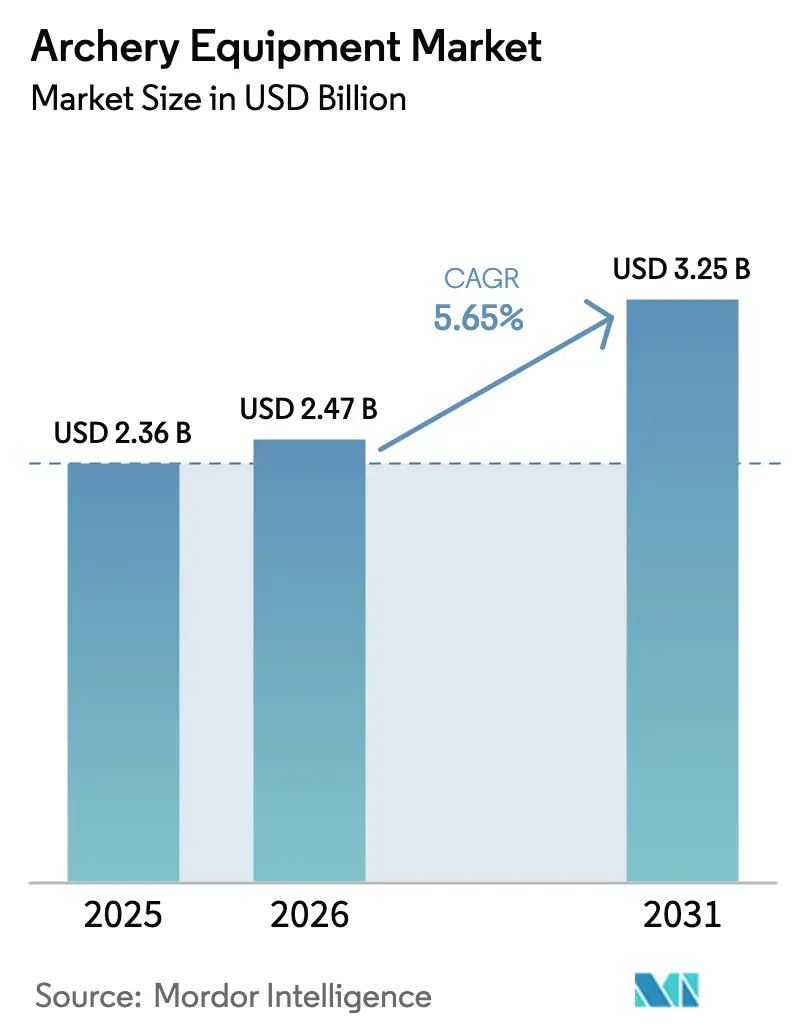
| Market Size (2026) | USD 2.47 Billion |
| Market Size (2031) | USD 3.25 Billion |
| Growth Rate (2026 - 2031) | 5.65 % |
| Fastest Growing Market | Asia-Pacific |
| Largest Market | North America |
| Market Concentration | Medium |
Major Players
*Disclaimer: Major Players sorted in no particular order Image © Mordor Intelligence. Reuse requires attribution under CC BY 4.0. |
|
Archery Equipment Market Analysis by Mordor Intelligence
The archery equipment market size was valued at USD 2.36 billion in 2025 and estimated to grow from USD 2.47 billion in 2026 to reach USD 3.25 billion by 2031, at a CAGR of 5.65% during the forecast period (2026-2031). The global archery equipment market is experiencing growth, driven by trends in recreation, sports, and lifestyle. Increased participation in outdoor and adventure activities, particularly among younger demographics, is fueling interest in archery as both a hobby and a fitness pursuit. According to the Archery Trade Association, archery participation in the United States has grown significantly, rising from 7 million in 2000 to over 19 million by 2025[1]Source: National Archery in the Schools Program, "NASP® Credited in Dominant Participation Rates of Youth Archers in New Federal Report," naspschools.org. The growing popularity of competitive events and school or club-level training programs is further increasing demand for bows, arrows, and protective gear. Media exposure through historical, fantasy, and sports-related content has heightened awareness and cultural appeal, encouraging first-time users to engage with the sport. Technological advancements, such as lightweight composite materials, precision sights, and ergonomic designs, are enhancing equipment usability and safety, attracting more beginner participants. Additional factors, including rising female participation, the expansion of archery ranges and sports tourism, and increasing disposable incomes in developing economies, are also contributing to market growth. Moreover, the growth of e-commerce retailing, do-it-yourself backyard sports setups, and hunting traditions in specific regions supports replacement and upgrade cycles, collectively sustaining global demand for archery equipment.
Key Report Takeaways
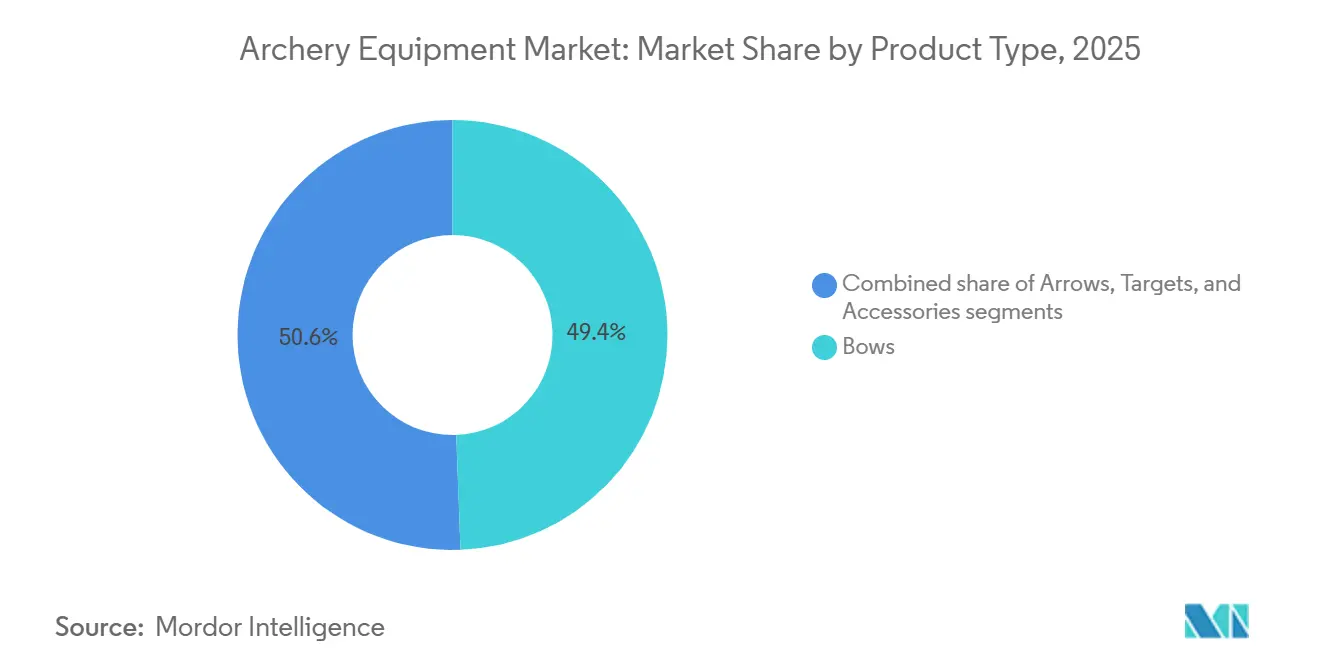
- By product type, bows led with 49.41% revenue share in 2025, while targets are projected to advance at a 6.73% CAGR through 2031.
- By end user, adults accounted for 80.84% share in 2025, and the kids segment is set to expand at a 7.01% CAGR over 2026-2031.
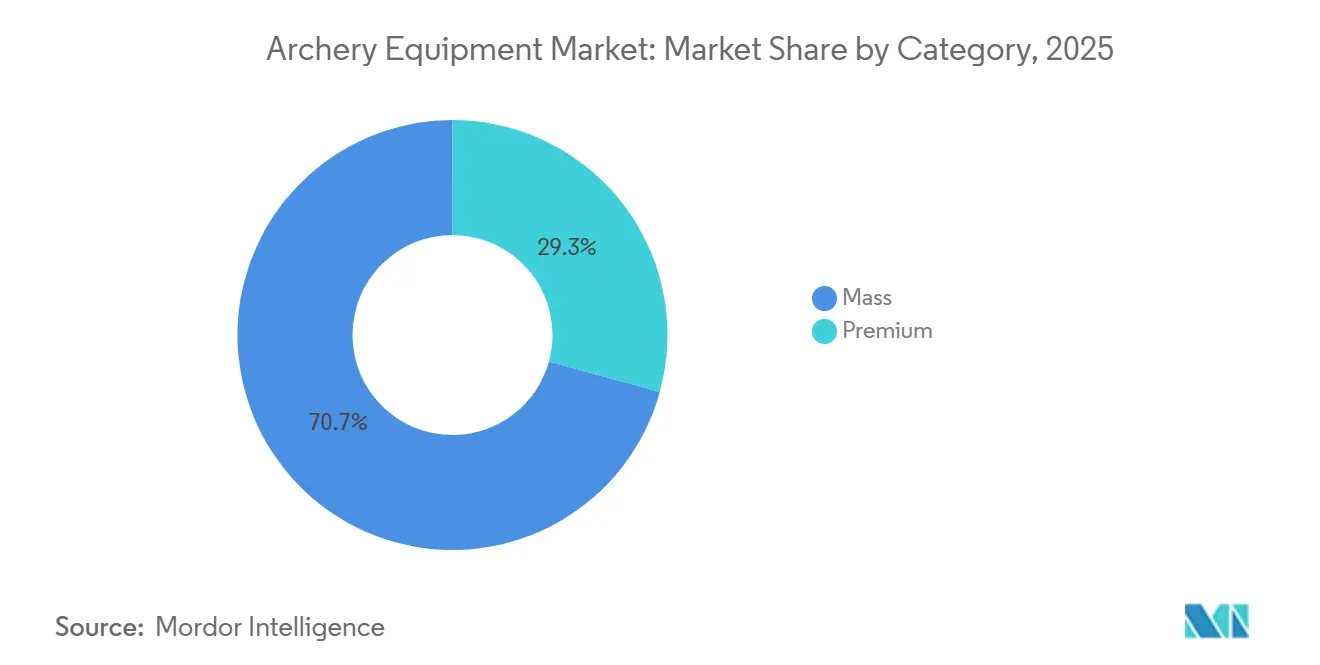
- By category, the mass tier held 70.73% revenue share in 2025, and premium products are forecast to grow at 6.91% CAGR during the same period.
- By distribution channel, offline retail stores captured 66.71% of 2025 revenue, whereas online retail stores are expected to record a 7.53% CAGR to 2031.
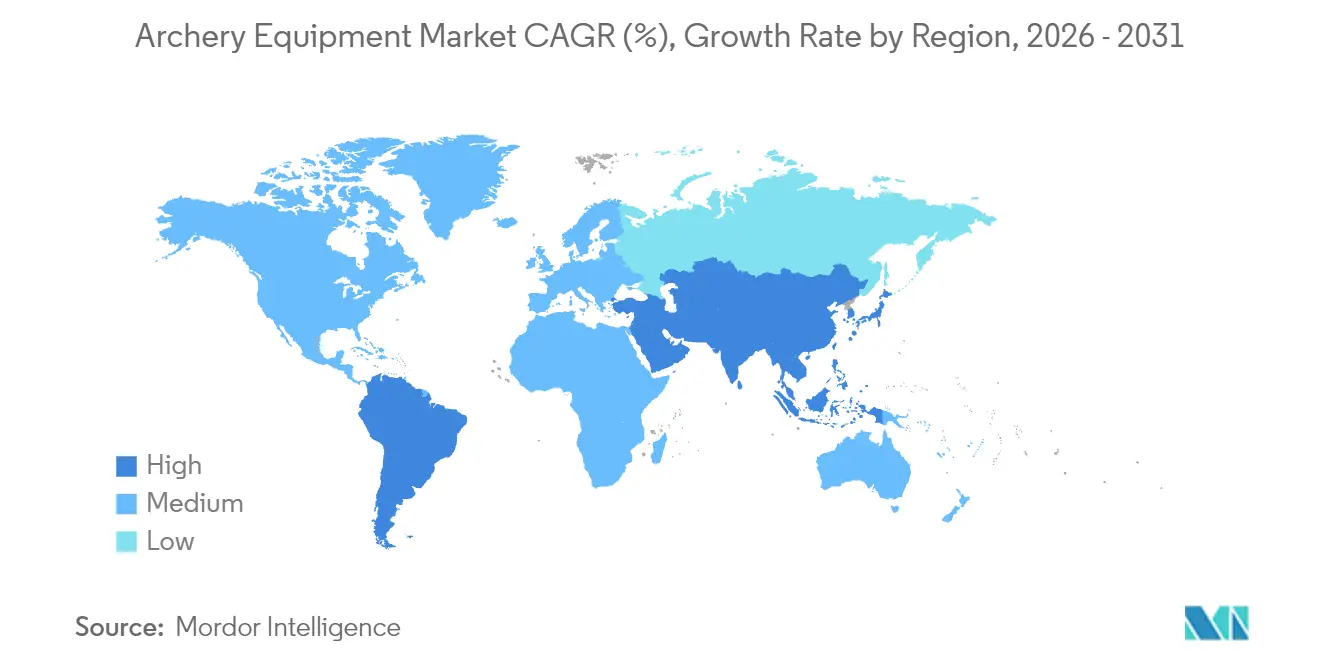
- By geography, North America led with 34.32% revenue share in 2025, while Asia-Pacific is projected to expand at a 7.24% CAGR through 2031.
Note: Market size and forecast figures in this report are generated using Mordor Intelligence’s proprietary estimation framework, updated with the latest available data and insights as of 2026.
Global Archery Equipment Market Trends and Insights
Drivers Impact Analysis*
| Driver | (~) % Impact on CAGR Forecast | Geographic Relevance | Impact Timeline |
|---|---|---|---|
| Renewed consumer interest in traditional and heritage sports | +0.6% | Global, with stronger resonance in North America and Europe | Medium term (2-4 years) |
| Continuous innovation and technological improvements in archery gear | +0.9% | Global, led by North America and Asia-Pacific manufacturing hubs | Long term (≥ 4 years) |
| Media coverage and major sporting events boosting visibility | +0.7% | Global, peak impact in Olympic host regions (Europe 2024, North America 2028) | Short term (≤ 2 years) |
| Growth of coaching centers, academies, and school-level training programs | +0.8% | North America and Asia-Pacific core, spillover to Europe and South America | Medium term (2-4 years) |
| Rising adoption of archery for both competitive play and leisure activities | +0.9% | Global, with accelerated uptake in Asia-Pacific and Middle East | Long term (≥ 4 years) |
| Increasing focus on personal health and fitness | +0.6% | Global, particularly urban centers in North America, Europe, and Asia-Pacific | Medium term (2-4 years) |
| Source: Mordor Intelligence | |||
Renewed consumer interest in traditional and heritage sports
The growing appreciation for culturally rooted and heritage-based sports is driving demand in the global archery equipment market. Consumers are increasingly seeking activities that offer historical connections, mindfulness, and skill development beyond conventional gym-focused fitness routines. Archery has gained renewed attention as both a recreational and educational activity. Families, schools, and community organizations are introducing the sport to younger generations to foster focus, discipline, and outdoor engagement, positioning it as an alternative to screen-based leisure activities. This resurgence is particularly notable among children and teenagers, with structured training programs creating long-term participation pathways. According to the "Target Shooting in the United States: Participation, Demographics, and Relationship with Hunting and Fishing" report published in March 2025, archery participation is highest among youth aged 6–15. This growth is supported by the expansion of the National Archery in the Schools Program (NASP), which has reached over 23.5 million students across more than 9,500 schools in the United States[2]Source: National Archery in the Schools Program, "NASP® Credited in Dominant Participation Rates of Youth Archers in New Federal Report," naspschools.org. Early exposure through such programs encourages continued involvement into adulthood, driving sustained demand for equipment, upgrades, and club memberships. Furthermore, cultural festivals, historical reenactments, and traditional sporting competitions in various regions are reinforcing archery’s identity as a heritage activity rather than a niche sport. This cultural positioning strengthens long-term consumer engagement and supports global demand for archery equipment.
Continuous innovation and technological improvements in archery gear
Advancements in materials, design engineering, and performance-enhancing accessories are significantly driving growth in the global archery equipment market. Manufacturers are developing lightweight carbon fiber and advanced composite bows that enhance durability while minimizing vibration and fatigue. These improvements make the sport more accessible for beginners and increase precision for professionals. Features such as adjustable draw-length systems, ergonomic grips, and vibration-dampening stabilizers enable users to customize equipment to their body mechanics, improving shooting accuracy and reducing the risk of injury. Additionally, innovations like precision sights, laser rangefinders, improved arrow spine consistency, and high-efficiency release aids are enhancing overall performance, encouraging enthusiasts to upgrade their gear more frequently. Smart accessories and digital tuning tools are further aiding archers by analyzing shooting form and optimizing equipment setup. This integration of technology is transforming archery from a traditional practice into a technology-supported sport. These advancements lower the entry barriers for new participants while motivating experienced users to replace outdated equipment. As a result, the consumer base is expanding, and repeat purchases are increasing, strengthening global demand for archery equipment.
Media coverage and major sporting events boosting visibility
Extensive broadcast exposure and international competitions are significantly enhancing public awareness and participation in archery, contributing to the growth of the global archery equipment market. Televised tournaments, live streaming platforms, and social media highlights enable audiences to closely observe athletes’ techniques, equipment setups, and match dynamics, transforming archery from a niche activity into an engaging spectator sport. High-profile events particularly motivate first-time participants and younger audiences to explore archery, while also encouraging existing players to upgrade their equipment to professional standards. Major global competitions serve as effective marketing platforms for manufacturers and sports federations by showcasing performance capabilities in real competitive settings. For instance, the Paris 2024 Games featured 128 archers from 53 nations competing at Les Invalides in a temporary 8,000-seat venue, achieving significant worldwide broadcast exposure[3]Source: World Archery Federation, "Complete guide to archery at the Paris 2024 Olympic Games," worldarchery.sport. Such large-scale visibility enhances the sport's aspirational appeal, drives enrollment in training programs and clubs, and ultimately increases demand for bows, arrows, and protective accessories across both recreational and professional segments.
Growth of coaching centers, academies, and school-level training programs
The growing network of professional coaching facilities, sports academies, and school-based training programs is significantly driving demand in the global archery equipment market. Educational institutions and private training centers are increasingly integrating archery into structured sports curricula to enhance students' concentration, coordination, and mental discipline. This institutional focus generates a consistent influx of beginners requiring starter kits, safety gear, and practice accessories, while advanced training levels drive demand for upgraded bows and precision equipment. Certified coaches and structured training programs have also lowered the skill barrier, making the sport more accessible to children, teenagers, and adults. Regular practice sessions, interschool competitions, and talent identification initiatives further strengthen long-term participation, resulting in repeat purchases and spending on equipment maintenance. Additionally, as more countries invest in grassroots sports development and Olympic-oriented training infrastructure, these organized learning environments continue to expand the user base, sustaining global demand for archery equipment.
Restraints Impact Analysis*
| Restraint | (~) % Impact on CAGR Forecast | Geographic Relevance | Impact Timeline |
|---|---|---|---|
| Relatively high cost of equipment and accessories | -0.4% | Global, most acute in South America, Africa, and lower-income Asia-Pacific markets | Short term (≤ 2 years) |
| Dependence on seasonal conditions and favorable weather | -0.2% | North America and Europe, particularly regions with harsh winters | Short term (≤ 2 years) |
| Low awareness across developing and untapped regions | -0.2% | Africa, parts of South America, and rural Asia-Pacific | Medium term (2-4 years) |
| Insufficient availability of dedicated archery ranges and facilities | -0.2% | Global, with gaps in urban centers and developing markets | Medium term (2-4 years) |
| Source: Mordor Intelligence | |||
Relatively high cost of equipment and accessories
The relatively high cost of archery equipment serves as a significant obstacle to broader adoption, limiting growth in the global archery equipment market. High-quality bows, arrows, sights, stabilizers, protective gear, and maintenance tools often require a substantial initial investment, particularly for compound and competition-grade equipment made with advanced materials and precision engineering. This cost deters beginners from entering the sport and discourages parents and schools from purchasing multiple sets of equipment for group training purposes. Additionally, ongoing expenses, such as replacing arrows, servicing strings, purchasing tuning accessories, and making periodic upgrades, contribute to the overall lifetime cost of ownership. These recurring costs often discourage casual users from sustained participation. Price sensitivity is especially pronounced in developing regions, where disposable income for specialized sports is limited. As a result, individuals in these areas often rely on shared or rented equipment rather than making personal purchases. This affordability issue hampers the conversion of new participants and reduces repeat purchases, ultimately restricting the market's overall growth potential.
Dependence on seasonal conditions and favorable weather
The reliance on favorable outdoor conditions poses challenges to consistent participation in archery, thereby limiting the growth of the global archery equipment market. In many regions, the sport is predominantly practiced in open fields or outdoor ranges, making it highly susceptible to adverse weather conditions such as rain, extreme heat, cold temperatures, and strong winds. These factors not only affect safety and shooting accuracy but also lead to reduced activity levels during unfavorable seasons. During such periods, training sessions, competitions, and recreational use often decline or cease altogether, resulting in decreased equipment usage and delays in replacement purchases. Beginners, in particular, face setbacks as irregular practice opportunities hinder skill development. Additionally, clubs and facilities experience lower attendance and reduced membership renewals, further impacting the market. While indoor ranges offer an alternative, their limited availability and the need for additional infrastructure investment restrict accessibility in many regions. This dependence on weather conditions creates fluctuating demand cycles, discouraging retailers from maintaining large inventories and constraining steady, year-round sales of archery equipment.
*Our forecasts treat driver/restraint impacts as directional, not additive. The impact forecasts reflect baseline growth, mix effects, and variable interactions.
Segment Analysis
By Product Type: Targets Surge as Training Infrastructure Expands
Bows accounted for 49.41% of product-type revenue in 2025, driven by increased participation in recreational and competitive archery, along with ongoing product innovations enhancing comfort, accuracy, and adjustability. Features such as lightweight composite materials, customizable draw lengths, and vibration-reduction technologies make modern bows more accessible for beginners while remaining attractive to experienced users seeking performance improvements. Furthermore, the expansion of youth training programs and club memberships supports first-time purchases, while dedicated hobbyists frequently replace or upgrade bows to align with their skill development, contributing to sustained repeat sales.
The market for archery targets is projected to grow at a CAGR of 6.73% from 2026 to 2031. The increasing adoption of archery targets is driven by a growing number of consumers practicing at home, in backyards, and in small indoor ranges, where safe training environments are crucial. Additionally, schools, coaching academies, and community clubs generate consistent institutional demand for durable targets to support daily practice. Advancements in self-healing foam and layered materials, which enhance product durability, further encourage individual ownership of targets. This supports regular practice sessions and drives replacement cycles as targets experience wear over time.


By End User: Kids Segment Accelerates on School Program Momentum
Adults accounted for 80.84% of end-user revenue in 2025. Within this group, purchases are primarily driven by recreational fitness and stress-relief activities that emphasize focus, coordination, and outdoor engagement. Additionally, many adults participate in competitive leagues, hobby clubs, and hunting traditions, which promote the purchase of high-performance gear and periodic upgrades as their skill levels advance. Increasing disposable income and growing interest in specialized hobbies further encourage consumers to invest in personalized equipment instead of renting. Technological advancements in comfort and precision also enhance the appeal of extended practice sessions.
The kids segment is anticipated to grow at a CAGR of 7.01% from 2026 to 2031. The demand in this segment is primarily influenced by school programs, beginner coaching classes, and youth sports initiatives that incorporate archery as a structured learning activity. Parents and educators recognize the sport's benefits in enhancing concentration, discipline, and confidence, driving the early adoption of starter kits and safety accessories. Additionally, participation in junior competitions and regular practice sessions generates recurring demand for replacement arrows and upgraded beginner equipment as children progress and refine their skills.
By Category: Premium Segment Gains as Customization Demand Rises
The mass segment accounted for 70.73% of category revenue in 2025. This segment is driven by affordability and accessibility, appealing to beginners, schools, and recreational users seeking low-cost starter kits for casual practice. The expansion of school programs, community sports initiatives, and backyard hobby participation has encouraged bulk purchases of basic bows, arrows, and targets. Additionally, retail availability through sporting goods chains and online marketplaces further supports this segment's growth.
Premium products are projected to grow at a CAGR of 6.91% from 2026 to 2031. The demand for premium equipment is driven by experienced archers, competitive shooters, and hunting enthusiasts who value precision, durability, and customization. The use of advanced materials, precise engineering, and performance-enhancing accessories encourages users to upgrade their equipment as their skills improve. Participation in tournaments and specialized training programs further motivates investment in high-quality gear. Additionally, brand reputation and professional endorsements enhance consumer trust in premium products. Custom finish options and custom traditional bows also cater to a niche premium segment.
By Distribution Channel: Offline Retail Dominance
Offline retail stores accounted for 66.71% of distribution-channel revenue in 2025. Physical sporting goods shops and professional archery stores benefit from the demand for hands-on fitting, tuning, and expert guidance, which are essential when selecting bows, draw weights, and accessories. Beginners and competitive shooters often prefer in-person demonstrations, safety instructions, and after-sales services, including string replacement and sight calibration. Additionally, local clubs and training centers frequently collaborate with nearby retailers for equipment supply, driving repeat purchases and reinforcing store-based sales.
Online retail stores are expected to grow at a CAGR of 7.53% from 2026 to 2031. The growth of online channels is driven by factors such as convenience, a broader range of products, and price transparency, enabling buyers to easily compare models, brands, and specifications. Hobbyists and returning users often purchase replacement arrows, targets, and accessories through e-commerce platforms due to the availability of quick delivery options. Additionally, customer reviews, tutorial content, and direct-to-consumer brand websites help reduce uncertainty, promoting remote purchases and improving access to specialized gear in regions lacking dedicated archery shops.
Geography Analysis
In 2025, North America is projected to account for 34.32% of global revenue, driven by a strong hunting tradition that sustains demand for compound bows and related accessories. The region benefits from a well-established retail network, including large outdoor chains and specialized pro shops, which offer fitting, maintenance, and training services, maintaining the prominence of store-based sales. Youth participation programs in schools are fostering a steady pipeline of future adult consumers, while the development of new public outdoor recreation complexes highlights ongoing government support for shooting sports. Canada and Mexico contribute smaller shares to regional demand, with Canada showing significant interest in traditional bow styles due to hunting regulations that allow specific equipment types in certain zones.
The Asia-Pacific region is projected to grow at a CAGR of 7.24% from 2026 to 2031, driven by Olympic aspirations in countries such as China, India, Japan, and South Korea. These ambitions are fostering public funding for athlete training and grassroots initiatives. The expansion of national programs and increased participation in international competitions are enhancing awareness and engagement in the region. Japan and South Korea, with their strong traditional and Olympic archery cultures, are also exploring additional disciplines as global event formats evolve. Meanwhile, Australia and Indonesia contribute through active tournament participation and hosting regional competitions. Urbanized markets like Singapore and Thailand are investing in indoor facilities to address land constraints and promote recreational participation.
Europe represents a mature market, dominated by major Western European countries, supported by well-established federation structures, club memberships, and regular tournament activities. The presence of performance training centers and indoor ranges facilitates year-round participation, while smaller nations are gradually adopting similar facilities on a smaller scale. Historical shooting traditions continue to influence parts of the region, maintaining interest in classic equipment styles. In comparison, South America, the Middle East, and Africa exhibit lower overall market penetration. However, countries such as Brazil, Argentina, and South Africa sustain activity through club networks and occasional participation in international events. Several Middle Eastern countries are investing in sports infrastructure as part of broader development initiatives, creating emerging opportunities.

Regulatory Landscape
Archery equipment is shaped by a mix of voluntary standards, event rulebooks, and product-safety frameworks that affect design and competition compliance. ASTM International Subcommittee F08.16 withdrew several legacy archery standards as of 2022 and 2026, including F1544 (velocity rating) and F1363 (overdraw risk).
World Archery Federation sets equipment regulations for sanctioned competition, with the 2026 rulebook version dated January 27, 2026 detailing division-specific requirements for Recurve, Compound, and Barebow setups. The Archery Trade Association also publishes technical guidelines covering terminology, thread dimensions, and mounting specifications, while U.S. consumer-product oversight can apply when products fall under youth or toy categories, with CPSC guidance referencing ASTM F963 applicability for projectile products.
Competitive Landscape
The archery equipment market is moderately concentrated, featuring a mix of globally recognized brands and specialized manufacturers. These players hold strong positions in specific product categories or regional markets. Larger companies compete by offering diverse innovation portfolios that include bows, arrows, and accessories. Meanwhile, niche players maintain their influence by focusing on specialized disciplines, such as traditional recurve equipment or high-precision arrows. Vertical integration has emerged as a significant competitive strategy, with manufacturers increasingly managing component production and expanding direct-to-consumer sales through proprietary digital platforms to enhance margins and strengthen brand loyalty.
ompetition in the market is primarily driven by incremental technological advancements. These include efficiency-enhancing cam systems, tuning features, and maintenance-reducing designs, which appeal to both competitive archers and retailers by minimizing servicing requirements. Pricing strategies and dealer agreements remain critical, as changes in distribution structures can impact retailer partnerships and profitability across the value chain. Manufacturers are increasingly exploring adjacent technologies, such as electronic scoring systems and sensor-based training equipment, often through collaborations with shooting ranges and training facilities.
Rapidly growing markets in the Asia-Pacific region present additional opportunities for expansion, particularly for brands that adapt their products to local shooting styles and retail environments. Companies offering certification programs or service support gain a competitive edge in addressing this issue. Compliance with established safety standards continues to reinforce entry barriers, favoring established brands over low-cost entrants. This dynamic helps maintain the overall market structure and provides a competitive advantage to companies with proven safety credentials. Additionally, the ability to meet these standards further strengthens the position of established players in the market.
Archery Equipment Industry Leaders
-
Escalade, Inc.
-
Pure Archery Group
-
Easton Technical Products, Inc.
-
Heritage Outdoor Group (PSE Archery)
-
Mathews Archery Inc.
- *Disclaimer: Major Players sorted in no particular order


Market Opportunities and Future Outlook
Brand consolidation and portfolio expansion are creating room for cross-selling arrows, accessories, and targets through existing retail and club channels. Escalade, Inc. broadened its archery portfolio via the September 2025 acquisition of Gold Tip from Revelyst, adding scale to serve hunting and target segments and enabling bundle offerings across arrows, rests, stabilizers, and related accessories.
Participation programs and event platforms also support manufacturer-to-retailer connections and onboarding for new consumers. The Archery Trade Association anchors this through the ATA Trade Show and the Archery and Bowhunting Supershow held in January 2026 in Indianapolis, alongside ATA member resources and technical guidelines that reduce operating friction for retailers and brands. NASP participation has reached more than 23.5 million students across 9,500+ schools in the United States, supporting school-based pathways for durable targets, beginner arrows, and protective gear, while omnichannel, service-enabled models help sustain replenishment-driven sales.
Recent Industry Developments
- April 2026: Escalade reported that its first quarter 2026 net sales increased 0.6 percent. The growth was driven primarily by strength in its archery categories following the Gold Tip acquisition.
- February 2026: Escalade completed the integration of the Gold Tip Archery acquisition. The consolidation expands the brand portfolio and enhances direct-to-consumer reach in archery.
- September 2025: Escalade acquired the Gold Tip archery brand from Revelyst. The acquisition strengthens Escalade's market position by adding a leading archery brand to its portfolio.


Research Methodology Framework and Report Scope
Market Definition and Coverage
This market covers revenues generated from archery equipment sold for sport, training, recreation, and hunting use, across retail and online channels, and counted at the point of sale to end users in each geography.
Scope exclusions: We exclude spending on range fees, coaching services, travel and events, and general outdoor apparel that is not specific to archery use.
Segmentation Overview
-
By Product Type
- Bows
- Arrows
- Targets
- Accessories
-
By End User
- Adult
- Kids
-
By Category
- Mass
- Premium
-
By Distribution Channel
- Offline Retail Stores
- Online Retail Stores
-
By Geography
-
North America
- United States
- Canada
- Mexico
- Rest of North America
-
Europe
- Germany
- United Kingdom
- Italy
- France
- Spain
- Netherlands
- Poland
- Belgium
- Sweden
- Rest of Europe
-
Asia-Pacific
- China
- India
- Japan
- Australia
- Indonesia
- South Korea
- Thailand
- Singapore
- Rest of Asia-Pacific
-
South America
- Brazil
- Argentina
- Colombia
- Chile
- Peru
- Rest of South America
-
Middle East and Africa
- South Africa
- Saudi Arabia
- United Arab Emirates
- Nigeria
- Egypt
- Morocco
- Turkey
- Rest of Middle East and Africa
-
North America
Data Sources, Market Sizing, and Validation
Desk Research
Desk research is used to set the market boundary and to anchor the model with repeatable participation and trade signals before assumptions are built. We review public sources such as the Archery Trade Association, the U.S. Fish and Wildlife Service (hunting participation and license data), World Archery publications, and relevant government trade and statistics portals that publish sports goods indicators.
To translate demand into value, we also rely on company filings and investor materials, product catalogs and price lists, and reputable press coverage that explains product refresh cycles and retail channel shifts. In a few cases, we reference paid subscriptions for company financials and intelligence, news and financials, and patent databases to confirm product launches and to sanity check price positioning. The desk sources listed here are illustrative only, and many other references were used for collection, validation, and clarification.
Primary Interviews and Surveys
Primary work is used to pressure test the demand pool, pricing ladders, and channel mix, and then to correct gaps left by public data. We speak with a mix of manufacturers, distributors, retailers, range operators, coaches, and competitive and hunting focused user groups across key regions, which helps us align assumptions on replacement cycles, entry-level versus premium mix, and accessory attachment rates.
Distribution of primary research fieldwork respondents
| Company type | Respondent position | Region |
|---|---|---|
| Top tier: 33% | CXOs: 13% | APAC: 43% |
| Mid tier: 45% | Functional/Unit leaders: 32% | EMEA: 34% |
| Smaller Players: 22% | Managers: 55% | Americas: 23% |
Market-Sizing & Forecasting
Sizing starts with a top-down build where participation indicators and retail availability are used to reconstruct the active equipment demand pool by region, and then spending per archer is applied across major buying occasions. The totals are corroborated with selective bottom-up approximations, such as sampled price points across bow types and accessories, channel checks on online versus offline share, and sanity checks from supplier and retailer conversations, which are then used to adjust the final number.
Key inputs we lean on include the split of target shooting versus hunting use, new entrant inflow from school and club programs, replacement timing for bows and wear items, typical accessory attachment (sights, rests, stabilizers, releases), and price bands by category (beginner, intermediate, premium). Where public data is thin, we handle gaps by using conservative proxy ratios agreed in interviews, and then re-testing the output against observed pricing and participation trends.
Forecasting is done using scenario analysis supported by expert consensus on variables that move demand, such as discretionary spending pressure, growth in organized archery participation, e-commerce penetration for equipment, and product innovation that lowers the learning curve. Under each scenario, price progression is modeled using observed catalog pricing and expected mix shift, and then the final forecast path is selected after reconciling with interview feedback.
Data Validation & Update Cycle
Validation is done through a few layers so the final outputs do not depend on a single assumption. We compare modeled totals against independent signals, such as participation trend lines, import and export movement for relevant goods, and the implied average spend per active archer, and then investigate any large variances before sign-off.
If an outlier is found, the related assumption is revisited and, when needed, respondents are re-contacted to confirm what changed (for example, a channel shift or a price jump tied to materials). A second analyst review is completed for the model logic, math checks, and narrative consistency. Reports are refreshed annually, with interim updates when material events occur, and a final pre-delivery pass is done so clients receive the latest updated view.
Mordor Intelligence's Archery Equipment Market Sizing Compared With Other Published Estimates
Published market sizes for archery equipment can look different even when they use similar years, because the category definitions and the pricing math are not always handled the same way. We usually see the biggest gaps coming from what gets counted as equipment versus adjacent spend, and from how averages are built across a wide mix of entry-level and premium products.
Some estimates fold in archery related services and broader outdoor items, which can push totals up quickly. Only equipment revenue is counted in Mordor Intelligence, and prices are rebuilt by region using product mix steps and replacement cycle checks that are revalidated in interviews and refreshed during updates.
Benchmark comparison
| Source | Market Size | Gaps in Research Methodology |
|---|---|---|
| Mordor Intelligence | USD 2.36 B (2025) | |
| Industry Association A | USD 2.10 B (2025) | Often reflects member-reported sell-in and participation-linked proxies, which can undercount online-only sales and smaller specialty retailers, and may apply a flatter global price assumption. |
| Global Consultancy B | USD 2.85 B (2025) | Typically expands scope to include broader outdoor recreation spend linked to archery, and may use aggressive price uplift and premium mix assumptions without consistent replacement-cycle validation. |
The spread in the table is mainly explained by scope and by how pricing and mix are treated across regions and buyer types. Our checks tie totals back to participation direction, channel structure, and realistic price ladders so the value can be repeated and updated in a consistent way.


Key Questions Answered in the Report
How large will the archery equipment market be by 2031?
It is projected to reach USD 3.25 billion, expanding at a 5.65% CAGR from 2026 to 2031.
Which region is expected to grow fastest?
Asia-Pacific is forecast to post the highest regional CAGR at 7.24% through 2031 due to government-funded training programs and Olympic ambitions.
What product category shows the quickest growth?
Targets lead with a 6.73% CAGR as new ranges and 3D courses require frequent replacements.
Why are online sales rising despite service limitations?
Virtual fitting tools, direct-to-consumer pricing, and hybrid click-and-collect models drive a 7.53% CAGR for online channels.
Page last updated on:


 Your data is secure and never sold or shared.


