
Antipsychotic Drugs Market Size and Share
Market Overview
| Study Period | 2020 - 2031 |
|---|---|
| Market Size (2026) | USD 21.35 Billion |
| Market Size (2031) | USD 28.88 Billion |
| Growth Rate (2026 - 2031) | 6.22 % |
| Fastest Growing Market | Asia Pacific |
| Largest Market | North America |
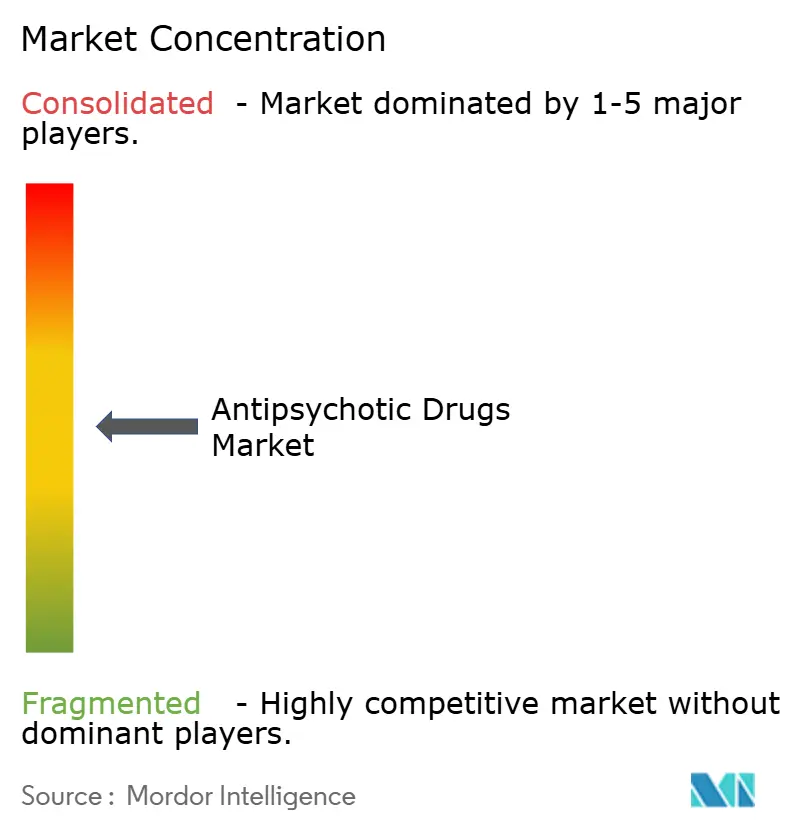
| Market Concentration | Medium |
Major Players *Disclaimer: Major Players sorted in no particular order Image © Mordor Intelligence. Reuse requires attribution under CC BY 4.0. | |
Antipsychotic Drugs Market Analysis by Mordor Intelligence
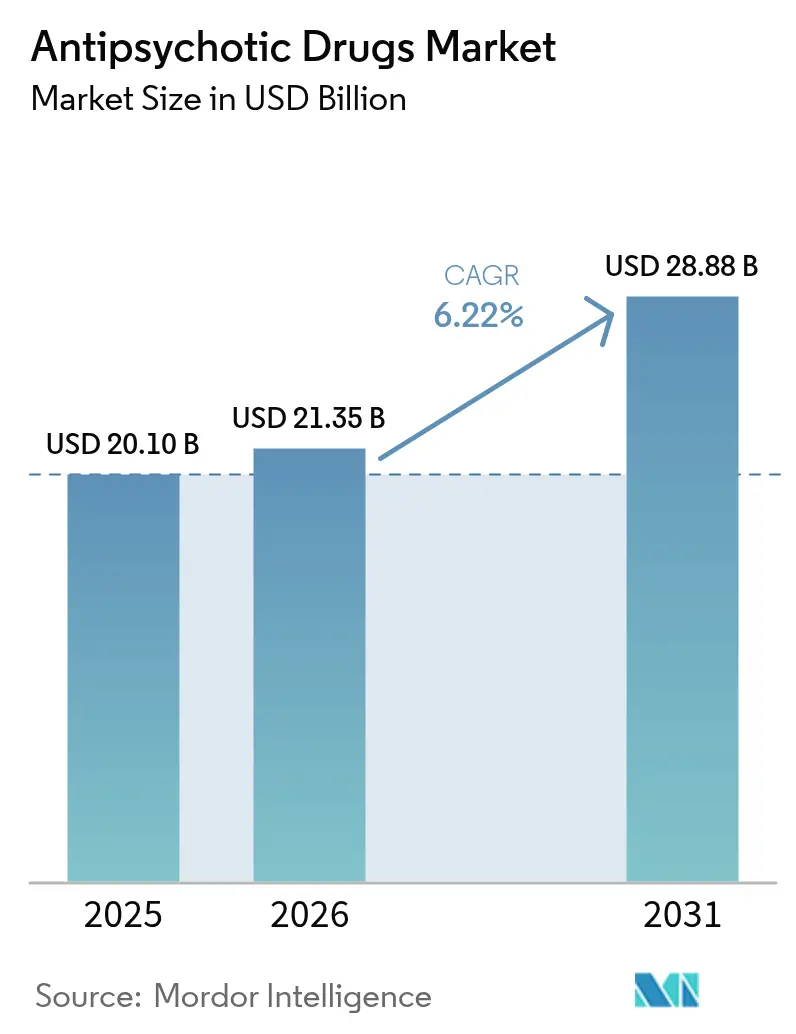
The Antipsychotic Drugs market size is expected to grow from USD 20.10 billion in 2025 to USD 21.35 billion in 2026 and is forecast to reach USD 28.88 billion by 2031 at 6.22% CAGR over 2026-2031.
Growth rests on three pillars: the steady rise in diagnosed mental-health disorders, brisk uptake of third-generation agents with dopamine-partial-agonist or muscarinic-receptor activity, and sustained public-payer funding that lowers patients’ out-of-pocket costs. Consolidation among innovators is reshaping the competitive arena, with recent high-value acquisitions designed to secure intellectual property and fast-track differentiated assets. In parallel, long-acting injectables gain momentum as real-world evidence confirms superior relapse prevention and cost offsets. Generics, however, intensify price pressure as patents expire on blockbuster atypical molecules, prompting firms to bundle medicines with digital-therapeutic companions that reinforce adherence and extend product lifecycles.
Key Report Takeaways
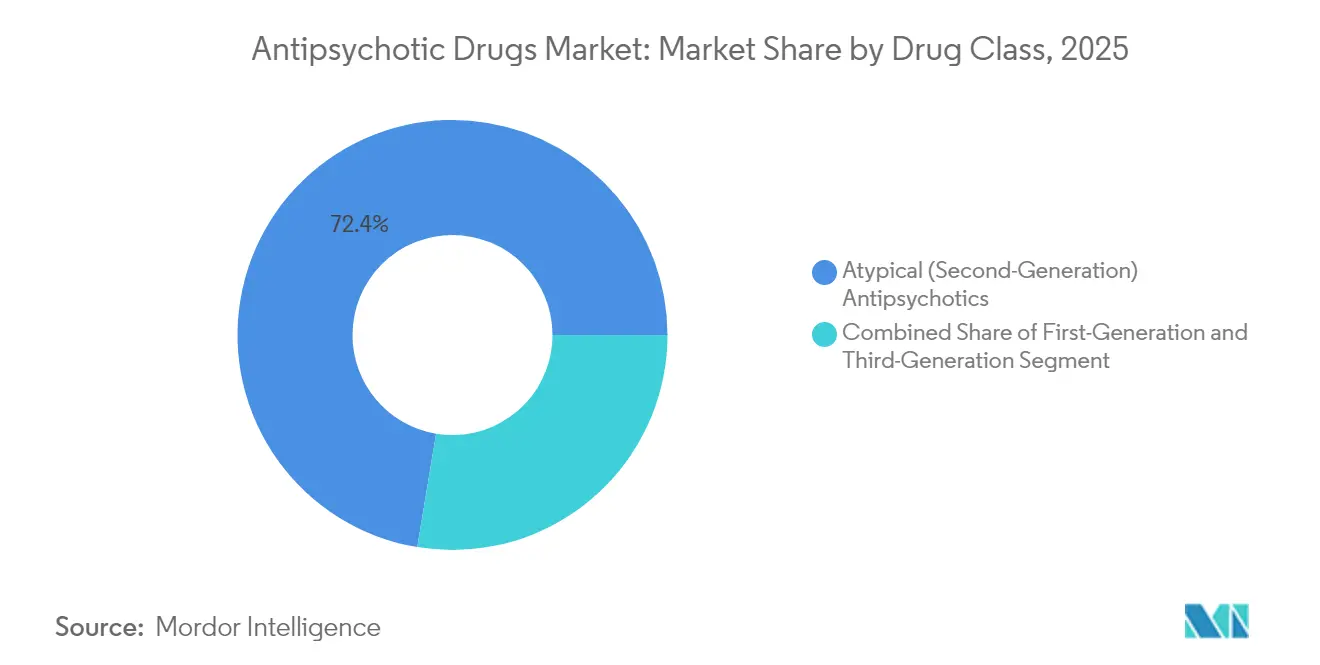
- By drug class, atypical agents led with 72.38% of antipsychotic drugs market share in 2025, while third-generation agents are projected to post the fastest 6.96% CAGR through 2031.
- By therapeutic application, schizophrenia commanded 61.72% of the antipsychotic drugs market size in 2025, whereas bipolar disorder is advancing at an 7.72% CAGR to 2031.
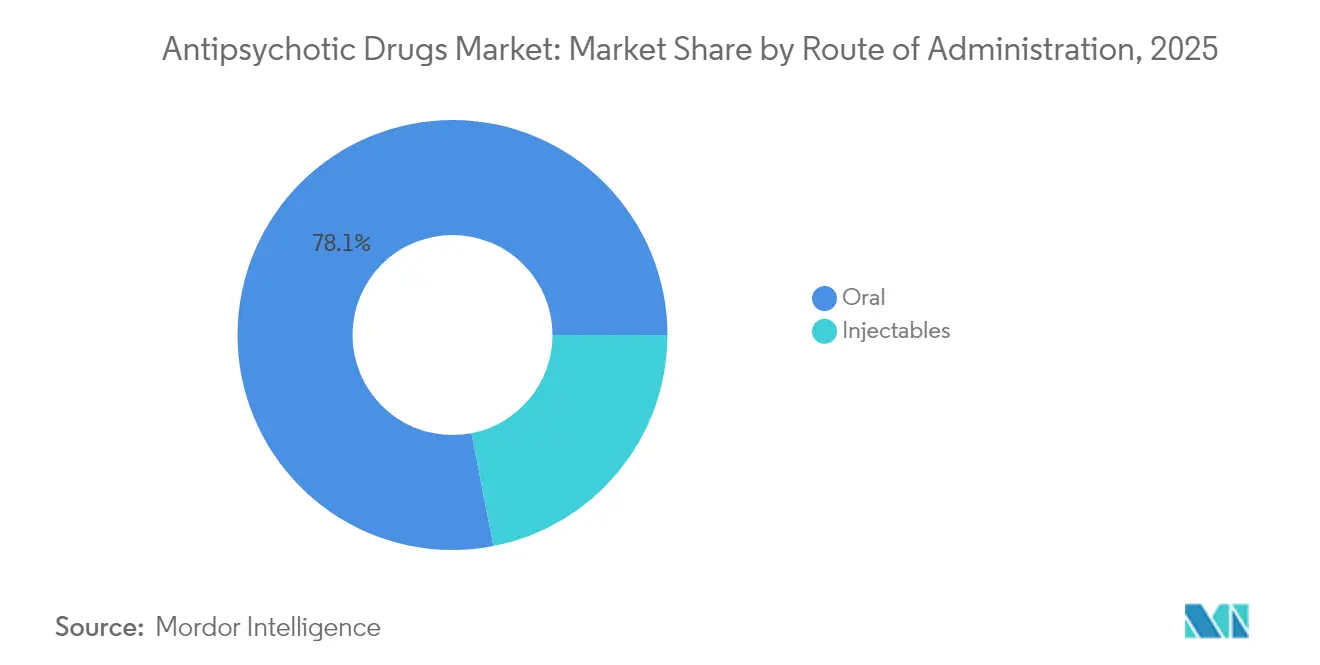
- By route of administration, oral formulations accounted for 78.05% revenue share in 2025; long-acting injectables are set to expand at a 7.55% CAGR between 2026 and 2031.
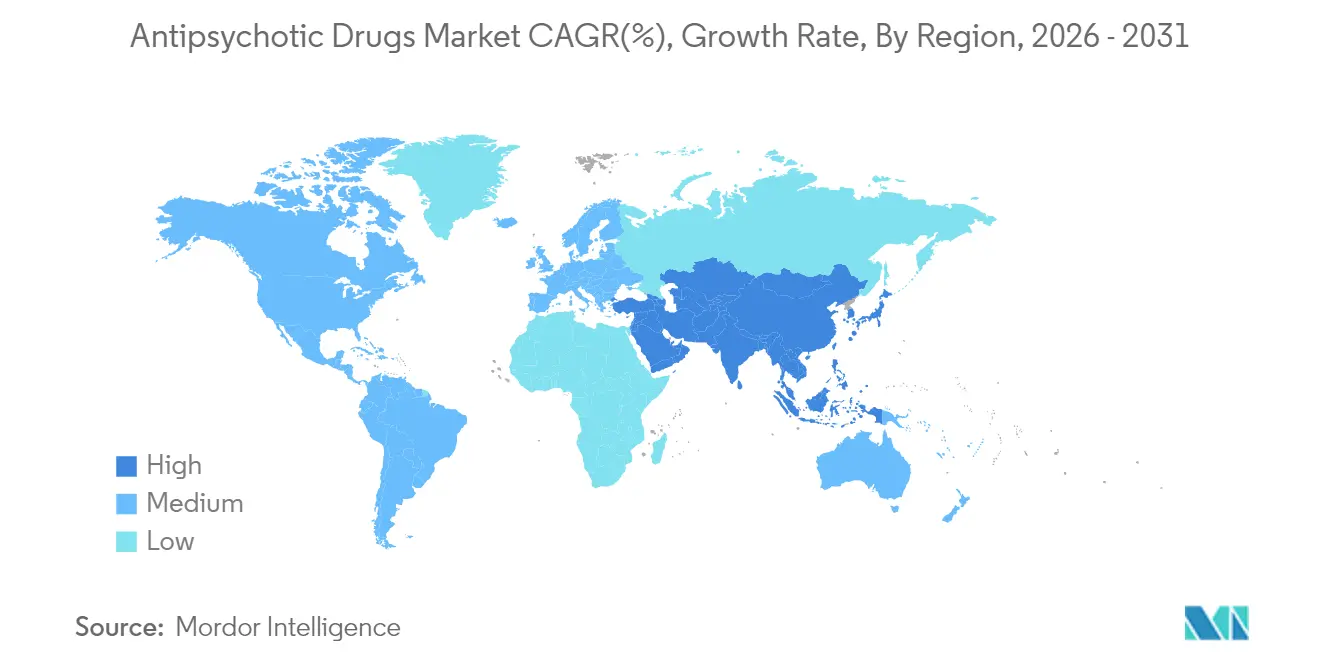
- By geography, North America contributed 39.22% of the antipsychotic drugs market share in 2025, while the Asia-Pacific region is the fastest-growing, with a 7.61% CAGR through 2031.
Note: Market size and forecast figures in this report are generated using Mordor Intelligence’s proprietary estimation framework, updated with the latest available data and insights as of 2026.
Market Trends and Insights
Drivers Impact Analysis of Antipsychotic Drugs Market*
| Driver | (~) % Impact on CAGR Forecast | Geographic Relevance | Peak Impact |
|---|---|---|---|
| Rising LAI Adoption in Community Mental-Health Programs | +1.0% | Global, strongest in North America & Europe, expanding in Asia-Pacific | Medium term (2-4 years) |
| Expanding Early-Psychosis Intervention Centers | +0.7% | North America & Europe lead | Long term (≥4 years) |
| Surge in Medicaid/Medicare Coverage for Third-Generation Agents | +0.9% | Primarily North America | Short term (≤2 years) |
| Increasing Focus of Governments and Health Care Organizations on Mental Health | +1.3% | Global | Medium to Long term (2-4+ years) |
| Digital-Therapeutic Companion Apps Boosting Medication Adherence | +0.5% | North America & Europe lead | Medium term (2-4 years) |
| Robust R&D Pipeline and FDA Approvals for Novel Formulations | +1.2% | Global, with North America & Europe; Asia-Pacific following | Short to Medium term (≤4 years) |
| Source: Mordor Intelligence | |||
Rising LAI Adoption in Community Mental-Health Programs
Long-acting injectable antipsychotics are closing the 50% non-adherence gap that undermines oral therapy. A 2024 Journal of Clinical Psychopharmacology study reported 30-day readmission rates of 1.9% for LAIs versus 8.3% for oral drugs, translating to a 77% reduction in early rehospitalizations. Early initiation of LAIs within 12 months of diagnosis yields annual healthcare savings of USD 7,195 per patient by reducing emergency department utilization. These findings persuade payers to reimburse LAIs earlier in treatment algorithms, accelerating penetration across community clinics.
Expanding Early-Psychosis Intervention Centers
Coordinated Specialty Care programs are scaling rapidly. The National Alliance on Mental Illness estimates that broader roll-out could reach 600,000-800,000 additional patients and generate USD 115-140 billion in system savings over a decade . A 2024 Hong Kong study in JAMA Network Open linked implementation of the EASY Plus model to steep declines in self-harm episodes among adults aged 26-44 years. These centers favor newer agents with balanced efficacy and tolerability profiles, fuelling demand for third-generation options.
Surge in Medicaid/Medicare Coverage for Third-Generation Agents
The 2025 Medicare Advantage and Part D rate notice increases payments by 3.70% and establishes a USD 2,000 out-of-pocket cap, thereby widening access to premium-priced novel antipsychotics.[1]All chronic diseases now fall under Medication Therapy Management, ensuring mental-health medicines are actively reviewed and supported. Expanded coverage accelerates uptake of agents such as cariprazine and brexpiprazole, cushioning revenue lost to generic erosion.
Digital-Therapeutic Companion Apps Boosting Medication Adherence
Smartphone-based tools that offer reminders, symptom diaries, and clinician dashboards are proving effective in psychiatric settings. A 2025 JMIR Mental Health synthesis found that alignment with patient needs and human support are key drivers of engagement. [2] The FDA granted Breakthrough Device status to a prescription digital therapeutic for schizophrenia in 2024, underscoring regulatory acceptance of software adjuncts. Improved adherence extends medication persistence, enlarging the treated population base.
Restraints Impact Analysis of Antipsychotic Drugs Market*
| Restraint | (~) % Impact on CAGR Forecast | Geographic Relevance | Peak Impact |
|---|---|---|---|
| Patent Cliffs of Key Atypical Molecules | -1.7 | Global, with highest impact in North America and Europe | Short term (≤ 2 yrs) |
| Addiction Caused Due to the Antipsychotic Drugs | -1.0 | Global | Long term (≥ 5 yrs) |
| Black-Box Warnings Limiting Pediatric Prescriptions | -0.8 | United States, European Union | Medium term (~ 3-4 yrs) |
| Price-Control Expansion under China's NRDL | -0.6 | China, with spillover effects in Asia-Pacific | Medium term (~ 3-4 yrs) |
| Source: Mordor Intelligence | |||
Patent Cliffs of Key Atypical Molecules
Major brands face imminent loss of exclusivity. Abilify Maintena’s patent expiry in June 2025 threatens 44% of its prescription base. Johnson & Johnson’s Invega Sustenna posted USD 2.9 billion in 2023 U.S. sales, yet generics from Teva and Viatris loom. Price erosion depresses branded revenue and compresses margins across the antipsychotic drugs market.
Addiction Caused Due to the Antipsychotic Drugs
Safety issues curb long-term acceptance. Tardive dyskinesia affects up to 127 per 1,000 users in the United States, impacting roughly 500,000 individuals. A 2024 study in Heart Rhythm linked certain agents to severe QT prolongation in more than 10% of users, raising arrhythmia risk . Such adverse-event profiles restrict prescribing in vulnerable cohorts, tempering overall uptake.
*Our forecasts treat driver/restraint impacts as directional, not additive. The impact forecasts reflect baseline growth, mix effects, and variable interactions.
Antipsychotic Drugs Market Segment Analysis
By Drug Class:
Third-Generation Agents Reshape Treatment ParadigmsAtypical formulations generated the largest antipsychotic drugs market size in 2025, capturing 72.38% revenue on the back of broad indications and payer familiarity. Third-generation agents, though smaller in absolute dollars, are forecast to outpace the overall market with a 6.96% CAGR through 2031. Their dopamine-partial-agonist or dual muscarinic activity mitigates extrapyramidal side effects, a clear advantage that bolsters clinician confidence. Bristol Myers Squibb’s Cobenfy (xanomeline-trospium), the first new mechanistic class in 70 years, underscores this pivot.
Improved metabolic profiles and reduced tardive-dyskinesia risk strengthen payer value propositions. The antipsychotic drugs market size attached to third-generation products is predicted to expand steadily as pipeline entrants such as roluperidone advance toward possible approval. First-generation agents remain useful in acute agitation and resource-strained settings, yet their share declines annually due to tolerability concerns.

By Therapeutic Application:
Bipolar Disorder Drives ExpansionSchizophrenia treatment dominated revenue, corresponding to 61.72% of 2025 antipsychotic drugs market share. Bipolar disorder is the fastest-growing use case, with an 7.72% CAGR projected as physicians embrace agents effective across manic and depressive phases. CAPLYTA (lumateperone) earned approval for bipolar I and II depression, prompting Johnson & Johnson's USD 14.6 billion acquisition of Intra-Cellular Therapies to secure the CAPLYTA franchise.
CAPLYTA's pending application in major depressive disorder and REXULTI's 2023 label extension for agitation in Alzheimer's dementia broaden clinical reach. Over the forecast period, the antipsychotic drugs market size linked to dementia-related psychosis is expected to increase as payers recognize the benefits of behavioral-symptom relief.
By Route of Administration:
Long-Acting Injectables Gain MomentumOral tablets retained the dominant position with 78.05% of total 2025 revenue, favored for chronic maintenance and flexibility. Yet the long-acting-injectable segment is set for a 7.55% CAGR through 2031 as adherence gains and longer dosing intervals improve outcomes. The antipsychotic drugs market size for LAIs will rise further with once-monthly and once-bimonthly formulations such as Rykindo, Uzedy, and Abilify Asimtufii obtaining regulatory clearance.
Phase 3 data for TEV-749, a subcutaneous olanzapine LAI, confirm efficacy and tolerability, signaling near-term expansion avenues. Short-acting injectables will remain niche, reserved for emergency stabilization.
Geography Analysis
North America Antipsychotic Drugs Market
North America generated 39.22% of global revenue in 2025, buoyed by early adoption of third-generation agents and payer reforms that cap annual patient out-of-pocket spend at USD 2,000 under Medicare Part D cms.gov. FDA approvals for muscarinic-receptor therapies and once-bimonthly LAIs sustain clinical enthusiasm, while Canada and Mexico add incremental growth through mental-health investment schemes.
APAC Antipsychotic Drugs Market
Asia-Pacific is the fastest-growing territory at a 7.61% CAGR through 2031. China’s domestic innovators secured the first U.S. nod for a Chinese-developed paliperidone palmitate LAI in 2024, spotlighting the region’s research ascent. Improved insurance penetration and destigmatization campaigns in India and Southeast Asia enlarge the treated population, further propelling the antipsychotic drugs market.
EMEA and South America Antipsychotic Drugs Market
Europe retains solid share anchored by universal health coverage and a regulatory focus on real-world evidence. The 2025 approval of Rxulti for adolescent schizophrenia widens access in a sensitive demographic. Price-volume agreements temper list-price inflation, yet offsetting uptake of novel therapies supports steady value growth. South America and the Middle East & Africa, though smaller, are forecast to out-perform historic averages as governments integrate mental-health services into national benefit packages.
Competitive Landscape
Strategic consolidation defines 2025 deal-flow. Johnson & Johnson purchased Intra-Cellular Therapies for USD 14.6 billion to secure CAPLYTA’s bipolar and schizophrenia franchises. Bristol Myers Squibb acquired Karuna Therapeutics to add KarXT, a muscarinic receptor agonist, underscoring appetite for mechanistic diversity.
Digital innovation introduces new entrants. Boehringer Ingelheim and Click Therapeutics’ investigational prescription digital therapeutic received Breakthrough Device status, marking software’s rise alongside molecules . Terran Biosciences’ TerXT aims to combine prodrugs of xanomeline and trospium in a once-daily oral and LAI formulation, challenging incumbents.
Partnership structures diversify risk. AbbVie’s USD 65 million upfront collaboration with Gilgamesh Pharmaceuticals explores neuroplastogens, with milestones worth up to USD 1.95 billion. Medium-sized players leverage licensing to extend geographic reach without over-stretching capital, preserving pipeline optionality in a competitive, data-driven environment.
Antipsychotic Drugs Industry Leaders
-
Eli Lily and Company
-
Johnson and Johnson
-
Pfizer Inc.
-
AstraZeneca plc
-
Otsuka Pharmaceutical Co, Ltd.
- *Disclaimer: Major Players sorted in no particular order
Antipsychotic Drugs Market Companies Covered in this Report
- Eli Lilly and Company
- AstraZeneca
- Johnson & Johnson
- Abbott Laboratories
- Pfizer
- Nova Biomedical
- Otsuka
- Luye Pharma
- Nihon Kohden
- Bristol-Myers Squibb
- Grifols
- Arkray
- Acadia Pharmaceuticals
- Convergent Technologies
- EKF Diagnostics
- PHC Holdings (Ascensia)
- WerfenLife Diagnostics China
- Edan Instruments
- Sphere Medical
- Brolis Sensor Technology
Market Opportunities and Future Outlook
Differentiated-mechanism and longer-horizon outcomes create near-term whitespace as generic competition tightens on established atypical molecules. In the United States, the Medicare Part D out-of-pocket cap of USD 2,000 (effective in the 2025 program updates) and broader Medication Therapy Management coverage for chronic conditions support access and adherence programs, which improves the commercial case for premium-priced third-generation and novel-mechanism therapies. The 2024 FDA approval of Bristol Myers Squibb's Cobenfy (xanomeline-trospium) for schizophrenia also reinforces a muscarinic-pathway approach, creating a competitively distinct segment that emphasizes tolerability, relapse prevention, and functional endpoints beyond dopamine D2 antagonism alone.
Opportunities are also building around relapse-prevention claims, longer-interval long-acting injectables, and delivery and combination strategies that help maintain persistence in real-world care pathways. Payer and regulatory attention to durable safety and effectiveness aligns with community mental-health program adoption of LAIs, where evidence cited in the report links LAIs to lower 30-day readmissions (1.9% vs 8.3% for oral therapy) and per-patient annual cost offsets. With ongoing 2026 approvals and filings, including Vanda's FDA approval for BYSANTI (milsaperidone) and Johnson & Johnson's FDA approval of a CAPLYTA (lumateperone) sNDA for relapse prevention in schizophrenia, the market continues to show commercial openings around new chemical entities and label expansion supported by longer-term data, alongside pipeline activity aimed at reducing dosing burden and addressing negative and cognitive symptoms.
Recent Industry Developments in Antipsychotic Drugs Market
- April 2026: Johnson & Johnson announced FDA approval of a supplemental NDA for CAPLYTA (lumateperone) for the prevention of relapse in schizophrenia, supported by long-term safety and efficacy data. The label expansion strengthens differentiation versus genericized atypicals by tying brand value to relapse-related outcomes and longitudinal evidence.
- February 2026: Vanda Pharmaceuticals announced FDA approval of BYSANTI (milsaperidone), a new chemical entity atypical antipsychotic, for schizophrenia in adults and for acute manic or mixed episodes associated with bipolar I disorder. The entry adds another branded option competing on clinical profile and positioning in bipolar disorder, the fastest-growing application segment in the market scope.
- September 2024: The FDA approved Bristol Myers Squibb's Cobenfy (xanomeline and trospium chloride) for the treatment of schizophrenia in adults, introducing a muscarinic agonist approach. This approval validated a non-dopaminergic mechanism and reset R&D and partnering priorities toward differentiated pathways that can command premium access despite patent cliffs.
Antipsychotic Drugs Market Report Scope and Research Methodology
Market Definition and Coverage
This market is measured as the revenue generated from prescription antipsychotic medicines used to manage psychosis-related conditions, counted at ex-manufacturer (ex-factory) prices and aggregated across major regions.
Scope exclusions: We exclude drugs used only as hypnotics, anxiolytics, or mood stabilizers when they do not have a formal psychosis-related indication.
Segments Covered in This Report
- By Drug Class
- Typical (First-Generation) Antipsychotics
- Atypical (Second-Generation) Antipsychotics
- Dopamine Partial Agonists (Third-Generation)
- By Therapeutic Application
- Schizophrenia
- Bipolar Disorder
- Major Depressive Disorder
- Dementia-Related Psychosis
- Others
- By Route of Administration
- Oral
- Injectables
- Long-Acting Injectables (LAIs)
- Short-Acting Injectables
- By Geography
- North America
- United States
- Canada
- Mexico
- Europe
- Germany
- United Kingdom
- France
- Italy
- Spain
- Rest of Europe
- Asia-Pacific
- China
- Japan
- India
- Australia
- South Korea
- Rest of Asia-Pacific
- Middle East & Africa
- GCC
- South Africa
- Rest of Middle East & Africa
- South America
- Brazil
- Argentina
- Rest of South America
- North America
Data Sources, Market Sizing, and Validation
Desk Research
Desk work starts with building a clean fact base around disease burden, treatment patterns, and how antipsychotic therapy is delivered (oral solids versus short and long-acting injectables). We primarily use public and official sources such as the World Health Organization, the US FDA and other national regulator labels, the US CDC, OECD health statistics, and peer-reviewed psychiatry and pharmacology journals to confirm definitions and demand signals.
On the commercial side, we review annual reports, investor presentations, and earnings commentary to understand portfolio focus and broad revenue direction. We also use paid subscriptions focused on company financials and news, plus patent databases where relevant, to cross-check timelines for launches and loss of exclusivity. These inputs do not directly equal the market total, but they help keep assumptions grounded before we validate them with primary feedback. The sources listed here are illustrative, and many other public references were also used for data collection, validation, and clarification.
Primary Interviews and Surveys
Primary discussions are used to convert the desk findings into a workable model by testing how prescribing choices shift by patient type, care setting, and region. We speak with a mix of manufacturers, distributors, and clinical stakeholders. We then check the inputs across APAC, EMEA, and the Americas so regional adoption patterns are not averaged out too early.
Distribution of primary research fieldwork respondents
| Company type | Respondent position | Region |
|---|---|---|
| Top tier: 29% | CXOs: 12% | APAC: 49% |
| Mid tier: 57% | Functional/Unit leaders: 41% | EMEA: 31% |
| Smaller Players: 14% | Managers: 47% | Americas: 20% |
Market-Sizing & Forecasting
Sizing begins with a top-down build where the treated patient pool is reconstructed by region using epidemiology signals and the expected share receiving antipsychotic therapy, and then that demand pool is translated into value using mix and pricing assumptions. To keep the totals practical, the model is anchored on a few market variables that can be tracked consistently, such as schizophrenia and bipolar disorder case load trends, uptake of long-acting injectables versus oral therapy, genericization after key loss-of-exclusivity events, and broad pricing pressure patterns across major healthcare systems.
Once the first cut is ready, we corroborate it with selective bottom-up approximations, such as sampled price per unit times estimated volumes for key therapy forms. We also run channel checks on how product mix shifts across hospital and retail dispensing. When data is thin for smaller countries, we fill gaps using proxy markets with similar care pathways, then re-scale using population, access to care, and reimbursement intensity so the output stays explainable.
Forecasts are produced using scenario analysis supported by trend-based smoothing. The key variables are stepped forward with input from primary experts on future LAI penetration, pipeline timing, and the pace of price erosion. Assumptions are kept explicit so users can see what changed between years and why.
Data Validation & Update Cycle
Validation is done through multiple checks that compare the model output against independent signals, including regional therapy uptake direction, mix shifts between oral and injectable products, and the timing of exclusivity changes that should move value. Outliers are flagged, reworked, and then reviewed in an internal analyst pass before sign-off. Follow-up calls are triggered when respondents disagree on a key assumption like adoption speed or pricing.
The report is refreshed annually, and interim updates are made when material events occur, such as major approvals, large safety label changes, or sharp pricing disruptions. Before delivery, we run a fresh review to ensure the latest public data and interview learnings are reflected in the final view.
Mordor Intelligence's Antipsychotic Drugs Market Size Compared With Other Published Estimates
Different publishers often show different market sizes because they do not all count the same drug scope, price basis, or treatment indications, and they also choose different base years. In pharmaceuticals, even a small shift like counting at retail price instead of ex-factory pricing can move totals in a noticeable way.
In this study, the main gap drivers are whether dementia-related psychosis is included, how long-acting injectables are valued versus oral therapies, and how generic erosion is stepped in after loss of exclusivity. Another driver is timing, since some estimates cite a 2024 or 2025 base year, which can sit on a different part of the cycle for approvals and pricing changes.
Benchmark comparison
| Source | Market Size | Gaps in Research Methodology |
|---|---|---|
| Mordor Intelligence | USD 21.35 B (2026) | |
| Global Consultancy A | USD 18.51 B (2025) | Uses an earlier base year and its headline value appears aligned to 2025 reporting, which can understate the later uplift from mix shift into long-acting injectables and post-2025 volume normalization. |
| Industry Research House B | USD 17.53 B (2024) | Anchored to 2024 estimates with limited clarity on ex-factory versus downstream pricing and indication boundaries, which can compress totals when adjacent psychosis indications and injectable value contribution are not fully captured. |
Across the three figures, most of the spread comes from year selection and how therapy mix and pricing basis are treated, rather than from a fundamentally different view of demand. By keeping the count tied to ex-factory drug revenue and explicitly including schizophrenia, bipolar disorder, and dementia-related psychosis products, the 2026 total is made more traceable in Mordor Intelligence.
Key Questions Answered in the Report
What is the current size of the antipsychotic drugs market?
The antipsychotic drugs market generated USD 21.35 billion in 2026 and is expected to reach USD 28.88 billion by 2031.
Which region is growing fastest?
Asia-Pacific is projected to expand at a 7.61% CAGR from 2026 to 2031, the highest regional growth rate in the industry.
Why are long-acting injectable antipsychotics gaining traction?
LAIs cut 30-day readmissions from 8.3% to 1.9%, improve adherence, and deliver annual cost savings of more than USD 7,000 per patient, driving wider adoption among payers and clinicians.
How will patent expiries affect market dynamics?
Loss of exclusivity for blockbuster atypicals such as Abilify Maintena and Invega Sustenna will heighten generic competition, trimming branded revenue and accelerating product bundling with digital supports.
Which therapeutic application is set for the quickest growth?
Bipolar disorder treatment is forecast to post the fastest 7.72% CAGR, supported by expanded labels for newer agents like lumateperone.