
Antiblock Additive Market Size and Share
Market Overview
| Study Period | 2020 - 2031 |
|---|---|
| Market Size (2026) | USD 1.03 Billion |
| Market Size (2031) | USD 1.33 Billion |
| Growth Rate (2026 - 2031) | 5.18 % |
| Fastest Growing Market | Asia Pacific |
| Largest Market | Asia Pacific |
| Market Concentration | Medium |
Major Players *Disclaimer: Major Players sorted in no particular order Image © Mordor Intelligence. Reuse requires attribution under CC BY 4.0. | |
Antiblock Additive Market Analysis by Mordor Intelligence
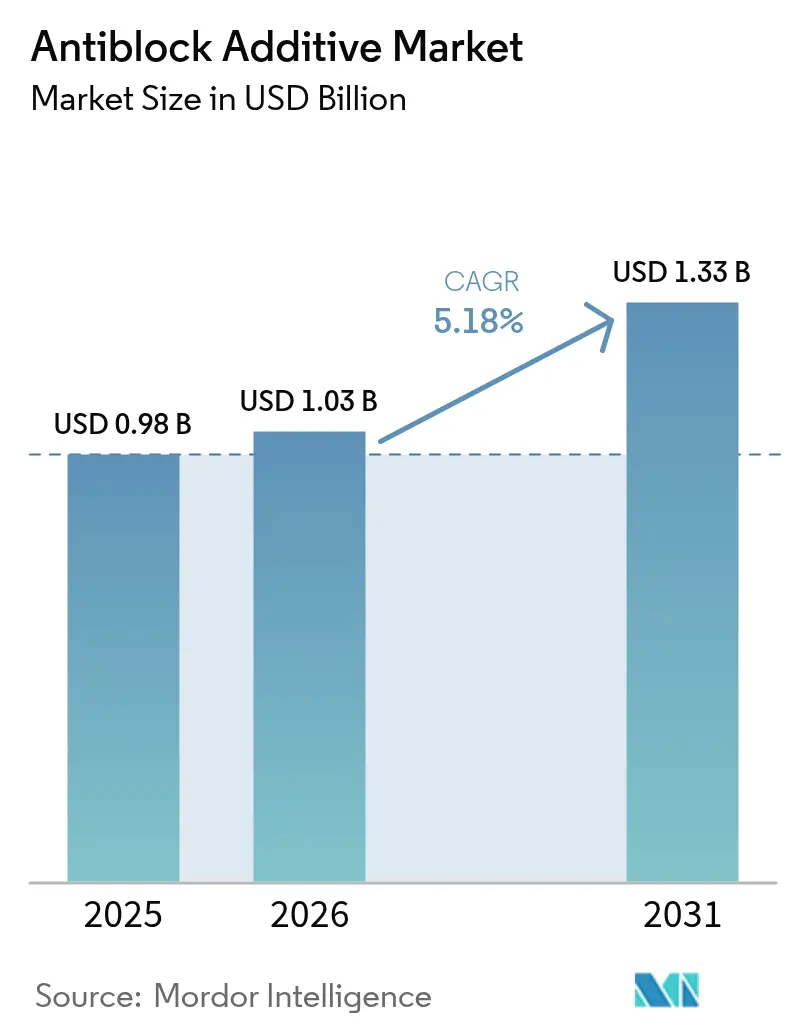
The Anti-block Additive market size in 2026 is estimated at USD 1.03 billion, growing from 2025 value of USD 0.98 billion with 2031 projections showing USD 1.33 billion, growing at 5.18% CAGR over 2026-2031. Demand strength arises from the expansion of e-commerce packaging, greenhouse agriculture, and mono-material recyclable films, each relies on anti-block technology to prevent film blocking, preserve optical clarity, and maintain line throughput. Brand-owner sustainability targets accelerate the shift from mineral to bio-based chemistries, while regulatory scrutiny of crystalline and amorphous silica puts pressure on traditional inorganic offerings. Meanwhile, Asia-Pacific retains its position as the largest production and consumption base, underpinned by integrated polymer value chains in China and India and supported by multinational investments in specialty chemical plants. Supply-side consolidation around semiconductor-grade silica and sodium-based agents raises input-cost volatility and compels formulators to qualify alternative raw materials that can pass Food and Drug Administration (FDA), European Union (EU), and China GB standards without compromising performance.
Key Report Takeaways
- By product type, inorganic additives led with 64.10% of the Anti-block Additives market share in 2025, while organic formulations are set to advance at a 6.00% CAGR through 2031.
- By polymer type, low-density polyethylene held 38.05% of the Anti-block Additives market size in 2025, whereas biaxially-oriented polypropylene is projected to be the fastest-growing polymer segment at a 6.17% CAGR to 2031.
- By application, food packaging accounted for 44.70% revenue share of the Anti-block Additives market size in 2025; agricultural films are expected to expand at a 6.22% CAGR during the same period.
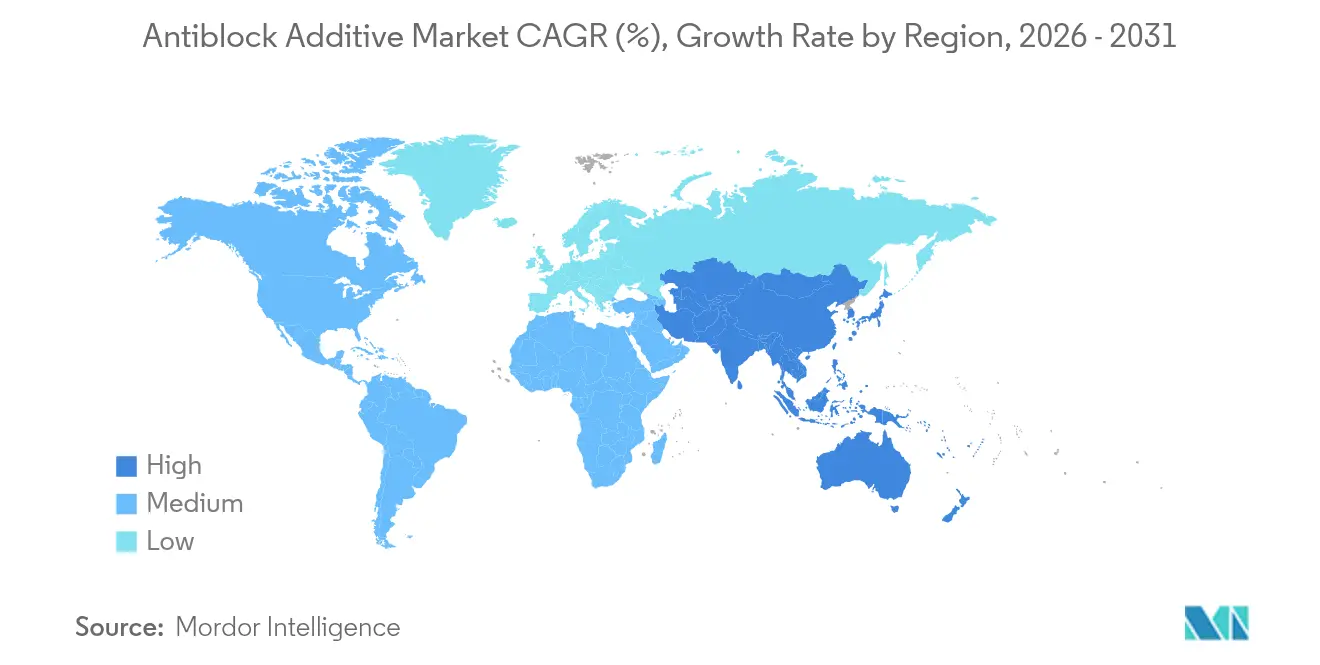
- By geography, Asia-Pacific commanded 30.30% of the Anti-block Additives market share in 2025 and is forecast to grow at a 6.05% CAGR to 2031.
Note: Market size and forecast figures in this report are generated using Mordor Intelligence’s proprietary estimation framework, updated with the latest available data and insights as of 2026.
Market Trends and Insights
Drivers Impact Analysis of Antiblock Additive Market*
| Driver | (~) % Impact on CAGR Forecast | Geographic Relevance | Impact Timeline |
|---|---|---|---|
| Surge in Flexible and Rigid Food Packaging Film Demand | +1.8% | Global, with concentration in APAC and North America | Medium term (2-4 years) |
| Expansion of Greenhouse and Mulch-film Agriculture | +1.2% | APAC core, spill-over to Europe and North America | Long term (≥ 4 years) |
| Rapid Growth of High-clarity BOPP Lines | +1.0% | Global, led by Asia-Pacific manufacturing hubs | Short term (≤ 2 years) |
| Brand-owner Shift Toward Mono-material Recyclability | +0.9% | Europe and North America, expanding to APAC | Medium term (2-4 years) |
| Expansion of E-commerce Sector Creating Non-sticking Packaging Films Demand | +0.7% | Global, concentrated in urban markets | Short term (≤ 2 years) |
| Source: Mordor Intelligence | |||
Surge in Flexible and Rigid Food Packaging Film Demand
Food manufacturers continue to accelerate flexible and rigid film adoption to support ready-to-eat and portion-controlled product lines. Modern high-speed form-fill-seal equipment requires antiblock agents that keep film layers separate without impairing clarity or sealability; bio-based Optislip grades demonstrate how surface-migration layers reduce blocking at lower loadings [1]. Thinner gauge initiatives heighten surface-to-surface contact, further elevating the importance of controllable surface roughness. Global ready-meal sales growth and regulatory pushes for extended shelf life collectively intensify demand for premium antiblock systems that withstand repeated temperature cycling. Consequently, anti-block additives transition from a cost item to a performance enabler, allowing suppliers to defend higher price points in value-added packaging contracts.
Expansion of Greenhouse and Mulch-film Agriculture
Precision farming and climate-controlled cultivation spur rapid uptake of greenhouse covers and mulch films that rely on anti-block technology to ease roll-out and retrieval. Optical transmittance must remain high to optimize photosynthesis; therefore, agents such as rice-husk-ash silica are gaining traction despite requiring 2,000–3,000 ppm (parts per million) loading, as they match the blocking resistance of commercial silica while supporting waste-valorization goals. Biodegradable mulch films create an attractive niche for organic antiblock solutions that integrate seamlessly into soil-degradable polymer matrices. Market expansion in India, China, and Gulf Cooperation Council states underscores the long-term nature of this driver as governments seek food-security gains.
Rapid Growth of High-clarity BOPP Lines
Brand owners migrating from polyethylene Terephthalate (PET) to clear biaxially oriented polypropylene (BOPP) for improved stiffness-to-weight ratios are installing new tenter and sequential-stretch units across Asia. High-clarity film grades demand anti-block particles small enough to minimize haze yet large enough to create effective micro-asperities; talc-based Optibloc formulations deliver sub-1% haze at 500 ppm dosage while ensuring line productivity. Electronics producers also adopt capacitor-grade BOPP, necessitating ultra-pure anti-block choices free from ionic contaminants. The tight technical window has lifted specialty additive margins and spurred research and development (R&D) into nano-silica and bio-wax hybrids capable of balancing thermal stability with dielectric integrity.
Brand-owner Shift Toward Mono-material Recyclability
European extended-producer-responsibility directives and North American retail commitments will soon target 100% recyclable packaging. Eliminating multi-layer structures places more onus on anti-block additives to deliver slip, clarity, and seal strength within a single polymer family. Clariant’s AddWorks PKG 158 stabilizer shows how synergistic packages can withstand multiple mechanical-recycling loops while preserving film color. Formulators now screen anti-block candidates for in-use performance and compatibility with optical sorters and re-melt rheology. These new selection criteria open market space for organic waxes and calcium-carbonate-coated starches that leave no residue in regrind streams.
Restraints Impact Analysis of Antiblock Additive Market*
| Restraint | (~) % Impact on CAGR Forecast | Geographic Relevance | Impact Timeline |
|---|---|---|---|
| Haze and Gloss Deterioration in Optical Films | –0.8% | Global premium packaging markets | Short term (≤ 2 years) |
| Stringent Migration Limits in Pharmaceutical Blister Packs | –0.6% | Europe and North America, expanding globally | Medium term (2-4 years) |
| Supply Risk of High-purity Sodium-based Inorganic Agents | –0.4% | Global, specialty applications | Long term (≥ 4 years) |
| Source: Mordor Intelligence | |||
Haze and Gloss Deterioration in Optical Films
High-end display and transparent barrier films tolerate negligible haze, forcing antiblock loadings well below standard industrial levels. Conventional silica or talc particles scatter visible light, and interactions with erucamide can form discoloring complexes that reduce shelf appeal. Electronics laminates require dual-function formulations that offset the loss of surface asperities with advanced low-migration slip aids, yet the R&D cost and qualification timelines slow commercialization. This constraint disproportionately affects the premium segment, dampening additive volume growth despite healthy unit economics.
Stringent Migration Limits in Pharmaceutical Blister Packs
Regulatory authorities enforce tight extractable and leachable thresholds under 21 CFR 178, mandating full toxicological dossiers before new anti-block chemistries can be adopted for pill cavities and sachets [2]. Nanoparticle-based systems face extra scrutiny because analytical methods to verify particle migration remain under debate. As a result, drug companies maintain legacy silica grades already granted Drug Master File status, limiting upgrade opportunities for suppliers and elongating conversion cycles to alternative solutions.
*Our forecasts treat driver/restraint impacts as directional, not additive. The impact forecasts reflect baseline growth, mix effects, and variable interactions.
Antiblock Additive Market Segment Analysis
By Product Type:
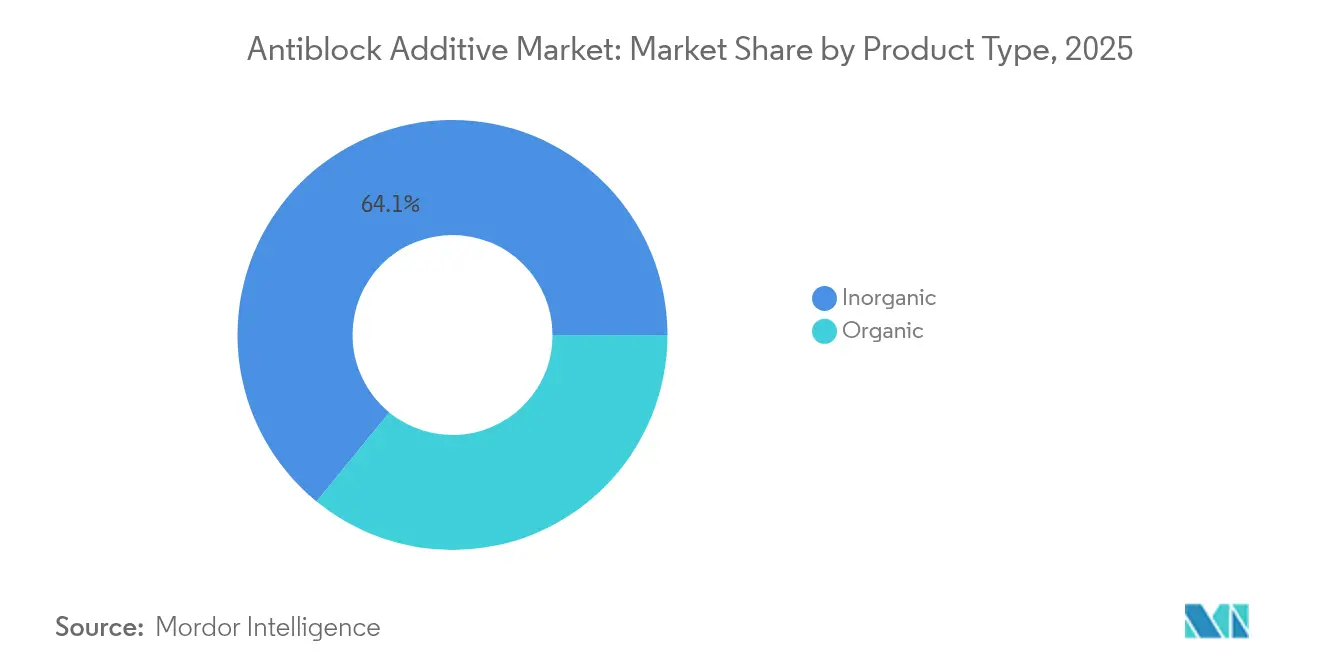
Organic Formulations Challenge Inorganic DominanceIn 2025, inorganic agents captured 64.10% of the global Anti-block Additives market share, largely through cost-effective silica, diatomite, and talc solutions that blend readily into polyethylene and polypropylene. However, the segment faces regulatory headwinds as the European Chemicals Agency (ECHA) weighs stricter crystalline-silica exposure limits. Organic solutions, fatty-acid amides, plant waxes, and starch-calcium carbonate composites are advancing at a 6.00% CAGR, closing the performance gap as suppliers refine particle morphology and surface energy. Hybrid systems combining micronized shell-based wax with nano-silica illustrate how formulators can cut mineral loading by 30% without losing blocking resistance or optical clarity. Film recyclers favor these bio-based alternatives because they leave no residual abrasion in regrind, supporting circular-economy targets. Consequently, organic share gains are expected across commodity and premium applications, narrowing volume spreads even as total demand expands.
Organic momentum is further fueled by improved dispersion techniques such as reactive-extrusion grafting that locks fatty-acid chains onto polymer backbones, limiting migration and bloom. Cost parity is becoming reachable at crude-oil price levels above USD 75/bbl, where petrochemical feedstocks inflate inorganic processing costs. The antiblock additives market therefore exhibits a gradual but irreversible tilt toward organics, especially in regions with robust recycling mandates or consumer eco-label programs.

By Polymer Type:
LDPE Leadership Faces BOPP ChallengeLow-density polyethylene (LDPE) maintained a 38.05% share of the Anti-block Additives market size in 2025, owing to its prevalence in grocery sacks, stretch hooders, and agricultural covers. LDPE’s amorphous morphology allows uniform silica dispersion, creating micro-asperities that prevent film fusion during roll-winding. Yet biaxially-oriented polypropylene is gathering pace, forecast to post a 6.17% CAGR through 2031 as converter investments in high-clarity lines multiply across Asia and Eastern Europe. BOPP’s rising acceptance in capacitor, confectionery, and tobacco overwraps increases demand for ultra-pure antiblock particles that do not impede dielectric performance. Linear Low-Density Polyethylene (LLDPE) and High-Density Polyethylene (HDPE) continue steady penetration in heavy-duty sacks and industrial liners, whereas Polyvinyl Chloride (PVC) has lost ground due to chlorine-content concerns.
Polymer-specific needs shape additive selection: LDPE tolerates coarser particles, allowing lower-cost diatomite, while BOPP requires sub-3 µm mean diameters. Hybrid multilayer barrier films are being replaced by recyclable mono-material laminates, often Polypropylene (PP) or Polyethylene (PE), shifting additive buyers toward chemistries compatible with mechanical reprocessing. Therefore, suppliers offering tailored masterbatches aligned with polymer rheology maintain competitive edge.
By Application:
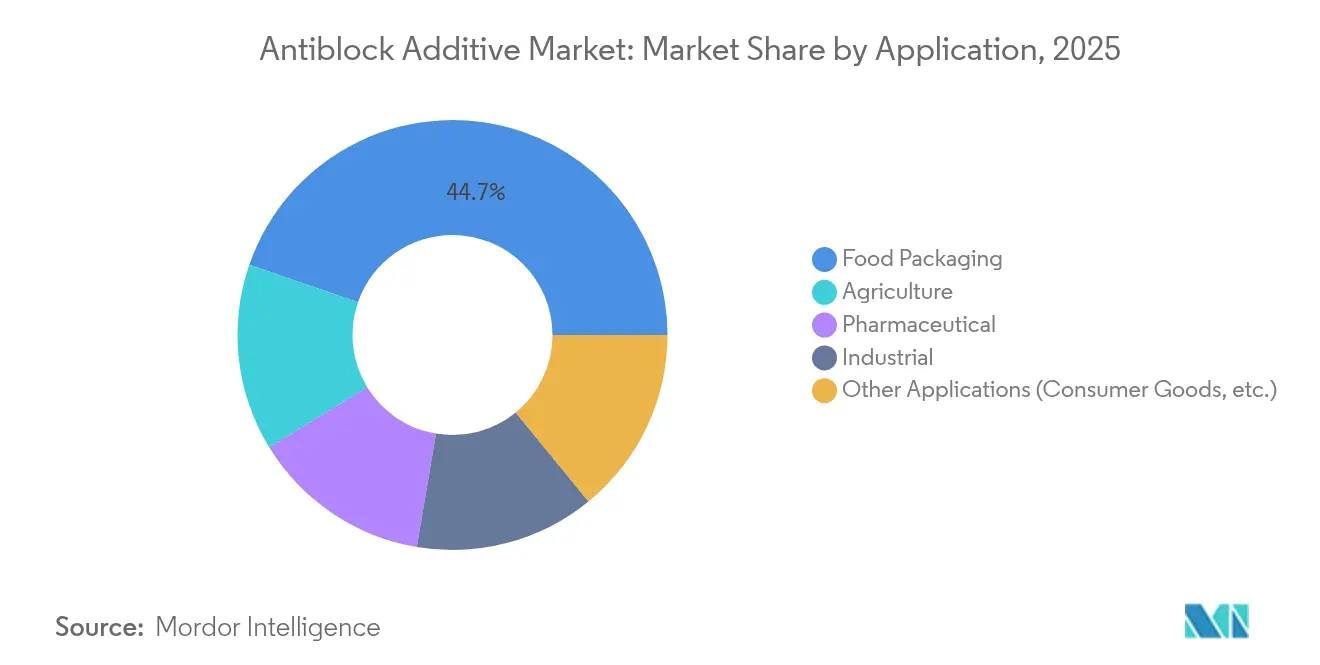
Food Packaging Dominance Challenged by AgricultureFood packaging absorbed 44.70% of global anti-block demand in 2025 due to high-volume snack, dairy, and ready-meal segments needing slip and antifog in addition to antiblock. Startup craft-food brands choosing transparent stand-up pouches reinforce this base. Agricultural films, however, will grow the fastest at a 6.22% CAGR as governments subsidize greenhouse expansion and biodegradable mulch adoption. Agricultural needs revolve around consistent optical transmission, dust resistance, and ease of field deployment, pushing innovation toward higher-load organic agents that balance cost and performance.
Pharmaceutical blister and sachet films remain a lucrative niche because of stringent purity norms, enabling premium pricing for United States Pharmacopeia (USP)-class silica. Though volumes are modest, industrial liners for construction and automotive interior skins utilize antiblock additives for processability during thermoforming. Consumer-goods shrink film increasingly adopts bio-based antiblock to safeguard recyclability claims printed on the pack. Application diversity cushions overall demand swings tied to any single end-use sector.
Geography Analysis
APAC Antiblock Additive Market
Asia-Pacific recorded 30.30% of the global Antiblock Additives market share in 2025 and is advancing at a 6.05% CAGR, driven by China’s integrated resin-to-film clusters and India’s e-commerce boom. Local supply of ethylene, propylene, and mineral fillers provides structural cost advantages, while domestic brands upgrade to thinner gauges, lifting unit additive consumption. Multinationals such as Evonik invested USD 200 Million in Nanjing specialty amine capacity to secure regional availability of raw materials for organo-modified additives.
North America Antiblock Additive Market
North America exhibited steady mid-single-digit growth in 2025 as frozen-food producers switched to lighter bags and pharmaceutical packagers maintained stringent specification lock-ins. FDA compliance requirements favor incumbents, giving US-based masterbatch companies stable margins. The region also pioneers post-consumer-recycled (PCR) film loops, which require robust antiblock packages tolerant to reprocessing heat histories.
Europe Antiblock Additive Market
Europe’s antiblock demand climbed modestly despite stringent REACH (Registration, Evaluation, Authorization, and Restriction of Chemicals) documentation burdens that raise testing costs. Packaging recyclability goals are accelerating the adoption of bio-wax solutions, and ECHA’s proposed silica limits intensify this pivot. Western European converters lead mono-material laminate adoption, fostering collaboration between additive suppliers and recycling consortia to validate downstream process compatibility.
South America and MEA Antiblock Additive Market
South America saw rising agricultural film consumption, notably in Brazil’s protected horticulture projects. Import dependence remains high for specialized antiblock grades, exposing converters to currency fluctuations. Middle East & Africa, though smaller in value, enjoy strong greenhouse adoption in Gulf states and North African citrus regions. Regional resin capacities in Saudi Arabia support film plants that increasingly source additives locally to manage lead times.
Europe, North America and APAC Antiblock Additive Market
The geographic mosaic underscores how proximity to raw materials, regulatory regimes, and end-use industries shapes demand trajectories, reinforcing Asia’s volume leadership while Europe and North America steer sustainability-driven innovation.
Value Chain Analysis
The antiblock additive value chain starts with upstream feedstocks, including mined and processed minerals (silica, talc, diatomaceous earth, calcium carbonate) and organic chemistries (fatty-acid amides, plant waxes, starch-based carriers). These inputs then go through particle refinement and, where needed, surface treatments to tune dispersion and optical performance. Additive producers and mineral processors supply powders or treated particulates to masterbatch compounders, who incorporate them into PE, PP, PET, or other carrier resins via dry blending and melt compounding.
The compound is delivered as concentrates to film converters and sheet producers. Converters dose antiblock masterbatches into LDPE, LLDPE, HDPE, and BOPP lines, and finished films are used in packaging, agriculture, pharmaceutical, and industrial applications where food-contact and low-migration compliance requirements (FDA, EU, China GB) shape grade qualification. Key pinch points cluster around high-purity inorganic inputs and consistency of specific ore grades, particularly for optical clarity and electronics-grade BOPP where impurity control matters. Supplier power rises when converters need semiconductor-grade or USP-class silica and when qualification cycles lock in incumbent formulations, while masterbatch suppliers compete through technical service, regulatory documentation, and multi-functional packages that bundle antiblock with slip or antifog for high-speed lines. Film production and compounding capacity concentrated in Asia-Pacific also elevates the role of local tolling and regionalized manufacturing footprints, while multinational suppliers use localized production and multi-sourcing to manage lead times and input volatility for large converters.
Competitive Landscape
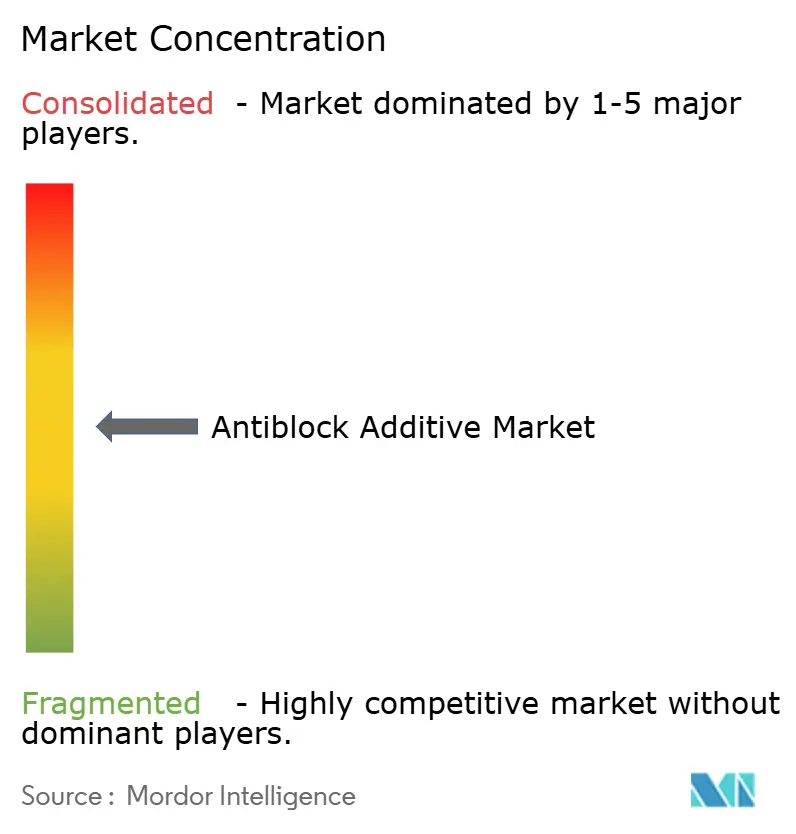
The Antiblock Additives market is moderately consolidated. Ampacet Corporation leverages a broad color and functional portfolio to bundle antiblock with slip and antifog, enhancing wallet share among flexible-packaging clients. Evonik Industries AG capitalizes on its organomodified siloxane and amine chemistry platforms to tailor hybrid organo-inorganic particles, addressing clarity-sensitive BOPP needs. LyondellBasell Industries Holdings B.V. integrates resin and additive supply to guarantee secure sourcing for multinational converters. Joint-venture activity centers on Asian masterbatch tolling, enabling Western formulators to localize production without heavy capital outlays. Short supply events in quartz and sodium trisilicate have raised the strategic importance of vertical integration and multi-sourcing, potentially spurring consolidation over the next five years.
Antiblock Additive Industry Leaders
-
Ampacet Corporation
-
ATLANTA
-
Avient Corporation
-
Tosaf Compounds Ltd.
-
Sukano
- *Disclaimer: Major Players sorted in no particular order
Antiblock Additive Market Companies Covered in this Report
- Ampacet Corporation
- ATLANTA
- Avient Corporation
- Cargill, Incorporated
- Evonik Industries AG
- Fine Organic Industries Limited
- Imerys
- Lifeline Technologies
- LyondellBasell Industries Holdings B.V.
- Mitsui Chemicals Inc.
- Momentive
- National Plastics Color, Inc.
- RTP Company
- Sukano
- Tosaf Compounds Ltd.
- W. R. Grace and Co.
Market Opportunities and Future Outlook
One clear opportunity is in formulations built for recycled-content films and mono-material packaging, where converters need antiblock systems that preserve optical clarity and line throughput despite wider resin variability. In mechanically recycled PE and PP, higher antiblock dosages are often required versus virgin resin, since residual contaminants and broader molecular weight distributions increase blocking risk. That dynamic creates room for suppliers that can deliver stable performance at lower treat rates, while formulators balance interactions between slip and antiblock, including adsorption of migrating slip agents by mineral fillers. The trend also supports additive packages that tolerate multiple heat histories without degrading haze or gloss, which helps premium flexible packaging and PCR-enabled shrink and overwrap films.
Innovation headroom also remains strongest in high-clarity BOPP and specialty PET/PETG film applications, where conventional mineral particles can fall short of haze targets. This pushes demand toward finer-particle options, hybrid approaches, and alternative chemistries, as well as delivery formats that simplify processing. Company activity reflects this direction, including Avient introducing Hiformer technology aimed at reducing BOPP film production complexity while improving film quality, with slip/antiblock solutions positioned for PET and PETG pharmaceutical packaging. Separately, compostable and biodegradable film structures create a niche for antiblock masterbatches tuned for compostable polymers, aligned with agricultural films and emerging compostable packaging formats that require controlled surface properties without undermining end-of-life claims.
Recent Industry Developments in Antiblock Additive Market
- April 2026: Avient launched Hiformer Slip + Antistatic, a super-concentrated liquid additive for BOPP films in the Latin American market. The launch supports simpler dosing and improved runnability on high-clarity BOPP lines, aligning antiblock-related performance needs with converter pressure to reduce production complexity.
- March 2025: Erteco expanded its partnership with Tosaf to include additives and whites in the Nordic countries. The broader distribution scope improves regional access to additive portfolios used in packaging and film applications, tightening service coverage for converters seeking faster qualification and supply continuity.
- June 2024: The European Chemicals Agency proposed stricter regulations for silicon dioxide compounds due to health risks associated with crystalline and amorphous forms. The move increases compliance attention on silica-based antiblock systems and elevates the strategic value of alternative chemistries and documented low-exposure, food-contact compliant grades.
Antiblock Additive Market Report Scope and Research Methodology
Market Definition and Coverage
This market covers antiblock additives used in polymer films and related plastic products to reduce surface sticking during processing, storage, and end use, and it is measured in value terms across major regions.
Scope exclusions: Pigments, fillers, slip additives, antiblocking masterbatch carrier resin value, and downstream film conversion services are excluded when they are not sold as antiblock additive value.
Segments Covered in This Report
- By Product Type
- Organic
- Inorganic
- By Polymer Type
- Low Density Polyethylene (LDPE)
- Linear Low-density Polyethylene (LLDPE)
- High-density polyethylene (HDPE)
- Biaxially-oriented Polypropylene (BOPP)
- Polyvinyl Chloride (PVC)
- Other Polymer Types (Polyethylene Terephthalate (PET), etc.)
- By Application
- Food Packaging
- Pharmaceutical
- Industrial
- Agriculture
- Other Applications (Consumer Goods, etc.)
- By Geography
- Asia-Pacific
- China
- Japan
- India
- South Korea
- ASEAN Countries
- Rest of Asia-Pacific
- North America
- United States
- Canada
- Mexico
- Europe
- Germany
- United Kingdom
- France
- Italy
- Spain
- Russia
- NORDIC Countries
- Rest of Europe
- South America
- Brazil
- Argentina
- Rest of South America
- Middle East and Africa
- Saudi Arabia
- South Africa
- Rest of Middle East and Africa
- Asia-Pacific
Data Sources, Market Sizing, and Validation
Desk Research
Desk work starts with public evidence that explains how much film is being produced and consumed, and where demand is shifting. We refer to sources such as the US International Trade Commission trade statistics, UN Comtrade, the US Environmental Protection Agency, Eurostat, and association materials from groups like plastics and packaging bodies that publish non-paywalled briefs.
Industry context is then built using company annual reports, investor presentations, technical datasheets, and reputed press coverage on packaging and agricultural films. A few paid subscriptions are used selectively for company financials and intelligence, patent databases, and shipment level import export checks where it helps validate pricing direction and major capacity moves. These desk sources are not exhaustive, and many other references were used to collect, validate, and clarify data points.
Primary Interviews and Surveys
Primary inputs come from interviews and short surveys with additive suppliers, polymer and masterbatch players, film converters, and large packaging and agriculture film users. Since this is a global market, we covered APAC, EMEA, and the Americas so that regional pricing, usage rates, and regulation driven formulation shifts could be checked and then fed back into the model.
Distribution of primary research fieldwork respondents
| Company type | Respondent position | Region |
|---|---|---|
| Top tier: 38% | CXOs: 15% | APAC: 46% |
| Mid tier: 46% | Functional/Unit leaders: 37% | EMEA: 30% |
| Smaller Players: 16% | Managers: 48% | Americas: 24% |
Market-Sizing & Forecasting
For sizing, a top-down approach is used where film and polymer demand signals are reconstructed by region and then translated into an antiblock additive demand pool using usage rate ranges that were validated with experts. The totals are then corroborated with selective bottom-up approximations, such as sampled supplier revenue splits, channel checks for masterbatch versus additive forms, and spot checks of average selling price (ASP) multiplied by estimated volumes, and adjustments are made when the two views do not align.
Key inputs we track include polyethylene and polypropylene film output trends, the share of food packaging and agricultural film in total film use, silica and organic antiblock raw material price movement, typical treat rates by polymer and application, and regional shifts in mono-material recyclable film structures. For forecasting, we rely on scenario analysis supported by a simple multivariate regression for the demand drivers that have stable public time series, and then we refine the run-rate with primary feedback on capacity additions and expected price pass-through. Where direct volume visibility is weak, gaps are handled by applying conservative adoption bands to the relevant film demand base and re-checking the result against trade and production indicators.
Data Validation & Update Cycle
Model outputs are validated through multiple checks so that unusual jumps are questioned before sign-off. We compare calculated market values against independent signals like polymer film growth, raw material price direction, trade balances, and supplier commentary, and outliers are flagged for rework.
A second analyst review is completed for assumptions, formulas, and unit consistency, followed by targeted re-contacts when large variances remain. Reports are refreshed annually, and interim updates are made when material events occur such as major plant expansions, sharp raw material changes, or policy updates. Before delivery, a final fresh pass is done so clients receive the latest updated view.
Mordor Intelligence's Antiblock Additive Market Sizing Compared With Other Published Estimates
Published market values for antiblock additives can vary even when they look like they measure the same thing, because the product boundary, pricing logic, and base year timing are not always aligned. Differences also come from how teams handle masterbatch versus neat additive sales, and how quickly regional price changes are reflected.
Masterbatch carrier resin value sits outside Mordor Intelligence's scope, which can pull the total down versus estimates that count the full masterbatch selling price rather than the active antiblock portion. In other cases, the spread is explained by using an older base year with a different silica cost level, applying aggressive treat-rate assumptions across all films, or using a single global ASP without region-specific conversion and currency timing checks.
Benchmark comparison
| Source | Market Size | Gaps in Research Methodology |
|---|---|---|
| Mordor Intelligence | USD 1.03 B (2026) | |
| Industry Research House A | USD 1.11 B (2025) | Uses a 2025 base year and a longer forecast window, and the public summary does not clarify whether masterbatch selling price is separated from active antiblock value, which can lift the reported total. |
| Industry Publisher B | USD 0.97 B (2024) | Starts from a 2024 value and the excerpt lacks detail on regional ASP build-up, currency timing, and treat-rate assumptions by polymer and application, which can compress or expand the market depending on the defaults used. |
Overall, the table shows that year selection and what is counted in the transaction value explain most of the gap, more than the growth rate itself. By keeping inputs tied to film demand pools, validated treat-rate ranges, and region-level pricing checks, our estimate stays traceable to steps that can be repeated and audited.
Key Questions Answered in the Report
What is the current size of the Anti-block Additives market?
The Anti-block Additives market size reached USD 1.03 Billion in 2026 and is projected to grow to USD 1.33 Billion by 2031.
Which region leads global demand for anti-block additives?
Asia-Pacific holds the largest share at 30.30% and is forecast to grow at a 6.05% CAGR through 2031 due to strong film manufacturing bases in China and India.
Which polymer segment is expected to grow the fastest?
Biaxially-oriented polypropylene is projected to post the highest CAGR of 6.17% through 2031, driven by demand for high-clarity packaging and capacitor films.
Why are bio-based anti-block additives gaining traction?
Regulatory pressure on silica exposure and increased focus on mono-material recyclability push converters toward bio-based solutions that maintain performance without mineral drawbacks.
How will tighter silica regulations in Europe affect the market?
Proposed ECHA limits could raise compliance costs for inorganic additives, accelerating the shift toward organic alternatives and hybrid formulations.