
Anti-slip Additives Market Size and Share
Market Overview
| Study Period | 2020 - 2031 |
|---|---|
| Market Size (2026) | USD 498.69 Million |
| Market Size (2031) | USD 616.28 Million |
| Growth Rate (2026 - 2031) | 4.33 % |
| Fastest Growing Market | Asia Pacific |
| Largest Market | Asia Pacific |
| Market Concentration | Medium |
Major Players *Disclaimer: Major Players sorted in no particular order Image © Mordor Intelligence. Reuse requires attribution under CC BY 4.0. | |
Anti-slip Additives Market Analysis by Mordor Intelligence
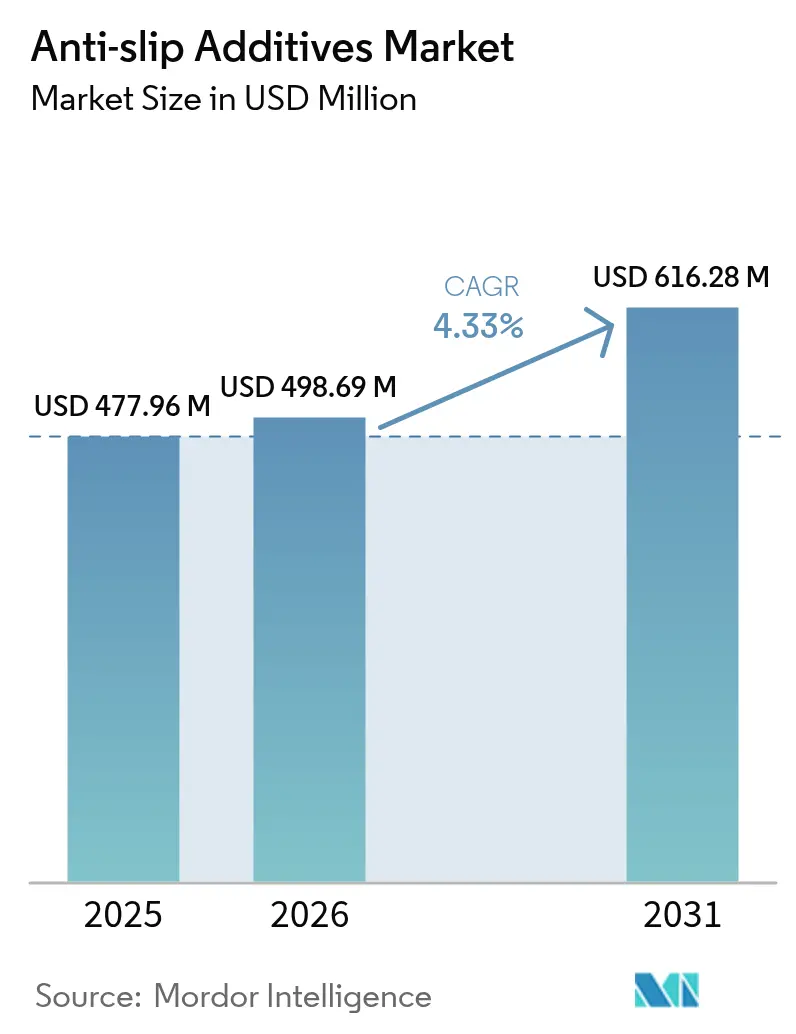
The Anti-slip Additives Market size was valued at USD 477.96 million in 2025 and estimated to grow from USD 498.69 million in 2026 to reach USD 616.28 million by 2031, at a CAGR of 4.33% during the forecast period (2026-2031). The growth outlook reflects steady adoption across manufacturing, construction, and marine sectors as employers tighten safety protocols and governments strengthen flooring standards. Heightened infrastructure spending in emerging economies, ongoing retrofits in mature regions, and the rollout of advanced low-VOC chemistries collectively anchor demand. In parallel, product innovation around nanoparticle dispersions and bio-based alternatives is widening application breadth while supporting compliance with evolving emission limits. Competitive intensity remains moderate because the leading suppliers benefit from large portfolios, global distribution, and sustained research and development pipelines even as smaller regional players vie for price-sensitive orders.
Key Report Takeaways
- By additive type, aluminum oxide led with 47.25% revenue share in 2025; silica is forecast to expand at a 5.05% CAGR through 2031.
- By additive nature, the powder form accounted for 50.15% of the Anti-Slip Additives market share in 2025 and are projected to grow at 4.42% CAGR to 2031.
- By application, industrial flooring captured 52.45% share of the Anti-Slip Additives market size in 2025 and is advancing at a 4.51% CAGR through 2031.
- By geography, Asia-Pacific commanded 56.62% of global revenue in 2025; the region is also set to post the fastest 4.62% CAGR to 2031.
Note: Market size and forecast figures in this report are generated using Mordor Intelligence’s proprietary estimation framework, updated with the latest available data and insights as of 2026.
Market Trends and Insights
Drivers Impact Analysis of Anti-slip Additives Market*
| Drivers | (~) % Impact on CAGR Forecast | Geographic Relevance | Impact Timeline |
|---|---|---|---|
| Growing demand for industrial flooring safety | + 1.2% | Global, with concentration in North America and EU | Short term (≤ 2 years) |
| Expansion of APAC construction sector | + 0.8% | APAC core, spill-over to MEA | Medium term (2-4 years) |
| Marine-deck safety compliance | +0.6% | Global, with emphasis on maritime nations | Medium term (2-4 years) |
| Nanoparticle-enabled durability upgrades | + 0.9% | North America and EU, expanding to APAC | Long term (≥ 4 years) |
| Phase-out of PFAS drives bio-based alternatives | + 0.7% | Global, with stricter enforcement in developed markets | Short term (≤ 2 years) |
| Source: Mordor Intelligence | |||
Growing Demand for Industrial Flooring Safety
Slips, trips, and falls rank as the second-leading cause of workplace fatalities in general industry, prompting regulators to tighten surface-traction mandates. Rising workers’ compensation premiums further encourage manufacturers to install high-performance coatings that sustain friction over the full maintenance cycle. In response, suppliers are engineering synthetic grains that embed evenly within epoxies or polyurethane screeds to achieve a balance of coefficient of friction and esthetic finish. End users increasingly integrate such solutions at the design stage rather than reacting to incidents, reflecting a wider shift toward risk-managed operations. As a result, industrial flooring remains the largest pull-through channel for the Anti-Slip Additives market.
Expansion of APAC Construction Sector
Aggressive infrastructure spending across China, India, and the ASEAN bloc is injecting steady volume into the Anti-Slip Additives market. Public procurement guidelines now specify slip-resistant pavement and transit concourse finishes, stimulating recurring orders for broadcast quartz and silica blends. Rapid urbanization raises pedestrian density, intensifying wear on floor surfaces and accelerating refurbishment cycles. Contractors value additives that disperse quickly in cementitious toppings and self-leveling mortars because jobsite timelines are compressed. Multinational owners of logistics hubs and regional manufacturing plants also impose global safety codes, multiplying addressable demand beyond classical public works. Consequently, Asia-Pacific simultaneously hosts the largest base and the fastest growth trajectory.
Marine-Deck Safety Compliance
Military and commercial fleet operators specify coatings that satisfy ASTM F718 and NAVSEA non-skid criteria, typically employing aluminum oxide or barium sulfate grains for high-load helicopter decks. Such platforms endure salt spray, temperature shocks, and hydraulic-fluid spills, creating niche demand for premium additive packages that maintain micro-profile over long dry-dock intervals. Shipyards increasingly favor non-abrasive synthetics on auxiliary decks to limit equipment wear without sacrificing grip. These stringent requirements allow suppliers to command price premiums that offset lower volumetric throughput relative to terrestrial uses, supporting margins in the Anti-Slip Additives market.
Nanoparticle-Enabled Durability Upgrades
Silica nanoparticles around 100 nm have demonstrated friction reductions of 38.3% and wear declines of 49.4% when dispersed at 5 wt% in water-borne lubricants. These advances translate into coatings that preserve traction across extended maintenance windows, reducing life-cycle cost for high-traffic assets. Suppliers leveraging nanoparticle technology differentiate on endurance and thin-film transparency, enabling designers to maintain floor esthetics while meeting slip benchmarks. As production scale improves, nanoparticle additives are moving from pilot lines toward mainstream industrial flooring, underpinning long-term growth in the Anti-Slip Additives market.
Restraints Impact Analysis of Anti-slip Additives Market*
| Restraints | (~) % Impact on CAGR Forecast | Geographic Relevance | Impact Timeline |
|---|---|---|---|
| VOC and hazardous-substance regulations | -0.7% | Global, with stricter enforcement in North America and EU | Short term (≤ 2 years) |
| Raw-material price volatility | -0.5% | Global, with particular impact on cost-sensitive markets | Medium term (2-4 years) |
| Shift to textured polymer flooring | -0.4% | North America and EU, expanding to APAC | Medium term (2-4 years) |
| Source: Mordor Intelligence | |||
VOC and Hazardous-Substance Regulations
The US National AIM Rule fixes a 400 g/l VOC ceiling for floor coatings, while certain state codes enforce even tighter thresholds, compelling reformulation toward water-borne or 100% solid systems. European REACH and local PFAS phase-out directives add complexity, evidenced by Micro Powders’ decision to terminate PTFE-based grades by end-2025[1]. Compliance accelerates research and development expenditure and lengthens qualification cycles, especially for small and mid-size producers. Although regulation ultimately steers users toward cleaner chemistries, near-term uncertainty can defer capital projects, temporarily muting order flow in the Anti-Slip Additives market.
Raw-Material Price Volatility
Aluminum oxide and silica spot prices fluctuate with energy tariffs, freight rates, and capacity shifts in China’s mineral-processing belt. High-purity alumina relies on energy-intensive calcination stages affected by emissions surcharges, exposing producers to margin compression during price spikes. While tier-one suppliers hedge via long-term contracts and backward integration, regional blenders often carry limited inventory, forcing rapid price pass-through that squeezes downstream applicators. Erratic costs complicate budgeting for large infrastructure tenders, at times encouraging substitution with lower-grade aggregates, which can weigh on unit revenue growth within the Anti-Slip Additives market.
*Our forecasts treat driver/restraint impacts as directional, not additive. The impact forecasts reflect baseline growth, mix effects, and variable interactions.
Anti-slip Additives Market Segment Analysis
By Additive Type:
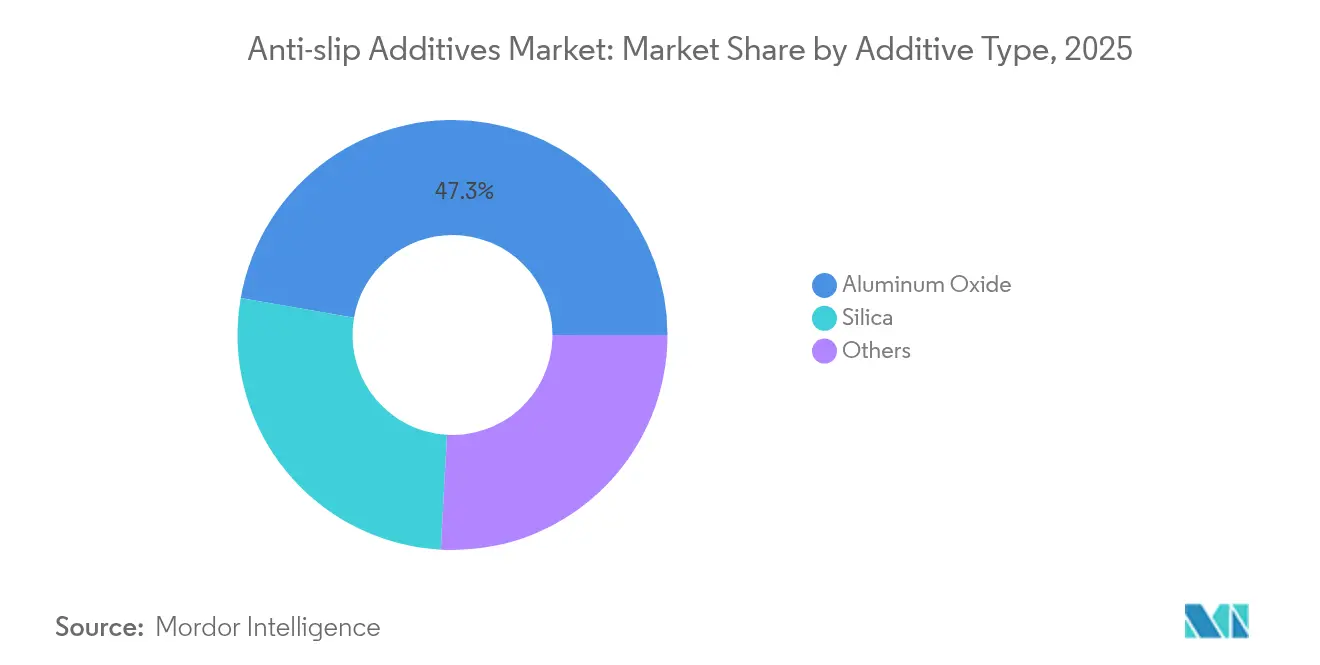
Aluminum Oxide Dominance Faces Silica InnovationAluminum oxide held 47.25% revenue share in 2025, underscoring its entrenched status among plant engineers who prize hardness and abrasion resistance for fork-truck aisles and loading bays. The segment’s maturity stems from proven field data and widespread distributor availability, giving purchasing managers confidence in predictable slip performance over multi-year maintenance cycles.
Yet silica is advancing at a market-leading 5.05% CAGR as precipitated and fumed variants leverage superior oil-absorption and low specific gravity to deliver the required surface profile at lower addition rates. PPG indicates that its precipitated silica can carry more than 40 times the weight of traditional bulking agents, translating into thinner yet efficient coatings. The shift also aligns with environmental preferences because silica grades typically exhibit benign regulatory profiles compared with certain metal oxides.

By Additive Nature:
Powder Form Maintains Versatility AdvantagePowder formulations occupied 50.15% of global revenue in 2025 and are projected to grow in lockstep with overall demand at 4.42% CAGR through 2031. Contractors favor powders because they broadcast easily onto wet film or disperse homogeneously when pre-mixed into epoxies. Lightweight polymeric powders such as SCOFIELD Traction Additive improve safety without altering appearance or adding application steps. Mix products that bundle additive and resin in one package reduce dosing errors yet add logistics complexity for multi-component industrial lines.
Continued investment in milling and surface-treatment technology supports powders’ versatility, enabling functionalization that counters floatation and improves adhesion to resins with disparate polarity. As a result, powders are forecast to hold their leadership position, with incremental gains derived from water-borne and UV-curable formulations where fine particle control underpins gloss retention.
By Application:
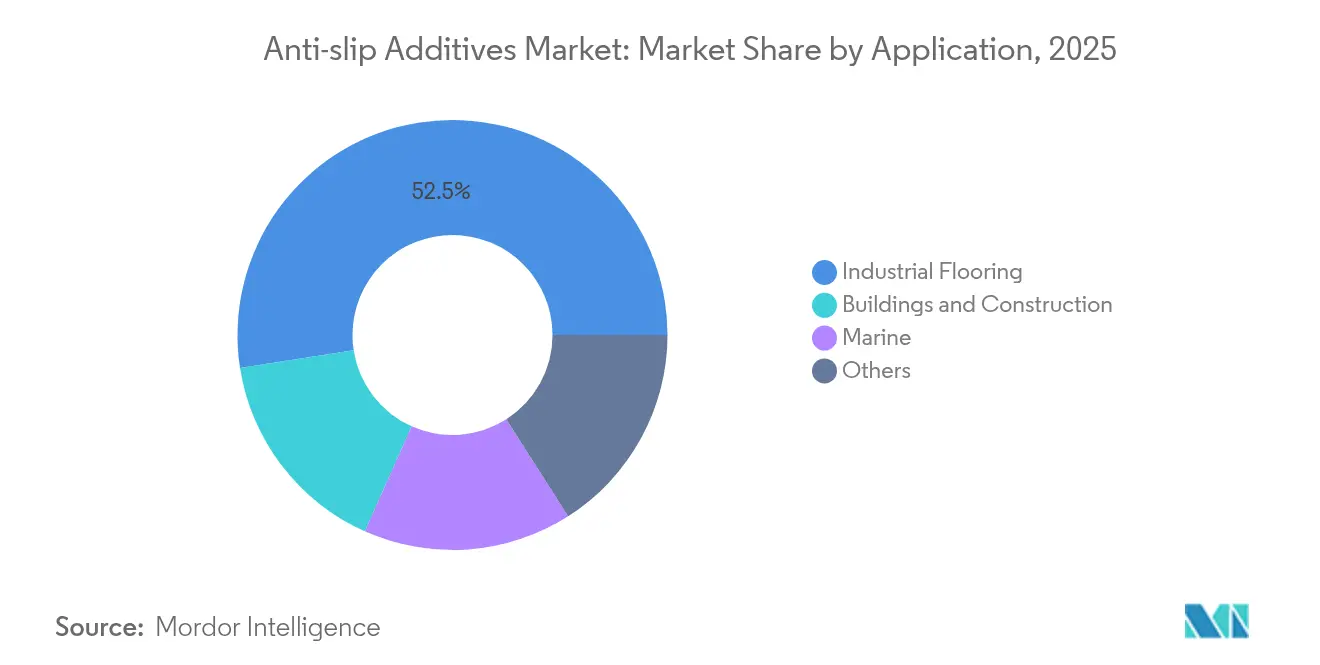
Industrial Flooring Drives Safety ComplianceIndustrial flooring accounted for 52.45% share in 2025, reflecting compulsory compliance programs in automotive, food processing, and pharmaceutical manufacturing. Floor coating OEMs embed additives during factory batching to guarantee coefficient-of-friction targets without relying on installer accuracy. European PVC flooring standard EN 13845:2017 mandates strict slip thresholds, reinforcing demand for additive-rich wear layers. Buildings and construction is supported by residential towers and commercial lobbies where owners want low-profile textures that uphold esthetics. The Anti-Slip Additives market size for marine decks, while modest, commands premium unit values because every flight deck or tanker hatch demands non-skid certification throughout harsh duty cycles.
Healthcare corridors, public transport platforms, and consumer goods packaging lines populate the “Others” bucket, each contributing small yet rising volumes as safety awareness filters into ancillary markets. Industrial flooring will remain the anchor vertical, but as demographic aging drives accessibility retrofits, public buildings are set to widen the usage base and cushion cyclical swings.
Geography Analysis
APAC Anti-slip Additives Market
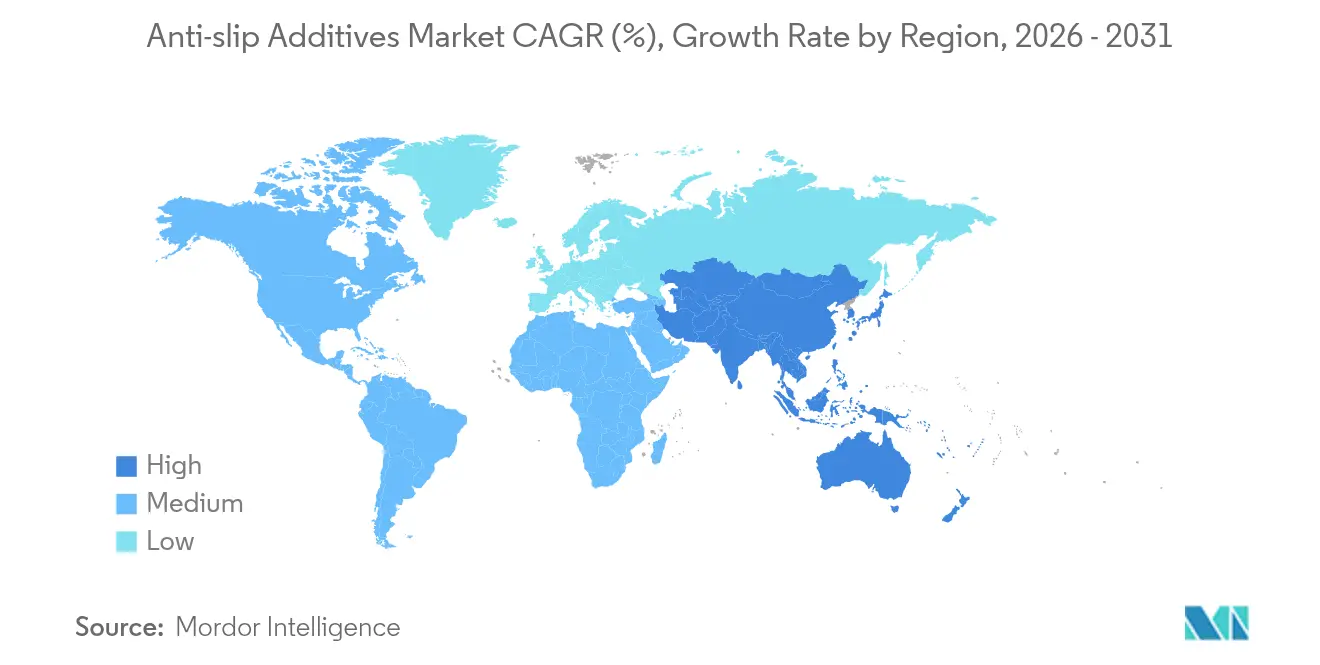
Asia-Pacific retained 56.62% revenue in 2025 and is forecast to expand at 4.62% CAGR, cementing its dual status as largest and fastest region. Surging investments in public infrastructure and mega-factory complexes anchor steady demand for floor coatings that integrate anti-slip powders at the batch stage.
North America and Europe Anti-slip Additives Market
North America and Europe each retain robust baseline demand anchored in regulatory discipline. The US National AIM Rule meshes with UL floor-slip testing to enforce low-VOC thresholds and friction certification. European directives require documented slip resistance in hospitals and rail terminals, steering specifiers toward certified coarse-texture systems. Although volume growth is slower, margin structures remain attractive because clients emphasize premium durability and environmental labels.
MEA and South America Anti-slip Additives Market
The Middle-East and Africa and South America deliver emerging upside. Gulf states’ airport and offshore complex expansions specify non-skid walkways to mitigate heat-related surface smoothness. In South America, resource-driven economies invest in safer mineral-processing and port facilities, sustaining additive orders despite broader economic swings. Collectively, these regions inject diversification into the Anti-Slip Additives market, buffering suppliers against demand plateaus in mature territories.
Regulatory Landscape
Regulation is increasingly shaped by safety-performance expectations for slip resistance and tighter chemicals rules for formulations that deliver anti-slip functionality. In the European Union, REACH Regulation (EU) 2023/2055 on intentionally added synthetic polymer microparticles was amended by Regulation (EU) 2026/1168, with user-facing instructions for use and disposal required from 17 October 2026 for products containing covered particles. This raises documentation and stewardship expectations for suppliers when polymeric particles or microstructured additives are part of the performance package.
Testing and compliance frameworks also influence specification in end-use segments. For packaging and polymers, analytical standards such as ASTM D6953-18 (erucamide slip additives in polyethylene) and China standard GB/T 25277-2010 (erucamide slip additives in polypropylene) formalize quality control for slip-related additives used in films and molded plastics. Trade policy adds additional complexity in 2026: the WTO Dialogue on Plastics Pollution released a ministerial statement and technical package (26 March 2026) to support trade-related cooperation and monitoring, while separate tariff actions and agreements affecting plastics trade flows can change sourcing economics for resin and additive inputs.
Value Chain Analysis
The value chain starts with upstream mineral and chemical feedstocks, including aluminum oxide and silica, alongside organic chemistries such as wax-based compounds and fatty amides (for film and polymer applications), and specialty silicone technologies used in permanent, non-migratory systems. These inputs move to additive producers and masterbatch manufacturers that tailor particle size distribution, surface treatment, and dispersion aids for epoxy, polyurethane, UV-curable, and thermoplastic processing windows, while targeting downstream traction and appearance requirements.
Midstream, formulators and compounders integrate anti-slip additives into coatings, sealers, flooring systems, and plastic films (LDPE, LLDPE, PP), then distribute products through both distributors and direct-to-project channels serving industrial flooring, buildings and construction, marine decks, and packaging converters. Technical service and qualification are pivotal nodes: migratory organic slip agents used for friction control in polymers require process tuning to avoid downstream issues such as printing or metallization interference. By contrast, permanent silicone-based masterbatches and non-migratory systems shift value toward specialty compounding and OEM-approved formulations, tightening links between additive suppliers, coating manufacturers, and end users.
Competitive Landscape
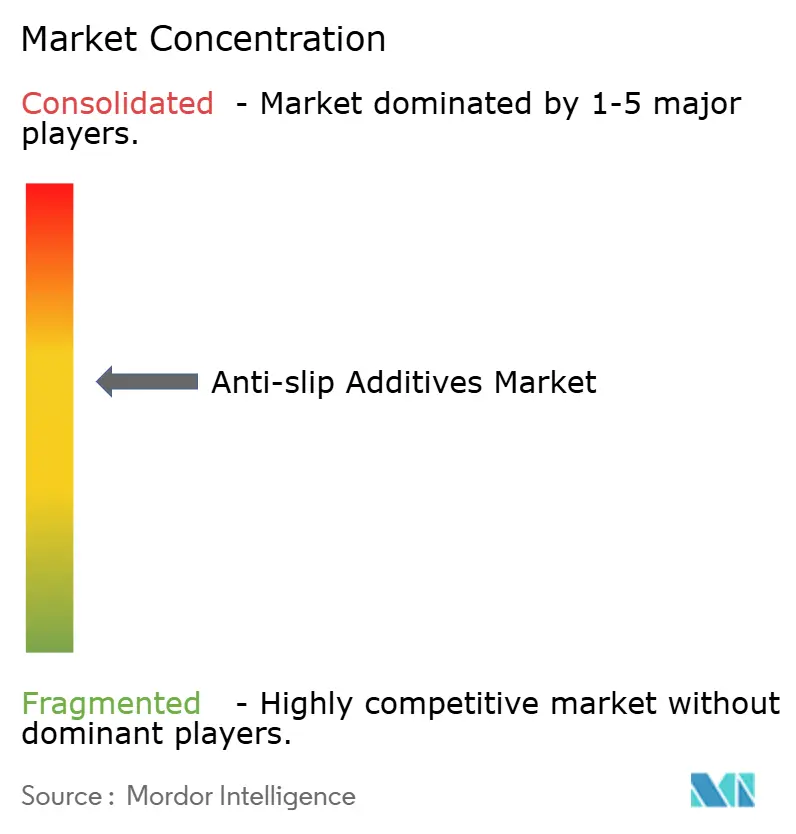
Moderate fragmentation defines the Anti-Slip Additives market. Top players benefit from integrated raw material sourcing, multi-continent manufacturing, and direct sales teams that influence specification at the architect and engineering level. Strategic moves encompass vertical integration, regional capacity additions, and alliances with coating formulators to embed additives during factory batching. Suppliers pivot from PFAS-containing grains toward bio-based or fluorine-free synthetics, capturing early-mover advantage in low-hazard portfolios. Nanoparticle platforms unlock high-margin niches where longevity and optical clarity outweigh unit price. Smaller players compete through localized service, custom particle sizing, and agile fulfillment. However, as multinationals deploy smart factories and digital color-matching, entry barriers for high-volume channels are climbing.
Anti-slip Additives Industry Leaders
-
Hempel A/S
-
Akzo Nobel N.V.
-
Axalta Coating Systems, LLC
-
ALTANA
-
PPG Industries Inc.
- *Disclaimer: Major Players sorted in no particular order
Anti-slip Additives Market Companies Covered in this Report
- Akzo Nobel N.V.
- ALTANA
- Ampacet Corporation
- Arkema
- Associated Chemical
- Axalta Coating Systems, LLC
- BASF
- Evonik Industries AG
- Hempel A/S
- Jotun
- PPG Industries Inc.
- Pro Chem Inc.
- Rust-Oleum Corporation
- SAICOS COLOUR GmbH
- Sika AG
- The Sherwin-Williams Company
Market Opportunities and Future Outlook
Formulation and portfolio opportunities are emerging where end users want fewer additives, simpler dosing, and stable performance across wet and dry conditions. In packaging films, multifunctional slip systems that combine properties in one formulation reduce inventory complexity and help converters manage line speed and static control. This is reflected by Avient launching Hiformer Slip + Antistatic for BOPP films in Latin America in April 2026, with a stated dosing window of 0.30% to 0.50%, pointing to demand for consolidated additive packages at practical let-down levels.
In coatings and flooring, the key opportunity sits in safer application profiles and standardized selection guidance for contaminated, high-traffic walkways. A shift away from traditional silica-based grit toward alternative aggregates connects to efforts to minimize worker exposure to respirable crystalline silica during application. Standards guidance such as ASTM F2965-25 (walkway surface and treatment selection) and test protocols such as ASTM F3445-24 (footwear slip resistance performance requirements) also support more measurable procurement and verification. Material innovation in viscoelastic and matrix-integrated approaches, including specialized polysiloxane structures in elastomers, supports anti-slip performance without relying solely on aggressive surface texturing, aligning with low-VOC system adoption and longer maintenance intervals in industrial and marine environments.
Recent Industry Developments in Anti-slip Additives Market
- May 2026: Akzo Nobel N.V. announced it would release an SEC Form F-4 related to its proposed merger with Axalta Coating Systems. The filing step advanced a major consolidation process in coatings, with potential to reshape product portfolios and specification influence across flooring, industrial coatings, and marine applications where anti-slip additives are commonly embedded.
- February 2026: Hempel completed the first round of applications of its Hempaguard NB silicone hull coating on the new Maersk vessel Tangier Maersk, following an initial yard application in October 2025. Bringing a newbuild-focused silicone hull technology into real vessel use reinforces performance-driven marine coating programs where traction, durability, and surface management requirements affect additive selection and qualification.
- May 2024: Hempel entered a strategic partnership with CVC Funds as a minority investor. The partnership was positioned to support transformational acquisitions and technology development, strengthening the ability to fund broader coatings capability build-outs that can include safety and functional additives used in floor and deck coating systems.
Anti-slip Additives Market Report Scope and Research Methodology
Market Definition and Coverage
This market covers materials added into coatings, paints, sealers, flooring compounds, and similar formulations to improve surface grip and reduce slip risk in real use. Revenue is counted at the additive product level, measured in USD, across major end-use settings where slip resistance is specified.
Scope exclusions: We exclude finished anti-slip coatings and ready-to-use flooring systems when the anti-slip component is not separately sold as an additive.
Segments Covered in This Report
- By Additive Type
- Aluminum Oxide
- Silica
- Others
- By Additive Nature
- Powder
- Aggregate
- Mix
- By Application
- Buildings and Construction
- Industrial Flooring
- Marine
- Others
- By Geography
- Asia-Pacific
- China
- India
- Japan
- South Korea
- ASEAN
- Rest of Asia-Pacific
- North America
- United States
- Canada
- Mexico
- Europe
- Germany
- United Kingdom
- France
- Italy
- Spain
- Russia
- Rest of Europe
- South America
- Brazil
- Argentina
- Rest of South America
- Middle-East and Africa
- Saudi Arabia
- South Africa
- Rest of Middle-East and Africa
- Asia-Pacific
Data Sources, Market Sizing, and Validation
Desk Research
Desk work started with public standards and safety references that explain how slip resistance is specified and tested in the field, which then anchors which products should be counted. OSHA guidance, NIOSH publications, International Labor Organization materials, and public ISO or ASTM summaries were used to understand typical use cases and compliance triggers.
We also reviewed trade and construction activity signals that influence demand for industrial flooring and building upgrades. Inputs included the US Census Bureau construction spending series, Eurostat construction indicators, and UN Comtrade trade statistics for relevant mineral inputs, followed by company filings, investor presentations, and reputable press releases to infer product mix. Patent databases were selectively checked to track formulation direction and the pace of innovation in anti-slip textures and dispersions. These sources are illustrative and not exhaustive, and many other references were used for data collection, validation, and clarification during the study.
Primary Interviews and Surveys
Primary discussions covered additive suppliers, formulators, distributors, and end users, including flooring contractors and facility teams, so assumptions on usage rates and price bands could be stress-tested against buying behavior. Coverage was balanced across APAC, EMEA, and the Americas, and respondent input was used to confirm how additive nature (powder, aggregate, mix) and key applications translate into real purchasing decisions.
Distribution of primary research fieldwork respondents
| Company type | Respondent position | Region |
|---|---|---|
| Top tier: 27% | CXOs: 20% | APAC: 43% |
| Mid tier: 51% | Functional/Unit leaders: 35% | EMEA: 32% |
| Smaller Players: 22% | Managers: 45% | Americas: 25% |
Market-Sizing & Forecasting
Market sizing is built using a top-down approach where construction and industrial flooring activity is converted into a demand pool, then filtered by the share of projects that specify slip resistance and use additive-based solutions. To keep the model grounded, we use practical inputs such as building and renovation intensity, industrial flooring area additions, marine and deck maintenance cycles, typical additive loading rates by formulation style, and observed price ranges by additive type.
The model is then cross-checked with selective bottom-up approximations, including sample supplier and channel checks, and simple volume-by-price builds for common product formats. This helps adjust for gaps where public data is thin. For forecasting, scenario analysis is used around construction cycles and safety-driven retrofit momentum, and the forward curve is guided by expert views on pricing, including mineral input trends, and adoption of newer low-odor and lower-VOC systems. Where a country-level split is not available, shares are bridged using region-level construction indicators and then reviewed with interview feedback before finalizing.
Data Validation & Update Cycle
Outputs are checked against independent signals such as regional construction trends, industrial production direction, and trade-flow movement for key inputs, and variances are investigated before sign-off. If a segment shows an unexpected jump, assumptions on loading rates, pricing progression, or application mix are revisited, and targeted re-contacts are triggered to confirm whether the change is real or model-driven.
A multi-step review is followed so that inputs, formulas, and logic are validated by more than one analyst, and the final numbers remain traceable to clear drivers. Reports are refreshed annually, and interim updates are made when material events occur, such as sharp raw material price changes or meaningful regulatory shifts. Before delivery, a final update pass is completed so clients receive the latest available view.
Mordor Intelligence's Anti Slip Additive Market Size Measured Against Other Published Estimates
Published market values for anti-slip additives do not always match, even when the segment names look similar, because the counted products and the base year can differ. Differences also come from how each study treats construction cycles and pricing movement, and whether the numbers reflect additives only or finished anti-slip systems.
Key gap drivers here tend to be scope boundaries (additive versus coating), the way prices are moved forward from the base year, and how application demand is tied to indicators like flooring upgrades and safety-led retrofits. Some estimates also apply a faster adoption curve without confirming loading rates by additive nature, which can move the value up quickly in the outer years.
Benchmark comparison
| Source | Market Size | Gaps in Research Methodology |
|---|---|---|
| Mordor Intelligence | USD 498.69 M (2026) | |
| Global Consultancy A | USD 390.41 M (2024) | Uses an earlier base year and a steeper growth assumption, and the scope language suggests some overlap with finished anti-slip coating demand rather than isolating additive-only revenue consistently across applications. |
| Industry Publisher B | USD 495.53 M (2025) | Close in value, but the time window and conversion approach differ, and the application mapping is more compact, which can shift how industrial flooring and building retrofits are allocated into the demand pool. |
Construction and industrial flooring activity, along with cross-checks on additive loading rates and realized price bands, are the evidence points that keep Mordor Intelligence tied to additive-only demand rather than blended system revenues. In practice, once the base year alignment and the add-on scope are made consistent, most of the spread narrows and the remaining difference is mainly from pricing progression and adoption speed assumptions.
Key Questions Answered in the Report
What is the current value of the Anti-Slip Additives market?
The Anti-Slip Additives market size reached USD 498.69 million in 2026 and is forecast to climb to USD 616.28 million by 2031.
Which additive type dominates global sales?
Aluminum oxide leads the market with 47.25% revenue share in 2025 thanks to proven hardness and abrasion resistance.
Why is Asia-Pacific growing the fastest?
Massive infrastructure investment, stringent safety codes, and expanding manufacturing footprints drive a 4.62% CAGR in the region.
How do VOC regulations influence product development?
Regulators impose strict VOC caps, forcing suppliers to reformulate toward water-borne and 100% solids systems, which raises research and development costs but spurs cleaner chemistries.
What technological trend offers the biggest upside?
Nanoparticle-enhanced additives deliver longer-lasting slip resistance and lower film thickness, opening high-margin opportunities across industrial and architectural coatings.