
Market Overview
| Study Period | 2020 - 2031 |
|---|---|
| Forecast Data Period | 2026 - 2031 |
| Base Year Market Size (2025) | USD 1.30 Billion |
| Market Size (2026) | USD 1.34 Billion |
| Market Size (2031) | USD 1.57 Billion |
| Growth Rate (2026 - 2031) | 3.24 % |
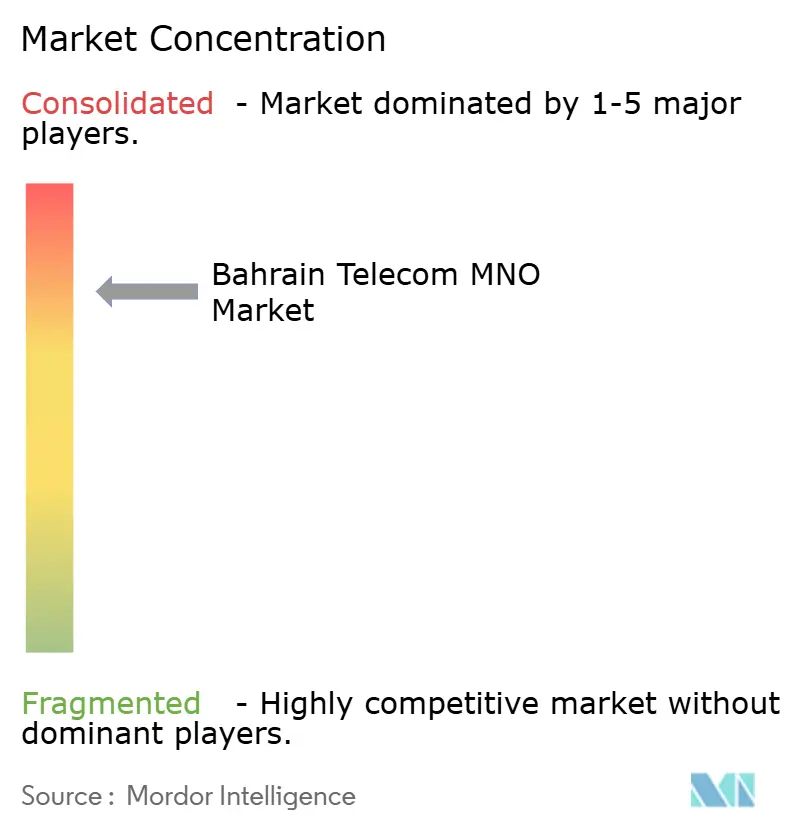
| Market Concentration | High |
Major Players *Disclaimer: Major Players sorted in no particular order Image © Mordor Intelligence. Reuse requires attribution under CC BY 4.0. | |
Bahrain Telecom MNO Market Analysis by Mordor Intelligence
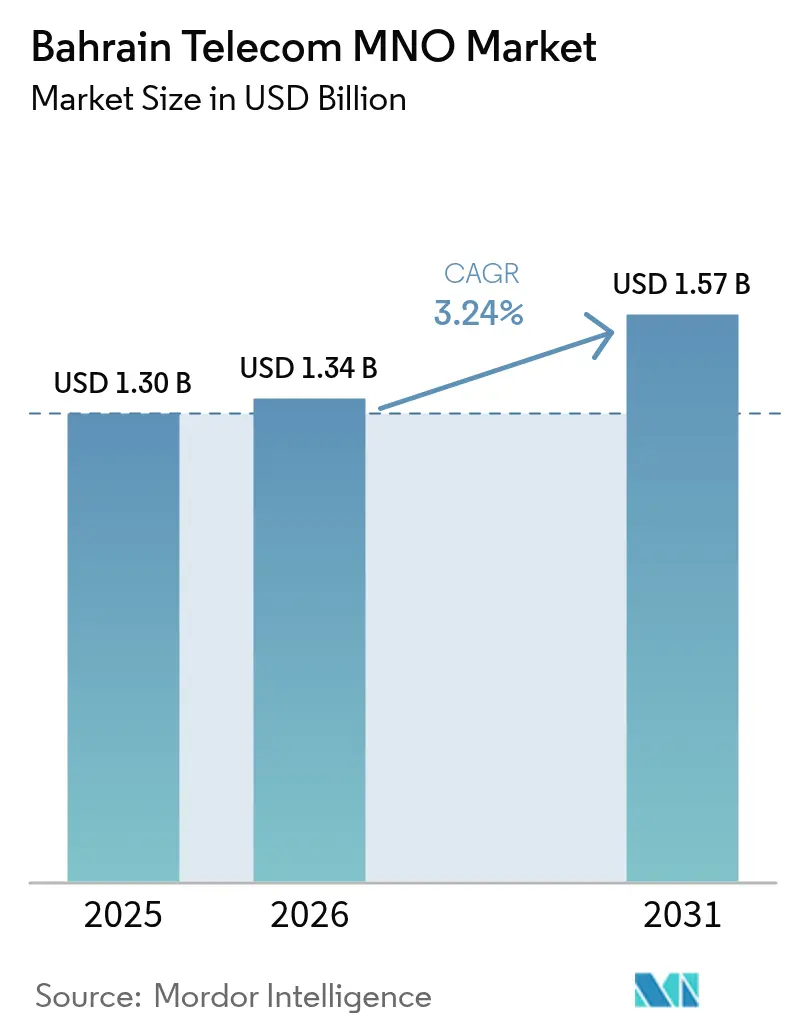
The Bahrain Telecom MNO Market size is expected to grow from USD 1.30 billion in 2025 to USD 1.34 billion in 2026 and is forecast to reach USD 1.57 billion by 2031 at 3.24% CAGR over 2026-2031.
The forecast shows a maturing landscape in which subscriber growth plateaus but value per connection rises, anchored by the kingdom’s all-encompassing 5G roll-out, wholesale fiber ubiquity, and a deliberate pivot toward premium digital services. Operators are channeling the bulk of their USD 250 million-plus 2023 capital outlay into spectrum-refarming, massive-MIMO upgrades, and edge compute nodes that lift network quality to support cloud workloads and low-latency enterprise use cases [1]. A government-led cloud-first policy that mandates public agencies to migrate 30% of their workloads to cloud platforms unlocks recurring data-center demand while expanding addressable ICT revenue well beyond pure connectivity. At the same time, a string of new submarine cable landings, most prominently the 2Africa Pearls branch in 2025, dramatically increases international bandwidth and positions Bahrain as a Gulf hub for wholesale transit traffic [2]. These structural tailwinds collectively offset headwinds such as a small population base, ARPU pressure stemming from three-player rivalry, and stepped-up regulatory costs, thereby underpinning steady topline expansion for the Bahrain telecom MNO market.
Key Report Takeaways
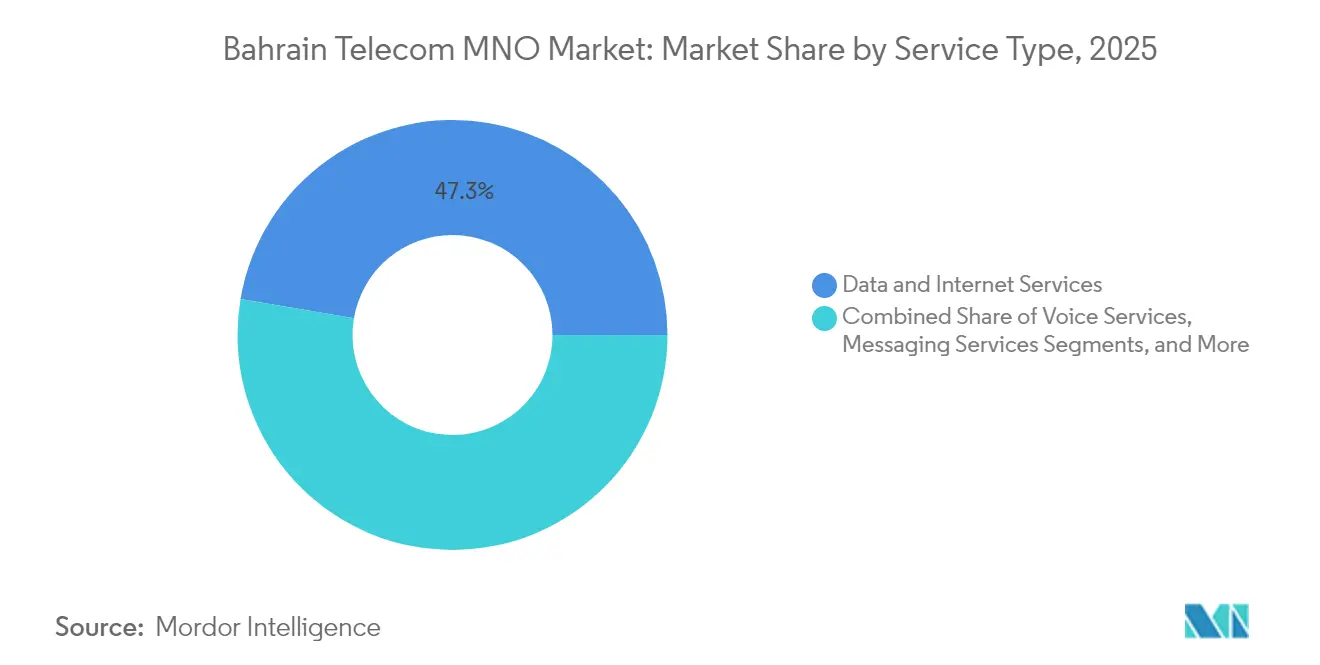
- By service type, data and internet commanded 47.32% of the Bahrain telecom MNO market share in 2025. IoT and M2M are projected to expand at a 3.35% CAGR through 2031.
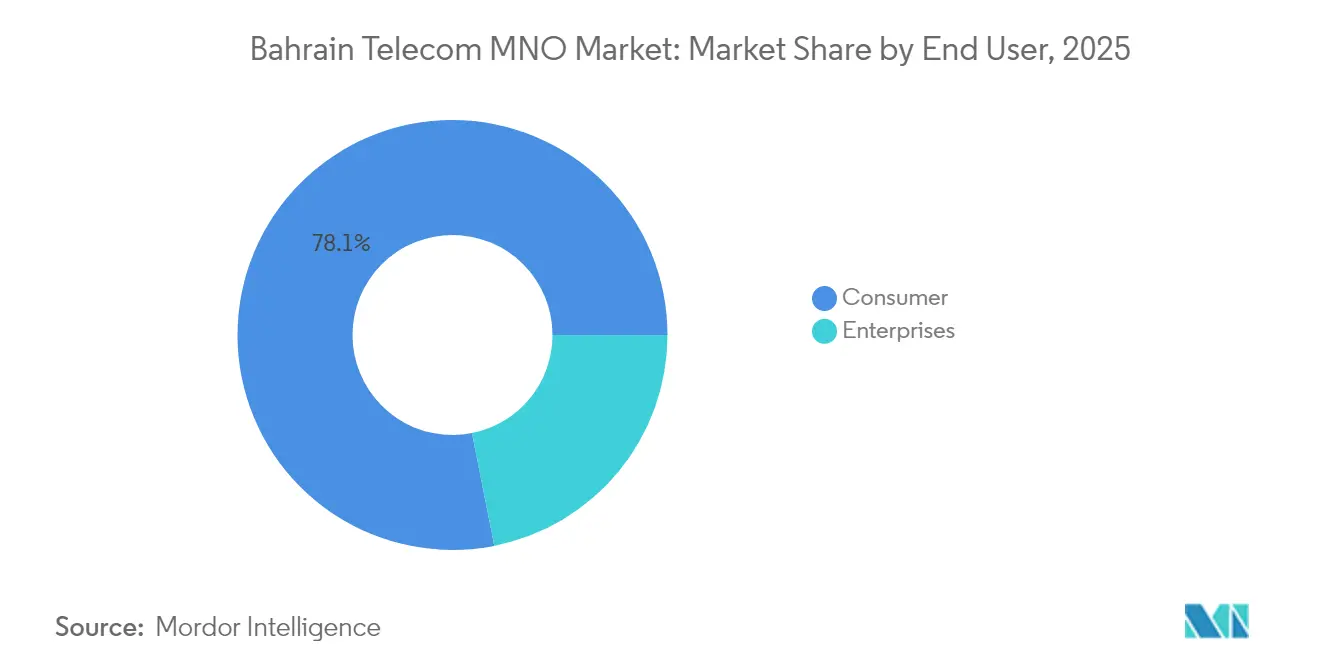
- By end-user, the consumer segment captured 78.12% revenue share in 2025, while the enterprise segment is set to grow at a 3.72% CAGR through 2031.
Note: Market size and forecast figures in this report are generated using Mordor Intelligence’s proprietary estimation framework, updated with the latest available data and insights as of 2026.
Bahrain Telecom MNO Market Trends and Insights
Drivers Impact Analysis*
| Driver | (~) % Impact on CAGR Forecast | Geographic Relevance | Impact Timeline |
|---|---|---|---|
| Explosive 5G data-traffic upsurge | +1.2% | National, focused on Manama and industrial corridors | Medium term (2-4 years) |
| National Broadband Network (BNET) open-access mandate | +0.8% | Nationwide, high concentration in business districts | Long term (≥ 4 years) |
| Government cloud-first and FinTech policies | +0.6% | Government and enterprise verticals | Medium term (2-4 years) |
| Surge in over-the-top (OTT) video consumption | +0.5% | Consumer-centric, nationwide | Short term (≤ 2 years) |
| Enterprise IoT demand in aluminum and oil-and-gas | +0.4% | Industrial zones (Alba, energy sites) | Long term (≥ 4 years) |
| Under-sea cable landing in 2025 boosts international capacity | +0.3% | National with regional spillover | Medium term (2-4 years) |
| Source: Mordor Intelligence | |||
Explosive 5G Data-Traffic Upsurge
Every major operator now offers nationwide 5G, and average downlink speed rebounded to 23.4 Mbps in Q2 2024 after earlier congestion setbacks [3]. Spectrum reclaimed from sunset 3G bands feeds wider 5G carriers and massive-MIMO deployments, enabling latency below 10 ms for enterprise edge applications. Batelco’s partnership with Ericsson on Voice over New Radio and millimeter-wave trials cements the technology pathway for ultra-reliable low-latency use cases in robotics, AR maintenance, and cloud gaming. Rapid take-up of fixed-wireless access, which already connects over 21% of homes, shows how 5G blurs boundaries between mobile and fixed broadband [4]. Crucially, higher data allowances and video-first usage are driving a steady uplift in blended ARPU, partially neutralizing the impact of headline tariff cuts.
National Broadband Network (BNET) Open-Access Mandate
BNET’s wholesale fiber grid reaches 95% of households and 99% of businesses, forcing MNOs to compete on experience and product depth rather than last-mile exclusivity. Batelco responded by bifurcating into an infrastructure business (Beyon’s NBNetco) and a retail arm, meeting separation rules while still monetizing passive assets through long-term leases. A carrier-grade revenue-assurance layer, powered by Mobileum, supports granular cost allocation and encourages smaller ISPs to enter value niches such as niche enterprise VPNs. The model cuts duplicated capex, accelerates gigabit access, and creates a fertile platform for digital-service layering, all of which magnify revenue prospects for the Bahrain telecom MNO market.
Government Cloud-First and FinTech Policies
Over 40 government services have already migrated to hyperscale clouds, reducing internal IT spend by up to 60% and compressing project timelines by two-thirds. AWS and Microsoft regional zones reinforce Bahrain’s positioning as a neutral data haven under Cloud Computing Law No. 56 of 2018, drawing foreign workloads that stimulate local cross-connect and transit demand. Operators monetize this momentum by bundling secure connectivity, managed SD-WAN, and edge security layers for ministries and banks. stc Bahrain’s Web3 Launchpad, developed with global partners, exemplifies how telcos branch into blockchain infrastructure to underpin tokenized payment rails and decentralized identity. Each new workload added to the cloud primes supplementary traffic across MNO backbones, expanding the Bahrain telecom MNO market.
Surge in OTT Video Consumption
Video already represents the majority of downstream traffic, and peak-hour throughput constraints have pushed operators to roll out edge caching nodes and CDN partnerships with vendors such as Huawei. Unlimited-data bundles are now mainstream, signifying the industry’s pivot toward speed-tiering rather than usage caps. Batelco’s cloud-ready Restaurant Management Solution shows how OTT extends beyond entertainment into integrated commerce, catalyzing data transactions across the hospitality vertical. Heightened demand for 4K streaming and interactive e-sports content accelerates traffic growth, raising the baseline for capacity planning and nudging ARPU upward in high-tier plans.
Restraints Impact Analysis*
| Restraint | (~) % Impact on CAGR Forecast | Geographic Relevance | Impact Timeline |
|---|---|---|---|
| Small addressable population base | -0.9% | Nationwide demographic ceiling | Long term (≥ 4 years) |
| Intensifying price-based competition → ARPU compression | -0.7% | All customer segments nationwide | Short term (≤ 2 years) |
| BNET structural separation limits infrastructure differentiation | -0.4% | National policy framework | Medium term (2-4 years) |
| Spectrum renewal fees and 5% VAT hikes | -0.3% | National tax and regulatory environment | Short term (≤ 2 years) |
| Source: Mordor Intelligence | |||
Small Addressable Population Base
Bahrain’s population of roughly 1.7 million yields an inherently capped subscriber pool, and mobile penetration surpassing 150% underscores full saturation. With little room for net additions, revenue growth rests on ARPU enhancement, upselling premium 5G tiers, and capturing enterprise wallet share. Operators are therefore exporting expertise abroad, as seen in Beyon’s UAE push, while also monetizing international transit made possible through new subsea systems. Inside the kingdom, the geographic concentration of economic activity in Manama compresses the revenue opportunity in outlying areas, necessitating surgical network investment and an emphasis on high-margin digital solutions.
Intensifying Price-Based Competition and ARPU Compression
The Telecommunications Regulatory Authority’s drive for affordable services and the leveling effect of BNET wholesale access encourage brisk tariff skirmishes. Average mobile prices fell 15% between 2018 and 2019, setting a precedent that continues to erode headline ARPU. Seamless VoIP apps and OTT messaging strip incremental revenue from legacy voice and SMS, forcing operators to reposition packages around generous data buckets and lifestyle add-ons. While subscribers benefit, sustained margin pressure complicates the funding of network upgrades just as 5G investment peaks. Operators thus face the dual challenge of maintaining price competitiveness and financing next-gen capabilities that differentiate experience.
*Our forecasts treat driver/restraint impacts as directional, not additive. The impact forecasts reflect baseline growth, mix effects, and variable interactions.
Segment Analysis
By Service Type: Data Services Drive Revenue Growth
Data and internet delivered 47.32% of the Bahrain telecom MNO market share in 2025, and the slice is projected to widen as video-centric usage accelerates. High-capacity 5G radio layers, combined with wholesale fiber backhaul, let operators position unlimited-data bundles at attractive price-to-performance ratios, stabilizing ARPU even in a price-sensitive environment. The Bahrain telecom MNO market harnesses this shift by embedding content partnerships, ranging from regional SVOD platforms to bundled gaming passes, that spur incremental megabyte consumption. IoT and M2M connectivity, while still a single-digit revenue contributor, is the fastest-growing stream at a 3.35% CAGR through 2031 as aluminum smelters, refineries, and utility grids digitalize operations. Voice revenue continues its measured descent; however, investments in Voice over New Radio ensure call quality remains sufficient for business-critical applications.
The enterprise pivot toward predictive maintenance and supply-chain telemetry lifts the value of narrow-band IoT, creating an opening for device-management platforms and analytics add-ons. Operators are also rejuvenating messaging with API-based CPaaS offers that integrate two-factor authentication and chatbot services for banks and airlines. OTT and pay-TV subscriptions piggyback on rising 5G fixed-wireless penetration, allowing telcos to capture a share of household entertainment spend. Collectively, the service-mix evolution raises the elasticity of the Bahrain telecom MNO market size as data-driven lines more than compensate for legacy declines.

By End-User: Enterprise Segment Accelerates Digital Transformation
Consumer business retains 78.12% of 2025 revenue, yet enterprise lines are forecast to expand at 3.72% CAGR, outpacing household growth and lifting the Bahrain telecom MNO market size in absolute terms. Demand stems from aggressive cloud adoption, digital identity roll-outs, and sector-specific automation mandates across government, banking, and heavy industry. Enterprises increasingly require integrated bundles, combining MPLS or SD-WAN connectivity, cybersecurity overlays, and hybrid-cloud orchestration, creating multi-service contracts with stickier lifetime value. Tie-ups such as Beyon Connect’s secure-communication suite for land registry authorities exemplify this pivot toward platform solutions.
On the consumer front, higher-tier unlimited plans, handset financing, and lifestyle super-apps stimulate spend in an otherwise saturated base. stc Bahrain’s BenefitPay integration shows how telcos leverage mobile apps to capture payment and commerce flows that ride on top of connectivity. The confluence of fintech, content, and 5G home broadband adds synergistic revenue, yet sustained innovation is needed to keep churn in check, given three-operator parity. As the enterprise slice enlarges, operators strike a healthier balance between volatile prepaid traffic and contract-based B2B revenue, thereby reinforcing the durability of Bahrain telecom MNO market earnings.
Geography Analysis
Nationwide 100% 4G coverage and near-ubiquitous 5G enable Bahrain’s operators to deliver homogeneous service quality in the world’s fifth-smallest country by land mass. Urban Manama, with dense office towers, government complexes, and retail malls, generates a disproportionately high volume of mobile traffic, prompting operators to deploy massive-MIMO cells, small-cell grids, and carrier aggregation layers to sustain gigabit-class throughput during office and evening peaks. Residential suburbs benefit from fixed-wireless access that competes with fiber for triple-play bundles, particularly in newly developed northern districts where trenching costs remain high.
Industrial zones in Alba and north-eastern energy corridors constitute high-value enterprise demand pockets. Batelco’s award-winning private 5G network at Alba smelter validates the willingness of heavy-industry clients to pay premium connectivity fees when latency-defined manufacturing KPIs are at stake. Such localized high-ARPU enclaves become critical to offset nationwide demographic constraints.
Internationally, Bahrain’s geographic midpoint between the Gulf and Indian Ocean hubs underpins its wholesale transit proposition. The forthcoming 2Africa Pearls landing boosts outbound capacity and diversifies routes away from congested chokepoints, allowing operators to monetize cross-border IP transit for neighboring countries and content networks. This wholesale upside expands total addressable revenue beyond the domestic consumer base, cushioning the Bahrain telecom MNO market against local saturation.
Regulatory Landscape
Bahrain's telecom sector is regulated by the Telecommunications Regulatory Authority (TRA), established under the Telecommunications Law in 2002. The TRA maintains active policy instruments covering licensing, tariffs, and spectrum management, including published Position Papers and Guidelines such as frequency license fee calculation guidance (with guideline entries dated June 9, 2024 and December 30, 2024).
The TRA's Schedule of Fees Regulation (latest promulgated in 2023 following a tariff rebalancing process, and reviewed as appropriate) sets out core charge components that affect MNO cost structures. It includes a BD 500 non-refundable telecommunications license application fee for initial applications and renewals, as well as defined annual and temporary frequency license fee constructs, with temporary fees charged monthly at 1/12 of the annual frequency fee plus an application fee. Alongside regulator-defined fees, operator compliance is increasingly formalized, with Zain Bahrain disclosing an ISO-aligned Regulatory Compliance Program (aligned to ISO 37301 and ISO 31000) supported by a compliance portal to track obligations.
Competitive Landscape
The triopoly of Batelco (Beyon), stc Bahrain, and Zain Bahrain creates a tightly contested marketplace where infrastructure parity erodes as BNET drives wholesale access. Batelco leads revenue share, leveraging deep fiber reach and the kingdom’s largest Tier III data center to cross-sell cloud colocation and managed security bundles. stc Bahrain exploits wholesale and subsea assets inherited from its Saudi parent to underprice international links and win multi-country enterprise contracts, while pioneering Web3 pilots in digital-asset custody and metaverse enablement. Zain Bahrain distinguishes itself through customer-experience analytics, including real-time service time predictions that reduce complaint handling and boost NPS.
Strategic priorities have converged on 5G densification, edge compute nodes, and digital-service portfolios that reach beyond connectivity. For example, Batelco’s collaboration with Nokia to extend private 5G into factories represents a new revenue pathway into operational technology budgets. Meanwhile, stc Bahrain’s CDN buildout with Huawei lowers latency for video-streaming partners, reinforcing its position in the premium-content arena. The intensity of innovation, yet high entry barriers, produce a moderately concentrated but dynamic Bahrain telecom MNO market.
Bahrain Telecom MNO Industry Leaders
-
Batelco (Beyon)
-
stc Bahrain
-
Zain Bahrain
- *Disclaimer: Major Players sorted in no particular order
Market Opportunities and Future Outlook
International capacity and wholesale transit remain key whitespace as Bahrain adds and diversifies subsea routes and landing infrastructure. stc Bahrain completed the landing of the 2Africa Pearls subsea cable system in July 2025, cited as increasing Bahrain's connectivity capacity by 10x. Beyon (Batelco) also announced the Khaleej North 800-km subsea cable project linking Bahrain with Saudi Arabia, Kuwait, and Iraq, with service timing communicated for Q2 2026. In parallel, Batelco and BNET signed a strategic agreement in November 2025 to deploy landing and inland infrastructure for the SEA-ME-WE 6 (SMW6) and Al Khaleej cable systems, creating more pathways for MNOs to monetize international connectivity through IP transit, carrier services, and enterprise-grade cross-border connectivity.
A second opportunity set sits at the intersection of cloud-first digitization and low-latency compute, where MNOs can bundle connectivity with sovereign and edge hosting to capture enterprise workloads beyond pure mobile service. The government cloud-first mandate (30% of public workloads to cloud) provides a structural demand base, and the January 2026 Batelco by Beyon partnership with Qareeb Data Centers to launch Bahrain's first edge data center (via a long-term lease of a new Batelco facility) points toward AI-ready, low-latency colocation and edge services. On the monetization layer tied to demand, fintech and digital commerce rails are becoming a practical adjacency for telcos, reinforced by stc Bahrain launching Mastercard Click to Pay in May 2026, which expands the addressable pool for payment-linked mobile propositions and merchant enablement built on top of data connectivity.
Recent Industry Developments
- June 2026: Zain Bahrain renewed a strategic partnership with the Ministry of Transportation and Telecommunications to enhance internet services at Bahrain Post branches and the Small Vessels Registration Office. The agreement reinforces telco participation in public-sector digital service delivery and supports stable, contract-based connectivity demand tied to government sites.
- December 2025: Batelco by Beyon signed an agreement with Cisco to modernize its IP backbone infrastructure, focusing on advanced routing, automation, and intelligent assurance tools. The upgrade strengthens network scalability and service assurance for higher data loads from 5G, cloud connectivity, and enterprise services.
- December 2024: BNET and Zain Bahrain completed a fiber backhaul asset transfer deal that moved fixed-fiber backhaul network assets from Zain Bahrain to BNET. The transfer supports Bahrain's open-access fiber model and shifts MNO differentiation toward service, experience, and digital solutions rather than proprietary backhaul ownership.
Research Methodology Framework and Report Scope
Market Definition and Coverage
For this report, the market is defined as the revenue generated in Bahrain by mobile network operators from providing telecom connectivity and related operator-led services to consumers and enterprises.
Scope exclusions: Handset sales, standalone device financing, and non-operator digital services that do not flow through an MNO revenue line are not counted.
Segmentation Overview
- Overall Telecom Revenue and ARPU
- Service Type
- Voice Services
- Data and Internet Services
- Messaging Services
- IoT and M2M Services
- OTT and Pay-TV Services
- Other Services (VAS, Roaming and International Services, Enterprise and Wholesale Services, etc.)
- End-User
- Enterprises
- Consumer
Data Sources, Market Sizing, and Validation
Desk Research
Desk work starts with building a clean fact base on Bahrain telecom demand and supply signals, then mapping them into the operator revenue pool. We rely on public statistics and regulatory releases, such as the Telecommunications Regulatory Authority (TRA) Bahrain dashboards and publications, the International Telecommunication Union (ITU) indicators, and World Bank macro series to keep population, income, and broadband readiness consistent.
To ground service intensity and network rollouts, we also review operator annual reports, investor presentations, and audited financial statements, along with spectrum and licensing notes published by the regulator. Where available, customs and trade summaries, plus patent databases, are used to sense the pace of network and device ecosystem upgrades without forcing them into revenue directly. For cross-checking, company financials and intelligence subscriptions and news and financials subscriptions are used to normalize reporting periods, currency, and one-time items. These desk research sources are illustrative and not exhaustive, and additional public references are also used to collect data, validate assumptions, and resolve open questions.
Primary Interviews and Surveys
Primary work is used to confirm what portion of operator revenue is tied to mobile services in Bahrain, and how pricing and usage are shifting across prepaid, postpaid, and enterprise accounts. We spoke with a mix of operator-side leaders, channel and enterprise stakeholders, and industry experts, then checked the takeaways against Bahrain context and relevant regional benchmarks to avoid over-reading a single data point.
Distribution of primary research fieldwork respondents
| Company type | Respondent position |
|---|---|
| Top tier: 30% | CXOs: 15% |
| Mid tier: 51% | Functional/Unit leaders: 38% |
| Smaller Players: 19% | Managers: 47% |
Market-Sizing & Forecasting
The model uses a top-down and bottom-up combination, where regulated market indicators and operator revenue disclosures are used to reconstruct the mobile operator service revenue pool for Bahrain, and then the totals are pressure-tested using selective bottom-up approximations. In practice, we cross-check the headline number using sampled ARPU by customer type, subscriber counts, and expected data usage uplift, which helps catch cases where pricing or mix is moving faster than volumes.
Key inputs that shape the size and forecast include mobile subscriber base trends, smartphone and 4G/5G adoption, data traffic growth, headline tariff movements, and enterprise mobility demand (including IoT and M2M where billed by the operator). When a sub-service is not consistently reported, the gap is handled by using peer ratios from nearby periods, then validating with interview feedback before rolling it back into the total. Forecasting is done using scenario analysis supported by short driver-based projections, where each driver is checked for realistic ranges during primary discussions, and then consolidated into a single base case.
Data Validation & Update Cycle
Validation is done in layers so results do not depend on one source. We compare modeled outputs against independent signals such as regulatory revenue snapshots, subscriber and penetration levels, and publicly stated operator performance, then investigate outliers before final sign-off.
If a variance is driven by a one-time accounting effect, a tax change, or a pricing reset, the assumptions are revisited and the relevant experts are re-contacted for confirmation. The report is refreshed annually, and interim updates are made when there is a material event such as a major tariff shift, spectrum action, or a step change in 5G coverage. Before delivery, an analyst completes a final review so the latest public information is reflected in the market view.
Mordor Intelligence's Bahrain Analysis of Telecom Sector Market Size Compared With Other Published Estimates
Published market values for Bahrain telecom do not always match because each publisher can count a different revenue pool, and not all of them align on timing and currency conversion. Differences also show up when one estimate mixes total telecom services with only mobile operator services, or when forecasts assume faster price growth than what tariff direction supports.
Handset sales and standalone device financing sit outside Mordor Intelligence's scope here, which is one reason the 2025 value can look higher or lower versus sources that bundle devices or, in the other direction, only track a narrower service revenue definition. The spread is also influenced by whether enterprise wholesale, roaming, and operator-led OTT and pay-TV bundles are included, and whether figures are based on audited operator reporting periods or blended calendar-year assumptions.
Benchmark comparison
| Source | Market Size | Gaps in Research Methodology |
|---|---|---|
| Mordor Intelligence | USD 1.30 B (2025) | |
| Global Telecom Data Publisher A | USD 0.54 B (2025) | Often presented as total telecom service revenue with a tighter service-only definition, and it can exclude operator-led bundles and some enterprise and wholesale lines that are counted within MNO reporting. |
| Regional Media Citation B | USD 1.30 B (2025) | Typically republishes a headline figure without detailing service inclusions, currency timing, or validation checks, which makes it hard to reconcile sub-service coverage and year cutoffs. |
The comparison shows that the biggest swings come from what is counted as telecom revenue and how completely operator revenue lines are captured in the year. By keeping inputs tied to subscriber base, ARPU direction, and service inclusions that can be rechecked, our estimate stays traceable even when external figures use a different definition.
Key Questions Answered in the Report
How big is the Bahrain telecom MNO market in 2026?
The Bahrain telecom MNO market size stands at USD 1.34 billion in 2026 with a projected CAGR of 3.24% through 2031.
What is driving revenue growth for Bahraini mobile operators?
Nationwide 5G rollout, government cloud-first mandates, growing OTT video consumption, and new international subsea cables are expanding high-value data usage and wholesale transit earnings.
Which service segment is expanding fastest?
IoT and M2M connectivity is growing at a 3.35% CAGR to 2031 as industrial and utility clients digitalize operations.
Why is enterprise demand important in Bahrain?
Enterprise services are forecast to grow at 3.72% CAGR because agencies and corporations increasingly bundle connectivity with cloud, cybersecurity, and IoT solutions under digital-transformation programs.
How is competition evolving among Batelco, stc Bahrain, and Zain Bahrain?
Infrastructure parity from BNET’s wholesale fiber forces operators to differentiate through 5G densification, customer-experience platforms, data centers, and emerging Web3 services.
What challenges could limit market growth?
A small population ceiling, persistent price wars that squeeze ARPU, and higher spectrum renewal fees temper the long-term revenue outlook.