
Anaerobic Adhesives Market Size and Share
Market Overview
| Study Period | 2020 - 2031 |
|---|---|
| Market Size (2026) | USD 657.73 Million |
| Market Size (2031) | USD 889.29 Million |
| Growth Rate (2026 - 2031) | 6.22 % |
| Fastest Growing Market | Asia-Pacific |
| Largest Market | Asia-Pacific |
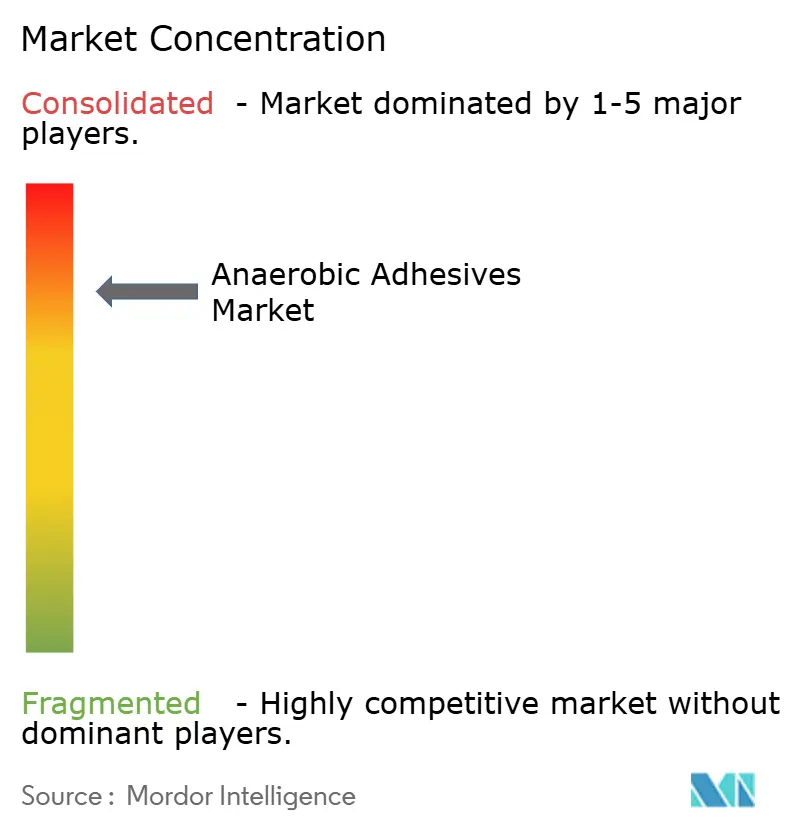
| Market Concentration | High |
Major Players *Disclaimer: Major Players sorted in no particular order Image © Mordor Intelligence. Reuse requires attribution under CC BY 4.0. | |
Anaerobic Adhesives Market Analysis by Mordor Intelligence
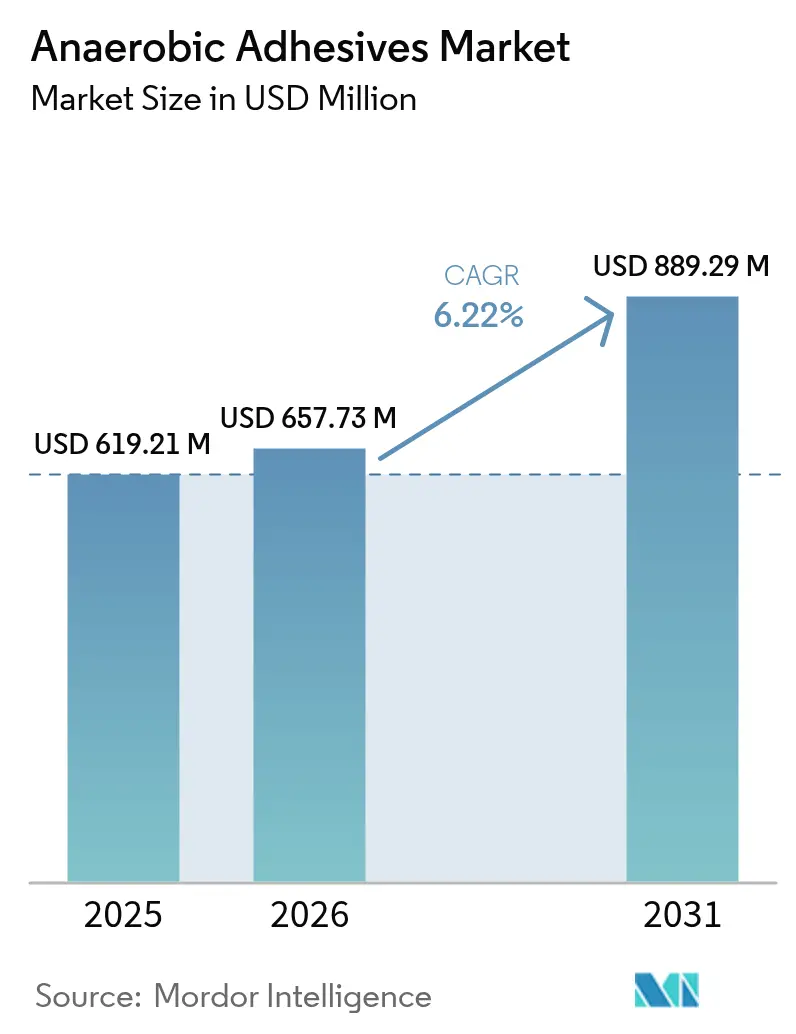
The Anaerobic Adhesives Market size was valued at USD 619.21 million in 2025 and estimated to grow from USD 657.73 million in 2026 to reach USD 889.29 million by 2031, at a CAGR of 6.22% during the forecast period (2026-2031). Rising demand for high-integrity fastening in electric vehicles, miniaturized electronics, and wind turbines is accelerating the shift from mechanical to chemical bonding. Manufacturers are prioritizing vibration-resistant, lightweight joining methods to improve product reliability and cut assembly weight. Tightening chemical regulations are simultaneously prompting rapid reformulation toward “label-free” products that remove substances of concern while preserving performance. Ongoing consolidation among leading suppliers is bringing scale advantages in research and development and global distribution, strengthening competitive moats while raising entry barriers for smaller formulators.
Key Report Takeaways
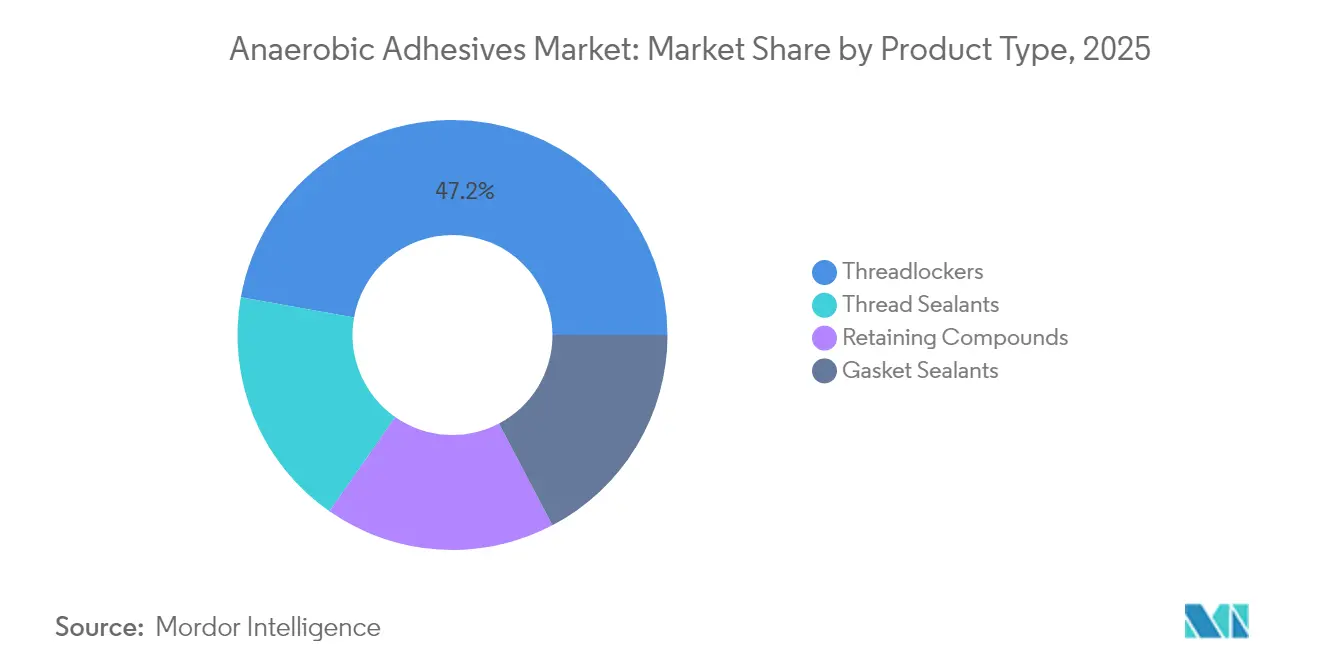
- By product category, threadlockers led with 47.20% revenue share in 2025, while thread sealants are forecast to expand at a 6.85% CAGR to 2031.
- By substrate material, metal parts commanded 70.30% of the anaerobic adhesives market share in 2025; plastics and composites are projected to grow at an 8.35% CAGR through 2031.
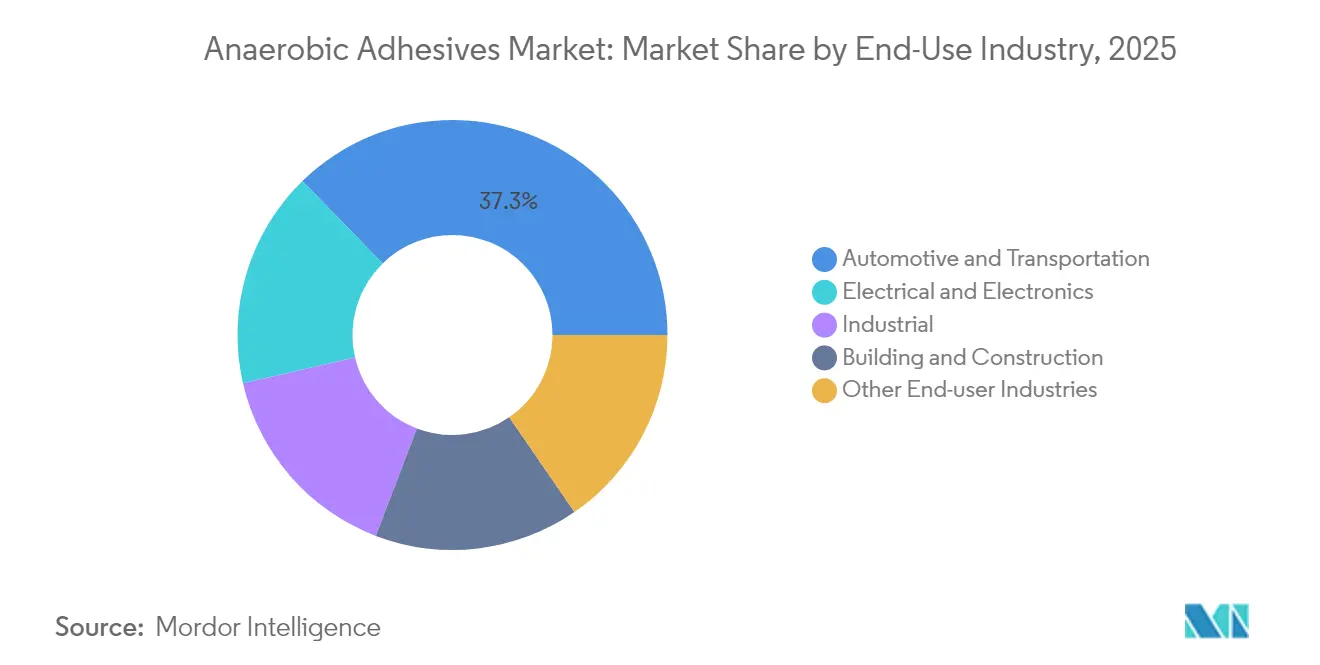
- By end-use industry, automotive and transportation held 37.30% share of the anaerobic adhesives market size in 2025, whereas electrical and electronics is advancing at an 7.74% CAGR through 2031.
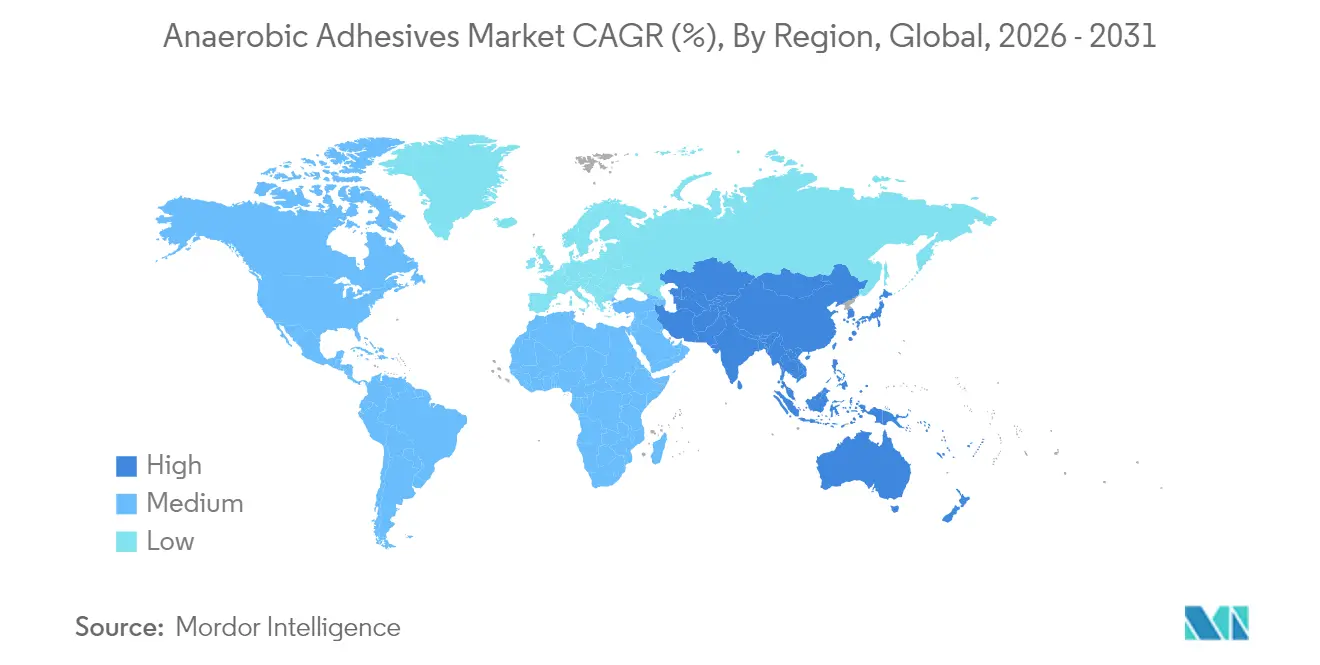
- By geography, Asia-Pacific accounted for 47.60% of the anaerobic adhesives market in 2025 and is set to grow at an 8.02% CAGR over 2026-2031.
Note: Market size and forecast figures in this report are generated using Mordor Intelligence’s proprietary estimation framework, updated with the latest available data and insights as of 2026.
Market Trends and Insights
Drivers Impact Analysis of Anaerobic Adhesives Market*
| Driver | (~) % Impact on CAGR Forecast | Geographic Relevance | Impact Timeline |
|---|---|---|---|
| Recovering Automotive Production in China, India & Mexico | +1.8% | Asia-Pacific, North America | Short term (≤ 2 years) |
| Rapid Miniaturisation in Consumer & Automotive Electronics Raising Demand for Threadlockers | +1.5% | Global, with concentration in Asia-Pacific | Medium term (2-4 years) |
| Accelerating Shift Toward Predictive Maintenance in Wind Turbines Boosting Retaining Compounds | +1.2% | Europe, North America | Medium term (2-4 years) |
| Growing OEM Preference for Lightweight, Vibration-Resistant Fastening Solutions in E-Mobility | +1.4% | Global, with early adoption in Europe and North America | Long term (≥ 4 years) |
| Increased adoption in aerospace for critical, high-stress joints | +0.9% | North America, Europe | Medium term (2-4 years) |
| Source: Mordor Intelligence | |||
Recovering automotive production in China, India and Mexico
Electric-vehicle output rose sharply in 2024, with China surpassing 35% EV production share. Battery packs and traction motors now rely on anaerobic threadlockers that withstand intense thermal cycling and vibration. Modular vehicle platforms magnify the need for uniform clamp load, and chemical fasteners provide the required concentricity at scale. Henkel notes specification of automotive-grade anaerobic formulations in more than 60% of new EV designs in Asia, underscoring the indispensability of chemical locking for next-generation drivetrains. These factors anchor a multi-year demand surge and reinforce the Asia-Pacific leadership in the anaerobic adhesives market.
Rapid miniaturisation in consumer and automotive electronics
Average thread diameters in handheld gadgets and in-vehicle controllers continue to shrink, compelling manufacturers to adopt low-viscosity, capillary threadlockers that flow into micro-threads without excess squeeze-out. A modern passenger car now contains about 3,000 electronic sub-assemblies, each vulnerable to vibration-induced loosening. Purpose-built anaerobic grades with controlled breakaway strength preserve serviceability while safeguarding high-density boards. Suppliers capitalise by launching micro-dispense packaging and precision dosing equipment, speeding adoption across contract manufacturing lines throughout the anaerobic adhesives market.
Accelerating shift toward predictive maintenance in wind turbines
Wind-farm operators pair IoT sensors with high-strength anaerobic retaining compounds to secure bearings and gear couplings exposed to forces exceeding 100 tons. Integration of LOCTITE Pulse monitoring systems cut unscheduled outages by 37% in European fleets, demonstrating how adhesive reliability underpins data-driven uptime strategies[1]. As turbine owners extend life cycles beyond 20 years, long-term adhesion and corrosion resistance become mission-critical, further boosting compound consumption across the anaerobic adhesives market.
Growing OEM preference for lightweight, vibration-resistant fastening in e-mobility
Premium EV programs now specify anaerobic threadlockers for over 70% of threaded joints in traction assemblies. Eliminating lock washers and split pins trims 3-5 kg from a mid-size EV, directly improving range. Adhesive-secured joints also deliver superior damping, minimising audible rattle and micro-fretting during vehicle life. Tier-one suppliers are co-developing custom grades that cure rapidly on aluminum housings, ensuring line-rate throughput while hitting stringent torque-to-yield targets. This cross-discipline partnership cements the role of advanced formulations in the evolving anaerobic adhesives market.
Restraints Impact Analysis of Anaerobic Adhesives Market*
| Restraint | (~) % Impact on CAGR Forecast | Geographic Relevance | Impact Timeline |
|---|---|---|---|
| Volatile Feedstock Prices | -0.7% | Global, with higher impact in Asia-Pacific | Short term (≤ 2 years) |
| Regulatory Pressure to Reduce Hazardous Stabilisers in Formulations (EU REACH, TSCA) | -0.9% | Europe, North America | Medium term (2-4 years) |
| Skilled-Labour Gap in Emerging Economies for Precision Assembly Applications | -0.5% | Asia-Pacific, South America | Medium term (2-4 years) |
| Source: Mordor Intelligence | |||
Volatile feedstock prices
Frequent swings in methacrylate-monomer costs squeeze gross margins, particularly for regional formulators lacking hedging capability. Production disruptions in key Asian chemical parks raise supply-chain risk and prompt inventory inflation across the anaerobic adhesives market. Large players counter with alternative raw-material recipes that hold shear strength while dampening cost volatility, giving them pricing leverage over smaller rivals.
Regulatory pressure to reduce hazardous stabilisers
The 2025 EPA ruling on trichloroethylene bans a common solvent in legacy formulations, forcing costly reformulation[2]. EU restrictions on phthalate-based stabilisers take full effect in 2026, compressing compliance timelines. Tier-one producers have budgeted USD 2-3 million per product line to qualify safer chemistries and avoid production downtime. While short-term costs weigh on profit, the pivot unlocks premium “label-free” ranges that strengthen brand equity and enhance user safety across the anaerobic adhesives market.
*Our forecasts treat driver/restraint impacts as directional, not additive. The impact forecasts reflect baseline growth, mix effects, and variable interactions.
Anaerobic Adhesives Market Segment Analysis
By Product Type:
Threadlockers Dominate Critical ApplicationsThreadlockers generated 47.20% revenue in 2025, reflecting entrenched preference for chemical locking over mechanical devices. Their unmatched ability to maintain clamp load under vibration keeps them integral to drivetrain, heavy-machinery, and precision instrumentation assembly. Specialty variants now target stainless steel, high-temperature zones, and micro-threads, widening the addressable pool. Thread sealants, although smaller, will outpace all other products with a 6.85% CAGR as fluid-handling systems demand simultaneous sealing and fastening. This double-functionality gives plant engineers a compelling cost-of-ownership advantage.
Manufacturers intensify research and devlopment on dual-cure systems blending anaerobic and UV triggers, enabling fixture within seconds yet delivering final anaerobic strength in enclosed metal joints. These innovations shorten takt times and support high-volume electronics production. Retaining compounds are scaling beyond traditional bearing bonds into wind-turbine assemblies, creating fresh revenue layers. Gasket sealants, though niche, solve rigid-flange challenges where legacy elastomer gaskets fail under high pressure, further diversifying the anaerobic adhesives market.

By Substrate Material:
Metal Dominance Faces Composite ChallengeMetal parts commanded 70.30% of global consumption in 2025 as ferrous and non-ferrous ions catalyse rapid cure. Enhanced primers now speed set-time on passive alloys such as stainless steel and zinc-plated fasteners, unlocking broader deployment in food-grade machinery where chrome steels prevail. The metal segment’s scale underpins economies that keep unit prices competitive, reinforcing its central role in the anaerobic adhesives market.
Plastics and composites, however, are the fastest-expanding substrate, projected at an 8.35% CAGR. Hybrid formulations introduce alternative redox initiators that cure reliably on non-metallic surfaces, enabling chemical fastening in lightweight battery enclosures and consumer-electronics frames. As electric-vehicle battery packs combine aluminum endplates with glass-fiber separators, multi-substrate adhesives bridge the gap and protect against galvanic corrosion, elevating the overall anaerobic adhesives market share for next-generation mixed-material assemblies.
By End-Use Industry:
Automotive Leadership Meets Electronics GrowthAutomotive and transportation sustained 37.30% revenue share in 2025, buoyed by the transition to electric drivetrains. Critical joints in e-axles, inverter housings, and battery trays depend on robust threadlocking to endure vibration amplitudes exceeding 15 g. Vehicle makers progressively substitute mechanical locks with anaerobic securing, saving weight and assembly steps while boosting warranty confidence. The segment’s scale sells production volumes that anchor baseline demand for the anaerobic adhesives market.
Electrical and electronics, though smaller in 2025, will climb fastest at an 7.74% CAGR through 2031. Miniaturized consumer devices and ADAS modules require accurate micro-fastener torque retention. Low-outgassing, electrically insulating variants now protect die-attach areas and sensor enclosures. EMS providers pair automated dispensers with vision systems to guarantee sub-milligram dosing accuracy, solidifying supply agreements that broaden the anaerobic adhesives industry footprint.
Geography Analysis
APAC Anaerobic Adhesives Market
Asia-Pacific led with 47.60% consumption in 2025, a dominance underpinned by China’s EV surge and India’s electronics push. Chinese OEMs embed anaerobic threadlockers in over 60% of new EV platforms, and policy incentives accelerate local sourcing, deepening regional expenditure. India’s Make-in-India initiative draws multinational smartphone and auto suppliers that import dispensing lines alongside adhesive consumables, advancing the anaerobic adhesives market size for South Asia. Mature Japanese and South Korean factories maintain top-tier specification standards, spurring demand for premium high-temperature grades.
North America Anaerobic Adhesives Market
North America remains pivotal for aerospace, defense, and wind-energy projects that require certified formulations. The United States fuels high-margin sales in satellite hardware, where low-outgassing grades meet NASA and ESA specifications. Mexico’s expanding car-assembly corridor attracts Tier-1 fastener coaters applying pre-applied threadlock films, lifting cross-border volumes. Canada, though smaller, buys large packages of retaining compounds for wind-turbine refurbishments across the Atlantic corridor.
EMEA and South America Anaerobic Adhesives Market
Europe ranks as an innovation leader. Stringent REACH rules motivate investment in label-free chemistries that shun phthalates and TCE. Germany’s premium carmakers co-develop solvent-free threadlockers, anchoring future revenue for the anaerobic adhesives market. France and the United Kingdom deploy predictive maintenance in onshore wind fleets, pairing sensor arrays with high-reliability retaining compounds. South America and Middle East and Africa remain nascent but see steady uptake in mining and energy infrastructure, signalling long-run potential once local skills and regulations mature.
Regulatory Landscape
Anaerobic adhesives are shaped by chemical registration, classification, and restriction frameworks that affect monomer and solvent choices as well as labeling. In Europe, REACH (including Annex XVII restrictions) and CLP labeling rules influence reformulation priorities toward lower-hazard, lower-label solutions, consistent with the report’s shift toward label-free products.
Access also depends on region-specific rules tied to application. In the United States, South Coast AQMD Rule 1168 governs VOC limits for adhesive and sealant uses, while China applies GB 4806.15-2024 for adhesives used in food contact materials, overseen by the National Health Commission of the PRC and the State Administration for Market Regulation. Separately, ASTM International published an updated ASTM D7446-09(2026) standard (January 2026), which can affect product qualification expectations for structural adhesive use cases referenced by industrial and transportation OEMs.
Value Chain Analysis
The value chain starts with upstream petrochemical and specialty chemical inputs, especially acrylate and methacrylate monomers, plus initiators, stabilizers, and additives that support oxygen-excluded curing in metal joints. Formulators then compound, fill, and package products across categories such as threadlockers, thread sealants, retaining compounds, and gasket sealants, while larger suppliers use scale to manage feedstock volatility and keep compliance documentation current under REACH/TSCA substance controls and VOC-related requirements.
Downstream, the go-to-market split runs between direct technical sales to OEMs and Tier suppliers, where on-site trials, process validation, and training feed into specification decisions, and indirect channels serving MRO demand through industrial distributors and regional partners. Switching costs tend to favor suppliers that combine chemistry with application support, dispensing guidance, and reliability programs across automotive, electronics assembly, wind, and industrial maintenance. Strategic moves around adjacent capability integration, such as H.B. Fuller adding pre-applied fastener technology through ND Industries, further support end-to-end fastening solutions, even though the report sizing excludes off-line pre-coated fasteners.
Competitive Landscape
The anaerobic adhesives market is consolidated, with the top five manufacturers—Henkel, 3M, H.B. Fuller, Permabond LLC, and ThreeBond. Henkel provides anaerobic adhesives through its LOCTITE portfolio, supported by 130 country channels and field-service academies that train plant technicians on correct usage. 3M, H.B. Fuller, Permabond, and ThreeBond round out the top tier, collectively shaping a consolidated structure in which scale drives resin sourcing advantages and rapid regulatory compliance. H.B. Fuller’s 2024 purchase of ND Industries widened its pre-applied fastener range and added the Vibra-Tite product line, giving customers turnkey mechanical-plus-chemical fastening solutions[3].
Mid-sized specialists pursue white-space niches. Permabond focuses on aerospace-qualified grades, Hernon Manufacturing targets low-outgassing satellite compounds, and Bondloc refines dual-cure systems. These firms leverage nimble research and development cycles to win programs where larger suppliers prioritize volume. Patent filings reached 150 in 2024, centering on hybrid photoinitiator blends and bio-based monomers. Such IP accumulation cements entry barriers and shapes negotiating power across the anaerobic adhesives market.
Sustainability is the next competitive front. Leading suppliers unveiled “green” product lines that eliminate label-trigger chemicals yet match tensile shear performance. Smaller formulators face capital strain meeting similar benchmarks, hastening consolidation as regulatory complexity deepens.
Anaerobic Adhesives Industry Leaders
-
Henkel AG & Co. KGaA
-
3M
-
H.B. Fuller Company
-
Permabond LLC
-
ThreeBond Holdings Co., Ltd
- *Disclaimer: Major Players sorted in no particular order
Anaerobic Adhesives Market Companies Covered in this Report
- 3M
- Anabond
- Chemence/Krylex
- Dymax
- H.B. Fuller Company
- Henkel AG & Co. KGaA
- Hernon Manufacturing
- Hi Bond Chemicals
- Kisling AG
- Loxeal S.r.l.
- Metlok Private Limited
- Novachem Corporation ltd
- Panacol-Elosol GmbH
- Permabond
- ThreeBond Holdings Co., Ltd.
- TOAGOSEI CO.,LTD.
Market Opportunities and Future Outlook
One whitespace is the expansion of lower-hazard, low-VOC, and label-simplified anaerobic portfolios that align with tightening chemical restrictions and end-user EHS requirements, while keeping torque retention and corrosion resistance intact. A second opportunity is program-led adoption, where threadlocking is tied to training, standard work, and application assurance in high-volume assembly. Henkel’s April 2026 launch of its global threadlocking adoption program is a tangible signal that suppliers are investing in demand generation and specification capture beyond product performance.
In wind reliability use cases, there is also room to bundle retaining-compound performance with monitoring and service support. Platform-linked uptime maintenance approaches can connect condition monitoring, dispensing controls, and account support to strengthen OEM and MRO penetration.
Recent Industry Developments in Anaerobic Adhesives Market
- May 2026: Henkel launched the Teroson EP 52 Series, a heat-curing, solvent-free, one-component structural adhesive aimed at automated automotive Body-in-White production and positioned with vibration-damping characteristics. The introduction broadens Henkel’s offering for OEM production lines seeking functional integration (bonding plus NVH performance) while reducing solvent-related process and compliance burdens.
- April 2025: Henkel introduced LOCTITE AA 5885, a one-part UV-curable polyacrylate sealant designed for automotive electronics gasketing. The launch reflects the push for faster processing and precision sealing in electronics-adjacent automotive assemblies, where cycle time and controlled application are key specification drivers.
- May 2024: The acquisition of ND Industries by H.B. Fuller was completed, expanding the Vibra-Tite brand and pre-applied fastener technology capabilities. The deal strengthened H.B. Fuller’s position in fastening solutions by expanding adjacent technology sets and deepening access to customers that buy integrated mechanical-plus-chemical assembly approaches.
Anaerobic Adhesives Market Report Scope and Research Methodology
Market Definition and Coverage
For this study, the anaerobic adhesives market covers one-component reactive adhesives that cure when air is excluded between close-fitting parts, mainly for locking, sealing, and retaining assemblies in industrial and transportation applications.
Scope exclusions: We exclude cyanoacrylate and other non-anaerobic chemistries, plus off-line pre-coated fasteners and dual-cure systems where anaerobic is only a secondary cure step.
Segments Covered in This Report
- By Product Type
- Threadlockers
- Thread Sealants
- Retaining Compounds
- Gasket Sealants
- By Substrate Material
- Metal
- Plastics and Composites
- Others (Ceramic, Glass)
- By End-Use Industry
- Automotive and Transportation
- Electrical and Electronics
- Industrial
- Building and Construction
- Other End-user Industries
- By Geography
- Asia-Pacific
- China
- India
- Japan
- South Korea
- Rest of Asia-Pacific
- North America
- United States
- Canada
- Mexico
- Europe
- Germany
- United Kingdom
- France
- Italy
- Rest of Europe
- South America
- Brazil
- Argentina
- Rest of South America
- Middle East and Africa
- Saudi Arabia
- South Africa
- Rest of Middle East and Africa
- Asia-Pacific
Data Sources, Market Sizing, and Validation
Desk Research
Desk research begins by mapping where anaerobic adhesives are consumed, which is mainly in mechanical assemblies that use threaded fasteners, flanges, and close-tolerance cylindrical fits. We review public and official references such as US Census manufacturing data, Eurostat production indicators, UN Comtrade trade flows for prepared adhesives, and safety and regulatory notes from bodies such as ECHA and the US EPA.
To keep assumptions practical, we also use company filings and investor presentations for end-market commentary, along with association and standards material that describes typical use cases in automotive, general industry, and electronics. When we need continuity across countries, paid subscriptions for company financials and patent databases are used to cross-check capacity moves, product activity, and pricing direction. These desk sources are illustrative and not exhaustive, and additional references were consulted to collect, validate, and clarify data points.
Primary Interviews and Surveys
Primary inputs come from interviews and short surveys with manufacturers, distributors, formulators, and procurement or maintenance teams that specify threadlockers, thread sealants, retaining compounds, and in-place gasketing materials. We use these discussions to confirm what is treated as anaerobic in purchasing, to sanity-check price bands by package size, and to validate where demand is shifting by region and end use before totals are finalized.
Distribution of primary research fieldwork respondents
| Company type | Respondent position | Region |
|---|---|---|
| Top tier: 34% | CXOs: 16% | APAC: 39% |
| Mid tier: 50% | Functional/Unit leaders: 41% | EMEA: 36% |
| Smaller Players: 16% | Managers: 43% | Americas: 25% |
Market-Sizing & Forecasting
Market sizing is built using a top-down approach where the demand pool is reconstructed from mechanical assembly activity and then narrowed to the share of joints where anaerobic locking or sealing is typically specified. For each region, we translate these activity indicators into volumes using practical usage rates, and then convert to value using average selling prices that reflect the mix of threadlock, sealant, retainer, and gasket grades.
Key inputs that move the model include production and build trends in vehicles and industrial machinery, fastener and joint density in common assemblies, the installed base of equipment that drives maintenance demand, and regional shifts toward higher-strength and chemical-resistant grades tied to performance and compliance expectations. ASP logic is handled by tracking pack-size mix, distribution markups, and raw material cost swings so price does not drift unrealistically year to year.
To keep totals grounded, we corroborate results with selective bottom-up checks, including sampled supplier revenue splits, channel checks with distributors, and volume-times-ASP spot checks for high-use applications. Forecasting uses scenario analysis supported by simple time-series smoothing, where production outlooks and maintenance cycles are treated as the main drivers and are adjusted using what interviewees expect for pricing and specification changes. Where bottom-up signals are thin in smaller countries, we bridge gaps using share-of-industry proxies that are linked back to the same demand indicators used in the main model.
Data Validation & Update Cycle
Validation is done through stepwise triangulation so the model does not depend on one data series. Analysts compare the output against independent signals such as trade direction, visible manufacturing cycles, and the implied per-unit adhesive spend for key end uses, then review outliers before sign-off.
If a variance is driven by a sudden price move, a regulation change, or a sharp regional demand shift, follow-up calls are triggered to re-check assumptions and reset the ASP or mix logic. Reports are refreshed annually, and interim updates are made when there are material events that can change pricing, supply, or demand direction. Before delivery, a final analyst pass is completed so clients receive the latest updated view.
Mordor Intelligence's Anaerobic Adhesives Market Estimate Compared With Other Published Estimates
Published market values for anaerobic adhesives can vary even when the product name looks the same, because the counted product set and the pricing timing are not consistent across sources. Differences also show up when one study anchors demand to assembly and maintenance activity, while another leans more on broader chemicals categories.
In practice, the biggest gaps come from what is included as anaerobic (for example, whether pre-coated fasteners or dual-cure products are counted) and how value is converted from volume, which depends on pack-size mix and distributor margins. Currency timing matters as well, since converting regional sales at different average exchange rates can shift the USD total, especially when price changes are happening in parallel. When ASP progression and exchange-rate timing are refreshed close to publication and then re-checked through distributor channel validation, Mordor Intelligence keeps the 2026 value tied to realistic pack-level pricing for threadlockers, thread sealants, retaining compounds, and in-place gaskets.
Benchmark comparison
| Source | Market Size | Gaps in Research Methodology |
|---|---|---|
| Mordor Intelligence | USD 657.73 M (2026) | |
| Global Consultancy A | USD 637.30 M (2024) | Uses an earlier base year and a different forecast window, and the scope language appears broader by application, which can shift the counted demand pool and the price mix versus a fastener-led consumption view. |
| Industry Publisher B | USD 715.40 M (2024) | Reports a higher 2024 value, which may reflect a different ASP build (such as a higher assumed premium-grade mix) and different USD conversion timing, making comparisons across years less like-for-like. |
The table shows that year choice and price handling can explain a large part of the spread, even before any real demand debate starts. By keeping scope rules explicit and by tying volume-to-value steps to observable assembly and maintenance indicators, the estimate remains traceable and repeatable when the model is re-run.
Key Questions Answered in the Report
What is driving the growth of the anaerobic adhesives market through 2031?
Demand for vibration-resistant fastening in electric vehicles, miniaturized electronics, and predictive-maintenance-ready wind turbines underpins a 6.22% CAGR outlook.
Which product type holds the largest share of the anaerobic adhesives market?
Threadlockers accounted for 47.20% of 2025 revenue because they reliably prevent loosening in threaded joints across industries.
Why is Asia-Pacific the leading regional market for anaerobic adhesives?
China’s EV boom and India’s expanding electronics production push Asia-Pacific to 47.60% share in 2025, with growth projected at 8.02% CAGR.
How are regulations shaping product development in the anaerobic adhesives industry?
EU REACH and US TSCA restrictions on solvents and stabilisers are forcing reformulation, accelerating the launch of label-free, VOC-free grades.
Which end-use industry is expected to grow fastest?
Electrical and electronics will expand at an 7.74% CAGR as device miniaturisation demands precision micro-thread securing solutions.
What strategic moves are leading companies making?
Major players pursue acquisitions, such as H.B. Fuller’s purchase of ND Industries, and introduce eco-label ranges to comply with evolving ESG requirements.
What is the current size of the anaerobic adhesives market?
The anaerobic adhesives market size is estimated at USD 657.73 million in 2026, and is expected to reach USD 889.29 million by 2031, at a CAGR of 6.22% during the forecast period (2026-2031).