
Market Overview
| Study Period | 2020 - 2031 |
|---|---|
| Forecast Data Period | 2026 - 2031 |
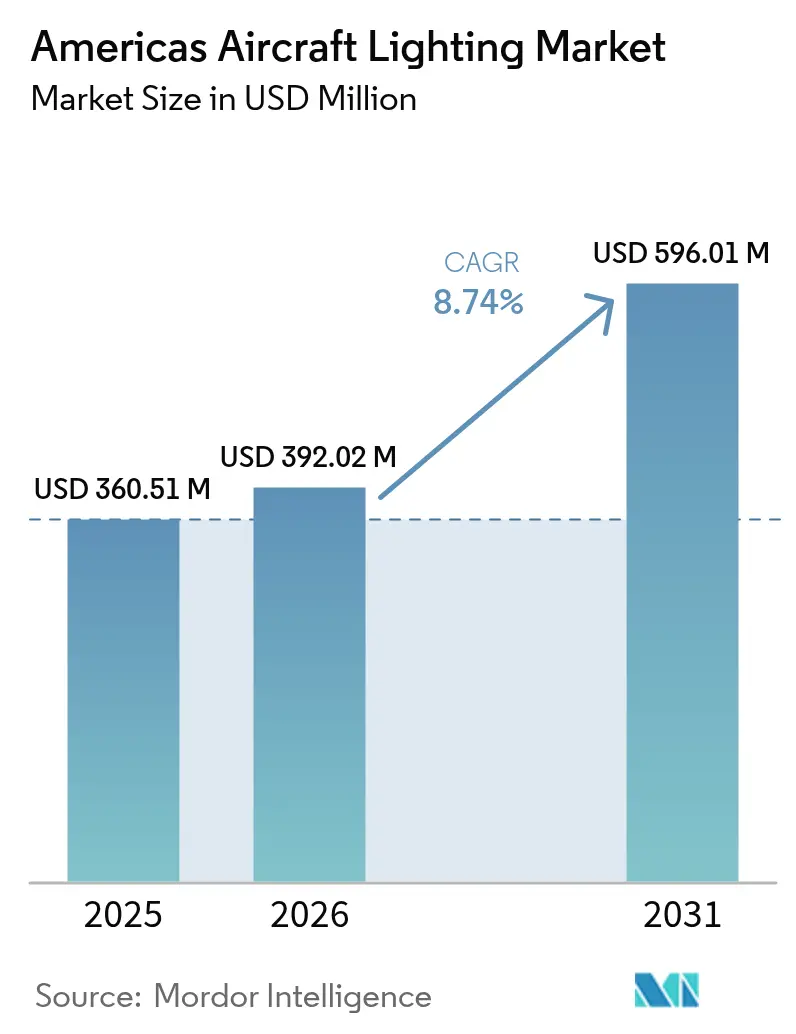
| Base Year Market Size (2025) | USD 360.51 Million |
| Market Size (2026) | USD 392.02 Million |
| Market Size (2031) | USD 596.01 Million |
| Growth Rate (2026 - 2031) | 8.74 % |
| Market Concentration | Medium |
Major Players *Disclaimer: Major Players sorted in no particular order Image © Mordor Intelligence. Reuse requires attribution under CC BY 4.0. | |
Americas Aircraft Lighting Market Analysis by Mordor Intelligence
Americas Aircraft Lighting Market size in 2026 is estimated at USD 392.02 million, growing from 2025 value of USD 360.51 million with 2031 projections showing USD 596.01 million, growing at 8.74% CAGR over 2026-2031.
Market Analysis
Rising fleet-modernization budgets, synchronized mercury-free regulations, and continued passenger-traffic recovery underpin this growth trajectory. Carriers prioritize LED retrofits that reduce power draw by 85% and cut recurring maintenance, while OEM deliveries stimulate linefit demand as Boeing, Airbus, and Embraer clear backlogs. North American dominance in aircraft production couples with Latin American narrowbody expansion, creating a dual-engine dynamic that anchors the Americas aircraft lighting market. Supply-chain pressure for qualified LED drivers and rare-earth phosphors presents near-term turbulence. However, accelerated FAA certification pathways now reduce approval cycles to 6-12 months, enabling quicker monetization of proven lighting platforms.
Key Report Takeaways
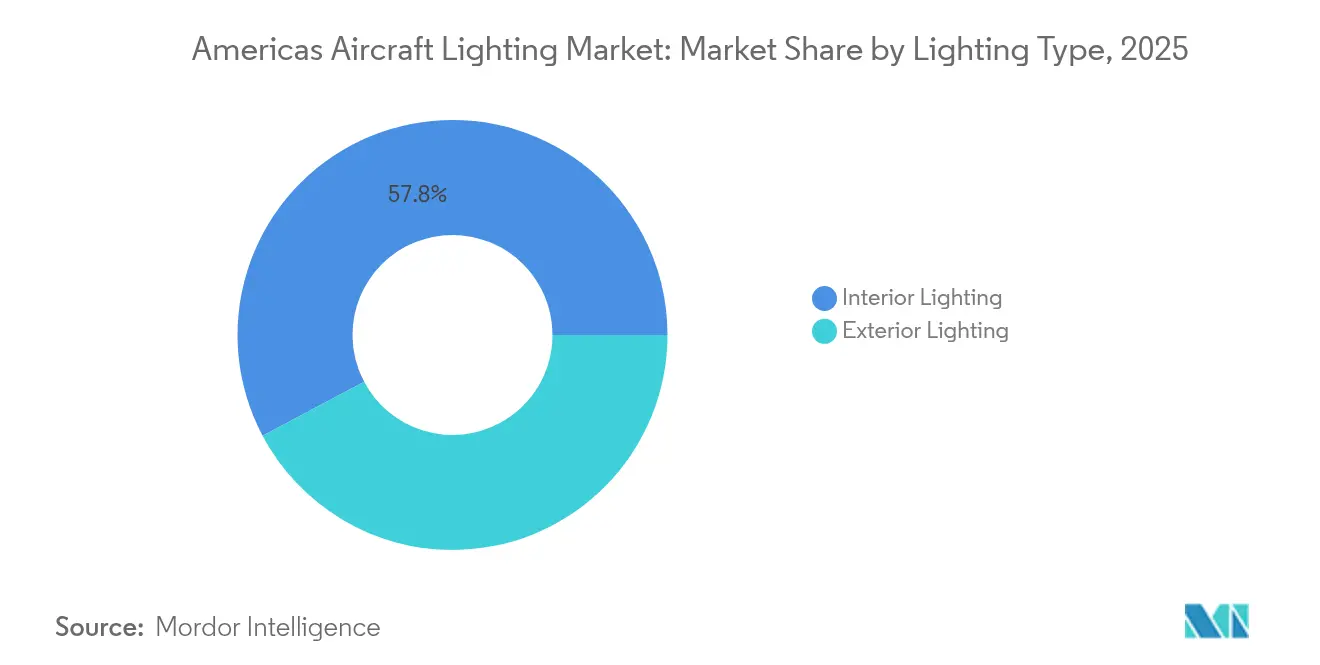
- By lighting type, interior lighting systems captured 57.76% of the Americas aircraft lighting market share in 2025; exterior lighting is projected to expand at a 7.12% CAGR through 2031.
- By aircraft type, narrowbody jets led the Americas aircraft lighting market, with 56.03% of the size in 2025, while business jets show the highest forecast CAGR, at 8.96% to 2031.
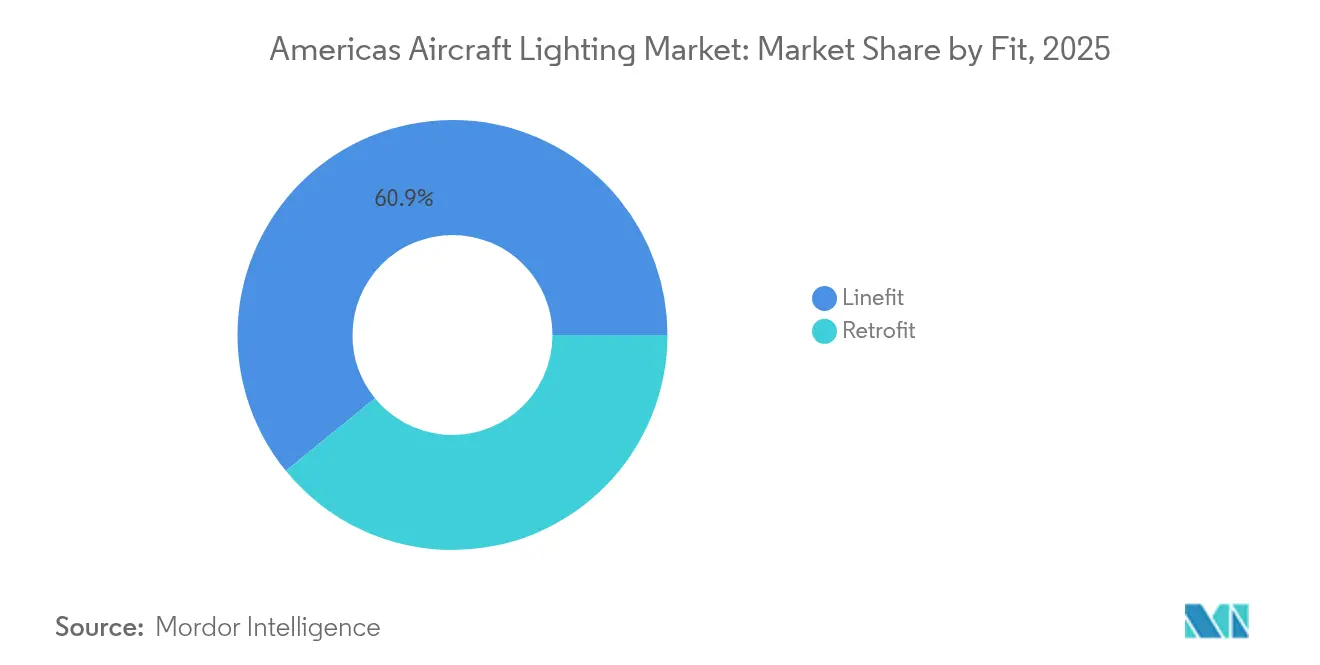
- By fit, linefit installations accounted for 60.88% of revenue in 2025; retrofit solutions advanced fastest, with a 7.26% CAGR through 2031.
- By technology, LED products dominated with 79.75% of America's aircraft lighting market share in 2025 and are growing at a 9.68% CAGR to 2031.
- By geography, the United States held 57.65% of regional revenue in 2025, whereas Brazil registered the fastest forecast CAGR of 8.05% through 2031.
Note: Market size and forecast figures in this report are generated using Mordor Intelligence’s proprietary estimation framework, updated with the latest available data and insights as of 2026.
Market Trends and Insights
Drivers Impact Analysis of Americas Aircraft Lighting Market*
| Driver | (~) % Impact on CAGR Forecast | Geographic Relevance | Impact Timeline |
|---|---|---|---|
| Fleet-wide LED retrofit programs gaining regulatory push | +2.1% | North and Latin America | Medium term (2-4 years) |
| Airlines’ cabin revamp for premium passenger experience | +1.8% | United States and Brazil | Short term (≤ 2 years) |
| Surging narrowbody aircraft orders in Latin America | +1.5% | Mexico and Brazil | Medium term (2-4 years) |
| Airline ESG and sustainability targets accelerating shift to low-power, mercury-free lighting | +1.3% | Canada and United States | Long term (≥ 4 years) |
| Increasing adoption of mood-lighting and circadian systems | +1.0% | North America and premium Latin carriers | Medium term (2-4 years) |
| Integrated cockpit-display backlighting in next-gen avionic suites | +0.8% | OEM centers across region | Long term (≥ 4 years) |
| Source: Mordor Intelligence | |||
Fleet-wide LED retrofit programs gaining regulatory push
Transport Canada’s mercury-free deadline of December 31, 2025, aligns with the European Union’s (EU's) 2024 ban, eliminating route-based loopholes and compelling carriers to accelerate LED conversions.[1] Airlines benefit from 85% lower power draw, translating into measurable fuel savings on long-haul missions. Streamlined FAA TSO-C30c approvals now cut typical certification cycles from 24 months to under 12, allowing compliance programs to conclude before regulatory grace periods expire.[2] Early adopters gain cost leadership and lower carbon footprints, strengthening ESG disclosures that resonate with investors and eco-conscious travelers.
Airlines’ cabin revamp for premium passenger experience
Delta’s 2024 interior refresh leveraged dynamic circadian lighting that modulates color temperature through all flight phases, improving arrival comfort and willingness to pay premium fares.[3] LED architecture enables scene changes via software rather than hardware swaps, supporting high aircraft utilization. Comparable upgrades in business aviation command 15-20% price premiums but yield demonstrable gains in charter rates and net promoter scores. Lighting synchronization with in-flight entertainment elevates ambience, making cabin illumination a revenue-generating amenity rather than a pure cost center. The trend reinforces high-margin demand for configurable LED systems across linefit and retrofit channels.
Surging narrowbody aircraft orders in Latin America
Copa Airlines committed to 6 B737-8 jets and LATAM ordered 10 B787s during 2024, underscoring a regional fleet-renewal cycle that doubles Latin America’s fleet by 2042. Daily utilization exceeding 10 hours accelerates lighting wear, boosting replacement demand. Mexican carriers’ pivot toward Embraer expands supplier opportunities across multiple platforms, while longer aircraft retention in Latin America sustains the aftermarket for LED retrofits. Diversified fleet profiles incentivize lighting vendors with multi-platform certification to penetrate burgeoning OEM lines and refurbishment programs.
Airline ESG and sustainability targets accelerating shift to low-power, mercury-free lighting
Carriers integrate lighting upgrades into net-zero roadmaps because verified LED deployments deliver quantifiable fuel and carbon savings, aligning with mandatory ESG reporting.[4] Procurement teams now require documented conflict-free sourcing of rare-earth materials and closed-loop manufacturing. Airlines marketing eco-friendly branding on eco-tourism routes use mercury-free cabins as proof points. Data-logging luminaires facilitate granular energy reporting, ensuring lighting sits within broader sustainability dashboards that track emissions from flight to ground operations.
Restraints Impact Analysis of Americas Aircraft Lighting Market*
| Restraint | (~) % Impact on CAGR Forecast | Geographic Relevance | Impact Timeline |
|---|---|---|---|
| Supply-chain bottlenecks of qualified LED drivers | -1.2% | Region-wide, OEM heavy | Short term (≤ 2 years) |
| Certification costs and multi-year design-approval cycles | -0.8% | Primarily North America | Medium term (2-4 years) |
| Volatility in raw-material prices (rare-earth phosphors) | -0.7% | Region-wide, strongest where LED supply chains cluster | Medium term (2-4 years) |
| Cabin weight-saving mandates limiting power budgets | -0.6% | United States and Canada aviation regulators | Medium term (2-4 years) |
| Source: Mordor Intelligence | |||
Supply-chain bottlenecks of qualified LED drivers
Wolfspeed’s silicon-carbide production delays magnified a scarcity of aerospace-grade drivers, stretching lead times to 52 weeks and forcing lighting OEMs to redesign around alternate chips. High-power exterior lights demand extreme thermal and EMI tolerances, narrowing the supplier pool. Airlines respond by stockpiling drivers, tying up working capital, and raising total installed costs, especially for regional operators with thinner balance sheets. Although capacity expansions are slated for 2026, intermittent shortages may crimp near-term installation volumes.
Certification costs and multi-year design-approval cycles
FAA and EASA approvals exceed USD 2 million per lighting suite and can span three years, discouraging small entrants and slowing disruptive innovation. With avionics life cycles shortening, a product may be near obsolescence by the time certification clears. Retrofit supplemental type certificates require extensive flight testing, adding further cost. Large tier-1 suppliers absorb these hurdles through diversified portfolios, widening the moat against emerging competitors and keeping pricing power concentrated among incumbents.
*Our forecasts treat driver/restraint impacts as directional, not additive. The impact forecasts reflect baseline growth, mix effects, and variable interactions.
Americas Aircraft Lighting Market Segment Analysis
By Lighting Type:
Interior systems maintain market leadershipInterior solutions provided 57.76% of 2025 revenue for the Americas aircraft lighting market, driven by mandatory exit-path illumination and value-added mood scenes. Airlines use programmable LEDs to align cabin ambience with brand colors and partner advertising, unlocking ancillary revenue and customer-experience gains. Longer refurbishment cycles, averaging 8-12 years, secure a predictable aftermarket stream that cushions OEM fluctuations.
Exterior lighting posts the 7.12% CAGR edge as carriers replace halogen strobes with LEDs that slash maintenance events by 90%. New anti-collision and navigation units meet stringent luminosity rules while consuming one-tenth the power, giving operators immediate payback.

By Aircraft Type:
Narrowbody dominance meets business-jet upsideNarrowbody platforms, the backbone of regional and domestic routes, commanded 56.03% of the Americas aircraft lighting market share in 2025 as high daily cycles accelerate lamp wear. Widebodies gravitate toward multi-zone mood packages to differentiate premium cabins on long-haul corridors, ensuring high content per tail.
Business jets capture a 8.96% CAGR through 2031 as owners specify fully customizable color palettes, fiber-optic accents, and app-controlled scenes. Helicopter operators, from offshore energy to EMS, continue migrating to sealed-beam LEDs that withstand vibration and salt spray.
By Fit:
Linefit reigns, retrofit gains speedLinefit secured 60.88% of 2025 revenue thanks to Boeing, Airbus, and Embraer throughput. Still, retrofit is the growth pacesetter at 7.26% CAGR as carriers seek immediate fuel and maintenance savings without waiting for new deliveries. The STG liTeMood kit illustrates the retrofit promise, trimming 30 kg per B737 and recovering investment inside two years. Additionally, the demand for more fuel-efficient operations continues to drive innovation in retrofit solutions, enabling airlines to stay competitive in a challenging market. As environmental regulations tighten, these upgrades not only improve operational efficiency but also contribute to sustainability efforts within the aviation industry.
By Technology:
LED supremacy deepensLED units carried 79.75% of the Americas aircraft lighting market share in 2025 and will climb further as a 9.68% CAGR eclipses fluorescent holdouts. Honeywell’s LED FACL retrofit cuts power draw by 85% and stretches operating life to 50,000 hours, underscoring LED economics. Smart LED nodes now embed health-monitoring sensors, paving the way for predictive maintenance dashboards that integrate lighting into broader digital twin schemes. As the industry evolves, advancements in LED technology are expected to enhance efficiency and safety further, making air travel more sustainable.
Geography Analysis
United States Aircraft Lighting Market
The US remains the primary demand center, driven by large-scale renewal programs such as American Airlines' 260-unit order and an active general-aviation fleet exceeding 200,000 aircraft. OEM linefit contracts benefit from Boeing's production footprint, while retrofit providers leverage dense MRO clusters that streamline installation logistics. The US further influences certification standards through FAA leadership, giving domestic suppliers early adoption opportunities and export leverage across the Americas aircraft lighting market.
Canada and Brazil Aircraft Lighting Market
Canada's enforceable mercury-free lighting mandate, effective December 2025, accelerates LED penetration and sets a precedent for neighboring markets. Operators leverage transport-development grants to fund retrofits suited for harsh winter operations, driving demand for high-luminance and vibration-resistant assemblies. Bilateral regulatory harmonization with Brazil facilitates South America's technology transfer and supplier localization.
The Americas Aircraft Lighting Market
Brazil and Mexico jointly outpace the regional average, propelled by LATAM's Dreamliner acquisition and Copa's B737-8 deliveries. Domestic manufacturers, notably Embraer, cultivate local supply chains that welcome lighting co-production under offset frameworks, enhancing regional value retention. Argentina, Colombia, and the wider Caribbean sustain steady retrofit demand as tourism rebounds, though macro-economic fluctuations may shift installation timelines. The Americas aircraft lighting market finds geographic growth nodes distributed across North and Latin America, balancing mature replacement cycles with emerging fleet expansions.
Regulatory Landscape
Aircraft lighting installed on transport-category aircraft in the Americas is governed primarily by FAA airworthiness requirements in 14 CFR Part 25, Subpart F, which sets installation, intensity/distribution, and color requirements for systems such as landing, position, and anti-collision lights (including sections 25.1383, 25.1389, and 25.1397). For suppliers, compliance typically follows a two-step path: FAA Technical Standard Order (TSO) authorization establishes minimum performance for the article, while separate aircraft-level approval (via type design approval or retrofit approvals) is required to legally install the lighting system on a specific airframe.
In Canada, Transport Canada oversight is anchored in the Canadian Aviation Regulations (CARs, SOR/96-433) and associated standards, including Standard 625 (Schedule 1) for position and anti-collision light systems and Standard 621 for obstacle marking and lighting requirements. CAR 301.07 also specifies lighting requirements for runways and taxiways used at night, reinforcing demand for compliant exterior lighting products and maintenance practices across Canadian operators and aerodromes.
Value Chain Analysis
The value chain starts with raw materials and electronics inputs (LED emitters, optics, housings, wiring, and especially qualified LED drivers and control electronics), then moves into design and engineering that must satisfy aerospace environmental and EMI requirements (commonly aligned to DO-160 expectations). Tier-1 and established suppliers in the Americas, including Collins Aerospace, Honeywell, and Astronics, typically manage system architecture, qualification testing, and certification workflows. This setup increases the advantage of vertically integrated capabilities and existing regulatory experience.
Downstream, production runs through component/module manufacturing and final assembly and test, then feeds two primary routes: linefit supply to OEM production programs and retrofit/aftermarket supply through MRO networks and distribution partners. Distribution agreements for cabin interior components (including lighting) improve availability and turn time, while field installation depends on aircraft-specific approvals and maintenance sign-offs. A persistent constraint in the market context is extended lead time for aerospace-grade LED drivers (noted up to 52 weeks), which drives redesign activity, inventory buffering, and tighter collaboration between lighting OEMs and specialized sub-tier electronics suppliers.
Competitive Landscape
Competitive Landscape
Tier-1 suppliers Collins Aerospace, Honeywell, and Safran dominate through vertically integrated portfolios covering interior, exterior, and cockpit lighting. Their regulatory rapport and certification resources discourage smaller entrants, especially given multi-million-dollar approval costs. Honeywell’s 2025 AI-driven avionics collaboration with NXP embeds advanced back-lighting, locking future wins across numerous flight-deck programs.
Safran’s USD 1.8 billion acquisition of Collins’ actuation unit in July 2025 expands systems integration leverage, allowing bundled lighting, flight controls, and power distribution bids that appeal to OEM cost-reduction mandates. Diehl Aviation champions accessibility-oriented lighting, winning awards for Space³ concepts that guide visually impaired passengers through illuminated pathways, indicating niche differentiation potential.
Disruptive threats come from specialized LED chipmakers targeting aerospace with automotive-grade economies of scale. Yet, stringent DO-160 environmental testing and protracted FAA oversight limit immediate penetration. Smart-lighting incumbents continue investing in sensor fusion and data analytics, embedding proprietary protocols that lock customers into long-term service contracts and solidify competitive moats within the Americas aircraft lighting market.
Americas Aircraft Lighting Industry Leaders
-
Honeywell International Inc.
-
Astronics Corporation
-
Collins Aerospace (RTX Corporation)
-
Safran SA
-
Diehl Stiftung & Co. KG
- *Disclaimer: Major Players sorted in no particular order

Americas Aircraft Lighting Market Companies Covered in this Report
- ACR Electronics, Inc.
- AeroLEDs LLC (Whelen Engineering, Inc.)
- Astronics Corporation
- Aveo Engineering Group, s.r.o.
- Bruce Aerospace Inc.
- Collins Aerospace (RTX Corporation)
- Diehl Stiftung & Co. KG
- Heads Up Technologies, Inc.
- Honeywell International Inc.
- Luminator Technology Group
- Oxley Group
- Precise Flight, Inc.
- Safran SA
- S.E.L.A. Lighting Systems
- Soderberg Manufacturing Company, Inc.
- Aircraft Spruce ® (Irwin International Inc.)
- AvioLights
Market Opportunities and Future Outlook
Mercury-free compliance and more harmonized operating requirements across North America are expanding the addressable retrofit scope for LED conversion programs, especially where operators prioritize near-term fuel and maintenance benefits from reduced power draw and longer life. Transport Canada enforcement timing (as reflected in the market context pointing to a December 2025 deadline) and FAA certification pathways (including the TSO framework plus aircraft-level installation approvals) establish a clearer compliance runway for suppliers that can deliver certified kits, documentation, and MRO-ready installation packages across multiple airframes.
White space is most visible where airlines and business aviation operators move beyond basic replacements into configurable cabin lighting, including circadian and mood systems integrated with cabin management and software controls. The report context points to Delta cabin refresh activity in 2024 and ongoing premiumization efforts, which supports demand for programmable interior systems with higher content per aircraft. On the exterior side, updated design criteria and standards activity (for example SAE ARP693F-2025 for landing and taxiing lights and ASTM F3234/F3234M-21R25 for small-aircraft exterior lighting) creates opportunities for suppliers that can standardize product families across platforms while managing certification costs and component constraints, including LED driver availability.
Recent Industry Developments in Americas Aircraft Lighting Market
- January 2026: Honeywell announced its LED Landing Search Light was selected by Bell Textron Inc. for the US Army MV-75 Future Long-Range Assault Aircraft (FLRAA). The selection reinforces the shift toward LED-based exterior lighting on new military rotorcraft and anchors linefit volume potential tied to a major next-generation platform.
- April 2025: Satair and RTX's Collins Aerospace extended their long-running relationship with a four-year distribution agreement extension covering cabin interior components, including Goodrich lighting solutions. The renewal strengthens parts availability and logistics for operators and MROs, supporting faster retrofit and spares fulfillment across the Americas.
- November 2024: Astronics highlighted its involvement on Boeing's MQ-25 program through awarded contracts that include custom-engineered exterior lighting support. The work underscores demand for specialized, program-specific lighting on unmanned platforms and broadens defense-driven pull-through for qualified exterior lighting designs.
Americas Aircraft Lighting Market Report Scope and Research Methodology
Market Definition and Coverage
For this study, the market covers the revenue generated from aircraft lighting systems sold for use on aircraft operated or built across the Americas, including interior and exterior lighting used for safety, visibility, and cabin functions.
Scope exclusions: We exclude non-aircraft lighting used in airports, ground vehicles, and general industrial or architectural lighting that is not installed on an aircraft.
Segments Covered in This Report
- By Lighting Type
- Interior Lighting
- Cabin Lighting
- Cockpit Lighting
- Emergency and Exit Lighting
- Cargo/Baggage Lighting
- Exterior Lighting
- Navigation and Position Lights
- Landing and Taxi Lights
- Anti-Collision and Strobe Lights
- Logo and Wing Inspection Lights
- Interior Lighting
- By Aircraft Type
- Narrowbody Aircraft
- Widebody Aircraft
- Regional Jets
- Business Jets
- Helicopters
- Unmanned Aerial Vehicles (UAVs)
- By Fit
- Linefit
- Retrofit
- By Technology
- Light-Emitting Diode (LED)
- Fluorescent
- Incandescent/Halogen
- By Geography
- United States
- Canada
- Mexico
- Brazil
- Argentina
- Rest of Americas
Data Sources, Market Sizing, and Validation
Desk Research
Desk research was used to set the base demand picture and keep assumptions realistic before numbers were modeled. We reviewed public aviation fleet and delivery indicators, retrofit and MRO activity signals, and safety-related lighting requirements that influence replacement cycles.
Sources used include public materials such as FAA and Transport Canada publications, ICAO and IATA aviation statistics, US Bureau of Transportation Statistics data, and trade data series from sources such as UN Comtrade. We also referenced company filings, investor presentations, technical product documentation, and credible aerospace press coverage. Where helpful, paid subscriptions were used for company financials and for patent database checks to understand technology shifts like LED upgrades. These desk sources are not exhaustive, and we used additional references to collect, cross-check, and clarify inputs.
Primary Interviews and Surveys
Primary work focused on validating what portion of lighting demand is tied to linefit versus retrofit, and how pricing changes when technology shifts and certification needs change. We spoke with a mix of aircraft program stakeholders, airline and MRO participants, and component-level specialists across the Americas so any gaps from desk inputs could be addressed, and assumptions could be confirmed with on-the-ground views.
Distribution of primary research fieldwork respondents
| Company type | Respondent position |
|---|---|
| Top tier: 39% | CXOs: 19% |
| Mid tier: 42% | Functional/Unit leaders: 33% |
| Smaller Players: 19% | Managers: 48% |
Market-Sizing & Forecasting
Sizing starts with a top-down demand reconstruction, where aircraft deliveries, active fleet size, and expected retrofit intensity are translated into lighting unit demand and value for the Americas. The totals are then checked using selective bottom-up approximations, such as sampled price points by lighting category and channel checks on typical replacement volumes, and the model is adjusted when the two views drift.
Inputs used in the model include aircraft production and delivery schedules, in-service fleet mix by aircraft type, retrofit adoption of LED systems, MRO visit frequency that triggers replacements, and typical price progression by interior versus exterior lighting. When market pockets are hard to observe directly, assumptions are bridged using aircraft utilization proxies and documented replacement intervals, then refined through expert feedback.
For forecasting, scenario analysis was used because demand can swing with delivery delays, airline capacity decisions, and defense procurement timing. The base case follows the most consistent expert view of fleet growth and retrofit rates, and upside or downside cases are applied when key variables shift together.
Data Validation & Update Cycle
Outputs are validated through triangulation across independent checks, including fleet and delivery signals, MRO activity cues, and implied spend per aircraft over time. Variance checks are run on growth rates, pricing jumps, and year-to-year step changes, and then outliers are reviewed in a second analyst pass before sign-off.
The report is refreshed annually, and interim updates are triggered when material events occur, such as a major aircraft program rate change or a new compliance-driven retrofit wave. Before delivery, a fresh review is completed so the final numbers reflect the latest available inputs.
Mordor Intelligence's Americas Aircraft Lighting Market Size Compared Against Other Published Estimates
Published market sizes for aircraft lighting in the Americas can differ because the boundary of what is counted is not always consistent, and the timing of the base year can shift the total in a fast-moving retrofit cycle. Differences also show up when one estimate focuses mainly on a single aircraft category, while another bundles broader aerospace lighting spend.
By tracking linefit deliveries, retrofit-driven replacement cycles, and technology mix shifts, Mordor Intelligence is able to keep the Americas aircraft lighting total anchored to aircraft-installed lighting demand rather than adjacent lighting categories.
Benchmark comparison
| Source | Market Size | Gaps in Research Methodology |
|---|---|---|
| Mordor Intelligence | USD 360.51 M (2025) | |
| Industry Publisher A | USD 4.68 B (2022) | The scope appears much broader than aircraft-installed lighting for the full Americas, since it is stated as North America only and may bundle wider aircraft electrical or lighting-related spend across military and commercial platforms, which inflates totals versus a tighter aircraft lighting system boundary. |
| Industry Publisher B | USD 0.90 B (2024) | This value is presented for the global aircraft lighting market, so it is not directly comparable to an Americas-only total. It can also differ if OE versus aftermarket mix assumptions and interior versus exterior price weighting are applied at a global average rather than region-specific retrofit patterns. |
The table shows that the spread is mainly explained by geography and what gets included under the lighting definition, rather than a simple math difference. When scope is kept to aircraft-installed lighting systems within the Americas and the timing of fleet and retrofit drivers is aligned to the stated base year, the estimate becomes easier to trace back to clear demand variables and repeatable steps.
Key Questions Answered in the Report
What is the projected value of the Americas aircraft lighting market by 2031?
The Americas aircraft lighting market is forecasted to reach USD 596.01 million by 2031, expanding at a 8.74% CAGR.
Which technology dominates sales?
LED solutions held 79.75% market share in 2025 and continue expanding due to efficiency and regulatory incentives.
Why are retrofit programs accelerating?
Mercury-free mandates effective in 2025 and compressed FAA approvals make LED conversions both mandatory and cost-effective.
Which countries show the fastest growth rates?
Brazil shows the highest CAGR at 8.05% through 2031 on large narrowbody orders and domestic manufacturing support.
What is the biggest supply-chain challenge?
Shortages of aerospace-grade LED drivers, driven by limited silicon-carbide capacity, extend delivery timelines.
How does lighting support airline ESG goals?
LEDs cut power draw up to 85%, lowering fuel burn and carbon emissions while eliminating hazardous mercury content.