
Ambient Assisted Living Market Size and Share
Market Overview
| Study Period | 2021 - 2031 |
|---|---|
| Market Size (2026) | USD 13.48 Billion |
| Market Size (2031) | USD 35.84 Billion |
| Growth Rate (2026 - 2031) | 21.60 % |
| Fastest Growing Market | Asia-Pacific |
| Largest Market | Europe |
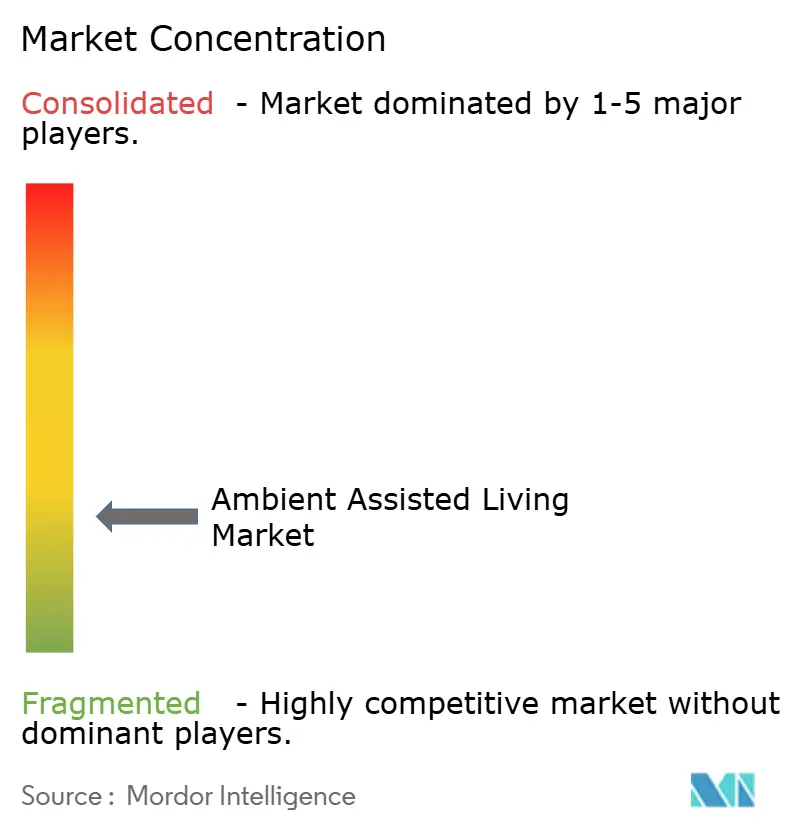
| Market Concentration | Low |
Major Players *Disclaimer: Major Players sorted in no particular order Image © Mordor Intelligence. Reuse requires attribution under CC BY 4.0. | |
Ambient Assisted Living Market Analysis by Mordor Intelligence
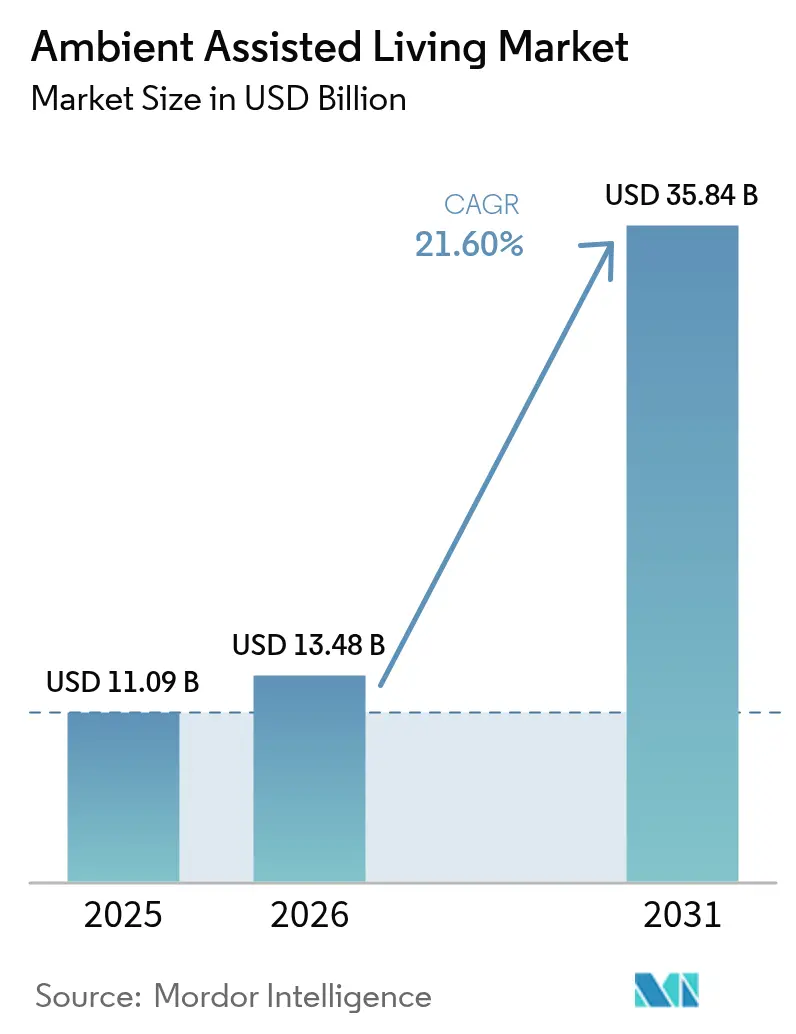
The Ambient Assisted Living market size was valued at USD 11.09 billion in 2025 and estimated to grow from USD 13.48 billion in 2026 to reach USD 35.84 billion by 2031, at a CAGR of 21.6% during the forecast period (2026-2031). Growth reflects the collision of demographic aging, supportive reimbursement reforms, and the steady commercialization of AI-driven home health technologies. Policy makers now view technology-enabled aging in place as critical national infrastructure, while payers recognize that proactive digital monitoring curbs hospital readmissions and long-term care costs. As sensor costs fall and edge computing matures, vendors are integrating predictive analytics, robotics, and voice assistants into unified platforms that extend independent living and alleviate caregiver shortages. Incumbents and start-ups alike are scaling partnerships to bundle hardware, software, and managed services for both residential and institutional buyers, positioning the Ambient Assisted Living market for sustained double-digit expansion through the decade.
Key Report Takeaways
- By component, hardware led with 51.35% revenue share in 2025; services are projected to grow at a 23.9% CAGR to 2031.
- By technology, smart-home automation commanded 47.85% of the Ambient Assisted Living market share in 2025, while social and companion robotics are forecast to expand at 22.85% CAGR.
- By system function, safety and security accounted for a 29.75% share of the Ambient Assisted Living market size in 2025; vitality and wellness is advancing at 22.75% CAGR through 2031.
- By deployment model, stand-alone residential units held 45.25% of 2025 revenue, whereas senior-care homes will post the fastest 23.5% CAGR.
- By age group, adults aged 70-79 represented 44.20% of 2025 revenue; the 80+ cohort is slated for 22.7% CAGR.
- By geography, Europe led with 33.65% revenue share in 2025, but Asia-Pacific will deliver the highest 23.1% CAGR to 2031.
Note: Market size and forecast figures in this report are generated using Mordor Intelligence’s proprietary estimation framework, updated with the latest available data and insights as of 2026.
Market Trends and Insights
Drivers Impact Analysis of Ambient Assisted Living Market*
| Driver | (~) % Impact on CAGR Forecast | Geographic Relevance | Impact Timeline |
|---|---|---|---|
| Rapid policy shifts toward ageing-in-place reimbursement models in OECD economies | +4.20% | North America and Europe | Medium term (2-4 years) |
| Surge in smart-home penetration among 65+ households in North America and Europe | +3.80% | North America and Europe | Short term (≤ 2 years) |
| AI-driven predictive analytics lowering false-alarm rates in emergency response | +3.50% | Global | Medium term (2-4 years) |
| 5G / fibre roll-outs enabling low-latency remote care services across Asia | +3.10% | Asia-Pacific | Long term (≥ 4 years) |
| EU Horizon Europe and AAL-Programme grants accelerating start-up adoption | +2.90% | Europe | Short term (≤ 2 years) |
| Declining costs of edge sensors and wearables | +2.70% | Global | Short term (≤ 2 years) |
| Source: Mordor Intelligence | |||
Rapid Policy Shifts Toward Aging-in-Place Reimbursement Models
Medicare Advantage began covering non-medical home supports in 2024, converting formerly out-of-pocket services into reimbursable benefits that directly fund Ambient Assisted Living solutions [1]. Similar parity is emerging in Medicaid Home and Community-Based Services, allowing payers to substitute costly institutional beds with sensor-enhanced home care. Across OECD economies, long-term care budgets are projected to rise sharply by 2050, reinforcing legislative momentum to subsidize proactive digital monitoring. These reforms reposition Ambient Assisted Living technologies from discretionary purchases to reimbursable care, enlarging the total addressable market and lowering adoption friction for health-system buyers.
Surge in Smart-Home Penetration Among 65+ Households
Older adults accelerated smart-device adoption during the pandemic, and by 2024 smartphone usage exceeded 80% among 55- to 65-year-olds in multiple high-income countries. Voice interfaces, ambient sensors, and connected appliances now integrate easily into the domestic environment, allowing providers to bundle fall detection, medication reminders, and social-engagement tools in one installation. Pilot programs funded through EU initiatives such as PHArA-ON demonstrated that passive ambient sensors achieved higher acceptance than wearables among frail seniors, supporting hardware strategies that minimize lifestyle disruption while collecting richer datasets for clinicians.
AI-Driven Predictive Analytics Lowering False-Alarm Rates
Machine-learning models trained on multimodal sensor streams detect health deterioration up to two weeks in advance and achieve over 96% accuracy in anomaly recognition [2]. This improvement mitigates the “alarm fatigue” that once plagued tele-care and encourages payers to reimburse continuous monitoring. Vendors embedding edge AI chips reduce latency to sub-second response times, enabling closed-loop safety interventions such as automatic lighting and caregiver call-outs. Hospitals piloting these platforms report measurable declines in emergency admissions and overnight observation costs, adding ROI evidence that further fuels Ambient Assisted Living market adoption.
5G / Fibre Roll-outs Enabling Low-Latency Remote Care Services Across Asia
Asia-Pacific governments are fast-tracking 5G coverage to extend telehealth to urban and rural populations. Japan’s National Broadband Plan and China’s smart-senior-care guidelines fund high-bandwidth networks capable of supporting 4K video and real-time vital-sign streaming. Pilot deployments across South Korea’s multiresident facilities show reliable sub-20-millisecond latency, allowing clinicians to supervise rehabilitation exercises remotely and invoke robotics for bedside assistance. As connectivity barriers fade, the Ambient Assisted Living market expands from simple home alarms to sophisticated mixed-reality physical-therapy and social-robotics programs.
Restraints Impact Analysis of Ambient Assisted Living Market*
| Restraint | (~) % Impact on CAGR Forecast | Geographic Relevance | Impact Timeline |
|---|---|---|---|
| Fragmented interoperability standards hindering unified caregiver dashboards | -2.80% | Global | Medium term (2-4 years) |
| Privacy and data-sovereignty rules (GDPR, HIPAA) limiting cross-border monitoring | -2.10% | Global, particularly EU and US | Long term (≥ 4 years) |
| Low digital literacy among 75+ cohort in rural regions | -1.90% | Global, particularly rural areas | Medium term (2-4 years) |
| Reimbursement gaps for non-clinical AAL services in emerging markets | -1.60% | Emerging markets | Long term (≥ 4 years) |
| Source: Mordor Intelligence | |||
Fragmented Interoperability Standards Hindering Unified Caregiver Dashboards
Residential and institutional buyers still juggle multiple proprietary portals because device makers interpret health-data templates differently. Despite progress in initiatives such as the United States Core Data for Interoperability and Europe’s EEHRxF, implementation remains uneven [3]. Integration costs suppress volume deployments, particularly in small home-care agencies that lack IT budgets. The absence of plug-and-play semantics delays cross-vendor analytics, limits predictive-model accuracy, and forces procurement teams to lock in single-brand ecosystems, creating switching frictions that mute near-term market acceleration.
Privacy and Data-Sovereignty Rules Limiting Cross-Border Monitoring
GDPR classifies ambient sensor data as health information, triggering strict transfer constraints that complicate cloud architectures. HIPAA introduces additional encryption and audit requirements that lift compliance spend for multinational providers. These overlapping mandates discourage global tele-care roll-outs and compel vendors to maintain region-specific data centers, capping economies of scale. While regulatory clarity is improving, risk-averse hospital systems often delay purchase decisions until legal frameworks mature, shaving incremental points from the global Ambient Assisted Living market CAGR.
*Our forecasts treat driver/restraint impacts as directional, not additive. The impact forecasts reflect baseline growth, mix effects, and variable interactions.
Ambient Assisted Living Market Segment Analysis
By Component:
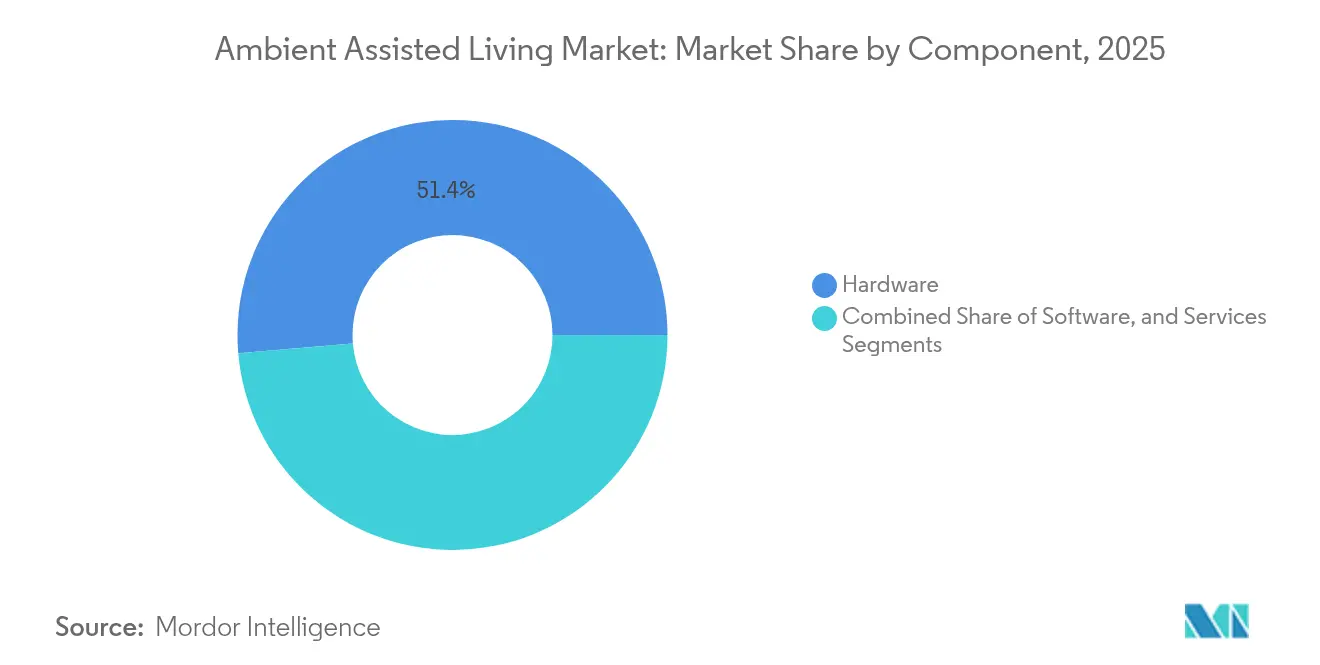
Hardware Dominance Meets Service InnovationHardware captured a 51.35% revenue share in 2025, underpinned by volume shipments of passive infrared sensors, door contacts, and wearables that anchor most installations. Unit prices dropped below USD 10 for basic motion sensors in 2025, widening access for mid-income households. Demand is shifting from single-function devices to multi-sensor modules that integrate environmental, biometric, and location data feeds. Vendors benefit from silicon advances that squeeze AI inference engines onto battery-powered tags, prolonging field life and trimming maintenance.
Services are scaling faster, projected at 23.9% CAGR to 2031 as providers monetize managed monitoring, AI-based alert triage, and 24/7 virtual call centers. Payers favor subscription bundles that combine hardware amortization, software licenses, and professional response teams under one capitated fee. The Ambient Assisted Living market size for service offerings is set to more than triple within five years, creating acquisition targets for telecom operators seeking recurring revenue diversification. Software layers add stickiness; platforms offering open APIs and remote firmware management reduce truck rolls and improve gross margins.

By Technology:
Smart Homes Lead, Robotics AccelerateSmart-home automation retained 47.85% revenue in 2025 by piggybacking on mature consumer ecosystems such as Zigbee, Z-Wave, and Wi-Fi. Voice assistants now integrate medication reminders, lighting cues, and caregiver check-ins without custom wiring, cutting installation times by 30%. Interoperability with mainstream devices positions vendors to upsell health services alongside entertainment subscriptions, broadening household reach.
Social and companion robotics, forecast to grow 22.85% CAGR, is transitioning from pilot novelty to scalable product line as natural-language processing and haptic feedback humanize interactions. Japan’s government injected more than USD 300 million into care-robot RandD programs, enabling rapid commercialization and export of turnkey robotic aides. Modular designs facilitate cost-effective customization for cultural context, and case studies report statistically significant reductions in loneliness metrics among isolated seniors. Vendors integrating robotics with telehealth portals enable seamless continuity of care, raising switching barriers and fueling the next leg of Ambient Assisted Living market expansion.
By System Function:
Safety Foundation Enables Wellness InnovationSafety and security applications accounted for 29.75% of 2025 revenue, reflecting universal demand for fall detection, door egress alerts, and emergency call buttons. Hospitals discharge planners increasingly prescribe home-monitoring kits at the point of exit to cut readmissions, bolstering volume growth. Legal mandates in several EU states require alarm systems in care homes, cementing baseline demand.
Vitality and wellness solutions are scaling at a 22.75% CAGR, propelled by AI models that flag declining mobility, dehydration, or cognitive impairment before acute events occur. Insurers pilot premium discounts tied to adherence metrics captured by ambient sensors, creating behavioral nudges with immediate economic incentives. The Ambient Assisted Living market size for wellness tools is expanding rapidly as evidence mounts that continuous behavioral coaching reduces long-term expenditure on chronic-disease management. Bundling safety and wellness under one dashboard accelerates cross-sell penetration and underpins long-run platform stickiness.
By Deployment Model:
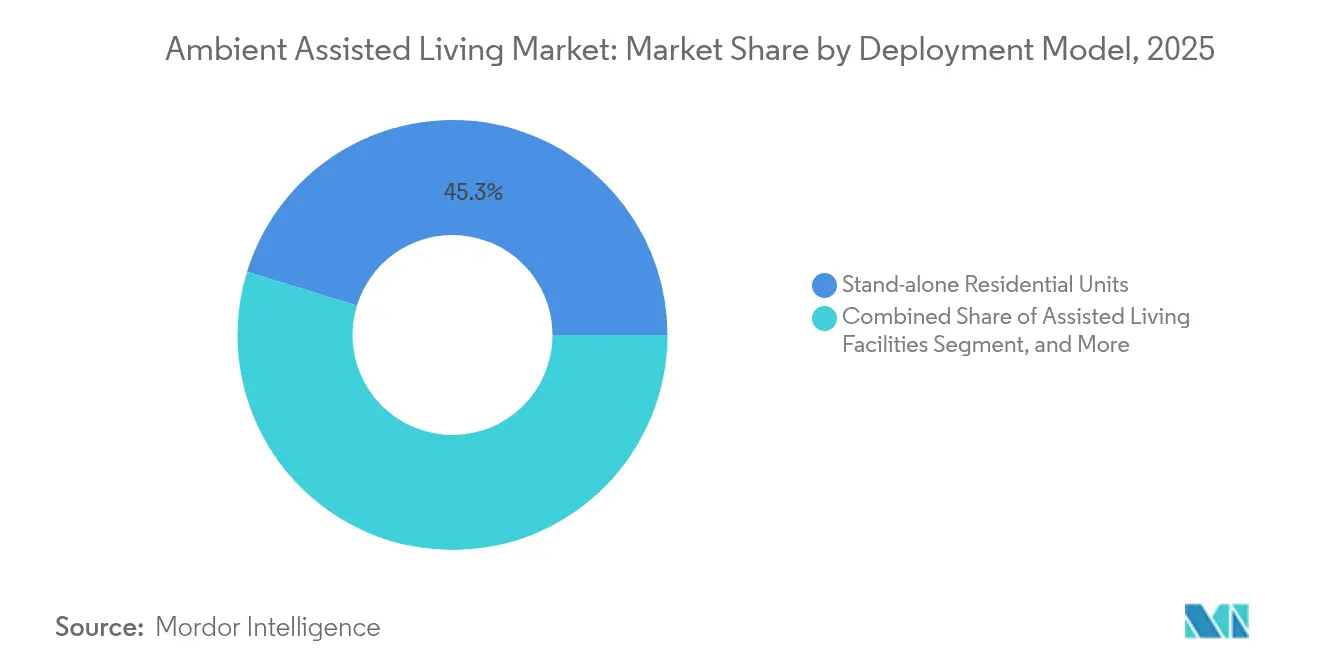
Residential Independence Drives Institutional InnovationStand-alone residential models retained 45.25% revenue share in 2025 as policy trends and family preferences converge on aging in place. Telecom operators bundle LTE routers, cloud storage, and emergency call services on single bills, lowering adoption friction for mass-market consumers. Integration with consumer voice assistants further simplifies on-boarding and broadens demographic reach.
Senior-care homes are poised for a 23.5% CAGR, leveraging Ambient Assisted Living platforms to stretch lean staffing budgets and comply with stricter safety regulations. Operators deploy room-level location analytics to predict wandering events and dynamically allocate personnel, delivering measurable productivity savings. Proof-of-concept studies document 25% fewer night-time falls and shortened emergency-response windows, strengthening ROI narratives driving procurement. Hospitals and rehabilitation clinics extend AAL systems to monitor post-acute patients at home, creating hybrid care pathways that blur institutional and residential boundaries, and deepening market opportunity.
By Age Group:
70–79 Dominance Shifts Toward 80+ GrowthAdults aged 70–79 secured 44.20% of 2025 spend, reflecting their blend of technology familiarity and rising health-support needs. This cohort adopts mobile apps and wearables readily, empowering vendors to deliver smartphone-centered subscription models. Market surveys reveal higher willingness to share health data within this age band, accelerating data-driven product refinement cycles.
The 80+ segment, predicted to grow 22.7% CAGR, brings more acute care needs and lower tech affinity, encouraging focus on passive sensing and voice navigation. Robotics that provide physical object retrieval and conversational engagement resonate strongly with this group, reducing caregiver burden. As global life expectancy edges upward and fertility rates fall, the 80+ population will increase by more than 50% before 2030, prompting payers to prioritize preventive home monitoring. Providers designing frictionless interfaces and battery-free sensor grids will gain outsized share in this emergent growth pocket of the Ambient Assisted Living market.
Geography Analysis
Europe Ambient Assisted Living Market
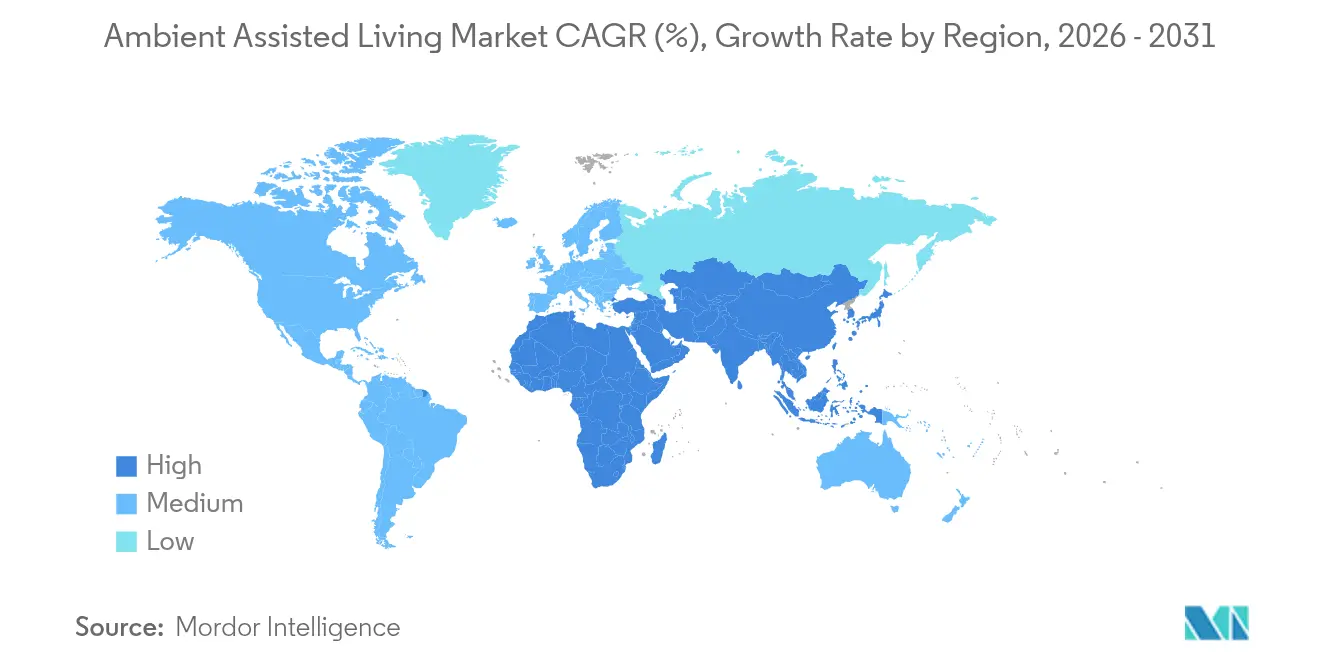
Europe commanded 33.65% revenue in 2025, supported by Horizon Europe grants that subsidize pilot deployments and build a pipeline of procurement-ready case studies ec.europa.eu. Mandatory emergency-response regulations in Nordic and DACH markets created predictable demand baselines, while GDPR compliance frameworks cultivated user trust. National health systems are increasingly integrating AAL alerts into electronic health records, smoothing clinician workflows and bolstering medical-device-class certification pathways. Vendors partnering with home-care agencies benefit from publicly funded reimbursement schemes that guarantee payment, anchoring recurring revenue streams.
APAC Ambient Assisted Living Market
Asia-Pacific will generate the fastest 23.1% CAGR as governments confront unprecedented aging curves. Japan’s robotics subsidies, China’s smart-senior-care national plan, and South Korea’s 5G-linked chronic-disease monitoring pilots illustrate policy-led market making. Urban density aids installation economics; sensor distribution costs fall when networks can service hundreds of apartments per vertical tower. However, rural digital divide persists, prompting satellite connectivity trials to ensure equitable access. Regional players collaborating with telecom carriers accelerate rollout by embedding AAL-ready firmware on consumer routers, shrinking time-to-market and fueling Ambient Assisted Living market acceleration across the region.
North America Ambient Assisted Living Market
North America maintains a large installed base, propelled by Medicare Advantage reimbursement and private insurer incentives. Hospital systems adopt predictive analytics to trim costly readmissions and meet value-based care targets. Venture funding remains vigorous, with AI-centric start-ups attracting rounds above USD 30 million that finance productization and geographic scaling. The United States is also a leading exporter of software middleware, licensing data-integration stacks to European and Asian device makers. Canada’s single-payer system conducts province-level procurement pilots, and lessons learned are forming national interoperability blueprints that could unlock broader adoption by 2027.
Regulatory Landscape
Ambient Assisted Living (AAL) solutions sit at the intersection of medical-device, cybersecurity, and AI governance regimes, and Europe continues to shape many of the requirements vendors plan around. In August 2024, the EU Artificial Intelligence Act entered into force, introducing mandatory risk management, data governance, and conformity assessment expectations for AI systems used in healthcare and AAL contexts, while GDPR continues to treat many ambient-sensor outputs as sensitive health data that tightens cross-border monitoring architectures.
Standardization is also moving quickly and increasingly used to de-risk procurement and conformity planning. IEC published updated 2024 guidance relevant to AAL architecture and interoperability, including IEC 63240-1:2024 (reference architecture), IEC SRD 63426:2024 (connected home interoperability), and IEC SRD 63473:2024 (use case standards inventory). In 2025, China implemented GB/Z 164-2025 guidelines for home healthcare products in ageing societies. In 2026, ISO/IEC publications such as ISO/TS 25558:2026 (enhancing safety in ageing societies) and ISO 25553-1:2026 (smart multigenerational neighborhoods) extend shared language for safety, usability, and deployment frameworks across regions.
Value Chain Analysis
The AAL value chain spans multi-vendor hardware (ambient sensors, wearables, gateways, and in-home hubs), software layers (device management, analytics, security, and care workflows), and downstream service delivery (installation, managed monitoring, and emergency response). Most platform decisions center on edge versus cloud processing, where latency, energy efficiency, and privacy constraints determine which functions run locally (alerting, basic anomaly detection) versus centrally (population analytics, model training).
Interoperability and semantic alignment remain key bottlenecks that add integration cost for providers operating mixed device fleets. The 2024 publication of IEC 63240-1:2024 and related IEC SRD documents (including IEC SRD 63426:2024 and IEC SRD 63473:2024) gives vendors and integrators reference architectures and use-case mappings that support more repeatable, standards-led deployments. On the data layer, vendors are using clinical vocabularies such as SNOMED CT and ontology-driven middleware to improve context-aware responses and reduce dashboard fragmentation, but rollout scale and documentation complexity continue to limit broader adoption.
Competitive Landscape
The Ambient Assisted Living market is fragmented; the top five players hold roughly 28% of global revenue. Philips leverages its health-system relationships to bundle connected lighting, sleep diagnostics, and emergency-response subscriptions, while Tunstall focuses on tele-care software embedded into national call-center frameworks. Legrand exploits channel synergies with its electrical-wiring portfolio to position resident-room infrastructure.
Strategic partnerships are the dominant scaling tactic. ASSA ABLOY’s acquisition of 9Solutions added AI-based real-time location services, strengthening its lock-hardware business with predictive safety features. Finland’s Cozify partnered with Vivago to integrate smart-home gateways with medical alarm wearables, delivering a single-invoice solution that resonates with municipal home-care agencies. Start-ups differentiate through edge analytics; Sensi.AI’s Series B funding will finance expansion into the US rehab-chain segment, where its audio-pattern recognition promises early detection of sepsis and urinary-tract infections.
Intellectual-property filings center on low-power radar sensing, emotion-recognition algorithms, and privacy-preserving federated learning. Patent race intensity is highest in Japan and the United States, where public research institutes co-innovate with mid-cap robotics firms. Vendor success increasingly depends on ecosystem orchestration rather than component innovation: platforms that aggregate third-party apps, expose open APIs, and support insurer billing codes accumulate network effects that raise migration costs for institutional buyers. Early-stage disruptors targeting rural and middle-income regions with low-bandwidth adaptive architectures may yet capture under-served markets and upend incumbent share.
Ambient Assisted Living Industry Leaders
-
Koninklijke Philips N.V.
-
Tunstall Healthcare Group
-
Legrand SA
-
Bosch Security & Safety Systems
-
Honeywell International Inc.
- *Disclaimer: Major Players sorted in no particular order
Ambient Assisted Living Market Companies Covered in this Report
- Koninklijke Philips N.V.
- Tunstall Healthcare Group
- Legrand SA
- Honeywell International Inc.
- Bosch Security & Safety Systems GmbH
- Johnson Controls International plc
- CareTech AB
- Doro AB
- Sensara BV
- Alcove Ltd
- 2PCS Solutions GmbH
- Cogvis Software and Consulting GmbH
- Cerner Corporation
- Televic Group NV
- Assisted Living Technologies Inc.
- GrandCare Systems
- Medical Guardian LLC
- GetSafe Home Security
- Huawei Technologies Co. Ltd.
- Panasonic Corporation
- Resideo Technologies Inc.
- LifeStation Inc.
Market Opportunities and Future Outlook
Privacy-preserving monitoring stands out as a primary whitespace as AAL expands beyond emergency alerting into continuous in-home assessment, where camera-based approaches can face buyer resistance. Non-camera modalities such as radar, sound, and motion sensing support fall risk, bed exit, and activity pattern monitoring, while better fitting privacy-by-design requirements that buyers increasingly request under regimes such as the EU AI Act and broader security-by-design expectations for connected products.
Industry activity in 2026 illustrates this direction. Comfort Keepers announced adoption of Vantiva HomeSight and launched its Comfort360 SafeGuard offering (powered by Pontosense), and Iveda launched Sleep Sense for IvedaCare to add contactless overnight monitoring capabilities for senior living environments. Interoperability-led deployments are another practical opportunity, especially when care spans health systems, housing providers, and social care agencies. IEC reference standards published in 2024 (IEC 63240-1:2024, IEC SRD 63426:2024, IEC SRD 63473:2024) and newer 2026 IoT-for-home-healthcare guidance (ISO/IEC TR 30123:2026) provide scaffolding for procurement specifications and multi-vendor integration roadmaps, helping reduce lock-in and integration risk. Data-sovereignty constraints also open space for architectures aligned with regional trust frameworks, with approaches such as GAIA-X referenced for smart living and AAL data sharing models that keep sensitive monitoring data governed within local ecosystems while still supporting cross-organization care coordination.
Recent Industry Developments in Ambient Assisted Living Market
- July 2026: Tunstall Healthcare Group launched an industry-first partnership programme designed to connect organizations across health, housing, and social care for more integrated, technology-enabled care delivery. The initiative formalizes how telecare vendors collaborate with service providers and commissioners, reinforcing platform-centric models rather than single-product deployments.
- May 2026: Koninklijke Philips N.V., together with consortium partners Cuviva and Vingmed, was selected by Region Stockholm to deliver vital technology for a hospital-at-home initiative supporting remote care for up to 15,000 patients annually. The award highlights how large public health systems are scaling monitoring and care workflows into the home, supporting enterprise-grade demand for connected care infrastructure.
- April 2024: Legrand announced the acquisition of Enovation, a Dutch provider of digital healthcare software, to be integrated into the Legrand Care business unit. The acquisition expands Legrand's software footprint in assisted living and healthcare, strengthening its ability to bundle connectivity, applications, and care workflows across European deployments.
Ambient Assisted Living Market Report Scope and Research Methodology
Market Definition and Coverage
The Ambient Assisted Living (AAL) market is defined as the revenues generated from connected products and services that support older adults to live more safely and independently through monitoring, alerts, and assistive automation in home and care settings.
Scope exclusions: This sizing excludes traditional assisted living facility room and board charges and general home renovation work that is not tied to AAL monitoring or response.
Segments Covered in This Report
- By Component
- Hardware
- Sensors
- Actuators
- Wearable and Smart Devices
- Smart Appliances
- Software (AI and Analytics Platforms, Middleware and Device Management, Security and Privacy)
- Services (Installation and Integration, Managed Services, Emergency Response and Monitoring)
- Hardware
- By Technology
- Smart Home and Automation
- Telehealth and Telecare
- Wearable Devices
- Social and Companion Robotics
- By System Function
- Safety and Security
- Communication and Connectivity
- Health and Medical Assistive
- Mobility and Transport
- Vitality and Wellness
- By Deployment Model
- Stand-alone Residential Units
- Assisted Living Facilities
- Senior Care Homes
- Hospitals and Clinics
- By Age Group
- 60-69 Years
- 70-79 Years
- 80+ Years
- By Geography
- North America
- United States
- Canada
- Mexico
- South America
- Brazil
- Argentina
- Rest of South America
- Asia Pacific
- China
- Japan
- India
- South Korea
- ASEAN
- Australia
- New Zealand
- Rest of Asia Pacific
- Europe
- Germany
- United Kingdom
- France
- Italy
- Spain
- Nordics (Sweden, Denmark, Norway, Finland)
- Rest of Europe
- Middle East and Africa
- Middle East
- Saudi Arabia
- United Arab Emirates
- Qatar
- Kuwait
- Bahrain
- Rest of Middle East
- Africa
- South Africa
- Nigeria
- Kenya
- Rest of Africa
- Middle East
- North America
Data Sources, Market Sizing, and Validation
Desk Research
Desk work started by mapping how AAL is described across public health and aging programs, then translating those descriptions into measurable categories such as monitoring devices, emergency response services, and software platforms. For the demand side, we relied on sources including the World Health Organization, United Nations population data, and the OECD for aging trends, plus government health agencies for independent living and chronic care indicators.
To anchor supply and commercialization patterns, we also reviewed sources such as U.S. SEC filings and investor presentations for listed companies, national digital health and smart home policy pages, and peer-reviewed research articles that outline common AAL functions like fall detection and remote activity tracking. Patent databases were used selectively to see where innovation is concentrated across sensors, connectivity, and analytics, which helped sanity check technology adoption timing. We also referenced paid subscriptions for company financials, intelligence, and news, along with patent databases, to cross-check company exposure to AAL-relevant lines of business. The desk sources listed here are illustrative only, and other public documents and datasets were used to collect, validate, and clarify inputs.
Primary Interviews and Surveys
Primary work focused on validating what gets paid for in real deployments, and where budgets sit across hardware, software, and ongoing monitoring services. We spoke with solution providers, channel partners, care setting operators, and healthcare-focused buyers across major regions, and used those inputs to tighten assumptions on pricing, replacement cycles, and active installed base growth.
Distribution of primary research fieldwork respondents
| Company type | Respondent position | Region |
|---|---|---|
| Top tier: 30% | CXOs: 15% | APAC: 46% |
| Mid tier: 53% | Functional/Unit leaders: 29% | EMEA: 35% |
| Smaller Players: 17% | Managers: 56% | Americas: 19% |
Market-Sizing & Forecasting
Market sizing was built using a top-down demand pool reconstruction tied to aging population counts and the realistic penetration of AAL solutions across home settings and care facilities. We then converted the demand pool into revenue using typical spending per active user or site. To keep the model practical, we used a small set of measurable inputs, such as 60+ population growth, share of seniors living alone, adoption levels of connected home devices, care facility bed counts where relevant, and average selling price ranges for monitoring devices and response services.
After the initial build, results were corroborated using selective bottom-up checks. These included sampled vendor revenue splits, channel feedback on shipped volumes, and a simplified ASP multiplied by unit volume approach for key device types. Where public financials did not separate AAL cleanly, we handled gaps by applying interview-based exposure ratios and excluding adjacent revenues like broader consumer smart home bundles that do not involve care workflows.
For forecasting, we used scenario analysis supported by interview consensus, since reimbursement support, regulatory emphasis on aging-in-place, and caregiver labor constraints can change adoption speed by region. The scenarios were anchored to observable signals, including device price trends, connectivity readiness, and reported expansion of remote monitoring programs. We then consolidated these into one base case for the final forecast.
Data Validation & Update Cycle
Outputs were checked across multiple angles to avoid reliance on one dataset. We compared modeled totals against independent signals, such as aging population growth rates, typical device and service price bands, and the implied unit volumes needed to support the revenue figure, then investigated any outliers before sign-off.
Each major assumption is reviewed in steps, starting with analyst cross-checks, followed by a second review focused on whether the market definition was applied consistently across regions and use settings. When a meaningful variance shows up, such as sudden pricing changes or new reimbursement language, we re-contact relevant experts to confirm the direction and magnitude of the change. Reports are refreshed annually, and interim updates are made when material events occur, followed by a final pre-delivery pass so clients receive the latest updated view.
Mordor Intelligence's Ambient Assisted Living Aal Market Size Compared Against Other Published Estimates
Published market values for AAL often differ because sources do not count the same revenue pools, and they also vary in the years used as their anchor points and how they treat services versus devices. Differences can also come from currency timing, whether prices are assumed to decline quickly, and how aggressively adoption is forecast across home care and facility settings.
Assisted living facility room and board revenue sits outside Mordor Intelligence's scope, which is a key reason some broader figures come out higher when they blend digital AAL solutions with general senior housing economics. Other gaps typically come from bundling consumer smart home products that are not linked to care workflows, using a single global ASP without regional adjustment, or relying on older adoption assumptions that are not refreshed after policy or reimbursement changes.
Benchmark comparison
| Source | Market Size | Gaps in Research Methodology |
|---|---|---|
| Mordor Intelligence | USD 13.48 B (2026) | |
| Industry Publisher A | USD 9.90 B (2024) | This estimate anchors to an earlier base year, and it can understate current revenues if newer deployments and service renewals after 2024 are not fully reflected. Differences can also come from how monitoring services are recognized, since some methods emphasize device sales more than recurring response fees. |
| Trade Journal B | USD 7.16 B (2025) | The reported value appears more conservative on adoption, especially across care facilities, and it may apply lower assumed spending per active user for combined device plus monitoring bundles. Variance can also be driven by currency conversion timing and limited regional price differentiation. |
Across the table, the spread is mainly explained by what gets counted as AAL revenue and how current the adoption and pricing assumptions are for devices plus ongoing services. By keeping inputs traceable to penetration, care setting coverage, and realistic price bands, the final value stays easier to reproduce and simpler to update when new demand signals appear.
Key Questions Answered in the Report
What is the current size of the Ambient Assisted Living market?
The market is valued at USD 13.48 billion in 2026 and is projected to reach USD 35.84 billion by 2031.
Which region leads Ambient Assisted Living adoption today?
Europe holds the largest share at 33.65% of 2025 revenue, supported by EU funding and clear regulatory frameworks.
What component segment is growing fastest?
Services are forecast to expand at 23.9% CAGR, driven by managed monitoring and emergency-response subscriptions.
How will robotics influence market growth?
Social and companion robotics are set to grow at 22.85% CAGR as natural-language and haptic technologies humanize interactions and reduce loneliness.