
Aluminum Electrolytic Capacitors Market Size and Share
Market Overview
| Study Period | 2020 - 2031 |
|---|---|
| Market Size (2026) | USD 4.63 Billion |
| Market Size (2031) | USD 5.48 Billion |
| Growth Rate (2026 - 2031) | 3.43 % |
| Fastest Growing Market | Middle East |
| Largest Market | Asia Pacific |
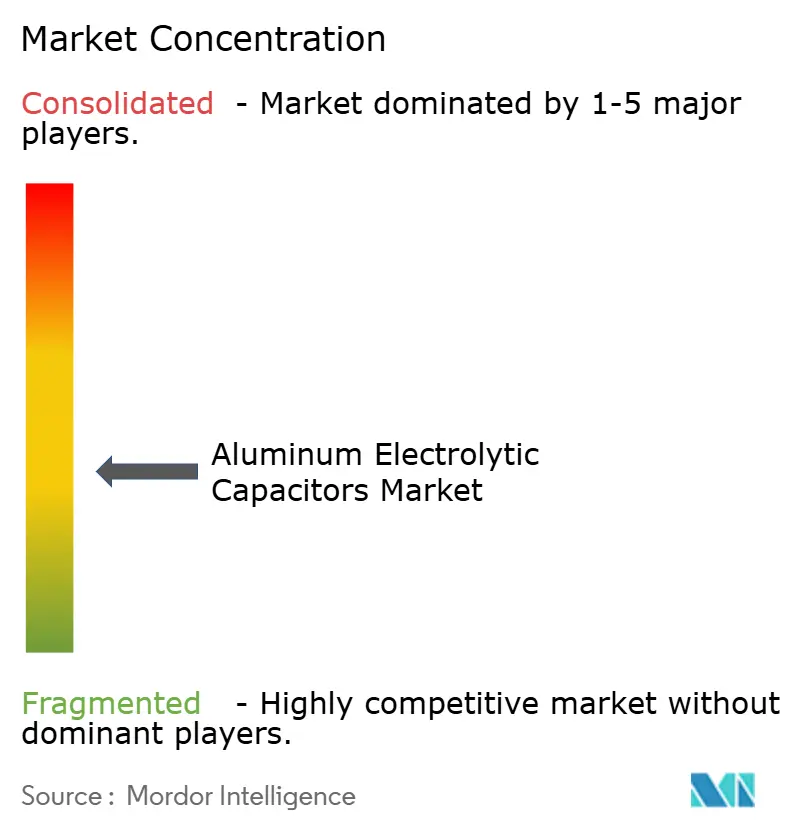
| Market Concentration | Medium |
Major Players *Disclaimer: Major Players sorted in no particular order Image © Mordor Intelligence. Reuse requires attribution under CC BY 4.0. | |
Aluminum Electrolytic Capacitors Market Analysis by Mordor Intelligence
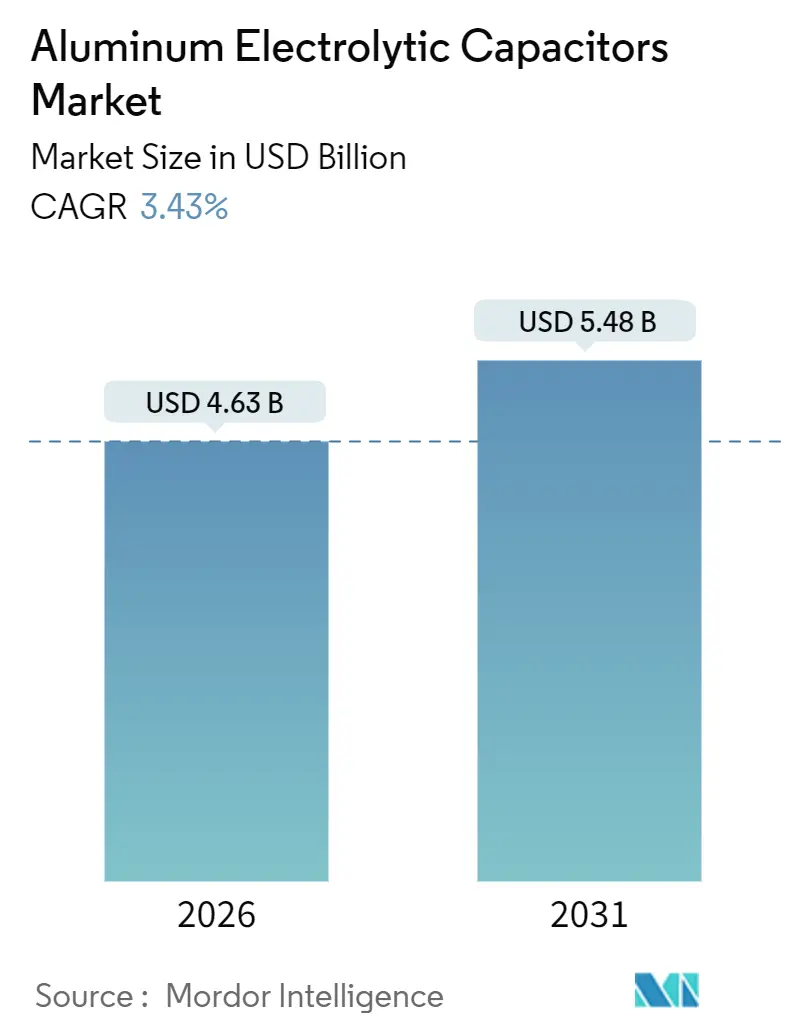
The aluminum electrolytic capacitors market size is USD 4.63 billion in 2026 and is forecast to reach USD 5.48 billion by 2031, reflecting a 3.43% CAGR through the period. Momentum stems from a shift toward high-voltage inverter topologies, 800 V electric-vehicle (EV) battery platforms, and wide-bandgap power devices that demand lower equivalent series resistance (ESR) and longer lifetime. Component miniaturization in smartphones, higher ripple-current densities in EV traction inverters, and renewable-energy mandates in the Middle East are reshaping product design and geographic demand patterns. Supplier strategies now emphasize hybrid polymer technology, captive etched-foil capacity, and automotive reliability qualifications to offset aluminum price volatility. At the same time, regional specialists leverage proximity and cost advantages to win design slots in consumer electronics and industrial automation.
Key Report Takeaways
- By voltage, low-voltage capacitors below 500 V held 64.21% of 2025 revenue, while the above-500 V segment is projected to grow at a 4.4% CAGR through 2031.
- By mounting configuration, surface-mount devices led with 49.84% share in 2025; snap-in designs are set to advance at a 4.1% CAGR to 2031.
- By electrolyte type, non-solid liquid variants accounted for 61.47% of 2025 sales, whereas solid polymer capacitors are forecast to expand at a 4.9% CAGR.
- By application, consumer electronics generated 32.53% of 2025 demand; automotive is positioned for the fastest 4.26% CAGR through 2031.
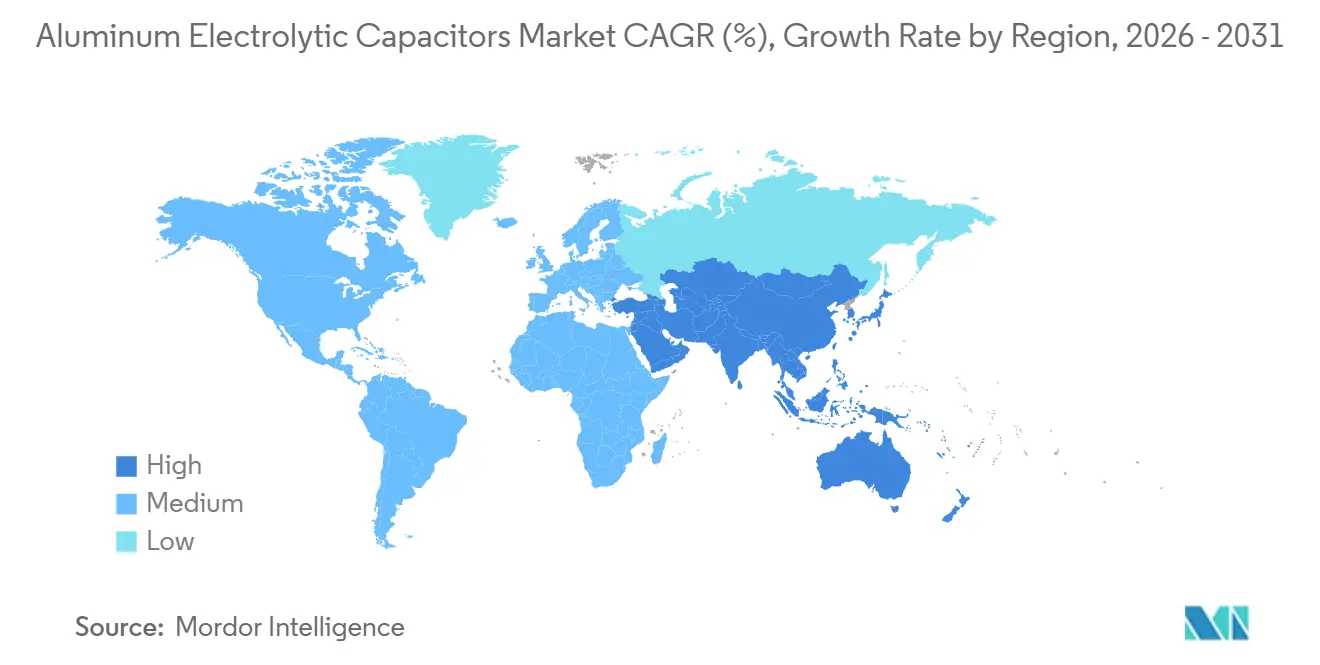
- By geography, the Asia Pacific region contributed 45.38% of 2025 revenue, while the Middle East is expected to post a 4.7% CAGR, the highest regional pace.
Note: Market size and forecast figures in this report are generated using Mordor Intelligence’s proprietary estimation framework, updated with the latest available data and insights as of January 2026.
Market Trends and Insights
Drivers Impact Analysis of Aluminum Electrolytic Capacitors Market*
| Driver | (~) % Impact on CAGR Forecast | Geographic Relevance | Impact Timeline |
|---|---|---|---|
| Shrinking PCB Real Estate Driving Ultra-miniaturised Capacitors | +0.50% | Global, with concentration in Asia Pacific consumer electronics hubs | Medium term (2-4 years) |
| Push Toward 800 V Battery Systems in EVs Elevates Ripple Current Requirements | +0.70% | North America, Europe, China | Medium term (2-4 years) |
| Growing Investments in Utility-Scale Solar Inverters | +0.60% | Middle East, Asia Pacific, North America | Long term (≥4 years) |
| Government Incentives for Smart Manufacturing (Industry 4.0) | +0.40% | Europe, North America, select Asia Pacific markets | Long term (≥4 years) |
| Wide-bandgap Power Devices Creating Need for Low-ESR Bulk Capacitance | +0.60% | Global, with early adoption in automotive and industrial segments | Medium term (2-4 years) |
| Edge AI Hardware Proliferation in 5G Base-Stations | +0.40% | Asia Pacific, North America, Europe | Medium term (2-4 years) |
| Source: Mordor Intelligence | |||
Shrinking PCB Real Estate Driving Ultra-Miniaturised Capacitors
Power-management circuits in smartphones and tablets continue to shrink, forcing suppliers to deliver identical capacitance in packages occupying 30% less board area than 2023 designs. Surface-mount aluminum electrolytic capacitors under 3 mm profile are displacing parallel banks of ceramics that create acoustic noise, an advantage demonstrated by Nichicon’s GYG hybrid series released in 2025.[1] Demand is concentrated in Asia Pacific, where contract manufacturers prioritize square-millimetre savings to sustain razor-thin margins. The driver’s 0.5% uplift to the overall CAGR reflects the sheer shipment volume of mobile devices. Capital investment in low-profile polymer cathode lines underlines the transition from traditional liquid electrolytes. Suppliers that cannot meet miniaturization roadmaps risk exclusion from next-generation handset reference designs.
Push Toward 800 V Battery Systems in EVs Elevates Ripple Current Requirements
Automakers are migrating from 400 V to 800 V pack voltages to shorten DC-fast-charging sessions and trim copper mass. The change doubles voltage stress on DC-link capacitors and pushes ripple current beyond 50 A RMS, overheating conventional liquid-electrolyte parts.[2] Panasonic’s ZL automotive series and Eaton’s EHBSA hybrid family illustrate the move to AEC-Q200 hybrid polymer solutions rated at 135 °C and ESR below 10 mΩ. EV adoption drives a 0.7% boost to market CAGR, with North America and Europe joining China in high-voltage rollouts. Onboard charger and traction-inverter suppliers increasingly stipulate polymer cathodes to eliminate derating, locking in higher average-selling-price (ASP) growth.
Growing Investments in Utility-Scale Solar Inverters
Gigawatt-scale solar farms in Saudi Arabia and the United Arab Emirates specify high-voltage capacitors rated 600-900 V for central inverters, propelling long-term demand. Central and string inverters rely on aluminum electrolytic capacitors to cushion switching transients and control harmonic distortion. Silicon-carbide (SiC) switches further extend lifetime by lowering operating temperature. The regional build-out underpins a 0.6% CAGR contribution, with Asia Pacific and North America following suit as renewable portfolios expand. Suppliers that localize production can avoid import duties and currency risk, cementing design wins through proximity and shorter lead times.
Wide-bandgap Power Devices Creating Need for Low-ESR Bulk Capacitance
SiC and gallium-nitride (GaN) transistors enable 100 kHz-plus switching, cutting passive magnetics volume by 50% yet exposing the ESR limitations of traditional through-hole capacitors. Even 20 mΩ at 200 kHz dissipates several watts of heat, threatening thermal runaway in compact enclosures. KEMET’s T520 polymer tantalum capacitors now pair with aluminum electrolytics in parallel to deliver both bulk energy and high-frequency bypass, highlighting a convergence of technologies.[3] Industrial drives and EV chargers see immediate benefit, lifting overall CAGR by 0.6%. Compliance with IEC 61071 has become a procurement mandate, forcing suppliers to invest in rigorous life testing.
Restraints Impact Analysis of Aluminum Electrolytic Capacitors Market*
| Restraint | (~) % Impact on CAGR Forecast | Geographic Relevance | Impact Timeline |
|---|---|---|---|
| Aluminum Price Volatility Compressing Margins | -0.40% | Global, with acute impact on Asia Pacific and Europe | Short term (≤2 years) |
| Supply Risk of High-Purity Etched Foil | -0.30% | Global, with concentration risk in Japan and China | Medium term (2-4 years) |
| Solid Polymer Reliability Concerns Above 125 °C | -0.20% | Automotive and industrial segments globally | Medium term (2-4 years) |
| Design-in Shift Toward Multi-layer Polymer Capacitors | -0.30% | Consumer electronics in Asia Pacific, North America | Long term (≥4 years) |
| Source: Mordor Intelligence | |||
Aluminium Price Volatility Compressing Margins
London Metal Exchange spot prices reached USD 2,955 per metric ton in December 2025, 20% higher than early-year forecasts, trimming gross margins for capacitor makers locked into three-month customer price lists. Etched foil comprises roughly 30% of bill-of-material cost, and a 60- to 90-day pass-through lag hampers price adjustments. The U.S. Department of Energy’s proposed carbon-border adjustments could add further cost pressure in coal-reliant grid regions. Smaller firms under USD 100 million revenue lack hedging leverage, heightening bankruptcy risk and limiting R&D budgets.
Supply Risk of High-Purity Etched Foil
Fewer than 10 suppliers, mainly in Japan and China, control high-surface-area etched foil production, and lead times doubled to 16 weeks in 2025. Environmental regulations on hazardous-waste treatment constrain capacity additions. Only Nippon Chemi-Con and Nichicon operate fully captive foil lines, insulating them from allocation shocks. Qualifying a new foil source requires up to 24 months, making sudden supplier exits a 0.3% drag on market CAGR. Manufacturers respond with multi-year offtake agreements, yet vertical-integration costs deter most mid-tier players.
*Our forecasts treat driver/restraint impacts as directional, not additive. The impact forecasts reflect baseline growth, mix effects, and variable interactions.
Aluminum Electrolytic Capacitors Market Segment Analysis
By Voltage:
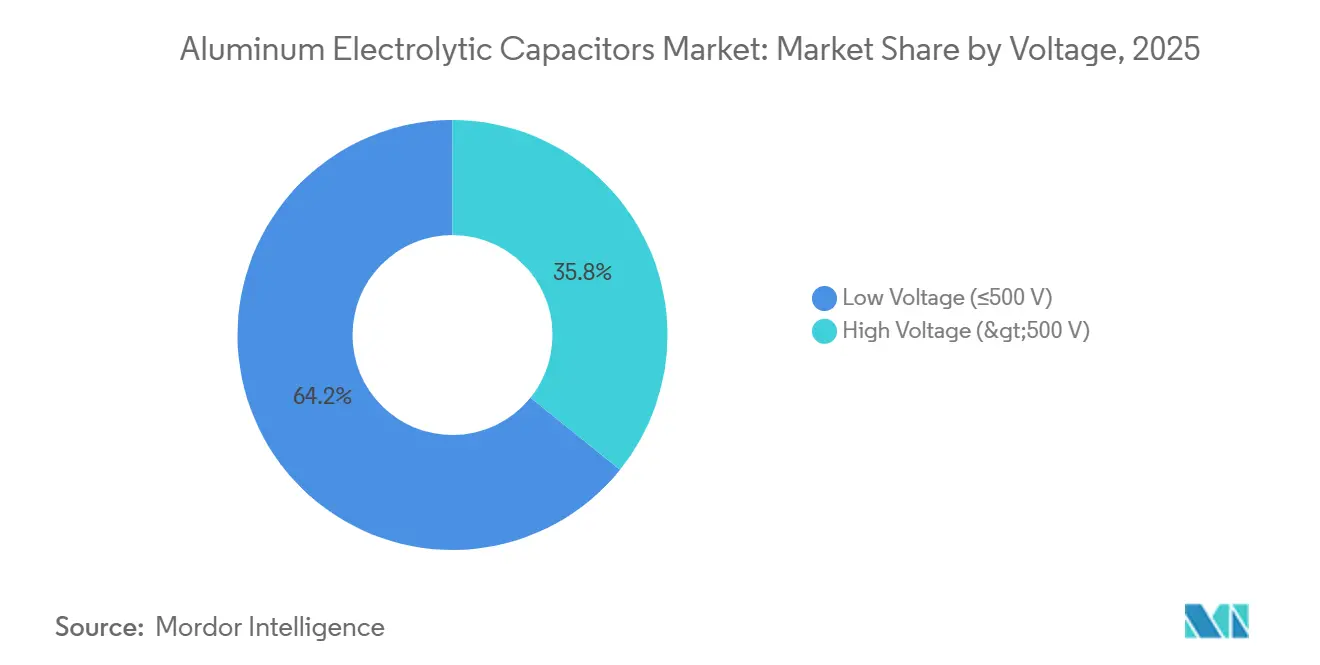
High-Voltage Variants Gain Traction in Power ConversionHigh-voltage aluminum electrolytic capacitors above 500 V are forecast to grow at 4.4% annually, eclipsing the 3.43% aluminum electrolytic capacitors market CAGR as solar inverters and industrial drives lift DC-bus voltages for efficiency. Low-voltage parts still command 64.21% of 2025 revenue thanks to phones, tablets, and 12-48 V automotive rails. High-voltage oxide layers require anodization precision near 1.2 nm per volt, pushing cleanroom investments and inline defect inspection.
Utility-scale solar projects in the Middle East and 800 V EV onboard chargers blur segmentation boundaries, with 450-500 V capacitors straddling both tiers. Panasonic’s ZL series targets this crossover with 135 °C endurance, underscoring thermal-management challenges in under-hood environments. As wide-bandgap semiconductors enable intermediate 600-700 V buses, the aluminum electrolytic capacitors market is likely to realign around new voltage clusters rather than the historical 500 V breakpoint.
By Electrolyte Type:
Solid Polymers Challenge Liquid IncumbentsSolid polymer capacitors should advance at 4.9% CAGR on the back of 5G base-station thermal demands, while non-solid liquid designs held 61.47% share in 2025. Hybrid polymer parts that marry aluminium oxide anodes with conductive-polymer cathodes bridge cost and performance gaps, extending life to 10,000 hours at 105 °C.
Solid polymer reliability above 125 °C remains a hurdle: conductive polymers degrade, limiting automotive under-hood deployment. Liquid electrolytes therefore retain dominance in applications below 85 °C and currents under 2 A RMS. The aluminum electrolytic capacitors market size for hybrid polymer formats is expected to expand steadily as qualification data accumulates, especially in automotive DC-DC converters where ESR dictates thermal-design budgets.
By Mounting Configuration:
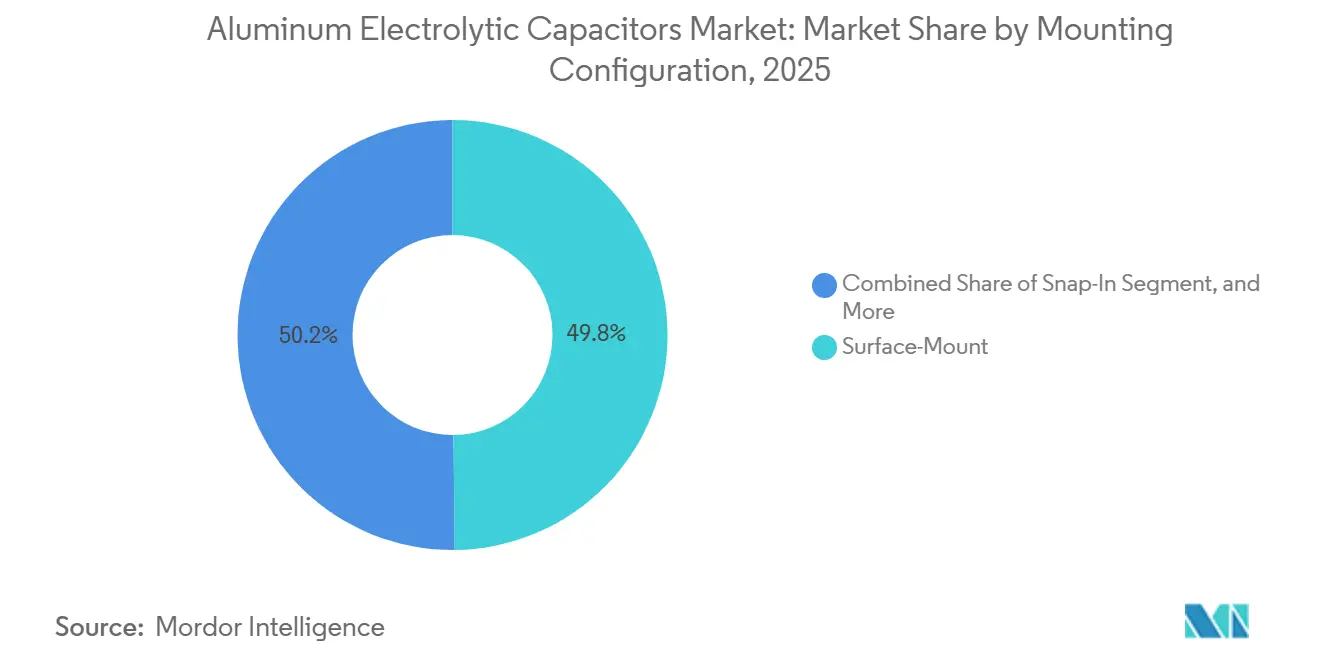
Snap-In Gains Ground in Modular Power SuppliesSurface-mount packages led 2025 revenue at 49.84%, favoured by pick-and-place automation and 40% board-area savings. Snap-in devices are forecast to rise 4.1% per year as industrial retrofits demand field-serviceable modules. Through-hole radial and axial parts decline gradually, while screw-terminal capacitors stay niche in high-power UPS and traction systems.
Factory-automation power supplies increasingly specify 400-500 V snap-in parts above 10,000 µF, slashing the number of parallel cans and easing inventory. Conversely, smartphone OEMs push surface-mount heights below 3 mm, requiring reflow profiles under 260 °C to protect polymer electrolytes. The aluminum electrolytic capacitors market share of through-hole formats will keep shrinking as labour rates favour automation.

By Application:
Automotive Electrification Outpaces Consumer ElectronicsConsumer electronics generated 32.53% of 2025 demand, yet automotive will outpace all segments with a 4.26% CAGR. EV traction inverters, 48 V mild-hybrid systems, and battery-management units raise average capacitance per vehicle. Telecom infrastructure and industrial automation provide stable baselines, while renewable-energy inverters expand in line with solar and wind installations.
China assembled 60% of global EV output in 2025, making GB/T 31467 compliance as essential as AEC-Q200. Panasonic’s fivefold capacity expansion completed in 2025, and its planned tripling by 2029, signals sustained demand for polymer hybrids. Consumer-electronics volumes remain cyclical, tied to handset upgrade cycles. Factory automation and collaborative robots fill the gap, driven by labour shortages in developed economies and incentives under Industry 4.0 programs.
Geography Analysis
APAC Aluminum Electrolytic Capacitors Market
Asia Pacific captured 45.38% of 2025 revenue, anchored by Chinese smartphone assembly plants, Japanese auto electronics, and Korean foundries. Domestic demand plus export volumes make the region the epicentre of the aluminum electrolytic capacitors market. Governments in Thailand, Malaysia, and Vietnam offer tax holidays, drawing capacity from Murata, Panasonic, and others.
Middle East Aluminum Electrolytic Capacitors Market
The Middle East posts the fastest 4.7% CAGR thanks to giga-scale solar farms such as Saudi Arabia’s 10 GW NEOM project and the United Arab Emirates’ 2.6 GW Mohammed bin Rashid Al Maktoum Solar Park. Inverters for these plants need 600-900 V capacitors rated for 100,000 hours at 85 °C, boosting high-voltage demand. Hitachi Energy’s Xi’an line tripled output in 2025 to serve Gulf Cooperation Council installations, underlining the region’s pull-on Chinese capacity.
The Americas, Europe and Africa Aluminum Electrolytic Capacitors Market
North America benefits from EV assembly expansions and hyperscale datacentre builds that require low-ESR DC-bus capacitance. Europe faces energy-price headwinds but sustains premium demand for automotive and industrial parts through electrification mandates. South America grows from a smaller base, led by Brazilian auto suppliers adopting hybrid platforms, while Africa remains an emerging market focused on off-grid solar controllers.
Regulatory Landscape
Compliance for aluminum electrolytic capacitors is shaped by international component standards and tighter substance-regulation documentation across major end markets. At the product-specification level, IEC standards such as IEC 60384 (including IEC 60384-25:2021 for fixed aluminum electrolytic surface-mount capacitors with conductive polymer solid electrolyte) anchor qualification and procurement expectations, alongside sectoral requirements referenced in this report such as IEC 61071 for power electronics applications.
National adoption and updates add additional layers for suppliers shipping globally, particularly into Asia. Korea has published KS C IEC 60384-26-2025 for fixed aluminum electrolytic capacitors with conductive polymer solid electrolyte, while China issued GB/T 6346.23-2025 with an implementation date of July 1, 2026, creating a clear compliance milestone for manufacturers and importers. On materials compliance, EU REACH-driven SVHC reporting continues to influence supplier declarations, illustrated by Rubycon updating its SVHC non-use certification on April 9, 2026 (covering 253 substances), which supports OEM due diligence in automotive, industrial, and energy applications.
Competitive Landscape
Moderate concentration prevails: Nippon Chemi-Con, Panasonic, Nichicon, Rubycon, and TDK hold roughly 40% combined share, leaving room for regional contenders such as Lelon Electronics, Samwha Capacitor Group, and CapXon. Japanese leaders pour capital into hybrid-polymer lines and captive etched-foil capacity, buffering commodity swings and commanding premium ASPs in automotive and renewable segments.
Chinese and Taiwanese manufacturers scale liquid-electrolyte volumes for price-sensitive consumer and industrial customers. Vertical integration remains rare; only two top players run in-house foil production, a strategic edge against supply shocks. Patent filings in 2025 target polymer cathode stability above 125 °C, signalling a race to extend solid-state reliability.
Western firms like Eaton achieved AEC-Q200 qualification in 2025, leveraging shorter lead times and local technical support to offset higher labour costs. Surface-mount adoption grows in fields once dominated by through-hole devices as contract assemblers push for fully automated lines. Niche opportunities arise in railway traction and marine propulsion, governed by EN 50155 and IEC 60068, where few suppliers currently compete.
Aluminum Electrolytic Capacitors Industry Leaders
-
KEMET Corporation (Yageo company)
-
Panasonic Corporation
-
Vishay Intertechnology Inc.
-
Rubycon Corporation
-
Nippon Chemi-Con Corporation
- *Disclaimer: Major Players sorted in no particular order
Aluminum Electrolytic Capacitors Market Companies Covered in this Report
- Nippon Chemi-Con Corporation
- Panasonic Holdings Corporation
- Yageo Corporation (KEMET)
- Vishay Intertechnology Inc.
- Nichicon Corporation
- Rubycon Corporation
- TDK Corporation (EPCOS Brand)
- Cornell Dubilier Electronics
- Lelon Electronics Corporation
- Samwha Capacitor Group
- Nantong Jianghai Capacitor Co.
- NIC Components Corp.
- Elna Co., Ltd.
- Suncon (Sanyo)
- Illinois Capacitor (Cornell)
- Hitano Enterprise Corp.
- Samyoung Electronics Co., Ltd.
- Taiwan Chinsan Electronics Industrial Co., Ltd.
- Cheng Tung Industrial Co., Ltd.
- CapXon Group
- Jianghai Europe Electronic Components GmbH
Market Opportunities and Future Outlook
Pricing and allocation dynamics in 2026 point to whitespace for suppliers that can secure etched-foil inputs, stabilize lead times, and provide qualified substitutes for high-stress power conversion designs. Multiple vendors initiated or announced capacitor price actions in mid-2026, including Yageo (price increases reported as effective July 1, 2026), Nichicon (portfolio price hikes announced in June 2026), KEMET (price increases effective June 1, 2026 for selected specifications), and Panasonic (a price adjustment mechanism for SP-Cap surface-mount solid aluminum capacitors for deliveries after July 1, 2026). These changes increase the commercial value of cost pass-through mechanisms, multi-sourcing, and localized support for OEMs designing around high ripple-current and high-temperature requirements.
Opportunity also comes from standard- and application-driven upgrades that shift customers toward polymer and hybrid electrolytics in compact packages. The July 1, 2026 implementation date for China’s GB/T 6346.23-2025, together with polymer-focused IEC and national standards (IEC 60384-25:2021 and KS C IEC 60384-26-2025), raises the importance of traceable compliance documentation and stable performance at elevated temperatures. In application terms, the report’s demand themes around 800 V EV platforms, wide-bandgap power devices, and utility-scale solar inverters translate into design-in needs for low-ESR bulk capacitance and higher voltage ratings, favoring suppliers that can pair automotive reliability qualifications with higher-voltage snap-in and compact surface-mount portfolios.
Recent Industry Developments in Aluminum Electrolytic Capacitors Market
- July 2026: Yageo reports notification to customers of price increases across its entire capacitor portfolio, including aluminum electrolytic capacitors, effective July 1, 2026, due to rising manufacturing costs. The action expands revenue protection for the supplier while signaling tighter supply chain economics that could pressure downstream customers to seek alternative sourcing. The move may influence pricing dynamics in the aluminum electrolytic segment and push customers to evaluate total cost of ownership across designs.
- January 2026: Vishay Intertechnology extends the 193 PUR-SI series of miniature snap-in power aluminum electrolytic capacitors with new 550V and 600V voltage ratings. The update broadens high-voltage capability in compact form factors, supporting higher energy density for automotive and industrial applications. This expansion strengthens Vishay headroom in premium segments and could affect competitive pricing.
- June 2025: Panasonic Industry Europe launches the ZVU series of hybrid aluminum electrolytic capacitors, offering ripple currents from 3.3Arms to 4.6Arms and operation up to 135C. The product expands high-reliability options for automotive and industrial electronics, reducing cooling requirements and improving energy efficiency. The development reinforces Panasonic's presence in the European market and may influence design-in decisions for high end applications.
Aluminum Electrolytic Capacitors Market Report Scope and Research Methodology
Market Definition and Coverage
This market covers revenue generated from aluminum electrolytic capacitors sold for use across electronics and electrical systems, counted at the point where the component is supplied into end equipment manufacturing and replacement demand.
Scope exclusions: Excludes adjacent capacitor families such as ceramic, film, and tantalum types, even when they serve similar filtering or energy-storage functions.
Segments Covered in This Report
- By Voltage
- High Voltage (Greater than 500 V)
- Low Voltage (Up to 500 V)
- By Electrolyte Type
- Non-solid (Liquid) Electrolyte
- Solid Polymer Electrolyte
- Hybrid Polymer
- By Mounting Configuration
- Surface-Mount
- Through-Hole (Radial, Axial)
- Snap-In
- Screw Terminal
- Other Mounting Configurations
- By Application
- Industrial Automation
- Telecommunications
- Consumer Electronics
- Automotive (ICE and EV)
- Energy and Power
- Other Applications
- By Geography
- North America
- United States
- Canada
- Mexico
- South America
- Brazil
- Argentina
- Rest of South America
- Europe
- Germany
- United Kingdom
- France
- Italy
- Russia
- Rest of Europe
- Asia Pacific
- China
- Japan
- South Korea
- India
- Rest of Asia Pacific
- Middle East
- Saudi Arabia
- United Arab Emirates
- Turkey
- Rest of Middle East
- Africa
- South Africa
- Nigeria
- Rest of Africa
- North America
Data Sources, Market Sizing, and Validation
Desk Research
Desk work started by mapping the component value chain and the demand pools that typically consume aluminum electrolytic capacitors, followed by a careful pass on global electronics and industrial activity indicators. We relied on public, non-paywalled sources such as UN Comtrade for trade flows, World Bank and IMF series for macro context, and government industry statistics portals for manufacturing output signals.
To make the numbers practical, we also reviewed sources such as IEC and JEITA publications for terminology and application cues, along with company annual reports, investor decks, and reputable press coverage for pricing commentary and capacity moves. In a few places, paid subscriptions supporting company financials, patent databases, and shipment-level trade datasets were used to cross-check entities, product families, and directional volume shifts. The desk sources listed here are illustrative only, and many other public references were used for data collection, validation, and clarification.
Primary Interviews and Surveys
Primary work was used to pressure-test the desk assumptions that usually move this market, especially voltage mix, polymer adoption, and price movements for key inputs. We spoke with a balanced set of stakeholders across the supply chain such as component manufacturers, distributors, and engineering or sourcing teams at end users, and then the feedback was used to refine conversion factors and reduce blind spots across regions.
Distribution of primary research fieldwork respondents
| Company type | Respondent position | Region |
|---|---|---|
| Top tier: 38% | CXOs: 15% | APAC: 53% |
| Mid tier: 46% | Functional/Unit leaders: 33% | EMEA: 29% |
| Smaller Players: 16% | Managers: 52% | Americas: 18% |
Market-Sizing & Forecasting
Sizing was built using top-down logic where electronics production, industrial output, and trade-linked demand pools were reconstructed by geography, and then translated into capacitor value using penetration and content-per-system ranges discussed with experts. The totals were then checked with selective bottom-up approximations, mainly a sampled ASP times volume logic for key applications and channel checks to ensure the split across mounting styles and voltage classes stayed realistic.
A few practical inputs were kept central so the model remains repeatable, including (illustrative) end-equipment build trends in industrial automation and telecom power systems, shifts in high-voltage use driven by inverter designs, mix movement toward solid and hybrid polymer types, and observed pricing behavior tied to raw material and energy costs. Where direct volume signals were weak, gaps were handled by using proxy indicators such as import-export movements for relevant component categories and by applying conservative utilization and replacement assumptions that were validated through interviews.
Forecasts were developed using scenario analysis, since demand is influenced by cycles in industrial capex and consumer electronics, and because application mix can change faster than total unit growth. Variable-level outlooks for the key drivers were aligned to consensus from primary respondents, and then rolled forward with clear assumptions for ASP progression and mix shifts over the forecast period.
Data Validation & Update Cycle
Validation was done by triangulating the model outputs against independent signals such as regional electronics output direction, trade movements, and the implied application mix that emerges from voltage and mounting splits. Any large variance triggered a second pass on assumptions, followed by targeted re-contacts with respondents to confirm whether the issue was timing, pricing, or a scope mismatch.
Before sign-off, the work goes through multi-step analyst reviews where calculations, unit consistency, and currency conversions are rechecked, and outliers are explained in plain terms. Reports are refreshed annually, with interim updates when material events occur, and a final pre-delivery pass is completed so clients receive the latest updated view.
Mordor Intelligence's Aluminum Electrolytic Capacitors Market Size Compared Against Other Published Estimates
Published market sizes for aluminum electrolytic capacitors often differ, even when the same end uses are discussed, because the included capacitor families, year labeling, and price assumptions do not always match. We also see differences when one estimate leans heavily on shipments and another leans on revenue, which can shift the value quickly when ASPs move.
Film capacitors are a common add-in that widens totals, and that category sits outside Mordor Intelligence's scope for this market, which helps explain why some published values look higher even for the same year. Other gaps usually come from how solid polymer and hybrid polymer adoption is treated inside the mix, whether high-voltage demand is tied to actual inverter build rates, and whether exchange rates and inflation adjustments are applied consistently across regions and update timing.
Benchmark comparison
| Source | Market Size | Gaps in Research Methodology |
|---|---|---|
| Mordor Intelligence | USD 4.63 B (2026) | |
| Global Consultancy A | USD 5.10 B (2026) | Uses a wider capacitor scope in practice by bundling adjacent power-capacitor categories for selected applications, and applies a higher blended ASP without clearly separating polymer share by voltage class. |
| Industry Association B | USD 4.20 B (2026) | Leans more on reported shipment trends and conservative pricing, which can understate revenue when mix shifts toward solid and hybrid polymer parts and when high-voltage content rises in industrial power systems. |
The spread across the three figures is mainly explained by product-family inclusions, how ASPs are carried forward, and how tightly application demand is linked to equipment build signals. By keeping the scope strictly on aluminum electrolytic capacitors and then validating the mix and pricing through repeatable checks, the resulting value stays easier to trace back to clear drivers and refresh when new data appears.
Key Questions Answered in the Report
What is the projected value of the aluminum electrolytic capacitors market by 2031?
The market is forecast to reach USD 5.48 billion by 2031.
Which voltage segment is growing the fastest?
Capacitors rated above 500 V are projected to expand at a 4.4% CAGR through 2031.
Why are hybrid polymer capacitors gaining traction in electric vehicles?
Hybrid polymers provide lower ESR and higher temperature endurance, meeting AEC-Q200 requirements for 800 V traction inverters.
Which region will post the highest growth rate?
The Middle East is expected to achieve a 4.7% CAGR through 2031, driven by large-scale renewable energy projects.
How does aluminum price volatility affect capacitor makers?
Spot-price swings compress margins because etched foil represents up to 30% of material cost and price pass-through can lag by up to 90 days.
What is the main supply-chain risk for aluminum electrolytic capacitors?
Dependence on fewer than 10 global suppliers of high-purity etched foil imposes a structural procurement risk.