
Alkyl Polyglycoside Market Size and Share
Market Overview
| Study Period | 2021 - 2031 |
|---|---|
| Market Volume (2026) | 99.34 kilotons |
| Market Volume (2031) | 115.83 kilotons |
| Growth Rate (2026 - 2031) | 3.12 % |
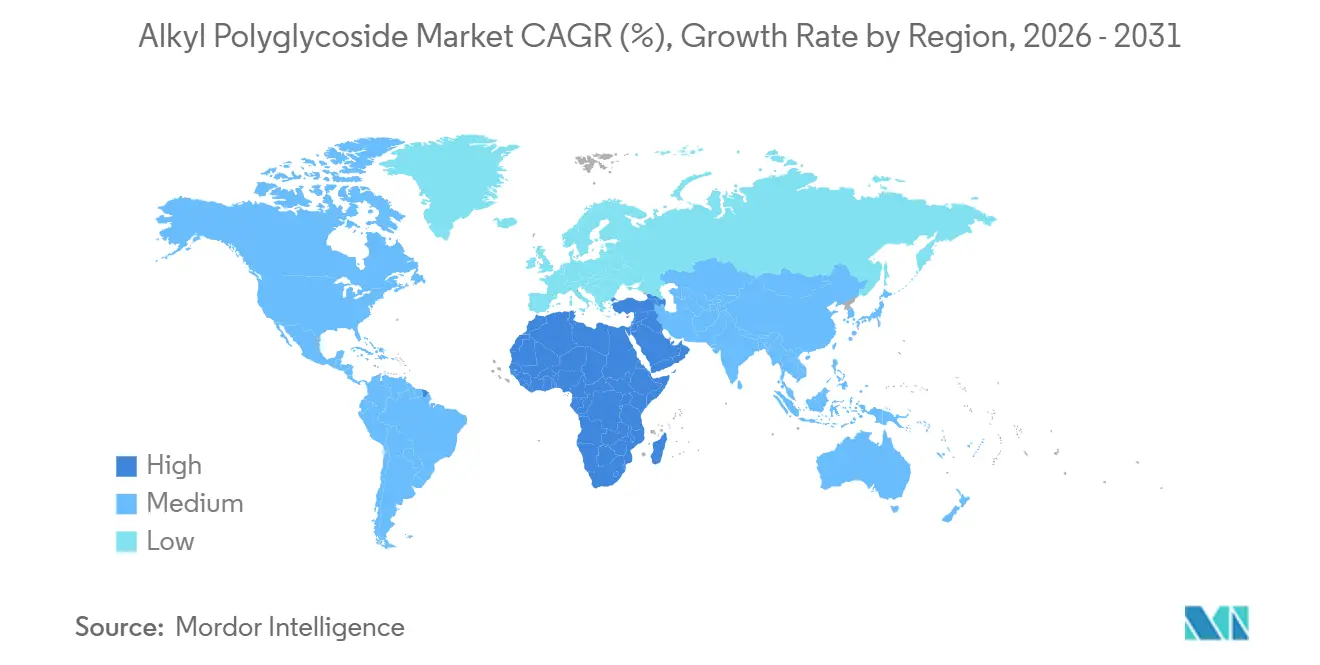
| Fastest Growing Market | Middle East and Africa |
| Largest Market | Asia Pacific |
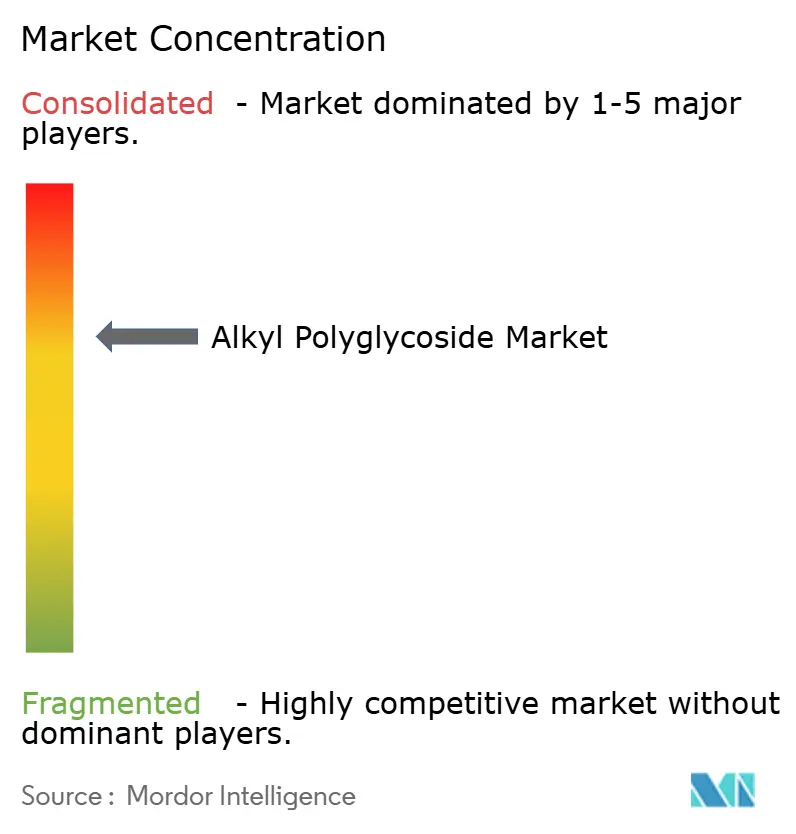
| Market Concentration | Medium |
Major Players *Disclaimer: Major Players sorted in no particular order Image © Mordor Intelligence. Reuse requires attribution under CC BY 4.0. | |
Alkyl Polyglycoside Market Analysis by Mordor Intelligence
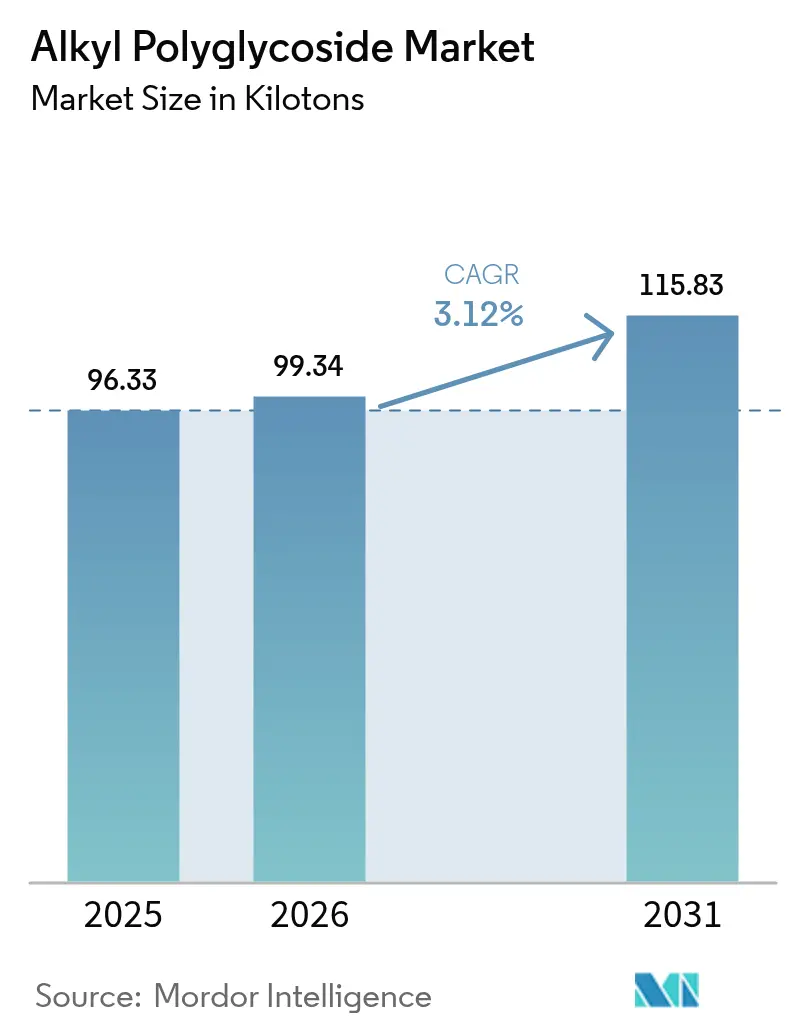
The Alkyl Polyglycoside Market size is projected to be 96.33 kilotons in 2025, 99.34 kilotons in 2026, and reach 115.83 kilotons by 2031, growing at a CAGR of 3.12% from 2026 to 2031. Demand is buoyed by the rapid phase-out of nonylphenol ethoxylates, rising consumer preference for bio-based cleaning agents, and the willingness of multinational brands to pay premiums for ingredients that meet clean-label criteria. Surfactant producers are shifting investment toward glycoside platforms that balance performance, cost, and sustainability, while capacity expansions across Asia and Europe affirm confidence in long-run structural demand. Feedstock integration among fatty-alcohol suppliers is lowering unit costs in Southeast Asia, and process innovations such as enzymatic glycosylation are shrinking carbon footprints, enabling premium pricing in North America and Europe. Nonetheless, the Alkyl polyglycoside market confronts substitution threats from betaines and energy-intensive spray-drying costs that curb margins in regions with high natural-gas prices.
Key Report Takeaways
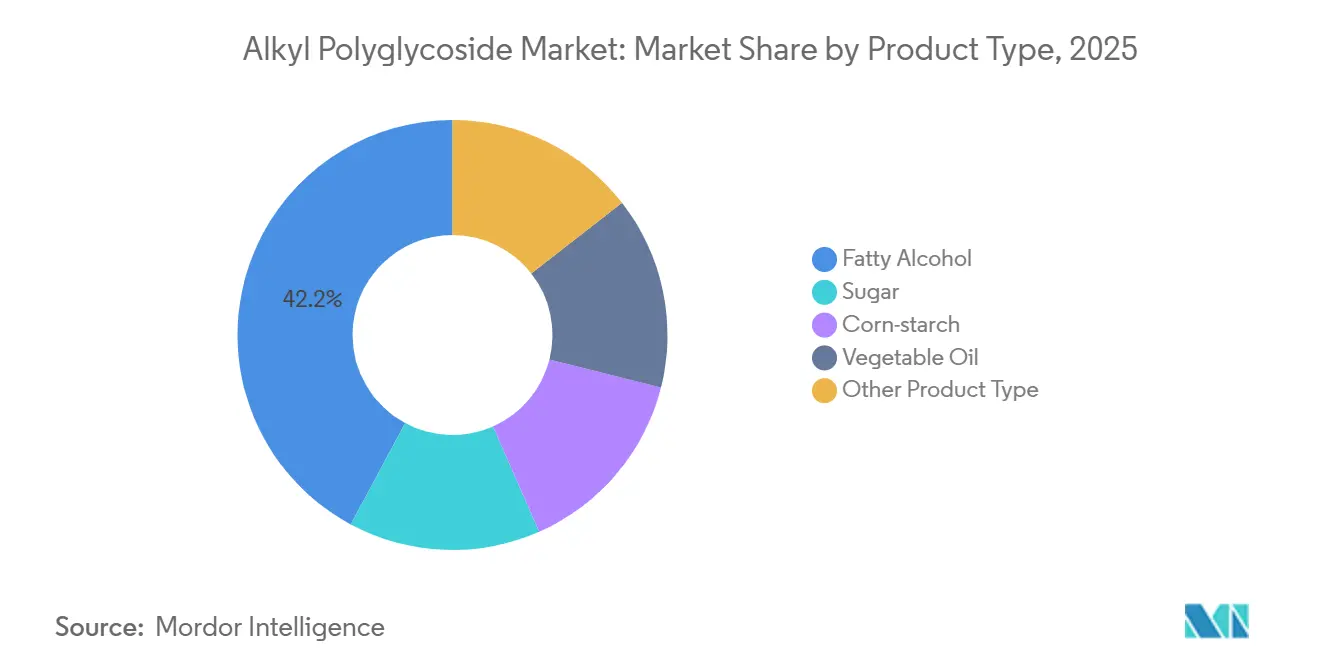
- By product category, fatty alcohol-based grades held 42.16% of the Alkyl Polyglucoside market share in 2025. The market share of vegetable oil is expected to grow at the fastest CAGR of 3.58% during the forecast period.
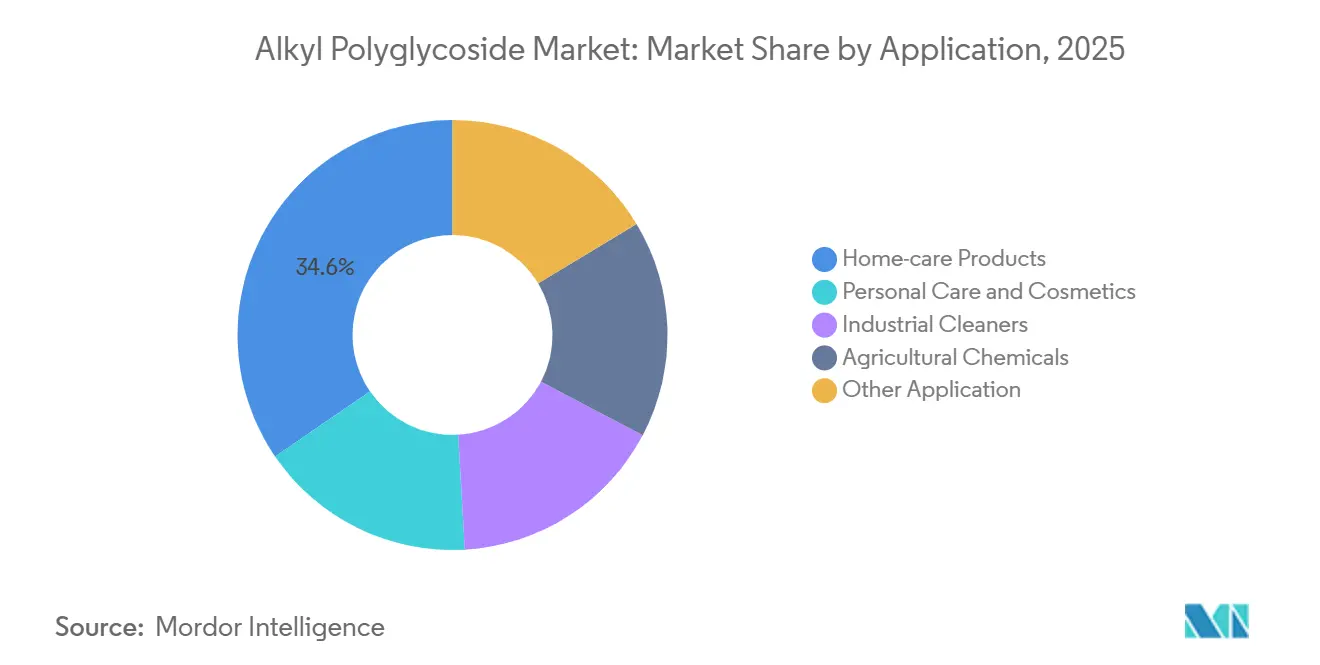
- By application, home-care products comprised the largest share of 34.55% of the market in 2025. Industrial cleaners are projected to grow at a 3.79% CAGR through 2031, outpacing all other applications.
- By geography, Asia-Pacific accounted for 45.96% of the 2025 volume, while the Middle East and Africa are poised for a 3.58% CAGR to 2031.
Note: Market size and forecast figures in this report are generated using Mordor Intelligence’s proprietary estimation framework, updated with the latest available data and insights as of 2026.
Market Trends and Insights
Drivers Impact Analysis of Alkyl Polyglycoside Market*
| Driver | (~) % Impact on CAGR Forecast | Geographic Relevance | Impact Timeline |
|---|---|---|---|
| Bio-based surfactants boom in home and personal-care | +0.9% | Global, with peak adoption in EU & North America | Medium term (2-4 years) |
| Regulatory phase-out of NPEs and other hazardous surfactants | +0.7% | EU core, spill-over to North America & APAC export-oriented manufacturers | Short term (≤ 2 years) |
| Capacity additions and backward integration among fatty-alcohol suppliers | +0.5% | APAC core (China, Malaysia, Indonesia), secondary in EU | Medium term (2-4 years) |
| APG penetration in industrial cleaning and oil-field fluids | +0.6% | Middle East & North America (oilfield), Global (industrial cleaners) | Long term (≥ 4 years) |
| Enzymatic and continuous-flow APG production cutting CO₂ footprint | +0.3% | EU & North America (sustainability-driven), early APAC adopters | Long term (≥ 4 years) |
| Source: Mordor Intelligence | |||
Bio-Based Surfactants Boom in Home and Personal-Care
Brand owners in Western Europe and North America report that 68% of households prioritized ingredient transparency over price in 2025, tipping reformulation economics decisively toward APG inclusion[1]. Procter & Gamble increased APG to 12% of its fabric-care surfactant load, reducing exposure to future ethoxylate bans. Personal-care lines substitute C8-C10 APG for sulfates to curb irritation, while Unilever registered a 22% rise in APG procurement, reinforcing a demand floor that shelters the Alkyl polyglycoside market from swings in discretionary spending.
Regulatory Phase-Out Of NPEs And Other Hazardous Surfactants
An EU REACH amendment in 2024 capped NPEs at 0.01 % in consumer detergents, compelling an industry-wide switch to APG[2]. Henkel attributed 18% of its European surfactant growth in 2025 to NPE-to-APG substitution and invested EUR 25 million in pilot trials. California’s Safer Consumer Products program echoed the restriction, nudging North American brands to harmonize formulations and magnifying extraterritorial demand.
Capacity Additions And Backward Integration Among Fatty-Alcohol Suppliers
Oleochemical producers in Southeast Asia are leveraging their captive palm-kernel and coconut-oil feedstocks to enter APG synthesis, a vertical-integration strategy that compresses the value chain and threatens merchant APG suppliers who lack upstream assets. Wilmar International’s 15,000 t plant in Johor delivers a 15-20 % landed-cost edge versus European peers, exemplifying Southeast Asia’s integrated model. KLK Oleo’s 12,000 t Selangor line targets Chinese converters, while BASF’s 8,000 t upgrade in Ludwigshafen leverages enzymatic routes to trade on carbon credentials rather than price.
APG Penetration In Industrial Cleaning And Oil-Field Fluids
Oilfield-service companies in the Permian Basin and the Middle East are specifying APG-based drilling muds and production chemicals to comply with offshore discharge regulations that prohibit persistent surfactants in produced water. Halliburton lifted APG’s share in drilling-fluid surfactants to 9% in 2025 on stricter offshore discharge rules. OECD 301B biodegradation rates above 90% mean operators meet OSPAR limits without costly water treatment. Ecolab’s institutional-cleaning launches used APG to cut customers’ wastewater-treatment costs by up to 20%, reinforcing industrial pull-through.
Restraints Impact Analysis of Alkyl Polyglycoside Market*
| Restraint | (~) % Impact on CAGR Forecast | Geographic Relevance | Impact Timeline |
|---|---|---|---|
| Competition from other mild surfactants (betaines, amine-oxides) | -0.40% | Global, with peak intensity in North America & EU personal-care formulations, moderate impact in APAC | Medium term (2-4 years) |
| High-energy demand for powder-grade APG spray-drying | -0.30% | EU & North America (high energy costs), limited impact in APAC and Middle East | Short term (≤ 2 years) |
| Licensing barriers from processive-glycosyltransferase patents | -0.20% | Global, with highest impact on mid-tier producers in APAC lacking capital for licensing fees, limited impact on integrated EU & North America players | Long term (≥ 4 years) |
| Source: Mordor Intelligence | |||
Competition From Other Mild Surfactants
Betaines and amine oxides are capturing share in premium personal-care formulations where formulators prioritize foam stability and sensory attributes over biodegradability alone. Cocamidopropyl betaine, in particular, offers superior foam density and skin-feel in sulfate-free shampoos, and it costs 10-15% less than C8-C10 APG on an active-matter basis, creating a persistent pricing headwind for APG suppliers. Evonik’s betaine volumes rose 8% year-over-year in 2025, outpacing APG growth in mid-tier brands that prize cost control. The Alkyl polyglycoside market thus leans increasingly on premium labels where biodegradability and carbon metrics can command higher prices.
High-Energy Demand For Powder-Grade APG Spray-Drying
Spray-drying APG solutions to 50-70% active-matter powders consumes 1,200-1,500 kWh per metric ton, a significant energy burden that erodes margins when natural-gas and electricity prices spike. European producers faced acute pressure in 2024 when natural-gas prices averaged EUR 45 per megawatt-hour, up from EUR 30 in 2023, prompting some converters to shift production toward liquid APG concentrates that bypass the drying step. Clariant cut powder output 12% in 2025, slicing energy needs by 60% per kilogram of active matter. In Asia-Pacific, lower energy tariffs sustain powder preference, but any LNG price shock or carbon levy could narrow that cost gap.
*Our forecasts treat driver/restraint impacts as directional, not additive. The impact forecasts reflect baseline growth, mix effects, and variable interactions.
Alkyl Polyglycoside Market Segment Analysis
By Product Type:
Feedstock Diversity Drives Margin DefenseFatty-alcohol APG dominated at 42.16% volume in 2025, giving this grade the largest Alkyl polyglycoside market share among product types. Vegetable-oil-derived variants, buoyed by palm-kernel and coconut integration, are projected to grow at a 3.58% CAGR and outpace the broader Alkyl polyglycoside market size through 2031. The shift mitigates palm-oil sustainability risk and lowers Scope 3 emissions, helping suppliers secure multi-year contracts with European detergent groups. Corn-starch and sugar routes appeal to North American formulators seeking domestic or non-GMO inputs, yet elevated corn prices in 2025 squeezed margins and reduced competitiveness against imported fatty alcohols. Enzymatic processes show strong compatibility with vegetable-oil substrates, avoiding color-body formation and shortening purification cycles.
Downstream, premium personal-care brands in Japan and South Korea favor low-carbon, vegetable-oil APG even at an 8-12% cost premium, while commodity home-care lines in Indonesia still rely on fatty-alcohol grades for price discipline. Sugar-based APG remains niche, reserved for certified-organic lines in Europe, where cost pass-through is viable. Synthetic-alcohol APG objects remain confined to agrochemical adjuvants where long regulatory approval cycles discourage feedstock changes, reinforcing a hybrid product landscape that cushions suppliers from single-feedstock shocks.

By Application:
Industrial Cleaners Outpace Traditional Home-CareHome-care detergents led demand with 34.55% of total volume in 2025, yet their growth slightly trails the broader Alkyl polyglycoside market as private-label price pressure lingers. Industrial cleaners headline the fastest trajectory at 3.79% CAGR, reflecting regulatory curbs on discharge toxicity and a total-cost-of-ownership calculus that favors APG despite higher per-kilogram prices. Oilfield uptake is material; North Sea operators saved USD 1.2 million per well by avoiding water reinjection after switching to APG-based muds, underscoring financial incentives.
Personal-care volumes advance steadily but face competition from betaines that match foam aesthetics at lower cost. Nevertheless, sulfate-free shampoos in Western markets continue to specify APG for its mildness, insulating some volume. Agricultural-chemical formulators employ APG to enhance leaf wetting and satisfy EU residue limits on exported crops, a niche yet sticky demand stream. Emerging uses in textile auxiliaries and leather tanning point to further diversification that could buffer future cyclical shocks.
Geography Analysis
APAC Alkyl Polyglycoside Market
Asia-Pacific retained 45.96% of global tonnage in 2025, the largest regional slice of the Alkyl polyglycoside market. Integrated oleochemical complexes in China’s Jiangsu and Guangdong provinces stream fatty alcohol directly into APG kettles, minimizing logistics costs. India’s detergent heartland in Gujarat and Tamil Nadu underpins local demand as per-capita soap consumption climbs. Draft Chinese guidelines to curtail NPEs in 2026 could spark an internal switch, intensifying domestic APG pull and reinforcing the region’s supply-demand balance. Southeast Asia is cementing its role as the low-cost export hub after Wilmar and KLK Oleo added 27,000 t of integrated capacity, while Japan and South Korea act as innovation nodes that reward enzymatically produced, hypoallergenic grades.
North America and Europe Alkyl Polyglycoside Market
North America and Europe contribute smaller volumes but higher unit margins to the Alkyl polyglycoside market size. EU REACH limits and the US Safer Choice scheme encourage APG adoption, and carbon pricing lets European producers levy premiums on low-CO₂ grades. Still, energy-intensive powder production faces profitability headwinds; Henkel sourced 68% of its 2025 APG in liquid form to reduce energy exposure. North American oilfields offer a stable demand stream that anchors baseline growth even when retail detergent volumes plateau.
MEA and South America Alkyl Polyglycoside Market
In the Middle East and Africa, Gulf oilfield-service providers mandated biodegradable surfactants in offshore fluids, directly lifting APG offtake. Sub-Saharan detergent start-ups promote clean rivers messaging to urban consumers, accelerating substitution in powder laundry products. Brazil and Argentina remain important for agrochemical adjuvants linked to EU export standards, while cost sensitivity tempers wider consumer adoption across Latin America.
Regulatory Landscape
In the European Union, alkyl polyglycosides used in detergents and surfactants sit within the REACH framework (Regulation (EC) No 1907/2006) for registration and safety data, while sector-specific rules are being updated through Regulation (EU) 2026/405, published in March 2026, which replaces the legacy Detergents Regulation (EC) No 648/2004. A key compliance anchor in the new framework is the requirement for ultimate aerobic biodegradation of surfactants, including a 60% mineralization threshold within 28 days, which tightens product qualification around biodegradability performance claims and test data.
In the United States, APG substances appear in EPA substance registries (TSCA context), and certain APG chemistries have established regulatory precedent for agricultural uses via EPA tolerance-exemption actions published in the Federal Register (for example, exemptions issued in 2005 and 2015 for specified alkyl polyglycoside derivatives). Together, the EU biodegradation-driven detergent rules and US registration or tolerance frameworks support downstream formulation access across home care, personal care, and selected agrochemical adjuvant uses, while increasing the importance of documentation and traceability for multinational brand owners.
Value Chain Analysis
The APG value chain begins with renewable carbohydrate feedstocks (glucose from corn, wheat, or potato starch) and fatty alcohols sourced from natural oils (commonly palm kernel or coconut) or petrochemical routes, and then proceeds through synthesis using industrial pathways such as transglycosidation, slurry processing, or glucose-feed techniques. Critical operating steps include controlling water content in the reaction mixture (commonly managed to avoid glucose polymerization), maintaining reaction homogeneity, and separating and recovering excess fatty alcohol, which links yield and economics to purification efficiency and upstream integration.
Downstream, APG producers supply concentrates or spray-dried powders to detergent, personal care, industrial cleaner, and agrochemical formulators. For powder grades, energy intensity remains a notable conversion bottleneck. Technology development in 2025 pointed to process intensification and greener chemistry options, including heterogeneous (solid acid) catalysts aimed at lowering the environmental burden of conventional liquid-acid catalysis, and high-gravity impinging-stream or rotating packed-bed reactor concepts designed to improve glucose conversion and reduce the fatty-alcohol-to-glucose ratio. These approaches can support cost and carbon-footprint improvements when scale-up stability is demonstrated.
Competitive Landscape
The Alkyl Polyglycoside market is moderately consolidated. Wilmar International and KLK Oleo together added 27,000 t of capacity during 2024-2025, leveraging captive palm-kernel and coconut-oil feedstocks to compete on landed cost. Chinese converters are also scaling to meet domestic detergent demand, creating a supply base that limits the pricing power of long-established Western producers. The competitive balance is likely to tighten as new capacity exceeds demand growth in the short term, prompting price competition and potential consolidation among merchant producers that lack either upstream integration or patented technology.
Alkyl Polyglycoside Industry Leaders
-
Dow
-
Clariant AG
-
BASF
-
Kao Corporation
-
Shanghai Fine Chemical Co., Ltd.
- *Disclaimer: Major Players sorted in no particular order
Alkyl Polyglycoside Market Companies Covered in this Report
- BASF
- Brillachem
- Clariant
- Croda International plc
- Dow
- Evonik Industries
- FENCHEM
- Galaxy Surfactants
- Kao Corporation
- Pilot Chemical Corp.
- Seppic (Arkema Group)
- Shanghai Chenhua International Trade Co., Ltd.
- Shanghai Fine Chemical Co., Ltd.
- Shanghai Sunwise Chemical Co., Ltd
- Silver Fern Chemical LLC.
Market Opportunities and Future Outlook
Compliance-driven substitution continues to create formulation whitespace where ethoxylated or discharge-sensitive surfactants are removed, with the EU regulatory reset in March 2026 (Regulation (EU) 2026/405 on detergents and surfactants) increasing the commercial value of surfactants that can document ultimate aerobic biodegradation performance. In practice, this ties APG adoption to measurable test outcomes rather than marketing claims alone, and it favors suppliers that can package robust biodegradation data, SDS or registration completeness (REACH and TSCA contexts), and consistent quality for multinational detergent and personal-care portfolios.
On the supply side, specific investments and technology pathways indicate how competition is shifting from price-only positioning toward availability and process efficiency. BASF inaugurated a new APG production facility at its Bangpakong site in Thailand in November 2025, reinforcing the role of regional supply networks in Asia-Pacific. In parallel, 2025 research emphasis on heterogeneous catalysts and intensified reactor systems, including high-gravity impinging-stream or rotating packed-bed approaches, points to a pathway to reduce molar ratios, improve conversion, and lower costs for producers competing against alternative mild surfactants and energy-intensive powder production routes.
Recent Industry Developments in Alkyl Polyglycoside Market
- March 2026: The European Union published Regulation (EU) 2026/405 on detergents and surfactants, updating and replacing the legacy Detergents Regulation framework. The regulation reinforces ultimate aerobic biodegradation requirements (including a 60% mineralization benchmark within 28 days) and increases the documentation burden across the detergent value chain, supporting demand for surfactants with strong biodegradation performance and verifiable test data.
- November 2025: BASF inaugurated a new Alkyl Polyglucosides (APG) production facility at its Bangpakong site in Thailand to increase regional supply for sustainable surfactants. The added capacity strengthens BASF's Asia-Pacific supply network and reduces reliance on cross-regional shipments for customers formulating home care and personal care products.
- October 2024: BASF introduced Emulgade Verde 10 LA, a bio-based surfactant positioned for rinse-off cleansing formulations, expanding its renewable surfactant toolkit used alongside APG systems. The launch supports broader reformulation programs toward bio-based surfactant blends where performance, mildness, and sustainability targets are balanced in finished products.
Alkyl Polyglycoside Market Report Scope and Research Methodology
Market Definition and Coverage
This market covers alkyl polyglycosides (APG) used as nonionic surfactants, measured as the physical demand for APG across major end-use formulations in cleaning, personal care, industrial, and agriculture applications.
Scope exclusions: Excludes soap noodles, alcohol ethoxylates, betaines, and other non-APG surfactant chemistries even when they are used in the same finished formulations.
Segments Covered in This Report
- By Product Type
- Fatty Alcohol
- Sugar
- Corn-starch
- Vegetable Oil
- Other Product Type
- By Application
- Personal Care and Cosmetics
- Home-care Products
- Industrial Cleaners
- Agricultural Chemicals
- Other Application
- By Geography
- Asia-Pacific
- China
- India
- Japan
- South Korea
- Indonesia
- Thailand
- Malaysia
- Vietnam
- Rest of Asia-Pacific
- North America
- United States
- Canada
- Mexico
- Europe
- Germany
- United Kingdom
- France
- Italy
- Spain
- Nordic Countries
- Turkey
- Russia
- Rest of Europe
- South America
- Brazil
- Argentina
- Colombia
- Rest of South America
- Middle East and Africa
- Saudi Arabia
- United Arab Emirates
- Qatar
- Egypt
- Nigeria
- South Africa
- Rest of Middle East and Africa
- Asia-Pacific
Data Sources, Market Sizing, and Validation
Desk Research
Desk research started by mapping how APG demand is created and how it appears in public statistics, so we could link end-use output to surfactant consumption. We used non-paywalled sources such as UN Comtrade trade statistics, U.S. International Trade Commission trade data, Eurostat, and national statistical agencies that report detergents, cosmetics, and agrochemical production series.
To keep assumptions realistic, we also relied on association and regulator materials such as the American Cleaning Institute, Cosmetics Europe, and the European Chemicals Agency, plus peer-reviewed articles on sugar-based surfactants and biodegradability. We reviewed company filings, investor presentations, and reputable press to understand capacity additions, feedstock exposure (fatty alcohols and glucose), and demand cues from key end markets. In some cases, we used paid subscriptions for company financials and a shipment-level import-export database to cross-check producer presence and regional trade flows. These sources are illustrative, and additional public documents were used to collect, cross-check, and clarify key inputs.
Primary Interviews and Surveys
Primary work focused on clarifying what the desk work could not show cleanly, especially APG usage intensity by application, typical concentration levels in formulations, and how customers substitute between APG and adjacent surfactants when prices change. We spoke with participants across the value chain, including producers, distributors, formulators, and large end-use buyers across APAC, EMEA, and the Americas, and then rechecked key inputs when interview signals conflicted.
Distribution of primary research fieldwork respondents
| Company type | Respondent position | Region |
|---|---|---|
| Top tier: 27% | CXOs: 14% | APAC: 45% |
| Mid tier: 59% | Functional/Unit leaders: 33% | EMEA: 29% |
| Smaller Players: 14% | Managers: 53% | Americas: 26% |
Market-Sizing & Forecasting
Sizing was built using a top-down approach where end-use output indicators were reconstructed by region, and then converted into APG demand using application-level penetration rates and typical dosage ranges in formulations. Because many public datasets do not report APG as a standalone line item, the model relies on clear demand pools such as home care detergent volumes, personal care production trends, industrial and institutional cleaning consumption, and agricultural adjuvant usage.
To keep results grounded, we corroborated totals with selective bottom-up approximations, such as supplier capacity and utilization signals, channel checks on import-export volumes, and sampled price-per-ton ranges to sanity-check the implied volume direction. Forecast inputs included fatty alcohol and glucose feedstock price direction, regulatory and retailer pressure toward biodegradable surfactants, shifts in premium cleaning and mild personal care formats, regional manufacturing growth for detergents and cosmetics, and substitution pressure from other mild surfactants.
For forecasting, scenario analysis was applied around two practical cases, a steady adoption path and a faster switch away from restricted ethoxylates, and then aligned with the reformulation and buying timelines described by industry respondents. Where bottom-up signals were incomplete, we used conservative utilization bands and trade-adjusted regional balancing so that no region showed an unrealistic supply-demand mismatch.
Data Validation & Update Cycle
Outputs were checked against independent signals such as trade balances, announced capacity moves, and the direction of downstream detergent and personal care production, and we investigated large variances before accepting the result. When a country or application showed an unusual jump, we revisited penetration assumptions and recontacted selected interviewees to confirm whether it was a real shift or a data artifact.
Before sign-off, the model and assumptions go through a multi-step analyst review, with consistency checks across regions and the full time series. The report is refreshed annually, with interim updates made when material events occur, such as major capacity additions, sharp feedstock swings, or notable regulatory changes. Right before delivery, a final pass is completed so the numbers reflect the latest available public indicators.
Mordor Intelligence's Alkyl Polyglycoside Apg Market Sizing Compared With Other Published Estimates
Published numbers for APG can look far apart because the market is reported in different units and the underlying scopes are not always aligned, even when the titles sound similar. Differences usually come from whether the estimate reflects physical demand, whether prices are modeled explicitly, and how substitution is treated when customers reformulate.
Finished detergent and home care product revenues are sometimes folded into APG totals in other publications, which can inflate the value base even though those finished products sit outside Mordor Intelligence's scope for this market. Another common gap is pricing, where some sources assume a single global average selling price, while others allow regional price spreads and time-lagged feedstock effects that change the implied USD size. Refresh cadence also matters because new APG capacity and feedstock volatility can shift volume and price assumptions within a year.
Benchmark comparison
| Source | Market Size | Gaps in Research Methodology |
|---|---|---|
| Mordor Intelligence | USD 0.10 B (2026) | |
| Industry Publisher A | USD 1.34 B (2024) | The figure is presented as a revenue valuation, and the published summary does not clearly separate APG surfactants from adjacent surfactants or finished-product value, which can push the comparable market total higher. |
| Industry Publisher B | USD 0.72 B (2024) | The estimate is value-led and depends heavily on average selling price assumptions and currency timing, and the public write-up provides limited detail on regional price spreads or validation checks against downstream output indicators. |
The table shows that the spread is mainly explained by scope inclusion and the way value is built from prices, not only by different growth views. When the model is anchored to end-use output signals and cross-checked with trade and capacity cues, the resulting number is more traceable and easier to update each year.
Key Questions Answered in the Report
What volume is the Alkyl polyglycoside market projected to reach by 2031?
It is forecast to reach 115.83 kilotons by 2031, reflecting a 3.12% CAGR from 2026.
Which end-use segment is growing fastest?
Industrial cleaners lead growth at a 3.79% CAGR, driven by oil-field and food-processing demand.
Why are integrated Southeast Asian producers gaining share?
Proximity to palm-kernel and coconut-oil feedstocks gives suppliers such as Wilmar and KLK Oleo a 15-20% landed-cost edge over European rivals.
How are manufacturers reducing APG’s carbon footprint?
Enzymatic glycosylation and continuous-flow reactors trim CO₂ emissions per kilogram by up to 30%, enabling premium pricing.
Which competing surfactants pose the biggest threat to APG in personal-care formulations?
Taines and amine oxides offer similar mildness and foam density at a lower active-matter cost, pressuring APG uptake in mass-market lines.