
Market Overview
| Study Period | 2020 - 2031 |
|---|---|
| Forecast Data Period | 2026 - 2031 |
| Base Year Market Size (2025) | USD 481.84 Million |
| Market Size (2026) | USD 520.63 Million |
| Market Size (2031) | USD 766.75 Million |
| Growth Rate (2026 - 2031) | 8.05 % |
| Market Concentration | Medium |
Major Players *Disclaimer: Major Players sorted in no particular order Image © Mordor Intelligence. Reuse requires attribution under CC BY 4.0. | |
Albania Facility Management Market Analysis by Mordor Intelligence
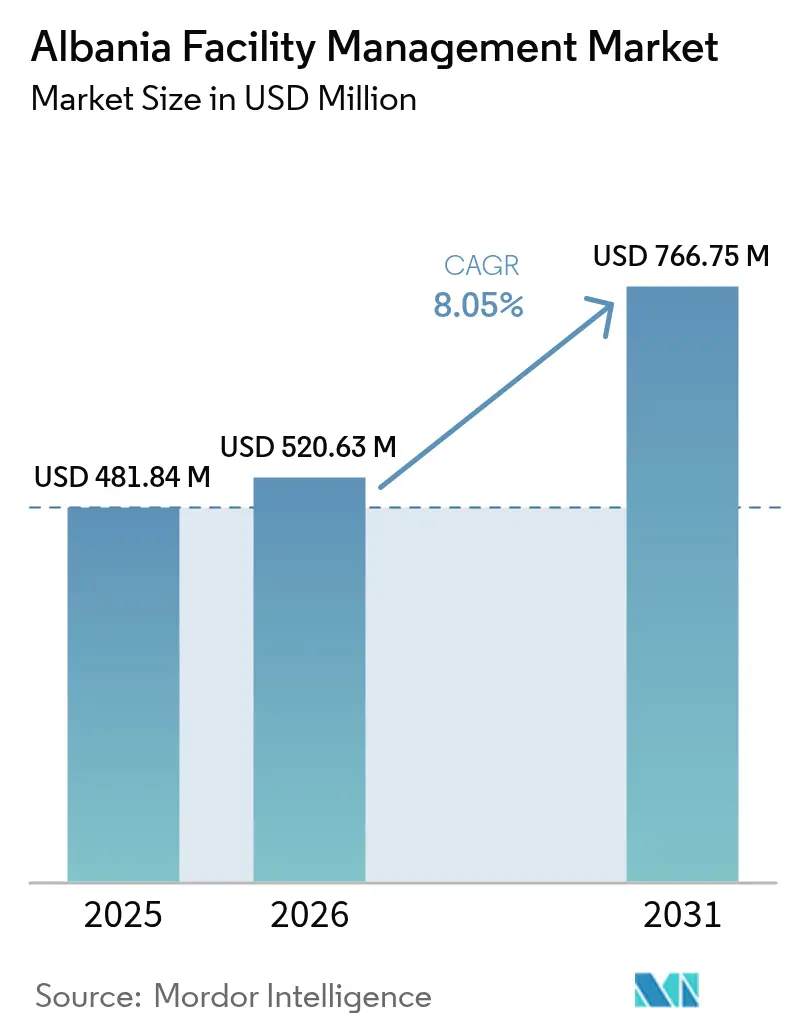
The Albania facility management market size is expected to grow from USD 481.84 million in 2025 to USD 520.63 million in 2026 and is forecast to reach USD 766.75 million by 2031 at 8.05% CAGR over 2026-2031. This Albania facility management market size outlook reflects rapid real-estate expansion, the 2026 roll-out of national energy-performance standards, and growing reliance on outsourced service providers.[1] Robust EU pre-accession financing, tighter building regulations, and technology adoption are aligning to shift building owners toward performance-based contracts that couple predictive maintenance with guaranteed energy savings. International hotel chains entering Tirana and the coastal corridor are setting new service benchmarks that cascade across commercial, institutional, and industrial properties. Technical skills shortages have magnified the cost advantages of outsourcing, while municipal infrastructure upgrades tied to EU funds are expanding the scope of professional facilities oversight. Together, these drivers are repositioning the Albania facility management market from reactive maintenance to data-driven asset stewardship.
Key Report Takeaways
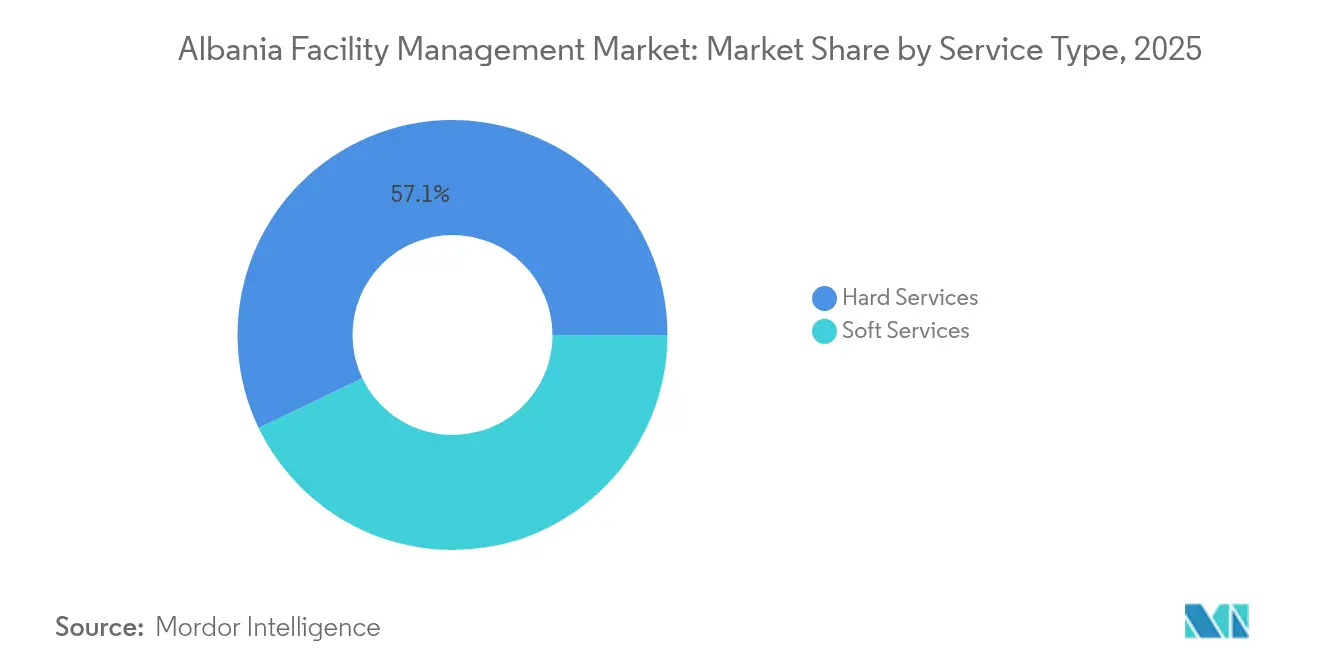
- By service type, hard services led with 57.12% of the Albania facility management market share in 2025.
- By offering type, outsourced models held 64.22% of the Albania facility management market size in 2025 and carry the fastest projected 9.12% CAGR through 2031.
- By end-user industry, commercial facilities accounted for 38.45% of Albania's facility management market share in 2025, while institutional and public infrastructure is set to expand at an 8.55% CAGR to 2031.
Note: Market size and forecast figures in this report are generated using Mordor Intelligence’s proprietary estimation framework, updated with the latest available data and insights as of 2026.
Albania Facility Management Market Trends and Insights
Drivers Impact Analysis*
| Driver | (~) % Impact on CAGR Forecast | Geographic Relevance | Impact Timeline |
|---|---|---|---|
| Technological advancements in building management systems | +1.8% | National, with early gains in Tirana, Durrës, Vlorë | Medium term (2-4 years) |
| Growth of the real estate sector | +2.1% | Coastal areas and the Tirana metropolitan region | Short term (≤ 2 years) |
| Increasing emphasis on green-building practices | +1.4% | National, driven by EU compliance requirements | Long term (≥ 4 years) |
| Macroeconomic indicators supporting FM demand | +1.2% | National, with spillover effects to regional centers | Medium term (2-4 years) |
| EU-funded energy-efficiency retrofit programs boosting FM outsourcing | +1.6% | National, prioritizing public buildings and infrastructure | Long term (≥ 4 years) |
| Expansion of flexible workspace and hybrid office models is increasing the FM scope | +0.9% | Urban centers, particularly Tirana and Durrës | Short term (≤ 2 years) |
| Source: Mordor Intelligence | |||
Technological Advancements in Building Management Systems
Albania’s facility owners are embedding smart meters, sensors, and analytics platforms to cut energy losses and extend asset life. National utility OSHEE has deployed 53,000 smart meters, demonstrating that real-time data can reduce technical losses and improve billing accuracy. With mandatory building-energy performance rules taking effect in 2026, automation will shift from an optional upgrade to a baseline compliance requirement. New hotel projects such as Hyatt Regency Tirana are specifying integrated HVAC, lighting, and security controls, raising expectations across the Albanian facility management market. Pilot projects in Tirana schools show that indoor-environment sensors can enhance comfort while lowering energy use. Vendors that pair digital platforms with on-site delivery are positioned to secure multi-year, performance-based contracts throughout the Albania facility management market.
Growth of the Real-Estate Sector
Gross fixed capital formation rose in 2024, feeding a pipeline of mixed-use towers, logistics hubs, and coastal resorts. Landmark developments such as the 50-storey Bond Tower merge retail, office, and hospitality functions, multiplying the service categories required per site. Higher property-tax assessments introduced in 2025 encourage owners to outsource facilities to specialists who can generate measurable cost savings. International investors are therefore accelerating demand for professional oversight, maintaining the upward trajectory of the Albania facility management market.
Increasing Emphasis on Green-Building Practices
Although hydropower accounts for 98% of national electricity, seasonal variability prompts building owners to adopt low-carbon technologies and demand-response software. Public-school retrofits achieved energy-use reductions of 40% when moving toward near-zero-energy standards. EU-aligned codes now require transparent tracking of resource consumption, pushing facilities teams toward integrated waste and energy reporting. EU-supported circular-economy funding of EUR 87 million for solid-waste infrastructure extends facility scopes to recycling optimisation. These regulations and incentives are embedding sustainability into every service contract within the Albanian facility management market.
EU-Funded Energy-Efficiency Retrofit Programmes Boosting FM Outsourcing
The EU accession framework adopted in 2024 unlocked multilateral capital for public-asset refurbishment. Albania’s Energy Efficiency Agency couples retrofit financing with multi-year performance contracts to guarantee savings. A fiscal plan to reduce public debt while raising capital expenditure makes outsourced facilities management attractive for municipalities under budget pressure. Projects such as Community Infrastructure Support in Durrës include long-term FM obligations alongside reconstruction funding. These arrangements push public bodies to rely on specialist operators, broadening the outsourced segment of the Albania facility management market.
Restraints Impact Analysis*
| Restraint | (~) % Impact on CAGR Forecast | Geographic Relevance | Impact Timeline |
|---|---|---|---|
| Labour-market constraints and skills shortage | -1.9% | National, with acute impact in rural areas | Short term (≤ 2 years) |
| Infrastructure gaps and regional disparities | -1.2% | Rural and secondary urban centers | Medium term (2-4 years) |
| Fragmented regulatory compliance is deterring foreign FM entrants | -0.8% | National, affecting international market entry | Long term (≥ 4 years) |
| Limited adoption of digital FM platforms among SME property owners | -0.7% | National, concentrated in smaller municipalities | Medium term (2-4 years) |
| Source: Mordor Intelligence | |||
Labour-Market Constraints and Skills Shortage
Only 60.9% of working-age Albanians hold a job, and many lack certificates in HVAC, automation, or energy management. Emigration drains technical talent, prompting 74% of companies to consider hiring foreign workers. Vocational pathways rarely include predictive-maintenance curricula, and upskilling initiatives will need time to close the gap. Rising wage premiums and recruitment delays place upward price pressure on the Albania facility management market.
Infrastructure Gaps and Regional Disparities
Waste-collection services cover 70% of the population, limiting integrated FM outside main cities. Broadband and digital-payment gaps hinder cloud-based work-order systems in inland municipalities. Road upgrades such as the Building Resilient Bridges programme are improving access, but mountainous terrain maintains high travel times and costs.[2] Until these disparities narrow, the growth of the Albania facility management market beyond the coastal and capital regions will be gradual.
*Our forecasts treat driver/restraint impacts as directional, not additive. The impact forecasts reflect baseline growth, mix effects, and variable interactions.
Segment Analysis
By Service Type: Hard Services Lead Infrastructure Modernization
Hard services generated USD 275.23 million in 2025, equal to 57.12% of overall revenue in the Albania facility management market. Ageing mechanical, electrical, and plumbing systems require upgrades before the 2026 energy-performance mandate. International hotel brands demand strict uptime and lifecycle cost management, driving adoption of variable-speed drives and high-efficiency chillers. Soft services, though smaller in share, are on track for a 9.35% CAGR as hygiene, workplace wellness, and flexible staffing become standard. Over the forecast horizon, soft services will capture a larger slice of the Albania facility management market, yet capital-intensive hard work will remain essential for code compliance.
Facilities managers increasingly bundle asset management with real-time analytics, moving from scheduled maintenance to predictive models. Cleaning, security, and catering are evolving into experience-oriented offerings, especially in mixed-use towers. This two-speed pattern allows providers to cross-sell, deepening wallet share within the Albania facility management market.

By Offering Type: Outsourcing Dominates Market Evolution
Outsourced contracts represented 64.22% of revenue in 2025 and will advance at a 9.12% CAGR through 2031, the highest growth among delivery models. International hotel chains and mixed-use developers prefer integrated providers that deliver single-invoice accountability. In-house management persists in defence and justice facilities where security protocols demand direct control, yet even ministries are carving out cleaning and landscaping to external specialists. Bundled FM models that exploit volume discounts on energy and consumables are spreading across Grade-A offices. The Albania facility management market is therefore mirroring European practice: owners focus on core real-estate strategy while vendors assume technical risk.
Third-party providers also benefit from a transparent business-registration reform that cuts company formation time to one day, making it easier to enter and scale. Technology platforms that unify work orders, compliance logs, and tenant feedback further cement outsourcing’s comparative advantage.
By End-User Industry: Commercial Leads While Institutional Accelerates
Commercial premises accounted for 38.45% of revenue in 2025, anchored in Tirana’s central business district where Class-A offices and retail destinations cluster. Technology firms and shared-service centres favour long-term agreements that guarantee uptime and cybersecurity-grade access control. Institutional and public infrastructure facilities are the fastest-growing end-user, advancing at an 8.55% CAGR as EU-funded retrofits require lifetime performance monitoring. Education and healthcare upgrades drive infection-control cleaning and IoT-based air-quality checks unfamiliar to traditional custodial teams.
Retail-warehouse hybrids along the Durrës-Vlorë corridor need seasonal staffing, prompting providers to design flexible workforce pools. Industrial facilities in energy and light manufacturing are emerging as growth niches as investors capitalise on competitive labour costs and renewable-energy availability. This diversity reinforces resilience across the Albania facility management market.

Geography Analysis
Tirana generates more than half of the national FM revenue, reflecting its concentration of embassies, mixed-use towers, and Grade-A offices that require 24/7 technical cover. Apartment prices in the capital climbed 16.9% year on year in 2024, incentivising owners to invest in professional upkeep. Integrated contracts featuring energy analytics and tenant-experience apps have become the norm, making Tirana a test bed for advanced services within the Albanian facility management market.
The coastal cities of Durrës, Vlorë, and Sarandë form the fastest-growing cluster as tourist arrivals topped 10 million in 2024. Resorts, marinas, and seasonal retail strips need scalable labour and mobile equipment fleets. Road and tunnel projects are shrinking travel times, enabling Tirana-based operators to run satellite teams along the coast. Seasonal demand fluctuations oblige providers to fine-tune staffing levels, yet opportunities for value-added services remain robust in the Albania facility management market.
Interior regions lag due to sparse infrastructure and smaller property footprints. However, programmes such as Building Resilient Bridges and KfW-backed solid-waste systems inject more than USD 100 million into secondary municipalities. As broadband and e-governance spread, cloud-based FM platforms will allow remote supervision, gradually unlocking efficiencies nationwide.
Regulatory Landscape
Albania's facility management market operates under a compliance framework shaped by construction and territory-planning rules, including Law No. 107/2014 on Territory Planning, plus sector-specific oversight for critical infrastructure. Decision No. 508 (25.09.2025) clarified the Ministry of Infrastructure and Energy's state responsibility fields for technical standards and monitoring across construction and urban development, reinforcing requirements around safety and energy conservation that flow into hard-FM scopes.
For technology and communications facilities, AKEP has tightened security and market-entry rules that affect how telecom sites, data rooms, and connected building systems are operated and maintained. In March 2026, AKEP approved a General Authorization Regime (Decision No. 10, dated 31.03.2026) aligning procedures with EU principles, and adopted mandatory technical, operational, and organizational security measures for electronic communications networks (Decision No. 8, dated 13.03.2026). This raises expectations for audit-ready maintenance records, access control, and risk management at TMT and other connectivity-dependent facilities.
Value Chain Analysis
The Albania facility management value chain starts with asset owners and developers, including commercial towers, hospitality projects, public institutions, logistics and industrial parks, which set service levels and compliance outcomes. These requirements flow into bundled and integrated FM providers that coordinate hard services (MEP, HVAC, fire and life safety, energy monitoring) and soft services (cleaning, security, front-of-house, waste handling). Delivery also depends on upstream inputs such as spare parts and consumables, specialist subcontractors (e.g., elevators and fire systems), and technology suppliers for BMS, sensors, and connectivity. Telecom upgrades such as One Albania's 5G rollout with Ericsson equipment illustrate how digital infrastructure becomes an enabling layer for remote monitoring, work-order management, and security controls.
On the downstream side, service execution and performance reporting increasingly sit in centralized multi-tenant sites where landlords prioritize standardized operations. Logistics and industrial ecosystems, including Tirana Logistic Park and Terra Park, bundle security, maintenance, waste management, and utilities monitoring for tenants. Supporting services such as warehousing, distribution, and fleet maintenance from logistics providers, including ALBKET and BALFIN's logistics activities, can influence response times and parts availability. EU integration priorities around transport and energy networks (TEN-T/TEN-E) further reinforce demand for documented, compliance-oriented O&M practices across public and private facilities.
Competitive Landscape
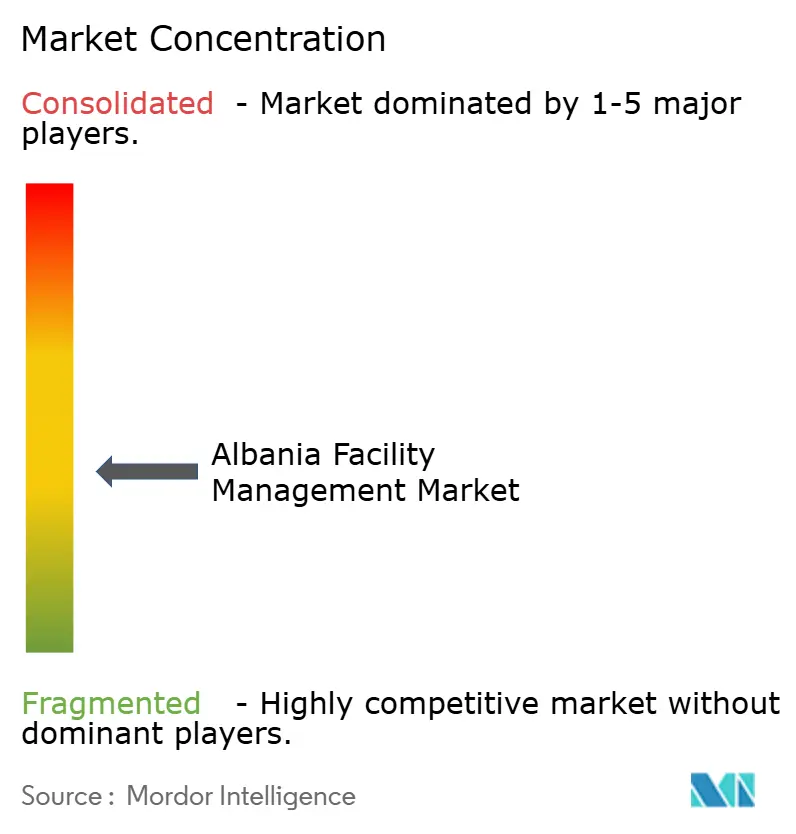
The Albania facility management market features moderate concentration: the five largest providers control a prominent share of revenue. Global firms such as Colliers supply advisory and benchmarking services, often pairing with local licensees for execution. Diversey Holdings offers hygiene chemicals and training, making it a preferred partner for hotels aiming at international cleanliness protocols.
Domestic leader ACREM manages more than 800,000 m² of commercial property and leverages strong local networks to win municipal contracts.[4] BMF Grup is scaling integrated packages that blend robotics, smart-meter analytics, and fire-safety audits, backed by 25 years of MEP expertise. Competitive edge is migrating toward vendors that invest in workforce certification and digital dashboards, prerequisites for EU-funded projects that demand audit-ready records.
Consolidation is expected as single-service firms grapple with rising compliance costs and talent shortages. Strategic alliances that combine foreign technology with local staffing are emerging as the favoured route to national coverage. Providers able to bundle energy-performance guarantees with traditional hard and soft services stand to capture premium margins across the Albania facility management market.
Albania Facility Management Industry Leaders
-
Globe William International
-
Mott Mcdonald
-
Diversey Holdings Ltd
-
AlbStar Sh.a.
-
Colliers
- *Disclaimer: Major Players sorted in no particular order
Market Opportunities and Future Outlook
Technology-led integrated FM is an active whitespace as Albania upgrades digital infrastructure and aligns with EU-oriented standards, supporting a shift toward connected operations where energy, safety, and security controls are managed together. One Albania's commercial 5G launch (November 2024) and its investment program for 5G standalone infrastructure targeting ports, airports, and industrial zones extend the base of facilities that can support continuous monitoring, uptime-driven maintenance, and cybersecurity-aware access management. That expansion increases demand for providers that combine hard services with BMS and analytics delivery.
Public and rural connectivity programs also expand addressable locations for professional FM and remote supervision models. On 27 January 2026, WBIF awarded a EUR 36.1 million investment grant for broadband infrastructure development in white areas across multiple regions, including Shkodra, Kukes, Dibra, Vlora, Gjirokastra, Fier, Berat, and Korce. These deployments create operational footprints, such as network huts and municipal and institutional endpoints, that require standardized maintenance, power-quality management, and security. Cross-border backbone efforts add additional enterprise infrastructure needs, including the April 2026 MoU between 4iG Group and Grid Telecom to explore a high-capacity terrestrial fibre link between Albania and Greece, supporting resilience-focused network facilities where outcome-based service models and documented compliance can differentiate FM vendors.
Recent Industry Developments
- April 2026: 4iG Group and Grid Telecom signed an MoU to explore a high-capacity terrestrial fibre link between Albania and Greece. The initiative strengthens regional backbone resilience and expands the footprint of fiber-related sites that require secure, standards-driven operations and maintenance. It also increases demand for integrated FM capabilities across power, access control, and uptime management at network facilities.
- January 2025: A case study published by T-MODE referenced Mott MacDonald as the client for implementation support to help establish rail passenger operations in Albania. This workstream supports modernization of transport operations and creates additional requirements for structured station and depot maintenance, safety procedures, and performance documentation. It reinforces the role of international engineering and program expertise in shaping long-term O&M practices.
- September 2024: Mott MacDonald highlighted ongoing design and engineering services for the Skavica hydropower project on the Drin River. Large energy-infrastructure programs expand demand for specialist technical oversight, compliance documentation, and lifecycle asset-management practices aligned with utility-grade reliability needs. The project pipeline also increases the addressable scope for hard-FM and safety-critical maintenance services.
Research Methodology Framework and Report Scope
Market Definition and Coverage
This market is defined as the value of facility management services delivered in Albania to operate, maintain, and support buildings and sites across hard and soft services, including work done in-house and through outsourcing.
Scope exclusions: This sizing excludes new-build construction and capital EPC work, along with one-time equipment sales that are not delivered as an FM service.
Segmentation Overview
- By Service Type
- Hard Services
- Asset Management
- MEP and HVAC Services
- Fire Systems and Safety
- Other Hard FM Services
- Soft Services
- Office Support and Security
- Cleaning Services
- Catering Services
- Other Soft FM Services
- Hard Services
- By Offering Type
- In-house
- Outsourced
- Single FM
- Bundled FM
- Integrated FM
- By End-user Industry
- Commercial (IT and Telecom, Retail and Warehouses, etc.)
- Hospitality (Hotels, Eateries, Large-scale Restaurants)
- Institutional and Public Infrastructure (Govt, Education, Transportation)
- Healthcare (Public and Private Facilities)
- Industrial and Process (Manufacturing, Energy, Mining)
- Other End-user Industries (Multi-housing, Entertainment, Sports and Leisure)
Data Sources, Market Sizing, and Validation
Desk Research
We first build the market map using public statistics and sector definitions that can be checked by any reader. For Albania, this typically includes sources such as INSTAT structural business statistics, business register releases, construction and building permit series, and relevant classifications for administrative and support service activities.
To keep the model grounded in real demand, we also review government and municipal procurement notices for cleaning, security, and maintenance contracts, alongside national energy and utility disclosures that signal operating intensity in commercial buildings. Broader reference points are added from sources such as the World Bank and Eurostat (where comparable series exist), plus company filings and investor presentations for large service providers that report regional revenue context. In a few cases, we also use paid subscriptions for company financials and intelligence, and for contracts and tenders screening, mainly to speed up cross-checks rather than to replace public data. The desk sources listed here are illustrative, and many other public documents and databases were used for data collection, validation, and clarification.
Primary Interviews and Surveys
Interviews and surveys with facility service providers, property and operations leaders, procurement teams, and building users in Albania help test outsourcing rates, contract values, labor costs, service mix, and changes in local demand. Respondents also clarify how recurring services are packaged and purchased, while unresolved differences are checked against desk evidence before the model is finalized.
Distribution of primary research fieldwork respondents
| Company type | Respondent position |
|---|---|
| Top tier: 26% | CXOs: 20% |
| Mid tier: 49% | Functional/Unit leaders: 28% |
| Smaller Players: 25% | Managers: 52% |
Market-Sizing & Forecasting
Market sizing starts with a top-down rebuild of the addressable spend tied to occupied building activity in Albania, and then it is translated into FM service demand using outsourcing penetration and service intensity by facility type. To make sure this is not just a theoretical pool, we corroborate totals with selective bottom-up checks, such as sampled contract values from tenders, provider revenue run-rates, and simple volume x price approximations for recurring services.
Key inputs that steer the model include the stock of commercial and institutional floor space implied by permits and completions, outsourcing versus in-house mix by end-user, typical contract length and renewal timing, hard versus soft service mix, and wage and utility cost direction that influences service pricing. When bottom-up signals are missing for smaller local providers, we fill gaps using conservative ranges for contract density per square meter and then reconcile the result back to observable procurement activity.
For forecasting, we mainly use scenario analysis supported by short time-series smoothing, since Albania can show step-changes from public spending cycles and new building additions. Assumptions for pricing and outsourcing adoption are reviewed with primary respondents, and then applied consistently across end-user groups before the final total is signed off.
Data Validation & Update Cycle
Outputs are checked against independent signals, including tender volumes, visible outsourcing activity in major end-user groups, and whether service mix trends (hard versus soft) remain realistic for local operations. We review year-on-year swings for anomalies, and where the model moves faster than the on-ground market, we recheck the input that caused it and, when needed, reconnect with interviewees.
Before publication, a second analyst reviews definitions, math, and key assumptions so that the final number is traceable back to a small set of repeatable steps. Reports are refreshed annually, and interim updates are triggered when there are material shifts such as regulation changes, large public contract waves, or major pricing shocks. Right before delivery, we do a fresh pass to ensure the latest available public releases are reflected.
Mordor Intelligence's Albania Facility Management Market Size Versus Other Published Estimates
It is common to see different published market values for facility management in Albania because each publisher can draw the line around services and delivery models in a different way, and then apply pricing and outsourcing assumptions that do not match local buying patterns.
In this study, the bigger gap drivers are usually whether in-house FM labor is counted or only outsourced contracts are counted, plus how integrated and bundled deals are treated when services are packaged under one agreement. Differences also come from how prices are stepped forward (for example, wage-led versus CPI-led increases), the timing of currency conversion, and how often assumptions are refreshed when public tenders and commercial occupancy shift.
Benchmark comparison
| Source | Market Size | Gaps in Research Methodology |
|---|---|---|
| Mordor Intelligence | USD 520.63 M (2026) | |
| Regional Consultancy A | USD 285.40 M (2026) | This estimate appears to lean toward outsourced contracts and may undercount in-house delivery, which can be meaningful in public infrastructure and parts of commercial real estate. It also uses a longer forecast window, so near-term price and penetration assumptions may not be recalibrated as often. |
| Trade Journal B | USD 590.00 M (2026) | This figure likely includes adjacent business support services beyond core FM (such as broader office administration and support), which inflates totals versus a service-defined FM scope. It may also apply higher average contract values without separating bundled packages from true integrated FM. |
The table shows that the spread is mainly explained by what is counted as FM revenue and how in-house work is handled, rather than by one single growth assumption. By keeping the service scope limited to hard and soft FM and explicitly modeling in-house alongside outsourced delivery, the number stays tied to real facility operations signals, a choice applied by Mordor Intelligence.
Key Questions Answered in the Report
What is the current value of the Albania facility management market?
The Albania facility management market size is USD 520.63 million in 2026 and is projected to grow to USD 766.75 million by 2031.
Which service category dominates revenue?
Hard services hold 57.12% of revenue because ageing mechanical, electrical, and plumbing systems require extensive upgrades.
Why is outsourcing expanding faster than in-house delivery?
Outsourced providers offer trained personnel, compliance guarantees, and technology platforms, driving a 9.12% CAGR for outsourced contracts through 2031.
Which end-user segment is advancing most quickly?
Institutional and public infrastructure facilities are growing at an 8.55% CAGR due to EU-funded retrofits that demand lifetime performance monitoring.
How will the 2026 energy-performance mandate affect demand?
Mandatory performance standards will increase uptake of IoT-enabled monitoring, predictive maintenance, and specialist energy-management services across the Albania facility management market.
Where are the highest geographic growth prospects?
The coastal corridor from Durrës to Vlorë is expanding fastest, spurred by tourism projects and infrastructure upgrades that require year-round facility oversight.