
Airport Security Market Size and Share
Market Overview
| Study Period | 2019 - 2031 |
|---|---|
| Market Size (2026) | USD 17.84 Billion |
| Market Size (2031) | USD 27.49 Billion |
| Growth Rate (2026 - 2031) | 9.04 % |
| Fastest Growing Market | Middle East and Africa |
| Largest Market | Asia Pacific |
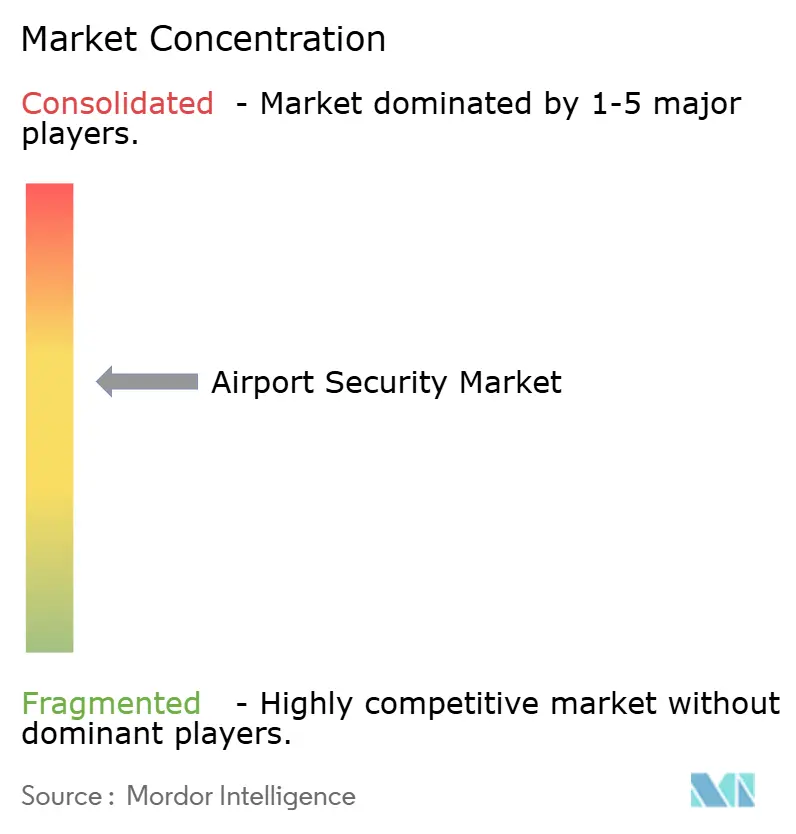
| Market Concentration | Medium |
Major Players *Disclaimer: Major Players sorted in no particular order Image © Mordor Intelligence. Reuse requires attribution under CC BY 4.0. | |
Airport Security Market Analysis by Mordor Intelligence
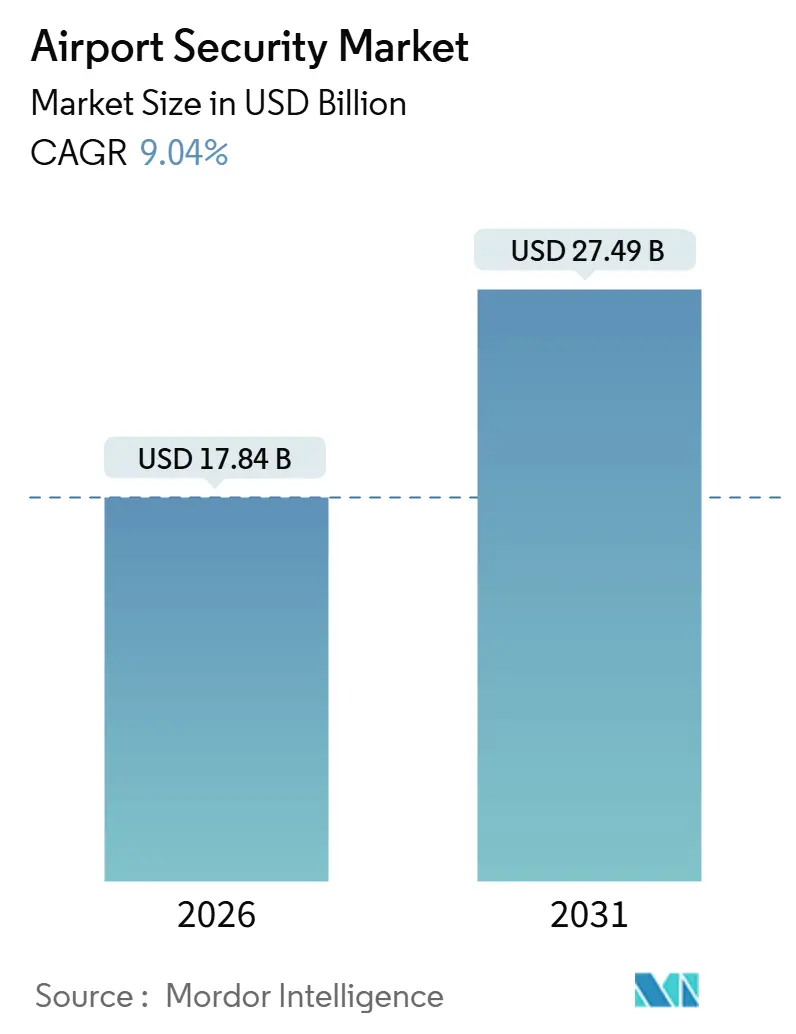
The airport security market size stood at USD 17.84 billion in 2026 and is projected to reach USD 27.49 billion by 2031, registering a 9.04% CAGR over the forecast period. Strong passenger recovery toward the 10 billion-traveler mark, rapid rollout of touchless biometric checkpoints, and mandates for cyber-physical resilience reposition security from a cost center to a revenue-protecting differentiator. Screening lanes are shifting to computed tomography (CT) scanners that allow liquids and laptops to remain in their bags. At the same time, credential-authentication kiosks verify faces against photo IDs in under two seconds, compressing curb-to-gate times and boosting retail spend. Integrated command centers stream edge data to the cloud for AI analytics that flag anomalies in real-time, allowing airports to redeploy staff from monitoring walls of cameras to resolving incidents. Mid-tier hubs are leapfrogging legacy systems with modular, cloud-native platforms procured as subscription services, shrinking integration cycles and aligning technology refresh with traffic growth. Regionally, the Asia-Pacific remains the revenue anchor. Still, the Middle East and Africa deliver the fastest compounded growth, as mega-projects, such as Riyadh’s King Salman International Airport, integrate seamless travel into master plans from the outset.
Key Report Takeaways
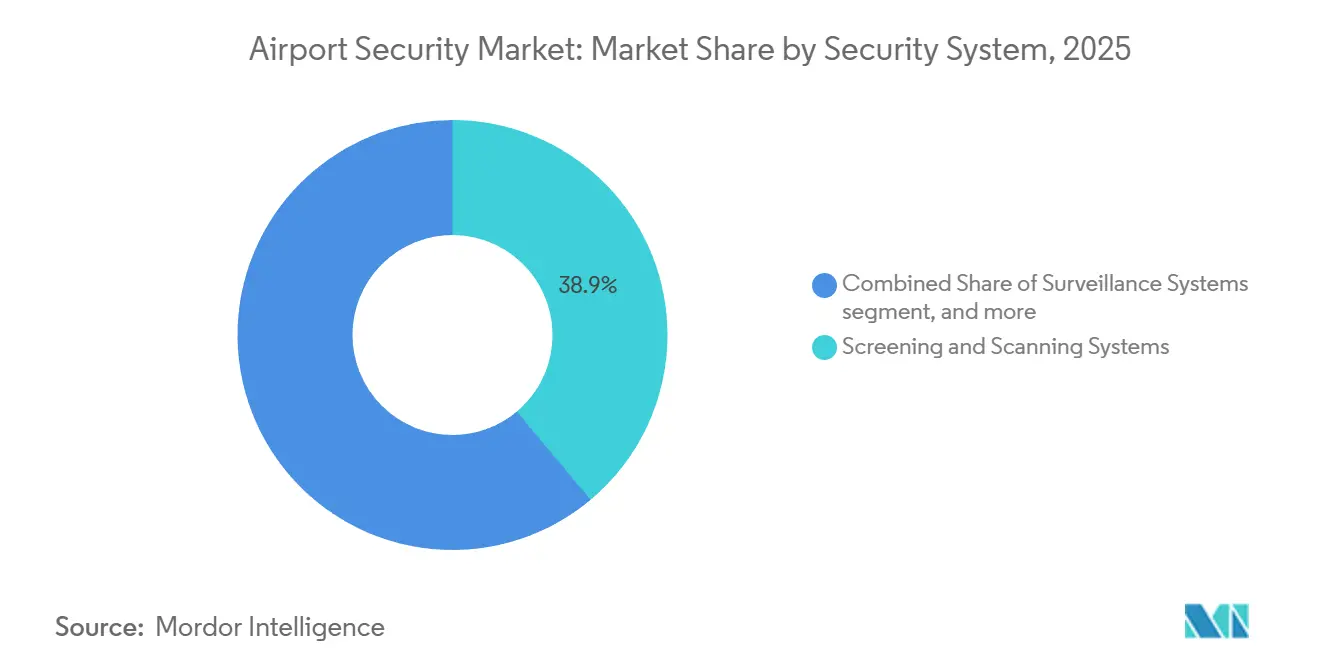
- By security system, screening and scanning accounted for a 38.90% share of the airport security market in 2025; access control and biometrics are forecasted to expand at a 10.75% CAGR through 2031.
- By airport size, hubs processing more than 50 million passengers captured 40.70% of the airport security market size in 2025, whereas the 15-30 million passenger tier is projected to advance at a 10.98% CAGR through 2031.
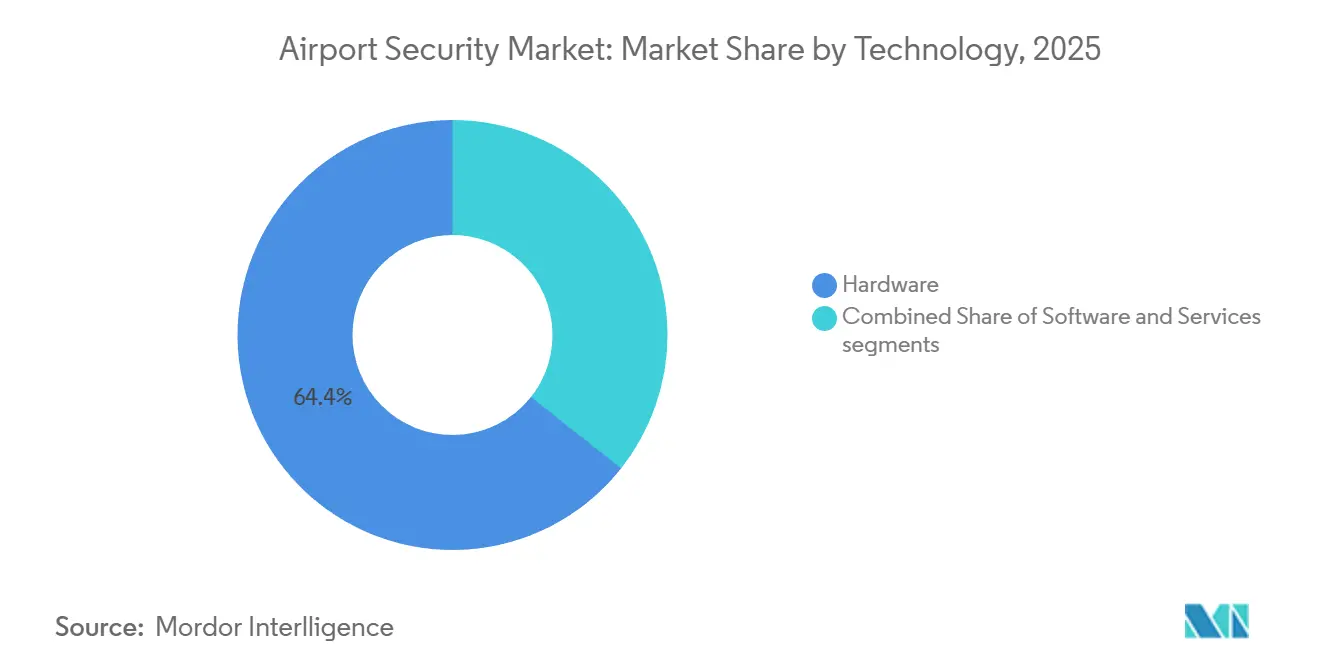
- By technology, hardware accounted for a 64.35% share of spending in 2025, and software is poised to grow at an 11.65% CAGR through 2031.
- By application, terminal zones accounted for 49.85% of 2025 revenue, while perimeter and restricted areas are projected to track a 12.50% CAGR to 2031.
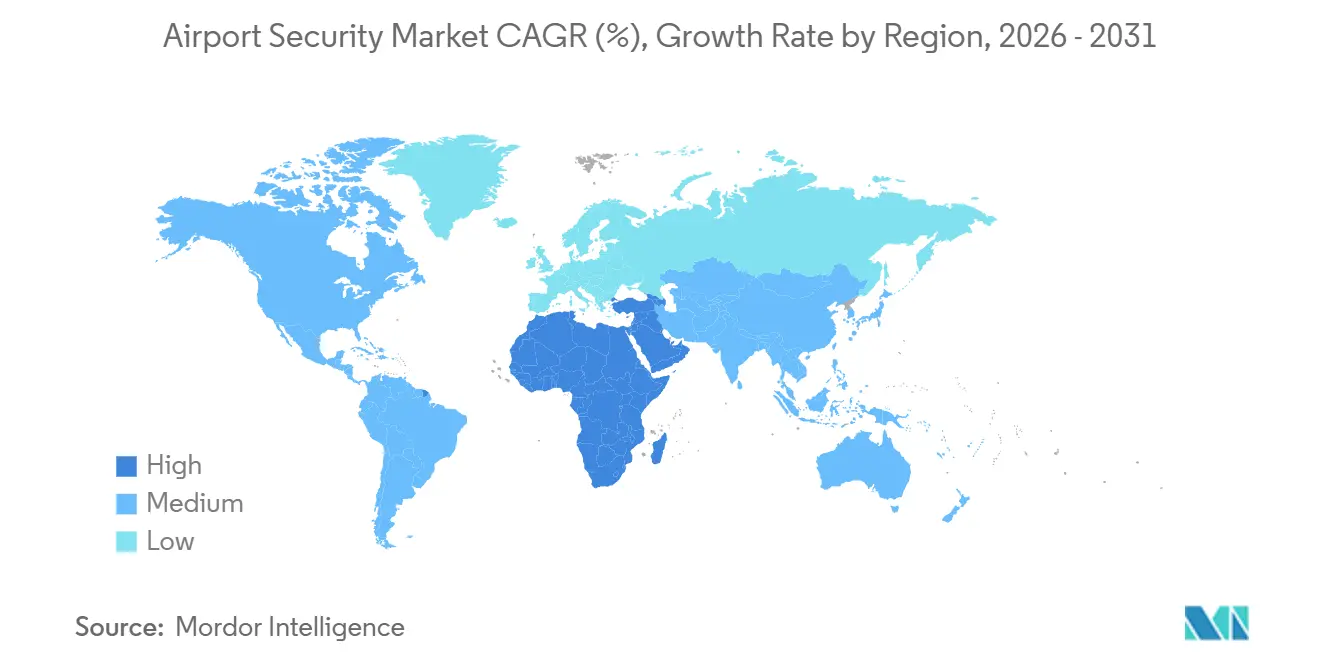
- By geography, the Asia-Pacific region held 36.45% of global revenue in 2025, but the Middle East and Africa are projected to grow at an 11.65% CAGR through 2031.
Note: Market size and forecast figures in this report are generated using Mordor Intelligence’s proprietary estimation framework, updated with the latest available data and insights as of January 2026.
Market Trends and Insights
Drivers Impact Analysis of Airport Security Market*
| Driver | (~) % Impact on CAGR Forecast | Geographic Relevance | Impact Timeline |
|---|---|---|---|
| Rising passenger traffic and touchless screening | +1.8% | Global, APAC and Middle East lead | Medium term (2–4 years) |
| Harmonized international security regulations | +1.5% | Global | Long term (≥ 4 years) |
| Integrated command-and-control (C2) with AI analytics | +1.6% | North America and Europe first adopters | Medium term (2–4 years) |
| Cyber-physical convergence and cloud migration | +1.3% | Global | Long term (≥ 4 years) |
| Biometric One-ID and seamless travel initiatives | +1.9% | APAC core, spill-over to Middle East and Europe | Short term (≤ 2 years) |
| Drone and UAS threats lifting perimeter demand | +1.2% | North America and Middle East | Medium term (2–4 years) |
| Source: Mordor Intelligence | |||
Rising Passenger Traffic and Touchless Screening
Record volumes now rival pre-pandemic highs, pressuring checkpoints to clear travelers in minutes rather than hours. The TSA installed 2,054 credential-authentication units across 250 airports by October 2025 and plans 3,585 units by 2049, with each device matching a passenger’s face to an encrypted ID in two seconds.[1] CT scanners deployed at 645 lanes allow passengers to keep liquids in their bags, eliminating bottlenecks that once dampened duty-free sales. Asia-Pacific hubs pilot curb-to-gate flows of under ten minutes, creating a service benchmark that forces legacy airports to accelerate their biometric adoption. Airlines support the transformation, noting a 40% reduction in missed-connection claims at sites running eGates. Health and hygiene preferences that emerged during COVID-19 remain persistent, reinforcing airports’ push for no-touch modalities and maintaining momentum for equipment upgrades despite softer yields in some regions.
Harmonized International Security Regulations
ICAO Annex 17 provides the standard baseline, but national overlays have historically forced vendors to maintain multiple product lines. The ECAC Common Evaluation Process now grants a single clearance across 44 European states, compressing certification time from years to months.[2] In parallel, the forthcoming 14th edition of Annex 17 will enshrine digital travel credentials, nudging airports to converge on interoperable biometric standards. The TSA’s 100% explosive-trace requirement for checked baggage contrasts with the statistical sampling still allowed in parts of Europe; momentum favors global parity as risk-based screening formalizes. Harmonization expands the addressable tenders, attracts more bidders, and ultimately lowers unit prices. It increases the upfront cost for entrants that must satisfy intricate cyber-assurance clauses embedded in modern specifications.
Integrated Command-and-Control with AI Analytics
Daily screening generates more than 5.5 million X-ray images at US checkpoints alone, a volume that exceeds the capacity for manual review. Unified platforms now integrate CCTV, perimeter radar, and access-control alerts on cloud dashboards, which push only high-probability anomalies to operators, reducing false alarms by up to 35%. DHS science guidance encourages a shift toward measurement-centric AI that infers material density rather than searching for patterns, resulting in a double-digit percentage reduction in secondary bag checks. Airports subscribe to monthly algorithm updates, severing the historic tie between security innovation and five-year hardware refresh cycles. Shared models propagate threat intelligence across networks, meaning a weapon profile first detected in Dallas can trigger auto-rules in Dubai within hours, without requiring local code rewrites.
Cyber-Physical Convergence and Cloud Migration
Touchless journeys rely on data exchange between credential kiosks, airline DCS, and border control backends, dissolving decades-old air gaps in operational technology. TSA cyber directives now require airports to implement zero-trust segmentation, continuous monitoring, and incident-response plans that parallel those of the power grid. Hyperscale clouds offer resilient uptime but concentrate systemic risk; a regional outage at a single provider could simultaneously ground multiple hubs. 24/7 security operations center coverage is part of their offering. Hybrid architectures are emerging, with edge appliances that enable latency-sensitive inference on-site, while periodic batch analytics are shifted to the cloud. Vendors bundle managed detection and response, filling internal talent gaps and providing 24/7 security operations center coverage as part of their subscription fees.
Restraints Impact Analysis of Airport Security Market*
| Restraint | (~) % Impact on CAGR Forecast | Geographic Relevance | Impact Timeline |
|---|---|---|---|
| Lengthy certification and qualification cycles | -1.2% | Global, acute in North America and Europe | Long term (≥ 4 years) |
| Scarcity of skilled aviation security technologists | -0.9% | Global, high turnover in North America and Europe | Medium term (2–4 years) |
| Integration debt from legacy infrastructure | -1.0% | Mature markets | Long term (≥ 4 years) |
| Capex compression amid uneven traffic recovery | -0.8% | Europe and APAC hubs | Short term (≤ 2 years) |
| Source: Mordor Intelligence | |||
Lengthy Certification and Qualification Cycles
Bringing a new screening modality from prototype to checkpoint can take more than 30 months in the US, where devices must navigate lab tests, live trials, and fleet-wide pilots before being added to the Qualified Products List. Explosive detection for checked baggage faces even longer timelines due to the complexity of classified threat libraries. Europe’s ECAC process shortens the evaluation period but still spans two years. Incumbents exploit portfolio pre-qualification, launching incremental upgrades under existing certificates, while startups burn capital waiting for approvals. Airports delay orders until certificates are finalized, producing a demand valley that slows innovation and stalls return on R&D investment.
Scarcity of Skilled Aviation Security Technologists
Checkpoint automation replaces repetitive document checks with systems that demand higher digital fluency. TSA turnover exceeds 20% at some US hubs, making it challenging to build cumulative expertise. Cybersecurity specialists who can segment OT networks earn premium salaries in finance and healthcare, leaving public-sector airports understaffed. Vendors now bundle training into service contracts, while curricula often lag behind technology shifts. By the time staff master one interface, a next-generation release alters workflows. Dependence on vendor-managed operations increases, eroding institutional knowledge and complicating the integration of multiple vendors over the equipment's life cycle.
*Our forecasts treat driver/restraint impacts as directional, not additive. The impact forecasts reflect baseline growth, mix effects, and variable interactions.
Airport Security Market Segment Analysis
By Security System:
Biometrics Gain MomentumScreening and scanning systems led the airport security market, accounting for 38.90% of the revenue in 2025, following the TSA's rollout of 645 CT lanes that allow passengers to leave liquids and electronics in their carry-ons. Access control and biometrics, however, are forecast to expand at a 10.75% CAGR through 2031 as airports replace manual ID checks with facial recognition, iris matching, and fingerprint verification. The push for seamless travel aligns with airlines' interest in shorter dwell times and higher ancillary revenue. Fingerprint readers remain prevalent for employee access due to cost advantages, but facial scanners dominate passenger flows because travelers do not need to pause to touch equipment. Iris technology has niche applications in restricted areas where false acceptance must approach zero; however, higher sensor costs restrain mass deployment. AI-powered surveillance enhances legacy cameras, alerting operators to instances of loitering, crowd density, or abandoned objects, thereby helping to offset labor shortages. Perimeter intrusion detection capitalizes on multilayer sensor arrays that detect drones, fence cuts, and ground vibrations. Fire and life-safety systems follow predictable replacement cycles, transitioning from Halon to clean-agent suppression in line with environmental regulations. At the same time, cybersecurity budgets rise to secure networks that once operated in isolation.
Second-generation command-and-control suites integrate these subsystems on cloud dashboards, allowing airports to subscribe to continuous software updates instead of multi-year hardware refreshes. Vendors market outcomes, promising queue times below ten minutes, rather than discrete equipment counts. This shift favors suppliers with extensive AI laboratories and large datasets to train models that flag anomalies with fewer false positives. Airports with legacy silos run middleware translators, but long-run economics favor full platform migrations that shed integration debt and deliver single-pane visibility into an expanding threat surface. The airport security market continues to reward solution providers that can balance open standards with turnkey delivery, ensuring airports avoid vendor lock-in while still meeting aggressive deployment timelines.

By Airport Size:
Mid-Tier Hubs Move FastHubs handling more than 50 million passengers held 40.70% of the airport security market size in 2025, reflecting capital concentration at gateways such as Dubai International and Beijing Daxing. Airports processing 15 to 30 million travelers are set to grow at the fastest rate, with a 10.98% CAGR, driven by modular cloud platforms that sidestep legacy integration pitfalls. Many mid-tier terminals have opened within the last decade, incorporating open-architecture cabling and IP cameras that support plug-and-play analytics without requiring re-wiring. Subscriptions convert upfront capital expenditures into operating predictable expenses, allowing these operators to scale security in line with traffic rather than making significant lump-sum investments.
Facilities with 5 to 15 million passengers often pursue vendor-managed service contracts, bundling equipment, software, and maintenance into a single per-passenger fee. This model transfers performance risk to suppliers, a compelling proposition for boards wary of technology obsolescence. Airports with fewer than 5 million passengers remain price-sensitive, purchasing metal detectors and 2D X-ray units until regulators compel them to upgrade to CT scanners. Conversely, hubs with 30 to 50 million passengers sit at a crossroads: their traffic justifies modernization, but 1990s-era infrastructure complicates adoption of AI-rich services. Incremental retrofits preserve continuity but prolong heterogeneous environments, whereas clean-sheet terminals in South-East Asia leapfrog with integrated biometric corridors and drone-aware perimeters from day one.
By Technology:
Software Accelerates as Hardware CommoditizesHardware accounted for 64.35% of 2025 spending, including CT scanners, millimeter-wave portals, perimeter radars, and access gates. However, software revenue is expected to climb at an 11.65% CAGR through 2031, as AI, video analytics, and cloud orchestration deliver the actionable intelligence that end users value most.[3] Measurement-centric AI now infers atomic number and density from image slices, lowering secondary bag pulls and shrinking staffing rosters. Subscription-based software lets vendors iterate monthly, compressing innovation cycles that once tracked hardware depreciation.
Services installation, training, and managed operations grow in lock-step with software, as airports outsource system upkeep to specialists who retain scarce cybersecurity and machine-learning talent. Outcome-based contracts align payments to performance metrics such as queue time or threat-detection rate. The approach reduces capex spikes but inflates opex lines, a shift finance departments manage via five-year rolling renewals. Vendors with vertical stacks that span hardware, software, and services can ensure interoperability. Still, airports mindful of lock-in negotiate data-ownership clauses that ensure algorithm portability at the end of the contract.
By Application:
Perimeter Rapidly ScalesTerminal zones generated 49.85% of 2025 revenue, including housing screening lanes, biometric eGates, and surveillance clusters that are critical to passenger throughput. Perimeter and restricted areas, however, are forecast to post a 12.50% CAGR through 2031, as drone incursions, fuel farm sabotage risk, and regulatory focus shift spending beyond the terminal envelope. Multi-sensor arrays, combining radar, RF, optical, and acoustic detectors, classify drones within seconds, with AI identifying only credible threats to human operators. Airside deployments now integrate video analytics that alert ramp crews to foreign-object debris or unscheduled vehicle movements, cutting runway incursion risk and associated regulatory fines.
Landside nodes, parking decks, ride-share curbs, and public-transit portals deploy automatic number plate recognition and vehicle screening to prevent car-bomb attacks. Cargo facilities confront unique challenges; 100% screening mandates interact with diverse package shapes, driving the adoption of explosive-trace portals and canine patrols. Application spending ultimately tracks threat proximity: Middle Eastern airports allocate outsized budgets to perimeters due to geopolitical instability, while North American hubs emphasize terminal throughput to absorb rising traveler counts without expanding physical footprints.
Geography Analysis
APAC Airport Security Market
Asian megahubs such as Beijing Daxing, Delhi Indira Gandhi, and Singapore Changi collectively accounted for more than one-third of the global airport security market revenue in 2025, reflecting sustained double-digit traffic growth and government-backed biometric mandates. India alone enrolled millions of domestic passengers into Digi Yatra, demonstrating a scalable cloud-native identity infrastructure that sidesteps legacy constraints. China’s five-year aviation plan earmarks cloud command centers for every gateway handling over 20 million fliers, embedding AI anomaly detection and drone-aware perimeters as baseline specifications. Regional low-cost carriers support security automation because faster boarding unlocks additional aircraft rotations, enhancing profitability.
MEA Airport Security Market
The Middle East and Africa are projected to experience the fastest compounded growth, driven by state-funded mega-projects strategically positioned to capture east-west transfer traffic. Saudi Arabia’s King Salman International, budgeted at USD 31 billion, combines perimeter radar fences, biometric boarding, and cloud-hosted security orchestration from day zero. Qatar’s Hamad International adds AI-video modules that detect micro-crowd surges, preventing queue spill-back during pilgrimage peaks. African investment concentrates in South Africa, Kenya, and Morocco, often under vendor-financed contracts that align payments with passenger fees. Multilateral banks sponsor upgrades to regional gateways along the African Continental Free Trade Area trade corridors, bundling security modernization with cargo digitization programs.
The Americas and Europe Airport Security Market
North America’s mature infrastructure moderates growth, but it still contributes sizable annual budgets as the TSA upgrades its checkpoint CT and credential-authentication fleets. Federal grants co-finance perimeter drone-detection pilots in Miami and Los Angeles, creating reference sites for regional airports seeking to replicate layered defenses. Europe’s recovery lags behind its eastern peers, which pressures capital expenditures. However, harmonized certification under ECAC reduces procurement friction once financing aligns. Southern American hubs pursue phased modernization; São Paulo Guarulhos focuses on checkpoint automation, while Santiago de Chile invests in perimeter fiber optics after a 2024 cargo heist highlighted blind spots.
Regulatory Landscape
Airport security requirements are anchored to ICAO Annex 17 as the global baseline, while national and regional overlays shape equipment certification, operating procedures, and audit regimes. In Europe, Commission Regulation (EU) 2026/247 updated the aviation-security framework tied to Regulation (EC) No 300/2008 by strengthening expectations around national quality control programs, including incident reporting and confidential security reporting systems aligned to ICAO standards. It was followed by Commission Implementing Regulation (EU) 2026/449, which refreshed detailed measures spanning access control, vehicle examination, aircraft security, and supplies, and adjusted the timing of certain explosive trace detection (ETD) algorithm upgrade deadlines. The updates indicate a risk-based approach that weighs technology readiness against compliance timelines.
In the United States, TSA rules and security programs continue to shape checkpoint, baggage, and workforce-screening operations, including identity and credential verification workflows that connect airports, airlines, and security contractors. In February 2026, TSA rolled out TSA ConfirmID as an alternative identity verification option for travelers without REAL ID-compliant identification, creating a defined pathway to maintain throughput while enforcing identity assurance. In June 2026, TSA published a Federal Register notice establishing a USD 19.00 per-employee, per-year fee for the Crewmember Access Point (CMAP) program, which replaces Known Crew Member (KCM) with biometric-enhanced access. Airports and airlines are therefore expected to keep their access points, identity systems, and operating procedures aligned as programs transition.
Value Chain Analysis
The airport security value chain spans (1) requirements and certification bodies (ICAO standards, regional evaluators such as ECAC, and national agencies such as TSA and police or border authorities), (2) system OEMs that produce screening and scanning hardware (CT, AIT, ETD, metal detection), surveillance and perimeter sensors, access control devices, and network-security appliances, and (3) software providers delivering AI-based detection, identity orchestration, and command-and-control platforms. Delivery typically runs through prime contractors and airport systems integrators that design lane and baggage-hall architectures, connect security endpoints to airport IT/OT networks and airline systems, and validate performance against national test protocols before operational acceptance.
The chain increasingly couples hardware with software subscriptions and managed services, reflecting the shift to continuous algorithm updates, 24/7 monitoring, and cyber-physical resilience requirements. Downstream participants include airports and terminal operators as buyers, airlines and handlers as operational stakeholders, and screening workforces that use the systems under regulator-defined procedures. Recent deployments highlight the integration-heavy nature of modern programs: Fraport and the German Federal Police moved APIDS AI screening into regular operation at Frankfurt Airport in January 2026, while Heathrow awarded baggage screening work tied to baggage handling system integration to Analogic in March 2026. As multi-vendor stacks become more common, the value chain places emphasis on interoperability (software layered onto certified scanners), spares and lifecycle support, and compliance documentation, with qualification cycles and change control shaping how quickly upgrades move from pilot lanes into fleet-wide rollout.
Competitive Landscape
The airport security market exhibits a moderate level of concentration, with diversified portfolios dominating the landscape, while specialist firms focus on niches such as AI, radar, and cyber defense. Five integrated suppliers, Smiths Detection, Rapiscan (OSI Systems), Leidos, Thales, and Honeywell, control a significant share of large-hub contracts. These companies leverage pre-qualified product families to streamline procurement processes. For instance, OSI Systems reported USD 294 million in revenue from its Security segment during Q1 of fiscal 2025, demonstrating hardware resilience despite margin pressures caused by the commoditization of scanners. Meanwhile, software and analytics remain fragmented, with startups offering API-ready modules for behavior detection, drone classification, and material recognition that integrate with existing hardware. Airports prefer this modular approach as it fosters innovation without rendering current assets obsolete, while also reducing vendor lock-in, which previously supported premium pricing models.
Strategic initiatives in the airport security market revolve around three primary approaches. Vertical integration involves hardware OEMs acquiring AI-focused companies to deliver comprehensive end-to-end solutions. For example, Honeywell's acquisition of Sine enhanced its visitor management capabilities. Geographic expansion sees Western incumbents partnering with local integrators to secure contracts in regions such as India, Indonesia, and Saudi Arabia, effectively navigating offset requirements. Outcome-based contracting is also gaining traction, with vendors guaranteeing lane throughput and system uptime, charging airports based on the number of passengers processed rather than upfront capital expenditures. This approach aligns vendor and airport interests but shifts performance risks to suppliers, favoring those with strong remote-support capabilities.
White-space opportunities are emerging in the convergence of cyber and physical security. Airports require solutions such as OT-specific firewalls, network segmentation, and incident-response orchestration, creating niches for specialists like Cyberbit and Claroty. Perimeter-intrusion detection remains a competitive area, with companies like Senstar integrating fence-mounted fiber optics with AI video analytics, and Rohde & Schwarz combining RF sensors for counter-drone defense. Additionally, patents related to biometric liveness verification and AI-driven threat scoring serve as critical intellectual property assets. The airport security industry continues to strike a balance between consolidation at the integrated-system level and the dynamic innovation driven by startups, ensuring a steady evolution of features and capabilities.
Airport Security Industry Leaders
-
Thales Group
-
Smiths Detection Group Ltd. (Smiths Group plc)
-
Leidos, Inc.
-
Rapiscan Systems, Inc. (OSI Systems, Inc.)
-
Honeywell International, Inc.
- *Disclaimer: Major Players sorted in no particular order
Airport Security Market Companies Covered in this Report
- Smiths Detection Group Ltd. (Smiths Group plc)
- Rapiscan Systems, Inc. (OSI Systems Inc.)
- Leidos, Inc.
- Thales Group
- Honeywell International, Inc.
- Siemens AG
- KEENINFINITY (Robert Bosch GmbH)
- Teledyne FLIR LLC (Teledyne Technologies Incorporated)
- Collins Aerospace (RTX Corporation)
- SITA N.V.
- NEC Corporation
- IDEMIA
- Nuctech Technology Co., Ltd.
- Garrett Electronics Inc.
- ICTS Europe S.A.
- Rohde & Schwarz GmbH & Co. KG
- Hart Security Limited
- Senstar Corp
Market Opportunities and Future Outlook
A key opportunity area sits at the intersection of biometric identity, open-architecture checkpoint modernization, and operational models that accelerate technology refresh without forcing airports into full rip-and-replace cycles. In May 2026, TSA launched PreCheck Touchless ID at Will Rogers International Airport, demonstrating an opt-in identity flow that reduces reliance on physical document handling and ties directly to access control and biometrics spend. In June 2026, TSA and Google Wallet announced an opt-in experience for PreCheck Touchless ID, broadening the link between digital identity, airline participation, and airport checkpoint operations, and creating whitespace for integrators that can connect biometrics, cybersecurity controls, and passenger-processing KPIs under unified governance.
Another opportunity is expanding advanced screening capacity and software-defined upgrades that raise throughput and detection performance across diverse airport sizes. TSA modernization activity provides a concrete demand signal: reporting in July 2026 cited 1,162 CT scanners installed across 296 airports, supporting a large installed base where AI-based prohibited-item detection and “image-on-alarm only” workflows can be layered through certified software and continuous updates rather than waiting for new hardware generations. On funding and procurement, the U.S. policy mix includes proposals such as H.R. 8770 to create an Aviation Security Checkpoint Technology Fund (USD 250 million annually in the bill), and TSA’s Gold Plus contracting concept, which introduces a pathway for airports to use privatized screening partnerships to deploy technology under more agile operating models. This broadens addressable demand for managed services, training, and performance-based contracting.
Recent Industry Developments in Airport Security Market
- July 2026: VMD Corp won a five-year contract to deliver passenger and baggage screening services at San Francisco International Airport under the TSA Screening Partnership Program. The award reinforces the shift toward outsourced screening operations tied to TSA standards, giving airports another route to align staffing models with faster deployment of checkpoint technologies.
- May 2025: OSI Systems secured a USD 36 million contract to deploy and maintain airport screening solutions at a major international airport in the Middle East, including systems such as Orion 920CT and Itemiser 5X. The win highlights ongoing large-hub investment in CT and trace detection as passenger volumes rise, with operators prioritizing lane throughput alongside explosives detection performance.
- February 2024: Leidos partnered with SeeTrue to apply AI algorithms to airport security and customs screening workflows. The collaboration reflected the market move toward software augmentation of existing imaging fleets, supporting faster detection cycles and enabling multi-vendor integration strategies for airports upgrading legacy screening environments.
Airport Security Market Report Scope and Research Methodology
Market Definition and Coverage
This market covers security systems and related services used at civilian passenger airports to protect people, baggage, aircraft-side areas, and critical airport infrastructure. Coverage starts at landside entry points and runs through terminal checkpoint operations and perimeter zones.
Scope exclusions: Cargo-only terminal security programs, military airbase security, and off-airport parking security solutions are not counted.
Segments Covered in This Report
- By Security System
- Screening and Scanning Systems
- Surveillance Systems
- Access Control and Biometrics
- Fingerprint Recognition
- Facial Recognition
- Iris and Retina Recognition
- Perimeter Intrusion Detection Systems
- Fire and Life-Safety Systems
- Cybersecurity and Network Protection
- Command, Control, and Integration Platforms
- By Airport Size
- Less than 5 Million
- 5 to 15 Million
- 15 to 30 Million
- 30 to 50 Million
- More than 50 Million
- By Technology
- Hardware
- Software
- Services
- By Application
- Terminal
- Airside
- Landside
- Perimeter and Restricted Areas
- Cargo and Logistics Facilities
- By Geography
- North America
- United States
- Canada
- Mexico
- Europe
- United Kingdom
- France
- Germany
- Italy
- Spain
- Rest of Europe
- Asia-Pacific
- China
- India
- Japan
- South Korea
- Singapore
- Rest of Asia-Pacific
- South America
- Brazil
- Argentina
- Rest of South America
- Middle East and Africa
- Middle East
- United Arab Emirates
- Saudi Arabia
- Qatar
- Rest of Middle East
- Africa
- South Africa
- Rest of Africa
- Middle East
- North America
Data Sources, Market Sizing, and Validation
Desk Research
Desk research was used to build the first version of the demand map and to set realistic guardrails for adoption and replacement cycles. We relied on public and official sources such as civil aviation regulator publications, airport authority statistics, ICAO and IATA traffic summaries, and government procurement notices for security and screening upgrades.
To keep assumptions practical, we also reviewed sources such as TSA-style checkpoint guidance releases, European aviation security rule updates, and customs and trade statistics for relevant equipment categories. In parallel, we reviewed peer reviewed papers on screening performance and throughput to calibrate lane capacity assumptions. Company annual reports, investor decks, and reputable press were used to understand product mixes and service intensity, and a paid subscription for company financials, news, and patent lookups supported cross checks when public detail was thin. These examples are not exhaustive, and other public sources were also used for data collection, validation, and clarification.
Primary Interviews and Surveys
Primary work was used to pressure test the desk assumptions and to fill gaps around pricing, refresh timing, and which airport areas are being modernized first. We spoke with a mix of airport operators, security integrators, screening equipment distributors, and advisers involved in regulatory compliance. Follow-up surveys were then used to align responses on regional differences across APAC, EMEA, and the Americas.
Distribution of primary research fieldwork respondents
| Company type | Respondent position | Region |
|---|---|---|
| Top tier: 33% | CXOs: 15% | APAC: 47% |
| Mid tier: 51% | Functional/Unit leaders: 39% | EMEA: 35% |
| Smaller Players: 16% | Managers: 46% | Americas: 18% |
Market-Sizing & Forecasting
Sizing starts with a top-down build where passenger volumes, airport count by size band, and security checkpoint density are used to reconstruct the active security demand pool across regions. From there, we layer in technology penetration indicators for screening, surveillance, access control, and perimeter monitoring, followed by typical replacement cycles and upgrade waves driven by evolving detection standards.
Once the regional totals are formed, they are corroborated through selective bottom-up approximations, such as sampled unit shipments multiplied by observed average selling prices, plus service attach rates for maintenance and software support. Key inputs used in the model include annual enplanements, aircraft movement trends, checkpoint lane throughput targets, capex intensity per airport expansion, and the share of projects that are new installs versus retrofit. For forecasting, scenario analysis was applied around traffic recovery paths and security modernization timing, and the chosen case was aligned to the consensus view from interviews on budget pacing and delivery lead times. Where supplier visibility was incomplete, gaps were handled by using comparable airport cohorts and applying conservative utilization and pricing ranges before totals were finalized.
Data Validation & Update Cycle
Outputs were validated through multiple checks so that extreme swings did not pass through unnoticed. We compared results with independent signals such as airport capex announcements, public tender volumes, and observed shipment and replacement patterns, and then reviewed variances by region and by solution type.
If a figure looked out of line, assumptions were revisited and, when needed, respondents were re-contacted to confirm whether the difference was real or caused by timing, currency conversion, or scope mismatch. Reviews are completed in steps before sign-off, and the report is refreshed annually with interim updates when material events occur. Before delivery, analysts run a final pass to ensure clients receive the most current view available.
Mordor Intelligence's Airport Security Market Sizing Compared With Other Published Estimates
Published airport security numbers can differ even when they appear to cover the same topic, because included airport types, counted security layers, and treatment of services versus equipment are not always consistent. Timing also matters, since some sources anchor on a recent base year while others start from a forecast year and then back-cast.
Cargo-only terminal security spending sits outside Mordor Intelligence's scope, which can pull the total below estimates that fold cargo screening and related facility security into the same bucket. Differences also come from how pricing is projected for CT and X-ray replacements, whether multi-year service contracts are counted in full at signing or spread across delivery years, and how currency conversion is handled when large programs are awarded in local currencies.
Benchmark comparison
| Source | Market Size | Gaps in Research Methodology |
|---|---|---|
| Mordor Intelligence | USD 17.84 B (2026) | |
| Global Consultancy A | USD 15.75 B (2024) | Uses a 2024 base and a 2025-2030 window, and the definition emphasizes location and technology splits, which can compress totals if longer-cycle service revenues and multi-year modernization timing are treated more conservatively. |
| Industry Publisher B | USD 17.48 B (2025) | Applies a longer 2025-2035 horizon and may include broader airport security activity across more facility types, with different assumptions on upgrade cadence and service inclusion that shift the starting-year value. |
Taken together, the spread is mainly explained by scope edges, base year selection, and how contract value is recognized over time. By tying the model to observable traffic indicators, replacement cycles, and realistic price progression, the final value stays traceable to clear inputs and can be repeated when new program or demand data emerges.
Key Questions Answered in the Report
How large is the airport security market in 2026 and what growth is expected?
The airport security market size is USD 17.84 billion in 2026 and is forecasted to reach USD 27.49 billion by 2031, reflecting a 9.04% CAGR.
Which security system segment is growing fastest?
Access control and biometrics are projected to post the highest 10.75% CAGR to 2031 as facial-recognition eGates replace manual ID checks at checkpoints.
Why are mid-tier airports adopting cloud-native security platforms?
Airports processing 15 to 30 million passengers lack heavy legacy infrastructure, so modular cloud tools let them modernize faster and scale spending with traffic volumes.
What drives the surge in perimeter-security spending?
Rising drone incursions and new counter-UAS mandates are pushing airports to add radar, RF, and AI-powered optical sensors around airfields, leading to a 12.50% CAGR in perimeter applications.
Which region will see the fastest airport security investment growth?
The Middle East and Africa are set for an 11.65% CAGR through 2031, anchored by mega-projects such as Saudi Arabia’s King Salman International Airport.
How are vendors adapting their business models?
Suppliers increasingly offer outcome-based contracts that tie payments to queue times or system uptime, shifting risk from airports to providers while encouraging continuous innovation.