
Aircraft Micro Turbine Market Size and Share
Market Overview
| Study Period | 2020 - 2031 |
|---|---|
| Market Size (2026) | USD 3.97 Billion |
| Market Size (2031) | USD 5.23 Billion |
| Growth Rate (2026 - 2031) | 5.66 % |
| Fastest Growing Market | Asia-Pacific |
| Largest Market | North America |
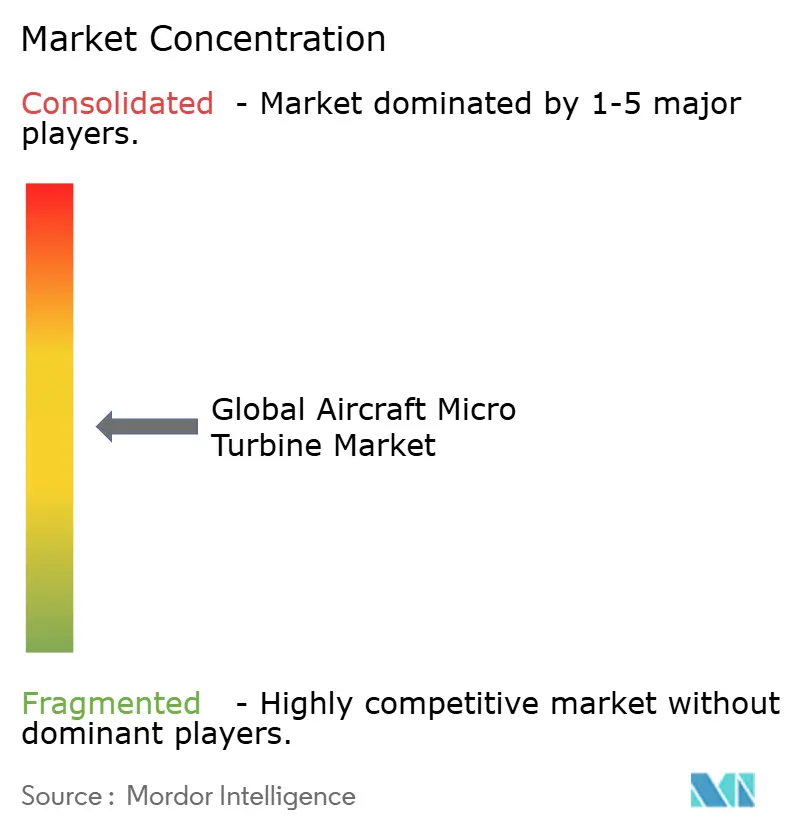
| Market Concentration | Medium |
Major Players *Disclaimer: Major Players sorted in no particular order Image © Mordor Intelligence. Reuse requires attribution under CC BY 4.0. | |
Aircraft Micro Turbine Market Analysis by Mordor Intelligence
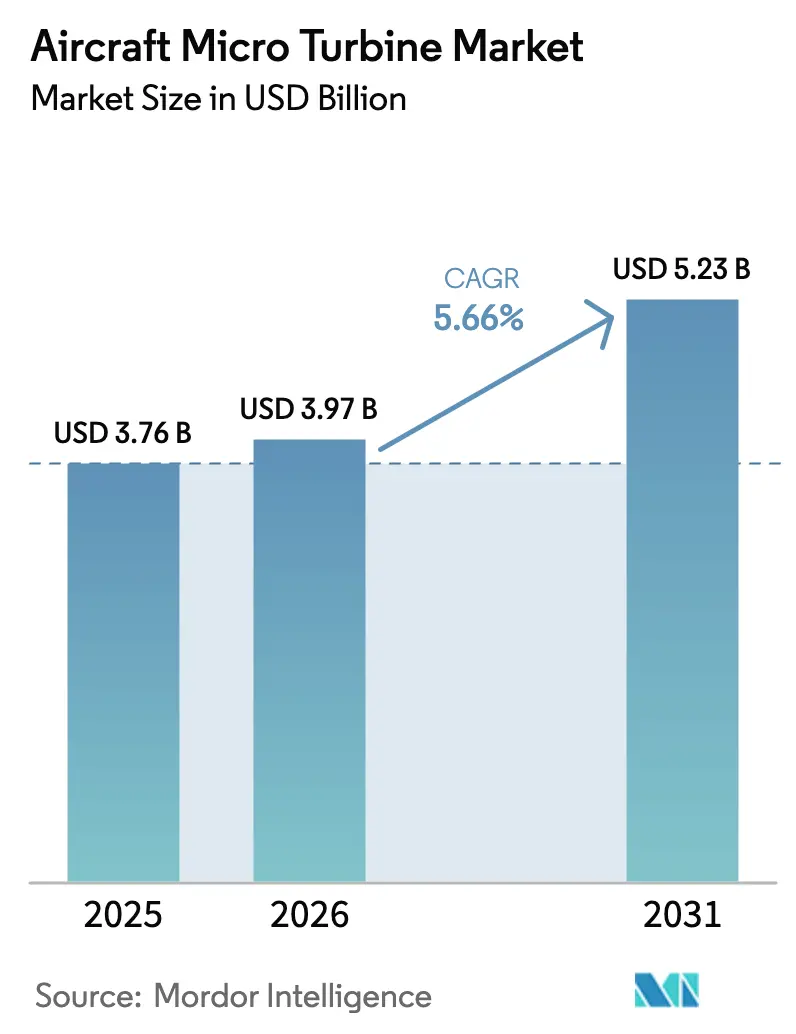
The aircraft micro turbine market size was valued at USD 3.76 billion in 2025 and estimated to grow from USD 3.97 billion in 2026 to reach USD 5.23 billion by 2031, at a CAGR of 5.66% during the forecast period (2026-2031). Robust defense spending on attritable drones, the urgency to decarbonize regional fleets, and fast-evolving hybrid-electric architectures underpin this expansion. OEMs scale turbines as range extenders for eVTOL projects, while commercial operators adopt power-dense units to overcome battery-only endurance limits. On the supply side, additive-manufacturing breakthroughs shorten development cycles and mitigate legacy bottlenecks that have curbed engine availability. Certification momentum—evidenced by the FAA’s powered-lift rule and EASA’s VTOL framework—also improves market visibility for investors and accelerates time-to-market for innovators.
Key Report Takeaways
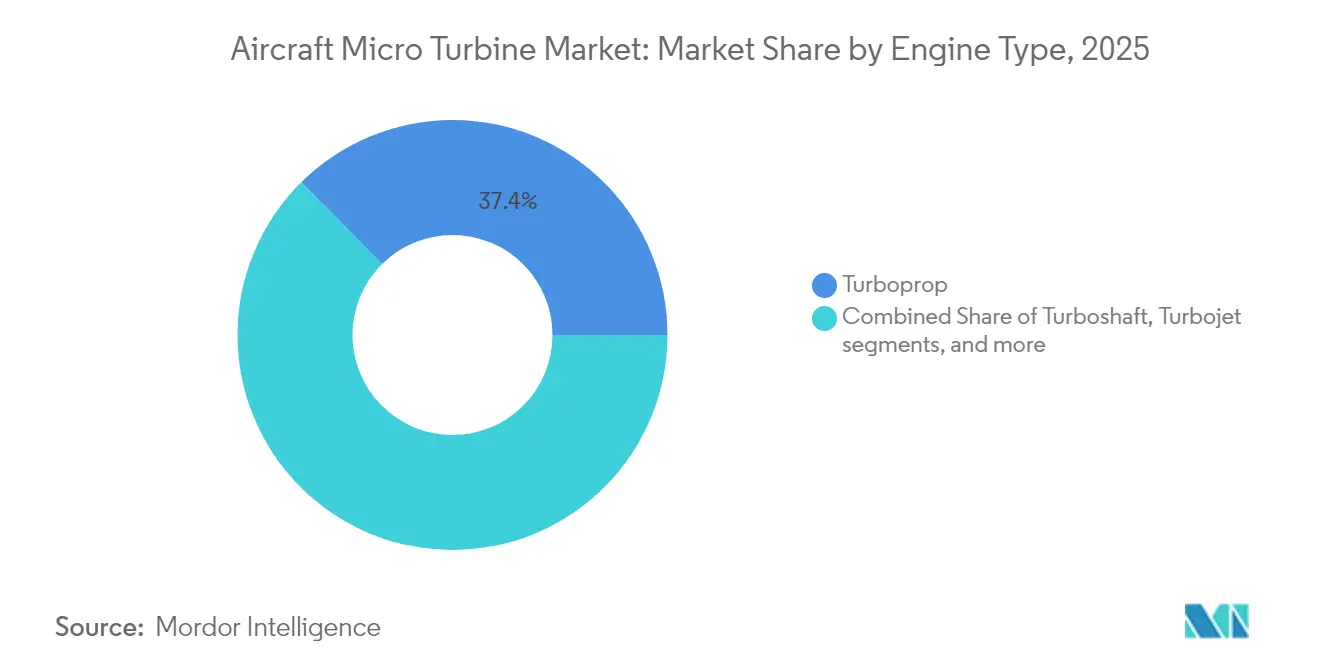
- By engine type, turboprop configurations led with 37.42% of the aircraft micro turbine market share in 2025, while turboshaft variants are expanding at a 7.36% CAGR through 2031.
- By power output, 60 to 90 kW systems accounted for 45.12% of the aircraft micro turbine market size in 2025; systems above 90 kW are projected to grow at a 6.47% CAGR to 2031.
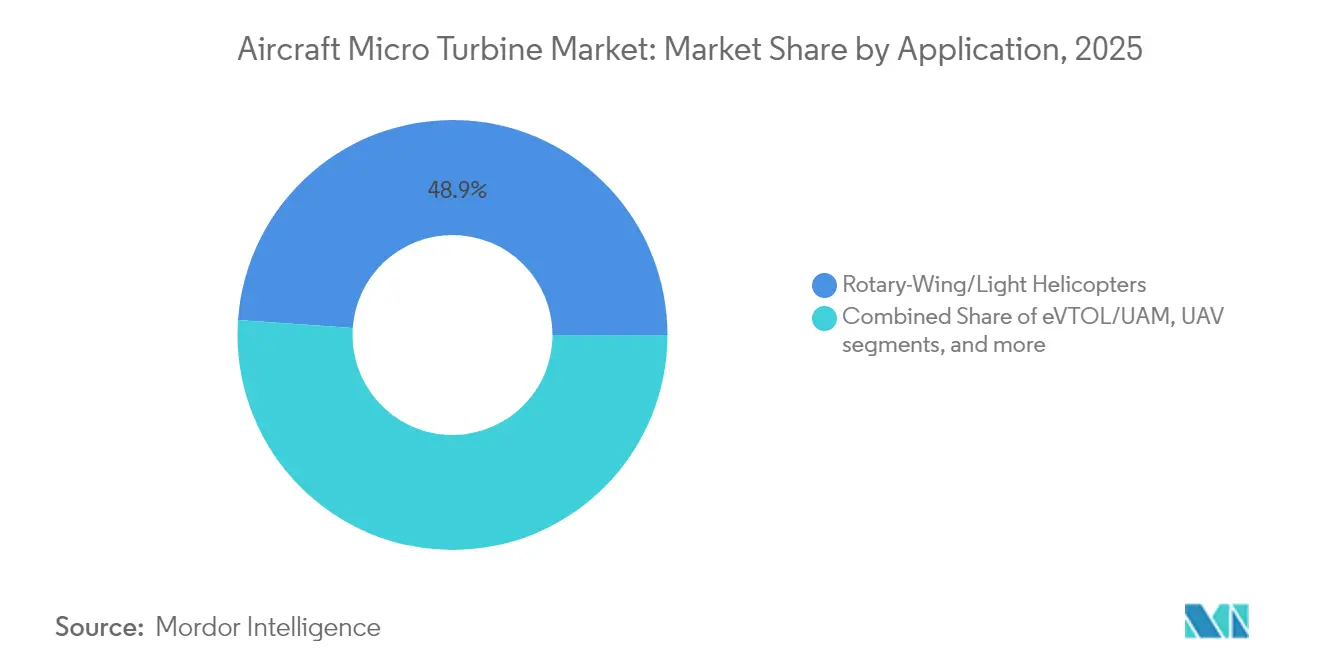
- By application, rotary-wing platforms captured 48.88% of the aircraft micro turbine market share in 2025; unmanned aerial vehicles are advancing at an 8.10% CAGR to 2031.
- By end user, commercial aviation held 42.76% of 2025 revenue, whereas UAV OEMs are forecasted to post a 6.98% CAGR through 2031.
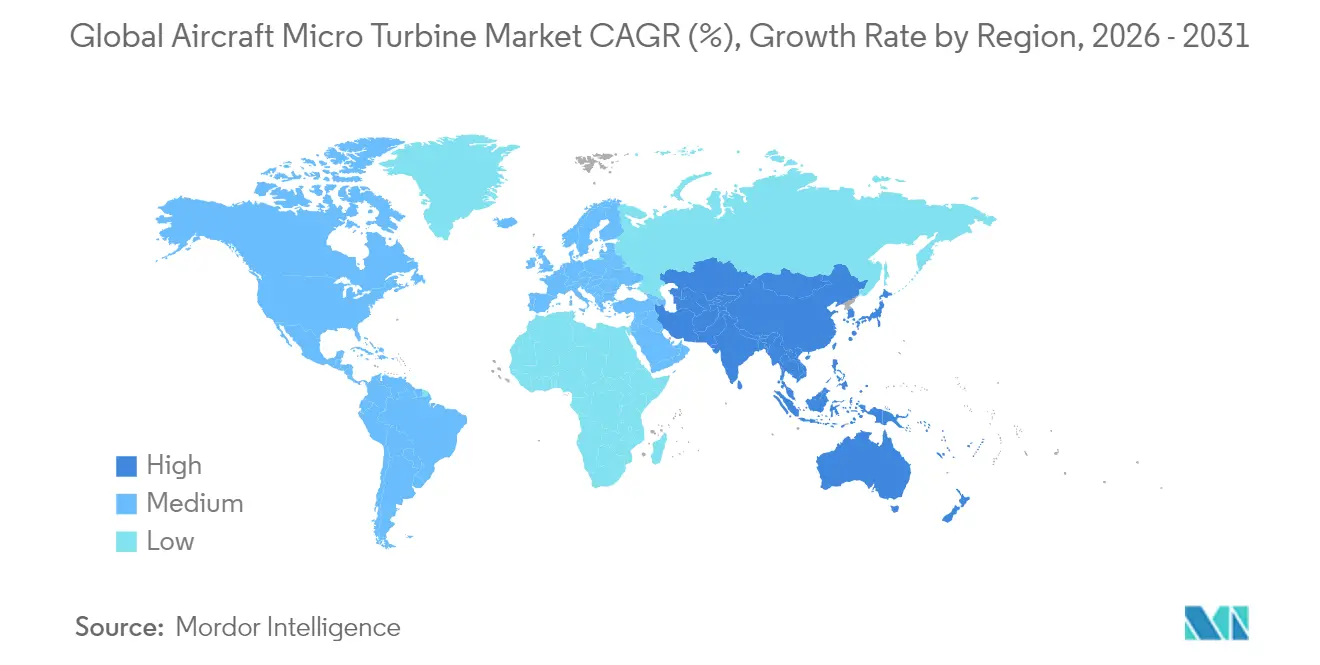
- North America maintained 39.05% regional dominance in 2025, but Asia-Pacific is the fastest-growing geography at 7.32% CAGR.
Note: Market size and forecast figures in this report are generated using Mordor Intelligence’s proprietary estimation framework, updated with the latest available data and insights as of 2026.
Global Aircraft Micro Turbine Market Trends and Insights
Drivers Impact Analysis*
| Driver | (~) % Impact on CAGR Forecast | Geographic Relevance | Impact Timeline |
|---|---|---|---|
| Growing deployment of endurance-focused UAVs | +1.2% | Global (North America and Asia-Pacific focus) | Medium term (2-4 years) |
| Rise of hybrid-electric range extenders for eVTOL/UAM | +0.9% | North America and EU expanding to Asia-Pacific | Long term (≥ 4 years) |
| Superior power-to-weight and multi-fuel capability vs piston engines | +0.8% | Global | Short term (≤ 2 years) |
| Fleet renewal of trainer and light aircraft | +0.7% | North America and EU | Medium term (2-4 years) |
| Defense demand for attritable drones | 1.1% | North America, with spillover to allied nations | Short term (≤ 2 years) |
| Adoption of micro-turbine APUs in more-electric regional aircraft | 0.6% | Global, led by commercial aviation hubs | Long term (≥ 4 years) |
| Source: Mordor Intelligence | |||
Growing Deployment of Endurance-Focused UAVs
Extended-mission drones dominate new procurement cycles as operators require flight times beyond eight hours. The USAF’s ATTAM program awarded USD 12.7 million to Kratos in 2024 to develop attritable engines, confirming federal commitment to long-loiter platforms.[1] Commercial operators in pipeline inspection and precision agriculture share the same endurance imperative, and micro turbines satisfy this demand by burning heavy fuels available at remote sites. Lower vibration levels lengthen sensor life, while simplified maintenance schedules reduce downtime across high-utilization fleets.
Rise of Hybrid-Electric Range Extenders for eVTOL/UAM
Honda’s 2024 test of a gas-turbine hybrid for eVTOL aircraft validated micro turbines as viable range extenders.[2] Urban air mobility developers use these units to triple practical range without breaching weight budgets. Regulatory clarity arrived in 2025 when the FAA integrated powered-lift aircraft into the National Airspace System, streamlining certification. Hybrid architectures also allay public reliability concerns by providing redundant power in case of battery faults.
Superior Power-to-Weight and Multi-Fuel Capability versus Piston Engines
Micro turbines deliver two-to-threefold higher power-to-weight ratios and sustain output at altitude. Turbotech’s R90 regenerative turboprop matches piston fuel burn while retaining turbine reliability.[3] Universal fuel compatibility lets military operators simplify logistics using diesel, Jet-A, or sustainable aviation fuels without hardware change. Reduced vibration mitigates airframe fatigue and improves ISR sensor clarity during high-endurance missions.
Fleet Renewal of Trainer and Light Aircraft
The US Navy chose the T-54A program to swap aging piston trainers for modern turbine platforms, cutting maintenance hours and fuel burn. GE Aerospace’s Catalyst, certified in 2025, offers a 16:1 pressure ratio and 18% lower fuel consumption, making it the first clean-sheet turboprop in decades. Flight schools gain curricula aligned with commercial turbine operations, while operators hedge against tightening emission rules by adopting more efficient powerplants.
Restraints Impact Analysis*
| Restraint | (~) % Impact on CAGR Forecast | Geographic Relevance | Impact Timeline |
|---|---|---|---|
| High acquisition and maintenance cost | −0.8% | Global | Short term (≤ 2 years) |
| Certification pathway uncertainty | −0.6% | Global (North America and EU) | Medium term (2-4 years) |
| Additive-manufacturing capacity bottlenecks for hot-section parts | −0.4% | Advanced manufacturing regions | Medium term (2-4 years) |
| Competition from lightweight hydrogen fuel cells | −0.3% | EU and North America | Long term (≥ 4 years) |
| Source: Mordor Intelligence | |||
High Acquisition and Maintenance Cost
Retail prices near USD 100,000 place turbines at a 3-5× premium to equivalent piston engines, as highlighted by Turbotech’s R90 offering. Specialized tooling and hot-section overhauls that can cost 40% of engine value exacerbate total ownership expenses. Global maintenance-capacity shortages are projected to peak in 2026, elevating hourly service rates and limiting adoption in cost-sensitive sectors like flight training and recreational aviation.
Certification Pathway Uncertainty
While the FAA’s powered-lift rule bridged a major gap, hybrid-electric systems still navigate overlapping turbine and battery standards that extend development by up to 18 months. European and US rules diverge on endurance testing for autonomous platforms, complicating global rollout plans. Attritable drones face a grey zone where legacy durability metrics inflate certification costs despite limited life-cycle intent, stalling fast-track fielding for emerging defense needs.
*Our forecasts treat driver/restraint impacts as directional, not additive. The impact forecasts reflect baseline growth, mix effects, and variable interactions.
Segment Analysis
By Engine Type: Turboprop Dominance with Turboshaft Momentum
Turboprops accounted for 37.42% of 2025 revenue, underscoring their entrenched role in trainers, light commuters, and endurance UAVs. This share positions turboprops as the single largest slice of the aircraft micro turbine market, benefiting from ready certification pathways and commodity propeller technology. Turboshaft units, however, advance at a 7.36% CAGR through 2031 as civil and parapublic rotorcraft orders rebound and hybrid-electric distributors favor shaft power. Turbojet designs populate high-speed reconnaissance drones but remain fuel-hungry for broader uptake.
Turbofan and recuperated variants occupy smaller technical niches but offer upside as heat-recovery systems elevate thermal efficiency. China's AES100 turboshaft entered production in 2025, signaling Asia-Pacific's capacity to erode Western lead times. The long-term shift toward shaft-coupled propulsion and regenerative cycles will reshape the aircraft micro turbine market as eVTOL, tiltrotor, and regional hybrid projects demand higher efficiency under strict emission ceilings.

By Power Output Rating: Mid-Range Sweet Spot with High-Power Upswing
Engines rated 60 to 90 kW delivered 45.12% of 2025 sales, anchoring the aircraft micro turbine market size for mainstream UAVs and light aircraft, where weight margins are narrow. System maturity reduces integration risk, letting OEMs meet aggressive entry-into-service dates without redesigning thermal management. Demand above 90 kW is scaling at 6.47% CAGR as heavy-lift UAVs, short-haul cargo planes, and distributed hybrid-electric demonstrators progress from prototype to low-rate production.
Sub-30 kW units cater to specialized ISR drones, while 30 to 60 kW platforms target trainer retrofits and lower-power tiltrotors. Power-scaling challenges center on thermal limits and gearbox mass, encouraging the adoption of ceramic matrix composites and additive-manufactured diffusers. FAA-funded CLEEN III projects that a 90 kW turbogenerator can cut block fuel up to 30% on regional flights, hinting at steep growth potential once program risk retires.
By Application: Rotorcraft Lead as UAVs Accelerate
Rotorcraft platforms retained 48.88% of the 2025 value, reflecting decades of turbine integration and the rotorcraft fleet’s sustained need for high power-to-weight ratios. The sector is buoyed by air-ambulance renewals and light military helicopter replacements that prize efficient hot-and-high performance. UAVs are the fastest-rising application at an 8.10% CAGR, driven by military attritable programs and commercial BVLOS demand. High-density power enables payload expansion without sacrificing range, a pivotal advantage over battery-centric propulsion.
Fixed-wing light aircraft continue steady buying cycles as flight schools modernize aluminum trainers. Though nascent, eVTOL projects are set to multiply post-2027 once early certification hurdles clear. Auxiliary power units for more-electric regional aircraft present incremental demand, especially where on-ground emission caps restrict turbine idle-time use.
By End User: Commercial Stability and UAV OEM Upsurge
Commercial aviation captured 42.76% of 2025 turnover, giving airlines and training providers the largest stake in the aircraft micro turbine market. Reliability metrics honed in airline service translate to favorable financing and residual-value profiles, cementing commercial dominance for the near term. UAV OEMs, however, outpace all peers with a 6.98% CAGR through 2031 as defense and infrastructure operators standardize on turbine-powered drones for multi-day missions.
Defense programs sustain baseline demand across ISR, loitering munitions, and swarming concepts. General aviation buyers favor turbines for situational-awareness flights and aerial work, whereas ruggedness and fuel flexibility justify higher capex. Research institutes round out the landscape by field-testing recuperated cycles, alternative fuels, and AI-driven engine-health monitoring that will influence mainstream adoption paths.
Geography Analysis
North America held 39.05% of 2025 revenue, supported by the USAF’s deep attritable drone pipeline, GE and Honeywell’s extensive supplier bases, and Mexico’s low-cost aerostructure clusters. Certification bodies, government R&D funding, and aftermarket MRO density create formidable entry barriers for foreign challengers.
Asia-Pacific is the most dynamic region, projected at 7.32% CAGR to 2031. China’s AES100 turboshaft license heralds indigenous capability in 1,000 kW class engines, while India accelerates under “Make in India” to close propulsion gaps for UAVs and light transport aircraft. Japan leverages Mitsubishi Heavy Industries’ partnership with Rolls-Royce to co-develop advanced turbogenerators, and Australia channels defense procurement into sovereign drone programs to secure supply chains.
Europe remains a powerhouse, home to Safran, Rolls-Royce, and Turbotech. Clean-Aviation funding steers investment toward hybrid-electric and hydrogen-ready micro turbines, incentivizing ultra-low-emission designs that exceed ICAO CO₂ standards. Eastern Europe’s growing MRO footprint and the Middle East’s airport expansion create reciprocal demand for export-friendly engines and aftermarket services, though geopolitical risks temper near-term scale-up.
Regulatory Landscape
Certification and operational compliance for aircraft micro turbines are primarily shaped by aviation authorities such as the FAA and EASA, with additional national pathways for electric and hybrid systems. In the UK, for example, the Civil Aviation Authority applies SC-E19 special conditions for electric and hybrid propulsion. Regulatory requirements for new aircraft categories and architectures, including powered-lift and VTOL certification frameworks referenced in the report context, also affect the test evidence required for turbine-electric integration (engine control, thermal management, and redundancy) at both the engine and aircraft levels.
Fuel and emissions compliance requirements underpin turbine operability across civil and defense-adjacent applications. Aviation turbine fuel specifications such as ASTM D1655 and ASTM D3093 govern kerosene-based jet fuels used by many micro turbines. Continued certification activity on turbine hot-section durability, including FAA approval activity reported in July 2026 for a high-pressure turbine durability kit on a large commercial engine program, reinforces the focus regulators place on life-limited parts, inspection regimes, and continued airworthiness practices that flow into micro-turbine design and maintenance documentation.
Value Chain Analysis
The aircraft micro turbine value chain begins with materials and critical components (superalloys, castings/forgings, bearings, combustors, hot-section parts, fuel systems, and electronics). It then moves through engine core design, prototyping, and qualification, followed by manufacturing, assembly, and integration into airframes or turbogenerator modules. Additive manufacturing is also compressing development cycles and part-count complexity in smaller turbine builds, with the evidence base citing Argive (Alloyed) using 3D printing approaches to produce micro turbine engines with fewer parts and improved material efficiency.
Downstream, OEMs and tier suppliers package micro turbines as propulsion units, APUs, or turbogenerators, with spares provisioning plus MRO and field service. Safran Power Units illustrates vertical participation across design and production for APUs and turbogenerators, including the TG600, which pairs with Safran Electrical & Power (GENeUS) generators for hybrid-electric architectures. Distribution and lifecycle support depend on platform-specific certification documentation and repair capability, while defense and UAS programs add parallel demand signals for scalable production, long-lead materials, and faster sustainment cycles.
Competitive Landscape
Market concentration is moderate. Safran, Honeywell, and RTX Corporation leverage long-cycle expertise, global support networks, and vertically integrated supply chains to secure high-volume contracts. Rolls-Royce adapts its Advance2 core for attritable engines, bridging legacy technology with low-unit-cost mandates.[4]
Specialist firms exploit white-space niches. PBS Group focuses on small turboshafts for light helicopters, while Turbotech pioneers recuperated cycles to rival piston efficiency. UAV Turbines targets hybrid-electric drones with sub-100 kW outputs, and Sierra Turbines employs additive manufacturing to eliminate 95% of conventional part counts, cutting lead times during supply crunches.
Competitive advantage now tilts toward firms mastering certification labyrinths and additive-manufactured hot sections. Companies that guarantee on-time delivery poach share as primes grapple with supply shortages. Cost pressure from attributable programs forces incumbents to redesign for manufacturability, inviting partnerships with agile start-ups versed in low-cost composite casings and printed fuel nozzles. The shift from lifetime durability to acceptable disposability marks a structural rewrite of turbomachinery economics.
Aircraft Micro Turbine Industry Leaders
-
Safran Power Units (Safran SA)
-
Honeywell International Inc.
-
Kratos Defense & Security Solutions, Inc.
-
PBS AEROSPACE Inc.
-
UAV Turbines, Inc.
- *Disclaimer: Major Players sorted in no particular order
Market Opportunities and Future Outlook
Hybrid-electric propulsion programs create near-term integration opportunities for micro turbines as range extenders and turbogenerators, especially where battery-only endurance and payload limits constrain mission profiles. One concrete example is the July 2026 development and production agreement between Electra and Safran for the TG600 turbogenerator to power the EL9 hybrid-electric aircraft, along with an initial order that points to movement from demonstration into industrial planning for turbine-electric modules.
Defense-driven UAS and autonomous aircraft initiatives also expand whitespace for small, production-scalable turbine engines built around cost, manufacturability, and mission-appropriate life targets rather than traditional fighter-engine durability assumptions. Recent program activity includes a U.S. Air Force prototype contract reported in March 2026 for Honeywell to develop the SkyShot 1600 engine for collaborative autonomous aircraft concepts, alongside supplier actions to expand small-engine output for missiles and loitering munitions. On the supply side, additive manufacturing adoption and modular electric-machine integration (generators, power electronics, and controls) offer differentiation through reduced lead times, simpler assembly, and certifiable hybrid powertrain packages.
Recent Industry Developments
- July 2026: Safran launched PHILEAS ground testing campaign to evaluate hybrid-electric technologies on high-pressure and low-pressure engine shafts. The initiative validates hybrid-electric propulsion for regional and short-haul platforms, and the modular propulsion approach could accelerate adoption of micro-turbine based powertrains in aircraft fleets.
- July 2026: Electra and Safran reach development and production agreement for TG600 turbogenerator (600 kW) powering EL9 Ultra Short hybrid-electric aircraft with initial order. The turbogenerator enables 600 kW class powerplants for hybrid-electric aircraft. Strengthens Safran Electra collaboration to scale 600 kW units for mass market in eVTOL and regional markets.
- June 2026: Kratos Defense and Security Solutions plans to scale Spartan turbojet engine production to 3,000 units annually for missile and loitering munition programs. The high-volume, small-turbine powerplant supports expendable and autonomous weapons platforms. Improved domestic capacity and long-lead procurement to meet defense procurement priorities.
Research Methodology Framework and Report Scope
Market Definition and Coverage
For this report, the aircraft micro turbine market is counted as revenue earned from micro turbine engines used on aircraft platforms, covering both propulsion and auxiliary power roles, and reported in USD across the study period.
Scope exclusions: The totals exclude ground-based micro turbines used for stationary power generation. They also exclude unrelated aircraft components that do not generate power through a turbine-based mechanism.
Segmentation Overview
- By Engine Type
- Turbojet
- Turboshaft
- Turboprop
- Turbofan
- Recuperated/Regenerative
- By Power Output Rating
- Less than 30 kW
- 30 to 60 kW
- 60 to 90 kW
- Greater than 90 kW
- By Application
- Unmanned Aerial Vehicles (UAVs)
- Manned Light Fixed-Wing Aircraft
- Rotary-Wing/Light Helicopters
- eVTOL/Urban Air Mobility (UAM)
- Aircraft Auxiliary Power Units (APUs)
- By End User
- Military and Defense
- Commercial Aviation
- General Aviation
- UAV OEMs/Drone Operators
- Research and Experimental
- By Geography
- North America
- United States
- Canada
- Mexico
- Europe
- Germany
- United Kingdom
- France
- Russia
- Rest of Europe
- Asia-Pacific
- China
- Japan
- India
- South Korea
- Australia
- Rest of Asia-Pacific
- South America
- Brazil
- Rest of South America
- Middle East and Africa
- Middle East
- United Arab Emirates
- Saudi Arabia
- Israel
- Rest of Middle East
- Africa
- South Africa
- Rest of Africa
- Middle East
- North America
Data Sources, Market Sizing, and Validation
Desk Research
Desk research was used to map the demand pool and set clear boundaries on what gets counted as aircraft micro turbines. We relied on public aviation safety and certification materials, including FAA rulemaking and guidance and EASA framework documents, since these help clarify what qualifies as an aircraft powerplant for emerging aircraft types.
We also used public defense and procurement signals, such as budget documents and award notices, along with trade and production statistics (for example, UN Comtrade and national statistical agencies) to understand shipment direction and regional concentration. Technical context was checked using sources such as NASA publications, NIST references where relevant, and peer-reviewed aerospace journals that discuss micro turbine performance and hybrid-electric architectures. Company filings, investor presentations, reputable press, and paid subscriptions for company financials, news and financials, patent checks, and selective aerospace and aviation aircraft-level databases were used to fill gaps. The desk sources listed here are illustrative only, and additional sources were consulted for data collection, cross-checks, and follow-up clarifications.
Primary Interviews and Surveys
Primary work was completed via expert interviews and structured surveys with engine-side stakeholders, aircraft OEM and integrator roles, and buyer-side teams involved in defense UAVs and emerging air mobility programs. We used these inputs to confirm what is actually shipping versus what remains in prototype stages, and to align pricing logic with realistic contract and certification timelines across major regions.
Distribution of primary research fieldwork respondents
| Company type | Respondent position | Region |
|---|---|---|
| Top tier: 37% | CXOs: 17% | APAC: 52% |
| Mid tier: 41% | Functional/Unit leaders: 29% | EMEA: 30% |
| Smaller Players: 22% | Managers: 54% | Americas: 18% |
Market-Sizing & Forecasting
Sizing starts with a top-down demand reconstruction based on aircraft and UAV delivery activity, platform-level adoption of micro turbines (including range-extender use cases), and the expected mix of propulsion versus auxiliary power installations. After the demand pool is set, we convert it into value using average selling prices that reflect rated power classes, typical integration complexity, and the split between OEM fitment and replacement demand.
To keep the model grounded, we corroborate totals with selective bottom-up checks, such as sampling a set of engine programs and multiplying estimated unit volumes by observed price bands, then comparing the outcome with supplier capacity signals and program timelines. Inputs in the model include defense UAV procurement momentum, certification and entry-into-service timing, aircraft production rates for relevant light and advanced air mobility platforms, power output class mix (for example, below 30 kW versus higher ratings), and regional fleet growth patterns.
For forecasting, we use scenario analysis so the outlook can adjust for program slippages, certification delays, and shifts in defense ordering cycles. Where bottom-up inputs are missing for smaller programs, gaps are handled through conservative penetration assumptions tied to similar platform archetypes, and those assumptions are revisited through follow-up expert checks.
Data Validation & Update Cycle
Validation is done through multiple rounds of checks so the final totals do not depend on a single data trail. Our analysts compare the modeled market size against independent signals like aircraft deliveries, procurement visibility, and the expected pace of certification approvals, then review outliers prior to sign-off.
When material variances appear by region or application, assumptions are re-opened and a short re-contact cycle is triggered with relevant experts to confirm what changed. Reports are refreshed annually, and interim updates are made when major events occur (such as new certification rules, large program awards, or meaningful production shifts). Before delivery, an analyst runs a final update so clients receive the most recent view aligned to current public information.
Mordor Intelligence's Aircraft Micro Turbine Market Size Versus Other Published Estimates
Published estimates for aircraft micro turbines can be far apart because the counted scope is not always consistent, and because timing assumptions differ around certification, deliveries, and when revenue is recognized. The biggest spreads usually come from how an aircraft micro turbine is distinguished from adjacent small turbine engine use cases, and from how pricing is carried forward over time.
By checking platform entry-into-service assumptions and then refreshing the OEM versus aftermarket split, Mordor Intelligence keeps the market value aligned with reachable installation volumes and defensible ASP bands, rather than optimistic program roadmaps or list-price style pricing. Another driver is forecast window alignment. Some sources anchor on 2023 and extend to 2033, while our forecast period centers on 2026 to 2031, which affects the implied growth path and midpoint market level.
Benchmark comparison
| Source | Market Size | Gaps in Research Methodology |
|---|---|---|
| Mordor Intelligence | USD 3.97 B (2026) | |
| Trade Journal A | USD 3.90 B (2023) | Uses an earlier base year and a longer horizon, and it does not clearly separate aircraft-installed demand from adjacent turbine use cases, which can shift the starting value. |
| Global Consultancy B | USD 3.10 B (2023) | Leans on a narrower engine-market definition and shorter 2024-2030 forecast window, which can undercount emerging AAM and defense-led adoption that ramps after the base year. |
The table shows that year alignment and what gets counted inside the aircraft boundary are the two main reasons the numbers separate. With a consistent revenue recognition point, clear treatment of propulsion versus auxiliary roles, and repeatable volume and pricing inputs, the estimate remains transparent enough to be rechecked as new delivery and certification data becomes available.
Key Questions Answered in the Report
What is the current size of the aircraft micro turbine market?
The aircraft micro turbine market stands at USD 3.97 billion in 2026 and is forecast to reach USD 5.23 billion by 2031.
Which engine configuration leads the market today?
Turboprop engines hold 37.42% of 2025 revenue, making them the dominant configuration.
Which application segment is expanding fastest?
Unmanned aerial vehicles are growing at an 8.10% CAGR through 2031 due to defense attritable programs and long-endurance commercial missions.
Why are hybrid-electric range extenders important for eVTOL aircraft?
Micro turbines acting as range extenders mitigate battery energy-density limits, tripling usable range while keeping vehicle weight within certification ceilings.
What is the biggest restraint hampering adoption?
High acquisition and maintenance costs—up to five times that of comparable piston engines—remain the principal barrier for cost-sensitive operators.
Which region will grow quickest over the next five years?
Asia-Pacific is projected to expand at a 7.32% CAGR, led by China’s indigenous turbine programs and India’s Make-in-India propulsion initiatives.