
Aircraft Fairings Market Size and Share
Market Overview
| Study Period | 2020 - 2031 |
|---|---|
| Market Size (2026) | USD 2.09 Billion |
| Market Size (2031) | USD 2.91 Billion |
| Growth Rate (2026 - 2031) | 6.82 % |
| Fastest Growing Market | Asia Pacific |
| Largest Market | North America |
| Market Concentration | Medium |
Major Players *Disclaimer: Major Players sorted in no particular order Image © Mordor Intelligence. Reuse requires attribution under CC BY 4.0. | |
Aircraft Fairings Market Analysis by Mordor Intelligence
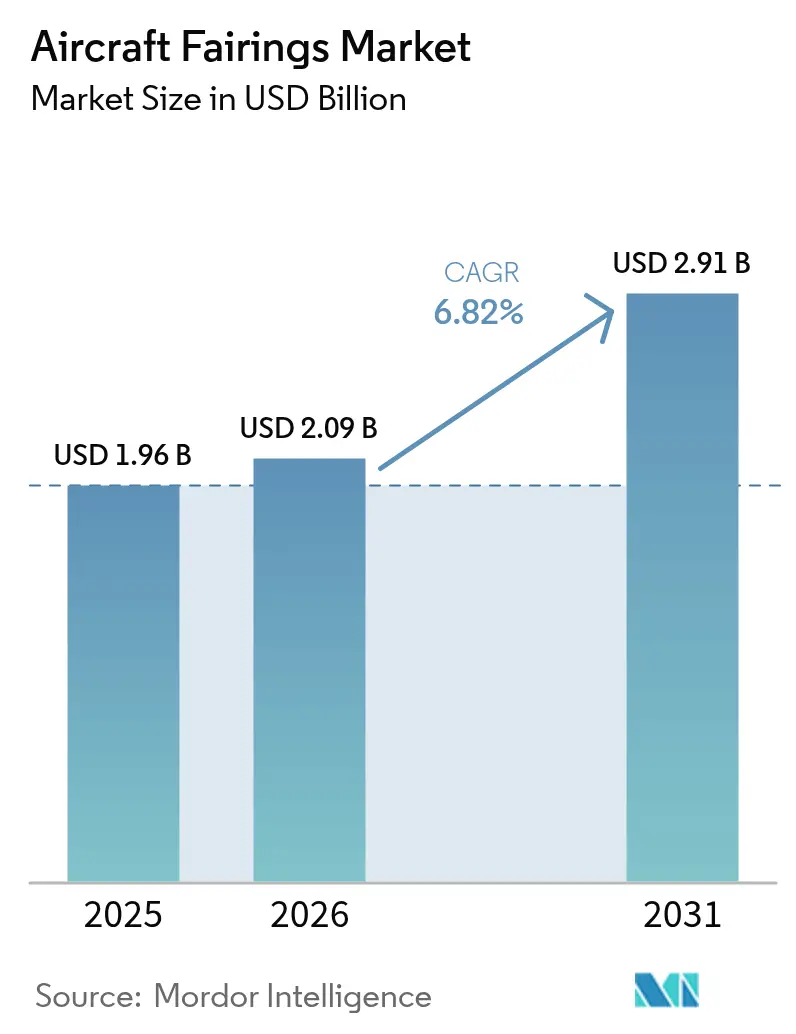
The aircraft fairings market size was valued at USD 1.96 billion in 2025 and estimated to grow from USD 2.09 billion in 2026 to reach USD 2.91 billion by 2031, at a CAGR of 6.82% during the forecast period (2026-2031). Robust production backlogs exceeding 15,000 commercial jets, rising fuel-efficiency mandates, and an accelerated push to replace aging fleets provide long-term demand visibility. Composite innovation is central to this growth pattern: carbon-fiber-reinforced polymer (CFRP) already accounts for 70% of fairing materials in service, a shift that cuts structural weight and improves corrosion resistance. Rising dependence on narrow-body programs, which contributed 48% of volumes in 2024, favors suppliers that can scale production while controlling costs. Meanwhile, the surge of UAV and eVTOL concepts—each prioritizing rapid prototyping and small-batch runs—creates premium niches that command higher margins per unit. As a result, the aircraft fairings market keeps bifurcating into high-volume commercial programs and fast-moving advanced-air-mobility demand pools, compelling suppliers to hedge capacity across both segments.
Key Report Takeaways
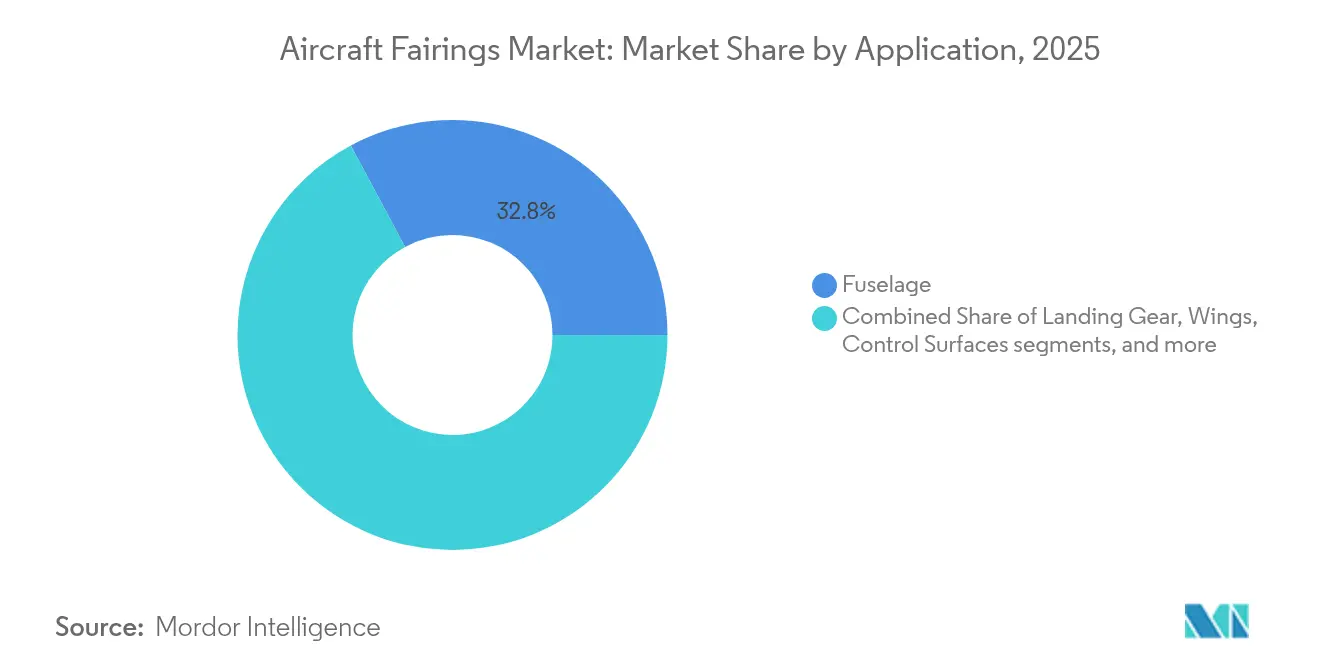
- By application, fuselage fairings led with 32.84% of the aircraft fairings market share in 2025; landing gear fairings are projected to post the highest 6.94% CAGR to 2031.
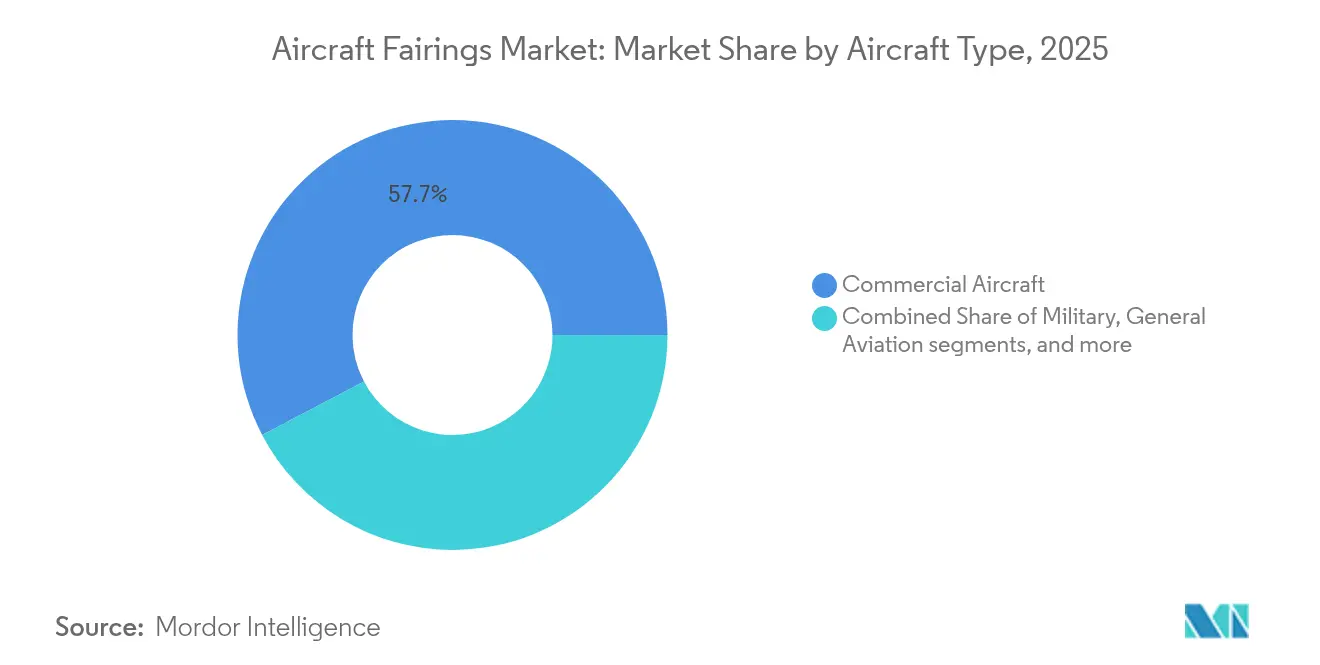
- By aircraft type, commercial aircraft accounted for 57.69% of the aircraft fairings market size in 2025, whereas the unmanned systems category is advancing at an 8.29% CAGR through 2031.
- By material, CFRP captured 62.78% of the revenue share in 2025; thermoplastic composites are forecast to expand at 8.86% CAGR through 2031.
- By sales channel, OEM deliveries represented 67.39% of the aircraft fairings market size in 2025, while aftermarket MRO is growing fastest at an 7.98% CAGR.
- By region, North America held a 36.24% share in 2025; Asia-Pacific is the fastest-growing geography, with an 8.51% CAGR to 2031.
Note: Market size and forecast figures in this report are generated using Mordor Intelligence’s proprietary estimation framework, updated with the latest available data and insights as of 2026.
Global Aircraft Fairings Market Trends and Insights
Drivers Impact Analysis*
| Driver | ( ~ ) % Impact on CAGR Forecast | Geographic Relevance | Impact Timeline |
|---|---|---|---|
| Surging composite adoption to meet fuel-efficiency targets | +1.8% | Global, with concentration in North America and Europe | Medium term (2-4 years) |
| Rapid fleet-wide replacement of aging aircraft | +1.5% | Global, particularly North America and Asia-Pacific | Long term (≥ 4 years) |
| Proliferation of UAV, advanced air mobility, and eVTOL platforms | +0.9% | North America and Europe leading, expanding to Asia-Pacific | Medium term (2-4 years) |
| Growth of aftermarket MRO expenditure on replacement fairings | +1.2% | Global | Short term (≤ 2 years) |
| Hybrid-electric aircraft programs spur new fairing designs | +0.7% | Europe and North America | Long term (≥ 4 years) |
| Record commercial single-aisle backlog underpins production visibility | +0.9% | Global | Medium term (2-4 years) |
| Source: Mordor Intelligence | |||
Surging Composite Adoption to Meet Fuel-Efficiency Targets
Airlines under acute fuel-cost pressure are switching from aluminum to CFRP fairings, lifting composite content on next-generation aircraft from 13% on legacy A330s to more than 50% today.[1] Airbus’ Multifunctional Fuselage Demonstrator shows that thermoplastic skins can cut a further 10% weight while supporting automated welding for 100-per-month build rates. Economic benefits remain compelling: lifetime fuel savings can offset 15-20% of an aircraft’s purchase price when installed composite fairings.[2] Yet this transition demands heavy capital outlays for autoclaves, robotic lay-up cells, and specialized labor, heightening entry barriers and prompting OEMs to favor partners owning mature composite ecosystems
Rapid Fleet-Wide Replacement of Aging Aircraft
More than 700 jets retire yearly, triggering component harvesting and refurbishment demand that enlarges the retrofit market. Wide-body fairings see sharper wear from long-haul cycles, pushing operators toward aerodynamic upgrade kits rather than new-build orders amid delivery delays. Circular-economy programs that reclaim composite fairings for secondary markets, exemplified by Sumitomo’s tie-up with Werner Aero, are gaining traction but face the hard reality that CFRP recycling is limited and cost-intensive.
Hybrid-Electric Aircraft Programs Spur New Fairing Designs
Emerging propulsion architectures require redesigned nacelles and cooling pathways, broadening fairing complexity. GE Aerospace’s blended-wing-body demonstrator integrates novel nacelle fairings that promise up to 50% fuel-burn improvements. Suppliers co-design thermal-management features alongside structural fairings to gain early-mover status in this new propulsion era.
Record Commercial Single-Aisle Backlog Underpins Production Visibility
Global single-aisle backlogs surpassing 15,000 units guarantee stable volume ordering for at least the next decade. Stable run rates help justify automation investments across composite fairing lines, pushing labor content per unit down and sustaining the aircraft fairings market as production footprints expand in the Americas and Asia.
Restraints Impact Analysis*
| Restraint | ( ~ ) % Impact on CAGR Forecast | Geographic Relevance | Impact Timeline |
|---|---|---|---|
| High and volatile prices of carbon fiber, epoxy, and high-temperature resins | -1.1% | North America and Europe | Short term (≤ 2 years) |
| Stringent certification cycles delaying new fairing technologies | -0.8% | Global | Medium term (2-4 years) |
| Supply-chain consolidation reducing sourcing optionality and compressing margins | -0.9% | Global, with primary effects in North America and Europe | Medium term (2-4 years) |
| Geopolitical trade tensions and tariffs inflating raw-material costs | -0.7% | Global, particularly affecting US-China trade and Europe-Asia supply chains | Short term (≤ 2 years) |
| Source: Mordor Intelligence | |||
High and Volatile Prices of Carbon-Fiber, Epoxy, and High-Temperature Resins Compress Supplier Margins
Carbon-fiber demand in aerospace is projected to grow 17% annually, but capacity additions require expensive, long-cycle investments. Geopolitical tension and tariff exposure complicate price forecasting, prompting suppliers to adopt cost-plus contracts yet forcing smaller firms into untenable working-capital positions.
Stringent Certification Cycles Delaying New Fairing Technologies
FAA Advisory Circular 20-62E and mirrored EASA rules extend validation timelines for novel thermoplastics or additive-manufactured fairings to 24-36 months, doubling compliance costs where dual approvals are required. Although the bilateral Technical Implementation Procedures streamline some paperwork, smaller innovators still struggle with the documentation rigor needed to satisfy global regulators.
*Our forecasts treat driver/restraint impacts as directional, not additive. The impact forecasts reflect baseline growth, mix effects, and variable interactions.
Segment Analysis
By Application: Integration-Driven Dominance of Fuselage Fairings
Fuselage fairings generated 32.84% of the aircraft fairings market size in 2025, thanks to their complex wing-body junction geometries and high OEM integration hurdles. Demand remains sticky because any design change obliges full aerodynamic retesting, making incumbent suppliers difficult to displace. Landing-gear fairings are accelerating at 6.94% CAGR, propelled by tighter airport noise limits and eVTOL program requirements for retractable struts. Wing-body and control-surface fairings stay aligned with mainstream build rates, whereas engine fairings pick up incremental growth from hybrid-electric demonstrators that mandate cooled fairing shells.
Emerging mobility platforms skew design briefings toward rapid manufacturing. Wichita State University’s research shows UAV operators prefer printable modular fairings in days, not weeks. Deutsche Aircraft’s D328eco contract bundling fuselage and landing-gear doors into a single award underlines OEM moves toward integrated supplier packages. Such bundling favors vendors with broad design toolsets and test-article capacity.

By Material: Carbon-Fiber Reinforced Polymer (CFRP) Strength Meets Thermoplastic Agility
CFRP’s 62.78% share underscores its entrenched status across wide-body, narrow-body, and even rotorcraft programs. Yet thermoplastic composites and additively manufactured polymers—growing 8.86% annually—remove autoclave bottlenecks and enable part-count consolidation that slashes assembly labor. For lightweight UAV fairings, cost sensitivity keeps glass fiber viable, while critical damage-tolerant locations (such as lower fuselage chine panels) still rely on aluminum-lithium alloys.
Hexcel’s HexAM PEKK-laser-sintering platform prints complex fairing brackets that are impossible to machine conventionally, cutting scrap and weight simultaneously. EU-funded DOMMINIO efforts extend this digital thread by embedding structural-health sensors into thermoplastic fairings, bringing predictive integrity monitoring directly to line-fit installations. Over time, blended material stacks that mate laminated CFRP skins to printed thermoplastic ribs could dominate the aircraft fairings market.
By Aircraft Type: Commercial Aviation Drives Market Foundation Amid Emerging Platform Disruption
Commercial aircraft represented 57.69% of the aircraft fairings market share in 2025, with narrow-body programs alone providing 48% and wide-body lines adding another 17%. This dominance stems from sustained production backlogs and airline fleet-renewal plans that translate into reliable, long-term demand for fairings across fuselage, wing, and nacelle locations. Boeing’s latest outlook points to more than 44,000 new jetliners entering service by 2038, of which 32,400 will be single-aisle models—a visibility window that underpins capacity commitments for fairing suppliers. At the same time, narrow-body output is ramping to ease capacity constraints. In contrast, wide-body assembly rates remain tempered because carriers are still trimming long-haul exposure and favoring fuel-efficient alternatives on medium-range missions.
UAV and eVTOL platforms introduce the fastest-growing pocket of demand with an 8.29% CAGR through 2031, creating opportunities for fairings that emphasize rapid fabrication and lower cost structures rather than the exhaustive certification path followed in commercial programs. Military aircraft provide a steady baseline supported by elevated defense budgets amid geopolitical tensions, while general aviation benefits from renewed interest in business travel. Airbus delivered 766 aircraft in 2024 and retained a backlog of 8,658 units, underscoring the depth of commercial production that continues to anchor the aircraft fairings market size. Concurrently, the company’s focus on next-generation designs and sustainable aviation fuel keeps composite fairing specifications advancing. JetZero’s blended-wing-body demonstrator, which targets a 50% fuel-burn reduction by tightly integrating nacelle and body fairings supplied by Collins Aerospace, highlights how commercial performance requirements accelerate technology cross-pollination across the wider aircraft fairings market. For suppliers, the challenge is to balance the rigorous qualification schedules of established airliner programs with the fast-track, iterative development cycles favored by emerging mobility platforms, forcing dual expertise in traditional certification and rapid prototyping.
By Sales Channel: OEM Dominance and Aftermarket Momentum
OEM lines consumed 67.39% of fairing shipments in 2025, reflecting line-fit installation efficiencies and tight engineering change controls at Airbus and Boeing. Nonetheless, aftermarket revenue grows at 7.98% CAGR as airlines extend asset lives amid delivery bottlenecks and capital rationing. VSE Aviation’s USD 750 million distribution wins illustrate the scale of logistics hubs required to stock varied fairings across global depots.
Higher aftermarket margins attract tier-2 players, yet the service imperative is onerous: FCAH Aerospace’s tie-in with Cobalt Aero Services spans nacelles, thrust reversers, and fairings, demanding 24-hour dispatch windows. Balancing inventory positions against working-capital drain becomes a critical success factor as component SKUs proliferate.
Geography Analysis
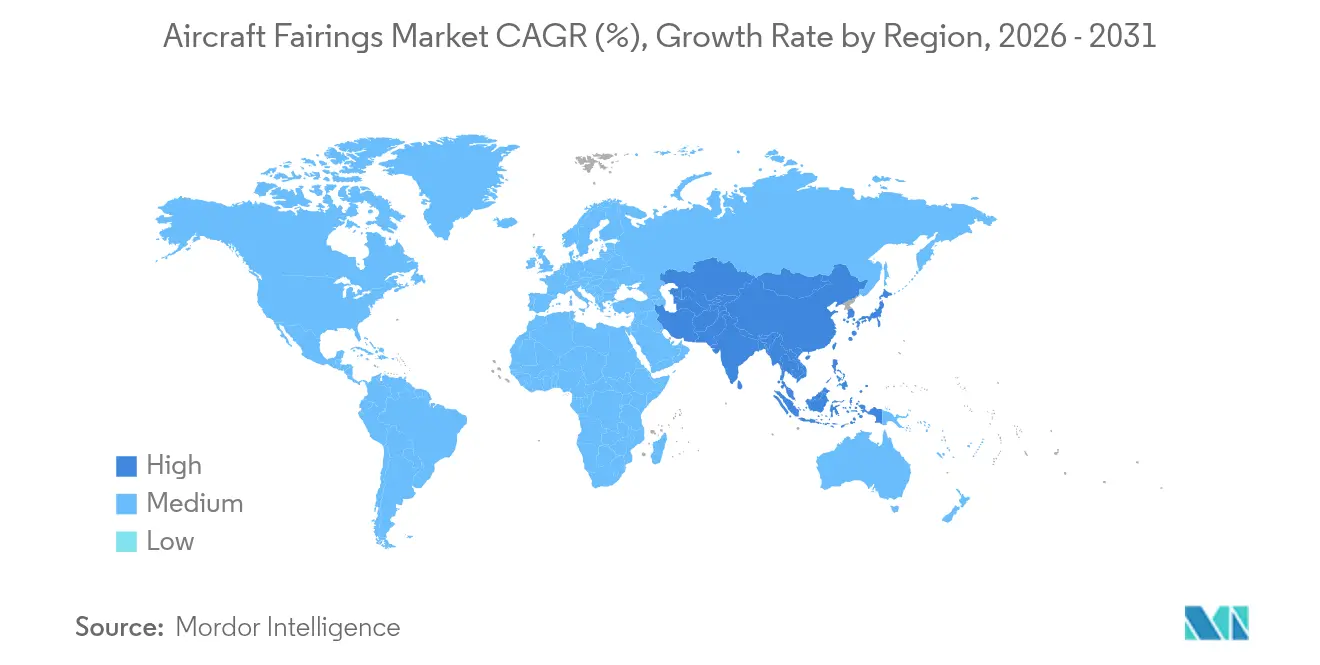
North America captured 36.24% of the aircraft fairings market share in 2025, supported by Boeing’s production recovery and a USD 1 billion GE Aerospace manufacturing commitment that boosts composite capacity in multiple US states. Long-established clusters in Washington and South Carolina give suppliers a mature ecosystem, although tariff policies and skilled-labor gaps continue to strain cost bases. RTX’s USD 2 billion facilities expansion highlights OEM faith in sustained demand even as the near-term operating environment remains inflationary.
Asia-Pacific is the fastest-growing region, showing 8.51% CAGR to 2031. Indigenous programs such as China’s C919 or India’s HTT-40 intensify localization mandates, drawing Western tier-1s into joint-venture factories. Strata Manufacturing recorded 38% output growth, exporting 11,774 structures across Airbus and Boeing models, signaling the Gulf’s ambition to become a composites powerhouse. Hanwha Aerospace’s new 100,000 m² Vietnam site for GE and Rolls-Royce components further validates the shift.
Europe benefits from Airbus’ production tempo and focuses on green materials. Airbus’ bio-based carbon-fiber feasibility trials for helicopter fairings mark early steps toward carbon-neutral supply chains. Japan preserves a niche as a high-grade carbon-fiber supplier, with Mitsubishi Chemical targeting 12% composite growth on future mobility programs. Meanwhile, Middle East and Africa markets leverage free-trade zones and proximity to long-haul routes to win offset work from OEMs. However, achieving certification parity with Western peers remains an ongoing task.
Regulatory Landscape
Aircraft fairings sold into transport-category programs are governed by aircraft-level airworthiness and structural safety rules, primarily FAA 14 CFR Part 25 in the United States and EASA CS-25 in Europe. Under these frameworks, applicants must support structural integrity for installed aerodynamic covers through design assessment, material allowables and strength-property verification, and test evidence against the applicable load and damage-tolerance expectations. Certification pathways are covered under FAA 14 CFR Part 21 and the EU implementing rules for design and production approvals, including type certificates, production organization approvals, and supplemental type certificates.
In Europe, Commission Implementing Regulation (EU) 2026/100 (issued January 2026) amended Regulations (EU) No 748/2012 and (EU) No 1321/2014, updating elements of certificate management and airworthiness review processes that shape how EU-based organizations maintain continued compliance documentation. For fairing suppliers, this raises the bar on configuration control and traceability across composite and metallic processes, supporting both OEM line-fit approvals and qualified replacement parts for in-service aircraft.
Value Chain Analysis
The aircraft fairings value chain is built around a tiered aerostructures model. Upstream inputs center on carbon-fiber composites (prepreg/resin systems) and lightweight metallic alloys, followed by specialized processing steps such as autoclave or OOA curing, AFP/ATL layup, machining, and finishing and coatings. Tier-2 and Tier-3 manufacturers typically handle fabrication, machining, and subassembly, while Tier-1 integrators focus on co-design, certification support, quality systems, and delivery into OEM final assembly lines and major nacelle or aerostructure work packages.
Downstream, shipments go to OEM production for line-fit installation and to aftermarket channels that rely on global distribution and MRO networks for spares positioning. This structure is reflected in participants such as Boeing, Airbus, and Pilatus on the OEM side, and ShinMaywa Industries, Strata Manufacturing (composite parts work for Pilatus PC-12 PRO and PC-24), and Elbit Systems-Cyclone among specialized suppliers. Operational constraints highlighted in 2025-2026, including labor and material bottlenecks and tight inventories, have stressed lead times for structural components. As a result, suppliers increasingly emphasize multi-sourcing, localized workshare or offset manufacturing, and repair-cycle throughput for serviceable fairings.
Competitive Landscape
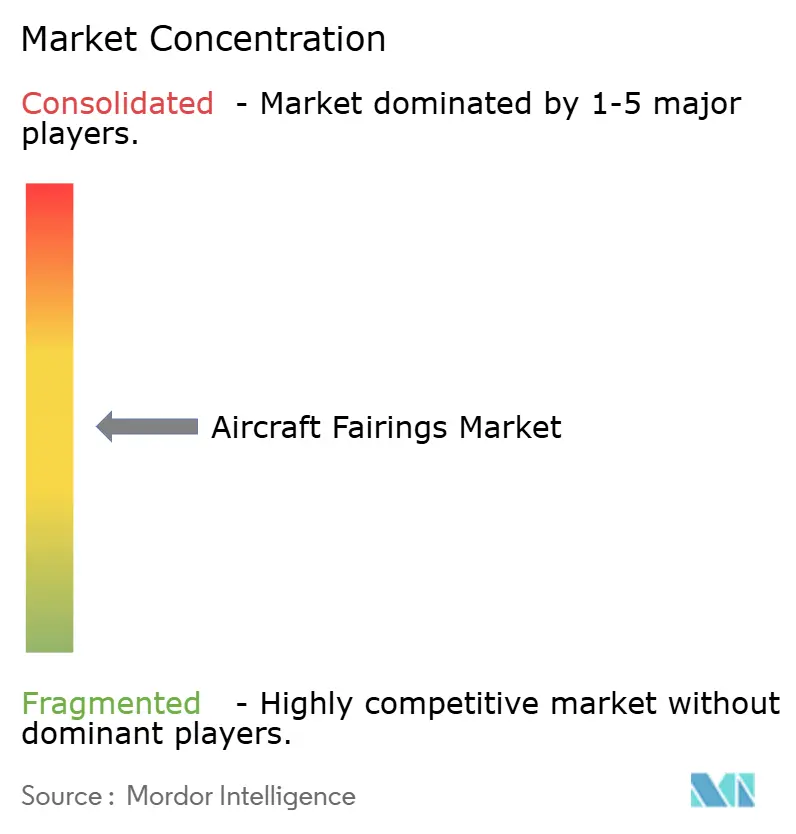
The aircraft fairings market is moderately concentrated, with tier-1 leaders—FACC AG, GKN Aerospace, and Collins Aerospace (RTX Corporation)—holding long-standing life-of-program contracts that deter new entrants. Nonetheless, supply-chain fragility since 2020 has prompted OEM reassessment of single-source dependencies. Some OEMs explore partial insourcing of critical fairings, while others seed new Asian suppliers for resilience. Capital-intensive composite expansions underline the widening capability gap; Collins’ USD 200 million Spokane brake-material upgrade enlarges capacity 50% and embeds further automation.
Operational excellence becomes a differentiator. FACC’s 2025 Aero Excellence Award shows how rigorous quality frameworks shorten cycle times and win OEM accolades. Additive manufacturing also disrupts cost structures; Hexcel’s HexAM demonstrations validate printed thermoplastic fairings ready for high-temperature zones, signaling a future where tooling-light processes break even at lower volumes.
The competitive chessboard further fragments along program lines: incumbent suppliers chase high-volume narrow-body awards, while agile specialists pivot toward eVTOL prototypes needing rapid turnaround. Cross-pollination of workforce and digital twins between these silos will decide margin leadership through 2030.
Aircraft Fairings Industry Leaders
-
Spirit AeroSystems, Inc.
-
FACC AG
-
Collins Aerospace (RTX Corporation)
-
GKN Aerospace
-
Airbus Aerostructures (Airbus SE)
- *Disclaimer: Major Players sorted in no particular order
Market Opportunities and Future Outlook
A practical whitespace is emerging in manufacturability upgrades for high-rate narrow-body and derivative programs, where fairings need to combine aerodynamic performance with faster cycle times and repeatable quality. As adoption shifts from traditional thermoset composites toward more automation-friendly approaches, including thermoplastic composites and higher levels of digital manufacturing control, suppliers that can industrialize rapid layup, welding and assembly methods, and consistent inspection and traceability aligned to Part 21 and CS-25 compliance requirements gain clearer paths to design wins.
Capacity and footprint investments also point to this push toward scalable aerostructures production. In March 2026, FACC began an approximately EUR 350 million investment program that includes a new high-tech plant in St. Martin im Innkreis, Austria, described as doubling aerostructures production capacity at that site, supporting higher-throughput structures and related aerodynamic covers within integrated work packages. At the same time, logistics and parts-flow volatility are leading OEMs to prioritize resilience, underscored by Boeing chartering an Antonov An-124 in June 2026 to move fuselage sections and mitigate delays. For fairing suppliers, the commercial advantage is tied to reducing lead times, localizing critical processes, and stabilizing deliveries across both OEM and aftermarket demand.
Recent Industry Developments
- July 2026: Collins Aerospace (RTX) opened a new Center of Excellence in Wolverhampton, U.K., focused on advancing and certifying its elecTRAS electric thrust reverser actuation technology for next-generation narrowbody aircraft. The center supports the shift toward more-electric architectures that affect nacelle and adjacent fairing interfaces, and it strengthens Collins position in future propulsion integration work packages.
- August 2025: Vertical Aerospace and Aciturri Aerostructures announced a long-term airframe partnership for the VX4 eVTOL, with Aciturri responsible for the entire airframe including fairings and other structural components. Consolidating responsibility for major structures and aerodynamic covers into one supplier reflects OEM preference for integrated packages and helps clarify volume exposure for suppliers working through iterative eVTOL design cycles.
- April 2025: Spirit AeroSystems entered a definitive agreement with Airbus to transfer ownership of industrial assets and sites producing Airbus aerostructures to Airbus, aligned with Spirit broader transaction activity. The realignment changes sourcing and industrial control for Airbus-linked aerostructure work, influencing where fairing-related fabrication and integration capabilities sit within the supply base.
Research Methodology Framework and Report Scope
Market Definition and Coverage
For this study, the market covers the value of aircraft fairings used on certified fixed-wing aircraft, counted when they are sold into OEM production lines or as qualified replacement parts through the aftermarket.
Scope exclusions: Launch-vehicle and missile payload fairings are excluded from this market sizing.
Segmentation Overview
- By Application
- Fuselage
- Landing Gear
- Wings
- Control Surfaces
- Engine
- By Material
- Carbon-Fiber Reinforced Polymer (CFRP)
- Glass-Fiber Composites
- Metal Alloys
- Thermoplastic Composites
- Additively-Manufactured Thermoplastics
- By Aircraft Type
- Commercial
- Narrow-Body Commercial Aircraft
- Wide-Body Commercial Aircraft
- Military
- Combat
- Non-Combat
- General Aviation
- Unmanned Systems
- Commercial
- By Sales Channel
- OEM Production
- Aftermarket MRO
- By Geography
- North America
- United States
- Canada
- Mexico
- Europe
- United Kingdom
- Germany
- France
- Russia
- Rest of Europe
- Asia-Pacific
- China
- Japan
- India
- South Korea
- Rest of Asia-Pacific
- South America
- Brazil
- Rest of South America
- Middle East and Africa
- Middle East
- Saudi Arabia
- United Arab Emirates
- Rest of Middle East
- Africa
- South Africa
- Rest of Africa
- Middle East
- North America
Data Sources, Market Sizing, and Validation
Desk Research
Desk work started by mapping where fairings demand shows up in the real world, which is mainly aircraft production and fleet activity, followed by replacement timing. We used public aircraft delivery and fleet indicators, then cross-checked them with repair and maintenance signals, so the early model was not built on a single data series.
For the public record, we referred to sources such as FAA and EASA airworthiness and certification information, ICAO air transport statistics, US DOT aviation data, and trade publications and association pages that track aircraft deliveries and backlogs. We also used company annual reports, investor presentations, press releases, and reputable aviation media to confirm product scope and program exposure, plus patent databases to sense material and manufacturing direction. In a few places, paid subscriptions were used only for company financials and news screening, and to spot-check import and export flows for relevant aerospace parts. This list is illustrative only, and many other public and internal-reference sources were also reviewed for data collection and clarification.
Primary Interviews and Surveys
Primary inputs were taken from interviews and short surveys with aerostructure and component supply chain participants, plus airline and MRO-side specialists who see replacement volumes and pricing behavior. Since this is a global market, the fieldwork was balanced across APAC, EMEA, and the Americas. Discussions were used to confirm what is counted as a fairing versus adjacent parts, and how OEM versus aftermarket pricing typically differs.
Respondent input was used to tighten the scope boundaries and replacement cadence assumptions used later in the value build.
Distribution of primary research fieldwork respondents
| Company type | Respondent position | Region |
|---|---|---|
| Top tier: 27% | CXOs: 13% | APAC: 48% |
| Mid tier: 58% | Functional/Unit leaders: 27% | EMEA: 31% |
| Smaller Players: 15% | Managers: 60% | Americas: 21% |
Market-Sizing & Forecasting
Sizing was built using a top-down approach where aircraft deliveries, in-service fleet counts, and maintenance cycles are used to reconstruct the annual demand pool for fairings, which is then translated into value using typical program-level pricing and material mix assumptions. The totals were then corroborated through selective bottom-up checks, such as sampling fairing sets per aircraft family, applying indicative ASPs, and validating the result through supplier and channel feedback.
Key inputs used in the model include commercial and military aircraft deliveries, installed fleet by major aircraft categories, aftermarket replacement frequency tied to checks and damage rates, composite versus metal share shifts that influence ASPs, and OEM versus MRO demand split behavior. When data gaps appear, we rely on conservative ranges agreed in interviews, then narrow them using nearby signals like backlog trends and utilization changes.
Forecasts were prepared using scenario analysis supported by a small set of demand drivers, mainly delivery ramp expectations, fleet aging and shop visit intensity, and material adoption trends that affect price progression. Assumptions were kept traceable so a reviewer can follow how each driver changes volume or pricing before the final CAGR path is accepted.
Data Validation & Update Cycle
Outputs were checked against independent signals, including aircraft delivery trends, fleet utilization direction, and the implied OEM versus aftermarket share, so the final number did not depend on a single assumption. Where the model produced sharp year-to-year changes, the inputs were rechecked, and respondents were re-contacted when the variance could not be explained by known events such as production slowdowns or maintenance normalization.
Before sign-off, the model goes through step-by-step analyst review, followed by a second pass that checks unit logic, currency consistency, and sensitivity ranges. Reports are refreshed annually, and interim updates are made when material events occur, such as major production rate changes or regulatory shifts that impact parts replacement. Right before delivery, we do a final sweep so clients receive the latest updated view.
Mordor Intelligence's Aircraft Fairings Market Size Compared Against Other Published Estimates
Published market sizes for aircraft fairings can look different even when the topic sounds identical, since each publisher chooses its own scope cut, year basis, and pricing logic. The biggest swings usually come from whether values are counted at OEM shipment pricing versus blended end-user spend, and whether the study mixes in adjacent aerodynamic parts that are not always treated as fairings.
Another common gap comes from the demand engine used, where some estimates lean heavily on broad aerospace output totals, while others tie demand more tightly to deliveries, installed base, and replacement cadence by application. Currency timing and refresh cadence also matter, especially when production rates and material costs change within the year, which can shift the reported number even if unit volumes are similar.
Benchmark comparison
| Source | Market Size | Gaps in Research Methodology |
|---|---|---|
| Mordor Intelligence | USD 2.09 B (2026) | |
| Global Consultancy A | USD 2.28 B (2024) | Uses a different base year and emphasizes end-use revenue shares, which can blend OEM pricing with broader commercial spend and move the total upward versus a shipment-led view. |
| Industry Research Firm B | USD 2.31 B (2024) | Counts a wider set of systems and component groupings around airframe interfaces, which can pull adjacent parts into the fairings total and lift the value in earlier years. |
The table shows that year selection and what gets counted inside the fairings definition are the two main reasons for the spread in reported values. Keeping the value build tied to aircraft deliveries, installed base replacements, and application-level scope reduces double counting, which is the discipline applied in the aircraft fairings market model by Mordor Intelligence.
Key Questions Answered in the Report
What is the current size of the aircraft fairings market?
The aircraft fairings market is valued at USD 2.09 billion in 2026 and is forecasted to grow to USD 2.91 billion by 2031.
Which application segment commands the largest share?
Fuselage fairings hold 32.84% of revenue in 2025, reflecting their integration complexity and critical aerodynamic role,
Why are thermoplastic composites gaining traction?
Thermoplastics enable faster cycle times, automated welding, and easier recycling, supporting a 8.86% CAGR through 2031
Which region is growing fastest?
Asia-Pacific leads growth at 8.51% CAGR, powered by indigenous jet programs and supply-chain localization.
How will hybrid-electric aircraft affect fairing design?
Hybrid propulsion architectures require new nacelle and cooling fairings, opening design-win opportunities for suppliers that can integrate thermal management with structural integrity.
What are the key challenges for new entrants?
Volatile carbon-fiber pricing and protracted FAA/EASA certification cycles extend ROI horizons and favor incumbents with capital and regulatory expertise.