
Market Overview
| Study Period | 2019 - 2031 |
|---|---|
| Market Size (2026) | USD 109.41 Billion |
| Market Size (2031) | USD 129.69 Billion |
| Growth Rate (2026 - 2031) | 3.46 % |
| Fastest Growing Market | Middle East |
| Largest Market | Asia Pacific |
| Market Concentration | High |
Major Players *Disclaimer: Major Players sorted in no particular order Image © Mordor Intelligence. Reuse requires attribution under CC BY 4.0. | |
Aircraft Engines Market Analysis by Mordor Intelligence
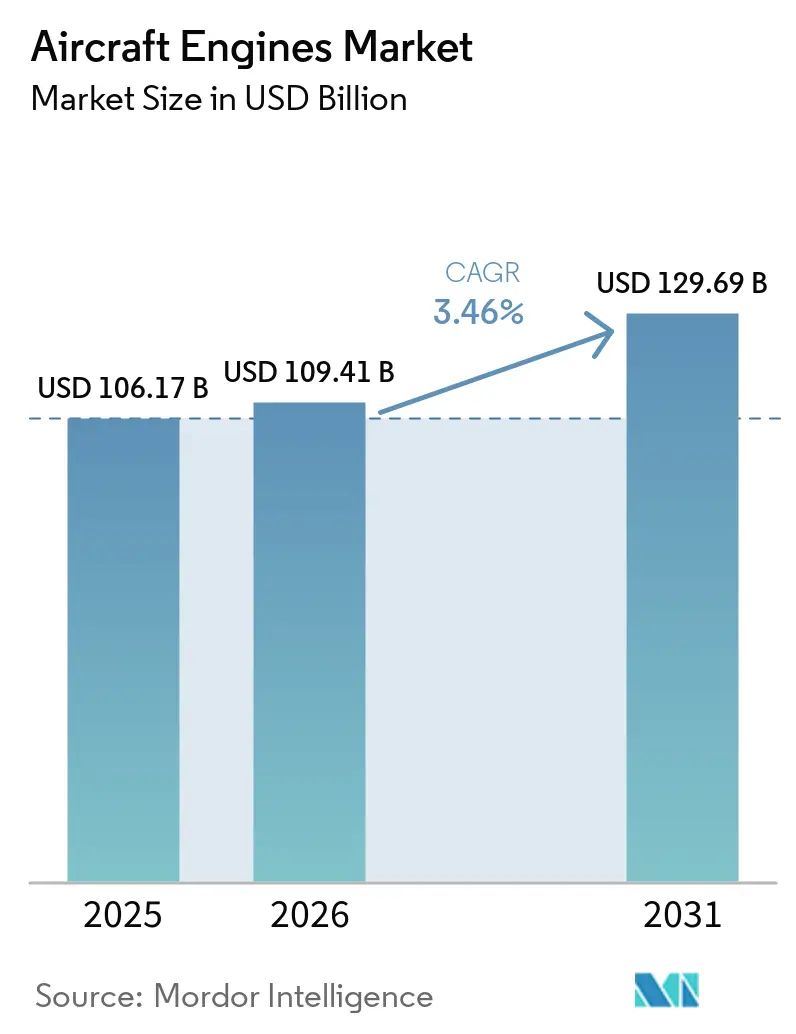
The aircraft engines market size is expected to increase from USD 106.17 billion in 2025 to USD 109.41 billion in 2026 and reach USD 129.69 billion by 2031, growing at a CAGR of 3.46% over 2026-2031. Demand is supported by the recovery of commercial aircraft production, a growing installed base of newer engines, and defense modernization programs. Engine deliveries remain linked to airframe production capacity, so supply constraints can defer original equipment revenue while increasing future maintenance activity. The aircraft engines market also benefits from long service lives because fleet growth creates recurring demand for repairs, overhauls, spare parts, and technical support. Manufacturers are expanding production and service capacity while protecting access to repair technology and long-term maintenance contracts. The aircraft engines market, therefore, combines a concentrated original equipment base with a broader maintenance opportunity that develops as recent engine deliveries mature.
Key Report Takeaways
- By engine type, turbofan engines held 64.78% of the aircraft engines market share in 2025, while hybrid-electric engines are projected to grow at a 6.51% CAGR through 2031.
- By aircraft type, narrowbody commercial aircraft accounted for 43.91% of the aircraft engines market share in 2025, while advanced air mobility is forecast to grow at a 7.12% CAGR through 2031.
- By technology, geared turbofan technology accounted for 36.38% of the aircraft engines market in 2025, while adaptive-cycle engines are projected to grow at a 7.52% CAGR through 2031.
- By thrust class, the 25,001-50,000 lbf class held 40.59% of the aircraft engines market share in 2025, while the more than 50,000 lbf class is forecast to grow at a 6.87% CAGR through 2031.
- By component, turbines accounted for 36.38% of the aircraft engines market size in 2025, while gearboxes are projected to expand at a 5.55% CAGR through 2031.
- By end user, OEM factory-fit installations accounted for 55.65% of the aircraft engines market share in 2025, while replacement and aftermarket services are forecast to grow at an 8.32% CAGR through 2031.
- By geography, the Asia-Pacific region accounted for 33.38% of 2025 revenue, while the Middle East is expected to grow at a 6.26% CAGR through 2031.
Note: Market size and forecast figures in this report are generated using Mordor Intelligence’s proprietary estimation framework, updated with the latest available data and insights as of January 2026.
Market Trends and Insights
Drivers Impact Analysis of Aircraft Engines Market*
| Driver | (~) % Impact on CAGR Forecast | Geographic Relevance | Impact Timeline |
|---|---|---|---|
| Fleet-wide shift toward LEAP and GTF engines in fast-growing Asian carriers | +0.90% | Asia-Pacific, South Asia, and Southeast Asia | Medium term (2-4 years) |
| Emerging twin-aisle production ramp-up post-supply-chain recovery | +0.60% | Global, with assembly in North America and Europe and demand from Asia-Pacific and the Middle East | Short term (≤ 2 years) |
| EU mandates for 100% SAF-ready engines in new type certificates | +0.50% | EU, with influence in the UK, Australia, and allied markets | Medium term (2-4 years) |
| NATO transport- and tanker-fleet modernization programs boosting military engine demand | +0.40% | Europe and North America | Medium term (2-4 years) |
| Helicopter fleet renewal for offshore energy operations raising turboshaft deliveries | +0.20% | North Sea, Brazil, West Africa, and Asia-Pacific | Short term (≤ 2 years) |
| Leasing-driven expansion of African regional-jet operators | +0.10% | Sub-Saharan Africa and North Africa | Long term (≥ 4 years) |
| Source: Mordor Intelligence | |||
Emerging Twin-Aisle Production Ramp-Up Post-Supply-Chain Recovery
Widebody production is gradually returning, and the aircraft engines market depends on that recovery, as twin-aisle aircraft require high-value engines. Airbus delivered 793 commercial aircraft in 2025, including 93 A330 and A350 aircraft, compared with 173 widebody deliveries in 2019.[1] This gap shows that widebody output had not returned to its earlier level during 2025. Engine suppliers must align their production plans with aircraft assembly schedules and component availability. A delayed aircraft delivery can move the associated engine revenue into a later period. It can also postpone the first major maintenance event for that engine, shifting part of the commercial impact from original equipment sales to future service demand.
The effect is important for large-engine service networks because shop visits are linked to operating hours and time on wing. Rolls-Royce reported that large-engine shop visits rose by more than 50% over 3 years and stated that it planned a further 20% increase in network capacity through the middle of the decade. This activity supports the aircraft engines market when new deliveries remain constrained. It also makes overhaul capacity, repair approvals, and spare-part availability central to competitive execution. The immediate opportunity lies in meeting existing fleet needs without creating new delays in the maintenance network. The longer effect is a larger stream of service work as widebody aircraft delivered during the recovery period enter scheduled maintenance cycles.
Fleet-Wide Shift Toward LEAP and GTF Engines in Fast-Growing Asian Carriers
Asian carriers are replacing older narrowbody fleets with aircraft powered by CFM LEAP and Pratt & Whitney GTF engines. IndiGo ordered more than 1,000 LEAP-1A engines in July 2026 for more than 510 A320neo-family aircraft. The order underscores India's importance to future narrowbody engine demand. It also reflects airline concerns about reliability and fleet availability after earlier GTF durability issues. The aircraft engines market benefits from this replacement cycle because each new aircraft delivery creates demand for original equipment and for longer maintenance support. Engine selection also affects which repair networks, spare-parts pools, and service agreements develop around a carrier's fleet.
The GTF remains present in Southeast Asia despite the greater LEAP order flow in India. AirAsia confirmed an order for 150 A220 aircraft powered by Pratt & Whitney GTF engines in May 2026. Tigerair Taiwan also signed a memorandum of understanding for GTF engines on 15 A321neo aircraft in July 2026. These commitments show that airline fleet decisions remain split between the two narrowbody engine families. Safran reported that civil engine services revenue increased 43% in USD in the first quarter of 2026. The growing installed base should support maintenance demand, but production limits can still restrict aircraft deliveries and reduce customer choice in the short term.
NATO Transport- and Tanker-Fleet Modernization Programs Boosting Military Engine Demand
European defense programs are driving demand for military turbofans, turboprops, and turboshafts in the aircraft engines market. In July 2026, Belgium, Croatia, France, Poland, Spain, Türkiye, and the UK launched a NATO High Visibility Project for a pooled A400M transport fleet. The program builds on multinational fleet operating models already used for tanker aircraft. A larger transport fleet would support demand for engines, spare parts, repair services, and maintenance training. It would also require coordinated service arrangements across participating nations. These requirements favor providers with established repair approvals and experience supporting government fleets.
The multinational MRTT fleet is expanding to 12 A330 MRTT aircraft by 2029, following Denmark and Sweden's entry in June 2025 and Finland's in July 2026. The aircraft uses Rolls-Royce Trent 700 engines, which links fleet expansion to a defined large-engine service base. The A400M program also creates maintenance work for the TP400 engine. MTU Aero Engines, Safran, and Avio Aero began cooperation in June 2025 to develop next-generation military helicopter engines. The aircraft engines market gains from this activity because military fleets are supported through long operating periods and require an approved maintenance infrastructure. The relevant commercial opportunity extends beyond engine supply to sustainment, repair capability, and component availability.
EU Mandates for 100% SAF-Ready Engines in New Type Certificates
SAF requirements are adding certification work for engine manufacturers serving European airlines. Regulation (EU) 2023/2405 requires a 2% SAF blend at EU airports from 2025, rising to 6% by 2030. These rules influence fuel-system validation, combustor assessment, and operating documentation. They also encourage engine makers to demonstrate that their products can use higher SAF blends. The aircraft engines market is affected because compliance work becomes part of new engine development and fleet support. Smaller manufacturers may face greater pressure because certification resources are concentrated among larger original equipment groups.
The EU’s policy path creates a practical reason for airlines to favor engines and aircraft with a clear, SAF compatibility plan. Engine makers that complete relevant validation can reduce uncertainty for operators facing regulatory obligations. The work also matters for existing fleets because airlines need guidance on approved fuel use and maintenance practices. The compliance requirement can strengthen demand for updated combustor designs and related engineering services. It can also increase the value of technical data held by engine manufacturers. The aircraft engines market will benefit where certification programs translate into replacement decisions, retrofit work, or a higher preference for newer engine platforms.
Restraints Impact Analysis of Aircraft Engines Market*
| Restraint | (~) % Impact on CAGR Forecast | Geographic Relevance | Impact Timeline |
|---|---|---|---|
| Margin pressure from independent MRO capacity growth | -0.5% | Global, concentrated in North America and Europe manufacturing hubs | Medium term (2-4 years) |
| Slow standardization of hydrogen-combustion engine architectures | -0.3% | Global, with early regulatory gaps in the EU and North America | Long term (≥ 4 years) |
| Persistent casting and forging bottlenecks limiting turbine-blade availability | -0.3% | Global, especially North America, Europe, and Asia-Pacific MRO hubs | Medium term (2-4 years) |
| High-temperature durability issues in hot-and-high Middle-East operations | -0.2% | Middle East and Africa | Short term (≤ 2 years) |
| Source: Mordor Intelligence | |||
Slow Standardization of Hydrogen-Combustion Engine Architectures
Hydrogen propulsion remains limited by certification uncertainty, even as manufacturers and research bodies examine its potential. The Federal Aviation Administration (FAA) states that existing airworthiness standards did not envision the use of fuel cells or hydrogen to power aircraft engines. Its roadmap places certification readiness for several issues within the 2028-2032 period.[2] This timetable limits the commercial readiness of hydrogen-combustion engine variants during the forecast period. Engine manufacturers may invest in combustor, fuel-system, and materials research before a settled certification pathway exists. The aircraft engines market, therefore, cannot rely on hydrogen programs for near-term production volumes.
Material performance is a central issue because hydrogen combustion can create different temperature and emissions conditions in turbine hot sections. University College London and the UK Civil Aviation Authority examined the effects of hydrogen combustion on nickel-based superalloys in 2025. Their work noted that many material certification and testing procedures do not consider hydrogen exposure. This creates additional engineering and validation requirements for engine developers. The restraint does not remove long-term propulsion interest, but it delays the point at which hydrogen-related products can make a meaningful commercial contribution. The aircraft engines market will remain focused on established turbofan, turboprop, and turboshaft architectures while regulatory and technical standards develop.
Margin Pressure from Independent MRO Capacity Growth
Independent maintenance providers are expanding their capacity to service new-generation engines, which could intensify price competition in the aftermarket. IATA has called for improved parts access and greater competition in engine maintenance. This discussion is important because original equipment manufacturers have historically retained strong control over repair data, parts supply, and long-term service agreements. As newer fleets reach their first major shop visits, independent providers can seek a larger role in inspections, repairs, and overhaul work. The aircraft engines market continues to benefit from higher shop visit volumes, but original equipment manufacturers may face greater pressure on service margins. This shift makes repair quality, turnaround time, and parts availability more important competitive factors.
MTU Aero Engines is preparing its Fort Worth facility to induct LEAP-1A engines in 2026 and expects the global LEAP aftermarket to peak at 8,000 annual shop visits by 2045. The program shows how maintenance capacity is developing alongside the expanding LEAP fleet. Independent growth can benefit airlines by adding choice and capacity, particularly when original equipment networks are busy. It can also reduce the warranty-period advantage previously held by original equipment manufacturers as engines age. The outcome depends on access to approved repairs, usable parts, and technical documentation. The aircraft engines market will continue to grow, driven by maintenance demand, although the revenue distribution between engine makers and independent providers may shift.
*Our forecasts treat driver/restraint impacts as directional, not additive. The impact forecasts reflect baseline growth, mix effects, and variable interactions.
Aircraft Engines Market Segment Analysis
By Engine Type:
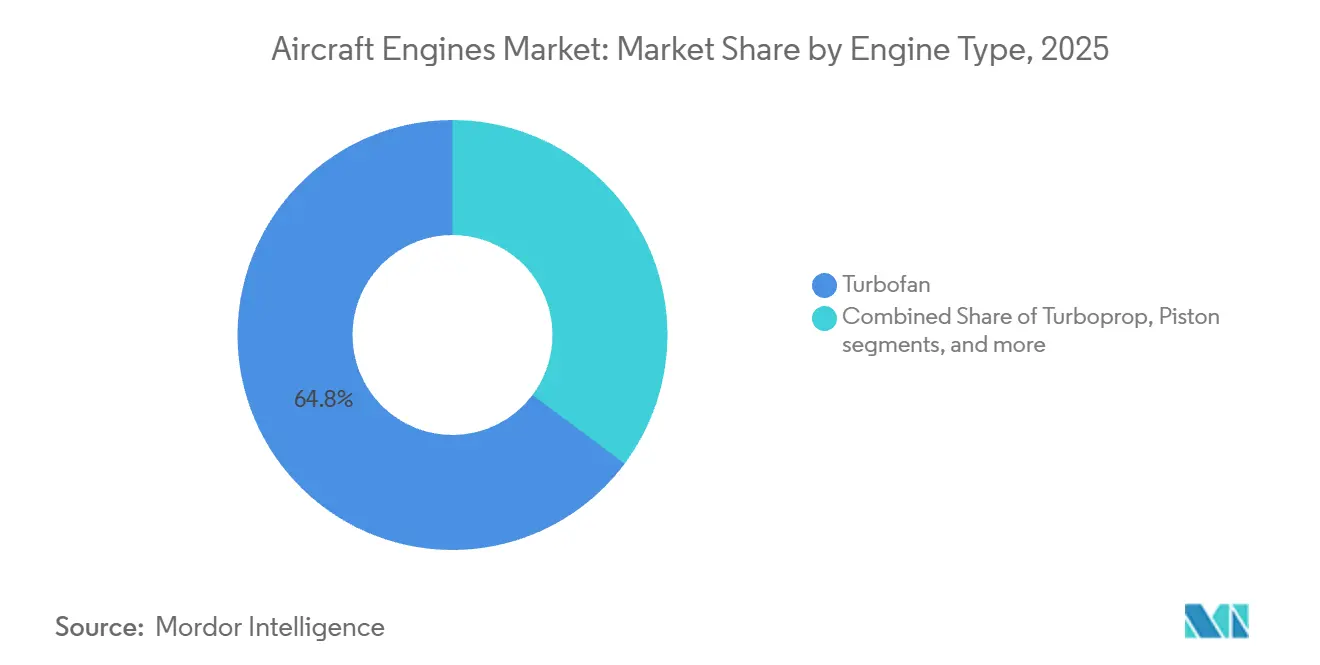
Hybrid-Electric Gains TractionTurbofan engines held 64.78% of the aircraft engines market share in 2025, reflecting their role in commercial narrowbody and widebody aircraft as well as military platforms. This category has the highest revenue weight because it includes the dominant propulsion systems used by large airline fleets. CFM delivered a record 1,800 LEAP engines in 2025. The LEAP installed base is expected to continue to grow as A320neo Family and B737 MAX aircraft enter service. Turboprop engines remain important for regional and cargo aircraft, as well as some utility applications. Turboshaft engines support helicopter fleets used in offshore energy, emergency services, military transport, and general aviation. Piston engines continue to serve flight training and smaller general aviation aircraft. These engine types give the aircraft engines market a diversified base, even though turbofans account for most of the value.
Hybrid-electric engines are projected to grow at a 6.51% CAGR through 2031, making them the fastest-growing engine-type segment in the aircraft engines market. GE Aerospace invested USD 300 million in Beta Technologies in September 2025 to support the development of a megawatt-class hybrid-electric turbogenerator for advanced air mobility and long-range vertical takeoff and landing aircraft.[3] The program draws on GE Aerospace experience with the T700 turboshaft family. Hybrid-electric development remains in the early stages of production, so near-term demand is lower than for conventional engines. Its importance lies in the potential for new propulsion applications in regional aircraft and advanced air mobility. The technology also creates demand for electrical integration, control systems, gearboxes, and thermal-management work. Manufacturers that combine established certification capabilities with hybrid-electric development can use those skills as future programs progress.

By Aircraft Type:
AAM Vehicles Lead GrowthNarrowbody commercial aircraft accounted for 43.91% of the aircraft engines market share in 2025. The segment is supported by airline demand for single-aisle aircraft used on domestic and medium-haul routes. Airbus ended 2025 with an 8,754-aircraft backlog. This backlog provides a substantial forward order base for engine suppliers, although production constraints may affect delivery timing. Widebody aircraft require higher-thrust engines and generate a separate demand pool for long-haul airline operations. Regional aircraft demand is rising, where operators seek to connect smaller cities and underserved routes. Military aviation supports propulsion demand through combat, transport, tanker, trainer, and rotorcraft fleets.
Advanced air mobility is forecast to grow at a 7.12% CAGR through 2031. This rate reflects the early development of new aircraft programs and the need for propulsion systems suited to emerging air mobility designs. UAVs form another growing application, especially in defense. The US Air Force selected GE Aerospace and Rolls-Royce in June 2026 for medium-thrust engine development under the Collaborative Combat Aircraft Increment 2 program. The decision formalizes a government-backed demand area for engines used in autonomous aircraft. General aviation includes business jets, helicopters, turboprop aircraft, and piston-engine aircraft, each with different operating and replacement cycles. The aircraft engines market benefits from this mix because established commercial fleets provide scale while new aircraft categories expand the range of propulsion needs.
By Technology:
Adaptive-Cycle Engines EmergeGeared turbofan technology held 36.38% of the aircraft engines market size in 2025. The technology is closely associated with the A220 and A320neo families and has a major position in global single-aisle aviation. Pratt & Whitney had received more than 13,000 GTF orders and commitments, while the fleet had surpassed 50 million flying hours by May 2026. The program's fuel efficiency supports airline interest, even though earlier durability concerns affected availability for some operators. MTU Aero Engines and Pratt & Whitney expanded their GTF maintenance collaboration in April 2025, increasing MTU's capacity to up to 600 annual shop visits across GTF models. Conventional turbofan and turboprop technology remains relevant across older commercial, military, cargo, and regional fleets.
Adaptive-cycle engines are forecast to grow at a 7.52% CAGR through 2031. Their demand is tied mainly to the US Air Force Next Generation Adaptive Propulsion program. GE Aerospace and Pratt & Whitney both progressed their adaptive engine work through assembly readiness reviews during 2026. The program targets propulsion for the Boeing F-47 and related next-generation defense requirements. Adaptive-cycle architecture is designed to alter bypass flow to balance cruise efficiency and combat thrust. The technology has a more specialized demand base than commercial narrowbody engines, but it supports high-value defense investment. Hybrid-electric propulsion and contra-rotating open-rotor concepts remain under development, with potential relevance to future regional and narrowbody aircraft. The aircraft engines market retains its current scale through conventional platforms while technology programs prepare for later replacement cycles.
By Thrust Class:
Mid-Range Class Anchors Volume, High-Thrust Grows FastestThe 25,001-50,000 lbf thrust class held 40.59% of the aircraft engines market share in 2025. It includes much of the engine range used in high-volume narrowbody aircraft operations. LEAP-1A and GTF variants operate in or near this class, linking them directly to the A320neo family. The 10,001-25,000 lbf range serves regional aircraft and larger business jets. The below 10,000 lbf category supports general aviation, unmanned aircraft, and early advanced air mobility programs. These applications reduce reliance on a single-aircraft mission. The middle thrust range nonetheless has the strongest volume position because narrowbody fleets are the largest part of commercial aviation.
The more than 50,000 lbf thrust class is projected to expand at a 6.87% CAGR through 2031. This part of the aircraft engines market is supported by widebody aircraft production and military engine development programs. The GE9X, which powers the B777-9, and the GEnx, which powers the B787, are both within this class. Higher-thrust engines require specialized materials, extensive testing, and large repair networks. Their service requirements create recurring work for approved maintenance providers. Military programs also increase demand, as next-generation fighter engines are designed to deliver higher performance than prior systems. The class has a smaller unit volume than narrowbody engines, but its high content value and service needs support its faster projected growth.
By Component:
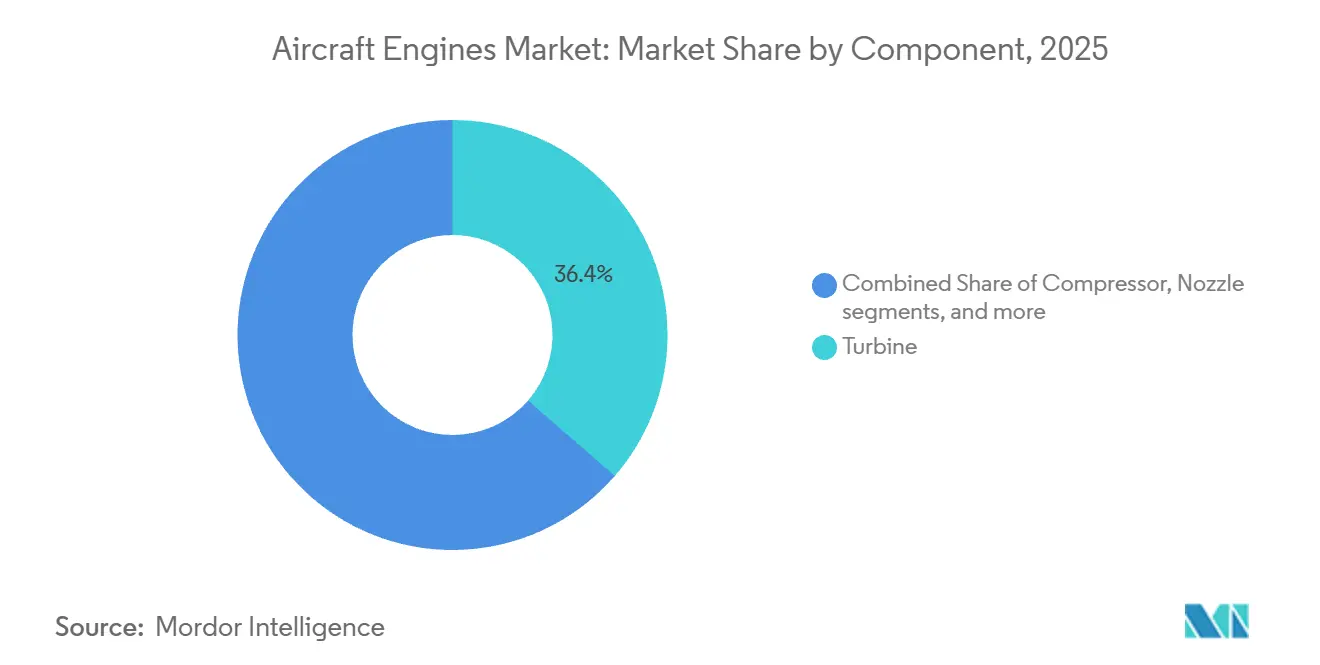
Gearbox Systems AccelerateTurbines accounted for 36.38% of the aircraft engines market size in 2025. This position reflects the engineering complexity of turbine parts, their high superalloy content, and their exposure to demanding operating conditions. Turbine blades, vanes, and disks require regular inspection and can require repair or replacement during engine shop visits. Rolls-Royce reported in 2025 that an improved Trent 1000 blade had more than doubled time on wing, while its durability program targeted an 80% improvement by 2027. Such improvements can reduce unplanned maintenance events while supporting longer-term demand for component service. Compressors are the next major component category. Nozzles, gearboxes, fans, combustors, full-authority digital engine controls, and other systems complete the engine's component structure.
Gearboxes are projected to grow at a 5.55% CAGR through 2031. The GTF reduction gearbox allows the fan and turbine to operate at different speeds and is central to the platform's design. It therefore has a direct role in the expansion of geared propulsion systems. Gearboxes are also relevant to hybrid-electric powertrains, where high-speed turbogenerators need to connect with electrical systems and other drivetrain components. GE Aerospace's hybrid-electric partnership with Beta Technologies draws on gearbox integration experience from the T700 engine family. Novel powertrain certification remains an important consideration for this segment. The aircraft engines market can benefit from gearbox demand as propulsion designs incorporate greater mechanical and electrical integration.
By End-User:
Aftermarket Gains MomentumOEM factory-fit installations accounted for 55.65% of the aircraft engines market share in 2025. This share reflects the sustained pace of commercial aircraft production and the need to equip new aircraft before delivery. CFM delivered 1,030 LEAP engines in the first half of 2026, more than 41% above the same period a year earlier. Production has expanded across France, Morocco, Belgium, Mexico, and India. OEM factory-fit demand depends on aircraft assembly rates, supplier output, and certification schedules. It also depends on airlines receiving aircraft on time and maintaining their financing and fleet plans. The original equipment channel remains a major source of revenue in the aircraft engines market because every newly built aircraft requires an engine installation.
Replacement and aftermarket services are forecast to grow at an 8.32% CAGR through 2031, the fastest rate among end-user categories. This activity includes scheduled overhauls, component repairs, spare parts, technical support, and engine replacements. Sanad expanded its Rolls-Royce Trent 700 maintenance partnership in February 2026 to cover up to 612 shop visits through 2031. The UK Export Finance also signed a GBP 750 million (USD 1 billion) financing agreement with GE Aerospace in July 2026 to support airline engine maintenance at regional sites in the United Kingdom. These actions show that maintenance capacity and financing are becoming important parts of the service economy. As LEAP and GTF fleets age, their shop-visit volumes should increase. The aircraft engines market is therefore likely to receive a larger share of its growth from service activity than from new engine production.
Geography Analysis
APAC Aircraft Engines Market
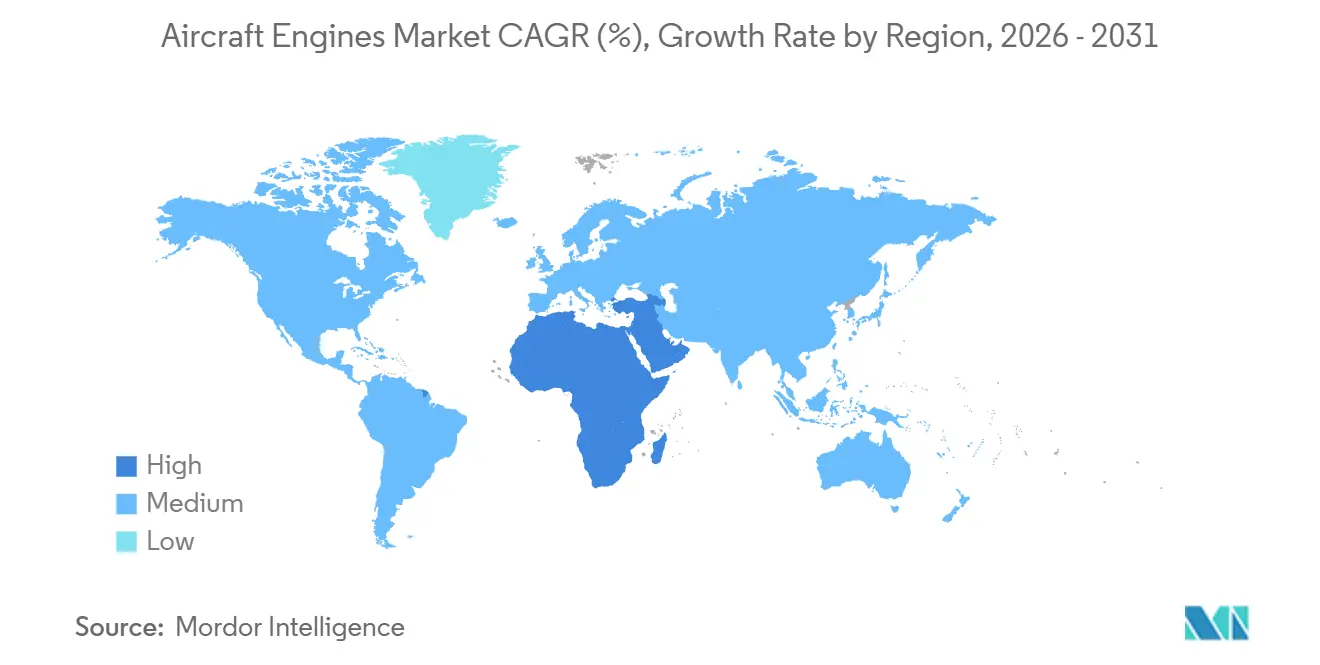
Asia-Pacific accounted for 33.38% of the aircraft engines market share in 2025, making it the largest regional segment. The region has the highest volume of narrowbody deliveries and a large base of low-cost carriers. The CFM LEAP fleet in Asia-Pacific grew 60% in fleet size and 77% in flight activity between 2024 and 2026. IndiGo’s order for more than 1,000 LEAP-1A engines demonstrates the importance of South Asia to the aircraft engines market. Safran and Hindustan Aeronautics Limited agreed in June 2025 to produce LEAP forged rotating parts in India.
North America and Europe Aircraft Engines Market
North America and Europe retain substantial activity in the aircraft engines market through aircraft assembly, engine manufacturing, defense procurement, and maintenance capacity. North America includes major assembly operations for CFM and GE Aerospace, while Europe includes facilities for Rolls-Royce, MTU Aero Engines, and Safran Aircraft Engines. The multinational A400M initiative and the expansion of the A330 MRTT fleet support European defense activity. European regulation also includes work on compatibility with SAF and engine certification. Russia’s United Engine Corporation remains disconnected from many Western supply chains due to sanctions.
MEA and South America Aircraft Engines Market
The Middle East is forecast to grow at a 6.26% CAGR through 2031, the fastest rate among geographic segments. Boeing stated in 2025 that Middle Eastern airlines would require nearly 1,400 widebody aircraft and 2,950 total deliveries through 2044. South America is growing more gradually through Embraer platforms, including the E2 aircraft powered by the GTF engines. Africa remains the smallest regional segment but has long-term potential through turboprop leasing and regional aircraft deliveries.
Competitive Landscape
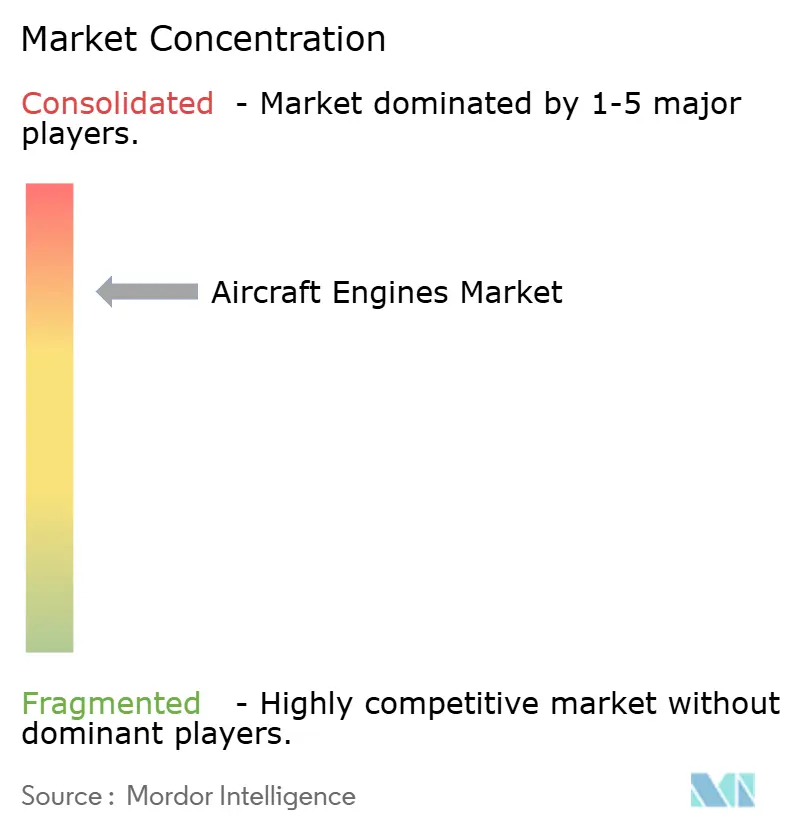
The aircraft engines market is highly concentrated, with General Electric Company, RTX Corporation, Rolls-Royce Holdings plc, Safran SA, and Honeywell Aerospace Inc. forming the principal original equipment groups across commercial and military programs. These companies hold key certifications, program rights, and service relationships for most major commercial platforms. The narrowbody sector is centered on CFM LEAP and Pratt & Whitney GTF engine families. Entry barriers are high because new engines need major development funding, extensive testing, certification, and a long operating record. Airlines also require confidence in maintenance support, spare parts, and engine availability.
Service revenue is a major competitive area because newer fleets are approaching higher volumes of maintenance work. IATA’s call for greater parts access highlights pressure for more competition in engine maintenance. Independent providers compete on repair capabilities, turnaround times, and local capacity. Safran completed its acquisition of Component Repair Technologies in January 2025, adding a 450-person US engine-parts repair specialist. The action strengthened Safran’s repair presence in the Americas and its control of component repair work.
Incumbents are using partnerships to retain a role in new propulsion programs. GE Aerospace invested USD 300 million in Beta Technologies in September 2025 to support the development of hybrid-electric flight. GE Aerospace and Rolls-Royce were selected in June 2026 for medium-thrust Collaborative Combat Aircraft engines. Safran, MTU Aero Engines, and Avio Aero formed a partnership in June 2025 for next-generation military helicopter engines.
Aircraft Engines Industry Leaders
-
Safran SA
-
General Electric Company
-
RTX Corporation
-
Rolls-Royce Holdings plc
-
Honeywell Aerospace Inc.
- *Disclaimer: Major Players sorted in no particular order
Aircraft Engines Market Companies Covered in this Report
- General Electric Company
- RTX Corporation
- CFM International
- Rolls-Royce Holdings plc
- Safran SA
- Honeywell Aerospace Inc.
- MTU Aero Engines AG
- IAE International Aero Engines AG
- IHI Corporation
- Mitsubishi Heavy Industries Aero Engines, Ltd. (Mitsubishi Heavy Industries, Ltd.)
- Textron Inc.
- United Engine Corporation (Rostec)
- Aviation Industry Corporation of China
- Kawasaki Heavy Industries, Ltd.
- Hanwha Corporation
- Williams International Co., L.L.C.
- Honda Motor Co., Ltd.
- PBS International Trading,a.s.
- GKN Aerospace Services Limited
Recent Industry Developments in Aircraft Engines Market
- July 2026: Hindustan Aeronautics Limited (HAL) and Safran Aircraft Engines signed a long-term agreement for the production and supply of turbine ring forgings in superalloys for the CFM LEAP engine program.
- July 2026: Pratt & Whitney, an RTX business, and Tigerair Taiwan signed a Memorandum of Understanding (MoU) to power 15 A321neo aircraft with GTF engines, comprising four firm and 11 leased aircraft. Tigerair Taiwan currently operates nine A320neo family aircraft powered by GTF engines and nine A320ceos powered by IAE V2500 engines.
- May 2025: Qatar Airways ordered more than 400 GE9X and GEnx engines, underpinning its forthcoming deliveries of the B777X and B787.
- February 2025: GE Catalyst turboprop secured FAA type certification after demonstrating 18% fuel-burn improvement over peer engines.
Aircraft Engines Market Report Scope and Research Methodology
Market Definition and Coverage
According to Mordor Intelligence, we define the aircraft engine market as the value of all newly built powerplants installed on fixed- and rotary-wing airframes across commercial, military, and general-aviation fleets; auxiliary power units, used engines, and stand-alone aftermarket parts are out of scope.
Scope Exclusion: After-sale MRO, leased spare engines, and APUs are intentionally excluded to prevent double counting.
Segments Covered in This Report
- By Engine Type
- Turbofan
- Turboprop
- Turboshaft
- Piston
- Hybrid-Electric
- By Aircraft Type
- Commercial Aviation
- Narrowbody Aircraft
- Widebody Aircraft
- Regional Aircraft
- Military Aviation
- Combat Aircraft
- Non-combat Aircraft
- General Aviation
- Business Jets
- Helicopters
- Turboprop Aircraft
- Piston Engine Aircraft
- Unmanned Aerial Vehicles (UAVs)
- Advanced Air Mobility (AAM)
- Commercial Aviation
- By Technology
- Conventional Turbofan/Turboprop
- Geared Turbofan (GTF)
- Contra-Rotating Open Rotor
- Adaptive-Cycle Engines
- Hybrid-Electric Propulsion
- By Thrust Class
- Less than 10,000 lbf
- 10,001 to 25,000 lbf
- 25,001 to 50,000 lbf
- Greater than 50,000 lbf
- By Component
- Compressor
- Turbine
- Nozzle
- Gearbox
- Other Components (Fan, Combustor, FADEC and Control Electronics, etc.)
- By End-User
- OEM Factory-Fit
- Replacement/Aftermarket
- By Geography
- North America
- United States
- Canada
- Mexico
- Europe
- United Kingdom
- France
- Germany
- Russia
- Rest of Europe
- Asia-Pacific
- China
- India
- Japan
- South Korea
- Rest of Asia-Pacific
- South America
- Brazil
- Rest of South America
- Middle East and Africa
- Middle East
- United Arab Emirates
- Saudi Arabia
- Rest of Middle East
- Africa
- Egypt
- Rest of Africa
- Middle East
- North America
Data Sources, Market Sizing, and Validation
Primary Research
We then interviewed aircraft leasing managers, propulsion-system engineers, airline technical-buying heads, and defense acquisition planners across North America, Europe, Asia-Pacific, and the Middle East. These conversations clarified real-world engine lead times, typical pricing brackets, service-life assumptions, and the speed at which hybrid-electric demonstrators may graduate to type certification.
Desk Research
Our analysts first assembled publicly available data from tier-1 authorities such as ICAO traffic statistics, FAA and EASA fleet registers, UN Comtrade HS-8411 trade codes, and Eurostat production indices. We layered these with insights from aviation trade bodies (IATA, AIA) and financial disclosures lodged with the SEC or equivalent regulators. Paid datasets, including Aviation Week orderbook intelligence, Airframer program trackers, and D&B Hoovers company revenues, helped complete delivery pipelines and OEM share splits. The sources cited here are illustrative; many additional publications and databases were consulted during evidence gathering.
Market-Sizing & Forecasting
The base year value emerges from a top-down build using global delivery tallies and fleet retirement schedules, which are then stress-tested with selective bottom-up supplier roll-ups and sampled average selling prices. Key variables, including annual passenger RPK growth, fleet modernization rates, thrust-class mix shifts, SAF blend mandates, and defense procurement outlays, feed a multivariate-regression model; ARIMA smoothing handles short-term shocks. Where bottom-up gaps appear (e.g. classified military volumes), we interpolate using region-specific engine-to-airframe ratios vetted by experts.
Data Validation & Update Cycle
Outputs undergo four-eye analyst review, variance checks against historical margins, and anomaly reconciliation with external indicators before sign-off. We refresh each model annually and trigger interim updates after material events such as major OEM guidance changes or geopolitically driven order spikes.
How Mordor Intelligence's Aircraft Engines Market Size Compares to Other Published Estimates
Published estimates differ because firms adopt dissimilar scopes, currency bases, and refresh cadences. Some fold in overhaul revenues or legacy spare sales; others convert currencies at spot rather than average rates.
Key gap drivers include inclusion of aftermarket MRO, divergent engine-price curves, and varying assumptions on narrow-body delivery recovery versus wide-body lag. Mordor reports only factory-fresh units and applies a blended ASP ladder that is re-benchmarked each quarter, which curbs overstatement when inflation spikes.
Benchmark comparison
| Market Size | Anonymized source | Primary gap driver |
|---|---|---|
| USD 106.17 bn (2025) | Mordor Intelligence | - |
| USD 63.93 bn (2024) | Global Consultancy A | Excludes military engines and uses delivery counts without price rebasing |
| USD 153.69 bn (2024) | Industry Research B | Adds aftermarket MRO plus APUs and applies list prices |
| USD 75.10 bn (2023) | Research Publisher C | Mixes calendar and fiscal years; partial currency conversion at year-end spot rates |
The comparison shows that figures can swing widely when spare-parts revenue or differing price books creep in. By isolating new-build engines, employing audited delivery data, and updating variables yearly, Mordor Intelligence delivers a balanced, transparent baseline that decision-makers can readily trace and replicate.
Key Questions Answered in the Report
What is the expected value of the Aircraft Engines Market by 2031?
The aircraft engines market is forecast to reach USD 129.69 billion by 2031, growing from USD 109.41 billion in 2026 at a 3.46% CAGR.
Which engine type has the largest share?
Turbofan engines held 64.78% share in 2025 because they power most commercial airline fleets and major military platforms.
What is driving aircraft engine aftermarket growth?
Replacement and aftermarket services are forecast to grow at an 8.32% CAGR through 2031 as LEAP, GTF, and large-engine fleets enter maintenance cycles.
Which region is growing fastest for aircraft engines?
The Middle East is projected to grow at a 6.26% CAGR through 2031, supported by widebody airline expansion and fleet orders.
How do SAF rules affect engine manufacturers?
EU's SAF requirements increase validation and certification work for fuel systems and combustor designs.
Why is the sector concentrated among a small group of companies?
Engine design requires substantial development investment, extensive certification, and global maintenance support, which favor established OEMs.