
Aircraft Door Market Size and Share
Market Overview
| Study Period | 2020 - 2031 |
|---|---|
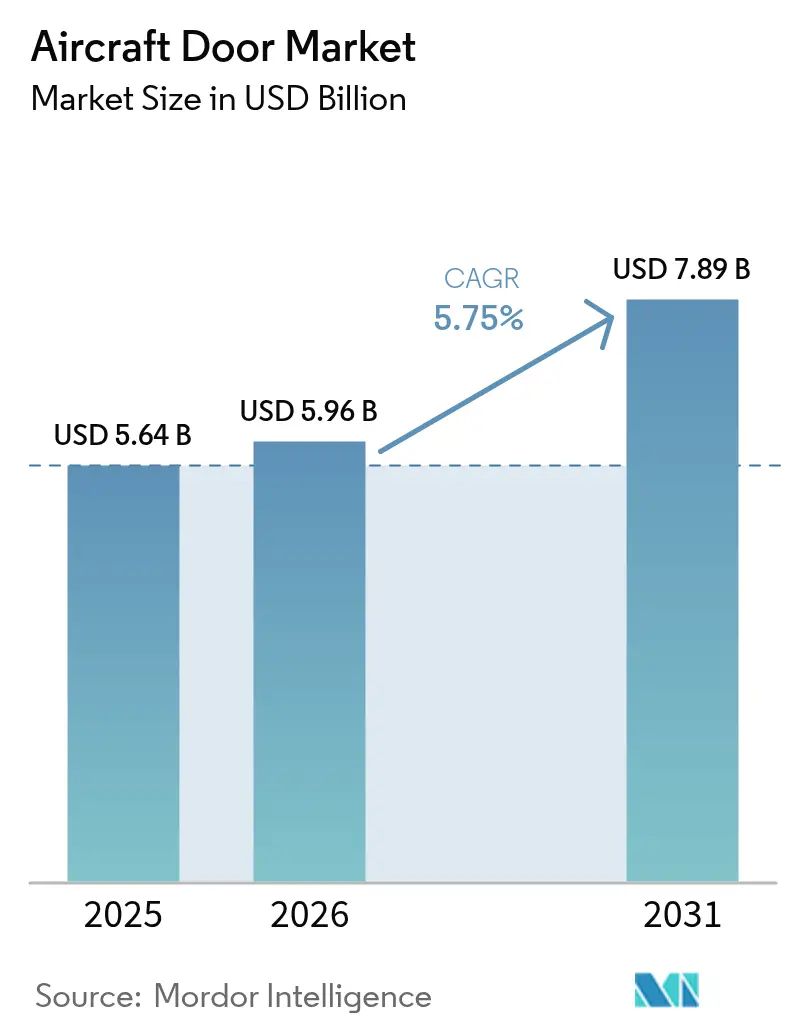
| Market Size (2026) | USD 5.96 Billion |
| Market Size (2031) | USD 7.89 Billion |
| Growth Rate (2026 - 2031) | 5.75 % |
| Fastest Growing Market | Asia Pacific |
| Largest Market | North America |
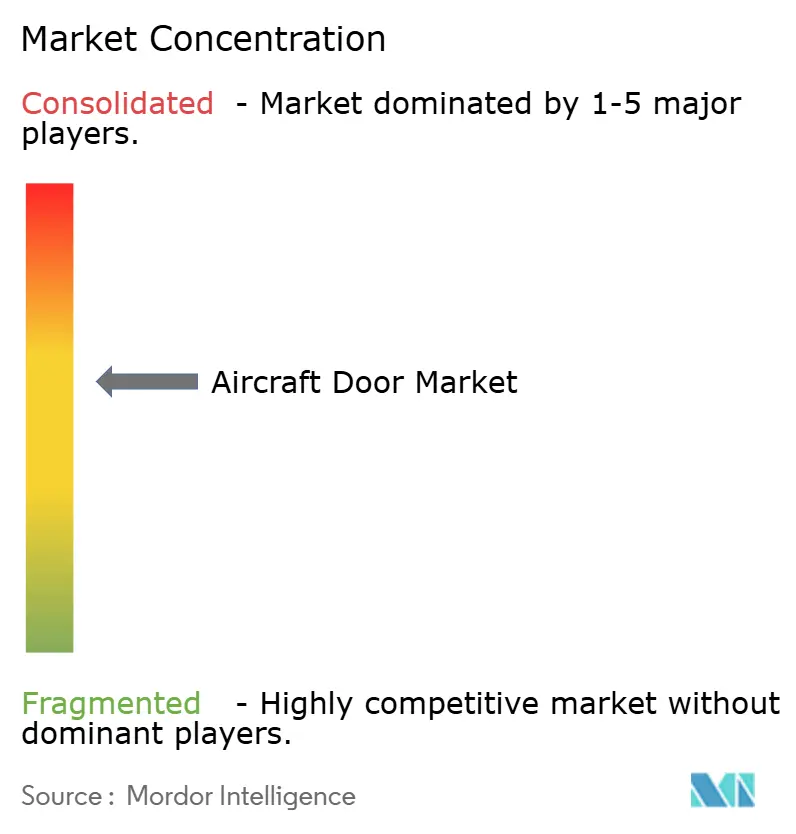
| Market Concentration | Medium |
Major Players *Disclaimer: Major Players sorted in no particular order Image © Mordor Intelligence. Reuse requires attribution under CC BY 4.0. | |
Aircraft Door Market Analysis by Mordor Intelligence
The aircraft door market size was valued at USD 5.64 billion in 2025 and estimated to grow from USD 5.96 billion in 2026 to reach USD 7.89 billion by 2031, at a CAGR of 5.75% during the forecast period (2026-2031). Growth has been anchored in record commercial backlogs at Airbus and Boeing, as well as the expansion of global fleets, and stricter safety expectations that prompt airlines to upgrade their door systems. Rising eVTOL production plans, an aftermarket surge linked to an aging global fleet, and the pivot toward electric actuation have further lifted demand. North American dominance rests on its deep OEM and MRO base, while Asia-Pacific’s supply-chain investments signal the next demand wave. Meanwhile, composite designs that reduce door weight by 20%, combined with real-time monitoring mandated by regulators, are reshaping product specifications.[1]
Key Report Takeaways
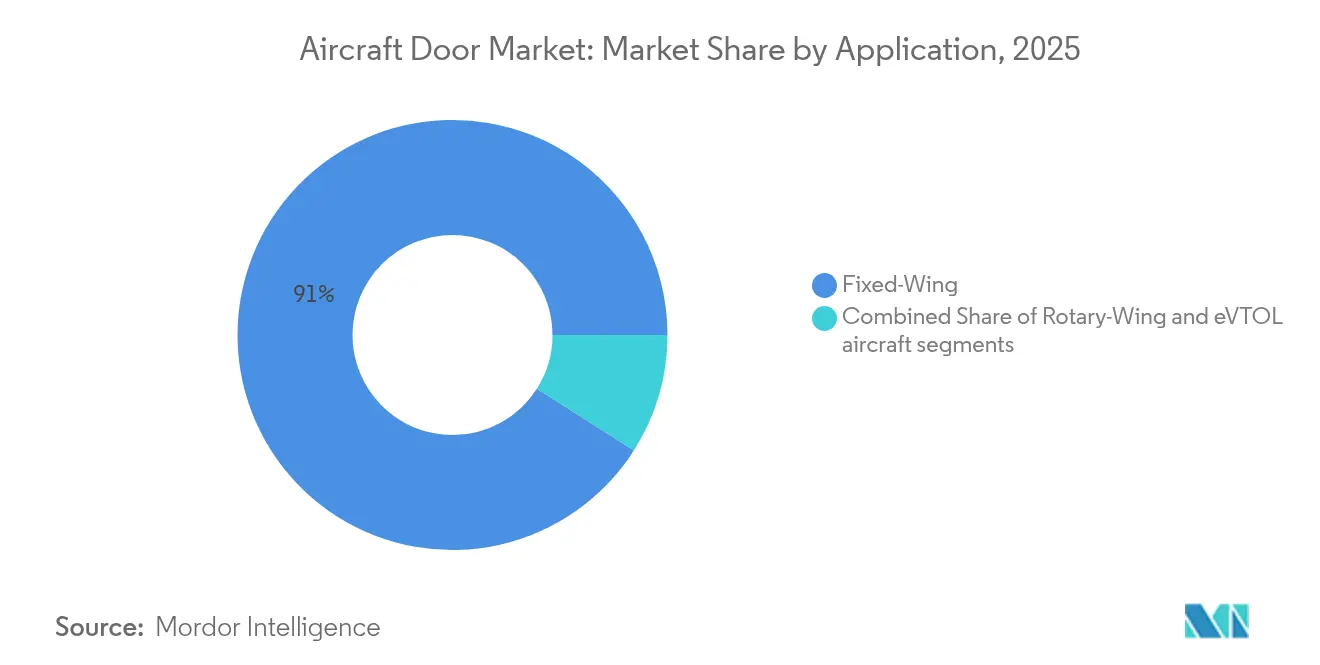
- By application, fixed-wing aircraft doors held 90.98% of the market share in 2025, while the eVTOL segment is projected to grow at an 8.06% CAGR to 2031.
- By door type, passenger doors accounted for 45.52% of the aircraft door market size in 2025 and are projected to advance at a 5.36% CAGR through 2031.
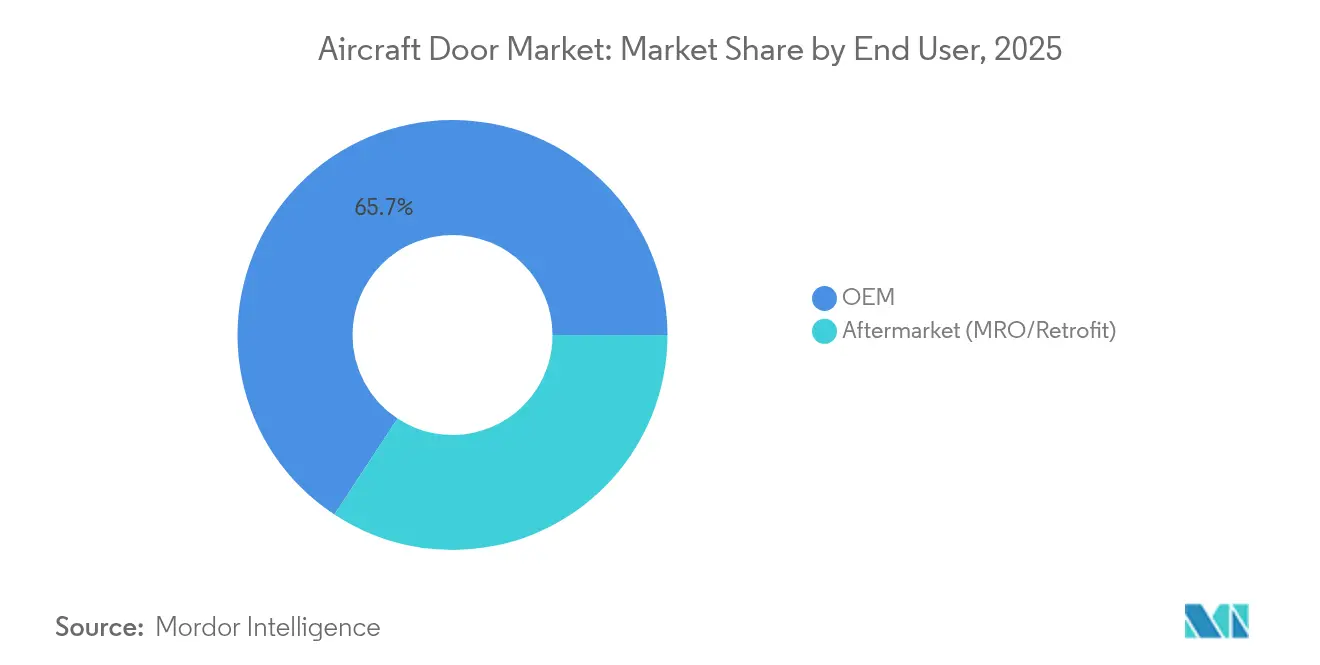
- By end use, the OEM segment accounted for 65.74% of revenue in 2025, while the aftermarket is expected to expand at a 6.22% CAGR between 2026 and 2031.
- By mechanism, hydraulic systems maintained a 52.15% share in 2025; however, the electric mechanisms are forecasted to rise at a 6.84% CAGR through 2031.
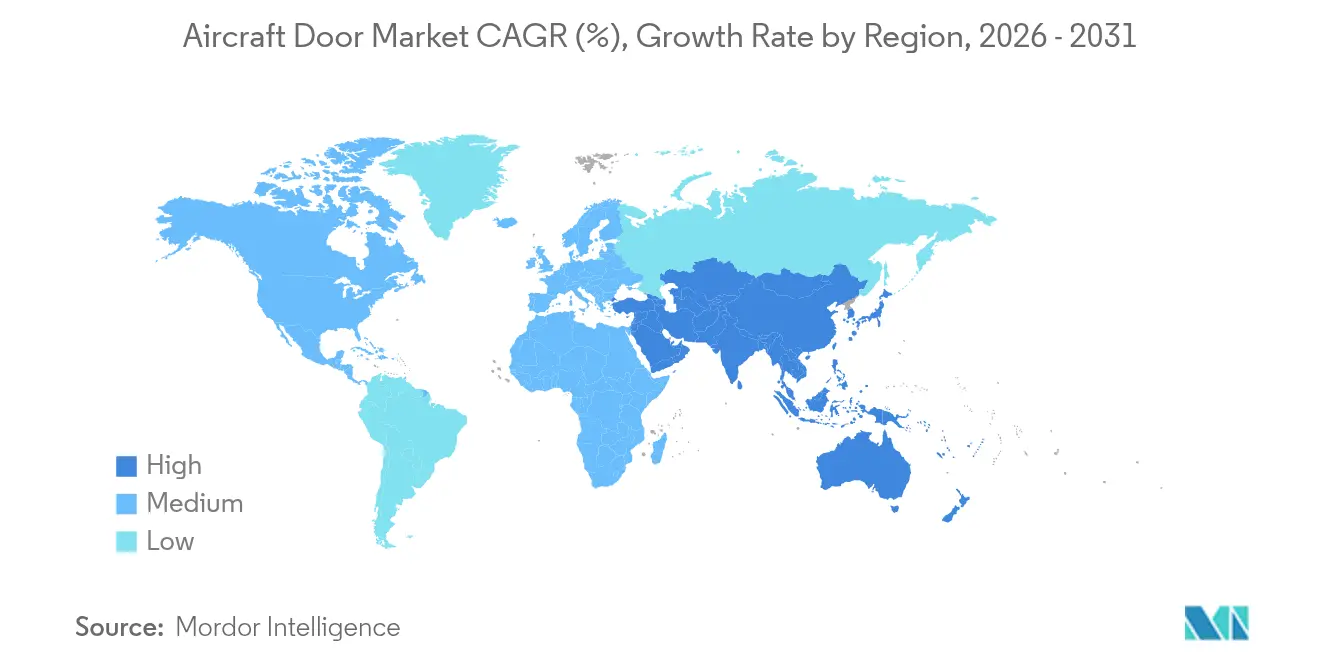
- By geography, North America accounted for 37.88% of the 2025 revenue; the Asia-Pacific region is projected to post the fastest growth, with a 6.63% CAGR through 2031.
Note: Market size and forecast figures in this report are generated using Mordor Intelligence’s proprietary estimation framework, updated with the latest available data and insights as of 2026.
Global Aircraft Door Market Trends and Insights
Drivers Impact Analysis*
| Driver | (~) % Impact on CAGR Forecast | Geographic Relevance | Impact Timeline |
|---|---|---|---|
| Fleet expansion and aircraft deliveries surge | +1.8% | Global (Asia-Pacific, North America) | Long term (≥ 4 years) |
| Lightweight composite adoption for fuel-efficiency | +1.2% | Global (North America, Europe) | Medium term (2-4 years) |
| Stricter passenger-safety and evacuation mandates | +0.9% | Global (North America, Europe) | Short term (≤ 2 years) |
| Passenger-to-freighter conversion boom | +0.7% | Global (Asia-Pacific, North America) | Medium term (2-4 years) |
| Urban-air-mobility (eVTOL) door innovations | +0.5% | North America, Europe, developed Asia-Pacific | Long term (≥ 4 years) |
| Aging-fleet MRO door replacements | +0.4% | Global (regions with older fleets) | Short term (≤ 2 years) |
| Source: Mordor Intelligence | |||
Fleet Expansion and Aircraft Deliveries Surge
The record number of unfilled orders, 8,658 at Airbus and 5,595 at Boeing in late 2024, created multi-year visibility for the aircraft door market. The backlog would take approximately 14 years to clear at current build rates, prompting suppliers to secure long-term capacity. Airbus projected more than 42,000 deliveries over 20 years, forcing door suppliers to expand their factories and adopt faster production methods, such as Fraunhofer IWU’s four-hour thermoplastic process, which yields 4,000 doors annually.[2] MRO providers have followed suit, with facilities adding taller hangar doors to handle widebody traffic.
Lightweight Composite Adoption for Fuel-efficiency
Advanced CFRP and thermoplastic composites cut door weight by up to 20%, trimming fuel burn and extending maintenance intervals. Collins Aerospace's one-piece thermoplastic door demonstrated a production cut from 110 hours to 4 hours by replacing mechanical fasteners with welding.[3] Hexcel's rapid-curing HexPly M51 prepreg supports higher takt rates while retaining structural integrity. These materials integrate easily with electric actuators, reinforcing the industry's move toward a more electric aircraft (MEA) architecture.
Stricter Passenger-safety and Evacuation Mandates
After a 2024 door-panel incident, the FAA placed Boeing under heightened oversight and issued directives covering lavatory and cargo door latches. The NTSB followed with urgent inspection recommendations for B757 door latches. Operators now adopt real-time latch-status sensors and predictive alerts that flag anomalies before gate departure. These requirements pulled passenger doors into the spotlight and accelerated retrofit activity for older fleets.
Passenger-to-freighter Conversion Boom
Over the past two decades, the expected 750 P2F conversions have lifted demand for large cargo doors that withstand high-cycle pressurization. Although narrowbody conversions are expected to decrease to fewer than 50 in 2025, widebody slots remain premium-priced. Door installation alone can reach USD 6.1 million on narrowbody frames and more than USD 14 million on widebody frames, cementing cargo doors as a high-value aftermarket niche.
Restraints Impact Analysis*
| Restraint | (~)% Impact on CAGR Forecast | Geographic Relevance | Impact Timeline |
|---|---|---|---|
| High R&D and certification cost barrier | -0.8% | Global (more impact in emerging markets) | Medium term (2-4 years) |
| Raw-material price and supply-chain volatility | -0.6% | Global (regions with constrained supply chains) | Short term (≤ 2 years) |
| Lengthy regulatory approval cycles | -0.5% | Global (North America, Europe) | Medium term (2-4 years) |
| Heightened OEM risk-aversion post door-failure incidents | -0.4% | Global (North America) | Short term (≤ 2 years) |
| Source: Mordor Intelligence | |||
High R&D and Certification Cost Barrier
Enhanced FAA scrutiny multiplied testing protocols and raised prototype costs, discouraging smaller entrants. Each material or actuation shift invites new certification pathways, lengthening programs, and tilting bargaining power toward large tier-1 integrators that can spread compliance expense across wide product lines.
Raw Material Price and Supply-chain Volatility
Aerospace-grade carbon fiber shortages in 2024-2025 forced door programs to dual-source resins and stockpile longer-lead items. Quality lapses increased as suppliers rushed to clear backlogs, necessitating additional inspection steps. These moves raised working-capital needs and tempered margin expansion for new-technology doors.
*Our forecasts treat driver/restraint impacts as directional, not additive. The impact forecasts reflect baseline growth, mix effects, and variable interactions.
Segment Analysis
By Application: Demand Split Between Legacy Fleets and Urban Air Mobility
The fixed-wing segment held 90.98% of the aircraft door market share in 2025, primarily driven by narrowbody aircraft, which comprised 62% of the global fleet. That dominance is likely to widen as airlines favor single-aisles for medium-haul routes. Business and general aviation expanded as private travel stayed resilient, encouraging MRO upgrades. Military programs offered steady volumes because US defense spending reached USD 886 billion in 2024.
The eVTOL segment’s 8.06% CAGR has attracted new entrants, such as Eve Air Mobility, which has selected Latecoere as its door supplier for deliveries starting in 2026. Certification frameworks now include vertical take-off constraints that require lighter, wider apertures and intuitive locking. As these aircraft integrate electric propulsion, demand for doors compatible with distributed power management will accelerate.

By Door Type: Passenger Experience Drives Fastest Growth
Passenger doors captured 45.52% of 2025 revenue, led by wide single-leaf designs that simplify evacuation and cabin seating flow. Passenger doors are expected to advance at a 5.36% CAGR to 2031 as airlines retrofit them with sensors and noise-dampening panels. Cargo doors ranked next, backed by P2F conversions and express-parcel trade, which spurred the development of wide apertures capable of handling ULD pallets. Emergency exits gained attention following mid-flight events, triggering latch design overhauls.
Service, utility, and cockpit doors filled niche requirements but benefited from the migration to composite materials. A growing share of the aircraft door market incorporates origami-inspired folding designs, such as the Zen Privacy Door, which simplifies assembly and reduces the number of parts.
By End Use: Aftermarket Narrows the Gap with OEM Production
As Airbus and Boeing pushed line rates higher, OEM deliveries still generated 65.74% of 2025 revenue, yet slots remain short. Fraunhofer IWU’s automated process hinted at profound cycle-time reductions, signalling efforts to protect market lead times. The aircraft door market size for OEM production is expected to expand with backlog clearance, although rate-ramp pressure may put a squeeze on margins.
Aftermarket work is expected to grow at a 6.22% CAGR. The average global fleet age reached 13.4 years in 2025, triggering the need for hinge and seal replacements. The FAA directive on B737 lavatory doors alone affects 2,612 aircraft. Cargo door retrofits in P2F conversions can account for a third of the total conversion expense, underscoring the aftermarket value.
By Mechanism: Electric Mechanism Rises From Niche to Mainstream
Hydraulic systems accounted for 52.15% of the revenue in 2025, primarily due to their ruggedness and legacy certification. Electric mechanisms, growing at a 6.84% CAGR, align with more-electric aircraft agendas and remove fluid-leak risks.
Hybrid systems combine hydraulic power for primary loads and electric drives for fine positioning, striking a balance between redundancy and weight targets. Pneumatic systems stayed niche, suited to regional climate-controlled cargo bays.
Geography Analysis
North America accounted for 37.88% of the 2025 revenue for the aircraft door market, supported by Boeing, a robust MRO network, and sustained defense budgets. FAA directives often set global precedents, so domestic suppliers refine their products first and then export them to other countries. The region's airline fleets had a higher average age, which led to increased aftermarket door replacements. eVTOL certification timelines in the United States drove domestic door suppliers to produce prototypes that pass rotary and fixed-wing criteria.
Asia-Pacific posted the fastest 6.63% CAGR outlook. China's domestic traffic recovery, India's Make-in-India initiative, and A220's door contract with Dynamatic Technologies shifted supply chains eastward. Regional fleets skew young but are growing quickly; door OEMs are establishing in-region composite lay-up plants to reduce logistics costs. Japan's push for fully automated passenger boarding bridges illustrates how airport infrastructure synchronizes with door technology.
Europe remained a technology driver, anchored by Airbus' final-assembly lines and its leadership in sustainable aviation. EASA's emphasis on composite flammability and crashworthiness standards increased certification burdens, indirectly supporting European materials firms. The market share of European composite suppliers in the aircraft door market is expected to rise as demand for thermoplastics increases. Middle East and Africa expanded capacity via Gulf carrier freighter orders, adding large cargo door opportunities that complement regional maintenance hubs.
Regulatory Landscape
Aircraft door certification is governed by transport-category airworthiness requirements that focus on preventing inadvertent in-flight opening and assuring structural integrity under pressurization and operational loads. In the United States, FAA rules in 14 CFR 25.783 set design and safety criteria for fuselage doors, including latching and locking provisions, safeguards against opening in flight, and means for visual inspection and indication for the flightcrew; compliance guidance is provided through FAA Advisory Circular AC 25.783-1A.
For global programs, door suppliers typically engineer to both FAA and EASA requirements, as EASA CS-25 contains corresponding fuselage door provisions for large aeroplanes and is used across European certification and validation pathways. Industry practices also reference standards bodies for design harmonization; for example, SAE International published the revised ARP499D recommended practice for interior doors in February 2026, updating guidance related to door use cases and safety considerations in transport aircraft.
Value Chain Analysis
The value chain begins with raw materials and semifinished inputs (aerospace-grade aluminum and titanium for hinges and fittings, CFRP/thermoplastic composites for skins and frames, seals, fasteners, and electrical/hydraulic actuation components). Tier-2 and tier-3 suppliers provide machined hardware, composite layups, windows and transparencies, sensors, and subassemblies that feed tier-1 aerostructure integrators. Tier-1 integrators (such as Collins Aerospace, Safran, Latecoere, and Spirit AeroSystems) design, manufacture, and certify complete door shipsets, then deliver to airframe OEM final-assembly lines or to MROs for retrofit and spares; certification compliance to 14 CFR 25.783 and EASA CS-25.783 acts as a gating step throughout design, testing, and production release.
Downstream, OEM installation, line-fit functional testing, and aircraft certification drive the initial-fit demand, while airlines and MRO networks sustain recurring revenue through overhauls, latch and hinge replacements, seal changes, and retrofit kits (including door-status indication upgrades). Recent sourcing and industrialization moves illustrate how OEMs are reshaping supplier footprints and capacity: Airbus awarded Dynamatic Technologies in February 2024 a contract covering manufacturing and assembly of all A220 door variants, while Latecoere was selected by Deutsche Aircraft (October 2023) as strategic supplier for all six doors of the D328eco program. On the technology side, production methods that reduce part count and assembly time, such as one-shot composite approaches and automated thermoplastic processes, are being adopted to meet higher build rates and tighter tolerance requirements.
Competitive Landscape
The aircraft door market featured a moderately consolidated field of tier-1 integrators with vertical capabilities that span concept, build, and service. Safran and Collins Aerospace leveraged avionics and cabin-systems portfolios to offer doors with embedded sensors. At the same time, Latecoere balanced structural expertise with composite know-how across several Airbus and eVTOL programs. Partnerships between airframe OEMs and research institutes accelerated the adoption of thermoplastics; Airbus and Fraunhofer IWU reduced cycle time from 110 hours to 4 hours, positioning thermoplastic doors as mainstream by the end of the decade.
Mergers continued to reshape supplier tiers. Boeing’s exploration of acquiring Spirit AeroSystems could vertically integrate the B737 and B787 door lines, consolidating bargaining power and possibly prompting Airbus to diversify its sourcing. Regional champions matured; India’s Dynamatic Technologies moved from sub-assemblies to complete door packages on the A220, signaling OEM confidence in emerging-market suppliers.
White-space prospects included electric actuation kits for legacy fleets, predictive maintenance software that ties door sensor data to component life prediction, and tailored door modules for eVTOL cabins. Saab’s composite escape doors for the B787 and Mitsubishi Heavy Industries’ automated boarding bridges underscored how adjacent infrastructure solutions feed design priorities.
Aircraft Door Industry Leaders
-
Safran SA
-
Collins Aerospace (RTX Corporation)
-
LATECOERE S.A
-
Elbit Systems Ltd.
-
Premium AEROTEC GmbH (Airbus SE)
- *Disclaimer: Major Players sorted in no particular order
Market Opportunities and Future Outlook
A primary opportunity area is capacity and localization tied to sustained OEM backlogs and the need to de-risk supply, particularly for door shipsets that sit on critical-path delivery schedules. Airbus investment signals this shift toward in-region manufacturing scale, including the June 2026 expansion of its Queretaro, Mexico facility with MX$646.7 million (about USD 34.5 million) to increase production capacity for commercial aircraft doors and helicopter components. On the supplier side, contracts and ramp-ready deliveries such as Dynamatic Technologies delivering its first complete A220 door ship-set in January 2026 reinforce whitespace for qualified second sources, process automation, and faster industrialization of door variants across passenger, service, cargo, and emergency configurations.
Technology-led whitespace is concentrated around more-electric aircraft architectures and the retrofit pathway from hydraulic to electric actuation where it improves weight, maintainability, and system integration. Airbus began testing A350F cargo loading and main deck cargo door actuation systems in May 2026 using an electric-powered system rather than hydraulic actuators, underscoring the shift in design requirements for large cargo doors and their associated mechanisms. Program-linked contract wins also highlight adjacent door categories with recurring production volumes, including Astronics being selected by Boeing in March 2026 to supply 737 MAX fuel tank access doors, and Aequs securing a Boeing contract in January 2026 to manufacture 767-2C aft access doors at its Belagavi Aerospace Cluster, supporting opportunities for specialized access-door families, tooling, and high-precision hinge and latch manufacturing.
Recent Industry Developments
- March 2026: Astronics was selected by Boeing to supply fuel tank access doors for the 737 MAX, with manufacturing planned in Clackamas, Oregon. The award strengthens Astronics position in a high-volume narrowbody program and adds qualified capacity for safety-critical access door hardware in the Boeing supply chain.
- January 2026: Dynamatic Technologies delivered the first complete ship-set of all eight door variants for the Airbus A220 from its Bengaluru, India facility. The milestone validates industrial readiness for multi-variant door production and supports Airbus efforts to broaden its door supply base beyond traditional aerostructure hubs.
- February 2024: Airbus awarded Dynamatic Technologies a contract to manufacture and assemble passenger, service, cargo, and emergency doors for the A220 family in India. The deal formalized a major sourcing shift that expands regional manufacturing capability and deepens the role of emerging-market suppliers in certified door structures.
Research Methodology Framework and Report Scope
Market Definition and Coverage
This market covers the value of aircraft door systems supplied for aircraft, including doors used for passenger entry, cargo loading, emergency exit, service access, cockpit and landing gear bays, across OEM fitment and replacements.
Scope exclusions: Cabin interior partitions, lavatory doors, and passenger boarding bridges are excluded from this sizing.
Segmentation Overview
- By Application
- Fixed-Wing
- Commercial Aviation
- Narrowbody Aircraft
- Widebody Aircraft
- Regional Jets
- Business and General Aviation
- Business Jets
- Light Aircraft
- Military Aviation
- Combat Aircraft
- Transport Aircraft
- Special Mission Aircraft
- Commercial Aviation
- Rotary Wing
- Commercial Helicopter
- Military Helicopter
- eVTOL Aircraft
- Fixed-Wing
- By Door Type
- Passenger
- Cargo
- Emergency Exit
- Service/Utility
- Landing Bay
- Cockpit
- By End Use
- OEM
- Aftermarket (MRO/Retrofit)
- By Mechanism
- Hydraulic
- Electric
- Pneumatic
- By Geography
- North America
- United States
- Canada
- Mexico
- South America
- Brazil
- Rest of South America
- Europe
- United Kingdom
- Germany
- France
- Italy
- Russia
- Rest of Europe
- Asia-Pacific
- China
- India
- Japan
- South Korea
- Australia
- Rest of Asia-Pacific
- Middle East and Africa
- Middle East
- Saudi Arabia
- United Arab Emirates
- Turkey
- Rest of Middle East
- Africa
- South Africa
- Rest of Africa
- Middle East
- North America
Data Sources, Market Sizing, and Validation
Desk Research
Desk research was used to set the basic demand pool and the main operating assumptions before numbers were modeled. We referred to public aviation and trade data that helps explain fleet activity, build rates, and replacement intensity, such as FAA aircraft registry and airworthiness information, EASA publications, ICAO statistical releases, and IATA traffic indicators.
To tighten assumptions, we also reviewed open sources such as aerospace safety rules and guidance, customs trade statistics for relevant aircraft parts categories, company annual reports and investor presentations, and technical papers and patents that describe door designs and actuation changes. For areas where public data is thin, we used paid subscriptions for company financials and intelligence, patent databases, and aerospace fleet and aircraft databases to cross-check platform counts and production trends. These sources are illustrative, and additional public documents were reviewed for data collection, validation, and clarification.
Primary Interviews and Surveys
Primary work was used to pressure-test the model and fill gaps that desk research cannot answer cleanly, especially around door content per aircraft, replacement timing, and pricing progression. We spoke with a mix of door and subsystem suppliers, MRO-focused participants, and aviation procurement and engineering roles across major regions. The respondent input helped confirm what is treated as door system revenue in each channel and how replacement activity typically maps to heavy checks and platform lifecycles in current programs.
Distribution of primary research fieldwork respondents
| Company type | Respondent position | Region |
|---|---|---|
| Top tier: 38% | CXOs: 14% | APAC: 39% |
| Mid tier: 43% | Functional/Unit leaders: 35% | EMEA: 37% |
| Smaller Players: 19% | Managers: 51% | Americas: 24% |
Market-Sizing & Forecasting
Market sizing was built using a top-down structure where aircraft production and fleet activity data reconstruct the installed base and annual deliveries, which are then translated into door demand by applying typical door counts and replacement shares by aircraft category. We corroborated results with selective bottom-up approximations, including sampled price per door across common programs and channel checks on aftermarket replacement behavior, and then adjusted when the two views diverged.
Inputs that materially move the model include annual aircraft deliveries by major aircraft class, active fleet size and utilization signals, expected share of doors replaced during heavy checks, the mix shift between passenger, cargo, and emergency exit door demand, and the progression of average selling prices as materials and actuation choices evolve. Where program level data is missing, gaps are handled by using proxy platforms with similar door architecture and applying conservative ranges that are later narrowed through interview feedback.
For forecasting, we used scenario analysis tied to published aircraft backlog and delivery guidance, airline traffic outlooks, and MRO cycle expectations, and then checked that the implied door volumes and pricing remain consistent with what practitioners expect over the next few years.
Data Validation & Update Cycle
Model outputs are compared with independent signals such as aircraft delivery totals, fleet growth, and aftermarket activity indicators, then reviewed for variances that do not align with real program timelines. If an outlier is found, the inputs are traced back to the specific aircraft class, region, or pricing assumption, and the relevant experts are re-contacted when clarification is needed.
Before sign-off, the sizing file is reviewed step-by-step to ensure formulas, units, and conversions are consistent, and so that assumptions are explained in plain language. Reports are refreshed annually, with interim updates when material events occur, such as sharp delivery schedule shifts or major regulatory and safety changes. Right before delivery, a final check is completed so the client receives the latest updated view.
Mordor Intelligence's Aircraft Door Market Sizing Compared With Other Published Estimates
Published market values for aircraft doors can differ more than expected because the timing and mechanics of the estimate are not always the same. Differences usually come from what is counted as an aircraft door, which aircraft types are included, and how pricing is carried through the forecast years.
A refresh-led gap shows up when exchange rates, base-year currency timing, and average selling price steps are not updated together with delivery schedules and aftermarket cycles. This is where the latest checks used in Mordor Intelligence help keep the estimate aligned to current program ramps and realistic price progression.
Benchmark comparison
| Source | Market Size | Gaps in Research Methodology |
|---|---|---|
| Mordor Intelligence | USD 5.96 B (2026) | |
| Global Consultancy A | USD 4.24 B (2024) | Uses an earlier base year and a different forecast window, which can understate current pricing and delivery ramps if currency timing and updated production schedules are not carried forward consistently. |
| Industry Publisher B | USD 3.68 B (2024) | Appears to rely more on shipment based framing and narrower scope assumptions, and the lower 2024 value can result when aftermarket door replacements and door BOM boundaries are not aligned with current fleet maintenance patterns. |
Across the three figures, the spread is mainly explained by base-year timing and by what is treated as a door system versus adjacent hardware. When the scope is kept to aircraft door systems and the model is refreshed with updated delivery, fleet, and pricing signals, the outcome becomes easier to trace back to clear volume and ASP drivers.
Key Questions Answered in the Report
What is the projected value of the aircraft door market by 2031?
The market is forecasted to reach USD 7.89 billion by 2031, witnessing a 5.75% CAGR.
Which application segment is growing the fastest?
EVTOL programs are slated to post an 8.06% CAGR between 2026 and 2031.
How large is the aftermarket opportunity?
The aftermarket segment is projected to expand at 6.22% CAGR, driven by a fleet age of 13.4 years and regulatory retrofit mandates.
Why are electric actuation systems gaining traction?
Electric drives reduce weight, eliminate hydraulic fluid risks, and align with more-electric aircraft architectures, supporting a 6.84% CAGR.
Which region will outpace others through 2031?
Asia-Pacific is expected to deliver the quickest 6.63% CAGR, buoyed by fleet growth in China and India and new door manufacturing contracts.
What impact could Boeing’s potential Spirit AeroSystems deal have?
The acquisition would vertically integrate key door production lines, likely reshaping supplier dynamics and sourcing strategies across the market.