
Air Starter Market Size and Share
Market Overview
| Study Period | 2021 - 2031 |
|---|---|
| Market Size (2026) | USD 435.69 Million |
| Market Size (2031) | USD 547.83 Million |
| Growth Rate (2026 - 2031) | 4.69 % |
| Fastest Growing Market | Asia Pacific |
| Largest Market | North America |
| Market Concentration | Medium |
Major Players *Disclaimer: Major Players sorted in no particular order Image © Mordor Intelligence. Reuse requires attribution under CC BY 4.0. | |
Air Starter Market Analysis by Mordor Intelligence
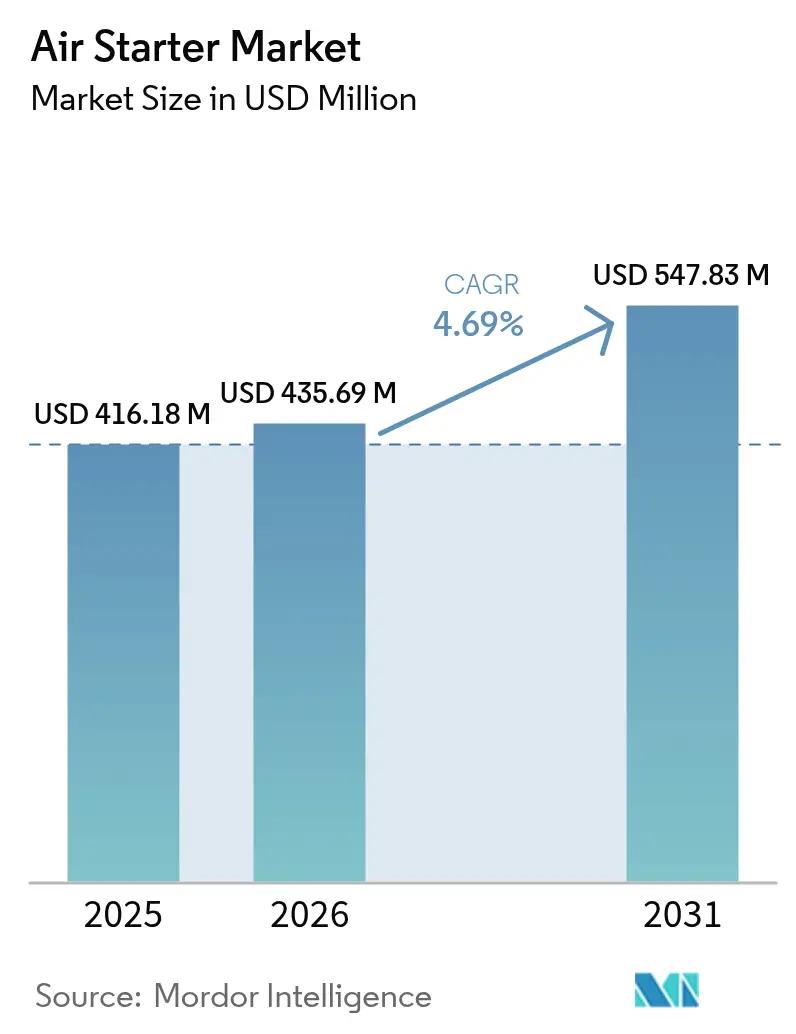
The Air Starter Market size was valued at USD 416.18 million in 2025 and estimated to grow from USD 435.69 million in 2026 to reach USD 547.83 million by 2031, at a CAGR of 4.69% during the forecast period (2026-2031).
Solid demand comes from hazardous-zone industries where pneumatic starters remain the safest ignition option, chiefly in oil and gas, LNG shipping, mining, and emerging hydrogen-ready power plants. OEMs emphasize ATEX- and IECEx-certified models to remove ignition risks, while fleet operators in LNG and dual-fuel shipping allocate larger capital budgets for starter upgrades. Mining contractors are scaling autonomous and electric fleets, which favor low-maintenance vane or hybrid systems. Retrofit programs for brownfield oil assets further expand installed bases, and service providers enhance aftermarket platforms that integrate hardware with predictive analytics to minimize downtime.
Key Report Takeaways
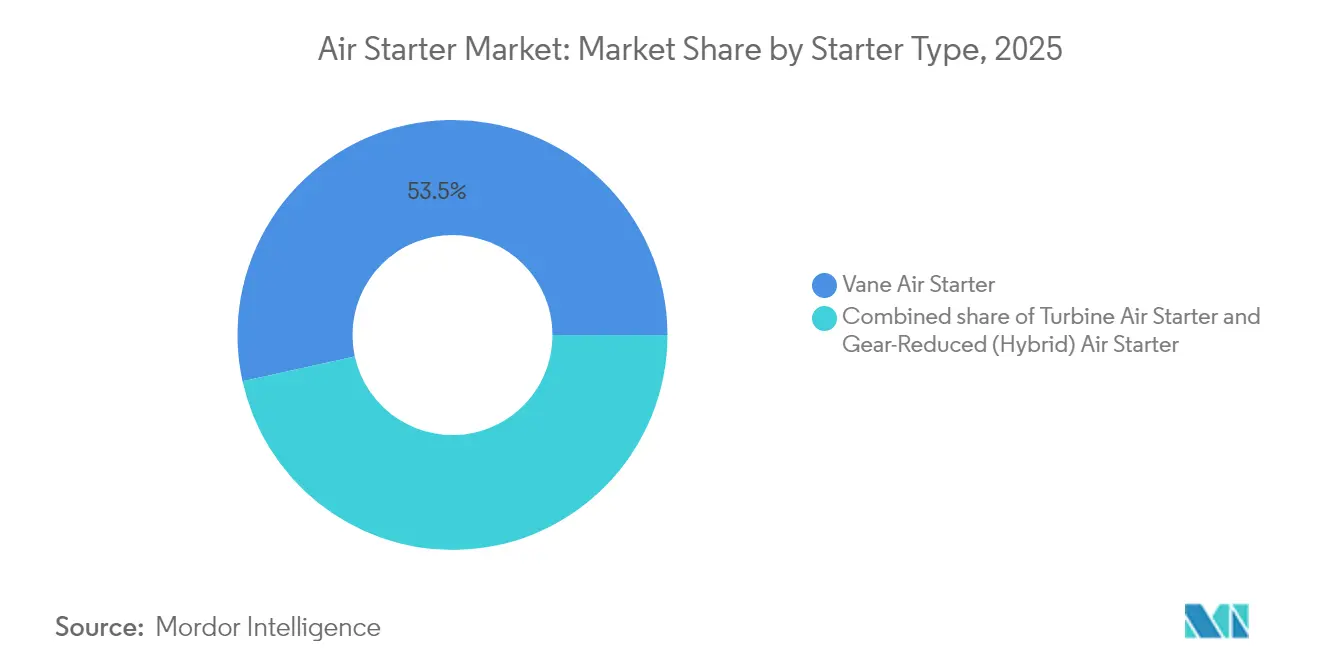
- By starter type, vane systems led with a 53.45% revenue share in 2025; gear-reduced hybrid units are forecast to expand at a 6.58% CAGR through 2031.
- By engine capacity, units with a capacity of up to 100 HP accounted for an 85.05% share of the air starter market size in 2025, whereas the 100-300 HP class is projected to grow at a 4.98% CAGR through 2031.
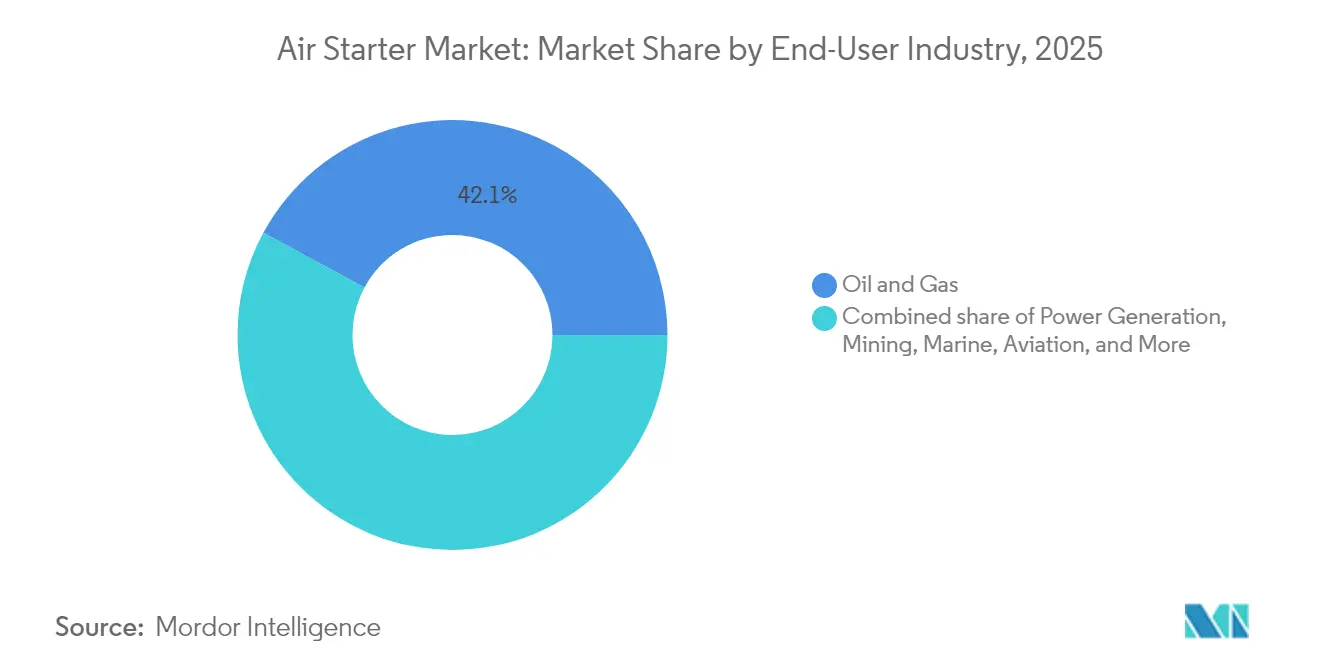
- By end-user industry, the oil and gas sector held 42.12% of the air starter market share in 2025 and is projected to advance at a 5.17% CAGR through 2031.
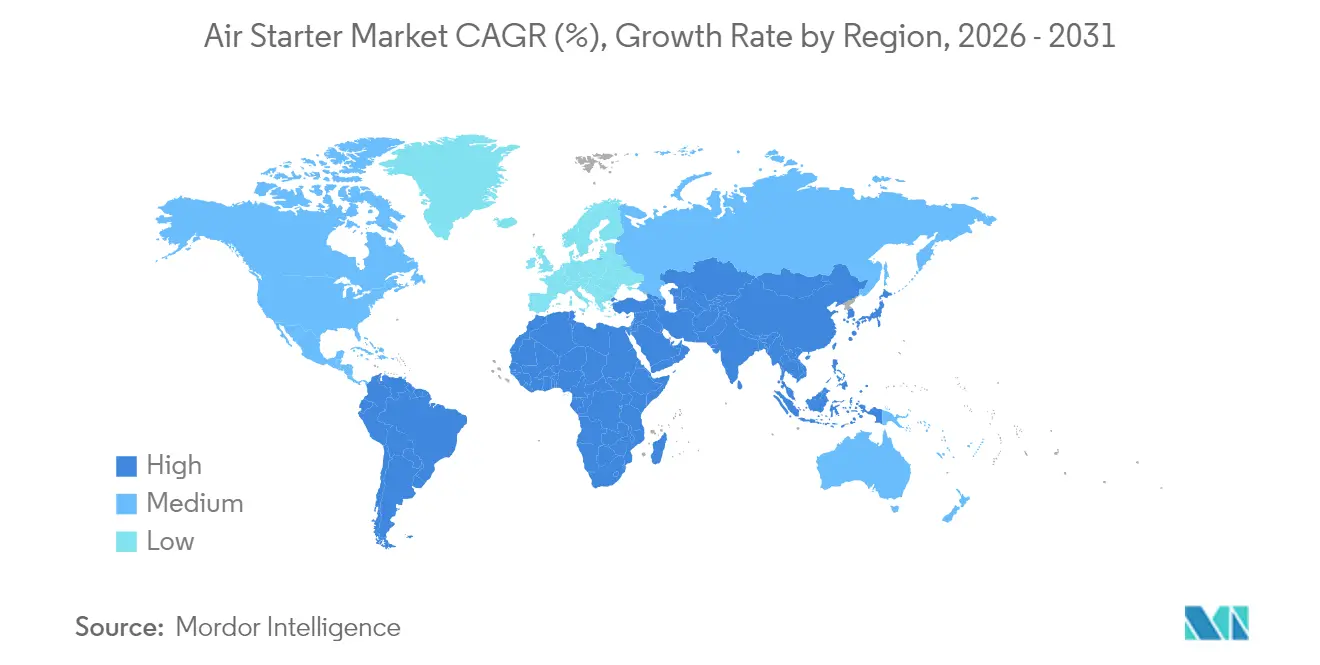
- By geography, North America commanded 39.45% of revenue in 2025, while Asia-Pacific is poised for the quickest expansion at a 6.72% CAGR.
Note: Market size and forecast figures in this report are generated using Mordor Intelligence’s proprietary estimation framework, updated with the latest available data and insights as of 2026.
Market Trends and Insights
Drivers Impact Analysis of Air Starter Market*
| Driver | (~) % Impact on CAGR Forecast | Geographic Relevance | Impact Timeline |
|---|---|---|---|
| Replacement of electric starters in hazardous zones | 0.80% | Global oil & gas, chemicals | Medium term (2–4 years) |
| LNG carrier fleet growth requiring ATEX starters | 0.60% | Global maritime, Asia-Pacific shipyards | Long term (≥4 years) |
| Brownfield life-extension retrofits | 0.70% | North America, Middle East, North Sea | Medium term (2–4 years) |
| Mining capex rebound | 0.50% | APAC, South America, Africa | Short term (≤2 years) |
| Hydrogen-ready gas turbine uptake | 0.40% | Europe, North America, Australia | Long term (≥4 years) |
| Autonomous haul trucks | 0.30% | Global mining regions | Medium term (2–4 years) |
| Source: Mordor Intelligence | |||
Rising replacement of electric starters with pneumatic starters in hazardous zones
Industrial operators are standardizing ATEX- and IECEx-certified pneumatic solutions to mitigate ignition risks in Class I, Division 1 areas.[1]ABB Group, “IECEx Certification for Explosion Protection,” abb.com Insurers are increasingly flagging non-certified electric units, which accelerates retrofit cycles across refineries, grain silos, and chemical plants. The safety-driven transition prioritizes operational continuity over upfront cost, especially in upstream drilling and gas compressio,n where unscheduled outages carry hefty penalties. Resulting demand is buoyed by turnkey retrofit kits that minimize downtime and align with tightening regional safety audits.
Growth of LNG carrier fleet requiring ATEX-rated turbine starters
Global LNG shipping backlogs support persistent orders for explosion-proof turbine starters, a must for dual-fuel propulsion and cargo handling in volatile atmospheres.[2]The Maritime Executive, “Maersk Boosts Dual-Fuel Fleet Investment,” maritime-executive.com Danish, Korean, and Chinese yards embed these systems at the design stage, while owners increase budgets—Maersk raised its annual vessel capex to USD 10–11 billion—to future-proof their fleets for synthetic and bio-LNG operations. Floating production, storage, and offloading units echo this trend, emphasizing compact, corrosion-resistant designs to minimize offshore maintenance.
IOCs’ brownfield life-extension programs boosting retrofit demand
Roughly 70% of global oil now flows from mature fields, prompting life-extension schemes that replace aging electric starters with maintenance-light vane models.[3]Baker Hughes, “Mature Assets Solutions,” bakerhughes.com Operators gain quicker returns than greenfield projects and cut unplanned trips, a key priority for offshore platforms with aging electrical infrastructure. Service integrators bundle retrofits with remote monitoring to streamline post-installation support and reinforce compliance credentials.
Recovery in mining equipment capex post-2024 commodity super-cycle
Higher copper and lithium prices lifted order books for autonomous and electrified rigs; Epiroc logged a 17% Q1 2025 order jump.[4]Epiroc AB, “Q1 2025 Interim Report,” epiroc.com Underground hard-rock sites prize pneumatic starters for their dust tolerance, vibration resistance, and long uptime, which is critical, as even minute-long failures can erode profits exceeding USD 100,000 per hour. Integration of IoT sensors feeds predictive algorithms that align maintenance with scheduled stoppages, driving equipment reliability mandates across APAC and Latin America.
Restraints Impact Analysis of Air Starter Market*
| Restraint | (~) % Impact on CAGR Forecast | Geographic Relevance | Impact Timeline |
|---|---|---|---|
| Electric-drive frac pumps deleting start cycles | -0.60% | North America shale basins | Short term (≤2 years) |
| OEM consolidation trimming multi-vendor specs | -0.40% | Global industrial hubs | Medium term (2–4 years) |
| Legacy air leaks inflating ownership costs | -0.30% | Global factories | Long term (≥4 years) |
| Dry-lube vane material scarcity | -0.20% | Global supply chains | Medium term (2–4 years) |
| Source: Mordor Intelligence | |||
Shift toward electric-drive frac pumps eliminating start-stop duty cycles
North American shale operators are transitioning to grid-powered or gas-turbine-generated electric frac spreads, which curbs the frequent engine restarts that historically drove air starter use. ProPetro’s three-year ExxonMobil deal exemplifies the shift, with dual-fuel or electric units already accounting for 65% of its fleet. Continuous pump operation reshapes starter demand patterns, forcing suppliers to diversify beyond legacy diesel applications.
OEM consolidation reducing multi-vendor starter specifications
Large industrial equipment builders are streamlining supply chains, locking in single-source agreements that narrow procurement rosters and squeeze smaller pneumatic specialists. Standardized platforms narrow customization margins and shift bargaining power toward integrators that can bundle starters with ancillary systems, thereby reducing the addressable volumes for niche vendors.
*Our forecasts treat driver/restraint impacts as directional, not additive. The impact forecasts reflect baseline growth, mix effects, and variable interactions.
Air Starter Market Segment Analysis
By Starter Type:
Vane Systems Lead Despite Hybrid InnovationVane starters dominated the air starter market with a 53.45% share in 2025, reflecting a long track record of field reliability and straightforward servicing protocols. Oil and gas operators value these traits for remote sites where tooling and power may be constrained. Turbine models serve marine and aerospace equipment needing rapid spin-up. Hybrid gear-reduced designs are accelerating at a 6.58% CAGR, combining pneumatic drive with mechanical reduction to boost torque density for autonomous machinery and hydrogen-ready turbines. Additive manufacturing is now unlocking lightweight superalloy rotors that enhance thermal tolerance in extreme-duty turbine variants, positioning hybrids as a future growth driver in the broader air starter market.
Ongoing R&D focuses on sealing improvements, dry-lube coatings, and tighter tolerances achievable through metal additive processes. These innovations aim to widen maintenance intervals, a key selling point for unmanned mines or unmanned offshore installations. Progressive standards bodies are also updating certification schemes to streamline cross-acceptance between ATEX and regional codes, potentially lowering homologation costs for hybrid entrants.


By Engine Capacity:
Small Engines Dominate Market ShareUnits with a capacity of up to 100 HP captured 85.05% of the 2025 sales due to their sheer volume in compressors, gensets, and mobile machinery. Smaller displacement installations benefit from compact vane architectures that keep parts counts low and overhaul times short. The 100–300 HP tier is expanding at the fastest rate, with a 4.98% CAGR, as mid-sized mines and marine auxiliaries upgrade to larger, more efficient engines that require robust starters capable of delivering higher torque without proportionate increases in weight or air consumption. Sensor integration is spreading quickly across all capacity bands, enabling real-time tracking of temperature, rotation speed, and pressure to anticipate wear conditions and schedule just-in-time service.
Designers in the >300 HP class experiment with modular dual-starter packages for mission-critical gas turbines, providing redundancy that satisfies stringent availability contracts in peaking power plants. While volumes here are modest, ASPs are substantially higher, giving suppliers a profitable niche alongside mass-market small-engine applications within the broader air starter market.
By End-User Industry:
Oil and Gas Sector Drives GrowthHolding 42.12% of 2025 revenue, oil and gas remains the anchor customer thanks to brownfield retrofits, LNG expansion, and midstream compressor upgrades. The segment also shows the quickest pace through 2031, at a 5.17% CAGR, because safety mandates and remote operations favor pneumatic over electric starters. Power generation follows where hydrogen-ready turbines need enhanced torque profiles. Mining demand is reviving with the rollouts of autonomous fleets, highlighting the robustness of starters in dusty, high-vibration environments. Marine applications—including LNG carriers and offshore support vessels—require ATEX-certified turbine models, which underpin a distinct, compliance-driven revenue stream within the air starter market.
Geography Analysis
North America Air Starter Market
North America led the way in 2025, accounting for 39.45% of revenue, driven by shale gas, offshore Gulf assets, and a robust pipeline of petrochemical upgrades. Harsh winters and desert heat test equipment to extremes, validating pneumatic resilience over a wide temperature range. The region’s aftermarket ecosystem is mature, offering rapid turnaround on rebuilds and certified spares, which reinforces loyalty to established brands.
APAC Air Starter Market
The Asia-Pacific region is the growth pacesetter, with a 6.72% CAGR projected to 2031. China’s industrial hubs and India’s grid expansion fuel demand, while Korean and Chinese shipyards pack LNG carriers with turbine starters destined for export routes. Rising H2 pilot projects in Japan and Australia further diversify orders toward high-torque designs suited for blended fuels. Local component suppliers are stepping up to shorten lead times, although ATEX compliance still favors European and U.S. firms in securing premium contracts.
EMEA Air Starter Market
Europe maintains a balanced outlook as legacy industries adapt to meet stringent worker safety directives. Hydrogen clusters in Germany and the Nordics create pockets of specialized demand for certified high-torque systems. The Middle East leverages brownfield gas infrastructure spending, and Africa’s copper and gold corridors drive mining-centric sales, both contributing to a steady flow of projects that keep regional service depots active within the global air starter market.

Regulatory Landscape
Air starters used in hazardous-area industrial machinery are shaped by explosion-protection and machinery safety frameworks, with ATEX and IECEx certifications often specified by OEMs and operators for installations in refineries, offshore platforms, chemical plants, and LNG-related applications. For aviation-related air-start interfaces, ISO 2026:2020 provides standardized aircraft engine starting air connection dimensions and clearances, supporting interchangeability across platforms and suppliers.
In Europe, Regulation (EU) 2023/1230 (the new Machinery Regulation) replaces the 2006 Machinery Directive and applies from 20 January 2027, requiring suppliers to update technical files, conformity assessment readiness, and safety documentation for equipment placed on the EU market. In the United States, US DOE energy conservation requirements for industrial air compressors under 10 CFR 431.345 took effect for units manufactured or imported starting January 10, 2025, which indirectly affects packaged starting-air skids where compressor selection and documentation are bundled. In India, the Ministry of Heavy Industries implemented mandatory BIS certification (Scheme X) for low-voltage switchgear and controlgear from May 10, 2025, including motor starters under IS/IEC 60947 series standards, adding compliance steps for air-start systems that integrate electrical control assemblies.
Competitive Landscape
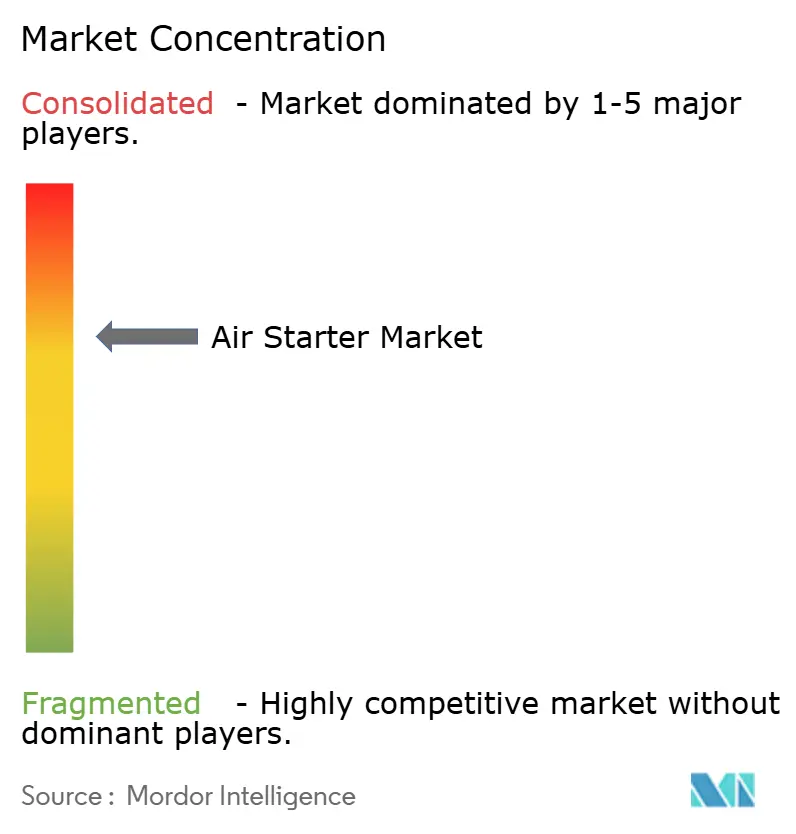
The field is moderately fragmented. Ingersoll Rand leads with a global service reach and 14 acquisitions in 2024 that deepened its air treatment and pump offerings, including a USD 146 million deal for Friulair. Competitors such as TDI, Gali, and Hilliard focus on niche turbine or vane specialties, while Epiroc and Caterpillar integrate proprietary starters into mining fleets. Technology battles now revolve around predictive analytics, additive manufacturing, and ultra-low-maintenance hybrid designs.
Strategic plays include vertical integration—pairing starters with compressors, dryers, and remote dashboards—to lock in customers across the entire equipment lifecycle. Certification leadership also matters; suppliers with harmonized ATEX, IECEx, and regional stamps win critical orders in high-risk zones. However, price competition exists for commoditized vane models, with value shifting toward total cost of ownership and uptime guarantees, thereby insulating premium suppliers from low-cost entrants.
Air Starter Industry Leaders
Ingersoll Rand plc
Tech Development Inc. (TDI)
Gali International
Austart
IPU Group
- *Disclaimer: Major Players sorted in no particular order
Air Starter Market Companies Covered in this Report
- Ingersoll Rand plc
- Tech Development Inc. (TDI)
- Gali International
- Austart (Air Starter Sales & Service)
- IPU Group
- KH Equipment Pty Ltd
- Air Starter Components (ASC)
- Multi Torque Industries
- Maradyne Corporation
- The Rowland Company
- Hilliard Corporation
- Atlas Copco (Air Power div.)
- Caterpillar Inc. (Starting Motors)
- Chicago Pneumatic
- Cummins Inc. (Starter Solutions)
- Powerstart Pty Ltd
- Turbine Kinetics Inc.
- DAB Industries
- Sullair LLC
- Parker Hannifin (Starter Systems)

Market Opportunities and Future Outlook
Integration and reliability upgrades across the starting system stack create room for suppliers that can bundle air starters with air compression, air treatment, and controls while maintaining hazardous-area certifications. Operators in oil and gas (42.12% of 2025 revenue) continue to prioritize retrofits and skid-level standardization for brownfield assets and offshore facilities, which supports demand for turnkey replacement kits, certified spares, and service programs designed to reduce downtime, particularly when insurers and site audits scrutinize non-certified ignition sources.
Technology signals from patent activity point to opportunities in compact, multifunction architectures that reduce weight and simplify installation. In February 2026, Hamilton Sundstrand Corporation received US Patent 12,546,260 B2 describing a pneumatic start system with an integrated electric generator and bleed-air pressure regulation, aligning with moves toward more integrated starter functionality. Separately, a December 2025 US patent application (20250389228) described an integrated air turbine starter assembly that relocates the overrunning clutch into the gearbox to reduce weight and overhang moment, suggesting continued packaging-led design improvements. On the aftermarket side, component availability remains a purchasing driver for critical compression and starting applications, with MASCO Miller Air Starter Co emphasizing deep inventories of OEM components and support, reinforcing service readiness as a competitive lever alongside ATEX and IECEx certification depth.
Recent Industry Developments in Air Starter Market
- May 2026: Ingersoll Rand announced a multiyear strategic partnership with Garrett Motion to develop next-generation oil-free air compressor technologies, with initial product introductions planned in 2026. The partnership supports system-level offerings where starting-air availability, air quality, and maintenance intervals are tightly linked in hazardous and uptime-critical environments. It also strengthens large-supplier leverage in packaged air solutions that can be specified alongside pneumatic starting systems.
- March 2026: Gali Group completed an IECEx-certified air and compressor package for an offshore oil and gas project in the Middle East, combining dual compressors, a receiver, control panels, and air treatment lines on a single skid. This reflects ongoing demand for integrated, certified packages rather than standalone components in offshore and hazardous-zone projects. It also highlights IECEx execution capability as a differentiator for suppliers serving export and cross-border work.
- April 2025: Ingersoll Rand acquired G and D Chillers and Advanced Gas Technologies for USD 27 million to expand its air treatment and on-site gas generation portfolios. Expanding air treatment capabilities supports bundled offerings where starter performance and lifecycle costs depend on clean, dry, and correctly conditioned air supply. The acquisitions also support aftermarket attachment by expanding the equipment footprint serviced under one supplier.


Air Starter Market Report Scope and Research Methodology
Market Definition and Coverage
For this report, the market covers revenue earned from air starters used to crank and start engines or turbines using compressed air, across industrial, marine, aviation, and heavy equipment settings. We count the sale of new air starter units and direct replacement demand tracked through the same product family.
Scope exclusions: Electric starter motors, hydraulic starters, and complete air start units (as packaged ground support systems) are excluded when they are not sold as an air starter product.
Segments Covered in This Report
- By Starter Type
- Vane Air Starter
- Turbine Air Starter
- Gear-Reduced (Hybrid) Air Starter
- By Horsepower Rating
- Up to 100 HP
- 100 to 300 HP
- Above 300 HP
- By End-User Industry
- Oil and Gas
- Power Generation
- Mining
- Marine (LNG, FPSO, Naval)
- Aviation
- Transportation (Heavy-Duty Trucks, Rail)
- By Geography
- North America
- United States
- Canada
- Mexico
- Europe
- Germany
- United Kingdom
- France
- Italy
- NORDIC Countries
- Russia
- Rest of Europe
- Asia-Pacific
- China
- India
- Japan
- South Korea
- ASEAN Countries
- Rest of Asia-Pacific
- South America
- Brazil
- Argentina
- Rest of South America
- Middle East and Africa
- Saudi Arabia
- United Arab Emirates
- South Africa
- Egypt
- Rest of Middle East and Africa
- North America
Data Sources, Market Sizing, and Validation
Desk Research
Desk work starts by mapping where air starters are typically installed, then connecting demand to public indicators for engine, turbine, and equipment activity. We rely on non-paywalled sources such as US EIA energy statistics, US Bureau of Labor Statistics industrial activity series, UN Comtrade trade data, World Bank macro indicators, and IMO or flag-state marine publications to understand fleet and operating patterns.
To keep assumptions realistic, we also use sources such as company annual reports, investor presentations, product catalogs, technical manuals, and reputable press coverage of new engine programs and retrofit cycles. When needed, paid subscriptions are used for company financials and intelligence, patent databases, and shipment-level import-export checks so unit flow and pricing ranges can be sanity-checked. The desk sources listed here are illustrative only, and we also used other public and paid references for collection, cross-checking, and clarification.
Primary Interviews and Surveys
Primary calls and surveys were used to confirm what gets counted as an air starter sale, how replacement intervals differ by duty cycle, and how pricing moves with materials and lead times. We spoke with a mix of manufacturers, distributors, and service shops, along with end users in oil and gas, power generation, marine operations, mining, aviation ground operations, and heavy transportation across the major regions, so our assumptions could be pressure-tested before finalizing the model.
Distribution of primary research fieldwork respondents
| Company type | Respondent position | Region |
|---|---|---|
| Top tier: 32% | CXOs: 20% | APAC: 47% |
| Mid tier: 48% | Functional/Unit leaders: 39% | EMEA: 34% |
| Smaller Players: 20% | Managers: 41% | Americas: 19% |
Market-Sizing & Forecasting
Sizing begins with a top-down build where equipment activity is translated into a practical demand pool, then filtered through air-start penetration by application. For example, we reconstruct demand by linking the installed base of relevant engines and turbines, operating intensity, and replacement cycles to the expected number of air starter changes in a year. That is then converted to value using typical price bands.
To keep the total grounded, we add selective bottom-up checks, such as sampled average selling price (ASP) times estimated unit demand by end use, distributor channel checks for replacement-heavy markets, and supplier roll-ups where financial disclosures allow it. Key inputs that shaped the model include the active fleet in marine and rail, new build and overhaul cadence in oil and gas and power generation, horsepower mix trends, compressed-air system adoption for hazardous environments, and observed price movement tied to materials and delivery times. Forecasts were produced using scenario analysis around engine activity, capex cycles, and replacement timing, then adjusted using the consensus ranges heard from interviewees. When direct unit signals were thin for smaller regions, gaps were handled through proxy indicators such as imports, industrial output, and fleet growth, followed by re-checks against regional shares shared by practitioners.
Data Validation & Update Cycle
Validation is done in layers so obvious errors do not slip through. We compare model outputs against independent signals such as import trends, engine and turbine shipment headlines, and regional industrial and energy activity, then investigate outliers before the numbers are finalized.
A second analyst review is completed to check formulas, assumptions, and year-to-year continuity, and interview follow-ups are triggered when a key input moves beyond a reasonable range. Reports are refreshed annually, with interim updates when major events occur, such as sharp commodity moves, supply disruptions, or large program changes. Before delivery, a fresh review pass is completed so clients receive the most current view available at that time.
Mordor Intelligence's Air Starter Market Estimate Compared With Other Published Estimates
Published market sizes for air starters can look far apart because each publisher counts different products, uses different timing for currency and pricing, and applies its own view of replacement demand versus new build demand. We have seen that even a small scope change, such as pulling in a related starter category, can shift the total quickly in a market of this size.
Complete air start units sold as ground support packages sit outside Mordor Intelligence's scope, which keeps the total focused on air starter products tied directly to engine and turbine starting demand, and avoids mixing in broader support equipment value. Gaps also come from how sources treat end-use boundaries (aviation ground equipment versus onboard applications), whether they model horsepower mix shifts, and whether pricing is held flat or stepped up using materials and lead-time signals, followed by different refresh cadences.
Benchmark comparison
| Source | Market Size | Gaps in Research Methodology |
|---|---|---|
| Mordor Intelligence | USD 0.44 B (2026) | |
| Industry Newswire A | USD 0.45 B (2024) | Uses a different base year and often reflects a press-release summary that can blend adjacent starter categories and faster pricing assumptions, which makes comparisons sensitive to timing and included product scope. |
| Global Data Publisher B | USD 0.48 B (2024) | May align the market to a broader definition such as air starter motors, and can lean on supplier-side revenue aggregation with limited visibility into replacement cycles by end use, which can lift totals in regions with heavy aftermarket activity. |
The spread mainly traces back to what gets counted as the product, which year is used as the anchor, and how replacement intensity is treated across marine, oil and gas, and power generation. By keeping assumptions tied to observable equipment activity and interview-validated replacement behavior, the final number stays traceable and repeatable when the model is updated.


Key Questions Answered in the Report
What is the current size of the air starter market?
The Air Starter Market size was USD 435.69 million in 2026 and is forecast to climb to USD547.83 million by 2031.
Which segment is growing fastest within the air starter market?
Gear-reduced hybrid air starters post the highest growth, advancing at a 6.58% CAGR through 2031.
Why are pneumatic starters preferred in LNG carriers?
ATEX-rated pneumatic turbine starters eliminate ignition sources in explosive cargo environments, meeting safety codes for dual-fuel propulsion.
How will electric-drive frac pumps affect air starter demand?
Continuous electric pumps reduce start-stop cycles, curbing short-term pneumatic starter requirements in North American shale operations.
Which region will lead air starter market growth up to 2031?
Asia-Pacific is projected to record the fastest regional CAGR at 6.72%, driven by industrial expansion, LNG infrastructure and shipbuilding backlogs.
What role does predictive maintenance play in the air starter industry?
Sensors and analytics platforms forecast service needs, decreasing downtime and strengthening the aftermarket’s share in long-term revenue.
Page last updated on:


 Your data is secure and never sold or shared.


