
Air Ambulance Service Market Size and Share
Market Overview
| Study Period | 2020 - 2031 |
|---|---|
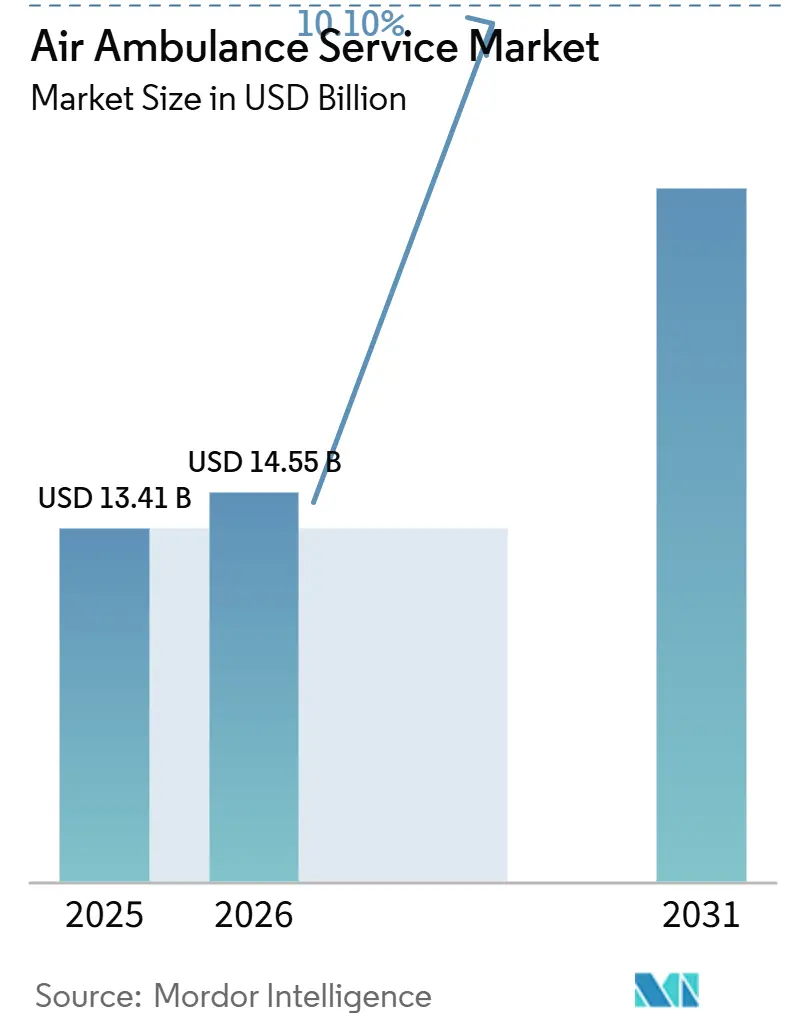
| Market Size (2026) | USD 14.55 Billion |
| Market Size (2031) | USD 23.54 Billion |
| Growth Rate (2026 - 2031) | 10.10 % |
| Fastest Growing Market | Asia Pacific |
| Largest Market | North America |
| Market Concentration | Medium |
Major Players *Disclaimer: Major Players sorted in no particular order Image © Mordor Intelligence. Reuse requires attribution under CC BY 4.0. | |
Air Ambulance Service Market Analysis by Mordor Intelligence
The air ambulance service market size is expected to grow from USD 13.41 billion in 2025 to USD 14.55 billion in 2026 and is forecasted to reach USD 23.54 billion by 2031 at a 10.1% CAGR over 2026-2031. This growth is driven by the increasing need for rapid transport in cardiovascular and trauma emergencies, improved insurance reimbursements under the No Surprises Act, and the expansion of integrated health systems establishing in-house fleets to retain high-acuity cases within their networks. Fleet modernization is progressing as operators invest in IFR-capable helicopters and explore electric vertical takeoff and landing (eVTOL) aircraft, which can reduce per-flight costs by up to 50%. Government initiatives, such as the USD 50 billion CMS Rural Health Transformation program, are enhancing cash flow for low-volume routes, while AI-based dispatch tools are enabling quicker launches and better asset utilization. Although competitive intensity remains moderate, recent trends in debt refinancing and market consolidation indicate that achieving scale is increasingly critical to manage high operating costs effectively.
Key Report Takeaways
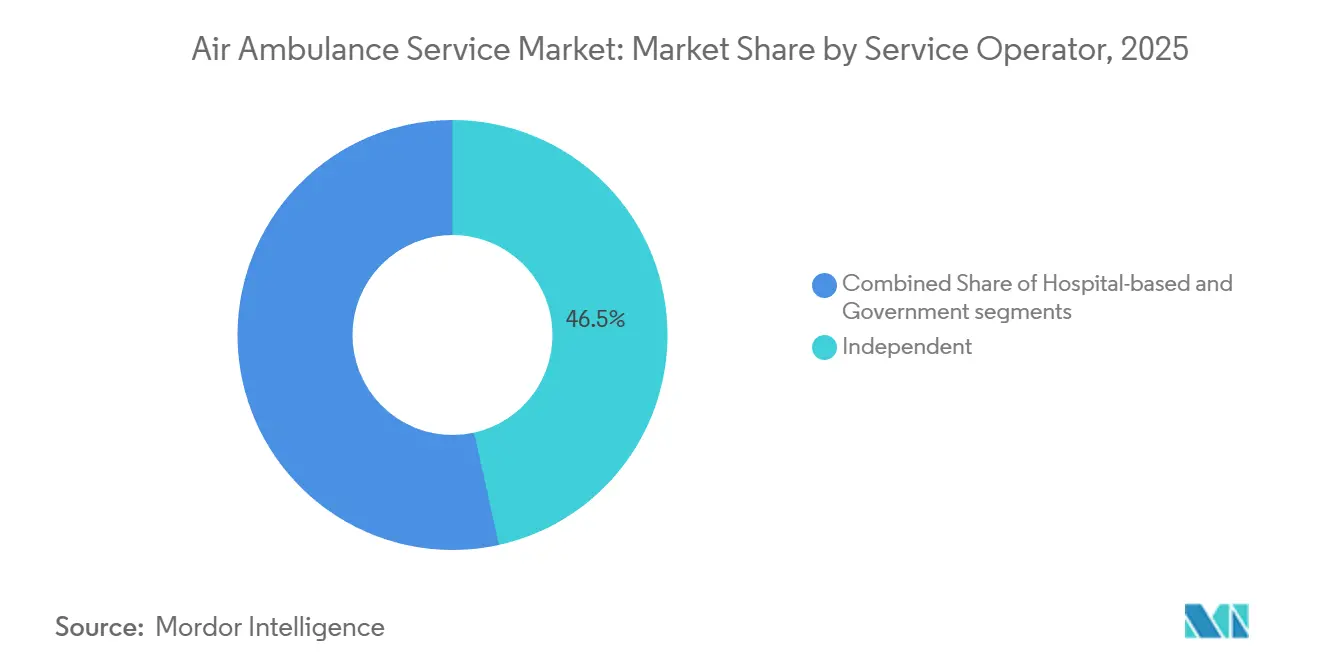
- By service operator, independent operators held 46.53% of the air ambulance service market share in 2025, while hospital-based models are forecast to grow at an 11.89% CAGR through 2031.
- By aircraft type, fixed-wing platforms led the air ambulance service market, accounting for 53.59% of the market size in 2025; rotary-wing units are projected to grow at a 10.68% CAGR through 2031, driven by the implementation of IFR upgrades.
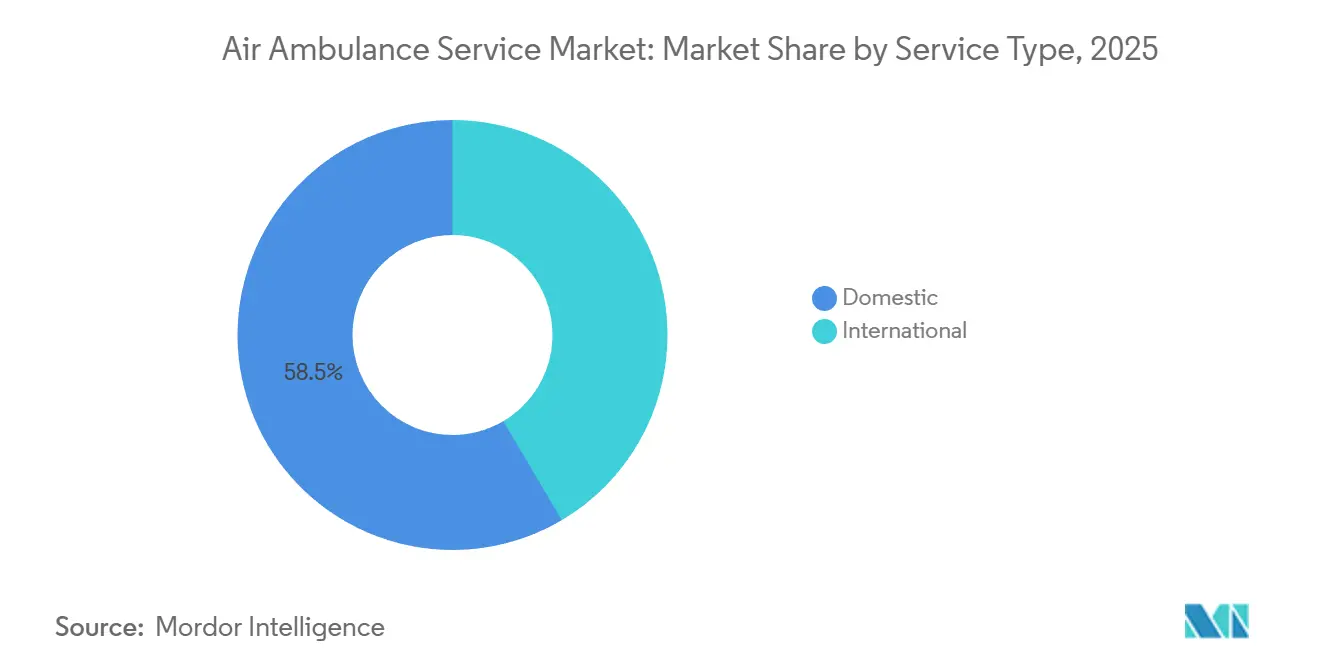
- By service type, domestic missions accounted for 58.49% of global revenue in 2025, while international repatriation is forecast to grow at a 12.01% CAGR through 2031.
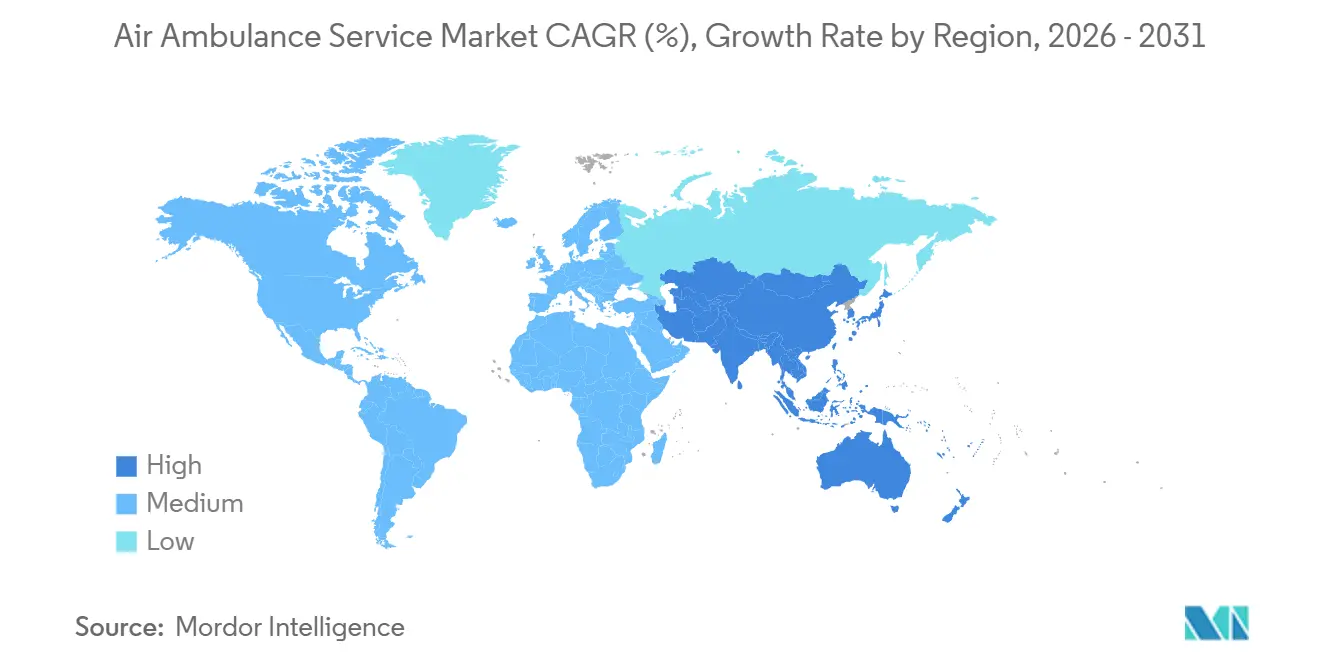
- By geography, North America accounted for 38.9% of the 2025 revenue, while the Asia-Pacific region is projected to grow at an 11.95% CAGR through 2031.
Note: Market size and forecast figures in this report are generated using Mordor Intelligence’s proprietary estimation framework, updated with the latest available data and insights as of January 2026.
Global Air Ambulance Service Market Trends and Insights
Drivers Impact Analysis*
| Driver | (%) Impact on CAGR Forecast | Geographic Relevance | Impact Timeline |
|---|---|---|---|
| Growing prevalence of cardiovascular and trauma emergencies | +1.8% | Global with higher impact in aging populations of North America and Europe | Medium term (2-4 years) |
| Expansion of private medical insurance coverage | +1.5% | Asia-Pacific core, spill-over to South America | Medium term (2-4 years) |
| Government subsidies for rural critical-care access | +1.2% | North America and Australia, emerging in India and Brazil | Long term (≥ 4 years) |
| eVTOL integration accelerating rapid response times | +0.9% | North America and EU pilot programs, expanding globally | Long term (≥ 4 years) |
| Cross-border tele-ICU network partnerships | +0.7% | Europe and North America, expanding to Asia-Pacific | Medium term (2-4 years) |
| AI-driven flight-route optimization reducing response time | +0.6% | Global with early adoption in developed markets | Short term (≤ 2 years) |
| Source: Mordor Intelligence | |||
Growing Prevalence of Cardiovascular and Trauma Emergencies
Cardiac and trauma cases account for the majority of helicopter emergency medical service missions, with 385,366 patients transported in 2023, primarily for these conditions.[1] Survival rates for rural cardiac arrest are 30% lower than urban averages, making reduced transport times critical. Air transport can cut travel time from 60 minutes by ground to 15 minutes by air, significantly improving outcomes. In England, helicopters achieved a median cardiac arrest response time of 19 minutes, compared to 28 minutes for ground units, resulting in an increase in return-of-spontaneous-circulation rates. Peer-reviewed studies indicate a 12% reduction in mortality when trauma patients are transported by air instead of ground. Aging populations in developed regions are expected to sustain demand through 2031.
Expansion of Private Medical Insurance Coverage
The No Surprises Act, effective January 2022, reduced balance billing, lowering out-of-pocket costs for patients and enabling more covered air ambulance flights. In 2024, CMS introduced the Air Ambulance Data Collection program, enhancing cost transparency for payers and operators. Major insurers, including UnitedHealthcare, Cigna, Anthem, and Blue Cross Blue Shield, now provide clear clinical criteria for flight authorization, covering conditions such as hemodynamic instability and airway compromise. A 50% Medicare rural add-on payment further supports operator economics in frontier areas. Upcoming standards from the CMS–DOT advisory committee are expected to improve reimbursement predictability.
Government Subsidies for Rural Critical-care Access
In 2022, federal grants totaling USD 42.90 million supported rural providers in building helipads and acquiring necessary equipment. The FY2026 budget allocates USD 50 billion over five years to enhance emergency coverage in underserved US counties. Additional grant programs from the US Department of Agriculture provide funding for helipads and crew training. Similar initiatives in Saudi Arabia funded seven helicopters around Mecca to serve 2 million Hajj pilgrims in 2024. These subsidies enable carriers to maintain operations on low-volume routes that would otherwise be unprofitable.
eVTOL Integration Accelerating Rapid Response Times
Archer Aviation and the Cleveland Clinic plan to introduce eVTOL medical flights by 2025, offering five-minute dispatch times for 50-mile missions. Beta Technologies is testing battery-powered aircraft with Air Methods to validate endurance and payload capabilities. Eve Air Mobility and Joby Aviation are progressing toward FAA approvals, potentially opening North American corridors by 2027. Electric propulsion reduces fuel and maintenance costs while adhering to strict urban noise regulations.
Restraints Impact Analysis*
| Restraint | (%) Impact on CAGR Forecast | Geographic Relevance | Impact Timeline |
|---|---|---|---|
| High operating and maintenance costs | -1.3% | Global with higher impact in cost-sensitive emerging markets | Short term (≤ 2 years) |
| Shortage of trained aero-medical professionals | -1.1% | North America and Europe, expanding to Asia-Pacific | Medium term (2-4 years) |
| Stringent aviation regulatory approvals | -0.8% | Global with varying intensity by jurisdiction | Long term (≥ 4 years) |
| Spectrum congestion hampering in-flight telemedicine | -0.5% | Urban areas globally, particularly dense metropolitan regions | Medium term (2-4 years) |
| Source: Mordor Intelligence | |||
High Operating and Maintenance Costs
Annual helicopter operating costs range from USD 2.9 million to USD 6.5 million, with fuel expenses accounting for up to 35% of the total operating costs.[2] Turbine overhauls can exceed USD 500,000, while rising insurance premiums and multi-crew staffing further increase costs. Low-volume rural bases struggle to achieve economies of scale, prompting smaller providers to consider consolidation or exit from the market.
Shortage of Trained Aero-medical Professionals
Employment growth for EMTs and paramedics is projected at only 5% through 2033, falling short of the expected double-digit growth in air ambulance missions.[3] Flight crews require specialized certifications, such as critical-care paramedic and advanced airway management, as well as 2,000 flight hours for pilots, limiting the candidate pool. While earn-while-you-learn programs have been introduced, significant workforce relief is not expected for another three to five years.
*Our forecasts treat driver/restraint impacts as directional, not additive. The impact forecasts reflect baseline growth, mix effects, and variable interactions.
Segment Analysis
By Service Operator: Hospital Systems Deepen Integration
Hospital systems represent the fastest-growing segment in the air ambulance service market, with an expected CAGR of 11.89%. This growth is driven by their ability to transport high-acuity cases directly to owned intensive-care units, ensuring downstream revenue. The Cleveland Clinic–Archer eVTOL project exemplifies this approach. Independent operators, while maintaining a projected 46.53% market share in 2025, face challenges such as rising fuel costs, labor expenses, and negotiations with payers. Global Medical Response’s USD 5.4 billion refinancing positions it to expand into underserved rural areas where hospital-operated fleets are absent. Government-run services, such as Australia’s Royal Flying Doctor Service, address service gaps with taxpayer funding, shielding them from fluctuations in reimbursement.
Hospital ownership facilitates cross-functional scheduling, data sharing, and the negotiation of bundled payment contracts with insurers, thereby reducing per-patient transport costs. Independent operators, such as GMR with its 387 US bases, offer extensive geographic coverage but are more vulnerable to regulatory and fuel price changes. Air Methods’ 2023 restructuring, which reduced USD 1 billion in debt, highlights the financial challenges faced by standalone operators. Looking ahead, hybrid joint ventures where hospitals take minority stakes in established operators could combine financial stability with operational expertise, reshaping competition in the air ambulance service market.

By Aircraft Type: Helicopters Close the Gap
Fixed-wing aircraft are projected to account for 53.59% of 2025 revenue, driven by their suitability for long-haul repatriation and pressurized cabins capable of carrying ECMO or incubators on intercontinental routes. This segment benefited significantly from the post-pandemic rebound in international volumes. However, rotary-wing aircraft are expected to grow at a 10.68% CAGR, supported by the introduction of IFR-capable models like the Bell 407GXi and Bell 429, which enhance operational capabilities in adverse weather conditions. Airbus’ H140 order from STAT MedEvac further reflects demand for helicopters with quiet, spacious cabins.
Helicopters remain critical for scene pickups and rooftop landings, particularly within 150-mile radii of level-I trauma centers. Fixed-wing operators are modernizing their fleets with Pilatus PC-24 jets and King Air 350i turboprops to improve fuel efficiency. The emergence of eVTOL aircraft is expected to impact short-haul helicopter missions while complementing fixed-wing operations on longer routes. Overall, rotary-wing aircraft are anticipated to continue narrowing the market share gap with fixed-wing aircraft through 2031.
By Service Type: International Travel Accelerates
Domestic flights are projected to account for 58.49% of 2025 revenue, but international repatriation services are expected to grow at a faster CAGR of 12.01%. This growth is driven by increasing demand for bedside-to-bedside transfers from medical tourism and expatriate communities. Partnerships like International SOS and SAF Aerogroup’s tele-ICU initiative reduce the need for onboard physicians, lowering costs and expanding accessibility. Transatlantic ICU jet services start at approximately USD 25,000, with providers like Brasil Vida and AirMed offering global coverage that reassures insurers.
Domestic growth is expected to moderate as expanded ground EMS capabilities absorb some short-haul transfers, and payer scrutiny limits reimbursement increases. However, rural areas with challenging topography and long travel times ensure the continued necessity of air transport. Consequently, international routes are poised to contribute significantly to incremental revenue, prompting operators to strategically position aircraft in hubs such as Dubai, Singapore, and Miami to support the growing demand in the air ambulance service market.
Geography Analysis
North America is expected to generate 38.9% of global sales in 2025, supported by Medicare’s 50% rural add-on and the No Surprises Act, which simplifies payer settlements. GMR’s extensive network of 387 bases across all 50 states, combined with its commitment to acquiring 53 new aircraft, strengthens its domestic presence. In Canada, provincial programs like Ornge ensure coverage in remote northern regions. Mexico, however, remains underserved, presenting opportunities for new entrants willing to navigate regulatory challenges.
The Asia-Pacific region is projected to achieve the fastest CAGR of 11.95% through 2031, driven by the liberalization of helicopter EMS in China and India. Japan’s Doctor Helicopter system serves as a model for public-private collaboration. In the Middle East and Africa, Saudi Arabia’s Mecca fleet demonstrates targeted government investment to address episodic surges in demand. Dubai’s strategic positioning as a hub for Eurasian medical tourism further enhances the region’s growth potential.
In Europe, state-funded HEMS programs, such as Germany’s DRF network with 52 helicopters, coexist with charity-funded operations in the UK, France, Turkey, and South Africa, all of which contribute to the regional landscape. In Africa, political instability and low insurance penetration limit the expansion of the broader market. However, niche opportunities exist in sectors such as mining, oil, and safari tourism, which require critical-care transport services.
Mordor Intelligence provides coverage of the air ambulance service market across other key regional markets, including Europe, each with their regulatory frameworks and demand patterns.
Regulatory Landscape
Air ambulance operators must comply with aviation rules governing on-demand and commuter operations. In the United States, the Federal Aviation Administration (FAA) regulates air ambulance activity under 14 CFR Part 135, including Subpart L requirements covering operational control, pilot instrument qualifications, and mandated safety technologies.
These aviation requirements shape fleet upgrade cycles, dispatch and operations-control-center practices, and the pace at which operators can add bases or expand into new geographies. On the healthcare payment and oversight side, the Centers for Medicare and Medicaid Services (CMS) administers federal requirements tied to the No Surprises Act, including provider reporting and transparency obligations for air ambulance services. A key recent anchor is the Air Ambulance Quality and Patient Safety Advisory Committee (AAQPS), established under the Consolidated Appropriations Act, 2021, which finalized and delivered its recommendations to Congress on June 11, 2026, centering on quality, patient safety, and clinical capability standards. Operators also maintain formal compliance programs for participation in federal healthcare programs (for example, internal compliance committee structures), which reinforces the need for auditable documentation, clinical governance, and standardized operational policies.
Value Chain Analysis
The value chain starts with aircraft and mission-enabling equipment supply, including rotary-wing and fixed-wing platforms, avionics and safety systems, and specialized mission kits. After certification and configuration to meet jurisdictional operating rules, operators build operational readiness through operations control centers, dispatch and flight-following capabilities, safety management systems, and maintenance ecosystems that support high-utilization fleets, including upkeep of safety technologies referenced in Part 135 frameworks.
Service delivery is then coordinated with healthcare and public-safety stakeholders, including hospital systems, EMS agencies, and landing-zone partners such as fire and law-enforcement teams, which enable safe scene access and patient transfer. Clinical staffing (flight nurses, paramedics, and critical-care teams) and onboard and ground clinical protocols run alongside payer authorization and billing workflows that influence case acceptance and reimbursement timing. Industry bodies such as the Association of Air Medical Services (AAMS) provide safety resources and convene operators around standard practices. After transport, clinical handoff documentation, quality reporting, and incident preparedness processes feed back into safety and compliance programs.
Competitive Landscape
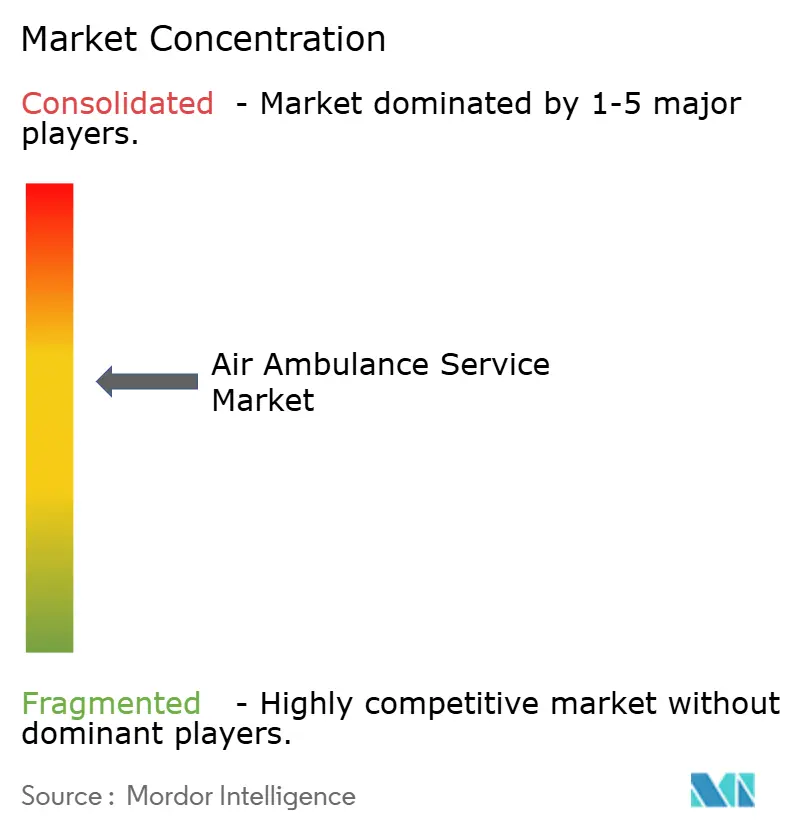
The air ambulance service market exhibits moderate concentration, with the top three US carriers, GMR, Air Methods, and PHI Health, dominating domestic operations. However, the European and Asia-Pacific markets remain fragmented. GMR leverages its scale to negotiate insurance contracts and invest in AI-driven dispatch systems and tele-ICU retrofits, illustrating how larger players can benefit from technological advancements. Following its restructuring, Air Methods has reduced its operational footprint, creating opportunities for competitors to enter its former markets. Additionally, Toll Group’s planned 2024 acquisition of Pel-Air’s fixed-wing assets highlights logistics companies' growing interest in aeromedical transport as a complementary service.
eVTOL manufacturers are forming joint ventures with hospital systems, introducing new competition and reducing entry barriers in urban areas. Accreditation from the Commission on Accreditation of Medical Transport Systems has become essential for securing premium contracts, prompting smaller operators to either invest in upgrades or pursue mergers. Regulatory changes under the FAA and CMS quality committees favor companies capable of funding advanced avionics, safety systems, and evidence-based clinical protocols. Overall, strategic alliances, refinancing efforts, and technological advancements are expected to continue reshaping the air ambulance service market through 2031.
Air Ambulance Service Industry Leaders
-
Air Methods Corporation
-
Global Medical Response, Inc.
-
PHI Health, LLC
-
REVA Inc.
-
Avincis Aviation Group, S.A.U.
- *Disclaimer: Major Players sorted in no particular order
Market Opportunities and Future Outlook
Quality and patient-safety standardization creates a clearer whitespace for operators that can formalize clinical governance and evidence-based reporting, particularly as CMS reporting requirements under the No Surprises Act increase visibility into utilization and cost structures. The AAQPS recommendations delivered to Congress on June 11, 2026, also elevate the concept of transitioning air ambulance operators from supplier to provider status, which supports opportunities for tighter clinical oversight models, clearer scope-of-service definitions, and more differentiated contracting for higher-acuity capabilities.
Bidirectional patient data exchange between air ambulance providers and hospitals is another practical opening, especially for integrated delivery networks focused on continuity from dispatch through ICU admission. Tele-ICU and remote clinical oversight models, already visible in long-haul operations through partnerships such as International SOS and SAF Aerogroup, provide a pathway to extend specialist coverage without adding onboard staffing on every mission. At the same time, operators investing in IFR-capable helicopters and dispatch optimization tools can convert more missions in adverse-weather or time-critical windows while improving asset utilization, aligning operational upgrades with evolving quality expectations and payer scrutiny.
Recent Industry Developments
- June 2026: Air Methods opened a new air medical base in Russell County, Kentucky, at the Russell County Airport. The added base extends coverage for time-sensitive emergencies and improves network density in a rural corridor where ground transport can be constrained.
- November 2025: Air Methods opened the LifeNet 1-4 base in Sioux City, Iowa, to serve western Iowa, eastern Nebraska, and southeastern South Dakota. The expansion increases regional reach and strengthens the operator's ability to balance coverage and utilization across adjacent service areas.
- March 2025: Air Methods signed purchase agreements with Bell Textron and Airbus Helicopters for nearly 50 new aircraft, including Bell 407GXis, Bell 429s, Airbus H125s, and H135s. This fleet modernization supports operational resilience and standardization across bases, with platform selection aligned to mission profiles and equipment configurations used in HEMS operations.
Research Methodology Framework and Report Scope
Market Definition and Coverage
For this study, the air ambulance service market is defined as revenue earned from medically staffed air transport for emergency response and interfacility transfer, using rotary-wing and fixed-wing aircraft across domestic and international missions.
Scope exclusions: We exclude routine non-medical air charter, purely sightseeing or tourism flights, and standard scheduled passenger cargo airline operations that are not sold as air medical transport.
Segmentation Overview
- By Service Operator
- Hospital-based
- Independent
- Government
- By Aircraft Type
- Fixed-Wing
- Rotary-Wing
- By Service Type
- Domestic
- International
- By Geography
- North America
- United States
- Canada
- Mexico
- Europe
- United Kingdom
- France
- Germany
- Russia
- Rest of Europe
- Asia-Pacific
- China
- India
- Japan
- South Korea
- Australia
- Rest of Asia-Pacific
- South America
- Brazil
- Rest of South America
- Middle East and Africa
- Middle East
- Saudi Arabia
- United Arab Emirates
- Turkey
- Africa
- South Africa
- Egypt
- Middle East
- North America
Data Sources, Market Sizing, and Validation
Desk Research
Desk research was used to set the market context and to lock basic parameters before we moved into assumptions and model-building. We reviewed public health and transport datasets and regulatory references to understand where utilization is likely to be higher, including rural access gaps and time-critical care needs.
Sources used include materials such as the World Health Organization health statistics, OECD health indicators, US CDC injury and cardiovascular burden releases, FAA and EASA aviation safety and fleet references, and government health spending series such as World Bank and national health ministries. We also used company filings, investor presentations, reputable press coverage, and selected paid subscriptions for company financials and intelligence, news and financials, patent databases, and tenders or contracts, where they helped confirm fleet additions, base expansions, and funding cycles. This list is illustrative, and many other public sources were also checked for data collection, validation, and clarification.
Primary Interviews and Surveys
Primary work focused on validating how operators price flights, how payer mix affects realizations, and how dispatch and clinical staffing constraints limit available capacity in practice. We spoke with a mix of independent operators, hospital programs, and public agencies, and we balanced perspectives from commercial, medical, and operations roles across major regions so the gaps from desk research could be closed and assumptions could be stress-tested.
Distribution of primary research fieldwork respondents
| Company type | Respondent position | Region |
|---|---|---|
| Top tier: 29% | CXOs: 13% | APAC: 47% |
| Mid tier: 57% | Functional/Unit leaders: 43% | EMEA: 33% |
| Smaller Players: 14% | Managers: 44% | Americas: 20% |
Market-Sizing & Forecasting
Sizing started from a top-down build where emergency care demand pools were reconstructed by region and then filtered through air transport eligibility and access, before being translated into flights and revenue. We used this as the main spine because not every operator discloses full, comparable financials.
Key inputs included the mix of rotary-wing versus fixed-wing missions, typical mission distance and duration patterns (domestic versus international), reimbursement and payer mix signals that affect net realizations, fleet and base availability that caps flight volume, and the share of interfacility transfers versus scene response that changes clinical staffing needs. Results were then checked using selective bottom-up approximations, such as sampling operator revenues where available, triangulating utilization per aircraft, and applying realistic price bands to estimated flight volumes, with gaps handled by peer-group averages and region-level normalization.
For forecasting, we used scenario analysis supported by light multivariate regression on variables like trauma and cardiovascular burden trends, aging population growth, fleet modernization cadence, and reimbursement stability, and then the outputs were reviewed with expert feedback so the forward curve stayed practical.
Data Validation & Update Cycle
Model outputs were validated through triangulation across independent signals, including aircraft availability trends, healthcare utilization indicators, and operator-level capacity constraints discussed in interviews. Variance checks were performed for outliers by region and by aircraft type, and then assumptions were reviewed in multiple analyst passes so the logic stayed consistent from the demand pool through to revenue.
When a material mismatch was seen, such as revenue growing faster than plausible flight volume or an abrupt pricing jump without reimbursement support, we rechecked the inputs and, where needed, re-contacted sources to resolve the gap. Reports are refreshed annually, with interim updates when major events occur, and a final pre-delivery review is completed so clients receive the latest updated view.
Mordor Intelligence's Air Ambulance Service Market Size Measured Against Other Published Estimates
Published market sizes for air ambulance services often vary because each publisher makes different choices on what revenue to count, which years to anchor on, and how to convert flight activity into dollars. Differences also show up when one study leans more on list prices, while another uses net realizations after payer effects and contract terms.
The main gap comes from whether adjacent medical transport activity is folded in, where Mordor Intelligence counts only medically staffed fixed-wing and rotary-wing air ambulance missions and keeps general air charter and non-medical transport outside the total, with the base year figures updated as of January 2026.
Benchmark comparison
| Source | Market Size | Gaps in Research Methodology |
|---|---|---|
| Mordor Intelligence | USD 14.55 B (2026) | |
| Global Consultancy A | USD 24.58 B (2025) | Uses a broader definition and base year, with limited clarity on whether related medical transport revenue streams and wider service charges are included, which can inflate the total versus a pure air ambulance-only scope. |
| Trade Journal B | USD 6.77 B (2028) | Reports absolute growth over 2024 to 2028 rather than a comparable base-year market value, and the write-up mixes service descriptions and regions, which makes the implied sizing assumptions harder to reconcile to flight volumes and realizations. |
The spread mainly comes from scope choices and year anchoring, and then from how pricing is treated when moving from missions to revenue. By keeping inputs traceable to utilization, fleet constraints, and realistic net price ranges, the estimate remains repeatable and easier to audit across regions.
Key Questions Answered in the Report
How large is the air ambulance service market in 2026?
The air ambulance service market stands at USD 14.55 billion and is set to grow at a 10.10% CAGR to 2031.
Which aircraft type dominates current revenue?
Fixed-wing aircraft hold 53.59% of 2025 revenue because of their role in long-distance repatriation.
What region will grow fastest through 2031?
Asia-Pacific is forecasted to post an 11.95% CAGR thanks to helicopter EMS rollouts in China and India.
Why are hospital systems investing in their own fleets?
They aim to keep high-acuity cases inside their networks, generating inpatient revenue while improving clinical continuity.
How will eVTOL technology affect air medical transport?
EVTOL aircraft should cut per-flight operating costs by up to 50%, enabling rapid urban response with less noise.
What is the key restraint facing operators today?
High operating costs, USD 2.9 million to USD 6.5 million per helicopter per year, press margins, especially on low-volume rural routes.