
AI Search Visibility Services Market Size and Share
Market Overview
| Study Period | 2020 - 2031 |
|---|---|
| Market Size (2026) | USD 4.39 Billion |
| Market Size (2031) | USD 10.72 Billion |
| Growth Rate (2026 - 2031) | 19.55 % |
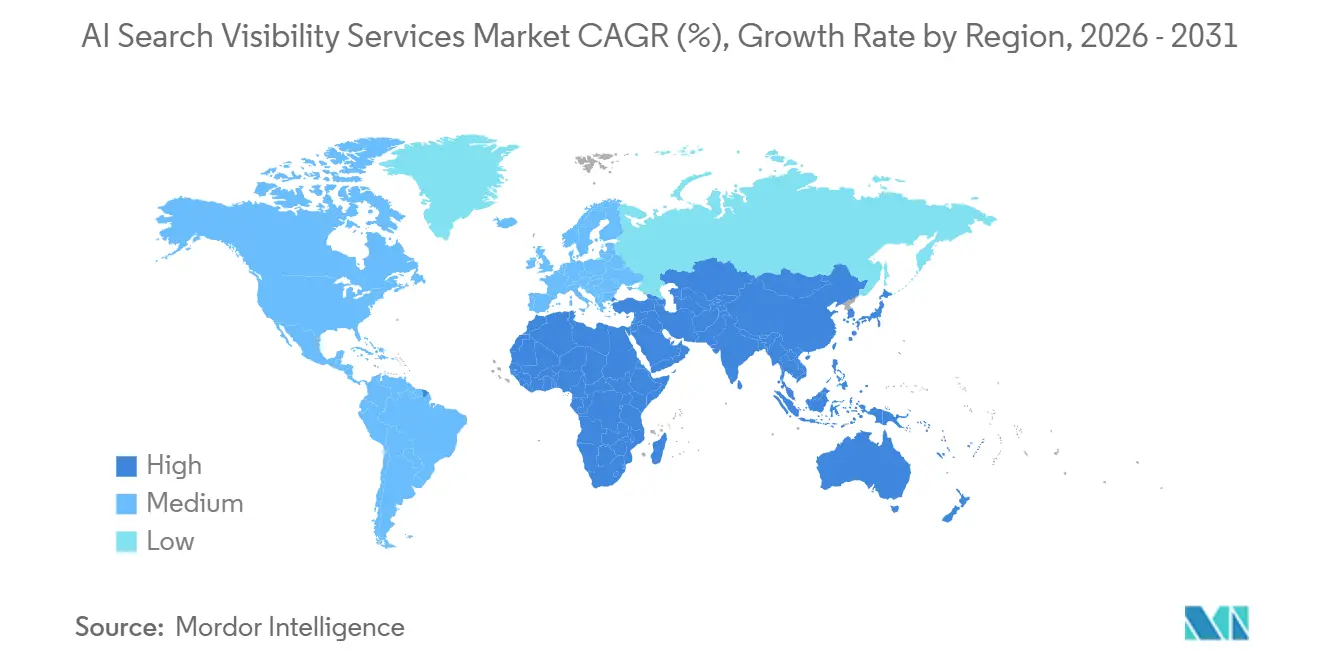
| Fastest Growing Market | Asia-Pacific |
| Largest Market | North America |
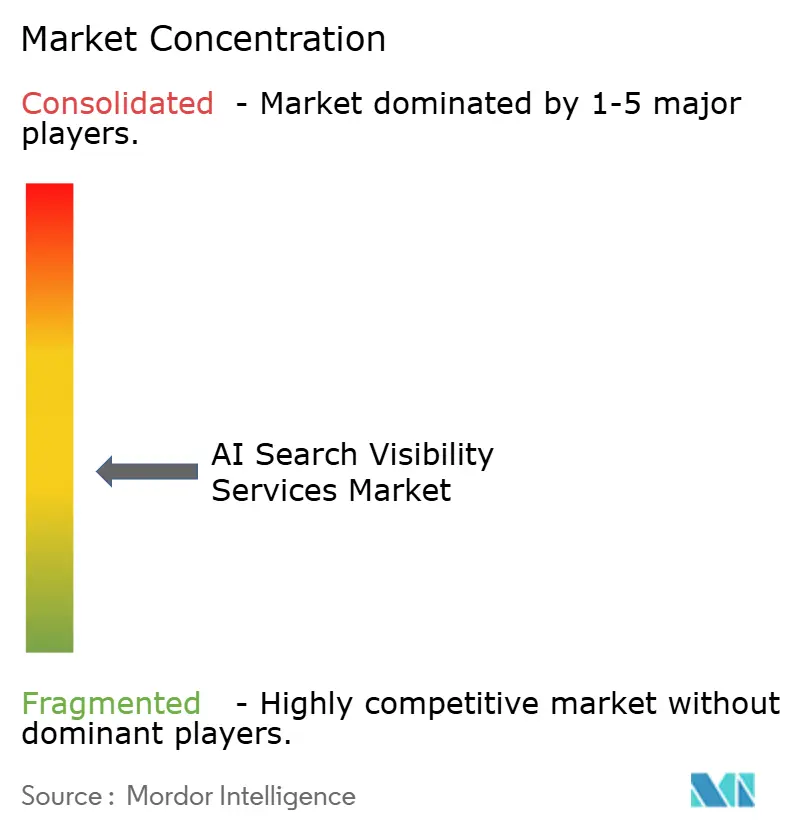
| Market Concentration | Medium |
Major Players *Disclaimer: Major Players sorted in no particular order Image © Mordor Intelligence. Reuse requires attribution under CC BY 4.0. | |
AI Search Visibility Services Market Analysis by Mordor Intelligence
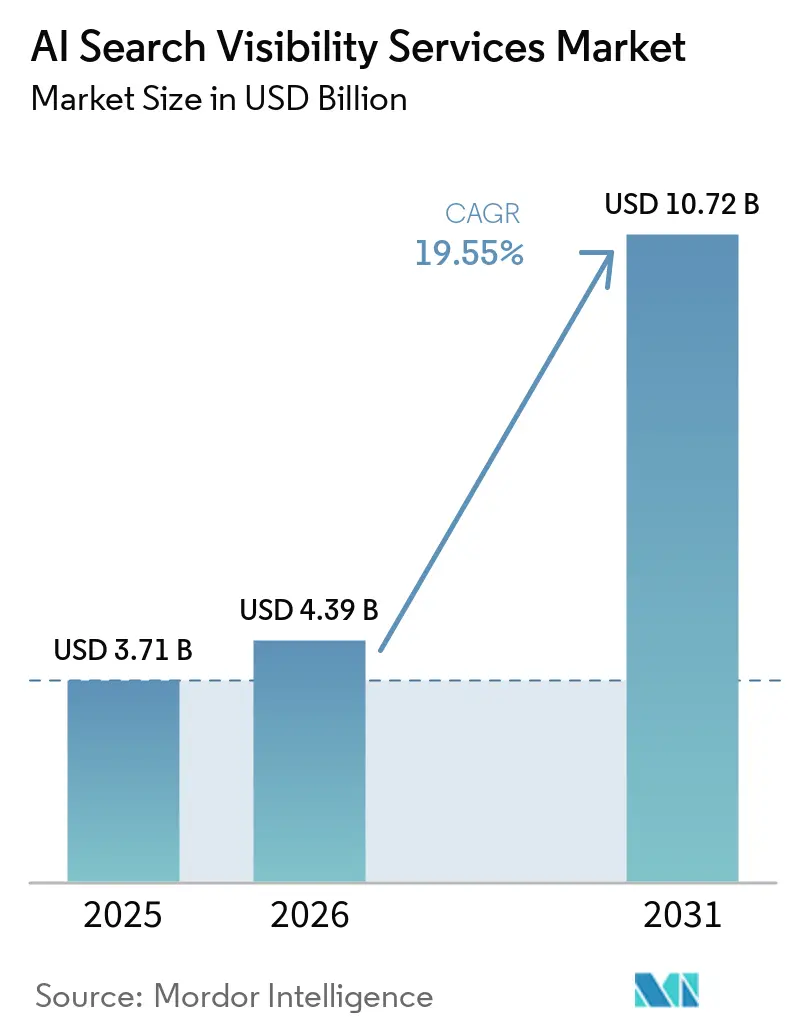
The AI search visibility services market size is projected to expand from USD 3.71 billion in 2025 and USD 4.39 billion in 2026 to USD 10.72 billion by 2031, registering a CAGR of 19.55% between 2026 to 2031. Growth reflects a change in how prospective customers discover brands, as answer engines increasingly shape research before users visit a company website or contact a sales team. Enterprises are moving budget toward citation visibility, structured content, and reporting that can show a brand’s presence across AI platforms and explain where visibility is incomplete. The opportunity is strongest where buyers make complex comparisons, because AI-generated answers can narrow the supplier set before a formal search begins and before conventional search advertising can influence the choice. Providers that combine technical implementation, content governance, and cross-engine measurement can address this need more effectively when their services link page-level fixes with ongoing evidence management. Competitive activity is also increasing as established search platforms and specialized providers develop tools for the AI search visibility services market.
Key Report Takeaways
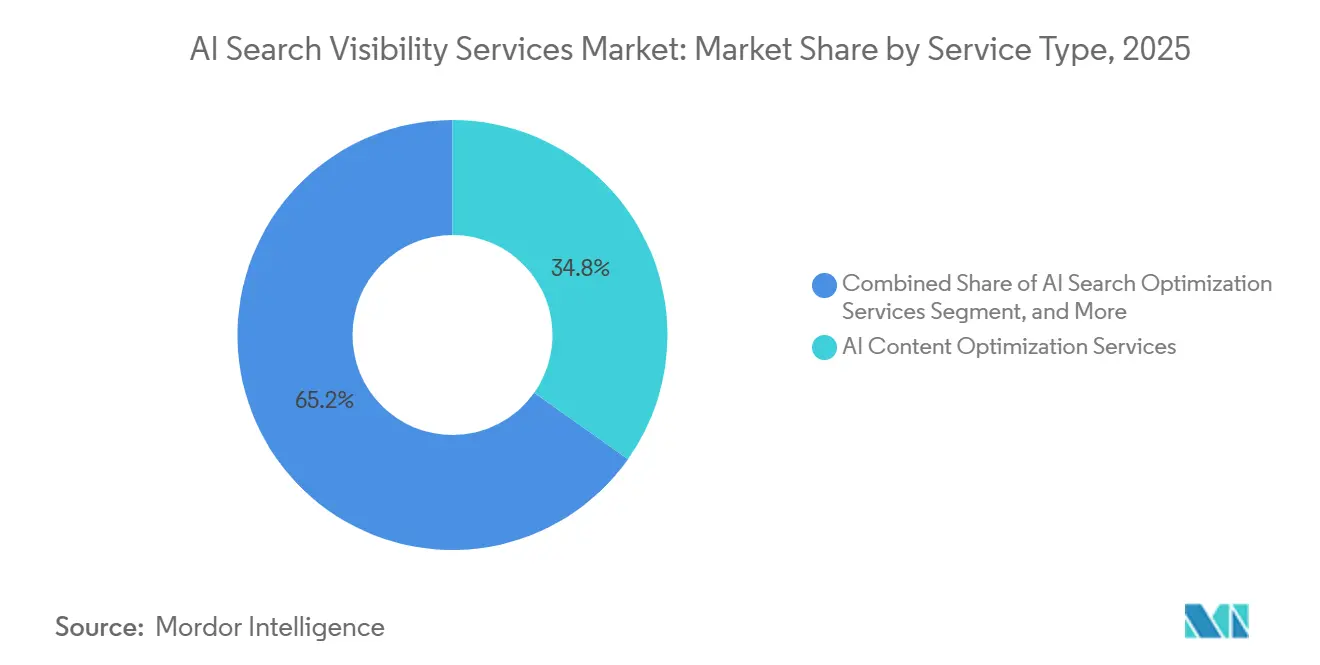
- By service type, AI Content Optimization Services held 34.80% of the AI search visibility services market share in 2025, while AI Citation and Knowledge Management Services are projected to expand at a CAGR of 19.96% through 2031.
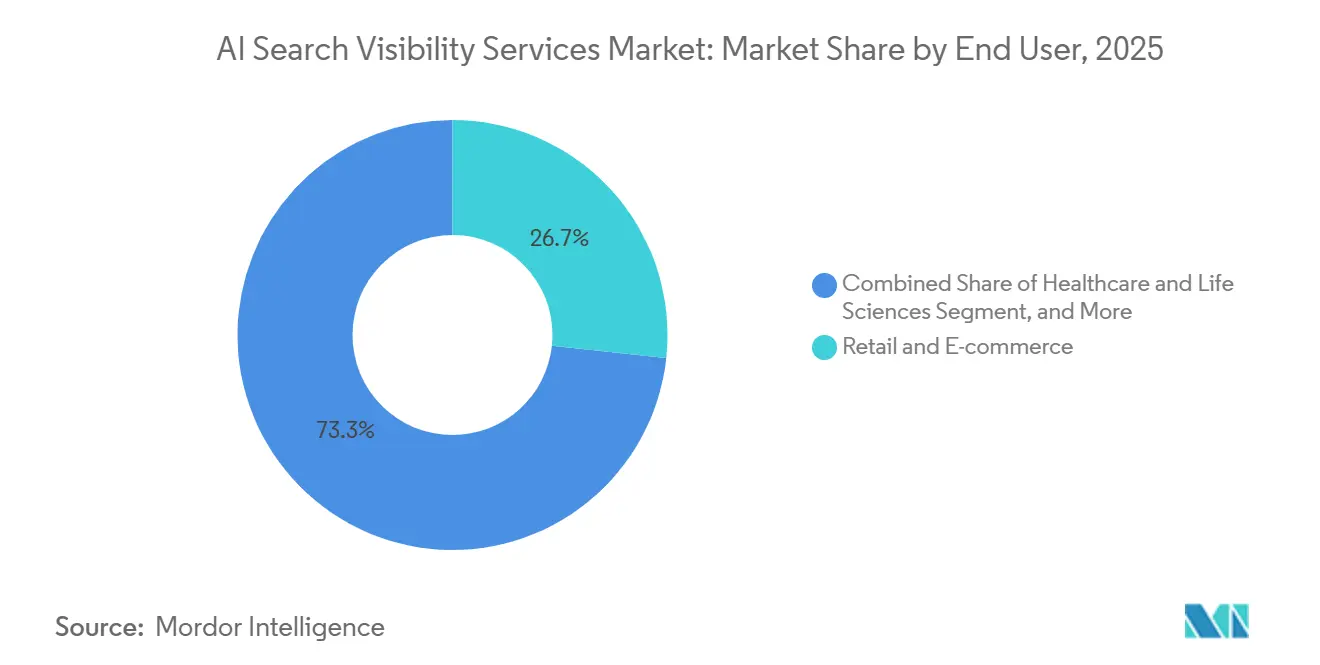
- By end user, Retail and e-commerce accounted for 26.70% of revenue in 2025, while Healthcare and Life Sciences are projected to grow at a 20.42% CAGR through 2031.
- By geography, North America held 44.51% of revenue in 2025, while Asia-Pacific is projected to expand at a CAGR of 20.12% through 2031.
Note: Market size and forecast figures in this report are generated using Mordor Intelligence’s proprietary estimation framework, updated with the latest available data and insights as of January 2026.
Market Trends and Insights
Drivers Impact Analysis of AI Search Visibility Services Market*
| Driver | (~) % Impact on CAGR Forecast | Geographic Relevance | Impact Timeline |
|---|---|---|---|
| Rising Zero-Click Discovery and AI-Mediated Buying Journeys | +5.5% | Global, with North America and Europe leading adoption | Short term (≤ 2 years) |
| Enterprise Shift From SEO Metrics to AI Visibility KPIs | +4.2% | North America and Europe, with Asia-Pacific accelerating | Short term (≤ 2 years) |
| Higher Conversion Quality From AI-Referred Visits | +2.4% | Global, concentrated in North America and Western Europe | Medium term (2-4 years) |
| Growing Adoption of Structured Content, Schema, and Entity Optimization | +2.0% | Global | Medium term (2-4 years) |
| Rapid Expansion of MCP and Agent-Accessible Brand Surfaces | +1.6% | Global, with North America and Europe leading implementation | Medium term (2-4 years) |
| Cross-Engine Localization Gaps Driving Multi-Market Monitoring Demand | +1.2% | Asia-Pacific core, spill-over to Middle East and South America | Long term (≥ 4 years) |
| Source: Mordor Intelligence | |||
Rising Zero-Click Discovery and AI-Mediated Buying Journeys
AI answer engines are changing the discovery process because a brand can be evaluated before a customer reaches a conventional results page, reads a product page, or submits an inquiry. Zero-click behavior reached 68.01% of U.S. Google searches in the first 4 months of 2026. Google AI Overviews appeared in 43% of search queries by mid-2026, up from 15% a year earlier, underscoring the importance of appearing in cited responses and being available to answer engines when a question is asked. AI search users also placed more weight on AI than traditional search when seeking information, according to the 2025 consumer research. This puts the AI search visibility services market closer to the top of the buying funnel than conventional ranking services because visibility can shape the initial set of brands considered. It also makes early visibility important for companies whose products require comparison and consideration across several vendors.
Enterprise Shift from SEO Metrics to AI Visibility KPIs
Enterprise spending is moving from traditional search metrics toward measures such as citation frequency, share of model, and AI referral conversion. 94% of surveyed senior marketing leaders planned to increase AEO and GEO investment in 2026, while enterprises allocated an average 12% of digital marketing budgets to these activities. It also stated that 65% of surveyed enterprise leaders allocated at least 25% of their 2026 marketing budget to AI search optimization, indicating that these programs are becoming a planned rather than experimental activity. Measurement remains incomplete, as only 16% of brands systematically tracked AI search performance in the cited 2025 survey. This gap creates demand for providers that can establish practical reporting methods, define meaningful baselines, and connect visibility activity to commercial outcomes. It also makes education, implementation support, and analytics central to the AI search visibility services market.
Higher Conversion Quality From AI-Referred Visits
AI-referred visitors can arrive with a more defined need because an answer engine may have already compared options, summarized relevant features, and filtered alternatives before the click. First-party Ahrefs data showing that AI search contributed 0.5% of visits but 12.1% of new signups in June 2025. It also reported that these visitors viewed 50% more pages per visit and had lower bounce rates than other visitors. This type of traffic can strengthen the commercial case for AI visibility in high-consideration categories, where each qualified visit carries greater potential value. B2B technology providers, financial services firms, and healthcare organizations can benefit when users have already narrowed the field. The AI search visibility services market, therefore, has a role beyond traffic generation because it can influence qualified discovery and the information available during early evaluation.
Growing Adoption of Structured Content, Schema, and Entity Optimization
Structured content is becoming increasingly important because AI systems need consistent information about companies, products, people, and topics to reliably interpret a source. Research from Princeton University and IIT Delhi found that content with citations and clear entity relationships improved generative engine visibility by up to 40%. Schema implementation, crawlability reviews, and entity resolution make it easier for systems to interpret a company’s claims, products, and relationships across its digital properties. Organizations can use a consistent Organization schema and sameAs properties to connect their owned information with recognized external references. These practices support the technical foundation of the AI search visibility services market and make content governance relevant to both marketing and digital operations. They also create demand for ongoing content maintenance rather than one-time keyword changes.
Restraints Impact Analysis of AI Search Visibility Services Market*
| Restraint | (~) % Impact on CAGR Forecast | Geographic Relevance | Impact Timeline |
|---|---|---|---|
| Opaque Model Behavior and Attribution Blind Spots | -2.3% | Global | Short term (≤ 2 years) |
| Fragmented AI Engine Source Preferences and Measurement Standards | -1.8% | Global | Medium term (2-4 years) |
| Crawl-to-Click Imbalance Weakening Publisher Incentives | -1.0% | North America and Europe primarily | Medium term (2-4 years) |
| Content Control, Licensing, and Crawler Compliance Risks | -0.7% | North America and EU, with global regulatory spill-over | Long term (≥ 4 years) |
| Source: Mordor Intelligence | |||
Opaque Model Behavior and Attribution Blind Spots
Measurement is the main near-term constraint because AI citations often influence users without producing a measurable website visit or a clear record of the underlying source selection. Research from Cambridge University examining nearly 14,000 real-world LLM conversations found that Gemini did not provide a clickable citation in 92% of its answers. The same research showed that a system may evaluate more relevant pages than it cites, reducing the visibility of the sources that informed an answer and limiting a publisher’s ability to identify its contribution. Server-side AI agent requests can also avoid JavaScript and remain outside the scope of conventional analytics tools. This prevents firms from applying last-click attribution to all commercial influence generated by AI answers. Longer proof-of-value cycles can follow when buyers cannot connect citations to downstream revenue or compare results to familiar web analytics metrics.
Fragmented AI Engine Source Preferences and Measurement Standards
ChatGPT, Perplexity, Gemini, and Claude use different retrieval methods, source formats, and update cycles. This makes it difficult for a company to compare performance across engines using a single metric or to determine which changes yield the most consistent effect. It should be noted that no common definition had emerged for measures such as the share of model or citation frequency. A fragmented reporting environment can require parallel monitoring programs, separate prompt sets, and additional analytical work for enterprise buyers. It may also delay procurement when internal teams cannot compare the return on investment from AI visibility work with that of older digital channels. The AI search visibility services market will need clearer, auditable measures to reduce this barrier and support more consistent investment decisions.
*Our forecasts treat driver/restraint impacts as directional, not additive. The impact forecasts reflect baseline growth, mix effects, and variable interactions.
AI Search Visibility Services Market Segment Analysis
By Service Type:
Technical Delivery Leads Revenue, and Knowledge Graph Management Drives GrowthAI Content Optimization Services held 34.80% of the AI search visibility services market share in 2025. The category includes schema implementation, crawlability audits, and entity resolution workflows that help AI systems access and interpret digital content. These services are often the starting point for an enterprise program because other activities depend on accessible pages and consistent, structured information. Technical reviews can identify blocked paths, incomplete markup, and unclear entity relationships that reduce a brand’s visibility. AI Search Strategy and Consulting Services remain important because enterprises must integrate GEO work with existing search, content, and analytics teams. AI Content Optimization Services also support organizations that need to adapt existing material for AI-assisted discovery. In May 2026, Semrush expanded its AI Visibility Database to 32 countries and reported a database of 261 million LLM prompts, illustrating the scale of the data infrastructure used for cross-market monitoring.[1]Semrush, “Semrush Expands AI Visibility Database to 32 Countries, with 17 New Regional Markets,” Semrush News, semrush.com. Monitoring and Analytics Services are becoming increasingly relevant as companies track citations across multiple answer engines
AI Citation and Knowledge Management Services are projected to grow at a CAGR of 19.96% from 2026 to 2031. This growth reflects the need to manage the structured facts that agents use when assessing a brand, its products, and its authority. The Model Context Protocol can support agent access to brand-controlled data surfaces without persistent session overhead. The Agentic AI Foundation released the MCP 2026-07-28 specification update in July 2026, which established a stateless, HTTP-native architecture for this purpose. Adobe’s Catalog Agent in 2026 also focused on the structured product information that LLM bots can crawl. Providers that combine entity management with agent-accessible content can support organizations that need reliable information across AI interactions. This service category gives the AI search visibility services market a path toward recurring data governance work. It also shifts attention from isolated pages toward the quality and consistency of a company’s information environment.


By End User:
Service Managing Agencies Provide Scale, and B2B SaaS Shows the Fastest AdoptionRetail and e-commerce accounted for 26.70% of the AI search visibility services market in 2025. Agencies act as a deployment layer by managing AI visibility programs for multiple clients while leveraging platforms and specialized services. This position gives agencies an operational role in implementation, reporting, technical audits, and content changes. Their demand can also provide an early signal of broader enterprise adoption. Retail and e-commerce are other major user groups because AI-referred visitors may arrive after comparing products, prices, and suppliers. A 42% lift in retail conversion from AI-referred traffic in 2025. Media and Entertainment companies are adopting these services as AI search reduces referral traffic that has traditionally supported pageviews and advertising. IT and Telecom, BFSI, Healthcare and Life Sciences, and Automotive organizations also use these services where a customer decision requires research and trust.
Healthcare and life Sciences are projected to record the fastest end-user CAGR of 20.42% through 2031. The category benefits because software buyers often ask AI tools for comparisons, implementation guidance, and vendor recommendations before beginning a formal evaluation. AI referral traffic to B2B SaaS sites grew 527% year over year in 2025. It also found that 44% of 50 assessed B2B SaaS companies scored below 50 out of 100 on a composite AI visibility measure. This points to a large gap between the importance of AI discovery and the readiness of many software providers. Service providers can address this gap with prompt monitoring, technical improvements, entity profiles, and content aligned with buyer questions.
Geography Analysis
North America AI Search Visibility Services Market
North America held 44.51% of revenue in 2025. The region has a large concentration of enterprise digital marketing budgets and mature search operations, which gives providers access to teams already familiar with search performance management. U.S. organizations were early adopters of GEO programs and moved quickly toward AI visibility measures as answer engines gained a larger role in discovery. Enterprises allocated an average 12% of digital marketing budgets to AEO and GEO activities in 2026. The AI search visibility services market in North America remains important because buyers have both the budget and the operational maturity to use specialized providers, test new reporting methods, and extend programs across large digital portfolios.
Europe AI Search Visibility Services Market
Europe is shaped by commercial adoption and the need for content governance. Germany, the United Kingdom, and France are important markets because enterprises in these countries are preparing for wider AI search adoption and must consider local language, regulatory, and content management requirements. Google AI Overviews appeared in 15%-25% of German queries in early 2026. The EU AI Act’s GPAI Code of Practice became enforceable from August 2, 2026, increasing attention to responsible AI-accessible content governance and giving the AI search visibility services market a stronger compliance-related rationale in European enterprise programs.
APAC, MEA and South America AI Search Visibility Services Market
Asia-Pacific is projected to expand at a CAGR of 20.12% through 2031. Growth is supported by mobile-first AI use, expanding local models, and a diverse search engine environment that makes a single global approach less effective. India presents complexity because regional languages and domestic model deployment require a local approach to optimization, content review, and prompt monitoring. China is distinct because Baidu’s Ernie Bot, Alibaba’s Tongyi Qianwen, and ByteDance’s Doubao use localized data and citation patterns that differ from Western engines. The AI search visibility services market in Asia-Pacific can therefore benefit from multi-market monitoring, while South America, the Middle East, and Africa remain earlier-stage regions and Semrush added Argentina, Chile, Saudi Arabia, and South Africa to its AI Visibility Database in May 2026.

Competitive Landscape
The AI search visibility services market is moderately fragmented. Adobe Inc., following its acquisition of Semrush Holdings, Inc., and BrightEdge Technologies, Inc., competes for enterprise contracts with specialized providers such as AthenaHQ, Inc., Scrunch AI, Inc., and OtterlyAI GmbH. Competition centers on the depth of prompt data, the ability to compare several engines, and the extent to which workflow tools are integrated with existing analytics, content, and technical teams. Adobe introduced Brand Visibility in June 2026 by combining Adobe LLM Optimizer with Semrush Enterprise AI Optimization.[2]Adobe, “Adobe Introduces Brand Visibility: A Unified Solution for the AI Search Era,” Adobe Newsroom, adobe.com. The solution draws on nearly 300 million real-world AI search prompts and brings citation measurement and automated recommendations into a single workflow across ChatGPT, Google AI Mode, Microsoft Copilot, and Perplexity. This approach can appeal to large organizations that want AI visibility tools connected with their existing analytics operations and a common process for monitoring several answer engines.
BrightEdge launched AI Hyper Cube in March 2026 to show how brands appear across AI-driven search environments. The launch also added AI Agent Insights, which identifies AI systems that access a website and highlights technical barriers that can reduce discovery.[3]BrightEdge, “BrightEdge AI Catalyst Completes Search Picture for Brands to Win in AI Era,” BrightEdge, markets.businessinsider.com. Semrush introduced an MCP connector within Perplexity in June 2026, allowing Perplexity Computer users to access Semrush search intelligence as a native tool. Conductor has also positioned itself around KPI development through its 2026 enterprise benchmark. These moves show that vendors are competing not only to report citations but also to help clients identify, interpret, and resolve barriers to AI discovery.
Agentic search optimization is an important area of competition because AI agents need access to reliable brand information when they evaluate products or services. Organizations without compatible and well-structured data surfaces can have limited visibility in agent-driven buying workflows. Search Atlas LLC, First Answer, Inc., and Seerly, Inc. focus on the speed-to-citation needs of mid-market brands. These providers commonly use automated schema generation and entity profile management at lower prices than large enterprise suites. The AI search visibility services market can therefore support both comprehensive enterprise platforms and focused specialist offerings.
AI Search Visibility Services Industry Leaders
Adobe Inc.
BrightEdge Technologies, Inc.
Conductor LLC
Ahrefs Pte. Ltd.
Brandlight Inc.
- *Disclaimer: Major Players sorted in no particular order
AI Search Visibility Services Market Companies Covered in this Report
- Adobe Inc.
- BrightEdge Technologies, Inc.
- Conductor LLC
- Ahrefs Pte. Ltd.
- Brandlight Inc.
- OtterlyAI GmbH
- Scrunch AI, Inc.
- AthenaHQ, Inc.
- Search Atlas LLC
- First Answer, Inc.
- Aethon AI, Inc.
- iGEO, Inc.
- Onsomble, Inc.
- Seerly, Inc.

Recent Industry Developments in AI Search Visibility Services Market
- June 2026: Adobe Inc. and Semrush Holdings, Inc. jointly launched Adobe Brand Visibility, the first unified GEO solution that combines Adobe LLM Optimizer with Semrush's Enterprise AI Optimization and draws on nearly 300 million real-world AI search prompts. The platform provides enterprise teams with cross-engine citation measurement, automated optimization recommendations, and direct deployment against ChatGPT, Google AI Mode, Microsoft Copilot, and Perplexity AI within a single analytics workflow connected to Adobe's analytics suite.
- May 2026: Searchable, an AI performance marketing platform, raised USD 14 million in a round led by global venture capital firm Headline at an USD 85 million valuation. The platform tracks AI visibility across 10 AI engines and connects attribution data from Google Analytics and Search Console, addressing the measurement gap that standard enterprise analytics platforms cannot close on their own.
- May 2026: Semrush Holdings, Inc. launched Reddit Analysis and Negative Sentiment Analysis automations within its Enterprise AI Optimization solution. The additions give brands automated visibility into third-party sources, including community-driven platforms frequently cited by AI engines, that shape their AI search perception.
- April 2026: Semrush Holdings, Inc. introduced the LLM Gap Analyzer to its App Center, enabling marketing teams to map which competitors' content is consistently selected as sources in AI systems and identify specific content gaps that prevent citation. The tool surfaces per-article, per-keyword, and per-prompt analysis across major LLMs.


Global AI Search Visibility Services Market Report Scope
The AI search visibility services market encompasses solutions and services that help businesses optimize their presence, discoverability, and performance across AI-powered search platforms, generative search engines, conversational AI interfaces, and traditional search engines using AI-driven optimization techniques.
The AI Search Visibility Services Market Report is Segmented by Service Type (AI Search Strategy and Consulting Services, AI Content Optimization Services, AI Search Optimization Services, AI Citation and Knowledge Management Services, and AI Search Monitoring and Analytics Services), End User (Retail and E-commerce, Media and Entertainment, IT and Telecom, BFSI, Healthcare and Life Sciences, Automotive, and Other End Users), and Geography (North America, South America, Europe, Asia-Pacific, Middle East, and Africa). The Market Forecasts are Provided in Terms of Value (USD).
| AI Search Strategy and Consulting Services |
| AI Content Optimization Services |
| AI Search Optimization Services |
| AI Citation and Knowledge Management Services |
| AI Search Monitoring and Analytics Services |
| Retail and E-commerce |
| Media and Entertainment |
| IT and Telecom |
| BFSI |
| Healthcare and Life Sciences |
| Automotive |
| Other End Users |
| North America | United States |
| Canada | |
| Mexico | |
| South America | Brazil |
| Argentina | |
| Chile | |
| Rest of South America | |
| Europe | Germany |
| United Kingdom | |
| France | |
| Italy | |
| Spain | |
| Rest of Europe | |
| Asia-Pacific | China |
| Japan | |
| India | |
| South Korea | |
| Australia | |
| Rest of Asia-Pacific | |
| Middle East | Saudi Arabia |
| United Arab Emirates | |
| Qatar | |
| Rest of Middle East | |
| Africa | South Africa |
| Egypt | |
| Nigeria | |
| Rest of Africa |
| By Service Type | AI Search Strategy and Consulting Services | |
| AI Content Optimization Services | ||
| AI Search Optimization Services | ||
| AI Citation and Knowledge Management Services | ||
| AI Search Monitoring and Analytics Services | ||
| By End User | Retail and E-commerce | |
| Media and Entertainment | ||
| IT and Telecom | ||
| BFSI | ||
| Healthcare and Life Sciences | ||
| Automotive | ||
| Other End Users | ||
| By Geography | North America | United States |
| Canada | ||
| Mexico | ||
| South America | Brazil | |
| Argentina | ||
| Chile | ||
| Rest of South America | ||
| Europe | Germany | |
| United Kingdom | ||
| France | ||
| Italy | ||
| Spain | ||
| Rest of Europe | ||
| Asia-Pacific | China | |
| Japan | ||
| India | ||
| South Korea | ||
| Australia | ||
| Rest of Asia-Pacific | ||
| Middle East | Saudi Arabia | |
| United Arab Emirates | ||
| Qatar | ||
| Rest of Middle East | ||
| Africa | South Africa | |
| Egypt | ||
| Nigeria | ||
| Rest of Africa | ||


Key Questions Answered in the Report
What is the AI search visibility services market size?
The AI search visibility services market is projected to grow from USD 4.39 billion in 2026 to USD 10.72 billion by 2031 at a CAGR of 19.55%. The forecast reflects growing enterprise demand for technical implementation, structured content, and cross-engine measurement services.
What services are included in AI search visibility programs?
Core services include technical optimization, strategy and consulting, content optimization, monitoring and analytics, citation management, and entity and knowledge graph management. Within the AI search visibility services market, these services help companies improve how AI platforms access, interpret, and surface their information.
Which service type leads AI search visibility demand?
AI Content Optimization Services led with 34.80% of revenue in 2025 because schema, crawlability, and entity resolution support other visibility activities. Within the AI search visibility services market, this makes technical delivery a central revenue base.
Which end users are adopting these services most quickly?
Retail and E-commerce are projected to expand at a CAGR of 26.70% through 2031 as software buyers increasingly use AI tools for vendor comparisons. This creates an opportunity in the AI search visibility services market for providers that support prompt monitoring, technical readiness, and buyer-focused content.
Which region has the strongest demand for AI search visibility services?
North America held 44.51% of revenue in 2025, while Asia-Pacific is projected to grow fastest at a CAGR of 20.12% through 2031. The AI search visibility services market in Asia-Pacific is supported by varied languages, local models, and multiple engine environments.
Page last updated on:


 Your data is secure and never sold or shared.


