
Agriculture Drones Market Size and Share
Market Overview
| Study Period | 2021 - 2031 |
|---|---|
| Market Size (2026) | USD 1.8 Billion |
| Market Size (2031) | USD 3.9 Billion |
| Growth Rate (2026 - 2031) | 16.72 % |
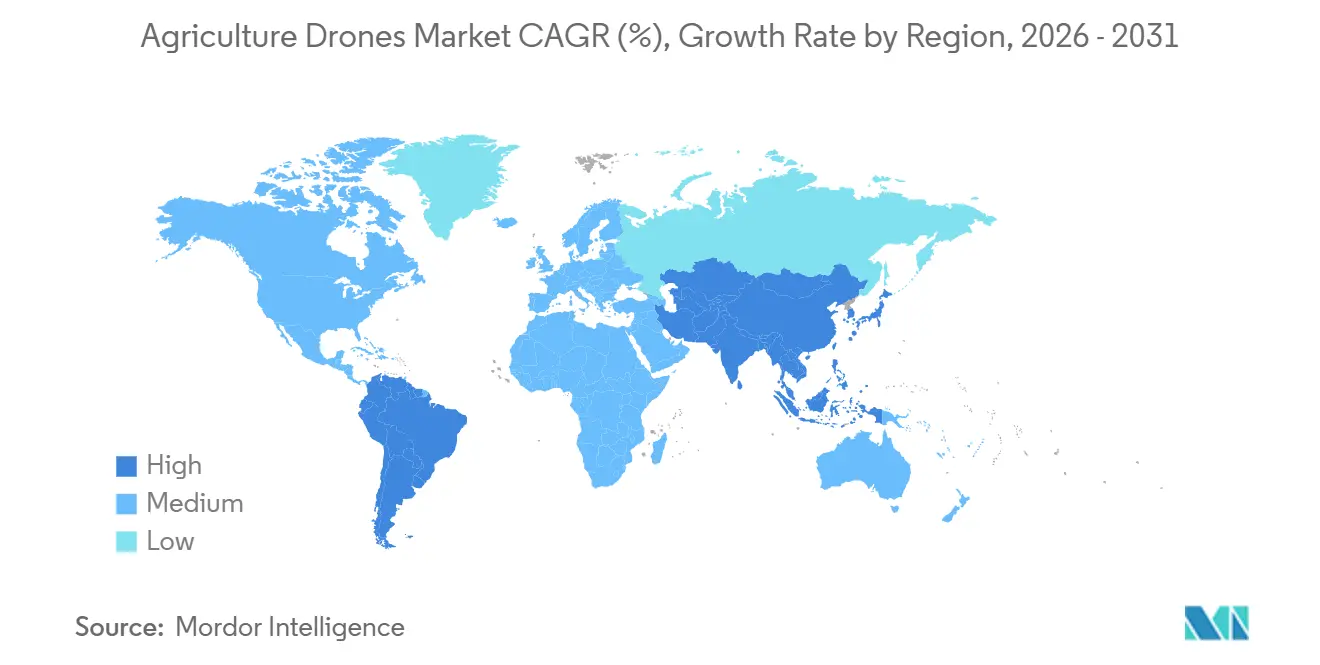
| Fastest Growing Market | Asia Pacific |
| Largest Market | North America |
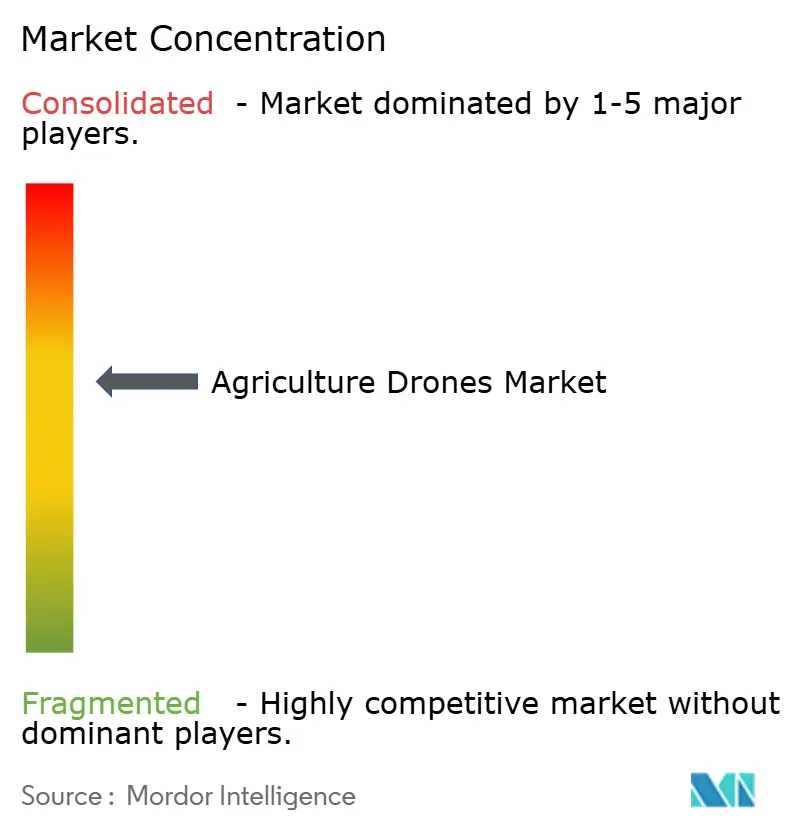
| Market Concentration | Medium |
Major Players *Disclaimer: Major Players sorted in no particular order Image © Mordor Intelligence. Reuse requires attribution under CC BY 4.0. | |
Agriculture Drones Market Analysis by Mordor Intelligence
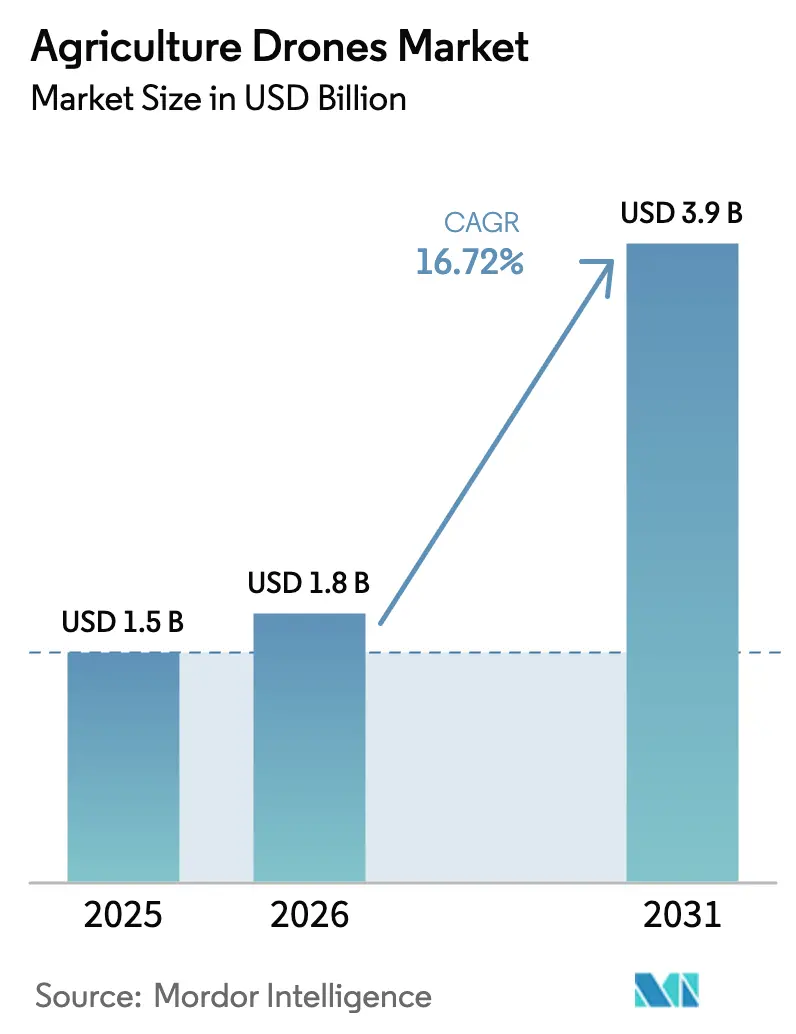
The agriculture drones market size was valued at USD 1.5 billion in 2025 and estimated to grow from USD 1.8 billion in 2026 to reach USD 3.9 billion by 2031, at a CAGR of 16.72% during the forecast period (2026-2031). Hardware prices continue to fall, while fertilizer and pesticide costs rise, prompting growers to adopt sensor-guided spraying, which reduces chemical use by up to 35.0%. National subsidy programs in the United States, India, Australia, and the United Kingdom are redirecting public funds toward aerial platforms, confirming that drones can simultaneously ease labor gaps and mitigate climate risks[1]Source: United States Department of Agriculture, “Direct Farm Ownership Loans,” USDA Farm Service Agency, usda.gov. Rotary-wing models currently dominate fleet counts, yet hybrid vertical-takeoff designs are gaining traction because they meet the extended endurance needs of large-scale estates. Parallel growth in edge artificial intelligence (AI) and fifth-generation (5G) farm connectivity compresses the time between image capture and variable-rate application, making in-field decision cycles almost immediate.
Key Report Takeaways
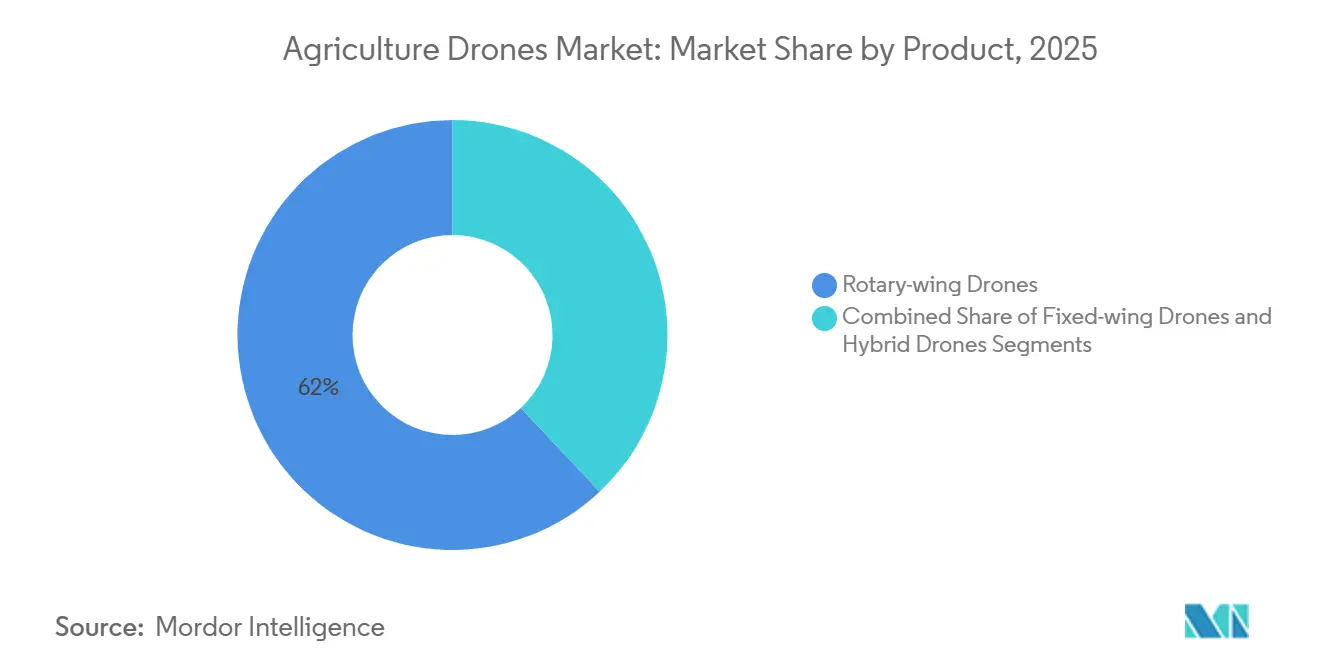
- By product category, rotary-wing drones led with 62.0% of the agriculture drones market share in 2025, whereas hybrid designs are forecast to expand at an 18.9% CAGR through 2031.
- By component, hardware accounted for 55.0% of the agriculture drones market size in 2025, while services are projected to advance at a 17.8% CAGR to 2031.
- By application, crop monitoring accounted for a 48.0% share of the agriculture drones market size in 2025, and crop spraying is projected to rise at an 18.4% CAGR through 2031.
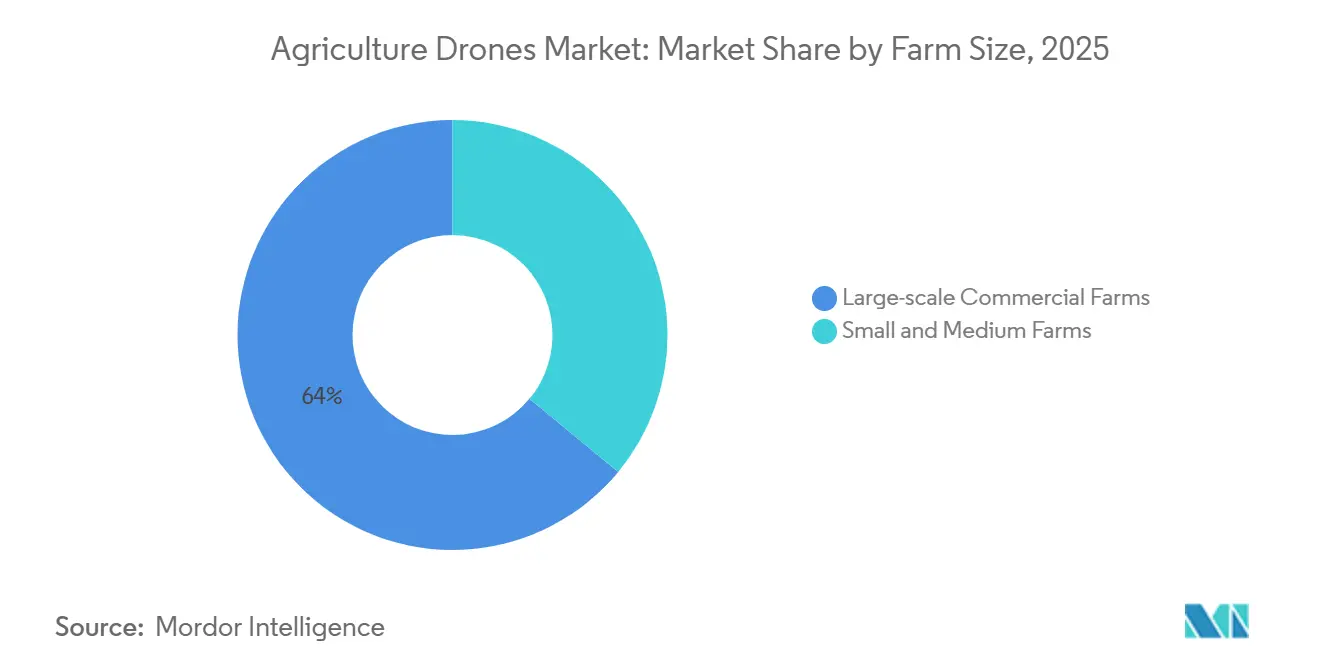
- By farm size, large-scale commercial farms captured 64.0% of the agricultural drones market share in 2025, while small and medium farms are anticipated to grow at a 17.6% CAGR to 2031.
- By geography, North America accounted for a 36.0% share of the revenue in 2025, and Asia-Pacific is projected to register an 18.5% CAGR through 2031.
Note: Market size and forecast figures in this report are generated using Mordor Intelligence’s proprietary estimation framework, updated with the latest available data and insights as of January 2026.
Market Trends and Insights
Drivers Impact Analysis of Agriculture Drones Market*
| Driver | (~) % Impact on CAGR Forecast | Geographic Relevance | Impact Timeline |
|---|---|---|---|
| Rapid decline in drone hardware prices | +3.0% | Global, with strongest uptake in Asia-Pacific and South America | Short term (≤ 2 years) |
| Expansion of 5G and edge-AI enabling real-time analytics | +2.8% | North America and Europe lead deployment, Asia-Pacific scaling rapidly | Medium term (2-4 years) |
| Government subsidies for precision agriculture | +3.2% | North America, Europe, Asia-Pacific (India, China), emerging in Africa | Short term (≤ 2 years) |
| Rising agro-chemical cost pushing variable-rate spraying demand | +2.9% | Global, particularly acute in North America, Europe, and Brazil | Medium term (2-4 years) |
| Climate-change driven need for crop stress monitoring | +2.6% | Global, with heightened urgency in drought-prone regions (Middle East, Africa, Australia) | Long term (≥ 4 years) |
| Carbon-credit markets rewarding low-input farming | +1.8% | North America and Europe early adopters, pilot programs in South America | Long term (≥ 4 years) |
| Source: Mordor Intelligence | |||
Rapid Decline in Drone Hardware Prices
Entry-level agricultural drones now retail for USD 2,000-4,000, down from USD 14,500 in 2016, allowing smallholder cooperatives to justify ownership[2]Source: South China Morning Post, “Chinese Agricultural Drone Prices Fall as Market Matures,” scmp.com. Mid-range platforms, priced at USD 8,000-15,000, include obstacle avoidance and automated mission planning features, which were once reserved for enterprise models topping USD 20,000. Modular airframes support payload swaps, extending the useful life and improving the return on investment. Subsidies in India and Australia eliminate up to 80.0% of the purchase cost, accelerating fleet turnover[3]Source: Australian Government Department of Agriculture, “On Farm Connectivity Program,” agriculture.gov.au. Hardware margins are stabilizing even as unit prices fall, signaling a maturing supply chain.
Expansion of 5G and Edge-AI Enabling Real-Time Analytics
Fifth-generation networks reduce latency to below twenty milliseconds, allowing drones to transmit imagery and receive prescription maps during a single flight. Trials on United States corn farms demonstrate that onboard convolutional networks can classify stress with 94.0% accuracy, thereby removing cloud-upload bottlenecks. Private 5G installations on large estates coordinate swarms of ten or more drones, providing daily coverage of over 1,000 acres. Edge processing also addresses privacy worries because raw images never leave the farm. Module prices under USD 500 are anticipated by 2027, opening the technology to mid-size growers.
Government Subsidies for Precision Agriculture
The United States Department of Agriculture (USDA) routed USD 300 million in Direct Conservation loans during 2025 toward aerial platforms. Australia’s On Farm Connectivity Program reimburses 50.0% of qualifying purchases up to AUD 30 million (USD 20 million) nationwide. India’s Namo Drone Didi plan allocates INR 800,000 (USD 9,600) to 15,000 women-led groups, forming community spraying networks[4]Source: Ministry of Agriculture and Farmers Welfare, “Namo Drone Didi Scheme,” agricoop.nic.in. The United Kingdom offers GBP 43 (USD 54) per hectare annually for camera-guided application, driving sustained fleet renewal.
Rising Agro-Chemical Cost Pushing Variable-Rate Spraying Demand
Fertilizer and pesticide price inflation, driven by natural gas feedstock costs and supply chain disruptions, has increased input expenses by 15.0-25.0% since 2024. This has prompted growers to optimize application rates using precision spraying. Variable-rate technology (VRT), enabled by drones, reduces chemical usage by 20.0-35.0%, saving USD 15-30 per acre for high-value crops such as grapes, almonds, and vegetables. Autonomous flight planning software integrates prescription maps, adjusting nozzle flow rates in real time. This is valuable in Brazil's sugarcane sector, where pest pressure varies across large estates. Regulatory pressure also supports the adoption of variable-rate technology (VRT), with the European Union's Sustainable Use of Pesticides Directive and the United States Environmental Protection Agency's (EPA) stewardship programs promoting precision methods.
Restraints Impact Analysis of Agriculture Drones Market*
| Restraint | (~) % Impact on CAGR Forecast | Geographic Relevance | Impact Timeline |
|---|---|---|---|
| Air-traffic integration hurdles | -2.1% | Global, with acute bottlenecks in North America and Europe due to dense airspace | Medium term (2-4 years) |
| Data-privacy concerns among farmers | -1.3% | Europe (GDPR enforcement), North America (state-level fragmentation), emerging in Asia-Pacific | Short term (≤ 2 years) |
| Short battery endurance for large acreage | -1.7% | Global, particularly constraining in North America, South America, and Australia with broad-acre farms | Medium term (2-4 years) |
| Fragmented regulatory standards across countries | -1.5% | Global, with highest compliance costs for multinational OEMs operating across North America, Europe, and Asia-Pacific | Long term (≥ 4 years) |
| Source: Mordor Intelligence | |||
Air-Traffic Integration Hurdles
Unmanned Traffic Management systems for integrating agricultural drones into controlled airspace are under development, delaying Beyond Visual Line of Sight operations essential for large farms. The Federal Aviation Administration's 2024 Notice of Proposed Rulemaking for Beyond Visual Line of Sight remains unresolved, leaving operators reliant on waivers. The European Union's U-space regulation mandates the implementation of U-space airspace by 2027, but the timing of implementation varies. Remote identification requirements add USD 100-300 per unit in hardware costs. Until the infrastructure matures, drones remain limited to visual line-of-sight operations, covering 50-100 acres per flight.
Short Battery Endurance for Large Acreage
Lithium-polymer batteries in rotary-wing drones provide 15-30 minutes of flight, limiting daily coverage to 50-150 acres. Large farms of 1,000-5,000 acres in regions such as North America and Australia find multi-rotor platforms to be inefficient. Fixed-wing drones offer flight times of 45-90 minutes but lack hovering capabilities for precision tasks. Hybrid vertical takeoff and landing platforms, such as AeroVironment's Quantix Recon, can cover 400 acres in 45 minutes but cost over USD 15,000, which limits their adoption. Solid-state batteries promise 50-100% energy density gains but remain 3-5 years away and cost 200-300% more than lithium-polymer batteries. Endurance constraints force operators to prioritize high-value crops, leaving routine monitoring to satellites or ground scouts.
*Our forecasts treat driver/restraint impacts as directional, not additive. The impact forecasts reflect baseline growth, mix effects, and variable interactions.
Agriculture Drones Market Segment Analysis
By Product:
Hybrid Platforms Bridge Endurance GapRotary-wing drones held a 62.0% market share in the agricultural drones market in 2025, dominating crop spraying and livestock monitoring due to their hovering capability and maneuverability, despite having endurance limitations. Hybrid drones are projected to grow at a 18.9% CAGR through 2031, driven by demand for platforms that combine vertical takeoff with fixed-wing cruise efficiency. AeroVironment's Quantix Recon offers 45-minute flight times and 400-acre coverage per sortie, addressing productivity gaps in broad-acre estates. Fixed-wing drones, with an endurance of 45-90 minutes, are commonly used in mapping and surveying, but they lack the precision required for variable-rate spraying. Regulatory approvals for Beyond Visual Line of Sight (BVLOS) operations will benefit hybrid and fixed-wing drones due to their extended range.
Rotary-wing platforms dominate the sub-USD 10,000 segment, with manufacturers such as SZ DJI Technology Co., Ltd. and XAG Co., Ltd. offering feature-rich models. Hybrid platforms are gaining traction due to their versatility in spraying, scouting, and irrigation management, particularly in regions such as India and Southeast Asia, where smallholder farmers cultivate multiple crops.


By Component:
Services Segment Disrupts Capital ModelIn 2025, hardware accounted for 55.0% of the agricultural drones market size, including airframes, sensors, batteries, and ground control stations. However, the services segment is projected to grow at a CAGR of 17.8% through 2031. Drone-as-a-Service (DaaS) models reduce upfront capital requirements and transfer operational risks to specialized providers. Companies such as DroneDeploy, Inc. and PrecisionHawk, Inc. offer subscription-based analytics platforms that bundle flight operations, data processing, and agronomic insights for USD 5-15 per acre per season, making precision agriculture accessible to farms that cannot justify investments of USD 10,000-30,000 in hardware.
Software components, such as flight planning, image stitching, and machine learning inference, are increasingly delivered via cloud platforms, creating recurring revenue streams and improving vendor margins. Services such as pilot training, maintenance contracts, and regulatory compliance support are particularly valuable in regions like India and Africa, where technical expertise is limited.
By Application:
Autonomous Spraying Reshapes Input EconomicsCrop monitoring accounted for 48.0% of the application share in 2025, utilizing multispectral and thermal imaging to detect stress, disease, and nutrient deficiencies before visible symptoms appear. Crop spraying is anticipated to rise at an 18.4% CAGR through 2031, driven by autonomous platforms that reduce chemical usage by 20.0-35.0%. Companies like XAG Company Limited and SZ DJI Technology Company Limited lead this segment with platforms such as the XAG P100 and DJI Agras T50, featuring precision nozzle control and automated flight planning. Field mapping supports pre-season planning and post-harvest analysis, generating prescription maps for spraying and fertilization.
Livestock monitoring is a niche field, primarily focused in Australia and South America, where drones are used to locate animals and assess pastures. Irrigation management is increasing in water-scarce regions, with the use of thermal sensors to identify leaks and uneven distribution. Soil analysis is expanding with the use of affordable hyperspectral sensors that detect organic matter and pH, aiding in tillage strategies. Regulatory approvals for pesticide use via drones remain fragmented, with agencies such as the United States Environmental Protection Agency (EPA) and the European Food Safety Authority (EFSA) imposing restrictions. Autonomous spraying and real-time analytics are enabling drones to detect stress, generate prescriptions, and execute treatments in a single flight, thereby reducing decision cycles.
By Farm Size:
Cooperatives Unlock Smallholder AccessLarge-scale commercial farms held a 64.0% market share by farm size in 2025, leveraging economies of scale to justify investments of USD 20,000 to USD 50,000 in multi-drone fleets and dedicated pilot staff. Small and medium farms are adopting drone technology at a CAGR of 17.6% through 2031, supported by cooperative ownership models and government subsidies that reduce per-farm capital requirements. Australia's On Farm Connectivity Program offers USD 20,000 (AUD 30,000) rebates, helping mid-sized farms deploy connectivity infrastructure and precision tools, including drones.
Small and medium farms face barriers such as limited technical expertise, fragmented landholdings, and skepticism about return on investment. Training programs by equipment manufacturers and agricultural extension services address skill gaps, while smartphone-based ground control stations simplify operations.
Geography Analysis
APAC Agriculture Drones Market
The Asia-Pacific region is projected to grow at an 18.5% CAGR during 2026-2031, driven by China's extensive manufacturing capabilities and government-supported agricultural modernization initiatives. These programs position drones as essential tools for enhancing food security. The region faces labor shortages and rising wages, making automation a viable investment. SZ DJI Technology Co., Ltd. leverages its expertise in consumer drones to offer the Agras T50, T40, T25, and T10 series, priced between USD 5,000 and USD 27,000, targeting both smallholder and commercial farming segments.
North America Agriculture Drones Market
North America accounted for the largest market share, holding 36.0% in 2025, supported by a well-established precision agriculture infrastructure. The United States Department of Agriculture's (USDA) USD 300 million Direct Conservation Loan Program prioritizes aerial platforms and sensor networks. The Federal Aviation Administration's (FAA) Part 107 regulation, along with incremental beyond visual line of sight (BVLOS) waivers, facilitates the deployment of multi-drone fleets on large-scale commercial farms.
EMEA and South America Agriculture Drones Market
Europe's growth is constrained by the European Union Aviation Safety Agency's (EASA) U-space airspace integration timelines and the General Data Protection Regulation (GDPR) 's data privacy requirements, which slow the adoption of drone services. Germany, France, and the United Kingdom lead the region's deployment efforts. In South America, Brazil's large-scale sugarcane, soybean, and corn operations benefit from variable-rate spraying, while Argentina's grain and cattle sectors adopt drones for crop monitoring and pasture management. Africa and the Middle East face infrastructure gaps, including limited 4G/5G coverage and inadequate pilot training programs, which slow adoption compared to developed regions.

Regulatory Landscape
Regulation of agriculture drones continues to depend on how aviation rules, chemical-application permissions, and data requirements intersect, with material differences by jurisdiction. In the United States, agricultural dispensing operations generally align with FAA frameworks such as 14 CFR Part 107 for small UAS operations and 14 CFR Part 137 for agricultural aircraft operations. Operators often rely on exemptions and waivers, while broader BVLOS rulemaking remains a key gating item. In Europe, EASA rules under the Specific category increasingly standardize risk-based approvals via SORA, and Remote ID and class identification labeling requirements have been in force across EASA jurisdictions since January 1, 2024, raising baseline compliance expectations for OEMs and operators.
From 2025 through mid-2026, regulators and standards bodies introduced more structured pathways for higher-volume operations. EASA incorporated the SORA 2.5 package into its Easy Access Rules revision (June 2026), supporting more repeatable safety cases for professional missions, including agricultural work where member-state chemical permitting is also required. Several markets keep centralized agricultural and aviation oversight (for example, Japan via MLIT and MAFF for spraying authorization and pilot proficiency), while China pairs subsidy and training programs with its broader Ministry of Agriculture and Rural Affairs-led modernization agenda. Even with these steps, fragmented national requirements for aerial application permissions and airspace integration keep compliance and operating models highly country-specific for multinational OEMs and Drone-as-a-Service providers.
Competitive Landscape
The agriculture drones market demonstrates moderate concentration. In 2025, the top five companies accounted for the majority of the revenue, while analytics software and regional service delivery remained fragmented. SZ DJI Technology Co., Ltd. and XAG Co., Ltd. vertically integrate component sourcing and direct retail, delivering price leadership across product tiers. Yamaha Motor Co., Ltd. leverages four decades of unmanned helicopter know-how to hold a premium share in Japan’s rice paddies.
Start-ups like Hylio Inc. and Kray Technologies LLC are addressing market gaps with modular payloads and high-speed spraying solutions. Intellectual property activity around autonomous navigation continued to accelerate through 2024-2025, underscoring sustained innovation and a growing strategic focus on flight autonomy and decision-making intelligence. Meanwhile, subscription analytics firms like DroneDeploy Inc. and PrecisionHawk Inc. are pivoting toward Drone-in-a-Box systems, which raise utilization but demand hefty capital.
Competitive priorities focus on battery endurance, 5G connectivity, and carbon-credit data services that monetize sustainability metrics. Vendors blending open interfaces with proprietary AI pipelines position themselves to ride the next upgrade wave as regulatory clarity and edge computing converge.
Agriculture Drones Industry Leaders
SZ DJI Technology Co., Ltd.
XAG Co., Ltd.
Yamaha Motor Co., Ltd.
PrecisionHawk, Inc.
Parrot S.A.
- *Disclaimer: Major Players sorted in no particular order
Agriculture Drones Market Companies Covered in this Report
- SZ DJI Technology Co., Ltd.
- Yamaha Motor Co., Ltd.
- Parrot S.A.
- AeroVironment, Inc.
- PrecisionHawk, Inc.
- AgEagle Aerial Systems Inc.
- Trimble Inc.
- DELair SAS
- DroneDeploy, Inc.
- XAG Co., Ltd.
- Kray Technologies LLC
- Hylio, Inc.
- ShenZhen AEE Technology company
- AgEagle Aerial Systems
- Drone Volt S.A.

Market Opportunities and Future Outlook
Near-term opportunity centers on scaling drone operations from single-mission flights into integrated crop protection workflows that reduce labor and shorten the time between detection and treatment. OEM offerings increasingly pair higher-capacity platforms with supporting infrastructure, as reflected in XAG's July 2026 introduction of an autonomous crop protection concept that bundles a new drone platform with a ground-based drone airport and automated liquid mixing, and DJI Agriculture's July 2026 global launch of the Agras T55 and the Agras T100 dual-battery spraying system. These updates map to the market shift toward higher utilization per fleet, driven by faster refills, battery logistics, and more streamlined mission execution, which supports services-led models that charge per acre and bundle agronomy analytics.
Operational expansion also depends on clearer and more repeatable approval pathways for professional missions. EASA's June 2026 revision of its Easy Access Rules for UAS incorporated the SORA 2.5 risk assessment package, helping professional operators standardize documentation for higher-risk work. In the United States, FAA guidance for dispensing chemicals under Part 137 continues to shape how spray-drone operators structure certification and exemptions. Industry reporting from the American Spray Drone Coalition indicates US spray-drone activity reached 16.4 million treated acres in 2025 (up 58.7%), expanding the installed base for aftermarket services such as maintenance, training, compliance support, and variable-rate prescription workflows. Together, these proof points strengthen opportunities in turnkey autonomy stacks (drone plus ground infrastructure), Drone-as-a-Service expansion for small and mid-sized farms, and compliance-oriented software that operationalizes Remote ID, recordkeeping, and chemical application requirements across jurisdictions.
Recent Industry Developments in Agriculture Drones Market
- July 2026: DJI Agriculture announced the global launch of the Agras T55 and the Agras T100 Dual Battery Spraying System, targeting higher-throughput aerial spraying for large fields and orchards. The release highlights OEM focus on productivity per operator and per flight through higher-capacity platforms and updated power systems, supporting both fleet buyers and service providers scaling per-acre operations.
- February 2025: Yamaha Motor launched Yamaha Agriculture, Inc. to focus on automation and AI-enabled digital crop management for specialty crops. The company established a dedicated operating entity to consolidate Yamahas agriculture push, improving its ability to bundle equipment, software, and services into an integrated offering for commercial growers.
- May 2024: DJI Agriculture expanded its crop protection lineup with the Agras T50 and Agras T25, emphasizing aerial spraying and spreading capability upgrades. The launch increased competitive pressure in rotary-wing platforms, lifting baseline expectations for payload handling, automation features, and total cost per treated acre.


Agriculture Drones Market Report Scope and Research Methodology
Market Definition and Coverage
The agriculture drones market covers revenue earned from selling or leasing unmanned aerial drones built for farm use, where the payload is meant for sensing or spraying and the drone supports field decisions or input application.
Scope exclusions: Ground robots, satellite imagery services, and general consumer hobby drones are not counted, even if they are sometimes used around farms.
Segments Covered in This Report
- By Product
- Fixed-wing Drones
- Rotary-wing Drones
- Hybrid Drones
- By Component
- Hardware
- Software
- Services
- By Application
- Field Mapping and Surveying
- Crop Spraying
- Crop Monitoring/Field Surveillance
- Livestock Monitoring
- Irrigation Management
- Soil and Field Analysis
- By Farm Size
- Large-scale Commercial Farms
- Small and Medium Farms
- By Geography
- North America
- United States
- Canada
- Rest of North America
- South America
- Brazil
- Argentina
- Rest of South America
- Europe
- Germany
- United Kingdom
- France
- Russia
- Rest of Europe
- Asia-Pacific
- China
- India
- Japan
- Australia
- Rest of Asia-Pacific
- Middle East
- Saudi Arabia
- United Arab Emirates
- Rest of Middle East
- Africa
- South Africa
- Kenya
- Rest of Africa
- North America
Data Sources, Market Sizing, and Validation
Desk Research
Desk research was used to set a realistic demand and supply context before any modeling started. We referenced public sources such as USDA and NASS farm and crop data, FAO statistics, World Bank indicators, and aviation or unmanned aircraft guidance from bodies such as the FAA and EASA. Where it helped, we also reviewed customs and trade dashboards, patent databases, and peer-reviewed papers on drone-enabled precision agriculture outcomes.
To convert those signals into market value, we also checked general secondary sources, including company annual reports, investor presentations, reputable press coverage, and association websites tied to precision agriculture and unmanned systems. Select paid subscriptions were used for company financials and intelligence, and for news and financials, mainly to avoid missing small but material shifts in pricing, product mix, or go-to-market changes. These sources are illustrative and not exhaustive, and many other public references were used for data collection, validation, and clarification.
Primary Interviews and Surveys
Primary discussions were used to stress-test adoption assumptions and pricing, especially where public datasets do not split out farm-use drones cleanly. We spoke with a mix of drone OEMs and channel participants, spray and imaging service providers, agriculture input advisors, and large farm operators across APAC, EMEA, and the Americas. This helped ensure that region-specific operating rules and crop schedules were reflected in the final model.
Distribution of primary research fieldwork respondents
| Company type | Respondent position | Region |
|---|---|---|
| Top tier: 33% | CXOs: 17% | APAC: 45% |
| Mid tier: 45% | Functional/Unit leaders: 28% | EMEA: 37% |
| Smaller Players: 22% | Managers: 55% | Americas: 18% |
Market-Sizing & Forecasting
For market sizing, we use top-down and bottom-up logic together, with the top-down side doing most of the heavy lifting. Farm area, crop intensity, and the workable demand pool for drone mapping and spraying are reconstructed by region, then converted into value using adoption rates and typical spend per drone or lease contract.
The model is grounded in a small set of inputs that are easy to explain and re-check, including average selling price bands for spraying drones versus imaging drones, payload and battery replacement cycles that affect refresh demand, regulatory permission pace for spraying missions, and seasonality tied to planting and treatment windows. In markets where service providers dominate usage, we translate a share of activity back into leased units to avoid double counting.
Forecasting is run using scenario analysis, where baseline adoption curves are guided by expert views and then adjusted using external signals such as farm labor constraints, chemical application trends, and typical technology replacement cycles. After that, we do selective bottom-up checks using sampled supplier shipments, channel checks, and ASP-versus-volume cross-checks, and any gaps in coverage are bridged with conservative penetration assumptions that are explicitly documented.
Data Validation & Update Cycle
Outputs are validated through multiple passes that compare the model to independent signals, such as regional farm economics, drone registration or unmanned aircraft activity indicators where available, and visible shifts in pricing and payload mix. When a number looks off, we re-open the assumptions behind it, and we trigger follow-up calls with the same respondent types to confirm what changed.
Before sign-off, the work is reviewed by another analyst to ensure calculation steps, unit conversions, and currency timing are consistent across regions. Reports are refreshed annually, and interim updates are made when a material event changes regulation, pricing, or adoption patterns. Right before delivery, we do a final check so clients receive the latest updated view.
Mordor Intelligence's Agriculture Drones Market Size Measured Against Other Published Estimates
Published market values for agriculture drones often vary because the scope can shift, the year chosen for the base can differ, and pricing assumptions are not always aligned to real farm-use deployments. Differences also show up when one estimate counts services and adjacent digital products, while another focuses more on drone platforms and payload-linked revenue.
The main gap comes from whether drone-as-a-service, satellite imagery, and non-farm UAV use are mixed into the same number, where Mordor Intelligence counts only sale and leasing of purpose-built agriculture drones with camera or spray payloads plus onboard software, and it excludes ground robots and satellite imagery services.
Benchmark comparison
| Source | Market Size | Gaps in Research Methodology |
|---|---|---|
| Mordor Intelligence | USD 1.8 B (2026) | |
| Industry Publisher A | USD 6.10 B (2024) | Uses an earlier base year and a wider bundle that can include software and service revenue alongside hardware, which can inflate totals versus a sale and leasing focused scope. |
| Global Publisher B | USD 3.39 B (2025) | Uses factory-gate revenue treatment and includes creator-sold related services, and the faster growth profile can lift the near-term number compared with a model that separates services and applies adoption checks by farm-use cases. |
The spread in the table is mainly explained by scope packaging, revenue recognition (factory gate versus broader spend), and the base year chosen. When the demand pool is tied back to farm area, seasonal spray and scouting use cases, and realistic price bands by payload type, the resulting market value stays traceable to clear inputs and repeatable checks.


Key Questions Answered in the Report
How fast is the agriculture drones market growing between 2026 and 2031?
The sector is projected to post a 16.72% CAGR, taking value from USD 1.8 billion in 2026 to USD 3.9 billion by 2031.
Which platform type is gaining the most ground?
Hybrid vertical-takeoff drones show the highest momentum, advancing at an 18.9% CAGR through 2031 as they merge hover precision with fixed-wing endurance.
What is driving demand for drone-based crop spraying?
Rising fertilizer and pesticide costs make variable-rate spraying attractive, saving 20.0-35.0% on inputs while meeting tightening environmental rules.
How are small farms accessing drone technology?
Cooperative ownership, government subsidies such as India’s Namo Drone Didi, and pay-per-acre Drone-as-a-Service models lower capital barriers.
Which region holds the strongest growth outlook?
Asia-Pacific leads with an 18.5% CAGR through 2031, supported by China’s manufacturing scale and aggressive subsidy programs across India, Japan, and Australia.
What regulatory change could unlock larger acreage coverage?
Broad deployment of U-space corridors in Europe and streamlined BVLOS approvals by the FAA would allow extended-range flights, boosting productivity for broad-acre farms.
Page last updated on:


 Your data is secure and never sold or shared.


