
Agricultural Planting and Fertilizing Machinery Market Size and Share
Market Overview
| Study Period | 2021 - 2031 |
|---|---|
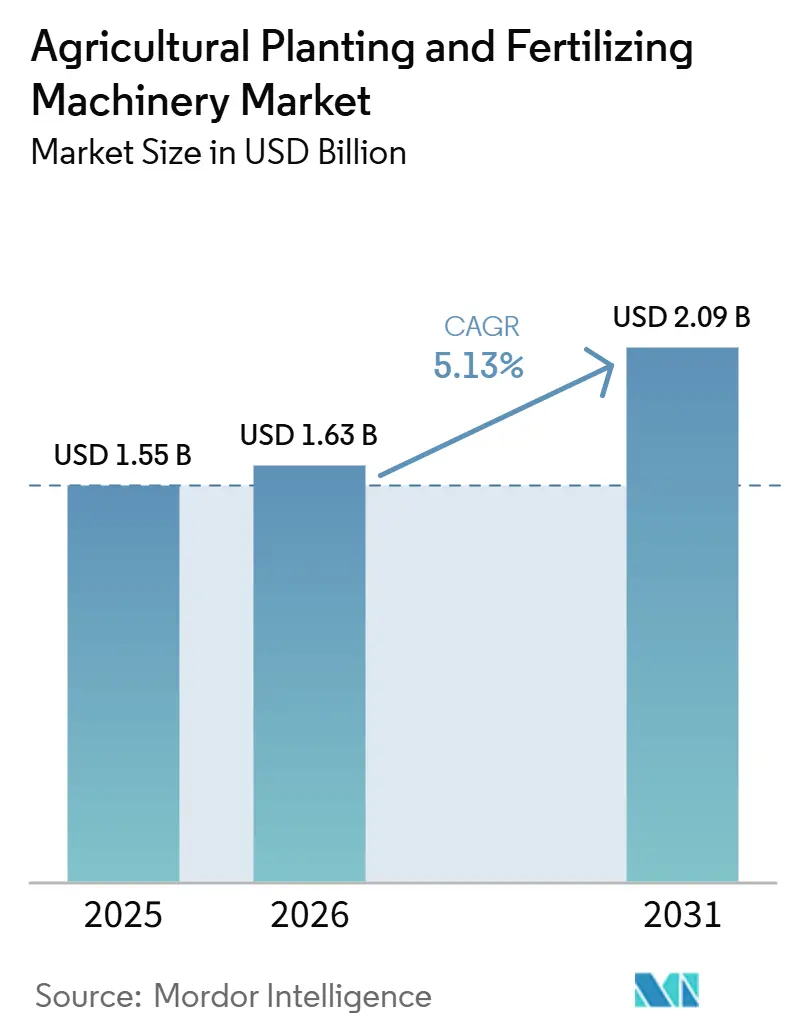
| Market Size (2026) | USD 1.63 Billion |
| Market Size (2031) | USD 2.09 Billion |
| Growth Rate (2026 - 2031) | 5.13 % |
| Fastest Growing Market | Asia-Pacific |
| Largest Market | North America |
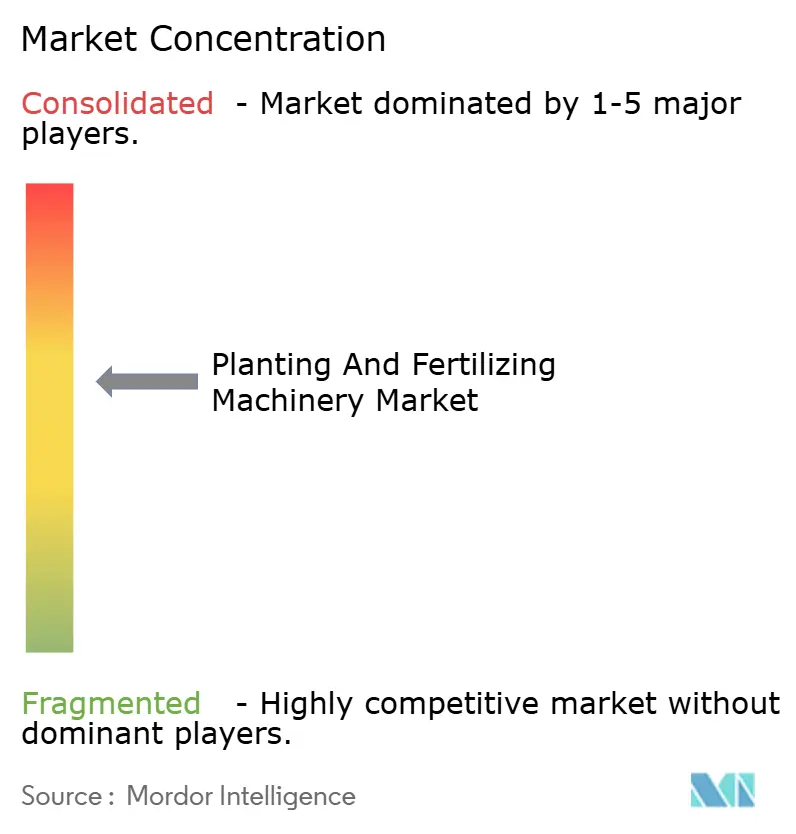
| Market Concentration | Medium |
Major Players *Disclaimer: Major Players sorted in no particular order Image © Mordor Intelligence. Reuse requires attribution under CC BY 4.0. | |
Agricultural Planting and Fertilizing Machinery Market Analysis by Mordor Intelligence
The agricultural planting and fertilizing machinery market size was valued at USD 1.55 billion in 2025 and is estimated to grow from USD 1.63 billion in 2026 to USD 2.09 billion by 2031, at a CAGR of 5.13% from 2026 to 2031. The market is following a steady growth path because farm labor has been shrinking across major agricultural economies, increasing the economic value of machinery that improves planting speed, placement accuracy, and fertilizer efficiency. Competitive activity is also shifting toward digital ecosystems because manufacturers connecting planter and applicator hardware with real-time agronomic data are building stronger repeat demand than companies competing only on upfront price. Precision upgrades, subsidy programs, and low-cost financing are shortening payback periods across several emerging markets, while leasing and pay-per-use models are widening equipment access where outright ownership remains difficult. High upfront costs, electronics cost inflation, and cybersecurity risks still limit adoption across parts of South Asia, Sub-Saharan Africa, and South America, yet the broader mechanization cycle remains favorable for the agricultural planting and fertilizing machinery market.
Key Report Takeaways
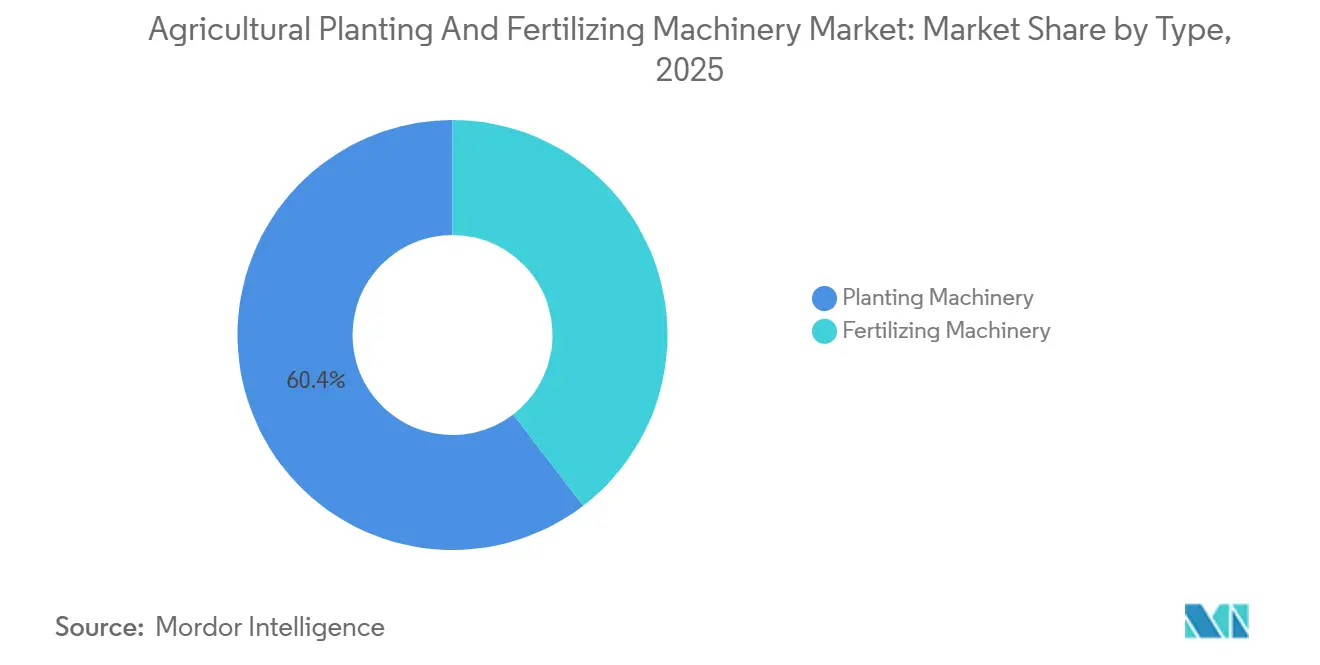
- By type, Planting Machinery accounted for 60.4% of the agricultural planting and fertilizing machinery market size in 2025, while Fertilizing Machinery is forecast to grow at a CAGR of 6.7% from 2026 to 2031.
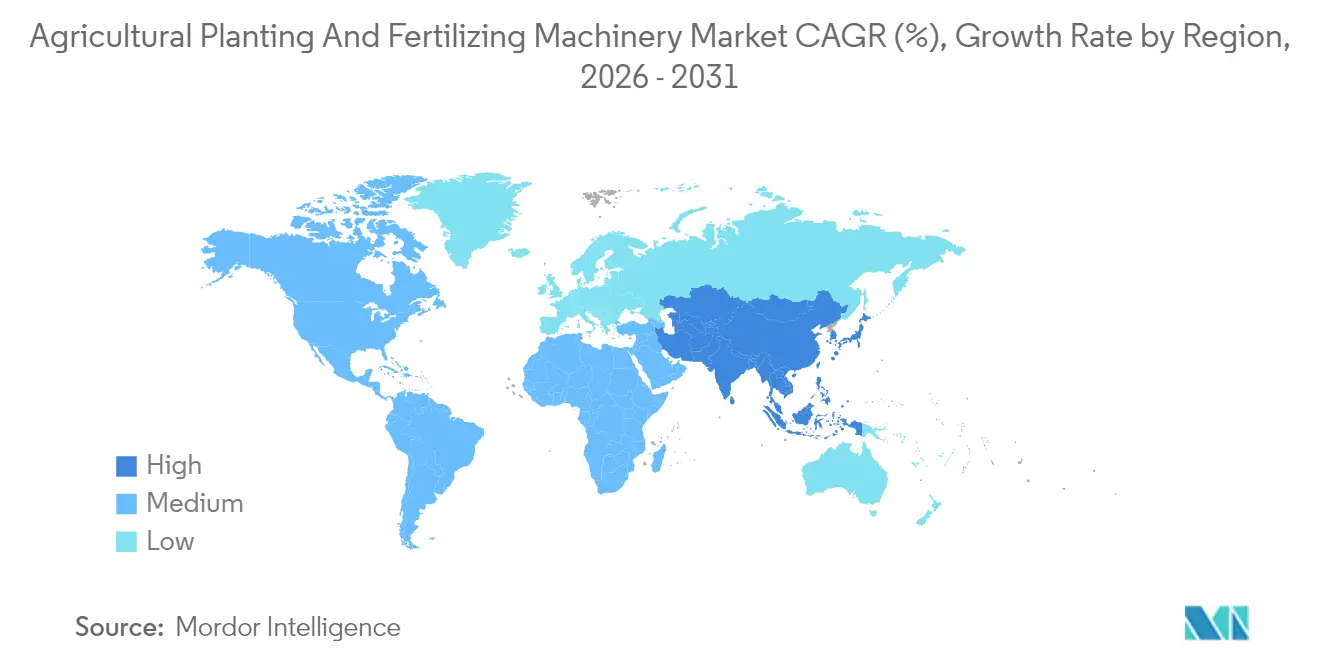
- By geography, North America accounted for 35.0% of the agricultural planting and fertilizing machinery market share in 2025, while Asia-Pacific is forecast to grow at a CAGR of 7.7% from 2026 to 2031.
Note: Market size and forecast figures in this report are generated using Mordor Intelligence’s proprietary estimation framework, updated with the latest available data and insights as of 2026.
Market Trends and Insights
Drivers Impact Analysis of Agricultural Planting and Fertilizing Machinery Market*
| Driver | (~) % Impact on CAGR Forecast | Geographic Relevance | Impact Timeline |
|---|---|---|---|
| Decline In Farm Labor Availability | +1.1% | Global, with highest intensity in North America, Europe, and aging rural economies of East Asia | Short term (≤ 2 years) |
| Increased Farm Mechanization Rates | +0.9% | India, China, Indonesia, and spillover markets in Sub-Saharan Africa and South America | Medium term (2-4 years) |
| Growing Adoption Of Precision Agriculture | +1% | North America and Europe first, with rising uptake in Australia, China, and Brazil | Short term (≤ 2 years) |
| Government Subsidies And Low-Interest Credit Lines | +0.7% | India, China, France, Saudi Arabia, and Brazil | Medium term (2-4 years) |
| Agriculture-Technology-as-a-Service Equipment Access Models | +0.5% | India, Brazil, Mexico, Kenya, Nigeria, and Ethiopia | Medium term (2-4 years) |
| Regenerative-Farming Carbon-Credit Incentives For Precision Input Placement | +0.4% | United States and Canada primarily, with early movement in Germany, France, and Brazil | Long term (≥ 4 years) |
| Source: Mordor Intelligence | |||
Decline in Farm Labor Availability
The agricultural planting and fertilizing machinery market is gaining direct support from tighter labor availability across major farming regions. The United States Department of Agriculture (USDA) Economic Research Service showed that H-2A certified positions rose from nearly 48,000 in fiscal 2005 to about 385,000 in fiscal 2024, while the National Agricultural Statistics Service reported average gross farm wages for hired workers at USD 19.10 per hour in 2024[1]Source: National Agricultural Statistics Service, “Farm Labor, November 2024,” United States Department of Agriculture, usda.gov. As a result, farms are placing greater value on seed drills, pneumatic planters, transplanters, and fertilizer applicators that reduce labor dependence and protect narrow planting windows.
Increased Farm Mechanization Rates
The agricultural planting and fertilizing machinery market is also expanding because farm mechanization rates continue to rise across several crop-producing economies. The trend is particularly visible in Asia, where policy support, machinery financing programs, and custom-hiring models are helping farmers move beyond basic tractor adoption toward more advanced field equipment that improves seeding and fertilizer placement efficiency. China and India remain central to this transition because both countries continue to support agricultural machinery modernization and precision farming initiatives. As a result, the agricultural planting and fertilizing machinery market is benefiting from a broader addressable customer base, particularly for equipment that combines planting and fertilizer application within a single operating cycle.
Growing Adoption of Precision Agriculture
The wider adoption of digital and precision agriculture technologies is supporting the agricultural planting and fertilizing machinery market. The United States Department of Agriculture Economic Research Service reported that guidance autosteer systems were used by 52% of midsize farms and 70% of large-scale crop-producing farms in 2023, highlighting the rapid integration of digital control systems into mainstream row-crop operations[2]Source: U.S. Government Accountability Office, “Precision Agriculture, Benefits and Challenges for Technology Adoption and Use,” Government Accountability Office, gao.gov. At the same time, the United States Government Accountability Office reported that overall adoption of precision agriculture practices stood at 27% of United States farms and ranches during 2022–2023, indicating substantial room for further technology penetration. That gap is important for the agricultural planting and fertilizing machinery market because planters and fertilizer applicators equipped with rate control, shutoff systems, and field data connectivity are increasingly being viewed as tools for margin protection rather than optional upgrades.
Government Subsidies And Low-Interest Credit Lines
The agricultural planting and fertilizing machinery market is benefiting from policy support that reduces upfront cost pressure and shortens equipment payback periods. China expanded its agricultural machinery scrapping and replacement subsidy program in 2025, while total central government allocation for agricultural machinery purchase and application subsidies reached CNY 24.6 billion, equivalent to approximately USD 3.4 billion[3]Source: The State Council of the People’s Republic of China, “China Expands Subsidy Program for Replacing Old Agricultural Machinery,” gov.cn. India’s Sub-Mission on Agricultural Mechanization supports tractor-driven implements, such as seed-cum-fertilizer drills, for small and marginal farmers through a subsidy of up to 50%. These programs are important for the agricultural planting and fertilizing machinery market because they shorten replacement cycles and help demand remain active even when volatile input prices pressure farm cash flow.
Restraints Impact Analysis of Agricultural Planting and Fertilizing Machinery Market*
| Restraint | (~) % Impact on CAGR Forecast | Geographic Relevance | Impact Timeline |
|---|---|---|---|
| High Initial Equipment Investment | -1.20% | India, Nigeria, Brazil, Mexico, Turkey, and other smallholder-dominant systems | Short term (≤ 2 years) |
| Complex Operation and Maintenance Requirements | -0.70% | India, China, South Africa, Brazil, and Argentina | Medium term (2-4 years) |
| Semiconductor Tariff and Sensor Supply Volatility | -0.50% | United States, Germany, China, and France, with spillover across North America and Europe | Short term (≤ 2 years) |
| Data Privacy and Cybersecurity Concerns Around Connected Machinery | -0.30% | United States, Germany, France, and Australia, especially in tighter compliance regimes | Long term (≥ 4 years) |
| Source: Mordor Intelligence | |||
High Initial Equipment Investment
The agricultural planting and fertilizing machinery market still faces its strongest barrier in the form of high upfront equipment cost. A 2025 study published in the South African Journal of Plant and Soil identified high initial investment cost as a major barrier to precision agriculture adoption, while a 2025 Frontiers in Sustainable Food Systems study in Brazil found that 64.6% of surveyed farmers in Rio Grande do Sul remained non-adopters of precision agriculture technologies. Even when subsidy programs are available, farmers often continue to face meaningful co-payment burdens that can consume multiple seasons of operating margin. This cost constraint limits penetration of advanced planters, transplanters, and fertilizer applicators, particularly in markets where mechanization potential remains high.
Semiconductor Tariff and Sensor Supply Volatility
The agricultural planting and fertilizing machinery market is now facing added cost pressure from electronics and sensor supply chains. A January 2026 White House proclamation imposed a 25% Section 232 tariff on certain advanced semiconductors and derivative products, creating additional cost exposure for electronics-intensive agricultural equipment such as precision planters and variable-rate fertilizer applicators. Modern planting and fertilizing platforms increasingly depend on controllers, cameras, rate-management systems, and navigation-linked terminals, making it difficult to simplify without reducing operational performance. If tariff pressure and sensor supply volatility persist, equipment buyers may delay upgrade cycles, while manufacturers could face tighter pricing flexibility across premium product lines.
*Our forecasts treat driver/restraint impacts as directional, not additive. The impact forecasts reflect baseline growth, mix effects, and variable interactions.
Agricultural Planting and Fertilizing Machinery Market Segment Analysis
By Type:
Planting Machinery Leads While Fertilizing Machinery Expands FasterPlanting Machinery accounted for 60.4% of the agricultural planting and fertilizing machinery market share in 2025, making it the largest product category across the report scope. The category maintains its lead because seeding and crop establishment remain universal field operations across cereals, oilseeds, pulses, rice, and horticulture systems, while seed drills remain the most adaptable machine type across varying soil conditions and farm sizes. Precision and pneumatic planters are also strengthening their position in high-value row-crop systems as growers place greater emphasis on emergence uniformity, row accuracy, and overlap reduction.
Fertilizing Machinery is forecast to grow at a CAGR of 6.7% from 2026 to 2031, reflecting the rising importance of nutrient efficiency within the agricultural planting and fertilizing machinery market. Variable-rate spreaders, in-furrow applicators, and seed-cum-fertilizer drills help farms reduce field passes, improve nutrient timing, and lower diesel consumption while placing nutrients closer to the crop root zone. Deere & Company demonstrated this direction in 2026 when it introduced a dual-product fertilizer system for 2027 model-year planters that combines ExactShot in-furrow application with ExactRate alongside-the-row placement, enabling up to 66% savings in in-furrow nutrient input. The remaining market opportunity continues to center on mechanical drills and mainstream planters in cost-sensitive regions, although the overall value mix is steadily shifting toward integrated planting and fertilizing systems.


Geography Analysis
North America and APAC Agricultural Planting and Fertilizing Machinery Market
North America accounted for 35.0% of the global agricultural planting and fertilizing machinery market value in 2025, while Asia-Pacific is forecast to grow at a CAGR of 7.7% from 2026 to 2031. North America maintains its leadership because of large row-crop farming operations, well-developed dealer networks, and deeper penetration of guidance, shutoff, and precision nutrient application systems across commercial planting activities. The United States Department of Agriculture Natural Resources Conservation Service added another demand signal in December 2025 through its USD 700 million Regenerative Pilot Program, which supports regenerative farming practices, including no-till systems and improved nutrient management. Asia-Pacific is expanding more rapidly because China and India continue to support mechanization through subsidy programs, upgrades to intelligent machinery, and broader access to equipment, thereby deepening mechanization across planting and fertilizing operations.
EMEA and South America Agricultural Planting and Fertilizing Machinery Market
South America remains an important growth contributor because Brazil’s soybean and corn double-crop systems require high-capacity planters and fertilizer spreaders capable of covering large field areas within narrow seasonal windows. Europe is characterized more by replacement and upgrade demand, particularly in Germany, France, and the United Kingdom, where farms continue shifting toward more precise drilling and nutrient application systems. Denmark reported high penetration of precision agriculture technologies across crop areas in 2023, highlighting how advanced parts of Europe are moving beyond initial adoption toward system refinement and repeat upgrades. The Middle East and Africa remain smaller in scale, though both regions are generating new demand through food security initiatives, desert farming investments, and pay-per-use mechanization models that reduce ownership barriers.
The Americas, Europe, APAC and Africa Agricultural Planting and Fertilizing Machinery Market
The agricultural planting and fertilizing machinery market is anticipated to expand regionally, driven by replacement demand in mature economies and first-time adoption in developing agricultural systems. In North America and Europe, future growth is likely to be driven primarily by premium row-unit upgrades, variable-rate fertilizer platforms, and integrated digital ecosystems that help farms manage productivity and input costs more efficiently. Across Asia-Pacific, Africa, and parts of South America, expansion will depend more on subsidy continuity, affordable financing, and service-based access models that separate machinery usage from ownership. This regional mix is anticipated to keep the agricultural planting and fertilizing machinery market balanced between high-value technology sales in developed economies and broader unit adoption across emerging farming regions.

Competitive Landscape
The agricultural planting and fertilizing machinery market is moderately fragmented, with the top 5 players collectively accounting for less than one-third of global market value. Deere & Company and CNH Industrial N.V. remain 2 of the most visible competitors because both companies are extending traditional hardware portfolios into broader digital operating systems that improve precision control, diagnostics, and farm data integration. Deere strengthened this position in 2026 through FurrowVision and dual-product nutrient placement advancements, while CNH Industrial continues expanding FieldOps and connected agronomy capabilities across its agricultural equipment portfolio. This structure keeps competitive intensity elevated because no single company holds sufficient market share to dictate pricing or product direction across all crop systems and geographies.
AGCO Corporation, Maschio Gaspardo S.p.A., and AMAZONEN-WERKE H. DREYER SE & Co. KG also maintain significant positions in the agricultural planting and fertilizing machinery market, although each company is pursuing a different expansion strategy. AGCO used the 2025 Farm Progress Show to showcase the Fendt Optimum planter integrated with Precision Planting technology and broader connectivity tools, while Maschio Gaspardo invested in LYNX AG LLC during 2025 and established a United States joint venture focused on large-format precision planter manufacturing. AMAZONEN-WERKE H. DREYER SE & Co. KG reinforced its international presence by opening a new facility in El Dorado, Kansas in December 2025 after reporting 2024 turnover of EUR 763 million, equivalent to approximately USD 824 million, with exports accounting for 80% of total sales. Beyond these companies, specialists such as Bourgault Industries Ltd., Kinze Manufacturing Inc., Väderstad AB, LEMKEN GmbH & Co. KG, and Bucher Industries AG through Kuhn continue shaping competition across specific crops, geographies, and equipment categories.
The agricultural planting and fertilizing machinery market is anticipated to expand further through platform integration, localized manufacturing, and stronger software-led value capture. Strategic developments during 2025 and 2026 indicate that manufacturers are increasingly pairing new hardware launches with digital rate control, row sensing, prescription support, and farm management platform connectivity rather than positioning machinery as a standalone asset. Maschio Gaspardo also expanded its India manufacturing footprint through a new facility project valued at EUR 25 million, equivalent to approximately USD 27 million, while Deere advanced proprietary nutrient placement technologies that strengthen product differentiation. Companies capable of combining agronomic performance, software usability, dependable service support, and flexible access models are likely to capture the next phase of growth across the agricultural planting and fertilizing machinery market.
Agricultural Planting and Fertilizing Machinery Industry Leaders
CNH Industrial NV
AGCO Corporation
Kubota Corporation
Deere & Company
Mahindra & Mahindra Limited
- *Disclaimer: Major Players sorted in no particular order
Agricultural Planting and Fertilizing Machinery Market Companies Covered in this Report
- Deere & Company
- CNH Industrial N.V.
- AGCO Corporation
- Kubota Corporation
- Mahindra & Mahindra Limited
- CLAAS KGaA mbH
- Bucher Industries AG
- Maschio Gaspardo S.p.A.
- Väderstad AB
- Kinze Manufacturing, Inc.
- HORSCH Maschinen GmbH
- AMAZONEN-WERKE H. DREYER SE & Co. KG
- Bourgault Industries Ltd.
- Topcon Positioning Systems, Inc. (Topcon Corporation)
- LEMKEN GmbH & Co. KG
Read Analysis of Agricultural Planting and Fertilizing Machinery Companies

Market Opportunities and Future Outlook
There is an emerging opportunity for integrated, multi-product nutrient placement and sensor-driven automation that reduces field passes while documenting application outcomes. Recent OEM actions point to this direction: John Deere introduced model year 2027 planter technology updates that combine in-furrow and side-band fertilizer delivery (ExactShot and ExactRate) with FurrowVision automation, indicating growing demand for planters that coordinate seeding and fertilization as a single, data-instrumented workflow.
Localized and modular fertilizer delivery hardware is also opening purchase pathways beyond full implement replacement, particularly as liquid systems and strip-till expand. In February 2026, Kuhn unveiled the Liqui-Pro System, a steerable 1,600-gallon liquid fertilizer cart for the Gladiator strip tillage system, and Environmental Tillage Systems launched a combined liquid (1,250-gallon) and dry (6-ton) fertilizer system for the SoilWarrior 4500, reinforcing demand for scalable nutrient platforms that integrate with soil-prep and planting. Cross-brand technology specialization is another track, with Grimme partnering with Amazone in May 2026 to integrate microgranulator capability into selected planting platforms, and Amazone launching the Precea 7500-TCC precision planter in June 2026 with a 3,000-liter fertilizer hopper and FertiSpot localized placement, supporting opportunities for OEMs and suppliers that can provide interoperable metering, sensing, and software layers across mixed fleets.
Recent Industry Developments in Agricultural Planting and Fertilizing Machinery Market
- June 2026: AMAZONEN-WERKE H. DREYER SE & Co. KG launched the Precea 7500-TCC precision planter with a 3,000-liter fertilizer hopper and FertiSpot placement, improving fertilizer precision, reducing waste, and advancing the agricultural and planting machinery markets.
- May 2026: Grimme partnered with AMAZONEN-WERKE H. DREYER SE & Co. KG to integrate microgranulator capability into selected planting platforms, enabling targeted micronutrient delivery, cross-brand compatibility, and strengthening the adoption of precision planting machinery.
- February 2026: John Deere introduced model year 2027 planter technology with in-furrow and side-band fertilizer delivery and FurrowVision automation, enhancing planting efficiency, traceability, and integrated solutions in the agriculture and planting machinery market.


Agricultural Planting and Fertilizing Machinery Market Report Scope and Research Methodology
Market Definition and Coverage
This market covers machinery used on farms to place seed and apply fertilizer in the field, including planting equipment and fertilizer application equipment, measured as revenue from equipment sales in USD.
Scope exclusions: Used equipment resale and routine repair services are excluded from the market value.
Segments Covered in This Report
- By Type
- Planting Machinery
- Seed Drills
- Planters
- Transplanters
- Fertilizing Machinery
- Seed-cum-Fertilizer Drills
- Fertilizer Spreaders
- Liquid and Starter Fertilizer Applicators
- Planting Machinery
- By Geography
- North America
- United States
- Canada
- Mexico
- Rest of North America
- South America
- Brazil
- Argentina
- Rest of South America
- Europe
- Germany
- United Kingdom
- France
- Italy
- Spain
- Russia
- Rest of Europe
- Asia-Pacific
- China
- India
- Japan
- Australia
- Indonesia
- Thailand
- Rest of Asia-Pacific
- Middle East
- Saudi Arabia
- Turkey
- United Arab Emirates
- Rest of Middle East
- Africa
- South Africa
- Nigeria
- Egypt
- Rest of Africa
- North America
Data Sources, Market Sizing, and Validation
Desk Research
To build the base structure, we first map what equipment is counted and where it is sold, then collect consistent public indicators that move with equipment demand. We typically review official agriculture statistics on crop area and farm inputs, such as those published by USDA and similar national agriculture ministries, and align those indicators with trade and production direction.
For cross-checks, we use sources such as FAOSTAT for crop and input trends, UN Comtrade for import and export signals for relevant machinery categories, and World Bank macro indicators that influence farm spending. We also use company filings, annual reports, investor presentations, and reputable farming equipment press to track product-mix changes and pricing commentary. Where needed, paid subscription data for company financials and a shipment-level trade database are used to cover gaps on smaller listed entities and to validate country-level trade flows. The sources listed here are not exhaustive, and additional public references were used for data collection, validation, and clarification.
Primary Interviews and Surveys
Next, we validate the demand picture through expert interviews and structured surveys across the value chain, including equipment makers, dealers, large farms, and agronomy-focused service providers. For a global market, inputs are balanced across APAC, EMEA, and the Americas so that differences in cropping calendars, mechanization levels, and subsidy influence are reflected in assumptions and final sizing.
Distribution of primary research fieldwork respondents
| Company type | Respondent position | Region |
|---|---|---|
| Top tier: 39% | CXOs: 13% | APAC: 47% |
| Mid tier: 47% | Functional/Unit leaders: 29% | EMEA: 35% |
| Smaller Players: 14% | Managers: 58% | Americas: 18% |
Market-Sizing & Forecasting
Sizing starts from a top-down build where planted area, crop mix shifts, and mechanization penetration are used to reconstruct the annual demand pool for planting and fertilizer application equipment at a country and regional level. From there, we apply market-specific conversion factors such as replacement cycles for seed drills and planters, dealer inventory normalization in high-season quarters, and observed pricing movement tied to steel and component costs.
To keep the model grounded, we run selective bottom-up approximations, such as sampled ASP times unit volumes by key equipment types, and channel checks with distributors on shipment direction. When data is thin for smaller markets, gaps are handled through proxy indicators like tractor fleet growth, fertilizer application intensity trends, and import shares for the relevant equipment categories, which are then reviewed with local experts.
For forecasting, we use scenario analysis supported by a light multivariate view of drivers like crop prices, farm income expectations, subsidy support, and acreage changes, since these variables influence purchase timing and upgrade decisions. Assumptions are finalized only after feedback confirms what is realistic for pricing, replacement, and adoption over the forecast window.
Data Validation & Update Cycle
Outputs are validated through multiple checks, including reconciling regional totals with independent signals such as machinery trade direction, acreage trends, and reported dealer sentiment. If the model shows an unusual jump, we re-check the underlying inputs, and we re-contact respondents to confirm whether the change is real or driven by a temporary factor like stocking or a subsidy window.
Before sign-off, the work is reviewed in steps so calculation logic, unit conversions, and country rollups are consistent. Reports are refreshed annually, and interim updates are made when material events occur, such as policy shifts, sharp input cost changes, or major demand disruptions. Right before delivery, a fresh pass is completed so clients receive the latest updated view.
Mordor Intelligence's Agricultural Planting and Fertilizing Machinery Market Size Compared With Other Published Estimates
Published market sizes for this space can look far apart because the included equipment list, the pricing basis, and the way regions are aggregated are not always the same. Differences also show up when some sources mix very broad farm machinery categories into one number, while others keep the scope closer to planting and fertilizer application equipment.
The benchmark table shows a much smaller total than some other published figures. In Mordor Intelligence's model, the value is limited to planting machinery (seed drills, planters and transplanters) and fertilizing machinery (seed-cum-fertilizer drills and fertilizer spreaders), rather than counting the wider agricultural machinery universe. Another gap driver is the price build, where some estimates rely on aggressive ASP inflation assumptions across all countries. Our approach uses country signals and interview checks to keep pricing steps tied to observed purchasing behavior and replacement timing.
Benchmark comparison
| Source | Market Size | Gaps in Research Methodology |
|---|---|---|
| Mordor Intelligence | USD 1.63 B (2026) | |
| Global Consultancy A | USD 122.50 B (2024) | Uses a much broader definition that appears to roll planting and fertilizing into overall farm machinery, which inflates totals versus equipment-only scope, and it is anchored to an earlier base year. |
| Industry Research Group B | USD 16.69 B (2024) | Likely counts adjacent equipment types such as precision planters and wider application categories, and its base-year pricing and currency timing can lift the stated value compared with a narrower equipment list. |
The table shows that scope and what gets bundled into the total are the main reasons for the spread across published numbers. By keeping inputs traceable to acreage, replacement, and pricing checks that can be repeated country by country, we arrive at a practical view that users can adjust when their internal scope is wider or narrower.


Key Questions Answered in the Report
What is the current value outlook for agricultural planting and fertilizing machinery?
The market is estimated at USD 1.63 billion in 2026 and is forecast to reach USD 2.09 billion by 2031, growing at a CAGR of 5.13% from 2026 to 2031.
Which product category leads demand worldwide?
Planting Machinery was the largest category in 2025, accounting for a 60.4% share, supported by the universal need for seeding across major crop systems.
Which product type is growing the fastest through 2031?
Fertilizing Machinery is the fastest-growing product type and is forecast to grow at a CAGR of 6.7% from 2026 to 2031, as farms prioritize nutrient efficiency and integrated application workflows.
Why are farmers investing more in precision-enabled planters and applicators?
Labor shortages, rising farm wages, stronger return on input savings, and policy support for mechanization are making precision equipment more attractive across both large and mid-sized farms.
Page last updated on:


 Your data is secure and never sold or shared.


