
Aftermarket TPMS Market Size and Share
Market Overview
| Study Period | 2019 - 2031 |
|---|---|
| Market Size (2026) | USD 3.62 Billion |
| Market Size (2031) | USD 5.63 Billion |
| Growth Rate (2026 - 2031) | 9.26 % |
| Fastest Growing Market | Asia Pacific |
| Largest Market | Europe |
| Market Concentration | Medium |
Major Players *Disclaimer: Major Players sorted in no particular order Image © Mordor Intelligence. Reuse requires attribution under CC BY 4.0. | |
Aftermarket TPMS Market Analysis by Mordor Intelligence
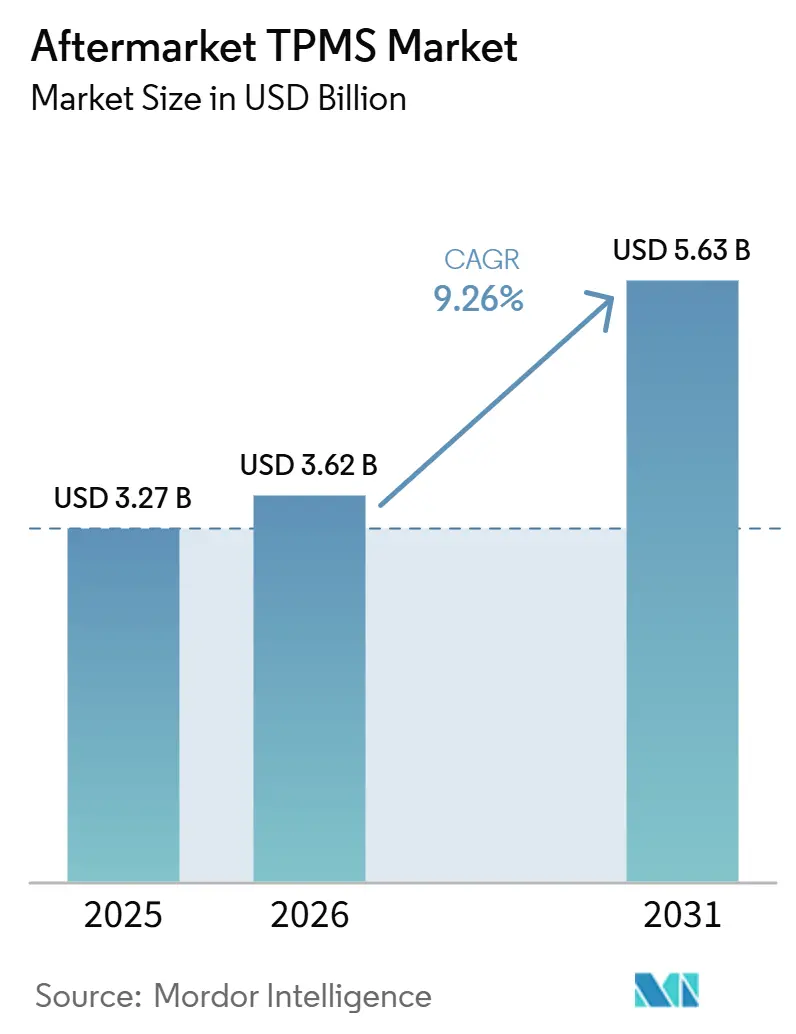
The Aftermarket TPMS market size is expected to grow from USD 3.27 billion in 2025 to USD 3.62 billion in 2026 and is forecast to reach USD 5.63 billion by 2031 at a 9.26% CAGR over 2026-2031. Regulatory mandates, rising vehicle age, and the shift toward connected-vehicle architectures are jointly expanding the addressable Aftermarket TPMS market across passenger and commercial fleets. Europe leads current revenue on the strength of long-standing UN R141 enforcement, while Asia-Pacific is accelerating fastest because India and China converted retrofit demand into law-driven urgency. Direct sensors dominate the share, yet smart units tied to telematics platforms are redefining value perception by adding predictive-maintenance capabilities. E-commerce, led by Amazon and OEM web stores, is reshaping distribution economics, and retrofit programs promise measurable payback periods that shorten purchase-decision cycles.
Key Report Takeaways
- By type, direct TPMS accounted for 82.35% of the 2025 Aftermarket TPMS market share and is advancing at a 9.83% CAGR through 2031.
- By technology integration, stand-alone units delivered 73.15% of 2025 revenue, whereas smart/connected units posted the fastest 13.17% CAGR through 2031.
- By vehicle type, passenger cars accounted for 79.02% of 2025 demand, while commercial vehicles will register the leading 11.39% CAGR over 2026-2031.
- By distribution channel, offline outlets captured 67.18% of 2025 revenue, yet online platforms will grow at an 11.86% CAGR to 2031.
- By geography, Europe held 39.26% of the Aftermarket TPMS market revenue in 2025, while Asia-Pacific is set to grow with a 14.33% CAGR.
Note: Market size and forecast figures in this report are generated using Mordor Intelligence’s proprietary estimation framework, updated with the latest available data and insights as of January 2026.
Market Trends and Insights
Drivers Impact Analysis of Aftermarket TPMS Market*
| Driver | (~) % Impact on CAGR Forecast | Geographic Relevance | Impact Timeline |
|---|---|---|---|
| Surge in Connected-Vehicle Architectures | +2.3% | North America and Europe lead | Medium term (2-4 years) |
| Mandates for TPMS Fitment | +2.1% | Asia-Pacific core, South America spill-over | Medium term (2-4 years) |
| Vehicle Parc and Average Vehicle Age | +1.8% | Global, North America and Europe focus | Long term (≥ 4 years) |
| Fleet Predictive-Maintenance Programs | +1.6% | North America fleets, spreading worldwide | Medium term (2-4 years) |
| Growth of E-commerce Aftermarket | +1.4% | Global, strongest in North America and Europe | Short term (≤ 2 years) |
| Discounts Tied to Tire Data | +0.9% | North America lead, emerging Europe | Medium term (2-4 years) |
| Source: Mordor Intelligence | |||
Surge in Connected-Vehicle Architectures Enabling Smart TPMS
Cloud platforms like Doran Connect 360 and Phillips Connect are now receiving data from smart sensors equipped with Bluetooth LE or cellular chips, steering the Aftermarket TPMS market towards predictive services. Infineon's XENSIV™ SP49 demonstrates the potential of embedded processors in load detection, and Continental's HT 5 trailer tire showcases the integration of RFID for real-time analytics.
Regulatory Mandates for TPMS Fitment
In a bid to comply with resale regulations and sidestep penalties, vehicle owners are retrofitting vehicles, spurring a surge in demand for the Aftermarket TPMS market. India's AIS-146 and China's GB/T 26149 are at the forefront of this movement [1]“GB/T 26149-2024,” Ministry of Industry and Information Technology, miit.gov.cn. Meanwhile, in 2024, Europe expanded UN R141 to encompass trucks and buses. Concurrently, ISO 21750 is standardizing dual-frequency sensors, facilitating smoother cross-regional distribution.
Rising Global Vehicle Parc and Average Vehicle Age
In 2025, the average vehicle age increased in the United States and the EU, extending replacement windows and driving sales in the Aftermarket TPMS market. The Asia-Pacific region, experiencing rapid parc growth and first-generation sensor fatigue, offers a significant dual opportunity for both retrofitting and replacement. A U.S. fleet demonstrated the tangible benefits of deploying retrofit kits.
Fleet Predictive-Maintenance Programs Using Retrofit TPMS
According to the North American Council for Freight Efficiency, a case study involving a fleet demonstrated significant annual savings with a short payback period, underscoring TPMS as a technology with a high return on investment. Research supported by the National Science Foundation highlights that digital-twin analytics can significantly extend tire life and reduce road calls, solidifying TPMS's integral role in the future of fleet maintenance.
Restraints Impact Analysis of Aftermarket TPMS Market*
| Restraint | (~) % Impact on CAGR Forecast | Geographic Relevance | Impact Timeline |
|---|---|---|---|
| Sensor and Service Cost Sensitivity | -1.2% | South America, Middle East and Africa, cost-sensitive Asia-Pacific | Short term (≤ 2 years) |
| Obsolescence with Vehicle-to-Cloud Monitoring | -0.9% | Global, North America and Europe focus | Medium term (2-4 years) |
| Integrated Smart/Airless Tire Technologies | -0.7% | North America and Europe early adoption | Long term (≥ 4 years) |
| Cyber-Security and Data-Privacy Concerns | -0.6% | Europe (GDPR), North America | Medium term (2-4 years) |
| Source: Mordor Intelligence | |||
Sensor and Service Cost Sensitivity in Price-Driven Regions
Dealership costs for sensor replacements prompt vehicle owners in South America, the Middle East, and Africa to either postpone repairs or opt for indirect systems. This trend is hindering the growth of the Aftermarket TPMS market in these regions. While DIY kits help ease the financial burden, the perception of non-criticality, especially in areas with lax enforcement, continues to hinder widespread adoption.
Rapid Tech-Obsolescence with Vehicle-to-Cloud Tire Monitoring
Research from Goodyear reveals that cloud-based load and wear analytics are encouraging fleets to retire units that are still functional. This trend is compressing product life cycles in the Aftermarket TPMS market. Meanwhile, platforms from Continental and Michelin are offering remote diagnostics, which reduce the importance of warnings displayed solely on dashboards.
*Our forecasts treat driver/restraint impacts as directional, not additive. The impact forecasts reflect baseline growth, mix effects, and variable interactions.
Aftermarket TPMS Market Segment Analysis
By Type:
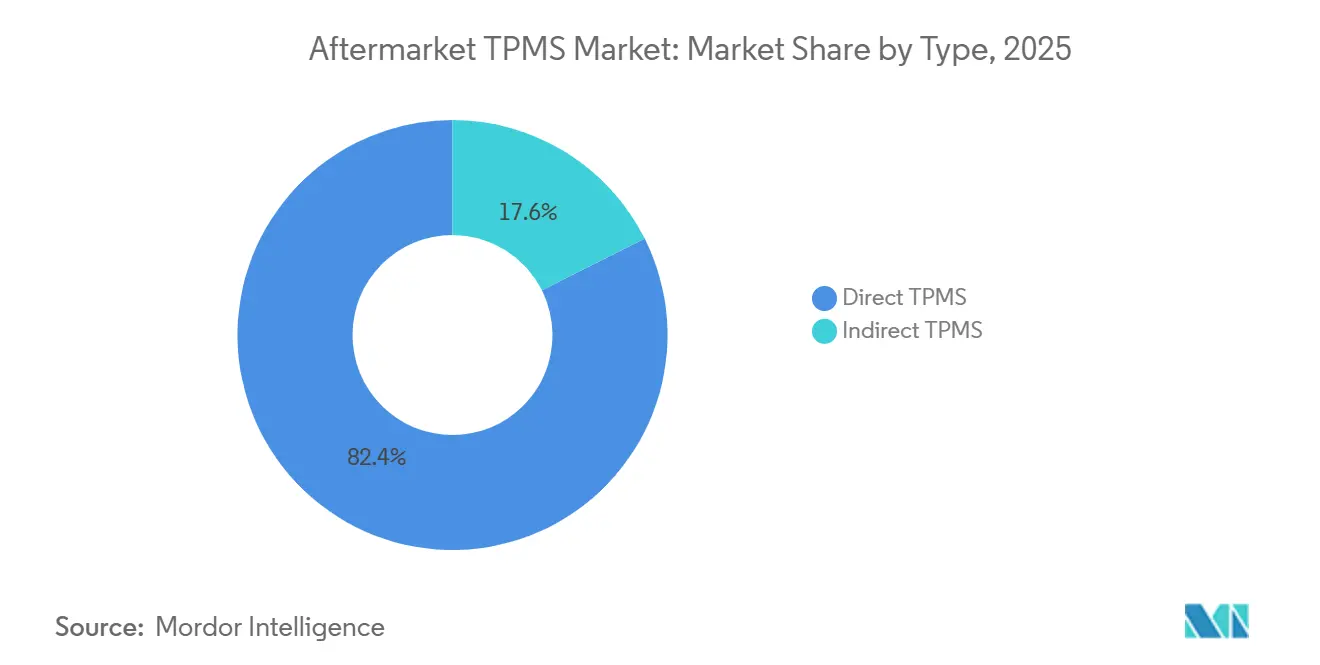
Direct TPMS Dominates Accuracy-Driven DemandDirect systems delivered 82.35% of 2025 revenue for the Aftermarket TPMS market and will outpace indirect alternatives at a 9.83% CAGR as mandates codify ±1 psi accuracy. The Aftermarket TPMS market size for direct sensors benefits from programmable EZ-sensor® SKUs that collapse inventory while adding auto-location functions [2]“EZ-sensor® Coverage Expansion,” Sensata Technologies, sensata.com.
Indirect TPMS maintains relevance in cost-sensitive niches where zero hardware outlay trumps precision, but false positives and simultaneous-leak blind spots limit growth. As more regions formalize direct-only requirements, indirect share will erode, keeping its role largely confined to legacy fleets or emerging markets without enforcement.


By Technology Integration:
Smart TPMS Reshapes Fleet EconomicsStand-alone units still anchored 73.15% of total revenue in 2025, yet smart/connected units are expanding at 13.17% CAGR, reflecting rising telematics adoption inside the Aftermarket TPMS market. Insurance incentives and falling Bluetooth chip costs narrow the price gap, signaling an inflection point by 2028.
Smart sensors transmit pressure, temperature, and battery status to cloud dashboards, enabling predictive alerts that drop roadside failures and justify subscription models. As connected hardware reaches price parity, distributors will pivot from one-off sales to service bundles that extend revenue capture across the sensor life cycle.
By Vehicle Type:
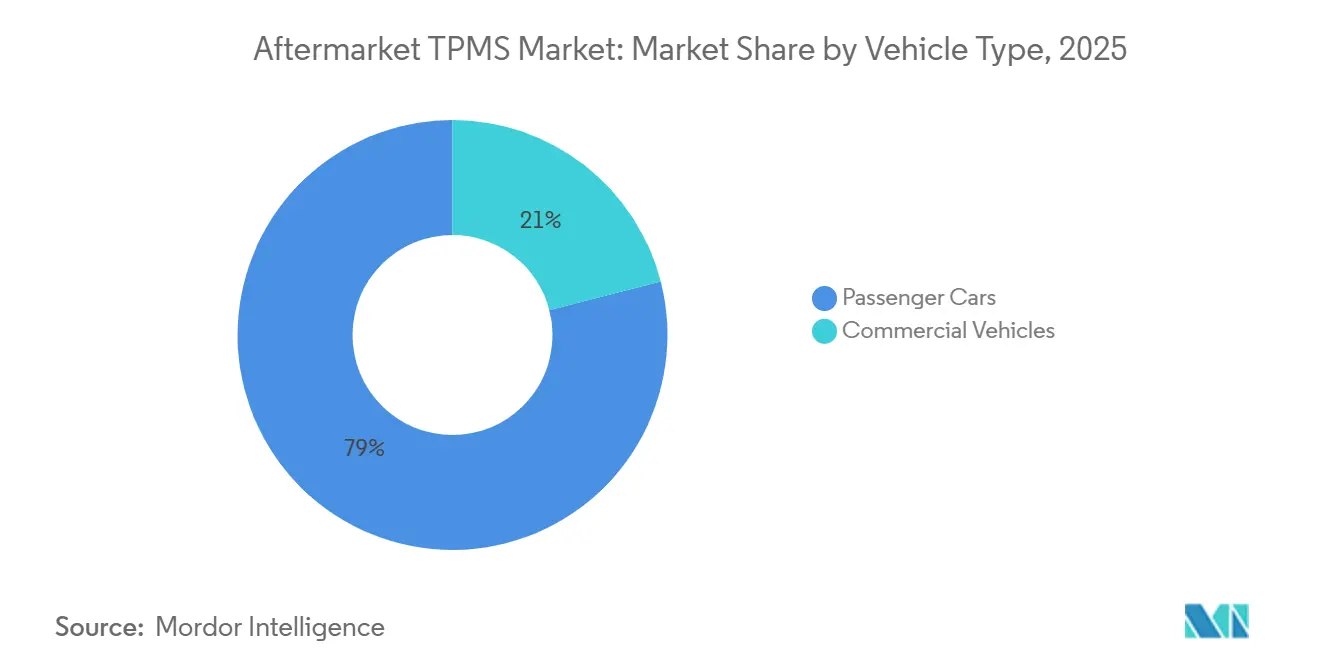
Commercial Fleets Drive Retrofit AccelerationPassenger cars commanded 79.02% of 2025 demand, but the Aftermarket TPMS market size expansion is fastest in commercial vehicles at an 11.39% CAGR, fueled by documented eight-month payback and fleet uptime imperatives.
Regulatory creep, such as Europe’s 2024 UN R141 extension, combines with ROI calculators to accelerate truck, bus, and van retrofits. Predictive-maintenance platforms turn tire pressure into a cost-avoidance metric, elevating TPMS from a compliance gadget to an operational lever for fuel and downtime control.
By Distribution Channel:
E-commerce Disrupts Traditional Parts NetworksOffline stores retained 67.18% revenue in 2025, yet online channels grow at 11.86% CAGR as Amazon’s category visibility and OEM web shops pull consumers toward DIY kits with video tutorials.
The Aftermarket TPMS market share advantage of brick-and-mortar hinges on installation support and same-day availability, but margin compression is steering shops toward mobile services and fleet contracts that e-commerce cannot replicate effectively.
Geography Analysis
Europe Aftermarket TPMS Market
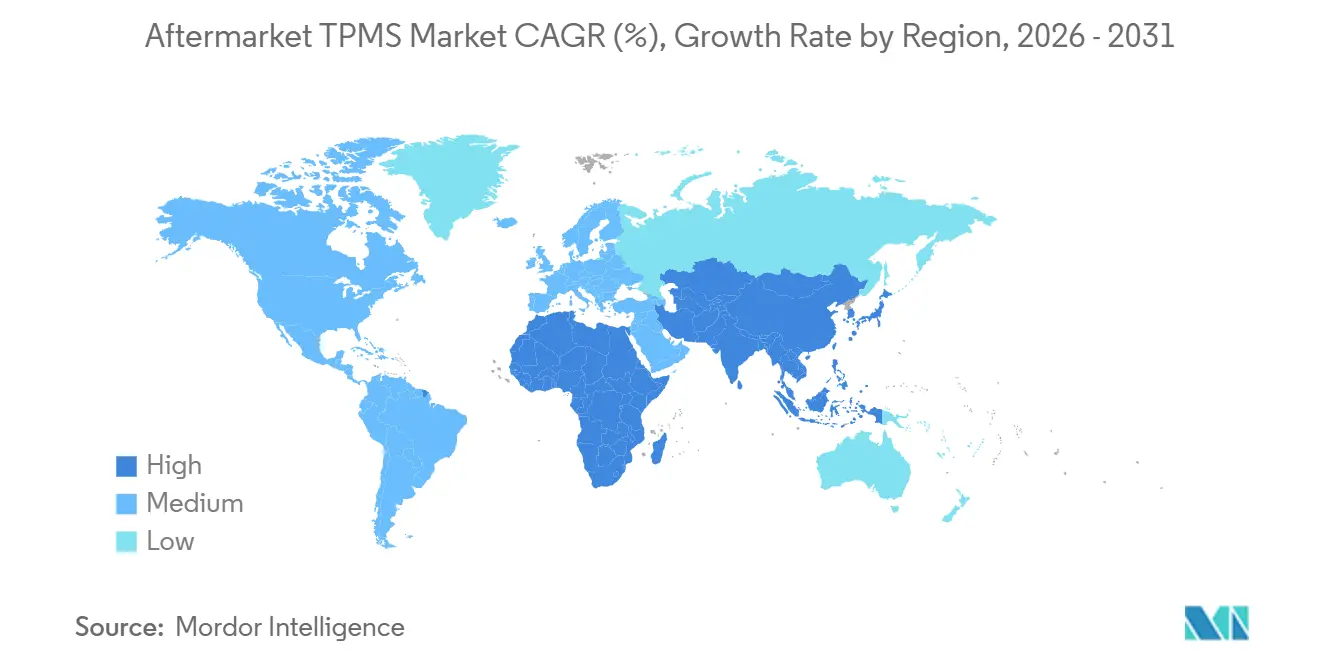
Europe contributed 39.26% of 2025 revenue in the Aftermarket TPMS market, anchored by strict roadworthiness tests and mature replacement cycles. Germany, the United Kingdom, France, Italy, and Spain dominate demand as technical inspections treat failed sensors as non-compliant, while the July 2024 UN R141 expansion has sparked a truck retrofit wave [3]“UN R141 Extension to Commercial Vehicles,” UNECE, unece.org . The Netherlands and Spain are first movers on connected TPMS, reflecting dense logistics corridors and high fleet utilization.
APAC Aftermarket TPMS Market
Asia-Pacific posts the strongest 14.33% CAGR to 2031, led by India’s AIS-146 enforcement and China's GB/T 26149 mandate, which is reshaping the automotive landscape. In India, cars manufactured before 2025 lack essential sensors, presenting a vast opportunity for the Aftermarket TPMS market. In China, with a large vehicle parc, first-generation sensors are cycled out of service every 5-10 years, generating consistent replacement revenue. Meanwhile, Japan and South Korea, though adopting voluntarily and at a slower pace, are emphasizing smart TPMS for their logistics fleets.
The Americas and MEA Aftermarket TPMS Market
North America, boasting the longest history with mandates and an aging fleet, sees steady replacements. With widespread vehicle ownership, the allure of insurance-telematics discounts drives upgrades to smart sensors. In Canada, the harsh winters lead to seasonal service spikes, especially as dashboard pressure warnings emerge. South America, along with the Middle East and Africa, finds itself in the nascent stages of this evolution. Here, the lack of regulation often postpones purchases, unless savings are showcased by multinational fleets or insurer programs. While pilot discounts in the United Arab Emirates hint at budding interest, the political and economic fluctuations in Brazil and Argentina hinder standardization efforts, limiting the current penetration of the Aftermarket TPMS market.
Mordor Intelligence provides coverage of the aftermarket tpms market across other key regional markets, including Europe, each with their regulatory frameworks and demand patterns. Detailed country-level analysis extends to China, India, United States, South Korea, and Japan incorporating local coverage and market participation, as required.

Competitive Landscape
Sensata Technologies (Schrader) commands significant OEM market penetration and utilizes the programmability of its EZ-sensor® to secure a dominant position on aftermarket shelves in the TPMS sector. While Continental AG, Pacific Industrial, Huf, DENSO, and ZF vie for prominence through the OEM channel, they grapple with pricing pressures from Chinese competitors like Baolong and Orange Electronic, who offer bulk sensors on platforms like Alibaba.
Strategic maneuvers encompass subscription analytics—like ContiConnect and Schrader TPMS Academy—and a push towards vertical e-commerce. Disruptors, exemplified by Autel’s trade-in campaign in 2026, leverage tool giveaways to foster installer loyalty. Meanwhile, Infineon’s SP49 chipset introduces load detection, steering TPMS towards a realm of multi-parameter intelligence. Michelin’s announcements of SmartLoad and SmartWear signal a potential upheaval: if commercialized at scale, their direct tire sensing integration could overshadow stand-alone sensors post-2030.
Cybersecurity adherence is carving out a niche as a key competitive edge. Vendors who align early with standards like ISO 5616 and ISO 15638-23 are reaping rewards, clinching contracts from fleets wary of data liabilities. This trend underscores a broader industry shift: moving from mere commodity hardware to sophisticated, value-added secure ecosystems.
Aftermarket TPMS Industry Leaders
Sensata Technologies, Inc. (Schrader)
Infineon Technologies AG
DENSO Corporation
ZF Friedrichshafen AG
Hamaton Automotive Technology Co., Ltd.
- *Disclaimer: Major Players sorted in no particular order

Aftermarket TPMS Market Companies Covered in this Report
- Continental AG
- Sensata Technologies, Inc. (Schrader)
- Pacific Industrial Co. Ltd.
- Huf Hulsbeck & Furst
- CUB Elecparts Inc
- DENSO Corporation
- ZF Friedrichshafen AG
- Steelmate Company Limited
- Shanghai Baolong Automotive Corporation
- Orange Electronic Co, Ltd.
- Valeo SA
- Alps Alpine Co., Ltd
- Autel Intelligent Technology Corp Ltd.
- PressurePro
- ATEQ TPMS
- Bartec Auto ID Limited
- Hamaton Automotive Technology Co., Ltd.
- Bendix Commercial Vehicle Systems
- Infineon Technologies AG

Recent Industry Developments in Aftermarket TPMS Market
- March 2026: Schrader TPMS Solutions added four OE-replacement part numbers covering Volkswagen, Subaru, Toyota, Infiniti, and Acura vehicles for aftermarket distribution.
- December 2025: At CES 2026, Michelin unveiled its AI-driven tire intelligence innovations, SmartLoad and SmartWear. These advancements integrate load, wear, and temperature sensing directly into tire construction.
- November 2025: JK Tyre launched India’s first embedded smart tires for passenger vehicles, featuring built-in sensors with a 5-7-year lifespan that stream data to a mobile app.
- July 2025: ZF Aftermarket expanded OptiTire™ TPMS for trailers into retrofit kits ahead of UN ECE-R 141 enforcement.


Global Aftermarket TPMS Market Report Scope
The scope includes segmentation by type (direct TPMS and indirect TPMS), technology integration (stand-alone TPMS units and smart/connected TPMS), vehicle type (passenger cars (hatchbacks, sedans, sports utility vehicles, and multi-purpose utility vehicles), and commercial vehicles (light commercial vehicles, medium and heavy commercial vehicles, and buses and coaches)), and distribution channel (offline - parts stores, specialty shops, service centers, and online - OEM sites/apps, e-commerce platforms). The analysis also covers regional-level segmentation, including North America, South America, Europe, Asia-Pacific, the Middle East, and Africa. Market size and growth forecasts are presented by value in USD and by volume in units.
| Direct TPMS |
| Indirect TPMS |
| Stand-alone TPMS Units |
| Smart/Connected TPMS |
| Passenger Cars | Hatchbacks |
| Sedans | |
| Sports Utility Vehicles (SUVs) and Multi-purpose Utility Vehicles (MUVs) | |
| Commercial Vehicles | Light Commercial Vehicles |
| Medium and Heavy Commercial Vehicles | |
| Buses and Coaches |
| Offline - Parts Stores, Specialty Shops, Service Centers |
| Online - OEM Sites/Apps, E-commerce Platforms |
| North America | United States |
| Canada | |
| Rest of North America | |
| South America | Brazil |
| Argentina | |
| Rest of South America | |
| Europe | Germany |
| United Kingdom | |
| Spain | |
| Italy | |
| France | |
| Netherlands | |
| Rest of Europe | |
| Asia-Pacific | India |
| China | |
| Japan | |
| South Korea | |
| Indonesia | |
| Rest of Asia-Pacific | |
| Middle East and Africa | United Arab Emirates |
| Saudi Arabia | |
| Turkey | |
| Egypt | |
| South Africa | |
| Rest of Middle East and Africa |
| By Type | Direct TPMS | |
| Indirect TPMS | ||
| By Technology Integration | Stand-alone TPMS Units | |
| Smart/Connected TPMS | ||
| By Vehicle Type | Passenger Cars | Hatchbacks |
| Sedans | ||
| Sports Utility Vehicles (SUVs) and Multi-purpose Utility Vehicles (MUVs) | ||
| Commercial Vehicles | Light Commercial Vehicles | |
| Medium and Heavy Commercial Vehicles | ||
| Buses and Coaches | ||
| By Distribution Channel | Offline - Parts Stores, Specialty Shops, Service Centers | |
| Online - OEM Sites/Apps, E-commerce Platforms | ||
| By Geography | North America | United States |
| Canada | ||
| Rest of North America | ||
| South America | Brazil | |
| Argentina | ||
| Rest of South America | ||
| Europe | Germany | |
| United Kingdom | ||
| Spain | ||
| Italy | ||
| France | ||
| Netherlands | ||
| Rest of Europe | ||
| Asia-Pacific | India | |
| China | ||
| Japan | ||
| South Korea | ||
| Indonesia | ||
| Rest of Asia-Pacific | ||
| Middle East and Africa | United Arab Emirates | |
| Saudi Arabia | ||
| Turkey | ||
| Egypt | ||
| South Africa | ||
| Rest of Middle East and Africa | ||


Key Questions Answered in the Report
How big will the Aftermarket TPMS market be by 2031?
It is projected to reach USD 5.63 billion by 2031, growing at a 9.26% CAGR from 2026 to 2031.
Which sensor type leads replacement demand?
Direct TPMS sensors command 82.35% of 2025 revenue and remain the dominant choice because regulations require ±1 psi accuracy.
What drives the rapid growth of online TPMS sales?
E-commerce platforms like Amazon offer DIY kits priced between USD 20 and USD 50, supported by tutorials and quick shipping, which attract cost-sensitive consumers.
How do insurance programs influence TPMS adoption?
Programs such as Nationwide SmartRide give drivers up to 40% premium discounts for sharing real-time tire pressure, providing a direct financial incentive to install smart sensors.
Page last updated on:


 Your data is secure and never sold or shared.


