Africa Polyether Ether Ketone (PEEK) Market Size and Share
Market Overview
| Study Period | 2020 - 2031 |
|---|---|
| Forecast Data Period | 2026 - 2031 |
| Base Year Market Size (2025) | 44.02 tons |
| Market Volume (2026) | 47.07 tons |
| Market Volume (2031) | 65.74 tons |
| Growth Rate (2026 - 2031) | 6.92 % |
| Market Concentration | High |
Major Players *Disclaimer: Major Players sorted in no particular order Image © Mordor Intelligence. Reuse requires attribution under CC BY 4.0. | |
Africa Polyether Ether Ketone (PEEK) Market Analysis by Mordor Intelligence
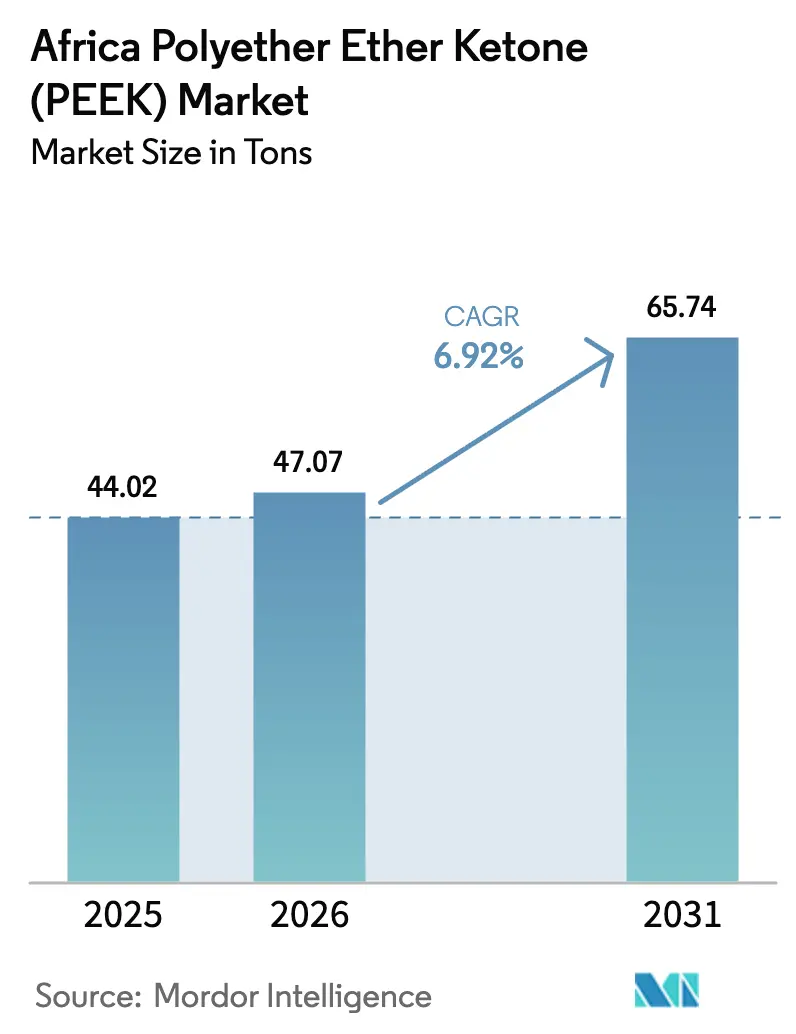
The Africa Polyether Ether Ketone Market size was valued at 44.02 tons in 2025 and estimated to grow from 47.07 tons in 2026 to reach 65.74 tons by 2031, at a CAGR of 6.92% during the forecast period (2026-2031). Demand acceleration arises from lightweighting in aerospace, drivetrain efficiency gains in vehicles, and subsea corrosion challenges in deep-water oil extraction. South Africa’s mature processing ecosystem keeps the region in a leadership position, yet capacity additions in Nigeria and Ghana are reshaping the competitive map. Supply agreements between global resin producers and African compounders lower import lead times, allowing quicker prototyping cycles for drone and medical device programs. Manufacturers also benefit from regulatory alignment with ISO 23153-1:2020 and ISO 10993, which shortens certification timelines for export-oriented components. Together, these factors embed PEEK as a strategic material rather than a commodity across Africa’s advanced manufacturing base.
Key Report Takeaways
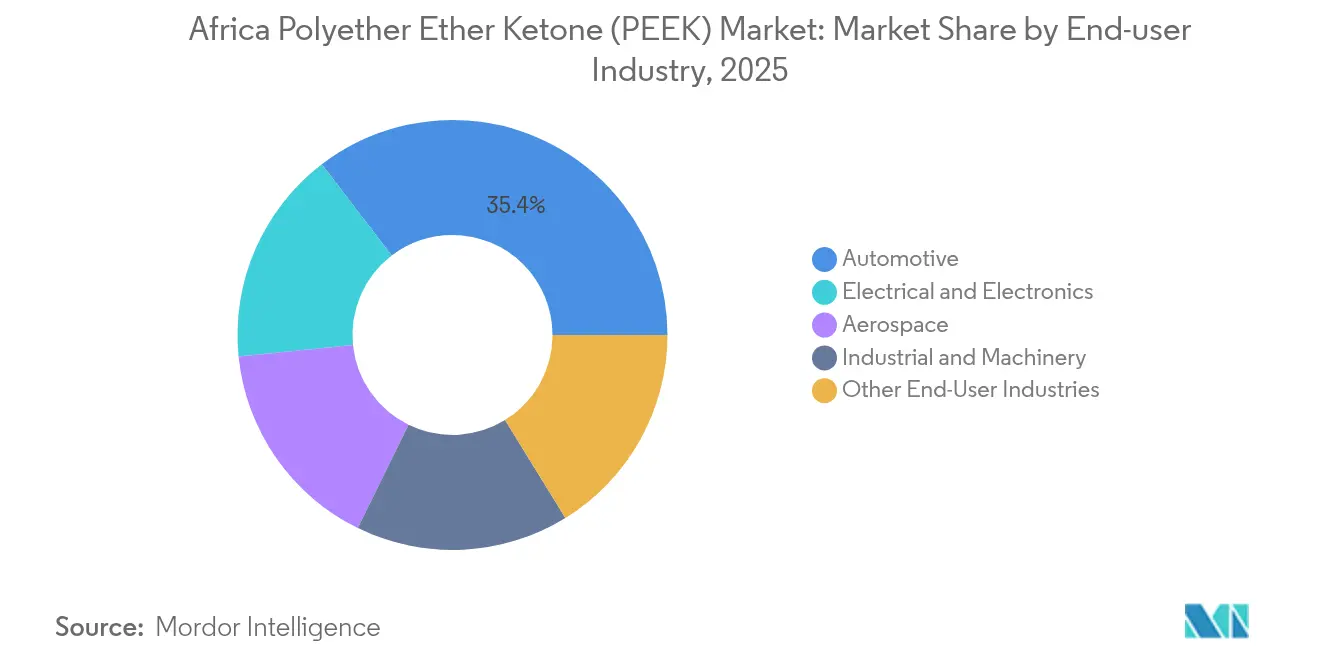
- By end-user industry, the automotive segment accounted for 35.40% of the Africa polyether ether ketone market in 2025; Other End-User Industries are poised to advance at an 8.25% CAGR through 2031.
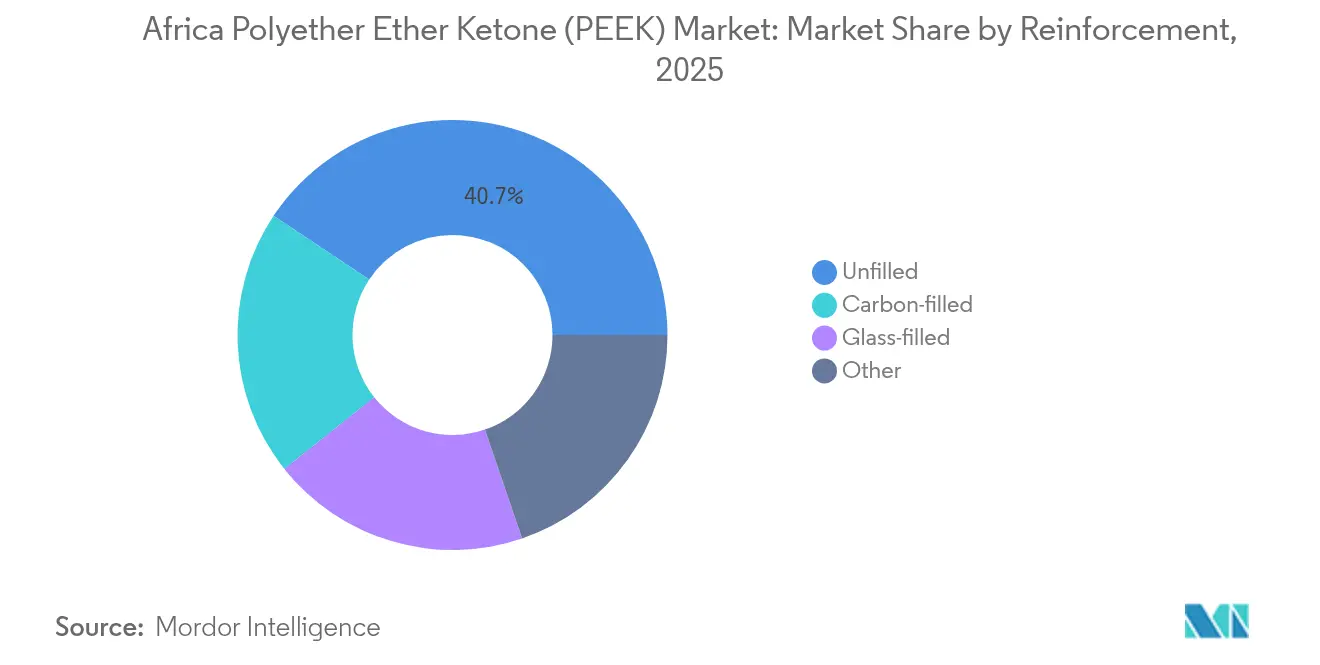
- By reinforcement type, unfilled grades captured 40.65% of the Africa polyether ether ketone market in 2025, whereas carbon-filled variants led growth at a 8.85% CAGR between 2026-2031.
- By geography, South Africa held 47.60% of the Africa polyether ether ketone market share in 2025, while the Rest of Africa is forecast to record the fastest 9.10% CAGR to 2031.
Note: Market size and forecast figures in this report are generated using Mordor Intelligence’s proprietary estimation framework, updated with the latest available data and insights as of 2026.
Africa Polyether Ether Ketone (PEEK) Market Trends and Insights
Drivers Impact Analysis*
| Drivers | (~) % Impact on CAGR Forecast | Geographic Relevance | Impact Timeline |
|---|---|---|---|
| Rising aerospace demand for lightweight, high-temperature polymers | +1.8% | South Africa, Nigeria, Rest of Africa | Medium term (2-4 years) |
| Rapid miniaturization in electrical and electronics boosting high-performance plastics | +1.5% | South Africa, Nigeria | Short term (≤ 2 years) |
| Growing localization of orthopedic implant manufacture | +1.2% | South Africa, Nigeria | Long term (≥ 4 years) |
| Shift to sulfur-rich deep-sea oil | +1.0% | Nigeria, Rest of Africa | Medium term (2-4 years) |
| Commercial drone adoption in mining and agriculture | +0.9% | Continental Africa | Short term (≤ 2 years) |
| Source: Mordor Intelligence | |||
Rising aerospace demand for lightweight, high-temperature polymers
Africa’s embryonic but rapidly professionalizing aerospace sector increasingly specifies PEEK for brackets, wire insulation, and interior structures that must endure 260 °C service temperatures without mass penalties. Victrex benchmarking shows up to 50% weight reduction versus aluminum while maintaining structural integrity[1]. South African Tier-1 suppliers to global jet programs now co-develop press-fit PEEK-based clips that simplify assembly and curb fuel burn. Nigerian maintenance, repair, and overhaul (MRO) facilities incorporate machined PEEK seals to cut downtime linked to thermal cycling. The adoption curve aligns with Original Equipment Manufacturer (OEM) offset policies that reward local content, reinforcing regional demand momentum through mid-decade.
Rapid miniaturization in electrical and electronics boosting high-performance plastics
APTIV PEEK film has shipped in more than 4 billion mobile devices worldwide, and similar footprint reductions are now targeted in African automotive control units and industrial drives[2]. Component densification in Nigeria’s smartphone assembly clusters drives the need for dielectrics that resist solder-reflow peaks above 250 °C. South African equipment makers adopt PEEK’s low dielectric constant to maintain signal fidelity in harsh mine automation networks. Compatibility with automated surface-mount processes accelerates scale-up, while rework cycles decrease because parts withstand multiple thermal excursions without warpage.
Growing localization of orthopedic implant manufacture
Healthcare reforms catalyze investment in domestic implant plants aimed at lowering import dependence and tailoring geometries to regional anthropometry. Evonik’s VESTAKEEP Fusion delivers more than 30% higher osteoblast adhesion versus standard grades, a decisive factor in tender awards to South African spine and joint specialists. Nigerian foundries retrofit with precision CNC routers capable of holding ±5 μm tolerances on PEEK intervertebral cages, mitigating rejection rates. ISO 10993 compliance gives producers an avenue to export to Europe, spurring capital expenditure on gamma-stable packaging lines. Training partnerships between universities and material suppliers bolster workforce skills, setting a long-run growth foundation.
Shift to sulfur-rich deep-sea oil
Nigeria’s pivot toward deeper, hotter, and more corrosive reservoirs forces operators to abandon conventional elastomers. Röchling documents that PEEK components maintain seal integrity at 450 bar for 10,000 hour duty cycles in sour service. Magma Global’s M-PIPE composite, reinforced with PEEK layers, demonstrated a 70% lower maintenance bill than carbon-steel flowlines during a multiyear offshore pilot. Ghanaian fabricators license the same technology to extend subsea tiebacks, broadening resin pull-through. As regional oil majors prioritize total-cost-of-ownership savings, PEEK’s higher material price is offset by fewer unplanned shutdowns and simplified inspection regimes.
Restraints Impact Analysis*
| Restraints | (~) % Impact on CAGR Forecast | Geographic Relevance | Impact Timeline |
|---|---|---|---|
| Price volatility of PEEK feedstock (hydroquinone, 4,4ʹ-difluorobenzophenone) | -1.5% | Continental Africa | Short term (≤ 2 years) |
| Limited extrusion and injection-molding capacity in Africa | -1.2% | Nigeria, South Africa | Medium term (2-4 years) |
| Skilled-labor shortage for precision machining | -0.8% | South Africa, Nigeria, Rest of Africa | Long term (≥ 4 years) |
| Source: Mordor Intelligence | |||
Limited extrusion and injection-molding capacity in Africa
PEEK’s 334 °C melting point and narrow processing window exceed the specification of most legacy polypropylene lines installed across African industrial parks. Only six commercial processors currently operate high-temperature presses fitted with nickel-chromium alloys required to avoid corrosion. Capacity constraints lead to queue times surpassing eight weeks for custom geometry trials, delaying product launches in sectors such as aerospace brackets. Investors hesitate to fund additional presses because throughput volumes remain relatively low; however, import duty relief for Class III medical devices is starting to tilt the economics by expanding qualified customer bases.
Skilled-labor shortage for precision machining
High-performance inserts, thin-walled housings, and complex lattice structures require machinists able to interpret PEEK’s differential thermal expansion characteristics. Zhao’s multi-factor review identifies exacting toolpath strategies needed to avoid delamination during finishing. Across Africa, only a handful of Technical and Vocational Education and Training (TVET) colleges include high-temperature polymer coursework, leading to chronic hiring gaps at OEMs and Tier-2 suppliers. Attrition compounds the problem as experienced operators migrate to Europe for higher wages. In response, Evonik funds on-site residencies where applications engineers mentor local staff in real-time, yet the talent pipeline will take several years to normalize.
*Our forecasts treat driver/restraint impacts as directional, not additive. The impact forecasts reflect baseline growth, mix effects, and variable interactions.
Segment Analysis
By End-User Industry: Automotive Maintains the Lead amid Diversification
Automotive accounts for 35.40% of the Africa polyether ether ketone market, with seals, bearings, and transmission components driving volume. In 2024, South African assembly plants substituted metal thrust washers with PEEK blends that cut component weight by 40% and lowered noise-vibration-harshness scores on compact SUVs. Nigeria’s burgeoning local content rules, which mandate domestic sourcing for at least 30% of powertrain parts, further elevate PEEK demand as regionally milled resins are channeled into under-hood connectors. The segment’s resilience also stems from electrification; battery pack manufacturers specify PEEK inter-cell spacers that resist electrolyte leakage at 180 °C. Collectively, these developments fortify the automotive segment’s baseline volumes and stabilize processor utilization rates across cyclical automotive output swings.
The Other End-User Industries category registers an 8.25% CAGR and represents the fastest-growing opportunity pool for the Africa polyether ether ketone market. Commercial drone platform builders value PEEK’s resistance to abrasive dust, enabling longer operational intervals in open-pit mines. Precision machining houses in Kenya adopt unfilled grades to fabricate chemical pump rotors for the floriculture sector, leveraging the material’s broad-spectrum chemical resistance. In Morocco, high-end bike component startups machine PEEK bushings to differentiate premium drivetrains. This array of niche applications diversifies revenue streams, reduces demand vulnerability to automotive cycles, and raises the average selling price per kilogram.

By Reinforcement Type: Unfilled Dominates while Carbon-Filled Gains Traction
Unfilled grades commanded 40.65% of the 2025 Africa polyether ether ketone market share, reflecting cost-aware procurement strategies in industries where baseline chemical and thermal performance suffices. Bulk volume originates in standard lip seals, compressor vanes, and electrical insulators, where reinforced material properties are unnecessary. Glass-filled formulations follow, selected by South African conveyor OEMs needing higher stiffness for large sprocket wheels operating in abrasive ore environments. Although unfilled grades remain the entry point for new PEEK adopters, the technical ceiling of unreinforced resin is prompting users to explore next-level formulations.
Carbon-filled variants exhibit a 8.85% CAGR through 2031 as customers pursue higher modulus and tribological gains that translate directly into uptime and energy savings. Tribology tests by Li et al. report a 36.4% wear reduction with 15 wt% short carbon fiber reinforcement. Mining pump makers in Zambia report 2,000 additional service hours after switching to carbon-laden thrust plates, slashing maintenance callouts. Aerospace brackets molded in carbon-filled PEEK pass 25,000-cycle vibration tests at −55 °C to 125 °C without cracking, a prerequisite for European Aviation Safety Agency DO-160G compliance. The premium price delta narrows as regional compounders incorporate locally sourced carbon fiber, granting processors a cost advantage and spurring wider uptake.
Geography Analysis
South Africa’s 47.60% hold on the Africa polyether ether ketone market stems from entrenched polymer conversion know-how, a deep supplier network, and public-private research and development consortia that speed technology transfer. Gauteng-based toolshops offer five-axis machining services certified to AS9100, enabling flight-qualified PEEK parts with sub-50 μm positional accuracy for export-grade drones. Multinational automakers operating in Port Elizabeth increasingly allocate sealing and bushing work orders to local PEEK specialists, a shift that shortens supply chains and shields against logistics shocks.
Nigeria is leveraging robust oil and gas activity that demands chemically inert materials for subsea architecture. Röchling confirms that PEEK seats used in high-pressure valves delivered a fourfold life extension versus polytetrafluoroethylene under sour service. Electronics assemblers clustered around Lagos adopt PEEK dielectric substrates for automotive control units, capitalizing on duty exemptions for components integrated into locally manufactured vehicles. Despite this demand base, Nigeria’s limited pool of PEEK-capable presses constrains production volumes, prompting partnerships with South African compounders for semi-finished stock.
Rest of Africa posts the fastest 9.10% CAGR, anchored by state-led industrialization plans in Ghana, Kenya, and Morocco. Morocco’s aerostructures corridor near Casablanca prototypes PEEK hinges used in business-jet cabin interiors, targeting compliance with Federal Aviation Regulation 25.853. Kenyan ag-tech companies scale precision agriculture drones that specify PEEK gears for fertilizer spreaders resilient to tropical humidity. Ghanaian mining equipment refurbishers pivot from bronze to carbon-filled PEEK bearings, citing 25% lower downtime costs. Across the region, European development banks fund Technical Vocational Education training focused on high-temperature polymer processing, laying groundwork for indigenous value addition.
Competitive Landscape
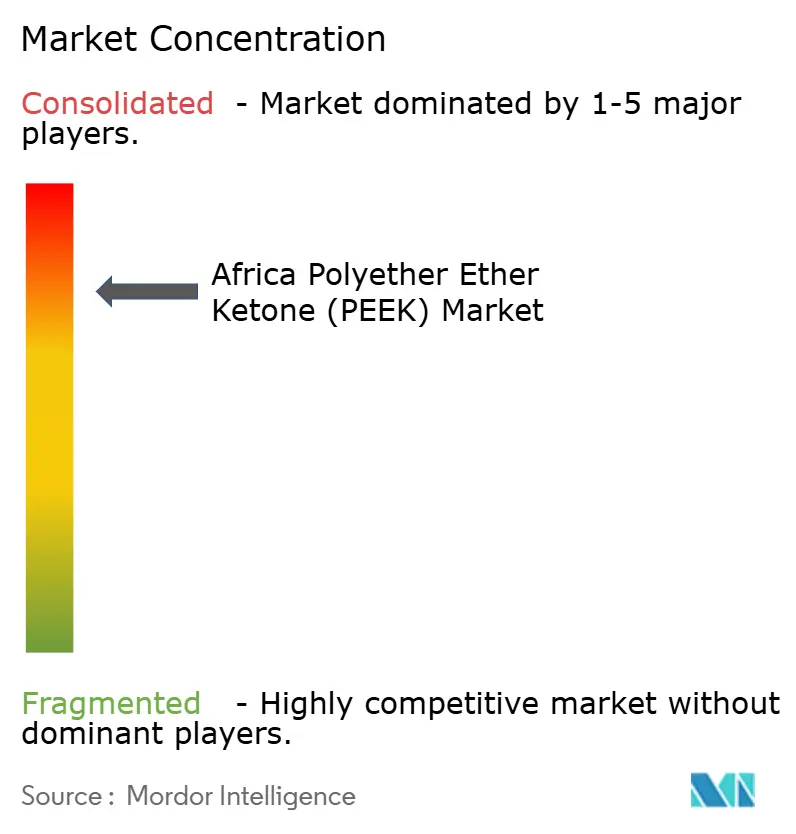
Africa’s PEEK supply chain is consolidated in nature. Second-tier competitors such as Solvay’s Veradel portfolio and Arkema’s Kepstan family court African converters through strategic stock-point agreements in Durban and Lagos. These agreements shorten transit times by 20 days compared with Europe-direct shipments. Meanwhile, local compounders experiment with hybrid carbon-glass mixes using South African basalt fibers to deliver a lower-cost modulus bump for industrial gears. Such formulation agility allows regional processors to defend share against imports of lower-priced high-temperature nylons.
Africa Polyether Ether Ketone (PEEK) Industry Leaders
-
Evonik Industries AG
-
Jilin Joinature Polymer Co. Ltd.
-
Pan Jin Zhongrun High-Performance Polymer Co. Ltd.
-
Syensqo
-
Victrex plc
- *Disclaimer: Major Players sorted in no particular order
Recent Industry Developments
- December 2024: Journal of Medical and Biological Engineering published finite-element analysis showing lattice-structured PEEK cervical disc replacements outperform traditional ball-and-socket designs.
- October 2023: Evonik Industries, Inc. introduced a new carbon-fiber reinforced PEEK filament for use in 3D printed medical implants. This smart biomaterial can be processed in common extrusion-based 3D printing technologies.
Africa Polyether Ether Ketone (PEEK) Market Report Scope
Aerospace, Automotive, Electrical and Electronics, Industrial and Machinery are covered as segments by End User Industry. Nigeria, South Africa are covered as segments by Country.| Aerospace |
| Automotive |
| Electrical and Electronics |
| Industrial and Machinery |
| Other End-User Industries |
| Unfilled |
| Glass-filled |
| Carbon-filled |
| Other |
| Nigeria |
| South Africa |
| Rest of Africa |
| By End-User Industry | Aerospace |
| Automotive | |
| Electrical and Electronics | |
| Industrial and Machinery | |
| Other End-User Industries | |
| By Reinforcement | Unfilled |
| Glass-filled | |
| Carbon-filled | |
| Other | |
| By Geography | Nigeria |
| South Africa | |
| Rest of Africa |
Market Definition
- End-user Industry - Automotive, Aerospace, Industrial Machinery, Electrical & Electronics, and Others are the end-user industries considered under the polyether ether ketone market.
- Resin - Under the scope of the study, virgin polyether ether ketone resin in primary forms such as powder, pellet, etc. are considered.
| Keyword | Definition |
|---|---|
| Acetal | This is a rigid material that has a slippery surface. It can easily withstand wear and tear in abusive work environments. This polymer is used for building applications such as gears, bearings, valve components, etc. |
| Acrylic | This synthetic resin is a derivative of acrylic acid. It forms a smooth surface and is mainly used for various indoor applications. The material can also be used for outdoor applications with a special formulation. |
| Cast film | A cast film is made by depositing a layer of plastic onto a surface then solidifying and removing the film from that surface. The plastic layer can be in molten form, in a solution, or in dispersion. |
| Colorants & Pigments | Colorants & Pigments are additives used to change the color of the plastic. They can be a powder or a resin/color premix. |
| Composite material | A composite material is a material that is produced from two or more constituent materials. These constituent materials have dissimilar chemical or physical properties and are merged to create a material with properties unlike the individual elements. |
| Degree of Polymerization (DP) | The number of monomeric units in a macromolecule, polymer, or oligomer molecule is referred to as the degree of polymerization or DP. Plastics with useful physical properties often have DPs in the thousands. |
| Dispersion | To create a suspension or solution of material in another substance, fine, agglomerated solid particles of one substance are dispersed in a liquid or another substance to form a dispersion. |
| Fiberglass | Fiberglass-reinforced plastic is a material made up of glass fibers embedded in a resin matrix. These materials have high tensile and impact strength. Handrails and platforms are two examples of lightweight structural applications that use standard fiberglass. |
| Fiber-reinforced polymer (FRP) | Fiber-reinforced polymer is a composite material made of a polymer matrix reinforced with fibers. The fibers are usually glass, carbon, aramid, or basalt. |
| Flake | This is a dry, peeled-off piece, usually with an uneven surface, and is the base of cellulosic plastics. |
| Fluoropolymers | This is a fluorocarbon-based polymer with multiple carbon-fluorine bonds. It is characterized by high resistance to solvents, acids, and bases. These materials are tough yet easy to machine. Some of the popular fluoropolymers are PTFE, ETFE, PVDF, PVF, etc. |
| Kevlar | Kevlar is the commonly referred name for aramid fiber, which was initially a Dupont brand for aramid fiber. Any group of lightweight, heat-resistant, solid, synthetic, aromatic polyamide materials that are fashioned into fibers, filaments, or sheets is called aramid fiber. They are classified into Para-aramid and Meta-aramid. |
| Laminate | A structure or surface composed of sequential layers of material bonded under pressure and heat to build up to the desired shape and width. |
| Nylon | They are synthetic fiber-forming polyamides formed into yarns and monofilaments. These fibers possess excellent tensile strength, durability, and elasticity. They have high melting points and can resist chemicals and various liquids. |
| PET preform | A preform is an intermediate product that is subsequently blown into a polyethylene terephthalate (PET) bottle or a container. |
| Plastic compounding | Compounding consists of preparing plastic formulations by mixing and/or blending polymers and additives in a molten state to achieve the desired characteristics. These blends are automatically dosed with fixed setpoints usually through feeders/hoppers. |
| Plastic pellets | Plastic pellets, also known as pre-production pellets or nurdles, are the building blocks for nearly every product made of plastic. |
| Polymerization | It is a chemical reaction of several monomer molecules to form polymer chains that form stable covalent bonds. |
| Styrene Copolymers | A copolymer is a polymer derived from more than one species of monomer, and a styrene copolymer is a chain of polymers consisting of styrene and acrylate. |
| Thermoplastics | Thermoplastics are defined as polymers that become soft material when it is heated and becomes hard when it is cooled. Thermoplastics have wide-ranging properties and can be remolded and recycled without affecting their physical properties. |
| Virgin Plastic | It is a basic form of plastic that has never been used, processed, or developed. It may be considered more valuable than recycled or already used materials. |
Research Methodology
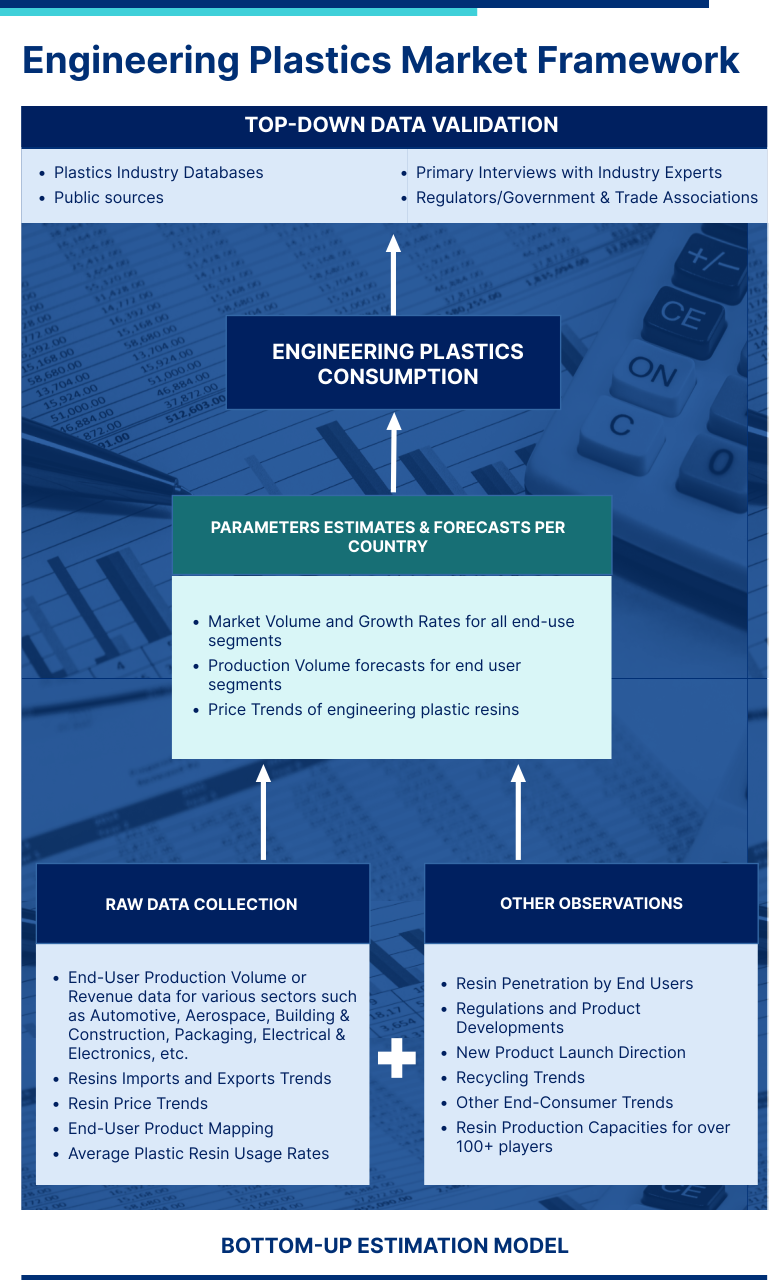
Mordor Intelligence follows a four-step methodology in all our reports.
- Step-1: Identify Key Variables: The quantifiable key variables (industry and extraneous) pertaining to the specific product segment and country are selected from a group of relevant variables & factors based on desk research & literature review; along with primary expert inputs. These variables are further confirmed through regression modeling (wherever required).
- Step-2: Build a Market Model: In order to build a robust forecasting methodology, the variables and factors identified in Step-1 are tested against available historical market numbers. Through an iterative process, the variables required for market forecast are set and the model is built on the basis of these variables.
- Step-3: Validate and Finalize: In this important step, all market numbers, variables and analyst calls are validated through an extensive network of primary research experts from the market studied. The respondents are selected across levels and functions to generate a holistic picture of the market studied.
- Step-4: Research Outputs: Syndicated Reports, Custom Consulting Assignments, Databases & Subscription Platforms